A Freaky Circle
March 9, 2021·Money

Source: Thor Ragnarok
A quick but important note: We don't have a dog in this fight. But we are conflicted. We have subscribers at almost all of the firms being mentioned. Our principals have done business with many of them. We've been clients of some, too. We like most of them. On both sides. We also don't really care what any of them think. Make of it what you will, but clear eyes, even with us.
THOR: How did you...
KORG: Yeah, no. This whole thing is a circle. But not a real circle, more like a freaky circle.
THOR: This doesn't make any sense.
KORG: No, nothing makes sense here.
Thor: Ragnarok (2017)
The whole of Thor: Ragnarok is pretty outstanding, as far as action-comedy films go. But the prison scene is almost certainly my favorite.
The premise is absurd. Thor - the guy in the picture above who isn't a walking rock, if superhero movies aren't your thing - is trying to escape a room that is plainly a circular hallway by dashing forward. It is a silly thing to do in the first place. Most circles boast that pesky feature whereby moving forward in one direction always brings you back to where you started. This room, however, is further designed so that running in one direction on the circle apparently doesn't permit you to run all the way around the circle. You are, perhaps randomly or perhaps predictably (the audience never learns, exactly), transported back to where you began.
Why go through the trouble of creating a freaky circle whose magical affectation simply recreates the most basic identifying feature of a garden-variety circle, that is, that trying to go forward will only bring you back to where you started? As Korg and Thor both observe, the whole gag doesn't make any sense.
All of which is why it's perfect. And why it's a perfect meta-joke. The freaky circle makes sense neither as a prison element nor a plot element. Making it both, however, makes it work for both. You, the audience, now feel a bit of the "Wait, what? Why?" confusion that Thor felt. Brilliant. Absurd.
But for all its absurdity, doesn't it also feel a little bit familiar?
After all, the usual shenanigans of our financial world bear the same garden variety features that they ever did: too-big-to-fail gain privatization and illiquidity/loss socialization. A half dozen institutions discovering how to leach value via transactions and flow on every novel method to "democratize investments". The rest of the nominal agents of the investment and corporate world leveraging the prudent man rule to capture as much value from principals as possible before the music stops, all under the guise of "yay, alignment."
Nothing new under the sun and all that.
And yet somehow the ways in which each of these garden variety features manifest has been made so impenetrable, so arcane, so purposefully complex that we're left to wonder why they even bothered with the layers of artifice in the first place.
In other words, it's freaky circles as far as the eye can see.
But I think that you, Korg, Thor and I got something wrong. It does make sense if we think less about what it means for us and more about what it means for the designer of the room. And there is only one possible reason why the designer of the circular prison - or, say, the construction finance lender who was transforming their industry using AI and Big Data - would create a Rube Goldberg device that caused us to end up in exactly the same place we were going to end up anyway.
They do it because it is helpful to them that it doesn't make any sense to us.
We wrote about it briefly before - but I just keep coming back to this Dyal - Owl Rock SPAC tie-up.
I'm still not sure what to make of it.
As we explained in that prior piece, Dyal is a private equity manager that, through funds it raises from the capital of big institutional asset pools (think pensions and university endowments), buys stakes in the management companies and general partners of other asset managers. It has a particular expertise buying stakes in private equity and credit shops.
Here's what we wrote about the "Blue Owl" deal in December:
The TLDR is this: one of Dyal’s funds bought a minority stake in one of the biggest private credit shops in 2018. Their funds bought a minority stake in a big direct lending / BDC sponsor firm earlier this year. The latter (HPS) formed the sponsor to a SPAC (Altimar) that has made a proposal that would merge the former (Owl Rock) with Dyal (the GP), its minority private equity investor.
Russian Nesting Deals, Epsilon Theory, December 3, 2020
This was weird enough on its own. But if there's a strong signal for "you're on to something" here at Epsilon Theory, it is when publishing something brings a paucity of attention in our comment section and social media - but a lot of direct attention from people in the industry. And this one did exactly that.
Sure enough, within a matter of weeks, we read of not one but two lawsuits from portfolio companies the Dyal funds had bought stakes in - Sixth Street Partners and Golub Capital - seeking injunctions against the proposed merger/IPO with the SPAC sponsored by the Dyal affiliate.
If this is not your world, know that these are not tiny shops. This isn't a single-store franchise in Des Moines standing up to corporate. Once upon a time, Sixth Street may have been your usual spin-out-half-of-a-Goldman-desk-in-2009-and-see-what-happens story, but the erstwhile special sits team that formed this company has built something really big and really successful. Different backstory for the Golub team, but same end-game. This is a huge private credit shop.
While we're at it, you could say the same thing for Dyal. Their ideas for how to exploit the underserved market need for liquidity for the owners of asset manager GPs germinated well after those of Petershill (Goldman) and roughly around the same time as those of Blackstone. Who are Goldman and Blackstone? Yeah, in this niche, that's the universal Jeopardy question to the answer, "The two firms you absolutely would not want to compete against if building a new investment industry-focused private equity business from scratch." Even so, Dyal still built a leadership-level position. Theirs is a ridiculous achievement. They're absolutely enormous. Good for them.
Same for Owl Rock. The placard on this particular door hasn't been around very long, but anyone who doesn't know Doug Ostrover doesn't know anything about this corner of our industry.
And so, because these are all legitimate Big Boys, and because these firms in question are already in partnerships with one another that must work, the internecine lawsuits themselves are a Big Deal.
The basic contention of both Sixth Street and Golub is that (1) they have a consent right to the transfer of ownership in their companies and (2) there are demonstrable breaches and/or reasons to believe that breaches of confidential information would be inevitable and endemic to the contemplated post-merger business model of Blue Owl - the contemplated Dyal/Owl Rock entity. In other words, Sixth Street and Golub think they get to vote on the deal, and they think there's no way that Dyal, their financial sponsor - which as Blue Owl will now be a direct competitor in the credit space - can credibly say they can or will abide by confidentiality requirements about their activities.
I have no idea if the former claim is true.
Most private equity investments take place through a series of limited partnership vehicles. It is certainly quite common for a private equity partnership to require consent to transfer an interest from one limited partner (LP) to another. The same is true for most direct private equity investments in companies. Likewise, a change in control of the management company with an advisory agreement with a fund will usually trigger a consent or proxy process among the fund's limited partners. Securities laws governing investment advisers require it, in fact, although since the client is technically the fund and not its limited partners, there IS an aggressive posture a private equity manager might take that runs an end-around on LPs. They rarely do so, and usually proceed with the usual LP consents. After all, if the purpose of the change in control is to create equity value for the private equity manager, there's no quicker way for a company reliant on raising new funds to destroy that value than to piss off their big LPs. In this case, the LPs are being asked to consent, so that's not really the question.
The question is whether a change in control of the management company to your usual private equity limited partnership would trigger an affirmative consent right for the underlying investments of that partnership. That would be really unusual. Then again, what Dyal is doing involves a level of partnership that is really unusual in private equity, and they are, in a sense, potentially in the same business as the companies they acquire. It is entirely reasonable that the purchase or operating agreements might contemplate such a consent right, and entirely reasonable that they might not, but without reading the actual, unredacted documents it is impossible to know.
As to the second claim? Look, you do a deal like this because you want a public market for your interests. Maybe because you want more independence and upside that currently belongs to your parent. Maybe because you know that when it comes to scale in this industry, more is almost always better. The reason you have to tell limited partners in the funds you manage that you are doing a deal (since one does not really tell one's clients "duh, because I want cash for my super-illiquid equity interest some day, you dummy") is because of "resources" and "access to deal flow." All of which makes it sort of awkward when you also have to say to portfolio companies and courts, "We will prevent any sharing of information that would constitute competition with our own portfolio companies."
Sort of like telling your clients "We will never use flour" and then issuing a press release that says, "We are excited to launch our new bread-making business." They aren't literally contradictory, but I mean, c'mon. Some lawyers are gonna make the tiresome expression "robust controls" do a hell of a lot of work in the next few months.
So maybe they get some kind of injunction and maybe they don't. In any case, no matter how strongly you might feel about it, my gut feeling is that no one's gonna stop a deal over the latter claim. Courts and regulators have created such a powerful narrative around "yay, robust controls!" that even if one party is literally telling their own LPs that doing things the controls would make really, really hard is the justification for doing the deal, our collective willingness to believe that information will not be shared in Bad Ways knows no bounds.
As for the former claim - which, again, may or may not have merit - Dyal has made their position abundantly clear:
Sixth Street is attempting to assert the existence of a consent right that we believe simply does not exist. We appreciate the broad support from investors, partner managers, and other key stakeholders. The strategic combination is tracking towards a close in the first half of this year.
Statement by David Wells, Outside PR for Blue Owl, as quoted in Institutional Investor
That may be true, too! The funny thing about it, though, is that at least some of this "broad support" appears to be a wee bit engineered. I know it would have been better to make a "manufactured consent" reference, but if you're jonesing for Chomsky, you're reading the wrong Epsilon Theory co-founder.
What do I mean by "a wee bit engineered?"
Well, the parties that the PR guy is presumably referring to (other than other portfolio companies) are, namely, the limited partners of the various Dyal and Owl Rock funds, the voting shareholders of the Altimar SPAC and the shareholders of the various Owl Rock-sponsored BDCs. In other words, a lot the people who do get to vote on the deal. OK, the people who get to vote on advisory contracts that are conditions to close the deal. Same difference.
Thing is, a number of the largest limited partners in the Dyal and Owl Rock funds and a couple of the largest shareholders in the Owl Rock-sponsored BDCs who have the effective right to consent to the transaction are also companies who own a piece of an Owl Rock management company holding entity. Little perk of being willing to seed private BDCs with a 9-digit wire transfer. In other words, there appear to be a range of institutions who may not necessarily be aligned with other LPs and shareholders.
In most cases, those institutions probably have an unencumbered right to vote, but even if they decided because of affiliation concerns or conflicts not to do so or to do so at a capped level, a non-abstention non-vote (i.e. where you just sit on the ballot) is still helpful to one leg of the 1940 Act's proxy rules. And if even that weren't true, it remains true that narratives of "unfairness" or "imprudence" begin with the big, credible institutions - or they do not begin at all. Because the fiduciary rule is built around this concept, the implied consent of the largest, most credible institutional players not only removes the risk of assent, but may even create risk to dissent.
Who are those institutions? For the most part, really sharp, well-run places with good folks running them. Like the State of New Jersey.
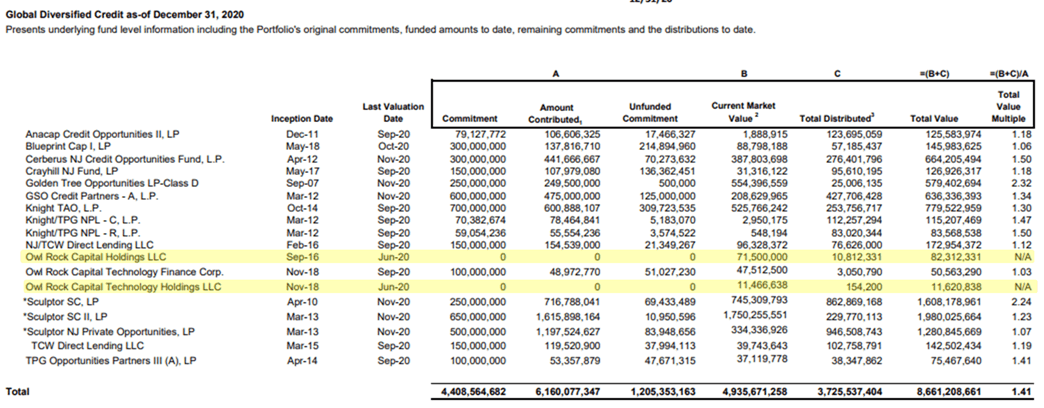
Source: New Jersey Division of Investments, December 2020 Monthly Director's Report
And Rhode Island.
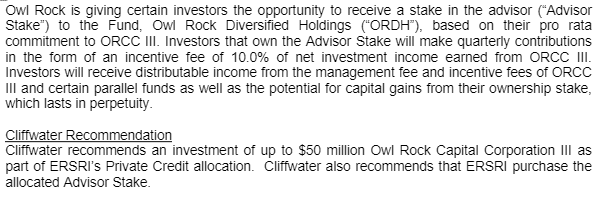
And maybe Oregon. Truth be told, I'm not sure if Oregon took Owl Rock up on the management company stake or not, although it seems to me they certainly would have been eligible for it at a $150 million commitment to ORCC III. Fun fact: they announced that commitment at the same time they announced a $125 million allocation to a Sixth Street European specialty lending fund. Small world.
Probably South Carolina, too, although if so, perhaps they've made the decision to merge that management company interest into the line item reporting their LP commitment on CAFRs. There are plenty of sharp allocators down there, so it seems like a reasonable assumption.
In short, Asset Manager A is merging with Asset Manager B, into whose equity securities Asset Manager A has already caused its own clients to invest, and to whom Asset Manager A has caused others of its own clients to lend money to, and is doing so through the acquisition by a SPAC sponsored by Asset Manager C, into whose equity securities Asset Manager A has also caused its own clients to invest, meaning that clients of Asset Manager A who had intended for their capital to be deployed on an arms-length basis are now effectively becoming both creditors and equity owners of Asset Manager A by merits of their enlistment of them as a vendor, and effectively both paying and receiving transaction fees and expenses to and from Asset Manager C, respectively. And this is able to happen, at least in small part, because Asset Manager B has granted equity ownership that would gain value in a transaction involving Asset Manager B to very large investors in their products who accordingly have a significant say in the outcome of a vote involving a transaction involving Asset Manager B.
Or, in the immortal words of Ray Stevens:
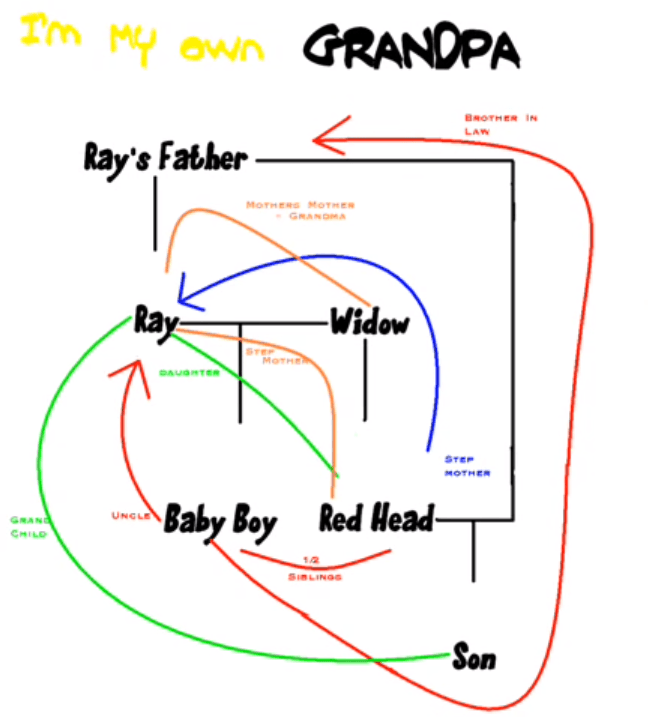
Source: Some YouTube Video of the Ray Stevens classic "I'm My Own Grandpa"
Alternatively, if you are a small LP or BDC investor who is wondering what is going on here, and you weren't large or important enough to merit getting a seed deal, let me translate the message to you:

But here's the real conundrum:
I'm pretty sure there's not anything illegal going on here.
Unless there's a real cause embedded in the agreements among these parties, I'm not sure there's anything tortious going on here.
Hell, I'm not even sure there's anything wrong going on here.
When Owl Rock gave all those big pensions and endowments effective GP ownership for their seed investments, what they were doing wasn't unusual. It certainly wasn't illegal. It was an entirely rational response to the power of a large block of capital with an appetite for risk. It is a power (because of my seat, not relatively unimportant me) I have some experience wielding. In my prior life, we squeezed external manager fees into oblivion because we could and because we felt that we should. We bought a stake in Bridgewater for Texas Teachers, an opportunity that came to us because we were a huge, strategic, long-term limited partner. An opportunity you probably didn't get to see.
We got to negotiate better structures than the deals you probably got, not because we were smarter or more charming, but because we were representatives of a $100 billion+ pool of assets. We also selected a hedge fund seeding / incubation partner whose offering included potentially getting us GP stakes in various funds in the same way all these big pools of capital did. I'm a big fan of the guys at Reservoir we ended up hiring to do exactly that.
There is nothing inherently nefarious about offering those deals. And nothing inherently nefarious about accepting them. Maybe you disagree. Fine, in which case I am nefarious, because I not only accepted these deals, I demanded them as a representative of an asset owner.
Nor is there anything inherently nefarious about the big institutions who will participate in the Altimar PIPEs that will grease the gears of this whole construction, or whatever benefits were offered to them in exchange for their support. Yes, even though it's Koch and whatever other bogeyman some might be tempted to summon to make all this seem blatantly evil, which it isn't.
Still, if you are a smaller institutional limited partner in some of these funds wondering why you're being jawboned about why "this is going to give us access to so much more in-house expertise!" and why "these lawsuits are no big deal!" and why "this isn't a distraction, we are still aligned with you!", so vote vote vote, I hear you.
And if you were a retail investor in the public BDC because you liked the yield and felt like your interests were served by the mutual self-interest of other equity owners, but then discovered that maybe some owners were more equal than others, and that maybe the goal of the adviser affiliate hired by the BDC wasn't just to maximize the returns of the BDC but of the adviser, and that maybe you'd like to express that with your vote, and that maybe you'd like to join with other BDC investors in doing that since clearly they're in the same shoes with you and...oh.
I hear you, too.
If I were a 'partner manager' with business overlaps, I would probably be hopping mad, and that's without even being party to any of the 'partnership' discussions. And yet, if I were a limited partner in one of the funds managed by the advisors in question, I would probably still vote yes on my proxy for the new advisory contract. First, because the GPs in question are really good at what they do and, in some cases, just about the only game in town. A no vote isn't going to get me those cheap co-investment rights on the next fund, and that probably matters more to my stakeholders than whether some not insignificant conflicts are being appropriately managed - or even that it is possible to manage them. Second, because the problem here, at least in my opinion, isn't that the people here are bad or that they're doing extremely bad things for investors.
The problem is that investors in 2021 are sold on a meme of markets in which equity owners and limited partners are "protected" by the mutual self-interest of other equity owners and limited partners (and boards, LOL) without taking into account that nested ownership structures allow powerful institutions to create incentive structures which manufacture...er...compliance for enough of the "important" participants to eliminate the effective agency of small institutions and individuals.
The problem is that we have decided to vest immense power into narratives about "incentives" and "alignment" and the ability to have "robust controls", when we know that each of those things is fragile to any change in assumptions about the underlying aims of the principals and agents involved. Here's a rule of thumb for you: they want a clear path to liquidity, and everything else is just pretty words.
The place this game leads us toward is a circular prison. Those who were sold on the "democratizing power" of vehicles like BDCs and SPACs that give "access to asset classes previously only open to big institutions" will realize that, as with every other investment, the sponsors will take their cut, and the big asset pools will take their cut, and the GPs that end up having lent money to themselves with their clients' money will take their cut, and at the end of the day, what you get is whatever they couldn't claim.
Same as it ever was.
The only difference is that the artifice through which all of this is achieved is far more obtuse, far more engineered, far more designed for the purpose of allowing those parties to do those things without opposition. I'm not saying that the Blue Owl transaction is unique. Quite the contrary. I am saying it is par for the course in outcome, except that its very structure is designed to distract or abstract from the manifold conflicts embedded in it to make that outcome more likely. It is a freaky circle, a thing which ends up at the same place but accelerates and ensures its outcome.
And makes us wonder what the hell is actually going on.
I DON'T know what that outcome will be for Dyal limited partners. I DON'T know what it will be for Owl Rock limited partners or shareholders in its various BDCs. I DON'T know what it will be for Dyal portfolio companies. These are really good investment firms with really smart people. If anyone can make a weird-ass, convoluted deal work, it's them.
What I DO know is that everything we are telling limited partners and shareholders about the democratization and alignment of their interests across markets, not just for this particular deal, is complete nonsense.
If you know how to parse those two truths, please let me know.



Comments
@Rusty This piece is right on the money for me. I’ve had a lot of experience in this space and I think you nailed it. Same as it ever was. And also, completely agree that there is nothing illegal going on here if you want to have clear eyes.
We could have a whole separate conversation about the suckers at the game (the garden variety LPs who don’t get the special gimmes) - however it seems to me that we are already having that conversation elsewhere in the comments sections and forums. That is the raison d’etre for the pack (very loosely defined).
A-propos robustness of the system and tying this idea into other ET ideas…the institutional response to Gamestop is now shaping up along the lines of “Yay, Regulations”. Apparently we are going to tighten restrictions on broker-dealers, blah, blah. Shocking. I know. Same as it ever was.
https://www.bloomberg.com/news/articles/2021-03-09/gamestop-prompts-u-s-to-consider-new-rules-for-options-shorts?srnd=premium&sref=9XsJozxv
This resonated. I am involved with a non-profit with a very modest endowment. The alternatives piece of the asset allocation did not have any real Private Equity/Private Credit/ Venture Capital when I joined. All of our outside advisors point to the success of Yale in the space and consider adding exposure like its a “no-brainer”. Look at those Sharpe ratios! (and the fees the brokers will earn). But, we will pay multiples of the fees, have no access to the insider streams of revenue, and get to buy in now, AFTER the trailing 10 year record of IPO’ing Unicorns. Has everyone so quickly forgotten how disgusted these plans were with the 10 year returns and illiquidity from the 1999-2009 experience? Few confidently projected the unique confluence of factors that drove this cycle’s returns. The safe asset class of Fixed Income destroyed as an unlevered return stream by Central Banks. The flood of capital desperate for a return stream earning above the actuarial rate for underfunded plans. The ability to offload private businesses at unheard of revenue multiples in spite of modest or no profitability.
The pack is trying to identify winners in an inflationary environment. These sectors miss all of the boxes. Reliance on overpriced capital to fund losses. At risk of rising labor costs from higher wages or work avoidance due to UBI. Needing ever higher multiples of revenue to drive future returns when inflation depresses valuation. Long lockups and large bid/ask spreads if the future script flips inflationary and the boards lose patience.
You should check out the Coinbase S-1. As Evan Lorenz points out in the most recent issue of Grant’s, democratize/democratized/democratizing is mentioned 11 times. Yet, there are super voting shares and longer terms for certain board members. Clearly, it takes an aristocrat to democratize correctly.
Continue the discussion at the Epsilon Theory Forum...