
A Tale of Two Cults
November 2, 2020·Politics
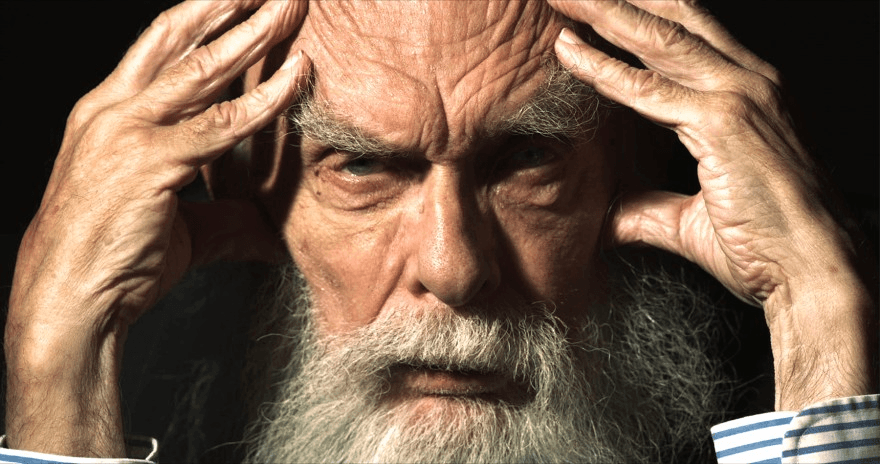
The Amazing Randi
The cult of Uri Geller should have died on August 1st, 1973.
It was the summer of Watergate. Johnny Carson lamented that the audience was sick of hearing about the scandal and didn't want him to monologue about it again. But H.R. Haldeman's haircut wasn't going to get a pass. It was, odd as it sounds to say it, a simpler time. And in Carson's defense, it was a very bad haircut.
Beyond obligatory jokes about the porcupine that had taken up residence atop Nixon's Chief of Staff, the Tonight Show that evening evoked an eclectic, variety show feeling. There were four representatives of the "Eskimo Indian Olympics", in full possession of a walrus baculum, which they proceeded to present to Johnny as a gift. As one does. There was Ricardo Montalbán, still well before his turn as Mr. Roarke and in between his portrayals of Khan. He was in full possession of his manifold manly powers, which he fearlessly deployed in movies about simian hegemony (the two bad ones, anyway) and every television series about...well, basically anything on TV between about 1956 and 1972.
And then there was Uri Geller, in full possession of his...um...psychokinetic powers?
If you don't know the story, Geller's excruciating twenty-two minute appearance on Carson that night is among the most awkward ever presented on television, whether scripted or otherwise. Beyond his purported ability to bend objects (spoons, mostly) with the power of his mind, Geller also claimed psychic, dowsing and other supernatural abilities at various points in his career as well. Carson, who was a practiced stage magician (and skeptic) himself, was excited to see these thrilling gifts in action.
After being invited on stage, Geller nervously observed various metal items arrayed on a table in front of him. He accordingly greeted Carson, McMahon and Montalbán with a confidence-inspiring "I'm scared." You see, Geller expected an interview. As he later attested, a Tonight Show producer provided him with a list of 40 different questions he might be asked. He was instead being asked to give a demonstration of his powers. It was completely unfair and unsporting, which is to say, positively delightful.
When you watch the video, you can see the gears furiously turning from the very first moments of the interview.
When pressed by Carson to demonstrate his prowess, Geller briefly tries to detect water in containers, then attempts to bend metal and guess at the contents of an envelope. But for the most part, Uri spends an interminable twenty-two minutes halfheartedly begging to be asked questions instead of being asked to perform, complaining about promises from the producers, and coming up with a stream excuses and explanations for his 'process' that might excuse the absence of any demonstrable psychokinetic ability. He ends with pseudo-scientific explanations of the failure as the absence of "controlled conditions." His utter inability to conjure the most basic supernatural phenomenon during the bit on Carson is rescued only on occasion by the preternatural charisma of Ricardo Montalbán.
In any real sense, it was a disaster.
There was a reason it was a disaster.
Yes, obviously it was a disaster because Geller couldn't actually do any of the supernatural feats he said he could. That's not what I mean. Clearly, under the right circumstances he was proficient at producing all sorts of illusions and stage magic. The "right circumstances" were those in which he had his own props, producers canvassing the audience and stagecraft elements to facilitate sleight of hand. In this case, however, before Geller's appearance, Johnny Carson had reached out to a frequent guest of the show, a fellow skeptic and even better stage magician by the name of James Randi.
You may know him as the Amazing Randi, who died last week at the age of 92. Randi was a remarkable man. Far more than just an entertainer, he devoted his life to showing the unvarnished reality underlying abstractions and illusions.
Geller was one of his favorite and most deserving targets.
When Carson's producers reached out, they asked the Amazing Randi what they needed to do to ensure that anything Geller did could only be achieved through the possession of true psychokinetic powers. His answer was simple: bring your own props, do it in secret, and don't let Geller's people near any of them.
The merciless video above was the result of this simple advice. Utter embarrassment, shame and ruin. Geller was mocked, ridiculed and laughed at. The people who believed that his sleight of hand and misdirection expertise were evidence of psychic powers received much the same treatment. In short, Johnny Carson's call to the Amazing Randi destroyed the cult of Uri Geller.
Except that isn't what happened. At all.
The nightmarish Carson appearance was NOT the end of Geller's career. In a lot of ways, it was the beginning, at least to a sort of stardom in the United States that he had already achieved in Israel. He was booked to another show almost immediately. That began a career of getting mining company executives (who, it must be said, always remained the greatest charlatans in the room) to pay him for dowsing services, doing basic stage magic routines and calling them extraterrestrial powers, stopping Brexit with his mind and preventing the relegation of Exeter City F.C. with infused crystals. Oh, and divining the root causes of COVID-19.
The curtain on Uri Geller was pulled...and nothing happened. The powerful play went on, and he still got to contribute a verse. And that verse was, "I'm a literal wizard and also I got my powers from aliens."
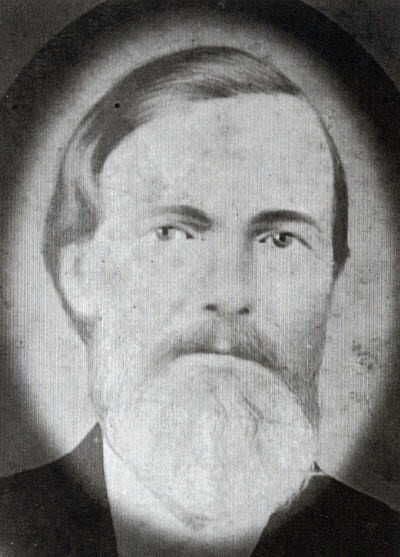
This behaloed figure is a man by the name of Richard B. Groves.
Reverend Groves was a minister of the Cumberland Presbyterian Church in Navarro County, Texas throughout the post-bellum 1860s and 1870s. He preached in churches around Corsicana, about an hour southeast of Dallas. At the time, it was a market town growing around an emerging cotton industry. It remained sleepy indeed until the arrival of the Houston & Texas Central Railroad in 1871. Even under the influx of settlers, cotton remained king. That is, until the first real producing field in Texas emerged from beneath the very streets of Corsicana in 1894. Literally.
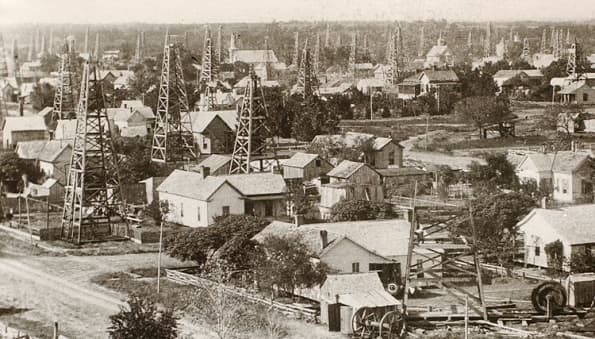
Corsicana, Texas during the oil boom days
The Cumberland Presbyterian Church - which still exists - was a quintessential frontier denomination. Methodists and Baptists alike made discretion the better part of valor in staffing circuits and permanent posts in frontier denominations, which is a kind way of saying they took what they could get. If Methodists have a natural tendency towards big tent revivalism to begin with, this tendency was amplified in frontier America. Presbyterians, on the other hand, had less of this predisposition, and the Cumberland Presbyterian Church was formed from a group of expelled revivalist ministers who looked on with envy to what the Baptists and Methodists were doing with (mostly untrained) ministers throughout Kentucky, Tennessee, Alabama, Arkansas and Texas.
By contemporary accounts, Rev. Richard Groves, who moved to Texas from the Cumberland River Valley of Kentucky (by way of pre-Chicago frontier Illinois) with his extended family of ministers, was a good and well-respected man.
There was another [Cumberland Presbyterian] Preacher who attended this meeting, by the name of Richard Groves. His home was in the vicinity of Corsicana. He evidently enjoyed the blessing of holiness. I think he came into the experience of it under Bro. Sim’s preaching. He seemed to be a man of considerable forces of character, positive in his convictions for truth; one who would not be likely to be “carried about by every wind of doctrine, and cunning craftiness whereby they lie in wait to deceive.
History of the Holiness Movement in Texas, and the Fanaticism Which Followed, by Rev. George McCulloch (1886)
It happened, however, that Groves and four other Cumberland Presbyterian ministers in Corsicana became convinced that they had discovered something new in the emerging "holiness doctrine," a crystallizing force in most frontier churches in the late 19th century. The basic idea was simple Wesleyan theology - that Christianity is not only accepting salvation from Christ, but the ongoing process of sanctification, God empowering Christians to better resist sin. Groves et al took it further. A lot further. They reasoned that the process of sanctification would allow Christians to be immune to even the temptation of sin. They could become, well, literally perfect. It opens up a lot of paths to crazytown. If they were free of the penalties of sin and free of the potential for sin, how then could they be assailed by the things to which man's fall in the Garden subjected him? How could they be assailed by illness? By age? By sickness? By the opposition of other preachers and politicians and citizens?
I'm sure you can see where this is going.
Under the tents of meetings in Corsicana and elsewhere in 1878, Groves and company quickly began to embrace the implications of their discovery. But not just the implications of their discovery, but the meaning of it. Surely, if God chose to reveal this truth to these men at this point in time, there must be meaning in that, too. Surely, if they had been made perfect through sanctification, they could know all that God knew, including the date and time of Christ's return and his judgment of the world.
So it was that Richard Groves became a millenialist cult leader.
In practical terms that probably seemed very reasonable to them at the time, they took a number of church elders, basically kidnapped two young women from the town and took an elderly minister away from his dying wife, and they locked themselves in the Groves farmhouse in Milford, Texas to further record the emerging perfection of their doctrine - and to await the imminent return of Christ. After a few days, the town sent a farmer to ask them if they might at least let the girls come back home before they returned to their various and sundry cult activities. They were refused, but after several calculated days for Christ's return passed, all participants left the compound and went back to life as it was.
Only they didn't, really. Wrong as they were in their predictions, their fervor simply led them to believe God was instructing them to expand the flock of those who knew the true doctrine. And so, during the winter of 1878 into 1879, each of the Corsicana Enthusiasts, as they came to be known, traveled all through Navarro and Limestone counties preaching the doctrine of absolute perfection and the imminent return of Christ.
Then, in the spring of 1879, Groves came across a pamphlet called Glad Tidings,published by one Henry T. Williams of Brooklyn, New York. It was a fanatical document of similar temperament - not, I think, associated with the later product of the Christadelphians of the same name. Richard Groves's brother William got it in his head that he would travel to New York to have a missing finger replaced, which was apparently among the services on offer by Mr. Williams. It made for a good opportunity to test his power, as well.
So it was that the community raised the funds to send William Groves to New York. When he returned to Corsicana, he was changed. No, not the missing finger. Forget about the finger. The finger wasn't important. He now had the ability to grant salvation. To forgive on God's behalf. To condemn on God's behalf. To hear God's will directly in a way that might contradict scripture or law, but which must be obeyed. Now the Bibles were gone, doctrine was gone, and the brothers Groves and their new partner Henry T. Williams were the center of a new religion.
And what is a new religion built around a people set apart, perfected by God, without a compound? On behalf of Williams, the Groves brothers along with a small group of other elders directed their flock to collect all of their belongings and worldly wealth, to be contributed to the establishment of a community near Little Rock, Arkansas. In all, 50 or 60 people went. They sold their farms, homes, businesses and other property, and on arriving at The Home, as Williams called it, were denied entry unless they would immediately pledge the same to him.
The Home was the 19th Century version of the Fyre Festival. Gruel for meals, hard labor, meager accommodations. In the end, the organizer runs off with the money. It failed almost immediately. Everything fell apart. Reality set in.
The curtain on the Corsicana Enthusiasts was pulled...and everyone saw it for what it was.
And then something funny happened - things went back to normal. Sure, for a few years, one of the hangers-on lived a life of free love (he was perfect, after all) back on a farm he held on to in Corsicana about 100 years before that was in style. William Groves stayed in Brooklyn and (one presumes) helped Williams continue to take advantage of other enthusiasts. But for the most part, once The Home collapsed, Richard Groves and most of the other 50 or 60 participants came back to Corsicana, poorer, wiser, ashamed and embarrassed.
And while there were generational consequences, while life was never the same, the communities largely accepted the wanderers back, both sheep and shepherds alike. Multiple local churches accepted the families back. They found work and contributed. They married and had families and sent them to the new public schools that were established in 1880.
It's a damn good thing too, if you ask me. Because while Richard Groves was leading a millenialist cult, he did so with his daughter in tow. And when Corsicana let him back into the fold, he did so with his daughter in tow.
My great-great grandmother.
But it raises an interesting question: how does it happen that revealing the lies painted over by narratives in one kind of cult only strengthens it, while in another it reveals it and destroys it utterly?
It's complicated.
The deceptions of a charismatic stage magician and a religious cult fanatic operate on vastly different scales, with different implications and consequences. Obviously. But in those rarest of moments when the real world intersects with narrative world, regardless of the scale and scope, it is our perception of the consequences of shifting axes from narrative to a world revealed that usually guides our behavior. What might happen if we admit and repent our deception? What might we expect if we once again submit to the seductive memes of the narratives spun by our cult telling us that we were never really intersecting with the real world at all, but with someone else's narrative? A narrative that must be defeated!
These weren't controlled conditions!
These townspeople with torches looking to reclaim these two young women have clearly been sent by the devil to oppose us!
This is why the everyday cults of our lives, be they investment, political or social, thrive by presenting each issue and each intersection between real world and narrative world as existential. When the stakes attached to a narrative are infinite, it is infinitely difficult to divest ourselves from it.
But those are the narratives of consequences created by those cults themselves. There are also, I think, a range of consequences - often entirely just - created by those who oppose them. Beyond the gulf in the scale and scope of the cults I described to you above, this is the difference between them: that the community of Corsicana decided to relax the consequences for those led into error and ruin.
It was mercy, not wrath, that destroyed the cult of the Corsicana Enthusiasts.
As we continue to write on Epsilon Theory about what we mean by BITFD, many readers have asked whether we should be talking more about how we build the thing back up. Now, truth be told, that is a big part of what we mean by BITFD in the first place. But let's take a reasonable observation at face value. Do you really want to build a functioning America the $!#@ up? Do you really? Because if you do, if you want to give fighting the Widening Gyre a fighting chance, you must do something that is a million times harder than laughing a self-important magician off the stage.
You must be merciful.
Don't mistake me. You don't have to forget. You shouldn't forget. To people who broke laws or behaved corruptly, do justice. To those entrusted with much who failed in their trust, do your diligence. To institutions that failed, do your worst. And let there be no doubt in anyone's mind that this shall always be the way. Sic semper tyrannis.
But to people who thought Wrong Things, show mercy.
To people who voted for the Wrong Person, show mercy.
To people who bought into Wrong Narratives, show mercy.
To people who got so over their skis that pivoting to the plain facts of [insert your favorite issue here] without obliterating ego integrity became impossible, show mercy.
I'll get a lot of responses - from a lot of different cults who think I'm talking about their particular nemesis, and I assure you, I'm not - saying to screw off, that all These People had it coming and have it coming. They'll get the shame they so richly deserve when the real world proves them wrong after [the election / COVID goes away / COVID gets worse / markets melt up / markets melt down]. Fine. You're right. 100%. Enjoy being right.
Just know that, while we wallow in the slop of our rightness, this isn't the path to build it back up. It's the path that makes it increasingly necessary to tear down the institutions that don't work in a polarized America. BITFU means worrying more about whether our town, state, country, world and markets are healthier, freer, more creative, more beautiful and more prosperous tomorrow than whether everyone agrees that we were right in the past.
There is a moment when the real world peeks through the narratives that surround us, and we convince ourselves that this will be the truth that frees our fellow citizens, investors and neighbors from their delusions.
But truth is only one of the necessary conditions for this kind of change. The other?
Mercy.
It will take both to BITFU. Do we have it in us?


Comments
Here it is – this is the post I’ve been waiting for. The complement to #BITFD. I predict that this is where you lose the fair-weather friends who have come for the burning, not for the building. The jackasses who just want to kick down the barn, not the good (and amateur but willing) carpenters who are ready to craft the new one.
Everyone would happily have fought against slavery, had they been in Lincoln’s place. Much harder to follow Lincoln’s example in promoting former enemies – Seward, Chase, and Bates – to his cabinet. I hope that the Epsilon Theory pack (and beyond) can embrace that level of citizenship – putting aside the thrill of lording over a former opponent to instead join hands in building something better.
Exactly right Rusty. We can’t move forward without mercy. Well written!
Thanks, Daniel! You are totally right that the fire brings in some audience more than others, but interestingly, outside of social media channels (i.e. Twitter), our most widely circulated notes actually tend to be of the BITFU variety. It surprised me, too, but I found it more than a little bit encouraging.
Thank you, Laurie!
Thank you Rusty, I needed to hear that today. I love the idea of all sides believing that they are right, yet granting mercy to all. It sounds like a wonderful world, but one that will probably destroy Twitter. I hope Ben’s ok with that.
It hit me after I posted my previous comment that our way forward is a so called “Circle of Mercy”, a positive feedback loop if you will… I don’t care who thinks they are right, I want to be involved in a Circle of Mercy, and today it starts with me. Thank you Rusty, I needed a reason to try and let go of my election angst, and you gave me a wonderful roadmap to my first step.
I’ve actually been a bit turned off by the phrase BITFD (not the ideas behind it), so this one felt like ET oxygen to me as I can’t wait for BIBU.
Rusty is spot on as it will take mercy to build it back up as does any damaged relationship. The victory dance feels good and can even be justified, but fair or not, it won’t lead to repair. The “no taunt” rule in football is a version of this (forced mercy, if you will) as the NFL wants to keep the game, season and league going forward.
And great writing Rusty - the stories were engaging and, by the time you got there, your conclusion had already achieved reader buy-in because of them.
Piety is a fickle friend.
fascinating. Your family’s campfire stories had to be pretty interesting growing up.
When judgement day comes , in this world or the next , what is it we all want? Judgment or Mercy?
I have not met a soul yet you wants judgement.
Maybe the Lords prayer is correct and we must first extend mercy-- before we can, in good faith, ask for it.
Continue the discussion at the Epsilon Theory Forum...