All Along the Watchtower
February 6, 2019·Media
'There must be some way out of here'
Said the joker to the thief
'There's too much confusion, I can't get no relief
Businessmen, they drink my wine
Plowmen dig my earth
None of them along the line know what any of it is worth'
'No reason to get excited', the thief he kindly spoke'
There are many here among us who feel that life is but a joke
But you and I, we've been through that, and this is not our fate
So let us not talk falsely now, the hour is getting late'
All along the watchtower, princes kept the view
While all the women came and went, barefoot servants, too
Outside in the distance a wildcat did growl
Two riders were approaching, the wind began to howl
All Along the Watchtower, by Bob Dylan (1967)
Quis custodiet Ipsos custodes?
But who will watch the watchmen?
Satires, by Juvenal (2nd Century)
We haven’t published an update on our Fiat News Index for a little while, but it is for a good reason. We are working on an improved version that does more to handle gradations, nuance and context in affective language. If the concept of fiat news is new to you, Ben’s original piece here offers the best explanation. In short, it is news which broadly cheapens the credibility of media by presenting opinion as fact. It debases information in the same way that a capricious sovereign might debase a currency. It tells you how to think.
But there is a certain type of fiat news which is the most pernicious, most in need of calling out where it rears its head. It seeks, like all fiat news, to present subjective judgments and opinions as fact. This type of news also elects itself as arbiter, responsible for determining the accuracy of the statements made by others. It’s not an unworthy goal. But in the hands of actors who wish to tell you how to think about a topic and not just inform you, it can do more to debase confidence in information and news than any other kind of media activity.
Yep. I’m talking about Fact Check Journalism.
Sure, there are examples of Fact Check Journalism doing good. And then there’s the NPR Fact Check of the 2019 State of the Union Address.
It’s a long read. I recommend it. If you’re like me, you’ll find yourself agreeing with most of the commentary. If you’re not, then maybe you won’t. But whether you agree with the commentary or not isn’t the point. Ignore whether you agreed or disagreed with its sentiments. Read it again and ask yourself: Is this really a fact check? Or is this person trying to shape how I think by presenting his or her opinions as a fact check? As it happens, I think you’ll find that there are actual fact checks in the article, mostly in the well-researched responses to the immigration and border wall questions, other responses to foreign policy and national security questions, and in many of Jim Zarroli’s checks on economic statements.
But with those exceptions, NPR’s Fact Check is an analysis, commentary and opinion piece. There’s nothing wrong with that on its own. That’s an important role of the press. But publishing a piece like this as a ‘fact check’ is not just fiat news. It is fraud, a fraud of the kind that will kill confidence in the media stone dead unless others of influence recognize it and disavow it.
What am I talking about? Let's take a look.
Source: NPR
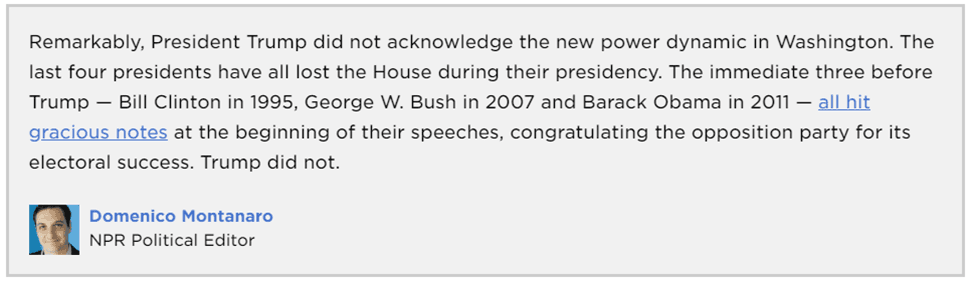
This ‘Fact Check’ is of a kind you might call the Benchmark Switch. It isn’t a fact check so much of a statement against reality, but against what the author believes should have been said. The intention of this kind of fact check is to establish common knowledge about what is conventional and acceptable, to frame your interpretation of the remainder of the speech. We are to begin by understanding that the speaker being evaluated is beginning his speech well outside the norm. Definitional, textbook fiat news.
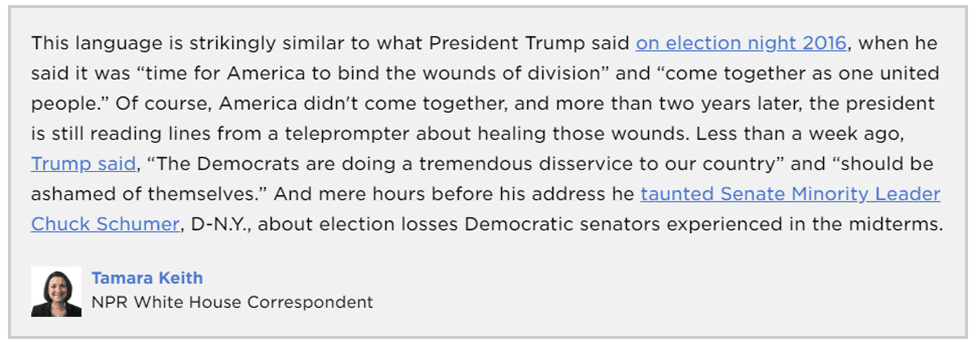
Source: NPR
This ‘Fact Check’ has a two-fer – Anecdotal Rebuttals and Emotionally Curated language. The author has elected to fact check an expressed desire, which is not entirely inappropriate. Although it is difficult to know in any absolute way if someone really wants to ‘binds wounds of division’, it is reasonable enough to assess whether their actions line up with that expressed desire. Yet the author simply lists a couple of examples and plays to the crowd with a ‘reading lines from a teleprompter’ bit. It’s a shame, because with as much as we write about the Widening Gyre, you won’t be surprised to learn that I completely agree with Tamara. But this isn’t fact-checking. This is an opinion the author wished to express, and found a ‘fact check’ to use as scaffolding for that opinion.
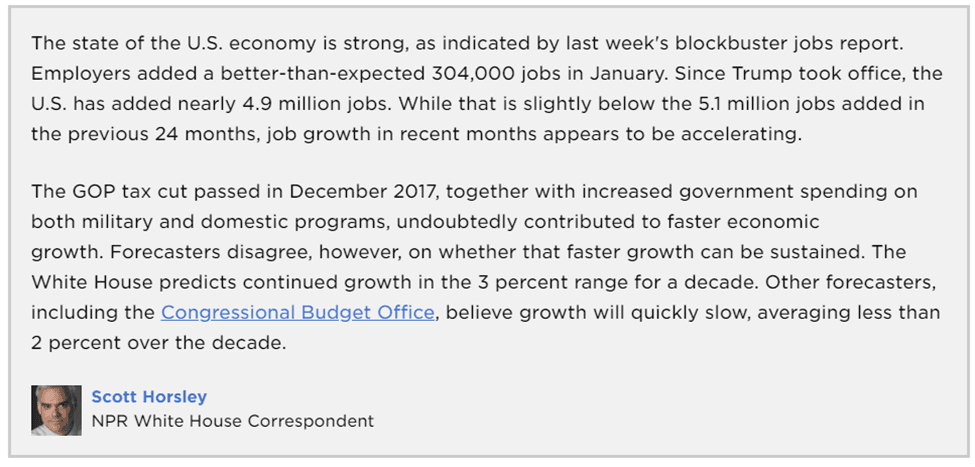
Source: NPR
This starts with a fact check, but then transitions into Necessary Context, the selective provision of additional facts to tell you the context in which the original fact should be interpreted. The author doesn’t trust you to know what to do with certain bits of information that imply that the economy has been doing well. You need to know his opinion about whether it has been influenced by certain policies, and he also wants you to know that he and ‘forecasters’ believe that it won’t be sustained, which is a fact check on…oh, nothing really. We just thought you should know, because reasons.
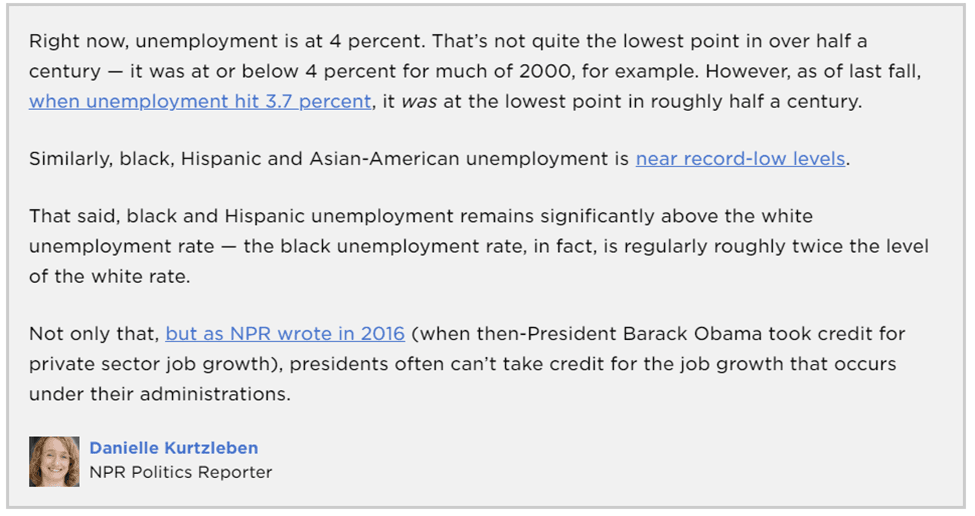
Source: NPR
This one starts out looking like a fact check, but ends up offering the reader a lovely combination of Benchmark Switching and Necessary Context. The author wishes the speaker had compared unemployment levels between two demographics, and fact checks against what she wishes had been said. She then wants to make sure that you know how to think about this data in context of the president’s achievements, even though no such claim about responsibility had been made.
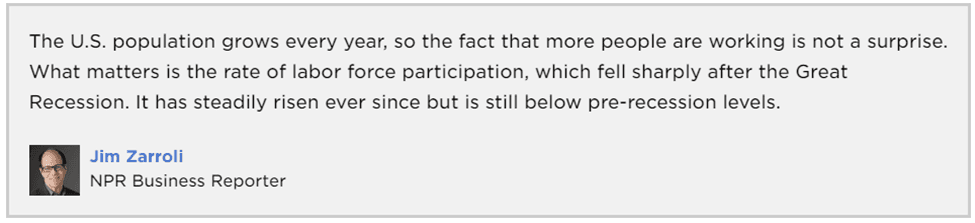
Source: NPR
Again, I largely agree with Jim on the point, and most of what Jim had to say in the piece was squarely in the true fact check camp. But consider a rule of thumb: If a fact check includes the terms, “what matters”, it is not a fact check. It is an opinion, and when it is presented as a fact or fact check, it is someone telling you how to think.
Source: NPR
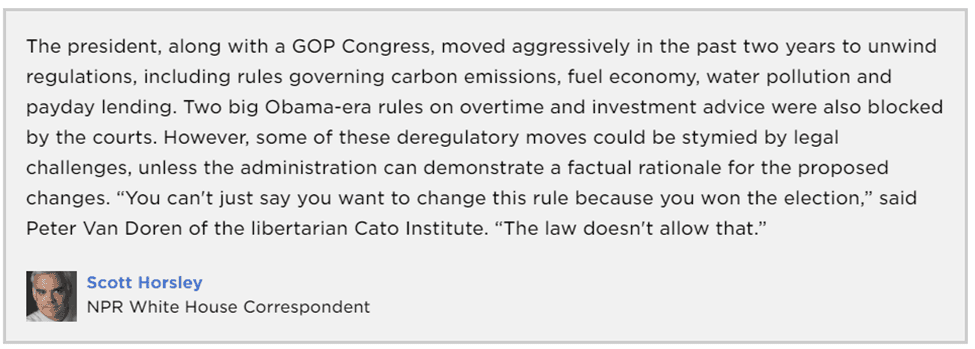
The legal challenges facing the eliminated regulations are a feature of a legitimate fact check, since they could bring the accuracy of the original statement into question. You’ve got a little bit of Necessary Context here, of course. The author wants to make sure you know that you should think about this policy as a bad thing. What’s the surest tell for this? Look for the word ‘including’, and see what follows. If the list is a bunch of things selectively curated to trigger a particular emotional response, be aware that our thinking is being curated, too. And not by us.
Source: NPR
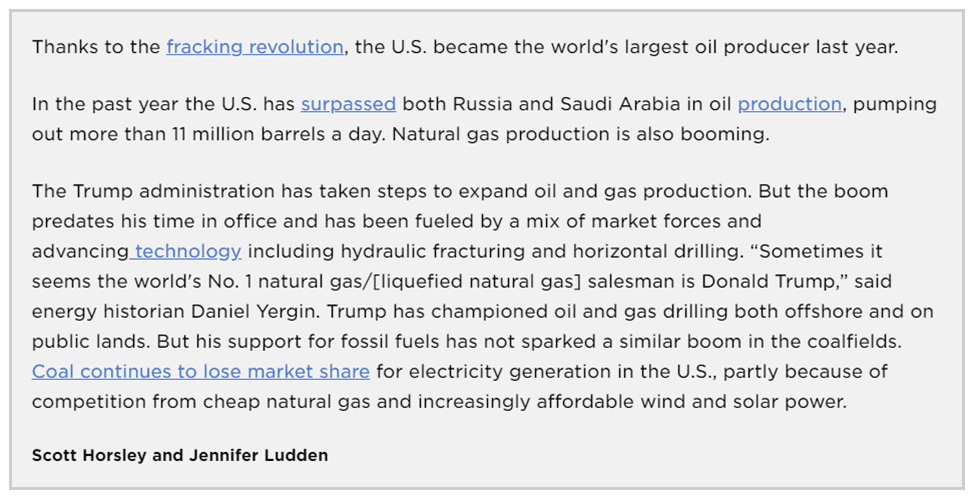
More Necessary Context. Lots of ‘buts,’ which in any kind of fact check is a sign that the author wants to guide how we think about and interpret the fact presented in the first clause.
Source: NPR
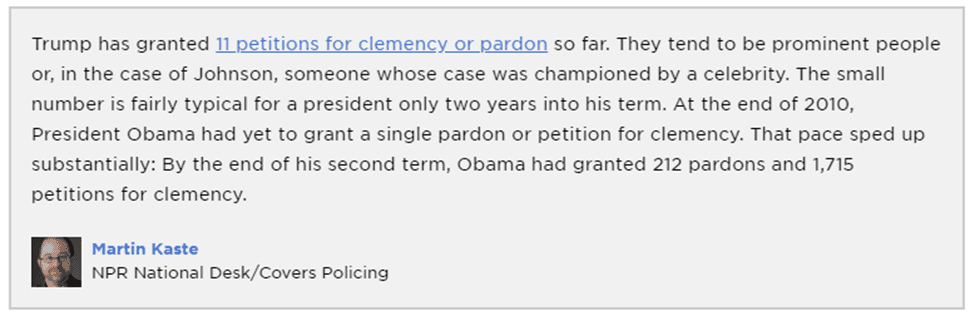
More Necessary Context. No fact checks here, just an author who wants to give you some additional context so that you can think about the issue in the way he wishes to frame it.
Source: NPR
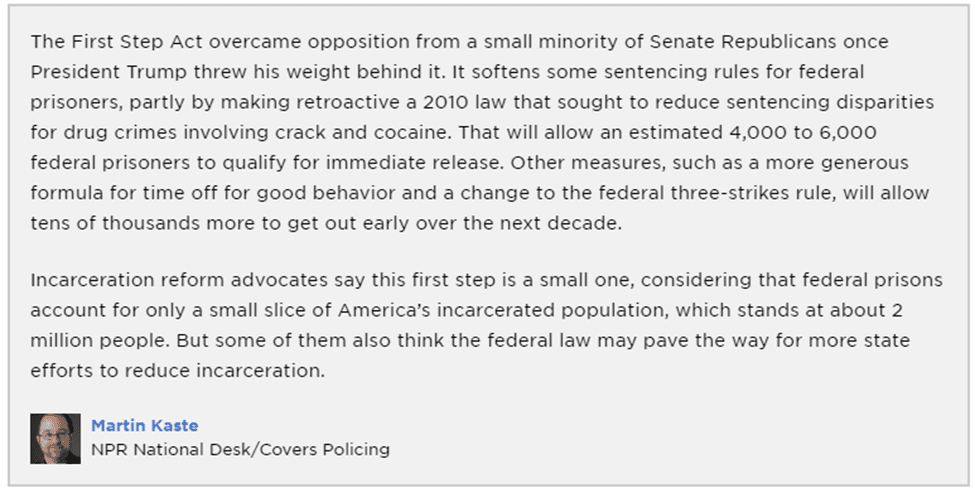
Necessary Context. Note the structure of each paragraph as well. ‘Bad things’ up front, and ‘grudging admissions’ at the back. This is not a fact check. It is another interpretation check, making sure that you interpret the facts ‘correctly.’ Vanilla fiat news.
Source: NPR
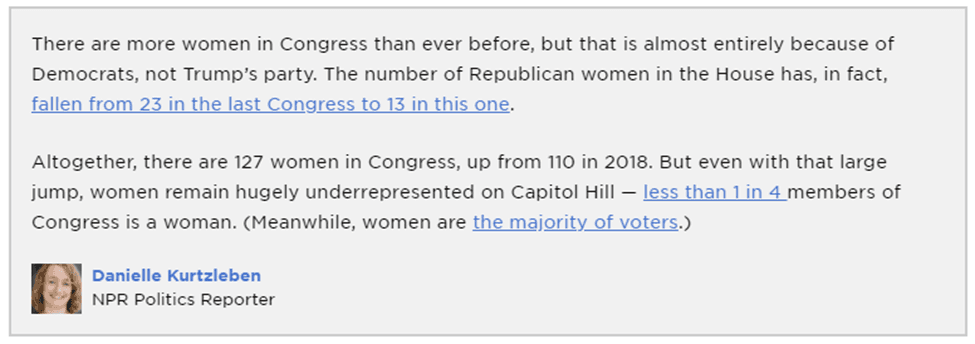
In response to a simple (and completely accurate) statement celebrating the record number of women in Congress, the author wants you to know all sorts of Necessary Context. The author has all sorts of opinions about this topic, and wants to present them to you in the context of a fact check. No fact has actually been checked in the drafting of this statement.

Source: NPR
Larry has all sorts of Necessary Context for you. No fact checks, really, but zealous attempts at purporting the existence of common knowledge – what everyone knows that everyone knows – about the issue. And if you didn’t know how to think about all these facts and context, Larry gives you an Emotionally Curated fact as a kicker at the end, just to be sure.
You will find more of these if you read the piece, and you’ll find more of them in any such piece, because many news organizations have allowed their so-called fact checking apparatuses to become melded with their editorial, commentary and analysis practices. And that, friends, is the problem. Our trust in media is under attack. Our confidence in its value being debased from without and within. From without, we are being told that the media are the enemy of the people. From within, we are presented with opinions and commentary that purport to be facts. Both serve to debase this critical social institution.
The widening gyre will guide you to concern yourself with one of these, to be offended at the two being conflated. It will make you recoil, since one of them is clearly a 'bigger problem' or 'more outrageous.' Resist that impulse. We must resist and defeat both of these threats. Someone must watch for riders. And someone must watch the watchmen.