Arbitrary Power
February 3, 2019·Politics
Freedom of Men under Government is, to have a standing Rule to live by, common to every one of that Society, and made by the Legislative Power erected in it; a Liberty to follow my own Will in all things, where the Rule prescribes not; and not to be subject to the inconstant, uncertain, unknown, Arbitrary Will of another Man: as Freedom of Nature is, to be under no other restraint but the Law of Nature.
Second Treatise of Government, by John Locke (1689)
This ornamental sign lies a couple miles south of my house.
It is not a thing that anyone takes very seriously, not because there’s anything unusual about where I live, but because there isn’t anything unusual about where I live. Every city in North America east of the Rockies maintains a cringeworthy “if you don’t like the weather here today, just wait until tomorrow” joke culture on account of the basic traits of our ubiquitous humid continental and humid sub-tropical climate types. So, too, do each of those same locations maintain some local lore about how bad drivers are in this location or that, suspending disbelief at the superficial silliness of the claim.
I’ve lived in Chicago, Philadelphia, Houston, Dallas, Austin, New York, Germany and now the wilds of Connecticut. Drivers are mostly the same, and what’s more, on a road with particular qualities – its width, its outlets, its proximity to towns, homes and the like – most drivers intuitively drive about the same speed. The difference isn’t the drivers.
It’s the rules.
If you picked up this road and everything about it – the surroundings, the level of traffic, the neighboring roads and communities – and put it in rural Texas, I feel very confident that the average speed driven would be about the same as it is here. Call it 40 miles per hour, give or take. But instead of having the number 25 written on this curiosity of a sign, however, it would have the number 35. That’s not to say that some drivers don’t attenuate their speed to some function of the posted speed limit, of course, but that’s part of what I’m getting at here.
Practically nobody wants to live in a system of extremely restrictive rules enforced in a rigid, inflexible manner. Practically nobody wants to live in a system with few laws and indifference toward the enforcement of the ones that do exist. There are two alternatives, and they form many of our social disagreements: do we create a system of firm laws but vest powers of judgment and fairness in officials to relax them where needed or do we create a system of limited laws which we can expect to be strictly enforced? These two approaches lead to different behaviors by the governor and the governed. They also lead to different kinds of asymmetric risk, even if the average outcome is the same.
I know where I come out on this one:
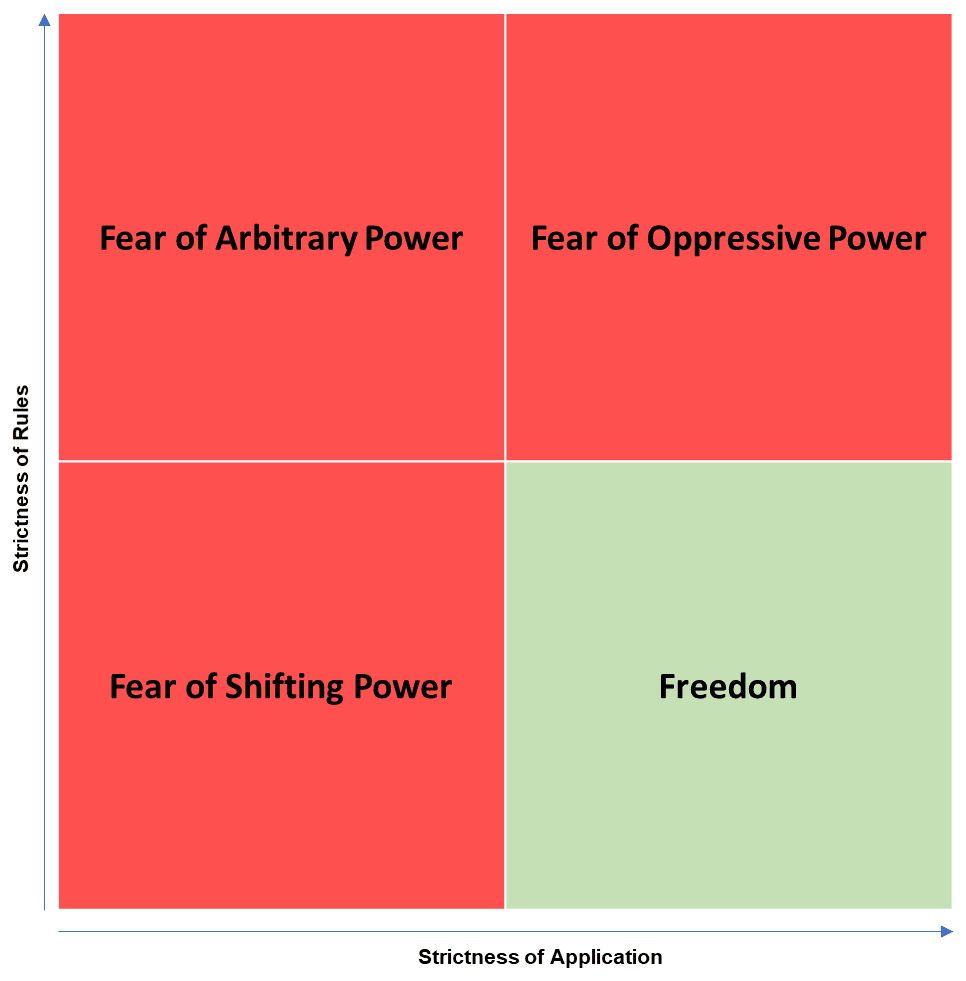
Forget about the broad social and political implications for a moment. After all, this is just basic rule-of-law stuff. It isn’t just an important question for our relationship with our government. It’s an important question for our relationship with our own processes, and an important component of the way we manage our own behaviors as human beings, civilians and investors. We make choices on this dimension all the time:
- When we diet or abstain from some kind of activity or food, we can set a range of targets and limitations, but give ourselves flexibility in whether we cheat on those rules. Or we can set a much more limited set of rules but interpret them strictly.
- When we set guidelines for our children, we can create a maze of rules and expectations onto which we layer occasional acts of mercy. Or we can be more permissive in our rules. We can allow failure. And ruthlessly enforce a much more limited set of core values and safety-related rules.
- When we build portfolios, we can constrain them to a firm, definitive framework of our understanding of financial markets, and then override whenever it seems like it may not be capturing something that worries us. Or we can be parsimonious in what we incorporate into our models, yet permit ourselves much less in the way of discretion over their interpretation.
In the same way that so many people who hear ‘rule of law’ still, for some reason, think it means ‘more rules and police’, many who hear ‘process-driven’ or ‘rules-based’ often think that this is a call for ‘more rules.’
It isn’t. Or at least, it shouldn’t be.
As we have written, part of the investment meaning behind Clear Eyes and Full Hearts is to act boldly on our beliefs while holding loosely to them. It is not strictly a paradox, but at least fascinating to note that we do this best when the processes we design to implement those beliefs reflect nearly the reverse: limited in scope yet rigid in application. If the reason isn’t immediately clear, it is this: if you incorporate a willingness to hold loosely to your beliefs, you must increase your certainty that your processes will tell you when it’s time to adjust them. If you permit yourself to insert judgment at every stage of your investments, from principles, to philosophy, to process, to implementation, you will end up being subject to arbitrary power.
Not from a government, or a judge, or a traffic cop. From your own mind.