Notes from the Road: Bayes and the Boreen
August 21, 2018·Money
I believe in American exceptionalism. Unironically. Still.
Millions of men and women over many centuries uprooted themselves from established lives of plenty and poverty alike. They bought passage or sold a portion of their futures for passage under indentures. They crossed the perilous Atlantic – and later, the Pacific – to start new lives as strangers in a strange land. Others were stripped of their freedom and sent here against their will. When they or their descendants were finally freed, a generation of millions were forced to start new lives among those who had enslaved them, who had thought them less than human.
A culture grew to maturity around the men and women who survived, conquered, and in some cases even sought out these trials. Such a culture was bound to be different from those of countries with static populations and largely stagnant genetic stock. It was bound to be exceptional. Maybe it is a story that Americans tell themselves, but would we be surprised to find that many Americans shared some genetic marker linked to restlessness? To ambition? To risk tolerance?
I wouldn’t.
I also believe, sadly, that much of what made us exceptional is fading. Not because we are admitting too many new immigrants who are diluting our special culture, as the dunderheaded nationalist right would argue. Not because we were never really special in the first place, as the insufferable I-tell-people-I’m-Canadian-when-I-vacation-in-Phuket political left would have it. No, it’s fading because comfort and plenty make it easier to forget the joy of work and the rewards of skin-in-the-game. It’s fading because we’ve structured our society to make it a hell of a lot easier to be a rent-seeker than to take a vested, tangible interest in the lives we are living and the lives of others we impact through our actions.
This is especially true in the investment industry, I think. On the good days, we take pride in being part of an important process for determining the cost of capital for governments and businesses. Normally, we wonder whether we are doing anything of value at all. On our bad days we wonder whether it is even possible for us to do anything of value. Sure, there are sociopathic personalities in this industry who don’t care about any of that. I hope this is not surprising to you. If it is, I have a lot more bad news for you when you’re ready. But there’s a reason you see so many investment executives moonlighting as musicians, high-end amateur cooks, craftsmen and craftswomen, things like that. It isn’t because they have enough money and they can. OK, it isn’t just because of that. It’s also because they want to do something that feels real. They want to escape the complacency of an industry with high pay but frequently low rewards.
They crave a journey. I admit it’s possible that I am projecting, dear reader. After all, Ben and I are dropping our jobs and starting a company. I bought a farm with my wife and kids and we’re moving to Connecticut. But I suspect I’m not alone. I know I’m not alone. Many of you are on or are thinking about journeys of your own, both great and small.
I want to write about some of them. Not because I think you particularly care about the minutiae of my life or Ben’s, but because the way in way we acquire knowledge from journeys and new experiences represents a marvelous case study. Notably, it can teach us how participants in financial and political markets respond to the unfolding of time and events. And yes, how they respond to Narrative. These Notes from the Road will study how we intentionally and unwittingly form priors – the beliefs or guesses we start from anytime we try to understand something new. They will study how we incorporate new information with our priors into views and ideas. They will study how that process of incorporating new information into our priors informs the quality of our decisions.
For fans of $10 words, as Ben would put it, this is a series about Bayesian inference, its utility and its intersection with Narrative. It’s also a series about how faulty reliance on those techniques – or the intuitive human thought processes they so resemble - can sometimes result in the implosion of portfolios and political dialogue alike.
The Devil’s Circle
This road begins at Shannon Airport, outside of Limerick, Ireland.
You see, my wife gave me the greatest gift I ever got (read into that what you will when you read these essays in the future, my sons). She sent me for a week. To Ireland. By myself. To sit on an island with three bottles of Tyrconnell 16-year. To do absolutely nothing. And all I had to do was get there. This isn’t a story about planes, trains and automobiles. It’s a story about highways, roundabouts and boreens.
When most Americans prepare to travel to the current and former British colonies and protectorates (and Thailand and parts of Japan, for some dumb reason) where vehicles drive on the wrong side of the road, the panic is palpable. It usually keeps us to taxis and trains, which means traveling to and between cities. That was not in my plans. I downloaded a computer game called Truck Simulator so that I could practice driving on the left side before I left. I’m not kidding. There really is a game in which the goal is to drive an 18-wheeler at responsible speeds. I really downloaded it and really played it and really ran into barriers in what looked most like the West End to see if the game would let me cruise the sidewalk for tourists who came to the greatest city in the world and decided they wanted to watch Aladdin: The Musical. It wouldn’t.
It obviously didn’t help me drive, either. But guess what? Real left-hand driving after a lifetime of right-hand driving was an absolute breeze anyway. Bayes would have happily told us why.
If you have driven for years, you have all sorts of knowledge about the act of operating a car. How do I turn the car on? How do I change gears? How much does my foot need to depress to accelerate at a particular rate? How much more slowly is the car in front of me driving, and when will I need to apply the brake? How much do I need to turn the steering wheel to cause the tires to turn by so many degrees? Where are the edges of the lane? What information do I need to determine if it is safe to turn?
When sitting down in a new kind of car, we don’t start by clearing our mind of all that car knowledge. We arrive with generalized priors about driving, since we’ve done it before, and cars, because we’ve seen them before. We also arrive with educated guesses about how driving this new car may be different. I know that they drive on the left in Ireland. I know that the driver sits on the right. If I’ve thought about it, I know that left turns are the turns in front of one direction of traffic, and right turns are the ones across two directions of traffic. I guess that the rules governing those will be like the opposite kind of turn here in the U.S. I guess that my muscles won’t do these things without thinking, but if I’m aware and intentional, I should be fine. I guess that slow traffic will stay on the left, and that I will pass on the right. I’m embarrassed that I’m not 100% certain, but I guess that the pedals aren’t reversed. I guess that the general rules of the road – use turn signals, yield to bigger roads if there isn’t a sign, brake at stop signs until your car rocks back – are pretty similar, too. I’ve been places where you can turn right on red and places where you can’t, so I don’t have a very good guess at whether I can turn left on red. Probably shouldn’t. I guess that the informal practices of drivers, like how closely they follow, when they honk, how liberally they will accelerate at yellow lights, how understood is it that a right turn yielder waiting in the intersection gets the last use of a yellow light, or that a merging entrance ramp zippers with slow moving traffic in the adjoining lane, are more or less like they are here.
There are some small things that our priors won’t capture. I didn’t form any priors about how differences in posture would affect me, for example. I didn’t realize that when I sit in a car, I immediately put my right arm on the console or passenger’s seat, and my left arm on the driver’s side door, left hand holding the steering wheel at 11 o’clock. I DID know that I put my right hand on the automatic gearshift like a dork, because my car aficionado friends have pointed it out to me, but I didn’t realize how instinctively I did so. I didn’t think about how I’d adjust my rear-view mirror in a slightly different direction.
But once I started driving, I took in all kinds of new information. Yes, the pedals are the same. Yes, the accelerator is less responsive, probably because of some EU law against having fun while driving. I saw other drivers and cars. I observed their behavior, speed and responses to different situations. I saw many exits before mine and could see how they worked. I saw signage. I took in the informal rules of driving behavior. Within a few minutes, I had it figured out. I laid my left arm casually on the tiny console of this weird euroeconomybox. This is what we mean by “Bayesian” in a nutshell: my inferences about factors I suspected would be related to left-hand driving were good enough to require a lot less information than if I were a blank slate, observing drivers and reading about Irish traffic laws.
And then it happened. The sign. The “Oh shit!” moment. Readers from countries with civilized driving laws, you know what I’m talking about. This evil monstrosity.
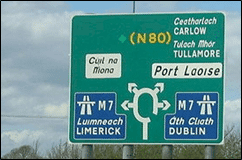
But I had a secret weapon. I’d played 45 minutes of Euro Truck Simulator. I knew what to expect. You come up on the Devil’s Circle. You yield. You look right. You always yield to the circle. Did you start your journey with a prior that the Irish are just as bad at using their turn signals as Americans? Good. When it’s your turn, you go. You have the right-of-way until you reach the point in the circle where you need to exit. I observed the car to the right of me doing the same things I was. Posterior probability stronger than my already strong prior. Things are looking good.
Until some jackass pulls out in front of me and forces me to slam on my brakes.
I had done everything right. Being conservative, I went all the way around the roundabout the first time. I was taking my time, because I knew a wrong turn this early could start a chain reaction of stress, and I wanted to make the correct turn. In the end, I don’t know if he didn’t see me, or if, in his experience – in his priors - no one ever continued around the roundabout to his entry point at this hour. I was on the inside lane where I should have been. Even after I reached my destination and took a moment to Google roundabout laws, determining I was in the right, I couldn’t shake that little bit of fear every time I entered one.
This isn’t a problem with Bayes, or with science. It’s a problem with us. When we start with a strong prior (e.g. roundabouts are violence) and encounter strong evidence confirming the prior was correct (e.g. Mad Max over here in his Opel hatchback), we often consider the problem solved. This may sound like what we all know of as confirmation bias, but it isn’t, really. Or at least, it’s a kind of meta confirmation bias, in which strong confirmation of our priors – seemingly static relationships between our priors and posteriors - causes us to consider certain matters settled science. We stop asking the question altogether.
As investors, we do this in a couple ways.
Often, the strong evidence that shuts down our questions looks like a long series of seemingly predictive data. Long-term equity returns are always positive. Stocks and bonds are negatively correlated. Investors should ignore the noise and keep to simple balanced portfolios. Value, low volatility, momentum and illiquidity all have a premium. U.S. residential real estate prices can’t fall. What we often miss is that the boring consistency between posterior and prior was being driven by an unexamined inference about the state of the world. In other words, the inferences we start from usually reflect a complex system of other inferences that we’ve accepted as givens. Wars don’t happen any more. Globalism and free trade are here to stay. Racism is dead and gone. Central banks have figured out government indebtedness problems. Markets are mature and liquid. Some of the roundabouts I want to write about will look like this: the accidents we cause through unexamined, uncritical priors.
Other roundabouts are big, single events, usually early in the evaluation process. Investors who started their careers around the crashes in 1987, 2000 or 2008 have a clear picture in their heads of the causes and appearances of a stock market crash. They may look at the same data as the rest of us, but their updated priors are frozen in time. Whatever shaped their early career is the battle they will continue to fight. Over and over and over. But when we are making new predictions, we’d usually be better off treating that big event for what it was: just some asshole in an Astra.
Thoughtful investors continue to examine the features of markets they come to think of as permanent and immutable. They continue to think about the states of the world that may be embedded in their inferences. They are relentless in questioning how their personal experiences may be influencing the questions they ask, and the experiments they set up to answer them.
The Boreens of Ballyburke
Having survived the roundabout ordeal, I was back in the relative safety and sanity of the highways of Ireland. More information, more confirmation. I can do this. Even upon exiting for the roads that would lead to Headford, the combination of information and expectations allowed me to navigate well through a range of small towns and villages. Like I said, the driving itself had become a breeze.
And then you hear it. The voice in the stereo. “In 300 meters, turn right onto…road.” That ellipsis isn’t replacing anything. Just road. Only isn’t a road. It’s a this, whatever this is. Then she gives you the gut punch: “Continue on road for 7 kilometers.” Noooooooooooooo. This is the actual road.
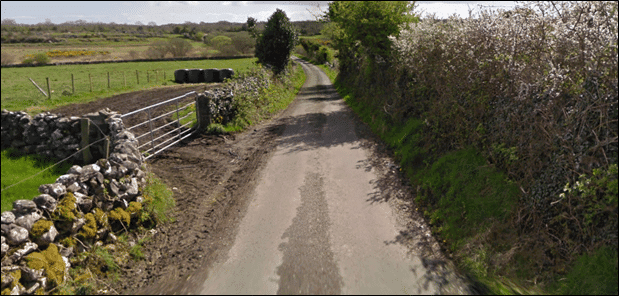
I prepared for the left-hand drive. I prepared for roundabouts. I prepared for sitting on the wrong side of the car. I didn’t prepare for this. I didn’t prepare for boreens, the apparently ubiquitous Irish roads which I can only imagine were paved and lined with stone walls when two horses abreast seemed just about right to some civil engineer back in aught-six. So bold is the conceit of these glorified sidewalks that the center is often left unpaved.
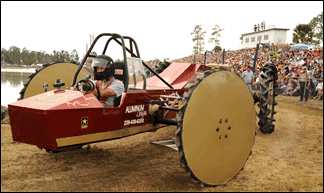
I’m not even sure what kind of wizardry they employ to achieve this. It’s not like a gravel road in which the grass grows through the rocks in the middle where the tires don’t go. These roads are paved. Someone intentionally did not pave the middle of these paved roads. I know I’m taking you down a rabbit hole here, but I am genuinely interested in learning what Dr. Seussian contraption they would use to make these roads. A Google image search led me to…whatever this is, so imagine a road created by a narrow truck dropping asphalt that is smoothed by a person driving a steamroller that looks something like this.
To drive on a boreen as a newcomer at twilight is sheer terror. I mean, sure, if there’s a driveway or a shoulder in plain sight, we’re all bright enough to figure out what to do. But if not? What forms must be observed? Who has right-of-way? Who is responsible if we get into an accident? Do I back up, or does that create more risk of an accident as I crest one of the many hills? Do we try to squeeze by one another? In the moment of adrenaline, as it were, all the updated priors and posteriors reboot, and you pull the car off the familiar right shoulder and skid into a patch of briars. Or y’know, that’s what I did. Until the guy in front of me calmly flashed his lights, backed up and wheeled right just into another small road off to the left to let me pass. As I did so, he flashed a smile and gave me the thumbs up they give in Ireland instead of a wave as a form of car-greeting and, in this case, I felt rather confident, as a form of good-natured ribbing.
When we approach the car on the boreen, and when there is nowhere to turn, the information that flows into our brains is so far afield from ANY of our priors that we don’t even know how to incorporate it. Even testing the information in any meaningful sense could result in a fiery explosion 4,500 miles from home. The stakes are so high. What if the China really does float the yuan? What if there really were meaningful inflation? Could our internal political divides really manifest in…war? It is paralyzing. The problem with any kind of adaptive estimation process – Bayesian updating - is excessive reliance on its predictive power. We understand much of this intuitively. If you’re driving on a boreen and don’t want to die, you drive slowly. But while most investors get that they should own proportionately less of very risky things, they miss another equally critical point: they should also own less of things for which the assumptions, priors and data which informed their prediction models are less stable. So much of why we talk so much and care so much Narrative abstractions is their ability to create stable-looking equilibria with remarkably unstable fundamental underpinnings.
That last point is less complicated than it sounds. The simple goal of this series, and an important goal behind all of the thought we apply to our investing lives, should be to challenge the axioms, priors and models we’ve built on decades of stability, growth and intervention. To constantly update them, even when they appear self-evident. Above all, to challenge ourselves, our dogmas and, painfully, the fact that our hard fought-for knowledge may often do more harm than good to our decision-making.
Glad to have you along for the journey.
PDF Download (Paid Subscription Required): http://www.epsilontheory.com/download/15659/

Comments
Start the discussion at the Epsilon Theory Forum...