
But I Did Have Breakfast
March 23, 2026·Politics
But I Did Have Breakfast: Kill Chains, Self-Reflection and the Iran Debacle
As a famous 4chan story goes, a graduate student was interviewing inmates at San Quentin Prison as part of some research project, where she would ask them to imagine how they would feel if they hadn’t eaten breakfast. Per the story, a significant portion of inmates responded with some variation of “But I did have breakfast”, unable to even contemplate a hypothetical thought experiment at odds with their own literal-minded experience. Now this is surely an apocryphal tale, and the supposed lesson – that an inability to imagine an alternative state of mind is a function of ‘low IQ’ – is the wrong lesson, but it’s an enduringly popular story because we all know people who are incapable or unwilling to engage in any counterfactual self-reflection, any what-if exercise of introspection.
Recently, billionaire venture capitalist Marc Andreessen made some waves on social media when he made the ludicrous claim on some podcast that introspection is a 20th century phenomenon and that “great men” of the past led entirely non-introspective lives. I think I know what Marc was getting at – that many mental constructs we consider to be fundamental or natural today were unknown even a few hundred years ago, and that constantly looking backwards and inwards at your ‘feelings’ can be counterproductive or even crippling – but in classic Marc form he doubled down on the most extreme form of this view, that the “But I did have breakfast” mentality of zero self-reflection, no brake and all gas, is the proper and aspirational state of mind for high-achievers. Like Marc.
Fellow billionaire venture capitalist Peter Thiel made similar comments recently, claiming that pervasive woke, social introspection is why we can’t have nice things, like a moonbase. So has fellow billionaire entrepreneur Elon Musk, who, in those spare moments when he’s not lamenting the loss of 1960s Rhodesian social norms, enjoys nothing more than celebrating the single-minded, anti-woke, grindcore pursuit of a good moonbase. So has fellow billionaire venture capitalist Joe Lonsdale, who took Andreessen’s personal-introspection-is-antithetical-to-greatness, sailed right through Thiel and Musk’s woke-introspection-is-why-we-can’t-have-nice-things, and landed with his fellow Palantir billionaires on political-introspection-is-a-commie-plot-and-probably-treason-in-time-of-war.
All of which got me to thinking: Why am I reading this now? Why are these billionaire investors celebrating and propagandizing the unexamined (personal/social/political) life now?
I think one reason, especially for the Palantir bros, is to give cover to Pete Hegseth as he eliminates those pesky rules of engagement and reassigns those pesky JAG officers and otherwise gets rid of all institutional means of introspection so that “war fighters” may have “maximum authority” to act. Which might be more understandable if our “war fighters” were storming the beaches at Normandy or on patrol in Vietnam, Iraq or Afghanistan, but is somehow more troubling when our “war fighters” are 1,000 miles away from the girls school military warehouse they’re targeting, pushing the launch button on a Tomahawk to complete a Palantir “kill chain”.
That’s Palantir’s new slogan, by the way: Connecting the Supply Chain to the Kill Chain. Swear to god, when I first saw this I thought it was a spoof, like a retro, post-apocalyptic poster from the new season of Fallout.
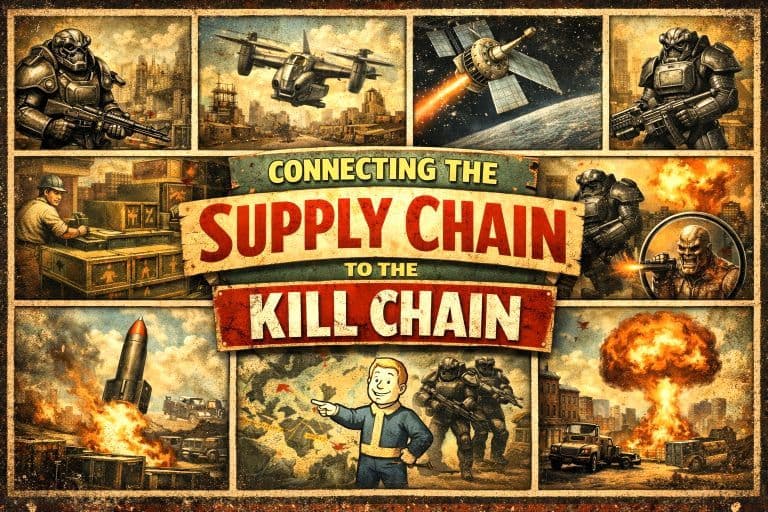
But no. It’s real. Gotta “speed up the kill chain”, that’s Palantir CEO Alex Karp’s new mantra.
Look, I am all for giving actual war fighters, the pilots and the sailors and the soldiers, the “maximum authority” to act in combat. I don’t want them second-guessing themselves, and I don’t want anyone else second-guessing them after the fact. But Alex freakin’ Karp is NOT a war fighter, and I think Palantir needs to be second- guessed and third-guessed all the time! “Speeding up the kill chain” deserves more institutional processes for self-reflection like rules of engagement and JAG review, more places for human circuit breakers and what-ifs, not fewer.
Institutional or personal self-reflection is a brake, and just like the brakes on your car, they are as necessary as the gas pedal for efficacy.
Especially in war time. Especially for nearly-autonomous, AI-powered ‘kill chains’.
I am not making an argument for counterfactual self-reflection in war time on moral grounds. I mean, I am, but even if you don’t want to engage with me on that score, even if you think that military conflict is somehow off limits from concepts of morality or justice (you’re wrong if you think that, but whatever), the argument for introspection can be put entirely into terms of self-interest.
First let’s get rid of the strawman that Marc Andreessen argues against, that the position for introspection (which both he and I define as thinking about your own thinking and your own state of mind), is that it gives you a privileged understanding of truth and reality. That through introspection you achieve knowledge about yourself and the world outside of yourself. Andreessen argues (and I agree), that introspection is a suspect oracle at best.
But c’mon, man. That’s not it. It’s not that introspection reveals the ‘truth’, whatever that means.
It’s that introspection reveals that you HAVE a state of mind.
Descartes didn’t say I am, therefore I think. No, it’s the other way around. The thinking is what generates the ‘I am’. It’s what generates the ‘I am’ in all of us. Introspection – by which we recognize our own ‘I am’ and the presence of an ‘I am’ in other thinkers – is the sine qua non for all social interactions. Or at least all successful social interactions! Efficacy in social interactions comes from treating others as possessing an ‘I am’, as being autonomous thinking beings, and this is as true for war and conflict as it is for love and friendship.
There’s an old military saying that reflects this: The enemy gets a vote. Meaning that no matter how badly you’re beating the other guy on the battlefield, no matter how much you would sue for peace if the situation were reversed, no matter how much you believe that you have a dominant strategy that constrains the other guy’s choices, there is ALWAYS a range of choices for the other guy and you do NOT have the final say on what that choice might be. Can you influence that vote? Can you make some votes costly and some votes pleasant? Of course! But ultimately, the other guy has an ‘I am’ just as much as you do. Ultimately, it’s his choice, even if you think it’s a bad or dumb choice. The enemy gets a vote.
The fatal flaw of any person or institution incapable or unwilling to engage in self-reflection or introspection is not so much that they have a stunted sense of themselves, but more so that they have a stunted sense of others.
They do not treat other persons or institutions as having an independent ‘I am’. They do not believe that the other player has a choice. They do not believe that the other player has a vote. They see the other person or institution’s decision-making process as a mirror of their own raw, unexamined preferences and desires. They act without a brake, without ever slowing down to accommodate the other player’s choices into their own decision-making matrix, because in their mind there is no slowing down required. They act non-strategically, as everything is an exercise in dominance or submission. As Churchill said about Hitler’s Germany, they’re either at your throat or at your feet. It’s not that they miscalculate the game theory (i.e., strategic interactions) involved, it’s that they don’t calculate at all.
It can work for a while, this mirroring of your own raw preferences onto others, particularly if you start from a really strong position and can just steamroll the other players. But eventually you run into someone you can’t steamroll. And they vote in a way that you weren’t expecting. And then you lose.
This is what happened in the Iran War. The US has already lost, in exactly the same way that Russia lost after the first three weeks of the Ukraine invasion. Trump and his buds like MBS believed that the Iranian regime was just another mob family that could be whacked into submission, because Trump and his Middle Eastern buds are all wannabe or actual mob bosses themselves. If the situation were reversed, and this is what I mean when I talk about mirroring your own raw, unexamined preferences and desires on the other player, the initial wave of bombs and assassinations would have been enough for a mob boss like Trump or MBS to say ‘whoa, whoa, whoa! let’s make a deal’. But that’s not going to happen with Iran. They’re voting to fight it out.
Like Russia, the US can keep fighting for as long as we want and there is no ‘defeat’ in the sense of being forced off the battlefield. But by the same token, the ‘victory’ imagined at the outset of the campaign is no longer possible. It’s just not. There is no reality in which Iran is rendered incapable of future attacks, conventional or nuclear, because the Iranian regime isn’t a mob family that can be eliminated or bought off or renditioned like the Saudi regime or the Venezuelan regime, and the Iranian economy is too big and robust to be bombed back to a pre-nuclear stage. Iran, Egypt, Turkey and Israel are real nations in a way that every other country in the Middle East is not, and you can’t decapitate a real nation. You also can’t invade it, at least not easily and not permanently. You can bomb the hell out of it and you can kill a lot of people and you can occupy parts of a nation if you’re so inclined (albeit with heavy losses and an inevitable retreat), but a real nation has an ‘I am’ and a range of choices that non-introspective players like Donald Trump and Vladimir Putin always miss. Iran voted in a way that this White House could not imagine, and all of our happy plans and strategies collapsed, in the same way that all the happy Russian plans and strategies for Ukraine collapsed. All that remains is a weighing of the economic and political costs of remaining in theatre for a conventional deterrence standoff versus the economic and political costs of a humiliating withdrawal and a far more powerful Iran in 5 years. There are no good outcomes remaining, only a range of bad outcomes where the pain can be concentrated or diffused over time, but not avoided.
We will get this weighing terribly wrong, too, unless we begin thinking of Iranian decision makers as having an independent ‘I am’ and a range of choices that is nothing like the preferences and desires this White House has projected onto them so far.
But I think we’re out of time for a change in thinking. We’ve got another week or so before 5,000 Marines get into striking distance of Hormuz and Kharg and the other Iranian islands, and it is hard for me to believe that Trump will choose not to play with his toys. I’ve played enough Civilization to know that when players bring their armies across a continent and set up two squares away from your border, they’re always lying when they say they’re ‘just passing through’. So I expect we’ll get the bombs dropped on civilian infrastructure and I expect we’ll get the Marine ‘boots on the ground’ because Trump and MBS cannot imagine anyone like them standing up to that. And then you get a Shahed hitting an Emirates desalination plant and a missile hitting an upstream Saudi oil field and the world as we know it changes forever.
Does it have to end like this? No. Whenever something has the potential to break the world, there are always off-ramps. It’s just really hard for me to see Trump not using the Marines when they get there, and if that happens I’m having a hard time seeing the off-ramps. But maybe he doesn’t. Maybe we end up with an overt, shared protection racket, where Iran charges $2 million per tanker to let them out of the Gulf and the US charges another $2 million per tanker to let them in. You think I’m kidding, but I’m not. I could totally see this happening. Then again, I could also see the US dropping a nuke on Pickaxe Mountain to ‘contain’ Iran’s enriched uranium by turning the entire mountain into fused, radioactive glass.
Whether or not there is a TACO of whatever path, permanent damage has been done not only to America’s position in the world but more importantly to the story we have told ourselves over the past 40 years about what matters in the global economic system. The fragility of our world’s economy to conventional missiles and drones has been well and truly revealed, and the fulcrum on which everything balances is energy. No one is prepared for this new story.
Welcome to the end of Pax Americana. Welcome to the Great Ravine.