
Does It Make a Sound?
August 13, 2019·Politics
PDF Download (Paid Subscription Required): Does It Make a Sound?
This is Hong Kong right now. The image is powerful. The audio is more powerful.
The people in this image and this video are singing "Do you hear the people sing," from Les Mis. It is a common protest song, but not the kind of thing that is allowed in 2019 China. If you know the curtain-dropping line from the play, you'll know why:
Do you hear the people sing?
Singing a song of angry men?
It is the music of a people
Who will not be slaves again
Les Miserables (1980)
Here is a video of police firing rubber bullets at well-prepared protesters.
Here is an article from the South China Morning Post discussing the aggressive use of tear gas to break up the protests.
Hong Kong protests: police under fire as viral video shows elderly residents of Yuen Long care home suffering from effects of tear gas [South China Morning Post]
The article is, of course, pure fiat news, an opinion piece that presents itself as a news update. The headline is selective and emotionally charged. The images are selected to evoke a particular response. Even when we agree with the narrative it is promoting - especially when we agree - fiat news should always give us pause.
But they aren't the only ones creating narratives here. The protesters are, too. Singing "it is the music of a people who will not be slaves again" is beautiful narrative creation. Standing peacefully, armed against tear gas and bullets with spray guns, umbrellas and plywood shields? Brilliantly disarming tear gas canisters with cones and water guns? This is Holy, Rough and Immediate theater, all at once.
And it is amazing.
If you're reading this, you probably know more about what's going on in Hong Kong than just an airport shutdown. Like us, you're probably Very Online, a ravenous consumer of global news. But for most of the country it is a different story.
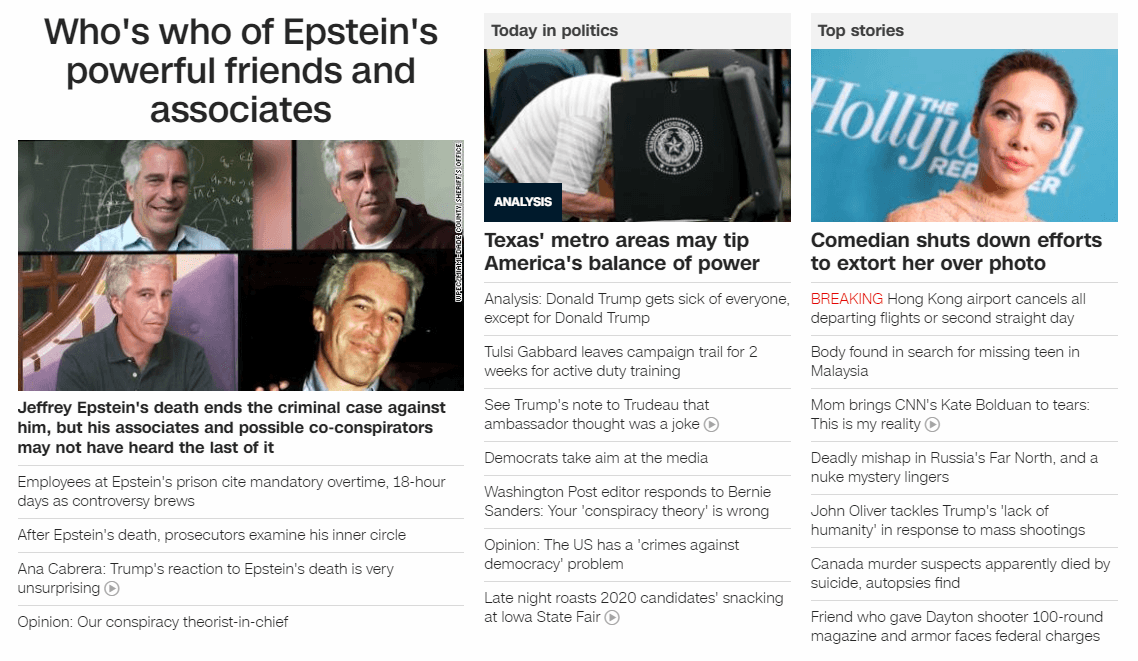
Here, for example, is the front page of CNN.com as of 7:00 AM CT this morning. Dig a little bit and you'll find something about the Hong Kong protests. Only don't look for a story about self-determination, disenfranchisement or extradition. You've got to look for a story about how this might affect you, fellow American. Found it yet?
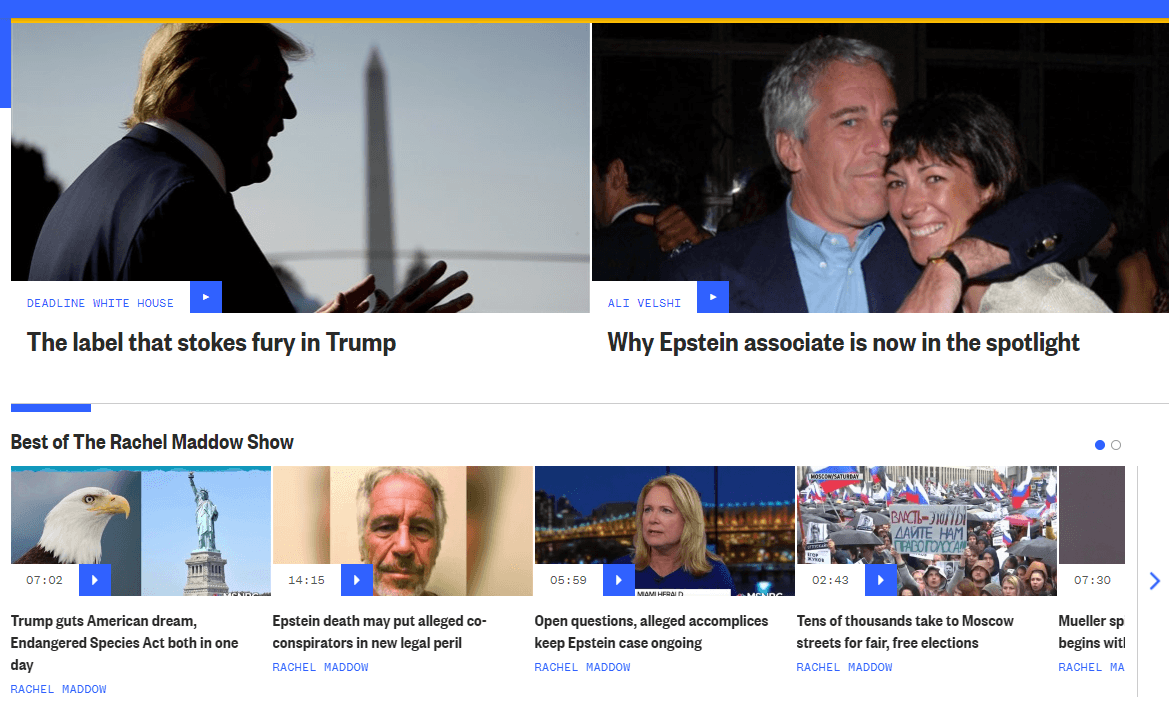
MSNBC's front page has nothing. Zilch. Lots to say about Russia, though.
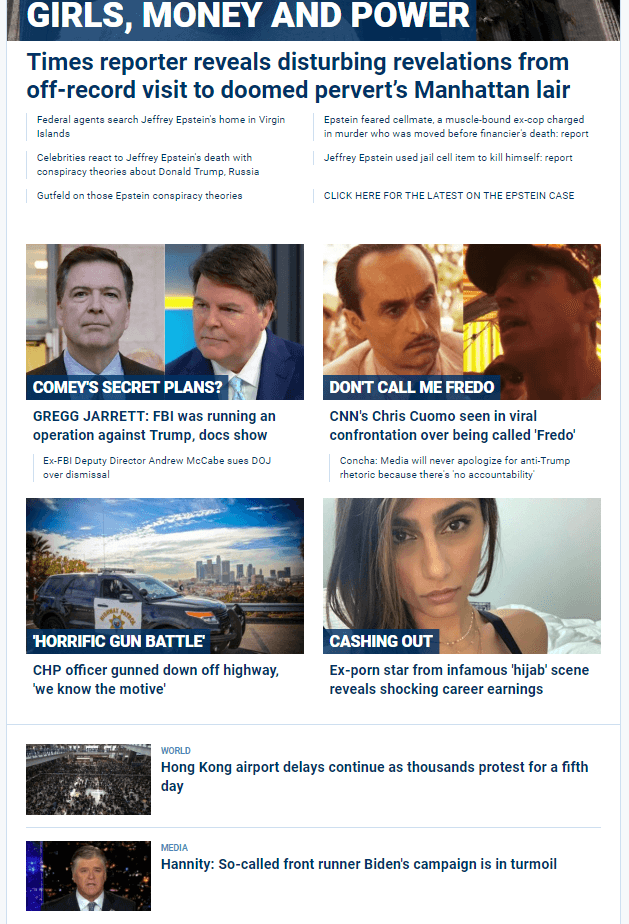
If you're willing to scroll down past fiat news send-ups of Comey and Cuomo, Fox will give you a similar angle to CNN. At least they acknowledge the protests. Unfortunately, in doing so their headline writer unwittingly reveals a bit too much about US missionaries' awareness of the protests: in short, they have not been paying attention to them for the months, not days, that they have been going on.
The Wall Street Journal puts it figuratively above-the-fold - they've got a good Hong Kong bureau - but again, the headliner news story is how this will affect your travel plans and the next two weeks of volatility in your portfolio. It IS a financial paper, so some grace is warranted here. Many of their reporters are doing good work. If you're looking for someone to follow, @birdyword is a good choice.
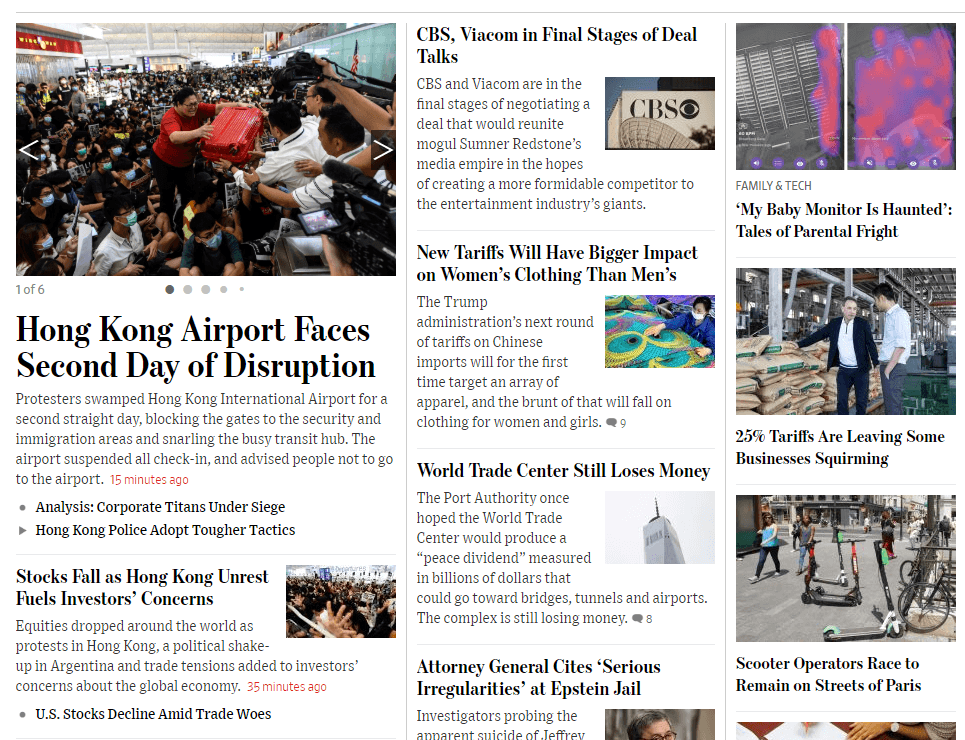
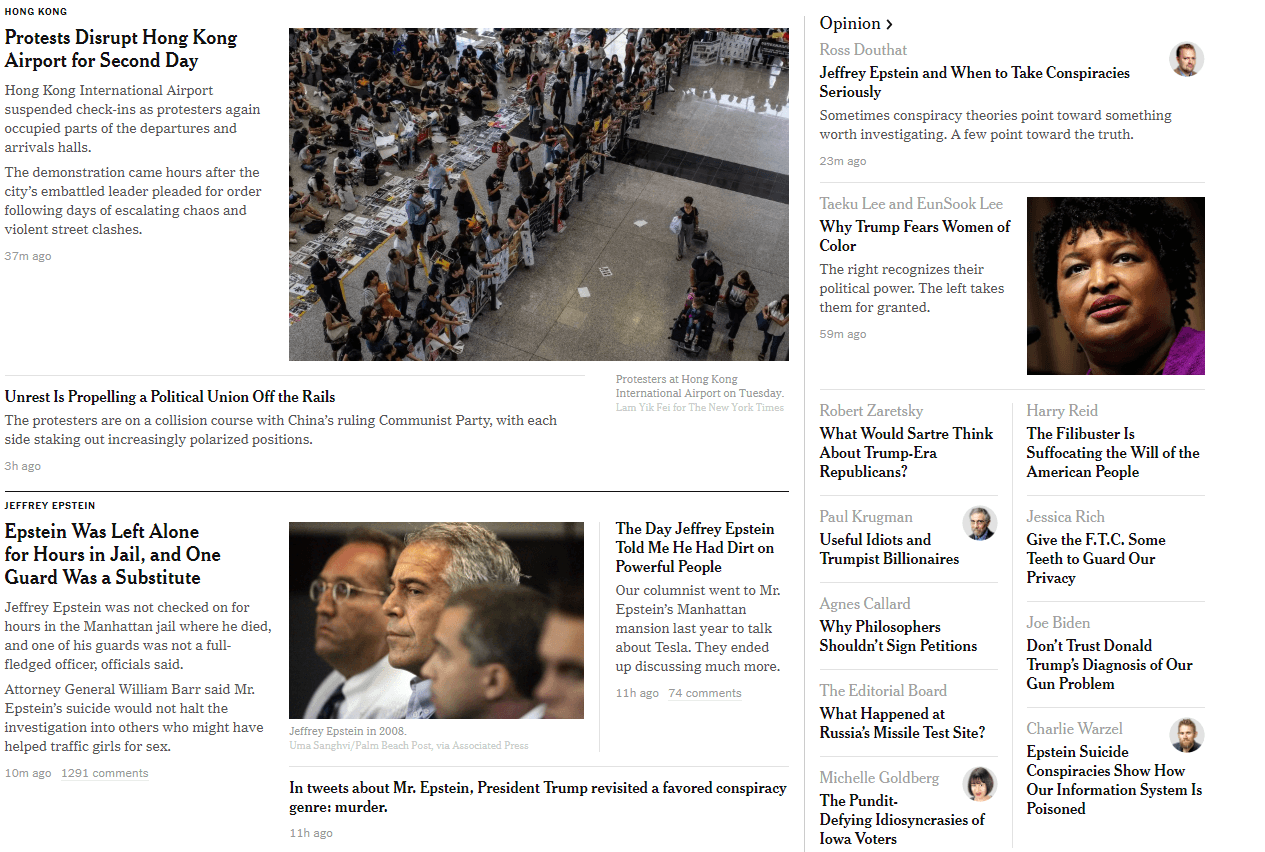
The New York Times gives the "airport thing" top billing, too, but the nature of their coverage (presented cheerfully next to "What Would Sartre Think about Trump-Era Republicans") would easily pass CCP censors. Every piece and every blurb being promoted is about the disruption being caused by the protests, and about the damage being done by them.
ET followers and subscribers - especially on social media - have been openly predicting over the last few days how quickly the Epstein case or the Hong Kong protest situation will fade from the zeitgeist, from the narratives about what's going on in our world.
They won't fade.
No, not because they're powerful or timeless. They won't fade because they don't exist.
There is no narrative, no common knowledge in the US about these protests. American media have largely stopped covering them, and they aren't written about as a "connected issue" for other topics. They have rarely, if ever, been connected to language used to discuss trade disputes with China. They aren't related to the three or four articles grudgingly discussing the Uighur muslim reeducation villages they've set up (shh!). But this isn't just US media. It's politicians, too, who seem loath to tie anything of everyday significance to what's happening over there.
The only reason at all the protests are getting coverage is in context of reports about Asian stocks and reports about flights in and out of Hong Kong. That's it. From Quid, below we present a network graph of the last two days worth of all global news. In bold at the extremity of the northeast quadrant are the entirely peripheral, unconnected, paltry collection of articles about these protests.

Source: Quid, Epsilon Theory
I'm sure we will get a lot of "isn't a clear-eyed view of the protests that they are unlikely to be successful" or "this will all be counterproductive" takes, which are very on-narrative responses. They also might not be wrong.
But wherever self-determination and resistance to the encroaching power of the state and oligarchical institutions find expression, there should our full hearts be also.
And our full voices.
PDF Download (Paid Subscription Required): Does It Make a Sound?


Comments
I am absolutely a ‘do you hear the people sing?’ kind of guy. To me, there is no excuse to run a repressive regime and run all over human rights.
That said, objectively, this protest has all the signs of a CIA operation that just happens to coincide with a trade and currency war between the two countries. (A ‘subversion expert’ from the US Consulate, according to Chinese state media, has been caught on camera with protest leaders.)
As a detective, the first question to ask is ‘who benefits?’
This event showcases precisely how the modern empire works. By soft power. By alliance with different factions, especially including those who believe in Enlightenment ideals. Thereby, the empire is able to wield considerable power by not spending much at all, because it doesn’t have much, compared to the costs of running the world.
The salaries of a few State Department/CIA employees vs. trillions in trade and FX markets. Brilliant.
P.S. If you find the setting of Les Miserables in mid-19th century France eerily apropos to the current event, it’s because it is. It never ceases to amaze me how people of passion find their voice in the most ingenious way. (And don’t laugh if and when the choice turns out to have come from a cultural advisor from the CIA.)
Of course there is truth in this. Of course there are constantly forces seeking to destabilize global adversaries. Clear eyes.
And that changes literally zero about the authenticity or truth of their cause or how we should regard it. Full hearts.
Besides, if the aim was to amplify this narrative, then whoever is stoking it is doing a terrible job.
Rusty, I’ve noticed the absence of narrative around this dramatic event. Is the media playing it down because it fears real “speaking truth to power” - and is that because the media is really on the side of the existing power / status quo geopolitical structure? If so, why? Why is it on the side of China?
Also, I’ve read, probably, every WSJ article on it and, while you are right about the headline you note or bent of this or that article, if you actually read all the articles, they’ve done a very good job of covering the event in-depth. As you note, for a financial paper at heart, I think they’ve done an outstanding job.
I hope I’m wrong, but I think China has too many cards to play and, in truth, while the 1997 handover agreement says some wonderful things - who’s going to enforce it, the UK?
The real China superpower moment / battle / generation defining event will be Taiwan. If I was Taiwan, I’d be in full-court-press mode buddying up to the US gov’t and marketing my story of a small democracy versus a Goliath dictatorship to the American public writ large. I don’t think Taiwan has any other strategy / hand to play that might save it from China.
Just my two cents.
Agreed that it’s authentic and passionate for 99% of the protestors. But there is no need to broadcast this story around the world more than it already is, since the pressure points are only in Hong Kong. If the Chinese army moves in and succeeds, then it will be time to promote the ‘standard’ global narrative.
Somewhere on Twitter I saw a brief video of student protesters waving American Flags and singing the national anthem. I was quite moved. I should’ve saved it but I assumed it would go viral since it is now not only kinda sorta news but also a way to poke Trump for inaction. The MSM is too incompetent to be corrupt.
Let’s also not forget what it was that really allowed the Chinese Communist Party to stay in power after the Tiananmen protests of 1989.
Trump has been quick to blame Chinese currency manipulation and the trade imbalance for loss of US jobs, etc. Do any of us really think the US elites were powerless to stop this manipulation in the 90s? They never wanted to, because we had the ‘Great Moderation’ and the ‘Goldilocks’ economy of low interest rates, low fiscal deficits (some surpluses under Clinton,) and low inflation. This was what it meant to have your issued money and debt supported by the biggest physically productive country in the world. Cheap Chinese goods became the new gold that underpinned the dollar’s value and the power that flowed from issuing it.
If the Communist regime survived by giving its people an artificially fast growth in opportunity and comfort, well that’s the cost of doing business isn’t it.
BTW, this is not some kind of accident, mistake, or what have you. If you think about it, it is exactly how the imperial system works. I will leave the elaboration of this argument as an exercise for the thinking reader (ie for those who would rather not turn a blind eye to a system that has benefited them so much.)
It pokes Trump, yes, so the MSM should love it / but it’s also pro-America in a fundamental - dare I say America “exceptionalism -” way, which the MSM hates.
Many of those contests are games of chicken that are very difficult to predict. So I don’t know.
It’s hard not to think that Taiwan looms large in those contests, I agree, but it’s also easy to lose sight of the more general historical examples of the failure of strong central control powers simply because the CCP has demonstrated some couple decades of proficiency in managing integration of technology into its oligarchic control of a modern state. Those pressures haven’t gone anywhere, and whether it’s HK, Taiwan or nothing at all, coercion grates against the human spirit every bit as much as it has in a million places before at a million times.
Me too. Amazing stuff.
(On your second point, call me an optimist, but I think they can still manage both! )
Love your viewpoint and spirit and share it, but also believe it can take a long, long - long - time to play out. That miserable borg of Soviet evil plodded on killing its people and their spirit for seventy-plus years and it never gave its people even a smidgeon of the growth and economic opportunity that China has produced (once it gave up communist economics, not politics).
Continue the discussion at the Epsilon Theory Forum...