
Election Rewind: June 2015
June 17, 2019·Politics
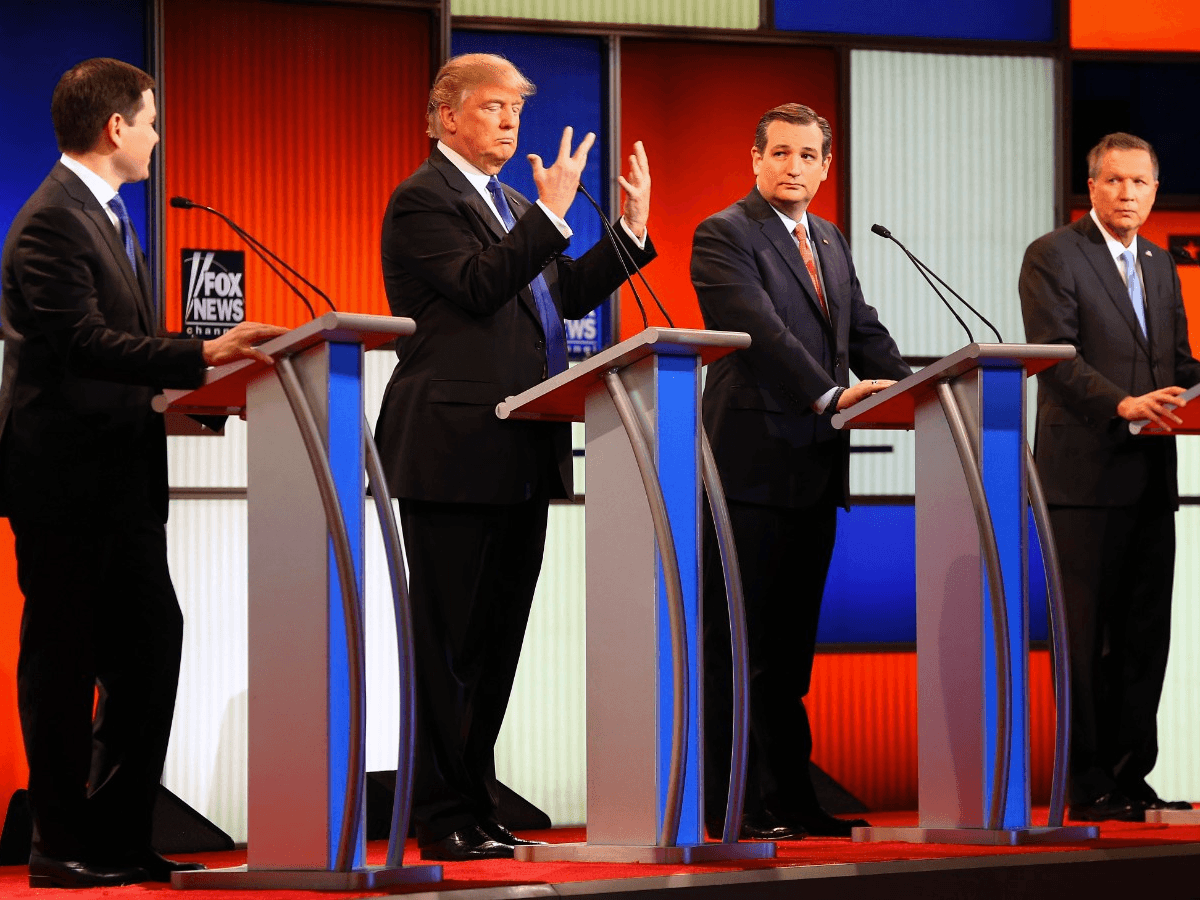
One of the questions that has come up from our ET Live! discussions about the 2020 elections is, "What would this have showed at this point in the last election?" It's a good question, so we decided to take a look.
It so happens that May 2015 was a pivotal month in the GOP primaries. Now-president Trump was polling at low single digits, but that wouldn't last for long. So what would you have seen in narrative structure that month? First, when looking at Attention - our measure for the external similarity of candidate-specific language used in media with the language relating to the election more broadly, you would have seen a few candidates who, despite widespread popularity, suffered from a narrative structure at odds with what the 2016 election was perceived to 'be about.' You also would have seen two candidates with middling single-digit poll numbers whose narratives in were media very in-line with what it was perceived to 'be about.'

What about sentiment?

There is a tendency when we think about elections and politics to think about populations and what they care about. We build up predictive engines based on demographics, expressed preferences and revealed preferences on issues, responses to poll questions and other inputs. In general, those models are pretty good. Well, they're OK.
We think that the time has come to stop predicting and to start observing - not what polls are saying or what our network of friends or social media followers are retweeting, but what the crowd thinks that the crowd thinks. We continue to think that the widest possible net of mass media, blogs and other primary content gives us the best window into observing that thing, which we call Common Knowledge.
Does this mean that Biden is Jeb, and that we can hand out the Carson, Cruz and Trump roles to some combination of Warren, Harris and Sanders? No. There are different circumstances for each (not least Sanders's prior electoral history), and there are a lot of actual events that can still influence that common knowledge. But for now, what we can observe is that Biden is a poor fit for what everyone knows that everyone knows the 2020 election is about. We can similarly observe that Sanders in particular is a good fit for that common knowledge, with a hell of a lot of rah-rah cheering coming from the kinds of language used to cover him by the impartial media.
It means something for the way we consume information, if we want our own views to be less shaped by our intuitive ability to unwittingly internalize and co-opt that common knowledge as our own points of view.
It also means something for how we ought to anticipate primary season playing out.



Comments
You and Rusty are on to something good Ben.
But you were joking about the “impartial media” comment, right?
If not, then please help me understand how the “not-so-impartial media “ doesn’t lose credibility and thus the ability to establish common knowledge. I think I might be missing something basic in your work.
Thanks.
Yes, I was joking.
Thank you for doing this, Rusty (and Ben)!
Well hindsight is 20/20 (2020?) but this data is actually surprising to me. My recollection is that Trump had maximum attention but terrible sentiment. Seeing Ben Carson up there as well is another surprise. Maybe I was ingesting too much Daily Show and too little Fox News to realize this was happening, though.
You’re not remembering incorrectly, I think, as things did change over time. But before Carson was falling asleep on stage, he really was seen as the very compelling, brilliant surgeon he was, and not the odd, slightly unsettling character he ended up being tagged with in most late-primary narratives. Trump’s coverage sentiment DID decline much closer to the end, but I think it would be fairer to say that it diverged and became bi-modal, not dissimilar from his post-election narrative structure.
Continue the discussion at the Epsilon Theory Forum...