Et in Arcadia ego
October 10, 2018·Money
And I said: Don’t you know that he said I will foller ye always even unto the end of the road…Neighbor, you caint get shed of him
Blood Meridian, by Cormac McCarthy
And rear a tomb, and write thereon this verse:
'I, Daphnis in the woods, from hence in fame
Am to the stars exalted, guardian once
Of a fair flock, myself more fair than they.'
Eclogues, No. V, by Virgil
There is a field at the end of a lane in Tennessee that sits long abandoned. A rusting livestock gate is held fast to the fence by heavy gauge wire, twisted by hand to keep it from swinging open. It may be that a caretaker once allowed sheep to graze here to keep the brambly bushes at bay. They have been absent for some time.
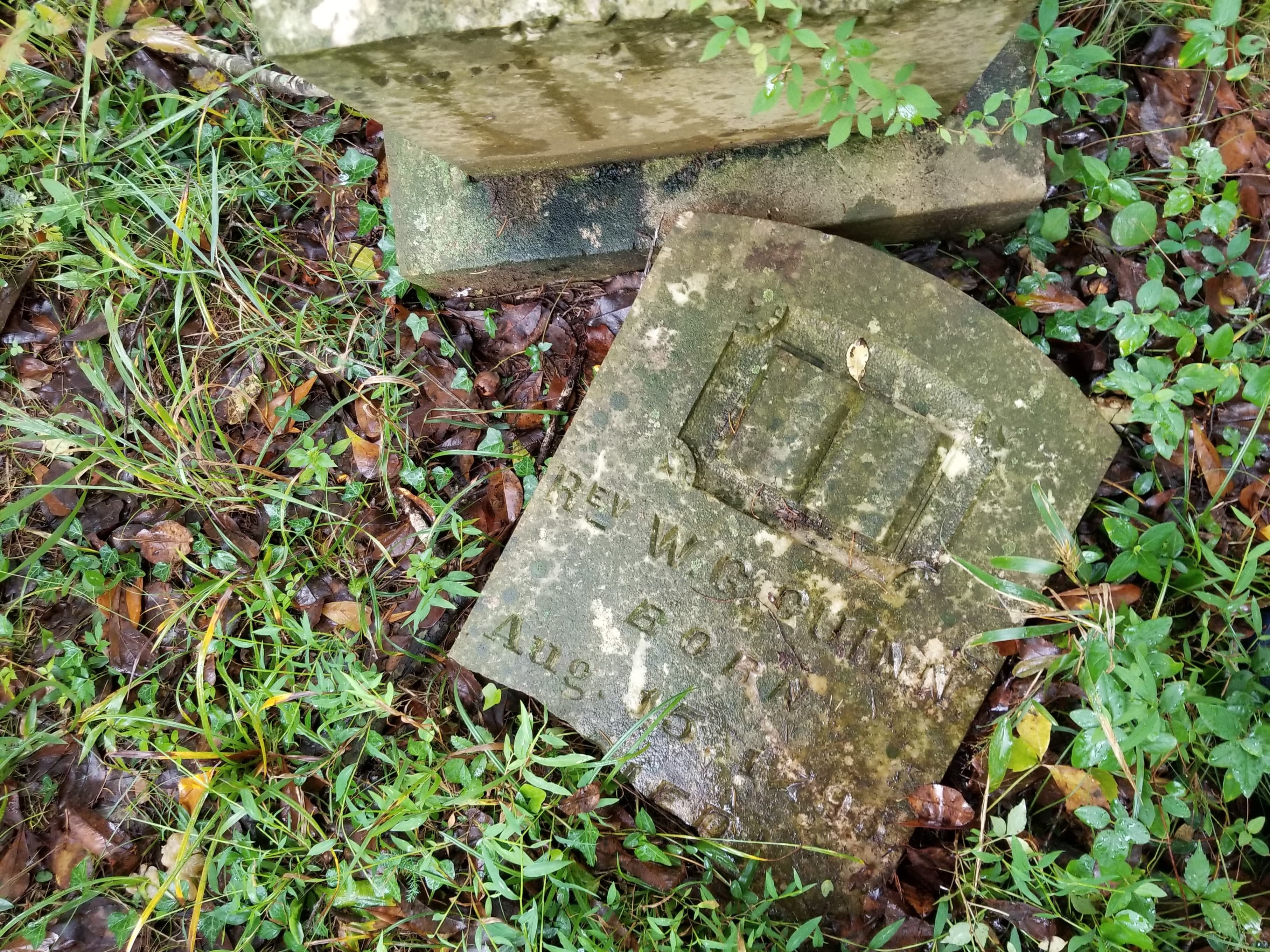
The name of the lane is Caldwell Cemetery Road. At its end is a graveyard of graveyards, a field of broken monuments and faded inscriptions set into soft Tennessee limestone. There are perhaps a dozen raised tombs besides. One hopes they are architectural and not sepulchral, because most are now little more than broken lean-tos, exposed on at least one side to the world and the elements. Far to the back of the burial ground, through tall weeds and bushes, a broken headstone lies on the grass. Rev. W. G. Guinn, it reads, born August 15, 1795. He was my fourth great-grandfather.
His son, one of the last of his short dozen children, died at 41. A few years later in 1892, that son’s wife dragged their seven children between the ages of 7 and 21 to Texas, where they became tenant farmers. It was a steep fall. You see, the Rev. William Guinn was an Important Man.
You would not go very wrong to say that the Methodist minister in the deep antebellum south was the most important man in town. While the Calvinists have since given way to the Baptists there, the swelling masses of pioneers and settlers who braved the Great Wagon Road through the Great Appalachian Valley of Virginia were, as a rule, Scots-Irish. Which meant that they were Presbyterian. Which meant that they were one camp meeting and a preacher on a horse away from being Methodists.
The preacher in a small town officiated marriages. He was the trusted arbiter of disputes. He was a voice of civil authority in letters to far-off politicians and governments. He blessed new homesites and new businesses. His church on Sunday would house the most concentrated version of a dispersed community. His home often served as the orphanage, homeless shelter and welfare office. All of this was true for the Rev. Guinn, beyond which he served as postmaster, justice of the peace and in many other roles over the course of his life. He may not have been the richest man in town. He may have been the most important.
And now his grave is forgotten and his monument broken, the fatal cracks no doubt caused by the fall of some ancient tree themselves already smoothed by rains and time. How long did it take for people to forget that they had even forgotten him? One generation? Two? Thirty years? Fifty?
There is a phrase I hear from time to time among investors and allocators: ‘our time horizon is infinite’. It is a phrase used to justify performance over other-than-infinite horizons, often very fairly. It is a belief used to justify illiquidity in investments, often very fairly. It is an expression sprinkled casually over all manner of short-termism and knee-jerk responses from boards, committees, bosses and constituencies. But within that truth, there is another that we should remember:
Your time horizon is not infinite. Your institution’s time horizon is not infinite.
To those who would roll their eyes and respond, “It might as well be. For all intents and purposes, it is effectively infinite,” please accept this amendment:
Your time horizon is not effectively infinite. Your institution’s time horizon is not effectively infinite.
‘Et in Arcadia ego’ is a stylization of a theme from Virgil’s Eclogues: even in Arcadia, there am I. The I, my friends, is death. Even in paradise, death is coming, and death is there. Even for our great institutions, for our university endowments and our great charitable foundations, death will come. This isn’t fatalistic. It isn’t morbid. It isn’t bearish. It can be bullish! It can be optimistic! Like a fire through the floor of a stagnant forest, the death that comes for these institutions may be their reformation into something newer and better. It may be great or small changes in the way society is ordered. It may be a change in their mission brought about by its achievement! One day we will conquer the diseases foundations have been established to research, and even that will be a death of a kind.
There are other deaths we cannot avoid. Smaller ones. Changes in governance. Changes in law. Changes in tax schemes. Changes in securities law and regulation. Changes in student loan markets. Changes in philanthropy and in centers of wealth. These are all a death for us as investors, because they may change what we ought to be doing, and because they may invalidate the strategies we employed before. Amid those deaths, we have one governing rule:
Your time horizon is the shortest period over which you may be forced by circumstance, behavior, prudence, constituencies, governments or outside forces to sell what you own.
This may still be a very long time! And so it may be the case that this reality should have no influence on our portfolios. But it must have an influence on our frameworks, our process and our risk management. It should color our strategic asset allocation reviews, and it should be part of the language of our engagement with oversight boards and other constituencies.
If I may be permitted a post-script, it is my personal belief that it should have one more effect: Our great universities and grand foundations should be spending more of those endowments to better execute their missions today. A lot more. Et in Arcadia, ego.

Comments
Having started on Wall St in the mid-'80s when partnerships were still strong - and senior partners kept most of their personal wealth in their firms as, the partners told you, the firm would be here much longer than they ever would - and, then, over the next five to ten years having watched most of those partnerships fail outright, flounder (and then be absorbed by another firm at pennies on the dollar), do kinda okay in a merger or a few, like Goldman, transition to greater riches - I was fortunate to learn early in my career how short “forever” can be.
Tangential to your argument is how little value today (or impact on duration) money out past ten, twenty, thirty or fifty years has. It’s an odd parallel to the power of compounding where investing money for the long-term results in much greater wealth simply owing to math and time. I’m a planner and worrier (the second drives the first in a reasonably rational mind), so I do think and try to plan out ten, twenty and thirty years. But what worries me is what you wrote - we really know so little about what that world will look like then / what will have endured / what can’t-fail business will be gone / etc.
Having lived through four ten-year cycles, and remembering all the advice that was “smart,” “conventional,” “safe,” etc. at the start of so many ten-years periods (and reading a lot of history, this stuff has been going on for thousands of years), I’m too humbled to have much conviction about the future and cynical about those who do. Perhaps you are right and colleges should run themselves more like businesses - “pay out” their “retained earnings” as lower tuition, award more scholarships, and invest in improving their institutions now (more research grants, better capital stock) - keeping only a modest amount of capital as a cushion. The future is unknown; hence, a confident institution, business or university (nonprofit or government), should have a strong balance sheet where assets align with liabilities and a sufficient cushion is kept for surprises, but where its future is based on (borrowing from Ben here) the process the institution has to maintain its competitive edge and relevancy as the world changes - and not on having a large pile of cash that (see Sears) can evanesce quickly if your process fails.
I wrote a paper in 2000 about investment efficiency in which we looked at behavioural factors impacting on investment management structures. SleepWell was all about regret risk and was a positive factor as it stopped structures changing too radically when trustees of pension funds changed.
But as Rusty says “There are other deaths we cannot avoid.”
In practice, your fund’s horizon is as finite as the next person managing the money who wants to make changes to the portfolio to put their stamp on it. Irrespective if the institution managing it does not change.
Exactly this.
Ozymandias by Percy Bysshe Shelley
I met a traveller from an antique land,
Who said—“Two vast and trunkless legs of stone
Stand in the desert. . . . Near them, on the sand,
Half sunk a shattered visage lies, whose frown,
And wrinkled lip, and sneer of cold command,
Tell that its sculptor well those passions read
Which yet survive, stamped on these lifeless things,
The hand that mocked them, and the heart that fed;
And on the pedestal, these words appear:
My name is Ozymandias, King of Kings;
Look on my Works, ye Mighty, and despair!
Nothing beside remains. Round the decay
Of that colossal Wreck, boundless and bare
The lone and level sands stretch far away.”
Continue the discussion at the Epsilon Theory Forum...