Fellow Contrarians Unite!
June 1, 2019·Money
I remember the first time I saw one of those dialect maps of the United States.
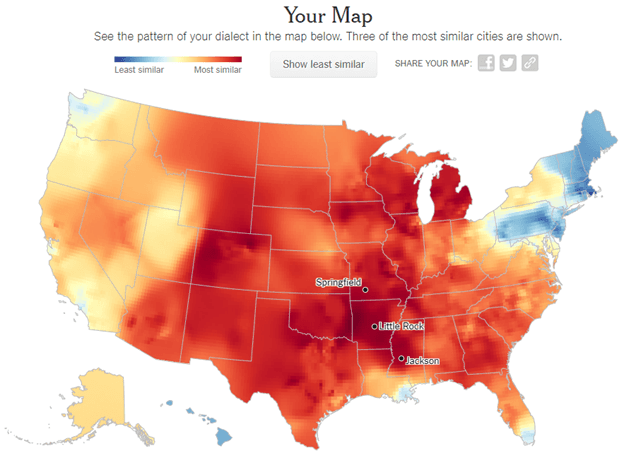
The best one is a still-active quiz on TheUpshot blog on the New York Times website. (Yes, unfortunately, it does now require you to create a free account to use it.) The questionnaire poses 25 multiple-choice questions about the word you use for certain things and how you pronounce it.
It then plots you on a map to guess where you're from. Like my accent, my dialect similarity map is a bit of a mess. I was born in Arkansas, but lived there less than a year before moving to an exurb of Chicago for 13 years. The rest of my youth was spent in rural southeast Texas. I guess the logic of the quiz split the difference and decided to call my dialect Generic Flyover State.
But Lord, what a joy it was to say 'pop' when I did make that move to rural Texas. It was always jarring to people - even though it was an extremely common term on TV and in movies. It always got a reaction, and being in high school, we always parsed through the relative logic of our terms. I argued that calling everything a "coke" just created ambiguity as to whether you were expressing a brand preference or general request for soda, and they teased me by asking if I made the same distinction on Kleenex. I loved it because it made me different.
I was a contrarian, you see.
When I started working in New York, I wore my mildest of Texas twang and my country-ass name like a badge of honor. I mean, how many people get to say they were named after their dad's hunting dog? The couple times I talked to my father on the phone at work, a small crowd would huddle around the door. It takes about 5 minutes talking to him for my fast-talking mild twang to transform into something much more like his deep, slow West Texas drawl. I loved it because it made me different.
I was a contrarian, you see.
I had always thought of myself in those terms as an investor, too. If you don't have and express a different view, and if you don't have an edge on that different view, you can't outperform. This isn't rocket science. In my years of meeting with fund managers of every variety, I don't think I've met a single professional investor who didn't think of themselves that way. Obviously it doesn't always manifest in the same manner, but anyone who is in the business of trying to get paid for taking compensated active risk takes that risk on positions where they disagree with what they think the market is discounting.
There is just one problem: With very few exceptions (e.g. risk arb, some rates trades), it is nearly impossible to confidently assert what consensus IS. Sure, the market gives us a 'consensus price' of a sort, but that's not really what we're talking about here. We're talking about the fundamental and macro consensuses that guide our forward-looking expectations, which can vary wildly even if they arrive at the same present market price. The result, at least in my experience of meeting with and evaluating investors, is that contrarianism usually boils down to one of these two definitions:
My views are different from those of the (relatively) tiny universe of investors I talk to.
My views are different from the straw man of "consensus" I built.
This is an awful lot of hand-waving given the basic importance of the question.
We investors go to conferences full of pension, endowment and foundation peers and come back with notes on what risks and opportunities everyone is focused on. We read partial surveys of what some subset of investors says they're most concerned about. We peruse our social media feeds, dominated by a non-representative sample of small-AUM players who ultimately have little influence on asset prices. We talk to other private equity people, or other hedge fund people, and we start to build this idea in our head that we've got our finger on the pulse of consensus. We dutifully read and incorporate into our understanding of possible views the Big Daily Note from our macro fund, even though we've got ten years of returns telling us it has jack squat to do with the way they're positioned. Maybe we make the pilgrimage to Omaha, not to build a model of consensus but to share in the group delusion that the real contrarians are just the people in that room.
We are an excited kid from Illinois who thinks he's spotted a contrarian opportunity because he's now surrounded by Texan kids who say 'coke'.
Maybe we allow ourselves to believe that EPS estimates and macro predictions from the sell side somehow form a consensus that we can invest against. Maybe we start thinking of pure relative multiples as an expression of whether something is out-of-favor, or build an intuitive mental model for identifying 'unloved', 'boring' industries and sectors. Maybe it's fund flows in and out of the sector, or sentiment from some Twitter-scraping NLP model, or just price momentum. We have a million ways of defining what it means to be contrarian, almost all of which conflict with one another in some way, almost all of which have some value in themselves, and none of which is actually the thing itself.
In other words, contrarianism is almost always a cartoon we build to make the ideas we kind of like fit with the philosophy we'd like to use as a label for them.
It is an idea we build on the shaky foundation of our unavoidably incomplete understanding of other investors, their preferences, their risk tolerances and how they would respond to different events. Wall Street isn't dumb, either. Our trading desks, our research guys, our fund managers, our advisers - they've learned to sell us things not just by telling us why their process and product are the best, but by helping us complete the straw man of what everyone else is getting wrong.
And we can't avoid it. Cartoon or not, investing without some set of beliefs about what other participants care about and will care about is just guessing. On Tilt.
What we can do is this:
- We can spend as much time challenging the provenance of our own contrarian cartoons as we do on building the other side of our thesis;
- We can start building the same kinds of challenges to our theories about 'what the market believes' as we do to 'what is true about this company/government/issuer';
- We can always ask 'Why am I reading this now?' when someone characterizes a view as consensus;
- We can do the same when someone says their view is 'outside' of consensus; and
- We can be mindful of missionaries and what they seek to present as common knowledge.
In the meantime, I'll be up here in Connecticut, being a contrarian.
Just like everyone else.



Comments
I love this note. I, too, used to like to think of myself as a contrarian. Now I apply a simple heuristic to help put whether an idea is “truly” contrarian into perspective (h/t to Jared Dillian of The Daily Dirtnap): the idea should be “obviously” stupid/“bad”. Stupid/“bad” to the point of making people angry or at least making them doubt my basic competency.
Very few ideas seem to both pass this simple test and be investable. Which to me is pretty consistent with this idea that what we like to think of as contrarianism is mostly just a cartoon.
Be careful the Cardinals don’t break into your barn. Those mean little f*ckers like to pick fights for no good reason. ; )
I think it’s a good standard. Might be a bit restrictive, all considered, but that’s probably the right approach.
There truly is little new or original under the sun…and even that thought is not terribly original.
Continue the discussion at the Epsilon Theory Forum...