Foundation and Empire
November 12, 2018·Money
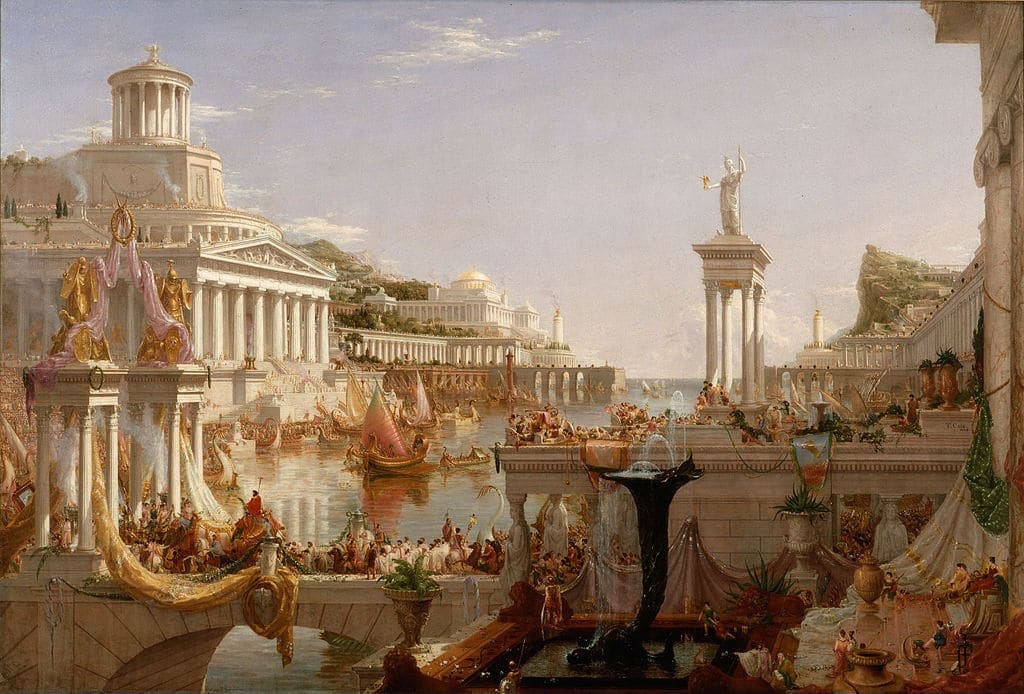
Thomas Cole, "The Consummation of Empire" (1836)
Every vice of the Empire has been repeated in the Foundation. Inertia! Our ruling class knows one law; no change. Despotism! They know one rule; force. Maldistribution! They know one desire; to hold what is theirs.
That quote is the narrative crux of Isaac Asimov's second book of the Foundation trilogy, Foundation and Empire (1952). It's the fatal flaw of the Foundation, formed originally as a noble form of galactic government, but now no better than (and easy pickings for) the Empire.
Hold that thought.
The narrative crux of the second note of the Things Fall Apart trilogy, Things Fall Apart (Part 2), can be found in the following chart. It's the relationship between U.S. household net worth (how rich we are) versus U.S. GDP (how much our economy has grown) from 1951 through today.
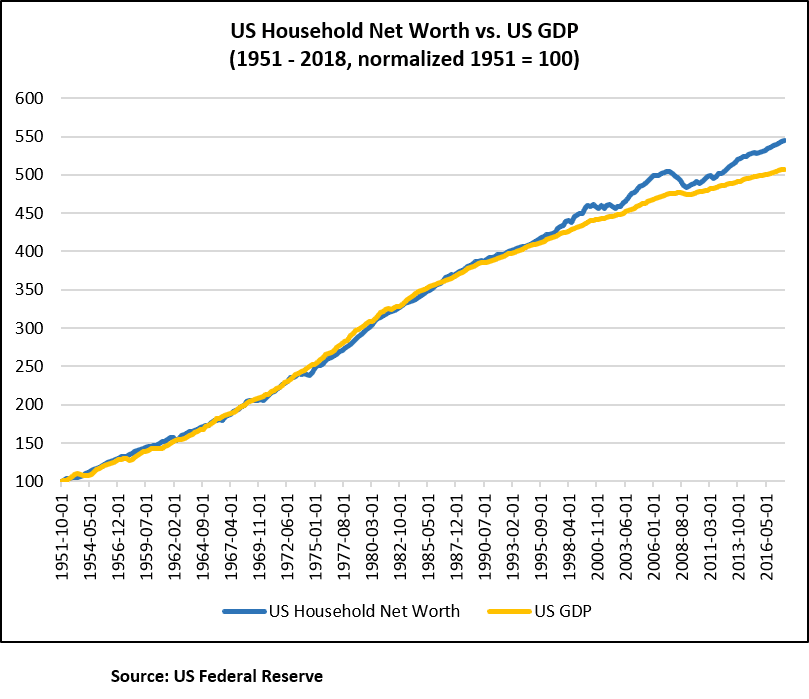
Both data sets are in nominal dollars (meaning neither is adjusted for inflation), both are compiled by the same people (the Fed) using the same methodology, and both are normalized at 100 to show growth rates. It's an apples-to-apples comparison, so don’t @ me about semi-log charting - it adds nothing here.
For 46 years, from 1951 to 1997, we were no more and no less rich than our economy grew. Which makes sense. That’s the neutral vision of monetary policy, where you’re not trying to pull forward future growth through leverage and easy money in order to create more wealth today.
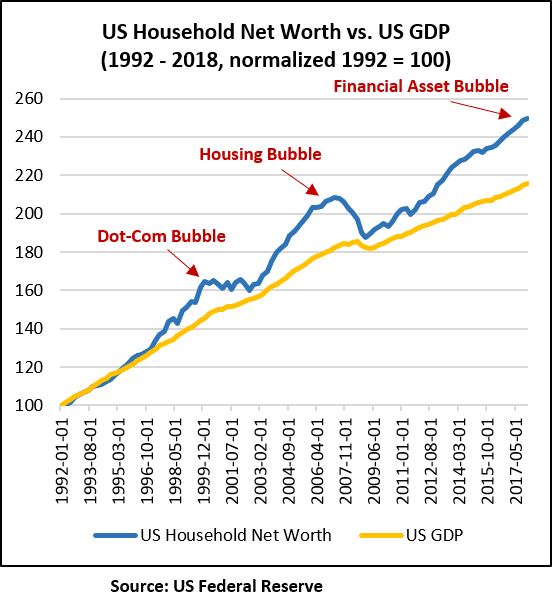
For the past 20 years, however, we have had a series of wealth bubbles – first the Dot-Com bubble, then the Housing Bubble, and today the Financial Asset Bubble – that have made us richer than our economy grows. Each of these bubbles was intentionally "blown" by the Fed through monetary policy. That's the tried and true method of creating a wealth bubble in the modern age of fiat money - you artificially lower the cost of money to encourage borrowing and leverage, which in turn pulls future growth into the present. It's a neat trick so long as you can keep it going.
But that's the problem, of course. The Fed can't keep it going, not if it wants to satisfy its raison d'etre, which is to keep inflation bottled up, particularly wage inflation. Once wage inflation starts to pick up, the Fed ALWAYS stops blowing bubbles. Why? Because the Fed, like every central bank, was created to support Capital in its eternal war with Labor. It's in the name. They are bankers. I know that sounds all Marxist and conspiratorial and all that, but it's really not. It's very straightforward. It's Alexander Hamilton, not Karl Marx.
In case you haven't noticed, wage inflation has started to pick up. The Fed has stopped blowing this Financial Asset Bubble. Then isn't the inescapable conclusion that we are now inevitably heading back to that GDP growth line? And if that IS the conclusion, then how bad could it get for investors?
In dollar terms, we are today about $10 trillion richer than we "should be" if our collective net worth simply followed our economic growth rate. I go through the (very) rough math here on what sort of hit I'd expect the S&P 500 to take if total US household net worth declined by $10 trillion, where most of that excess was in the form of financial assets like S&P 500 stocks, and I come up with a 25% decline.
Well that's no fun. And when I say "no fun", what I really mean is that it's electoral death for the current White House incumbent if a ~25% stock market decline hits before November 2020. Which means that I'm not the only one asking a very simple question:
How do we stay richer than our economy grows if the Fed isn't going to cooperate with bubble-blowing monetary policy?
There is another way.
The other way to be richer than your economy grows is to take wealth from the rest of the world. The other way is to turn alliance into empire. And then suck it dry. Or as we'd say in bloodless economic-speak, "extract rents".
The Athenians did it. The Romans did it. The British did it. And history remembers each of these imperial nations rather fondly. They were the Foundations of their day, at least as the victors write the history books.
I submit to you that the "economic nationalist" trade policies of Trump and Lighthizer and Navarro and Bannon and the rest of that crew understand this other way. I submit to you that when Trump expresses excitement over collecting some billions of dollars in Chinese tariffs, he genuinely believes that he is adding to the "wealth" of the United States. I submit to you that when Trump demands that Europe pay more for defense, his goal is to turn NATO into a profit center. I submit to you that applying a simple mercantilist lens explains 99% of our foreign policy towards Korea, Saudi Arabia, Iran and Russia.
Does this sort of rent-seeking empire-sucking foreign policy "work"? Sure, particularly if you run it like a mob protection racket. Cough, cough. I mean, of course it ultimately ends in tears and constant warfare, but hey, we've got an election to win. What's a little inertia, despotism and maldistribution among friends?
Asimov wrote Foundation and Empire in 1952, when America faced a similar temptation to rule the world as a giant protection racket. I'd argue that, for the most part, we denied those temptations then, preferring to establish soft hegemony to a hard rent-seeking empire. Eisenhower doesn't get enough credit for that whole Pax Americana thing. You know, after winning World War II. If only he had been a hotelier instead, why then maybe we could have accomplished something really great. Ah well, at least we have our opportunity now.
I'll close with an Alexander Hamilton quote, along with the next painting in Thomas Cole's Empire series, as both seem appropriate.
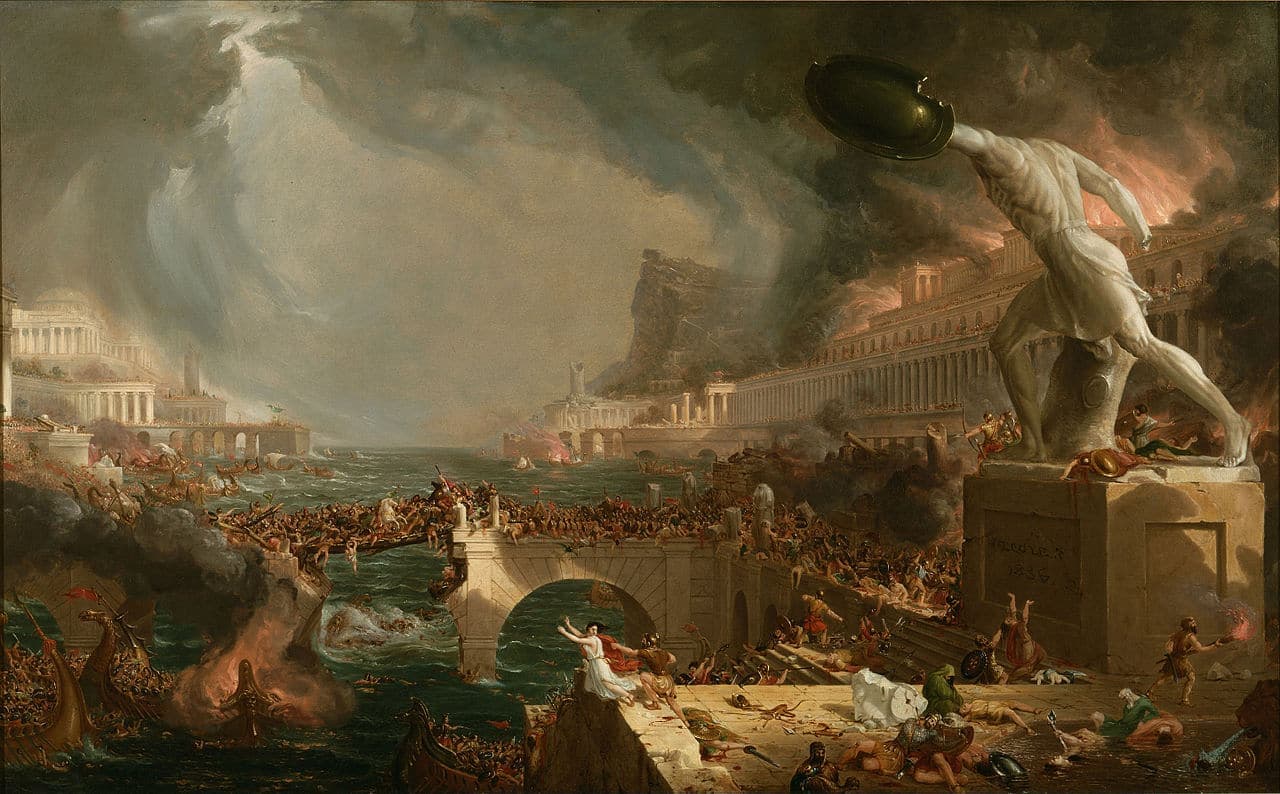
Thomas Cole, "Destruction" (1836)
When avarice takes the lead in a state, it is commonly the forerunner of its fall.



Comments
This is a compelling analysis, Ben, but I don’t see how the U.S. is going extract a significant amount of additional rent from the rest of world before November, 2020. Maybe you see it differently, but the capacity of both China and the E.U. to resist a mercantilist tilt by the U.S. looks robust to me – at least in the near term.
Ben, I don’t understand. The U.S. has yearly trade deficits in the billions with S. Korea, Saudi Arabia, and Russia (and next to no trade with Iran). Without getting into whether there’s any likelihood that Trump & Co. will be successful, I’m having trouble seeing how attempting to reduce those deficits is mercantilist. I guess maybe directionally mercantilist?
I’d submit that gently and not so gently forcing the rest of the world over the last 50+ years to accept a system where we print little pieces of paper (or the electronic equivalent), and then get goodies from all over the world in trade for that paper, looks an awful lot like something an empire would have done back in the bad old days.
What has happened in the oil market these past few months is a near perfect example of a rent seeking policy.
Trump announces strict sanctions on Iranian oil exports to be enforced starting in November. Then he puts pressure on the Saudis to increase production to make up for the Iranian shortfall. The Saudis comply. November rolls around and suddenly there are waivers granted to all of Iran’s best customers to continue to buy Iranian oil. The price of crude collapses and Trump takes credit for the resulting drop in gasoline prices. He is convinced low oil prices make America richer. Even though the US is now the world’s biggest oil producer, the folks who produce the stuff are far fewer than the consumers(voters) who buy it.
Seems like this chart should be on a log scale…
the alternative to the blue line dropping is it staying stagnant while the yellow line catches up. thoughts on probabilities?
I really like the chart, the pics, and the analysis - and anyone who can work in Asimov’s “Foundation” gets a gold star from me. But a serious question: Look closely at those graphs. There are two inflection points on the yellow graph that are being ignored. The curve goes from concave (curved upward, meaning increasing growth) to convex - and it looks like it occurs over the course of the 1980’s. It also appears to get more convex (worse) over the course of the 90’s. As two comments already note:
(1) how is reducing our massive trade imbalance with a lot of these countries “mercantilist?” i.e. Many of these countries have favored industries and they protect them with tariffs. In a (hypothetical) zero tariff world, our yellow curve would have to be higher all along, which makes sense when you consider what the US has actually added to the world in terms of inventions (start with electricity, for example, and work your way forward to the automobile and the internet.) Have we gotten anywhere near full return for what we invested from the rest of the world?
(2) The EU (and Japan) have benefitted tremendously from not having to pay for their own self-defense. Have we, too? Sure. But the EU hasn’t even paid (ever!) what it promised under NATO, all while sneering at the US and telling us what unsophisticated savages and brutes we are. (Not to mention in some cases, denying us use of their airspace, undercutting us diplomatically, etc.)
I’d like to see us involved in a lot less of these idiotic (Iraq), interminable (War on a Tactic), military adventures overseas, and I wonder to what extent these graphs would look different if some of those things were factored into them.
And, finally, even if this analysis is all completely correct, given what I’ve noted above, to what extent might this rent extraction be economically justifiable and correct the yellow curve upward?
Continue the discussion at the Epsilon Theory Forum...