Funding Secured
October 21, 2018·Money
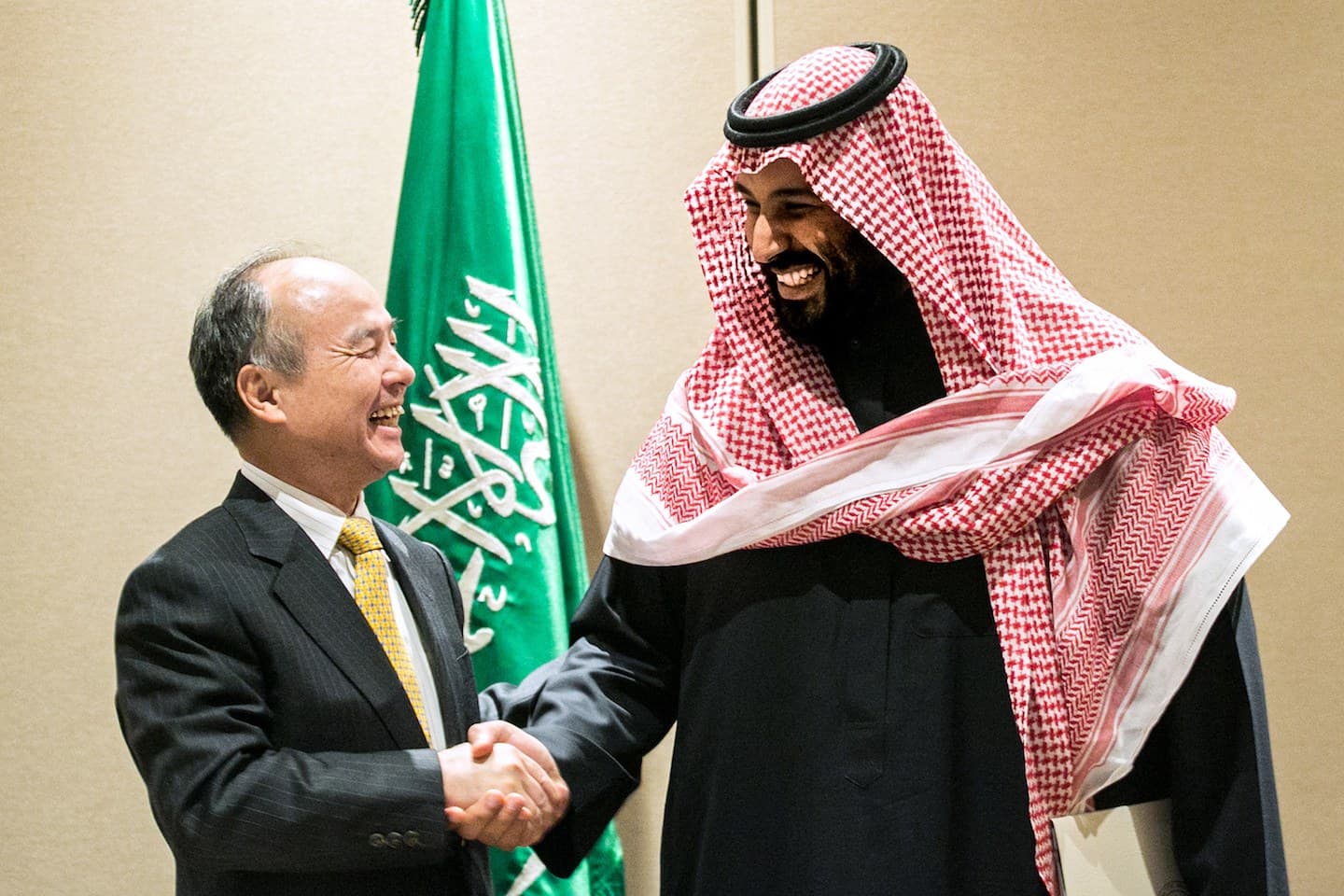
SoftBank CEO Masayoshi Son and Crown Prince MBS in happier times
Can you imagine if Tesla were actually moving forward today with the Saudi sovereign wealth fund in a take-private transaction? Can you imagine the uproar over Elon doing this sort of major deal with the Saudis after the Khashoggi regrettable altercation murder?
Well, no need to imagine. Or at least no need to imagine a unicorn financial transaction caught up in the wake of the Khashoggi events.
SoftBank Group Corp. is in discussions to take a majority stake in WeWork Cos., in what would be a giant bet on the eight-year-old provider of shared office space, according to people familiar with the talks.
The investment could total between $15 billion and $20 billion and would likely come from SoftBank’s Vision Fund, some of the people said. The $92 billion Vision Fund, which is backed largely by Saudi Arabia and Abu Dhabi wealth funds as well as by SoftBank, already owns nearly 20% of WeWork after last yearcommitting $4.4 billion in equity funding at a $20 billion valuation.
Talks are fluid and there is no guarantee there will be a deal, some of the people said.
SoftBank Explores Taking Majority Stake in WeWork, Wall Street Journal, October 9, 2018
Softbank's Vision Fund is the largest single private equity fund in the world, with about $100 billion in capital commitments, of which about half comes from Saudi Arabia. Over the past two years, the Vision Fund has transformed Silicon Valley, particularly in the relationship between capital markets and highly valued private tech companies - the so-called unicorns like Uber and Lyft and Palantir and Airbnb. Who needs an IPO for an exit when you've got the Vision Fund to write a multi-billion dollar check?
Case in point: the deal that was shadow-announced earlier this month between the Vision Fund and WeWork, a company that SoftBank valued at $20 billion last year despite, ummm, shall we say ... questionable business fundamentals to support that number and a subsequent bond raise. I mean, can anyone say "community-adjusted EBITDA" with a straight face? But hey, that was 12 months ago! What do you say we literally double down on that valuation and buy out all of the external investors in WeWork, so that it's just the Vision Fund and WeWork management that owns the company? How does that work for you?
OMG. If I'm one of those current private equity investors in WeWork, I am building a shrine in honor of Masayoshi Son, the SoftBank founder and Vision Fund frontman. If I am an investor or an employee of any of these other unicorn tech companies, I am lighting a candle and praying for Masayoshi Son's continued good health.
The Vision Fund, and more generally the Saudi money behind it, is a classic fin de siecle undertaking. It is The Greatest Fool in a private equity world that must find greater and greater fools for their investment funds to work here at the tail end of a very long and very profitable business cycle. The Vision Fund and its Saudi money isn't just a lucky break for both the financiers and the entrepreneurs of Silicon Valley. It is an answered prayer.
And here's the crazy thing ... the Khashoggi murder could blow this all up. Not just the WeWork deal. Not just the next mega-fund that SoftBank puts together. But this fund. The Vision Fund.
And if the Vision Fund is no longer viable as a player in Silicon Valley, then I don't think the unicorn valuations are viable, either.
Why do I think that there is now existential risk for the Vision Fund? Check out these narrative maps before and after news of the Khashoggi murder broke on October 3.
First here's the narrative map of the 608 unique major-media articles on "SoftBank Vision Fund" for the three months prior to the murder, so July 2 through October 2, 2018. I've colored the nodes (each node is a separate article) by sentiment, so green for positive, yellow for neutral, and red for negative.
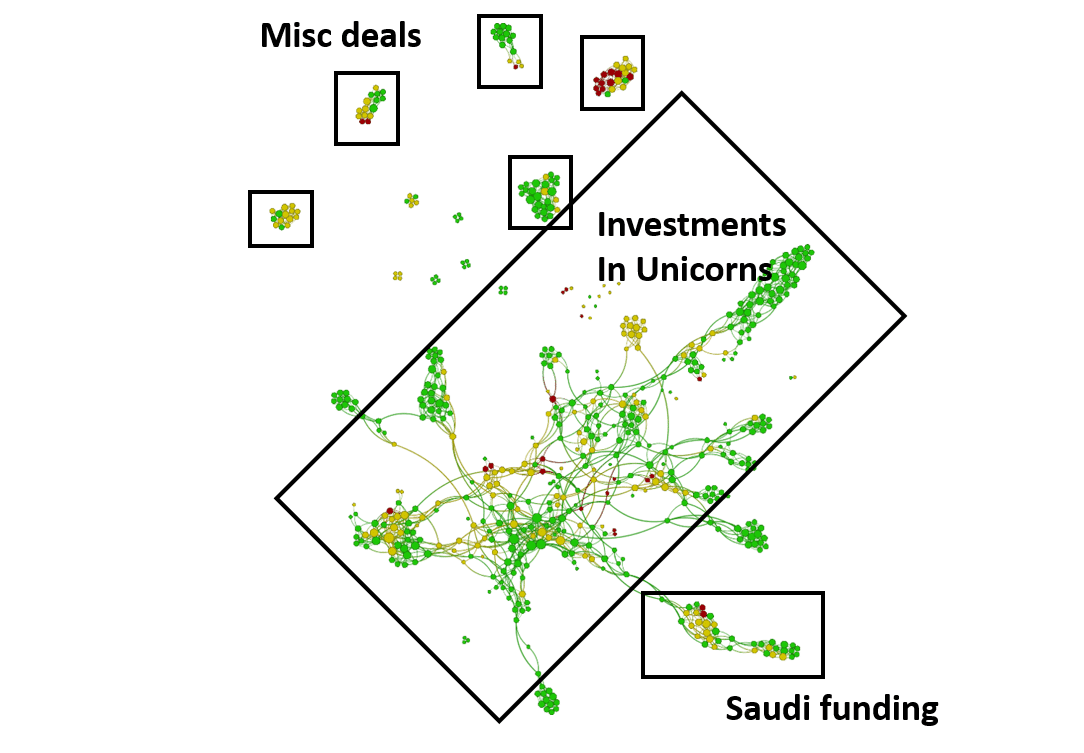
Source: Quid
As you can see, the core of the Vision Fund narrative is all about the deals it is doing. The Saudi connection is way off in the periphery of the overall narrative. Moreover, the sentiment across the map, including the peripheral Saudi thread, is VERY positive. Only 5% of these articles have a negative sentiment, and those are dominated by a very peripheral cluster of articles on microprocessor IP, stemming from SoftBank's acquisition of ARM in 2016.
But now look at the narrative map since October 3, consisting of 225 unique major-media articles on the Vision Fund.
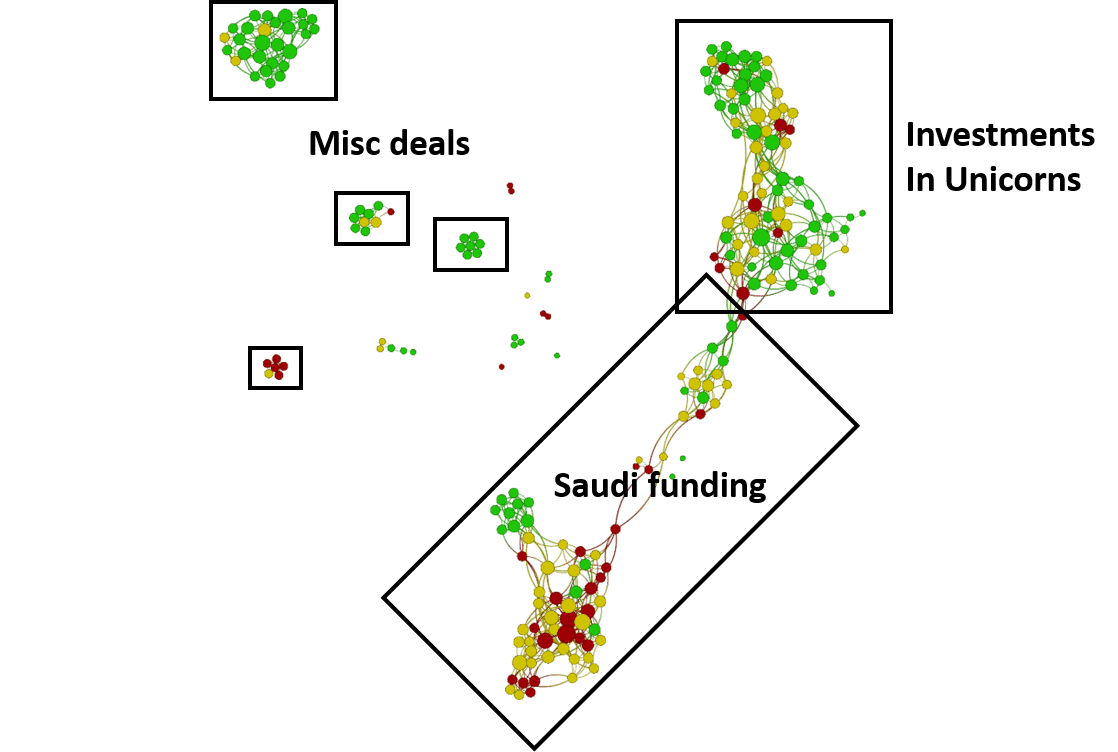
Source: Quid
This is a narrative train wreck. It's not just that the negative sentiment articles have more than tripled to 18%, and that positive sentiment articles are now less than half of the total (which is AWFUL for the normally rah-rah business press). No, the much more damaging aspect is that Saudi involvement is now at the core of the Vision Fund narrative. There are still more articles being published about the investments that the Vision Fund is making. But that narrative cluster is no longer at the heart of the map. The Vision Fund narrative is now defined by its Saudi funding, and that's a bell that never gets unrung.
I wrote a brief note last week about how common knowledge regarding the Saudi regime in general and Crown Prince MBS in particular had shifted, about how what everyone knows that everyone knows about MBS had changed. And once common knowledge changes, so does behavior. In many cases, it's the ONLY thing that can change behaviors.
Well, the common knowledge on SoftBank and the Vision Fund has changed, too. Today, everyone knows that everyone knows that it's Saudi money behind the fund. And that will absolutely change Silicon Valley's behavior vis-a-vis the Vision Fund, even if it changes nothing in what Silicon Valley already knew.
Will greed and the answered prayer of The Greatest Fool overcome the narrative stain that associating with the Vision Fund now brings? Maybe. I'd never want to bet against greed! But even more so, I wouldn't want to bet against the power of narrative.
Bottom line: I think that the MBS-is-a-Bond-villain narrative is now a significant risk to unicorn tech company valuations, through the intermediating narrative of SoftBank's Vision Fund.
PS - I'd like to give a major h/t to our readers for suggesting that we take a look at SoftBank through the lens of the Narrative Machine. Rusty and I are so fortunate to have found fellow truth-seekers throughout the financial services world. Please keep those cards and letters coming (ben.hunt@epsilontheory.com) with any ideas on future notes!

Comments
Awesome piece - and while not great for you, great for us that you are working hard on a weekend. It appears to me that a little of the air / the anger / the umbrage / the immediate outrage has gone out of the Saudi story in the popular press. Sure, as your map notes, it’s almost all still negative, but it seem to be less of a “full-on” media frenzy than it was five days ago (to wit, it’s fallen off my 85-year-old mom’s radar whose interest in news is completely main-stream-media headline driven). Almost as if someone at a high level said - “now tamp down the outrage a bit.” Ben, is there a way of looking the narrative map data to see if my finger-to-the-wind feel is reflected in the data? Thank you, Mark
Good question, Mark. Right now the Quid technology (and this is true for all Natural Language Processing routines, not specific to Quid) is very much a blunt tool. That said, Rusty and I are working on some tools to evaluate changes in the “density” of these narrative maps, which I think can give some insights on your question. We’ll keep you posted!
Continue the discussion at the Epsilon Theory Forum...