Gravity Sucks
February 22, 2019·Money
Our two greatest problems are gravity and paper work. We can lick gravity, but sometimes the paperwork is overwhelming.
Wernher von Braun, in the Chicago Sun-Times
Alongside the unexpected reemergence of an old friend - the narrative of central bank omnipotence - trade and tariffs have been front-of-mind for investors since early December. It's something we track in a recurring monthly series for our ET Professional subscribers.
In cases like the former, we think the narrative exerts a directional influence. When everybody knows that everybody knows that the Fed has a strong asset price protection mandate, then BTFD isn't just a bit. It's a rational response to that common knowledge. In cases like the latter, however, it is a bit more complicated. Market participants may be paying tremendous attention to tariffs and trade - and they are - but there isn't yet a consistently directional story being told about them.
It's an interesting mix of circumstances. No edge in trying to engage in fundamental prediction. Very little to make sense of in narrative space either. But the trade and tariffs issue still exerts significant gravity on all stories being told about markets. What's the result?
Chaos and bullshit.
To each of those noble ends, let's explore on a week-by-week basis just how financial media have told the story of US/China trade dispute. To do this, we explored all English language articles in the LexisNexis database about trade and tariffs from December 2 through the present. We further culled this list to include only stories that referenced 'trade' in the headline itself. There were 5,328 articles fitting these criteria.
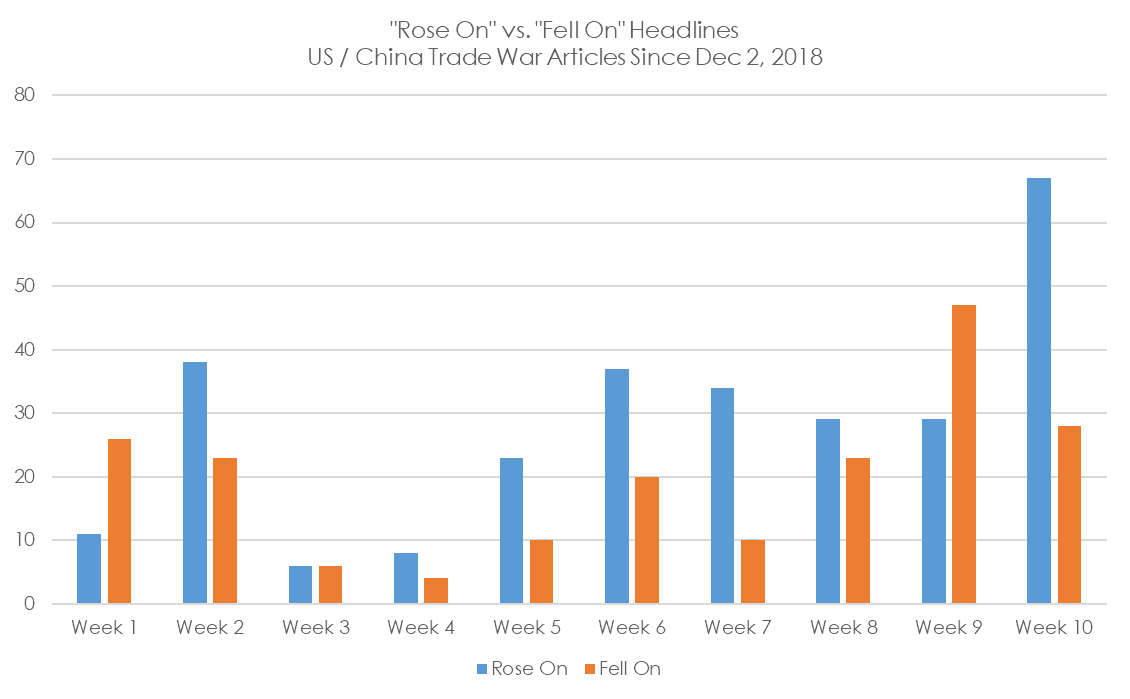
What are the stories we have been telling about tariffs and trade since the negotiation window opened? How have we discussed their impact on financial markets? Well, within single weeks, financial headlines both explained how markets 'rose on' trade and tariffs news and how they 'fell on' trade and tariffs news.
Source: Epsilon Theory, Quid, Moreover
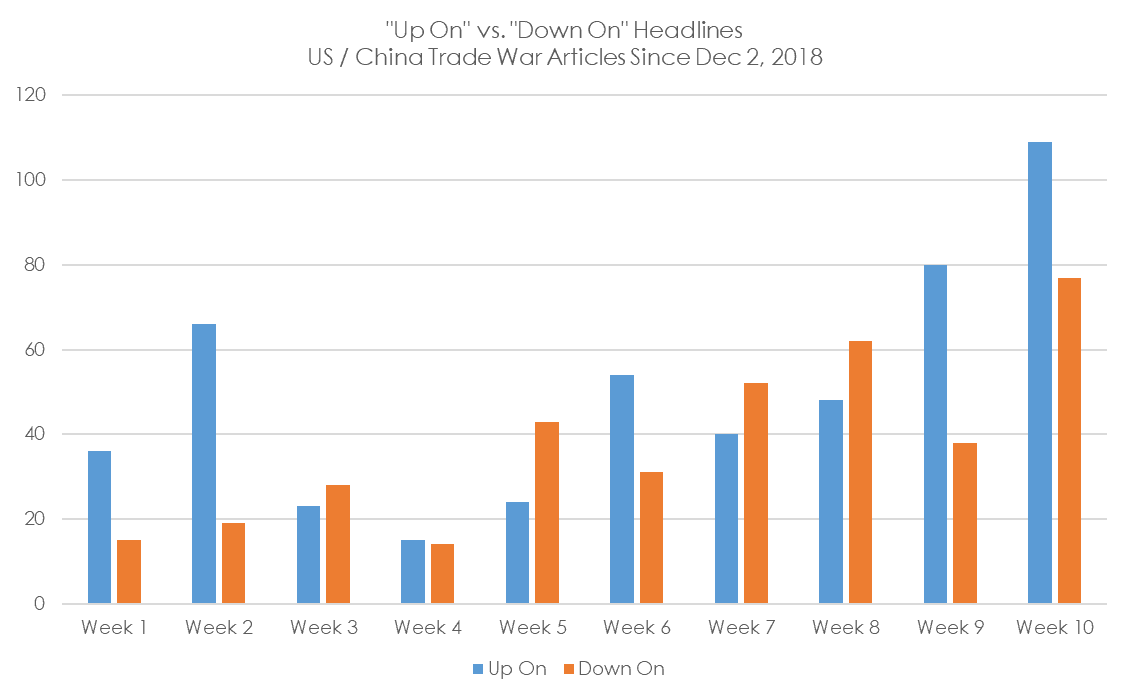
Within those same weeks, markets were 'up on' trade news on one day, and 'down on' trade news the next.
Source: Epsilon Theory, Quid, Moreover
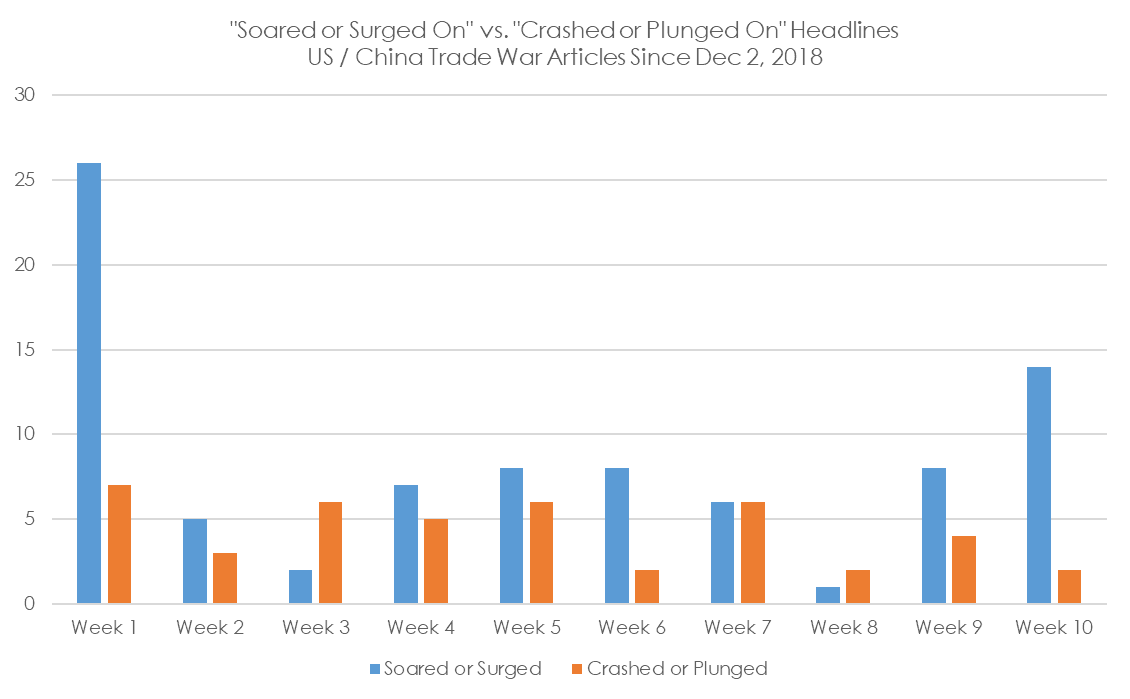
If hyperbole is more your speed, you didn't have to wait long. Markets 'soared' and 'surged' on trade news with some frequency, and 'crashed' and 'plunged' with almost equal frequency.
Source: Epsilon Theory, Quid, Moreover
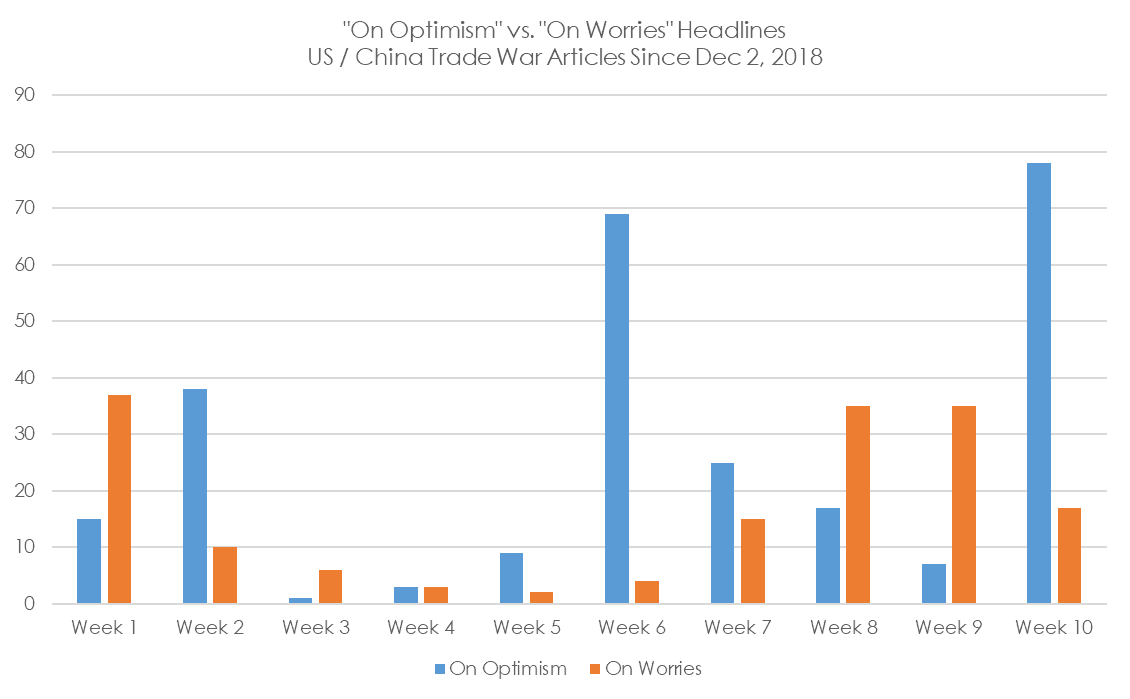
It should be no surprise that financial media characterized these market movements as being the result of trade news. After all, market participants apparently moved from worries to optimism on a nearly daily basis.
Source: Epsilon Theory, Quid, Moreover
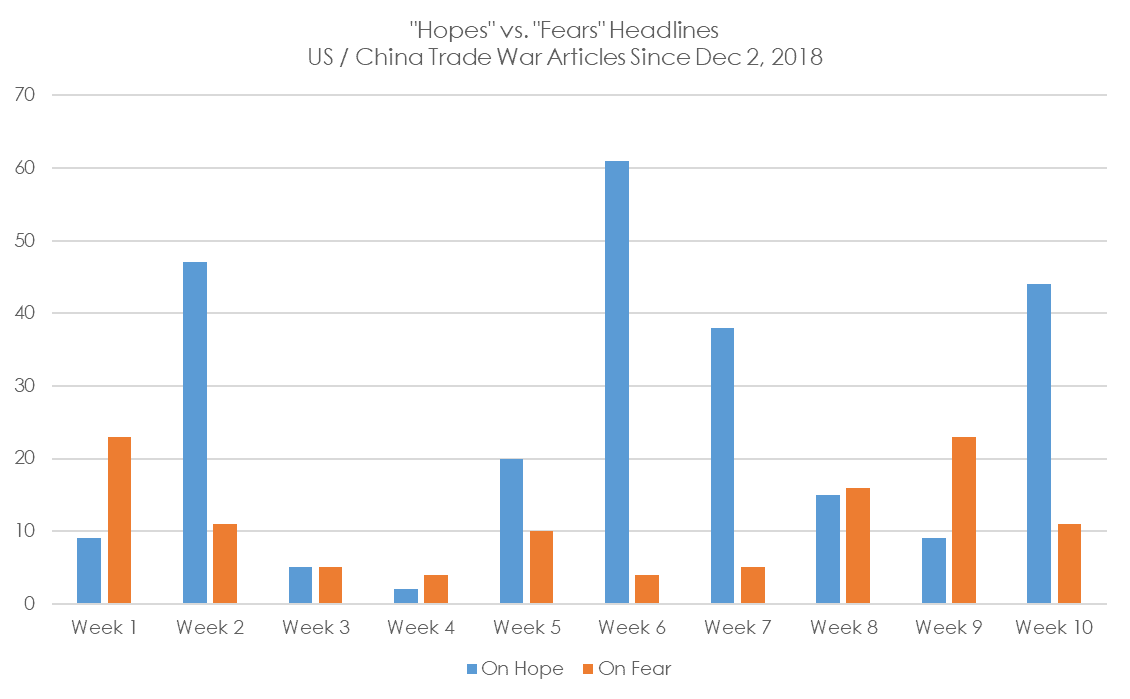
Or perhaps our motivations were more primal than simple worries or optimism. Perhaps markets soared and plunged on trade news because of our rising hopes and rising fears about trade and tariff resolution, which also apparently shifted on a daily basis.
Source: Epsilon Theory, Quid, Moreover
We are typically of the opinion that we can rarely afford to disregard media, research and other publishers that act as missionaries, or at a minimum, repeat and propagate missionary statements. Even if we think there is little substance to the ideas being presented, the statements and narratives which surround us still exert gravity. They still matter. Likewise, we are also nearly always of the opinion that "Stocks were up on X" articles are bad, widely understood to be bad, and unlikely to exert much influence.
But the gravity of a high attention narrative like trade and tariffs presents a sore temptation. Because we know that it is important, and because we know that everyone knows that everyone knows that it is important, the temptation to pay attention to updates, leaks and explanations of markets responding to this issue is strong. The temptation to incorporate our own interpretation of what others are discounting is strong. It is a recipe designed to appeal to confirm whatever bias we have about the issue, and to convince us that we have an edge in thinking about it.
So I will be less equivocal than usual. Until an announcement is made, continue to ignore it all. Ignore the news. Ignore the probability-based scenario research pieces. Ignore the daily 'up on', 'down on', 'hopes and fears' grind. The gravity of the trade and tariffs narrative means that every event, every market outcome, every surge and every fall, will be drawn into the stories being told about it.
Gravity sucks. Resist it.


Comments
No doubt that “trade” and “tariffs” have been moving markets lately. But does anyone really expect truly meaningful outcome on this topic. Personally I expect that the US and China will eventually settle on some grand soundings, but ultimately toothless/empty resolution so that they can both claim a “win” on this issue. Longer term, I think the damage on trade! and tariffs! (no italics available in the comments apparently) has already been done. A suspicion of Chinese links in supply chains has seeped into the American psyche (not just wackos, people that matter like politicians) and businesses no longer trust either the US or Chinese government to put commerce ahead of their respective political agendas.
See this article from AP earlier this week for an example of the alarming language used to describe the risks of working with Huawei https://www.apnews.com/f373e15671884f35bbe085a131c59262.
On the other side of the world, no matter what the outcome of Brexit is, the damage has been done. Economies have begun disintermediating at an accelerating rate. The world is no longer flat. To me that spells higher prices and competition for resources. I’m curious to what extent de-globalization plays into the inflation risk narrative.
Is there anything to the fact that the positive words “surged on,” “rose on,” “hope,” “optimism” generated more responses than the negative words? Does that indicate the market is leaning toward a perceived favorable outcome or (as I have a feeling I am) am I not really understanding the meaning of those charts?
Yeah, it MAY mean that, to some extent. It may also mean that the financial media is generally a bit rah-rah about this kind of thing. It may also mean that the words (selected for ubiquity and for simultaneous opposite comparisons) are an incomplete representation of overall sentiment, which wasn’t really where this article was going. Probably a mix of all of these.
Thank you sir.
Two data points were recently brought to my attention and I’m curious how much the trade narrative has played a role. The first is the Baltic Dry Index (BDI) that measures the cost of moving dry bulk goods around the world. BDI “plunged” in January and is down 51% since the beginning of the year. The second is the Small Business Optimum Index. One of the index components is Plans to Increase Inventory, which came in a net gain of 1%. Meaning just 1% of respondents intended to increase inventories in the months to come. If raw materials are not moving around the world and if business are not building out inventory it’s only a matter of time until GPDI is contracting.
My concern is the trade and tariff narrative pulled forward activity last year and companies plan to sell through their inventory this year.
Or am I wasting my time because as long as money is loose and fast none of this matters?
Not wasting time. It matters. But trade and tariff narratives are in many ways abstracted from the realities of trade. Here the realities you’re observing just happen to coincide with some of the fears attached to the narrative. What you saw in Jan is consistent with trends Ben had written about concerning global trade for a couple years now, even if the Baltic isn’t the top tier indicator it used to be. I’m not sure what to make of the Plans to Increase Inventory, but there’s no question that the Zeitgeist is a general slowdown in global trade activity.
Continue the discussion at the Epsilon Theory Forum...