Harrumph!
July 7, 2020·Politics
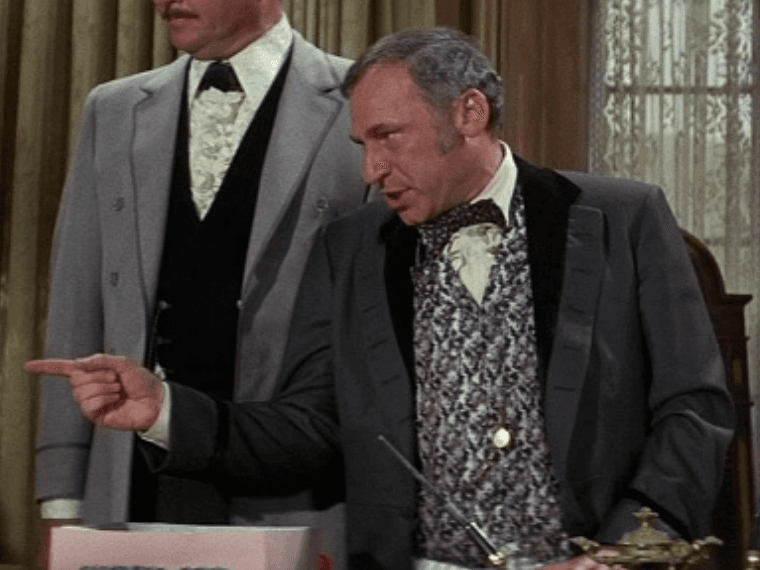
Governor William J. Le Petomane: We've got to protect our phony baloney jobs, gentlemen! We must do something about this immediately! Immediately! Immediately!
Room Full of Supporters / Cronies: Harrumph! Harrumph! Harrumph!
Le Petomane (pointing at one silent crony): I didn't get a harrumph outta that guy.
Hedley Lamarr: Give the governor harrumph!
Frightened Crony: Harrumph!
Le Petomane: You watch your ass.
- Blazing Saddles (1974)
Theatre and film make their way into the pages of Epsilon Theory quite a lot.
Some of that is admittedly because Ben just really, really likes The Godfather. Most of it, however, is because the same tools that are designed to steer emotional and intellectual responses in theatre are the tools of narrative. The same memes, the same forms, the same processes.
I have written about some of these shared forms in context of a framework developed by Peter Brook called the Empty Space. In it, Brook breaks down theatrical experiences into four classes: Deadly, Holy, Rough and Immediate.
Each time I have seen Hamilton it has been a Holy theatre experience.
That doesn't mean good. It doesn't mean spiritual. It isn't a pedestal. It means that the performances were filled with symbols and narrative cues built around our predictable physical responses to them. And it means that the cast presented them in something close to their natural, unaffected form. One of those rare cases in which narrative and meme are put to well-intentioned, positive uses.
There will come a time when Burr's build-up to George Washington striding in or his introduction to Lafayette before he leaps onto the table become stale and the cast is forced to try to go through motions to recreate the magic somehow. There will come a time when the pause after the "we get the job done" line doesn't get its usual whooping from the audience and the director tries to coax it back. When that time comes, the productions will take their Deadly turn into the dull and lifeless energy you'd find in most Broadway theatres on most nights. It will look much the same, but it will feel different. It happens to every show.
Until then, however, most of its performance are worthy of admiration, I think.
As pure history it includes a great deal of nonsense, of course, both in fact and in its alignment with my personal sensibilities. Hamilton, the protean creator of the Fed Put, would rank behind nearly every generally accepted founding father but Adams in my pantheon. Neither a maiden in need of defending nor a man in need of lionization. Still, as musical theater, I think it is a very fine work. As artistic take on historiography - you have no control who lives, who dies, who tells your story - it is singular.
Leaving artistic criticism aside, for quite some time it was also insanely popular. I don't think that is the sole result of the quality of the music and book. They are good, but plenty of other shows that didn't yield a fraction of the attention are really good, too. I don't think it was the unusual juxtaposition of subject matter and style either. Frankly, after Avenue Q mashed up an NC-17 version of The Graduate with the musical stylings of Sesame Street, it's hard to look at a blend of 90s-style hip-hop with American history as genre-busting. I don't think the mildly provocative immigration takes or the minority-and-immigrant-only casting approach are universal explanations either, although I think it is fair to say they attracted a new audience to a narrow industry dominated demographically by upper-middle class white tourists.
No, I think Hamilton is popular because Miranda's expression of what the American Experiment means is among the most expansive and inclusive ever represented in a work of art. It celebrates the enterprising individual - the need for men and women of action with an appetite for risk to force change from the bottom up. It celebrates the community - those who sacrifice personal glory to create an environment in which those risks can be taken by others. It celebrates the society - the rules we create together to make sure that everyone can play whatever role suits them without coercion. Whether or not they like the music or the protagonist or the historical accuracy or the cast preaching at Mike Pence in the audience, I don't think there is a full-hearted American of any political predisposition who couldn't watch the thing and conclude, "This captures a part of our story."
Miranda's Hamilton is, if nothing else, an authentic sermon on the civic duty to action.
The fact that Hamilton's model of what made, makes and will make America great is so expansive, so aware and capable of accommodating the contradictions and duties of independence, makes what comes next almost too predictable for words: it is officially not woke enough for 2020.
To wit, CNN published this in an opinion piece by a journalist and lecturer at Columbia University over the weekend:
Hamilton: is quaint and noncommittal. HamilFilm has arrived at a moment when America is not satisfied with ambivalence or compromise, but yearning for real and necessary change.
― The problem with the 'Hamilton' movie, CNN (July 5, 2020)
Others went even further.
These cringeworthy takes come from the far-left fringe only weeks after Lin-Manuel himself came under significant fire for not being quick enough to leverage official Hamilton social media channels to voice support for Black Lives Matter (for reference, the published public support came on May 30th, four days after initial protests had begun). The pressure was enough to generate apologies from other members of the production team, including producer Jeffrey Seller:
I'm not a politician. I'm not an activist. I'm not an expert. I'm a theater producer.
― Social Media Statement from Jeffrey Seller, as quoted by The Hollywood Reporter
I didn't get a harrumph outta that guy! Give the governor harrumph!
But what I realize today is most importantly I'm an American citizen and silence equals complicity and I apologize for my silence thus far.
- Social Media Statement from Jeffrey Seller, as quoted by The Hollywood Reporter
Harrumph!
There is a new, rapidly emerging narrative structure in America today. It doesn't have much to do with the language from the CNN piece or (thank God) from the lunatic fringe on Twitter. It is the familiar language from Sellers's apology: "silence equals complicity." From the background, this expression and its variants have exploded into common knowledge in less a month.
On its own, that isn't inherently bad. That is to say, we shouldn't necessarily be concerned that "Silence is Complicity" is now the narrative governing our cultural zeitgeist. And it is.
We should be concerned, however, that "silence" is being redefined as the failure to say what is demanded.
Because whether it is in 'service' to the left's political correctness or the right's patriotic correctness, we are taking a Holy idea - our joint civic duty to one another - and perverting it into the Deadly Theatre of induced social media mea culpas.
The obligation to act in the face of injustice facing our fellow citizen is neither new nor the domain of any modern political dogma.
The civic principle that we have positive obligations - duties to act on one another's behalf - has been argued for centuries. It is embedded in the political philosophy underlying just about every American founding document, even if we have seemingly abandoned it at every turn. It is a fundamental American social value, made perhaps more so by the observation that both the extreme far right and extreme far left probably disagree with all of what I just said.
As always, probably the most famous associated quotation is the apocryphal one. You know the one. That "all that is necessary for the triumph of evil is that good men do nothing" quote from Burke that JFK used? No, Burke never said that. And no, that doesn't matter. It is a pithy expression of the core idea underneath the silent/complicit construction, and Burke wrote plenty otherwise that said much the same:
It is not enough in a situation of trust in the commonwealth, that a man means well to his country; it is not enough that in his single person he never did an evil act, but always voted according to his conscience, and even harangued against every design which he apprehended to be prejudicial to the interests of his country. This innoxious and ineffectual character, that seems formed upon a plan of apology and disculpation, falls miserably short of the mark of publick duty. That duty demands and requires, that what is right should not only be made known, but made prevalent; that what is evil should not only be detected, but defeated.
- Thoughts on the Cause of the Present Discontents , by Edmund Burke (1770)
So did a wide range of other 18th and 19th century writers and political philosophers. Like John Stuart Mill.
Let not any one pacify his conscience by the delusion that he can do no harm if he takes no part, and forms no opinion. Bad men need nothing more to compass their ends, than that good men should look on and do nothing. He is not a good man who, without a protest, allows wrong to be committed in his name, and with the means which he helps to supply, because he will not trouble himself to use his mind on the subject. It depends on the habit of attending to and looking into public transactions, and on the degree of information and solid judgment respecting them that exists in the community, whether the conduct of the nation as a nation, both within itself and towards others, shall be selfish, corrupt, and tyrannical, or rational and enlightened, just and noble.
- Inaugural Address Delivered to the University of St. Andrews, by John Stuart Mill (1867)
The obligation for positive action by the moral citizen is a basic idea in most modern histories, too. For example, the inability and unwillingness of the German people to stand up against Nazism is a big part of the World War II story (even if Shirer and some other historians offer more grace for a propagandized people than most). The silence of priests and bishops about decades of rampant sexual misconduct and abuse within the church is a still-evolving part of the history of Christianity in the late 20th and 21st centuries. The acquiescence of white Americans to widespread segregation, racism, lynchings and mythologies about the confederacy is a big part of the history of the civil rights movement.
Martin Luther King, Jr. dealt very directly with the issue of this passivity, framing it in terms of its most common apologia.
One is what I often speak of as the myth of time. I’m sure that you’ve heard this. This is the argument that only time can solve the problem of racial injustice. Only time can bring integration into being. And so those who set forth this argument tend to say to the Negro and his allies in the white community, just be nice and just be patient and wait 100 or 200 years and the problem will work itself out. I think there is an answer to that myth. That is that time is neutral, it can be used either constructively or destructively. And I’m absolutely convinced that in so many instances the forces of ill will in our nation, the extreme righteous of our nation have used time much more effectively than the forces of good will. And it may well be that we will have to repent in this generation, not merely for the vitriolic words and the violent actions of the bad people who would bomb a church in Birmingham, Alabama but for the appalling silence and indifference of the good people who sit around and say wait on time. Somewhere we must come to see that human progress never rolls in on the wheels of inevitability.
- Martin Luther King, Jr. in the 1966 Convocation at Illinois Wesleyan University
Even our own Declaration of Independence treated the response of the governed to tyranny and evil as not only a right but as a duty.
But when a long train of abuses and usurpations, pursuing invariably the same Object evinces a design to reduce them under absolute Despotism, it is their right, it is their duty, to throw off such Government, and to provide new Guards for their future security...
- The Declaration of Independence (1776)
In short, it is a fundamental precept of western democratic civics that the citizen's freedom from coercion does not confer freedom from moral obligation. All of that is to say that, yes, fellow citizen, sometimes it will be not only your right but your duty to detect, speak up against and act in opposition to injustice.
Maybe you, like me, believe all of that passionately.
Maybe you, like me, still cringe when you see someone say that "silence is complicity."
If so, now is your chance to make an escape.
First, let me show you why we think this has emerged as the core of our cultural zeitgeist. No fancy Epsilon Theory narrative structure metrics - just coverage volume. The below chart presents our estimate of the number of articles published by month across major media outlets, blogs and newswires referencing variants of the linguistic construction relating silence and complicity. This comes from LexisNexis's database, so it isn't a complete representation of everything written. It omits some outlets that aren't licensed to be part of their database. But it's large enough and representative enough for our purposes.
I think you will see why immediately.
Articles Relating Silence and Complicity (November 2016 - June 2020)
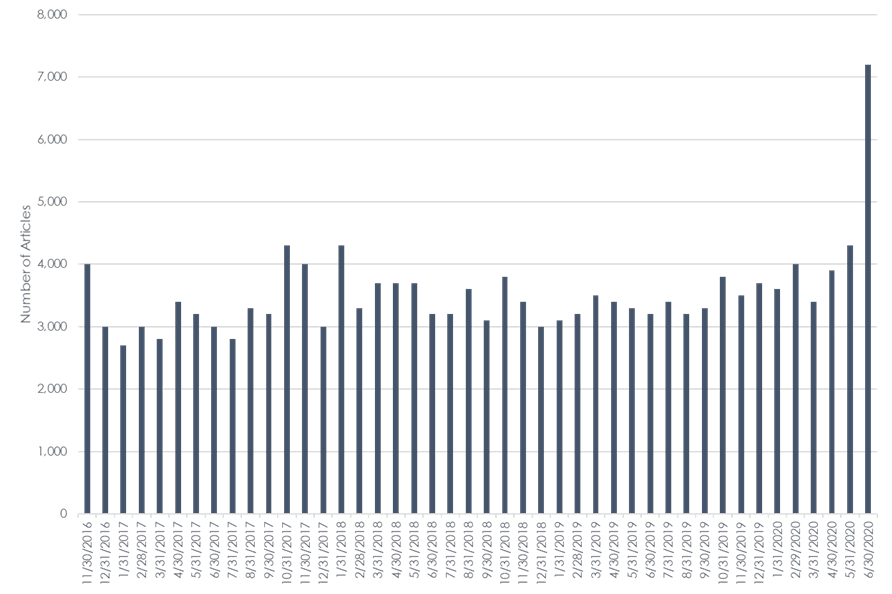
Source: Epsilon Theory, LexisNexis Newsdesk
There is no trend. There is 'before', and then there is 'after 5/26/2020'. That is when "being silent is being complicit" went from an occasional rhetorical technique to something that everybody knew that everybody knew was the framework for cultural debate.
It seems pretty obvious that coverage of the murder of George Floyd was the proximate cause of this immediate shift. But the interesting part of this isn't just the volume of articles using this language. It is the breadth of pieces that adopted it. In fact, roughly half of the pieces with "silence is complicity" language in June do not mention Floyd or police at all. Many evolved into discussions of race more broadly. Many covered the protests or the riots alone. Many were not about race per se, but specifically about the Black Lives Matter movement and organization. Perhaps most surprisingly - this language being historically in the wheelhouse of progressive politics - some were conservative outlet pieces about the riots, Antifa, destruction of monuments and anti-police sentiment.
On the one hand, I find it exhilarating. I think you can look at this chart - even if the phrase "silence is complicity" makes you cringe - and have hope. Hope that maybe it means we are dealing with issues we haven't had the courage to deal with during our lifetimes.
On the other hand, I find it worrisome.
I am worried because I don't think the dominant narrative for a movement we need to last and evolve is one which defines an objective that can be satisfied by cheap daily genuflection from celebrity social media interns and shoe companies with a library of documentaries about third world labor abuses.
I am worried because there is a veritable army of social media warriors and pundits out there, most of whom have done precious little for other human beings, all of whom stand to gain considerable cultural capital by sniping from the standing room only section, who stalk out institutions and individuals who haven't yet dropped their two cents on a political or social issue then demand that they give the governor harrumph. Beyond that, there is an inherently accusatory idea in the "silence is complicity" narrative that the whole of a person can be boiled down to what they've said on a topic on social media. It is understandable when you consider that the phrase is typically coming from a pundit who thinks that honor and glory should be allocated based on how much you've run your mouth about something, but being understandable doesn't make the Hedley Lamarr framework any less ludicrous.
I am worried because the demands that citizens speak up about injustice - which is a righteous moral demand - are being co-opted into expectations that they indicate their support for movements that encompass aims a lot broader than just anti-racism and the exploration of deep-seated roots in our social structures. Through abstraction, silence is being redefined not as the unwillingness to speak, but the unwillingness to say exactly what is demanded.
This demand that others recognize our rituals is a wholly bi-partisan thing. The patriotically correct right invites you to demonstrate your patriotism, but demands that you perform their rituals to accept your demonstration and sentiment as valid. Sure, you're investing in the lives of young people, supporting entrepreneurs, re-investing in your community, helping to drive voter turnout and promoting your political views in an appropriate political forum, but what do you do physically during the playing of the national anthem? Where are your flags? Why are you being silent about your love of America?
Give the governor harrumph!
The politically correct left invites you to demonstrate your commitment to ending racism, but demands that you perform their rituals to accept your demonstration and sentiment as valid. Sure, you are working on your heart, contemplating the advantages you may have gained by your race, gender, orientation and wealth, and trying to identify and fix where those advantages may be subconsciously invested in our institutions. But have you publicly offered your public support to the specific organizations we highlighted? Have you agreed with their platforms for change, and will you vote for candidates who vow to Defund the Police? Why are you being silent about racism?
Give the governor harrumph!
Speaking up - and acting - when we see injustice is our right and duty. When done correctly it can be a kind of Holy Theatre, a ritual that affects and inspires others to action. It needn't be non-disruptive. It needn't be peaceful. It needn't even be warm! But it must be authentic.
Perverting that holy idea into one that requires others to perform the rituals in exactly the way we demand, on the other hand, is Deadly Theatre. It is an empty, vacuous service that serves only ego and social capital.
The Civil Rights Movement of the 1960s was invested with the former. I think that's true of a lot of the 2020 protests thus far, as well.
Yet if the narrative structure here tells us anything, it is that top-down pressure is being applied to transform a bottom-up movement into a top-down movement that conforms more closely to our pre-existing political divisions.
It is our duty to resist that.


Comments
“Give the governor harrumph!”
One of your best analogies ever - and that’s saying a lot.
Brilliant diagnosis, Doctor Guinn! Anytime you include Burke, J.S. Mill, MLK, Jefferson (and Harvey Korman) in one commentary, you’ve hit a truly important conceptual target.
I feel like some of this is our inability to handle nuance. It seems (that is, I don’t know or have any specific evidence) that mass communication, by its nature, demands the simplification of messages. Dealing with intractable problems is difficult, requires consensus and compromise, and involves trade-offs between policies that may desirable but incompatible. It is just easier from a communications standpoint to focus on one specific issue and hammer it like a propagandist.
So, for instance, instead of discussions about/destruction/removal of monuments being just a part of a larger “ideology” or movement or protest it becomes the focus of the rhetoric.
I feel like there’s an unfortunate confluence between what is easy to do and what is simple to act upon. It’s riskless and easy to send a broad message of performative, rhetorical support for a simple part of a complex issue. Ex. A tweet saying: “I have white privilege and we need to stop ignoring it as a society.” And then doing nothing and changing nothing. But because there’s no risk and no rigor it lacks meaning, and can only serve the previously organized/existing channels and divisions.
I think your framework here of Holy vs. Deadly is a great way to understand how all of our public discourse (or, at least a lot of it) gets dragged out of reality into the rhetorical plane of narrative and speech.
All of this to say: I wonder if social media/the internet/24 hour news has truly made us all into the other-regarding Sheep to such an extent that it makes it almost impossible to fix anything as we’re all just crowd-watchers, unwilling to risk anything that may damage our social standing. No risk = no meaning = our perception of an empty, narcissistic, and nihilistic culture.
Just some random thoughts here that this piece brought to mind so don’t mind me. Excellent as always.
Thank you, Jane! I had a memory that Harvey had died only a couple years ago. The instant aging process I underwent when I discovered it took place 12 (!) years ago was regrettable.
So kind of you, Mark! Thanks!
Thanks, Eric. FWIW, I agree.
I think you’ll get the “two” of a one-two punch from Ben tomorrow, as it will argue something much like what you describe - and offer a solution. It is not an easy one, but worth a shot.
If you were referring to cook-book essay then I guess ET and their audience are on the same wave-length - though wasn’t expecting that much porn. Thanks!
Rusty, I celebrated the 4th by watching Hamilton and I was struck by how it seemed an anthem to the current bottom up movement. I had the hopeful feeling that it would be the classic of our time, that these young people and those young people sprang from the same unending revolutionary fount. Thanks for putting the risks to this revolution in such clear terms.
Continue the discussion at the Epsilon Theory Forum...