Home of the Brave Pulse
May 1, 2026·0 comments·Stories of America
AI-Era Media Narratives Converge Around Military Strength, Frontier Heritage, and the Changing Calculus of American Risk-Taking
Executive Summary
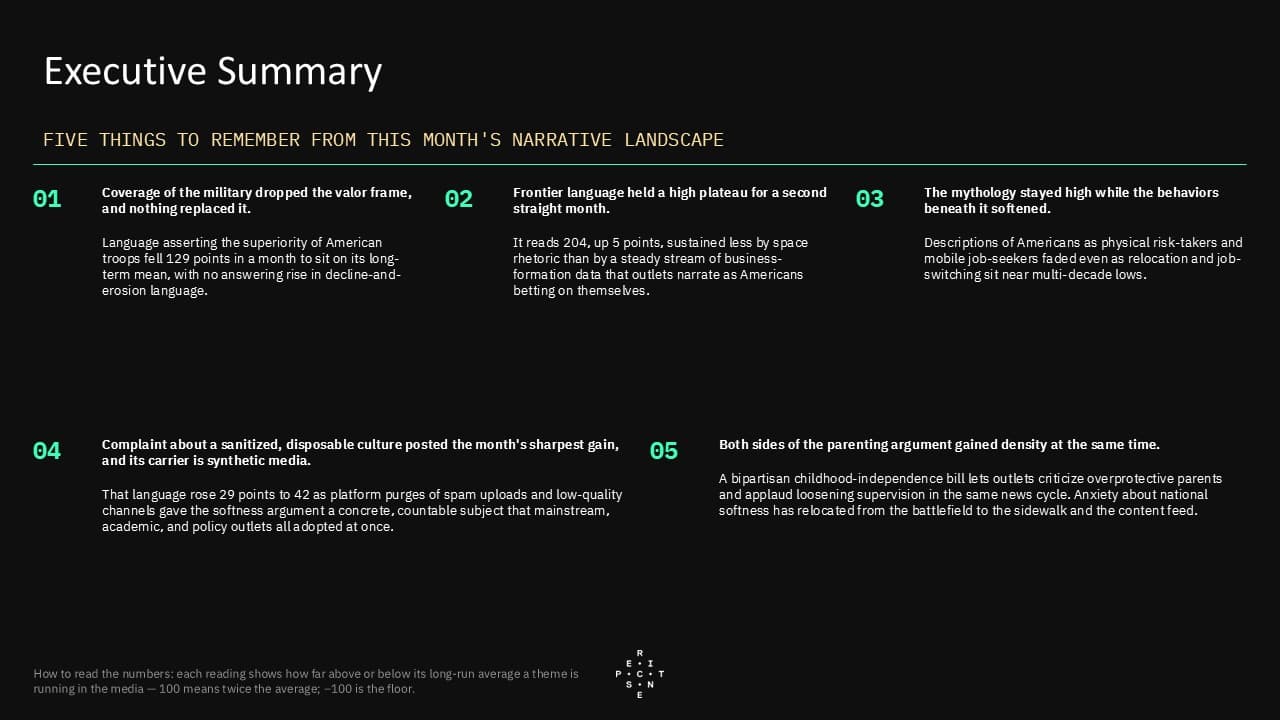
- Military celebratory rhetoric has become a fixed feature of the American media environment, but public opinion has not followed. Language arguing that American soldiers are the best in the world remains far above its long-term mean, while language questioning American military dominance has nearly disappeared. Yet polling shows that only about a third of Americans approve of the conflict with Iran. This widening gap between media posture and popular sentiment introduces persistent brand and political risk for AI companies — particularly those signing classified Pentagon contracts — even though the Department of Defense represents the single largest institutional market for AI products.
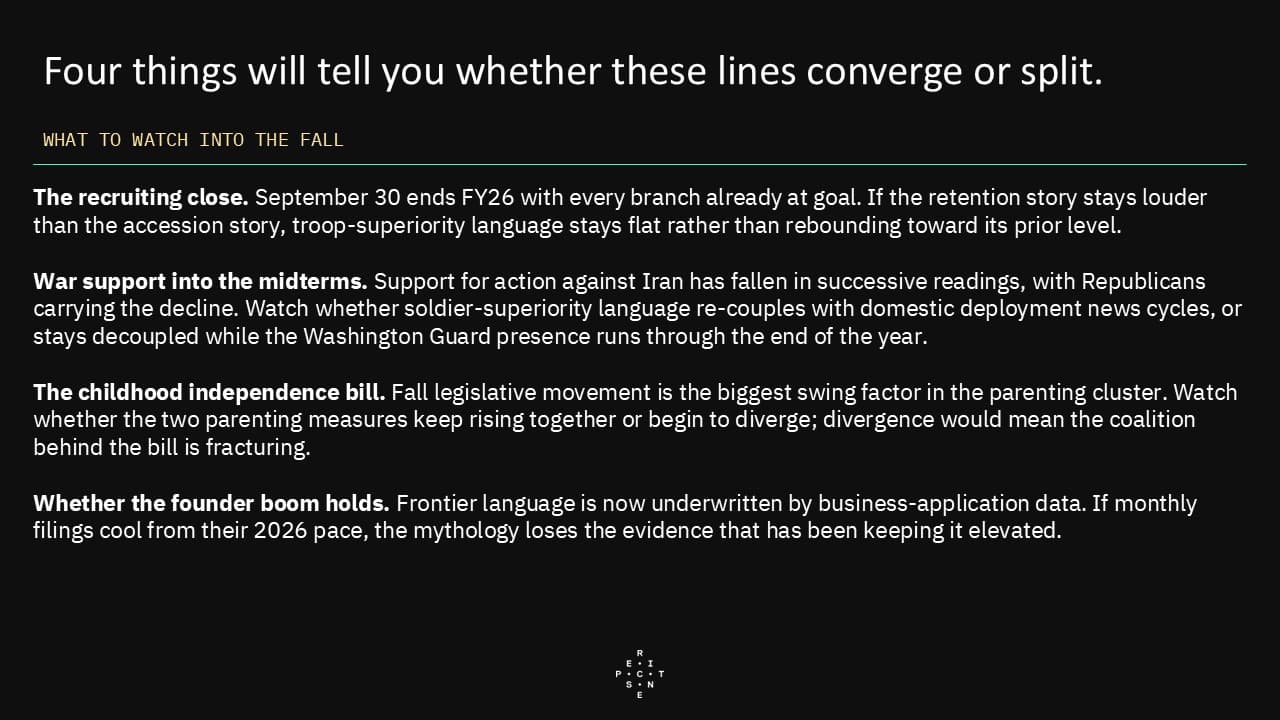
- The word "frontier" now operates simultaneously as a technology-industry designation and a cultural identity claim, and media discourse is reinforcing both meanings at once. Language celebrating America's frontier heritage and pioneering spirit posted its strongest gain across all tracked signatures this month, while critiques of sanitized suburban comfort sharply retreated. The AI industry's standard label for its most advanced systems — "frontier models" — borrows emotional resonance from this deeper national mythology, and government officials and industry advocates are explicitly drawing the lineage from westward expansion to AI development. This convergence may sustain public tolerance for large-scale AI investment even during a period of broader institutional skepticism.
- Record business formation has not produced a corresponding media narrative of entrepreneurial confidence or American self-reliance. New business applications are running at roughly double pre-pandemic levels, yet language describing Americans as willing to take risks sits squarely at its long-term average, and language asserting that true Americans have faith in their own abilities actually declined. Instead, a modest rise in language criticizing Americans for prioritizing comfort over ambition — combined with widespread reporting on AI-driven layoffs and post-displacement entrepreneurship — suggests that media is framing this activity less as bold ambition and more as an adaptive response to labor market disruption.
- Across military, cultural, and economic domains, artificial intelligence serves as the connective thread — but the motivations it is attached to differ sharply by context. In the military sphere, AI adoption is cast in terms of dominance and institutional strength. In the cultural sphere, it is wrapped in frontier mythology and national character. In the labor market, it is increasingly associated with necessity and displacement. The fact that a single technology can be narrated so differently depending on context suggests that the long-term public perception of AI products will depend heavily on which of these framings proves most durable — and that the currently dominant postures of strength and heritage may be concealing a more anxious undercurrent driven by what workers have lost rather than what they hope to gain.
---
Wartime Conditions and Pentagon AI Adoption Fuel a Dominant Pro-Military Media Posture
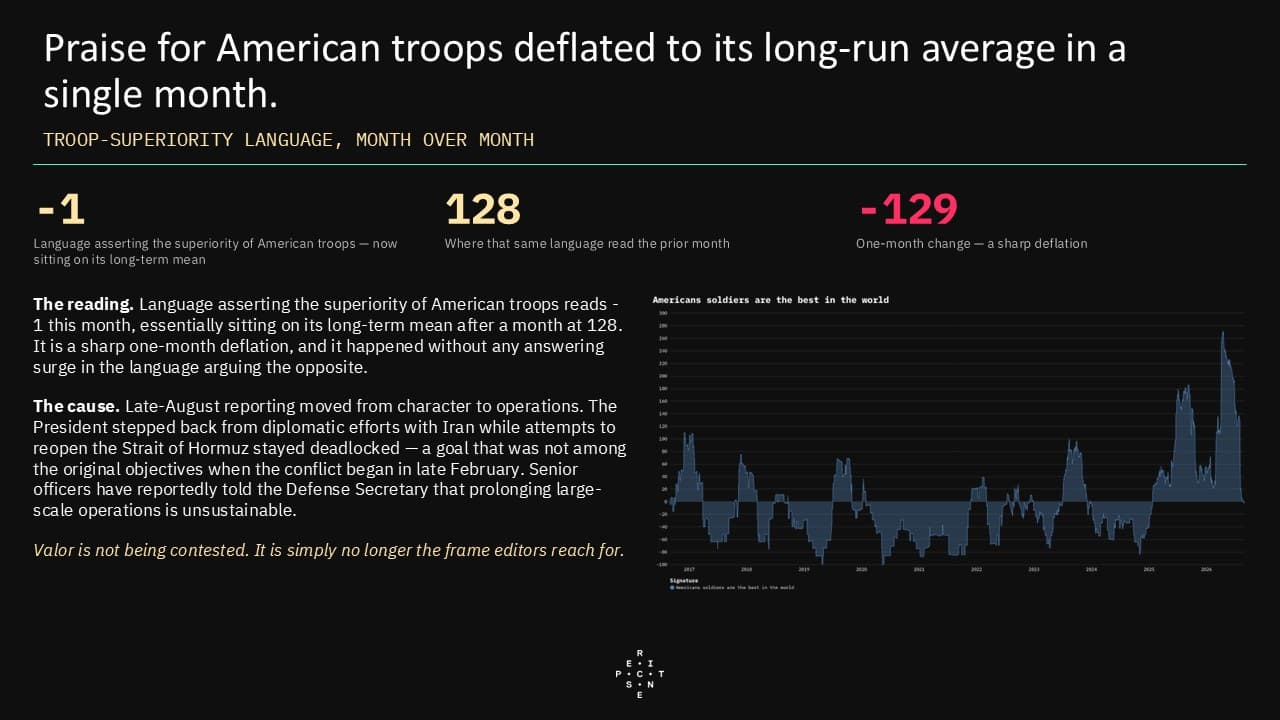
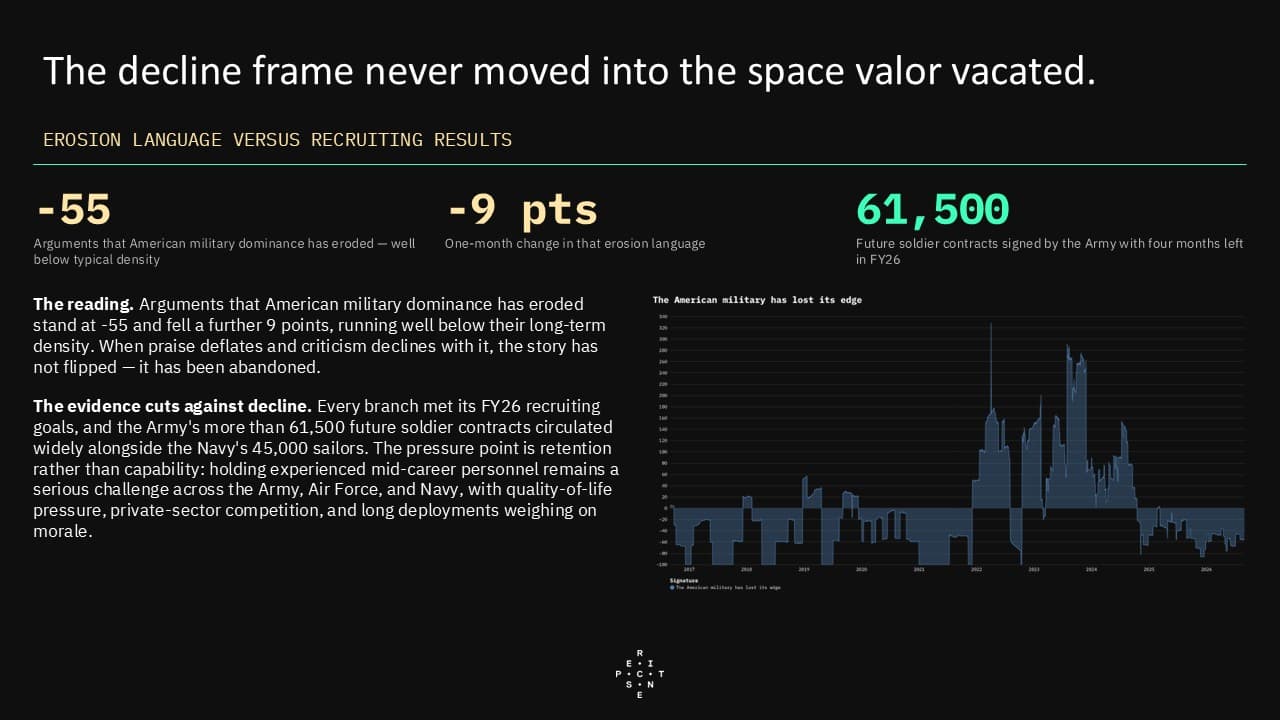
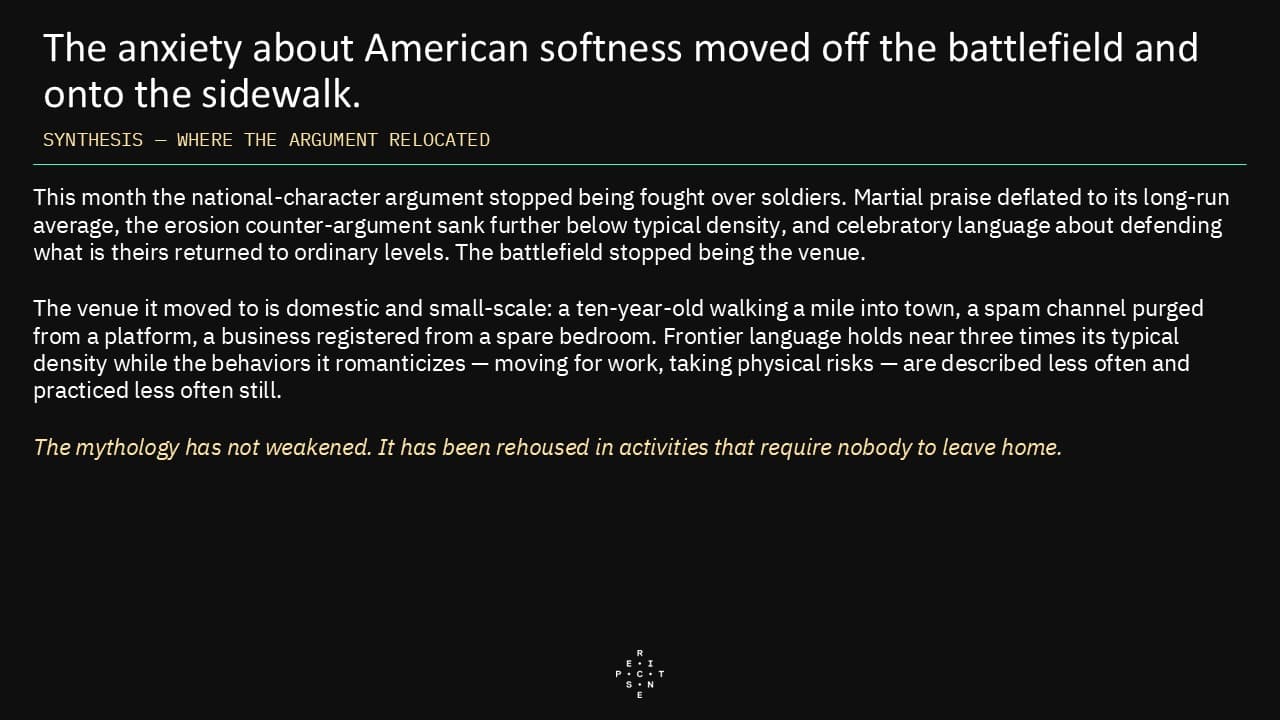
The American media environment in April 2026 has settled into a decidedly one-sided posture on military identity. Perscient's semantic signature tracking the density of language arguing that American soldiers are the best in the world registers an Index Value of 258, more than 250 points above its long-term mean. The reading held flat over the month, suggesting that this is no passing spike but a sustained feature of contemporary discourse. Meanwhile, our semantic signature tracking language arguing that American military dominance has declined fell to an Index Value of -64, dropping by 12 points, the single largest decline across all signatures in the dataset. The gap between these two readings describes a media environment where celebratory military rhetoric is deeply entrenched and language questioning American military standing has almost entirely receded.
Since late February, the United States and Israel have been at war with Iran, and the Trump administration unveiled a $1.5 trillion Pentagon budget proposal for FY2027 on April 21, representing a 42 percent year-over-year increase. Defense Secretary Pete Hegseth faced pointed questioning from Congress about the conflict's costs and legal basis in his first appearance since the war began, while the New York Times broke down what $25 billion in war spending actually means against historical benchmarks. Fox News celebrated Trump as "the most successful wartime president since World War II," illustrating the breadth of the media's military confidence narrative.
Artificial intelligence is central to this posture. Secretary Hegseth's January memorandum directing the Pentagon to become an "AI-first" war-fighting institution set the tone, and the Department of the Air Force released its own Data and AI Strategies in April to recruit, train, and retain AI professionals. In late April, Google signed a classified AI contract with the Pentagon allowing its models to be used for "any lawful government purpose," a move that drew an open letter of opposition from more than 600 Google employees, many from DeepMind. Anduril won a spot in a $1.8 billion Space Force contract, and the Pentagon expanded classified AI deals to six technology companies in total.
Not every AI company has embraced this trajectory. Anthropic was reportedly blacklisted from defense contracting after seeking restrictions on how its models could be used in military operations. As one social media account summarized the situation: "Anthropic held that line. Kept its guardrails on autonomous weapons and domestic surveillance. The Pentagon blacklisted them for it. Now Google, OpenAI, and xAI are all in. Anthropic is out."
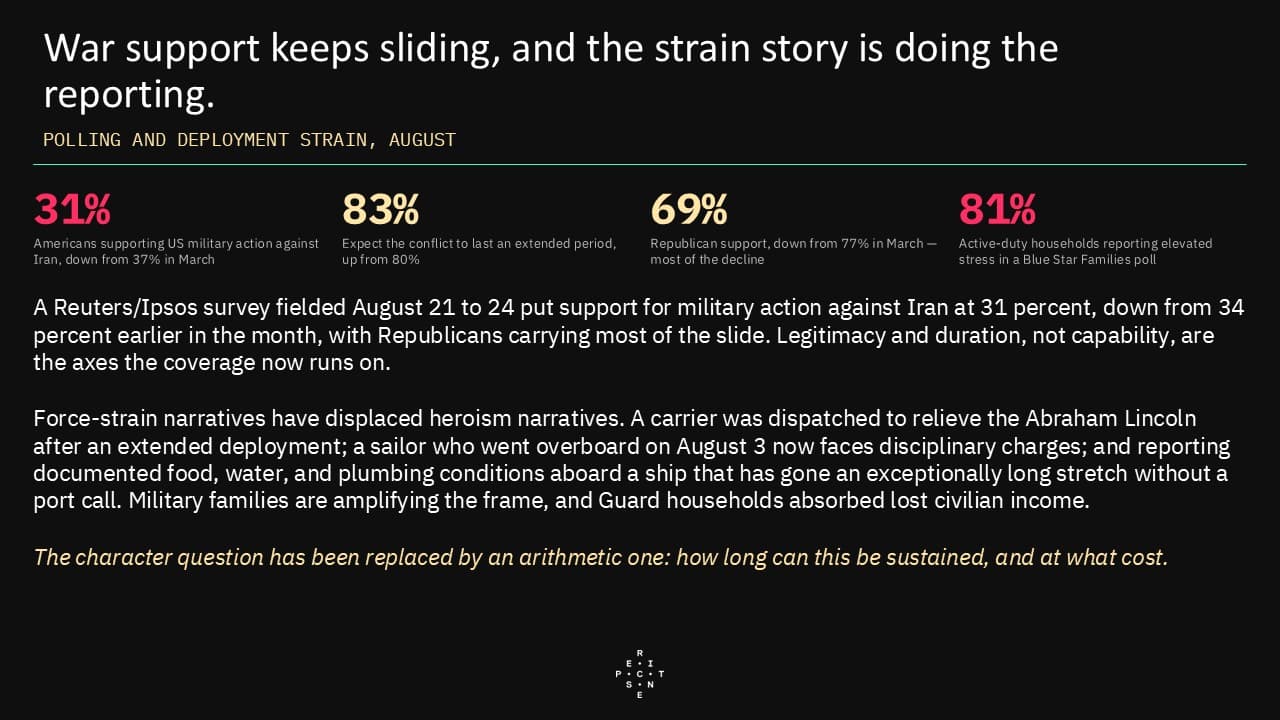
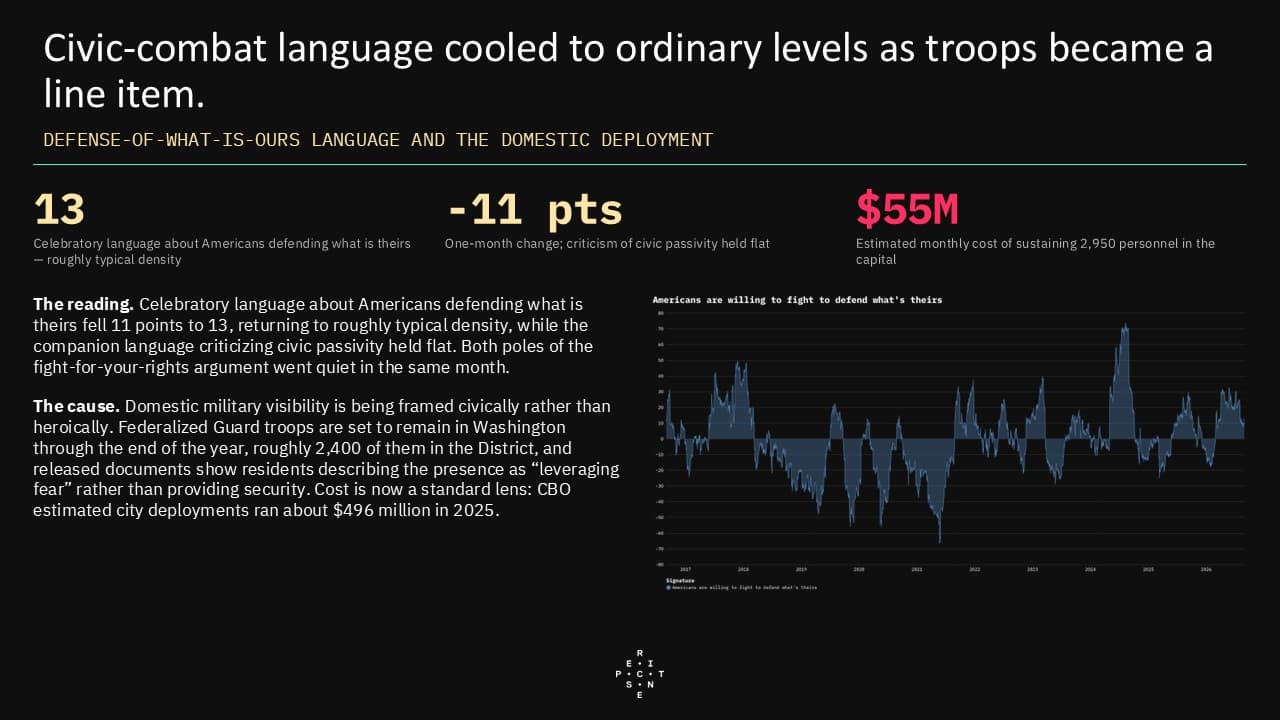
Yet the public's view of the underlying conflict diverges from the media's military confidence. A late April Reuters/Ipsos poll found that just 34 percent of Americans approve of the conflict with Iran, while an Economist/YouGov survey showed that only 30 percent were in support against 59 percent opposed. Our semantic signature tracking language celebrating American willingness to defend property, rights, or values sits at an Index Value of 27, still above average but declining by 3 points. This modest softening may reflect the limits of sustained celebratory defense rhetoric when public appetite for the conflict itself continues to erode. The Pentagon offers the largest single institutional market for AI products, but the widening gap between institutional enthusiasm and public opposition to the war introduces brand and political complexity that will not resolve easily.
Frontier Heritage Language Strengthens as Suburban Comfort Critiques Retreat — Echoing AI's Own "Frontier" Framing
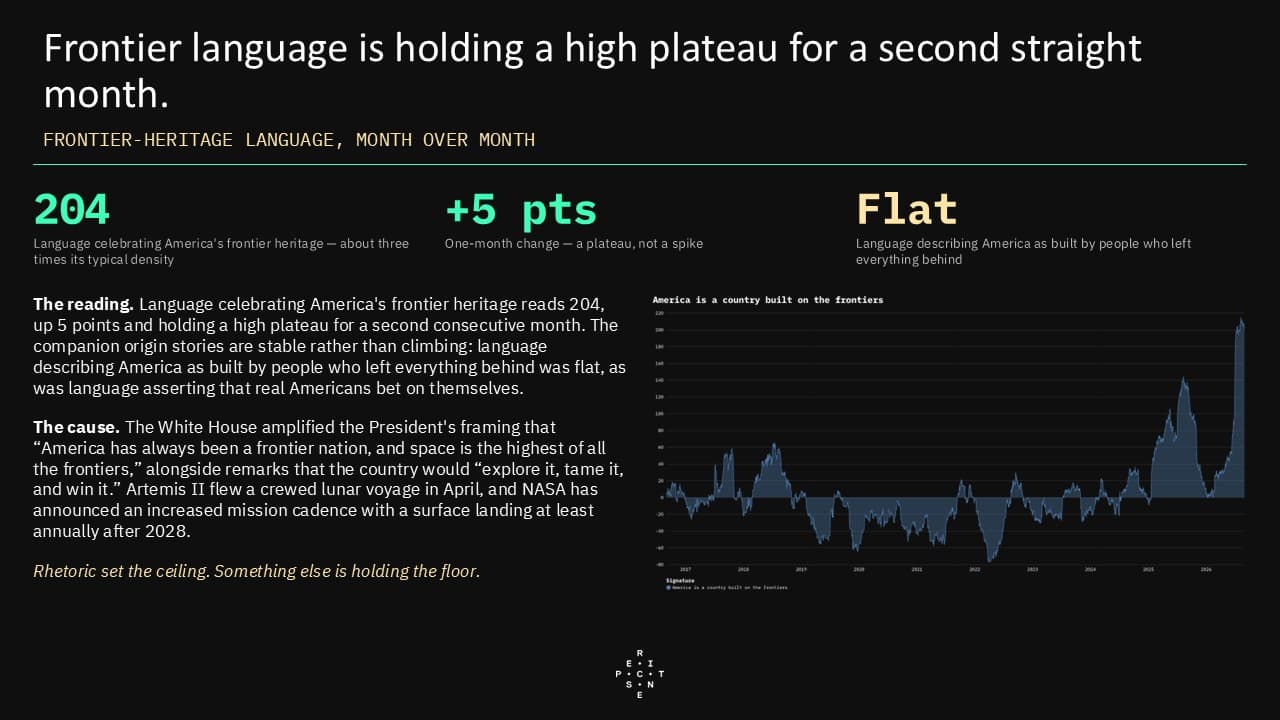
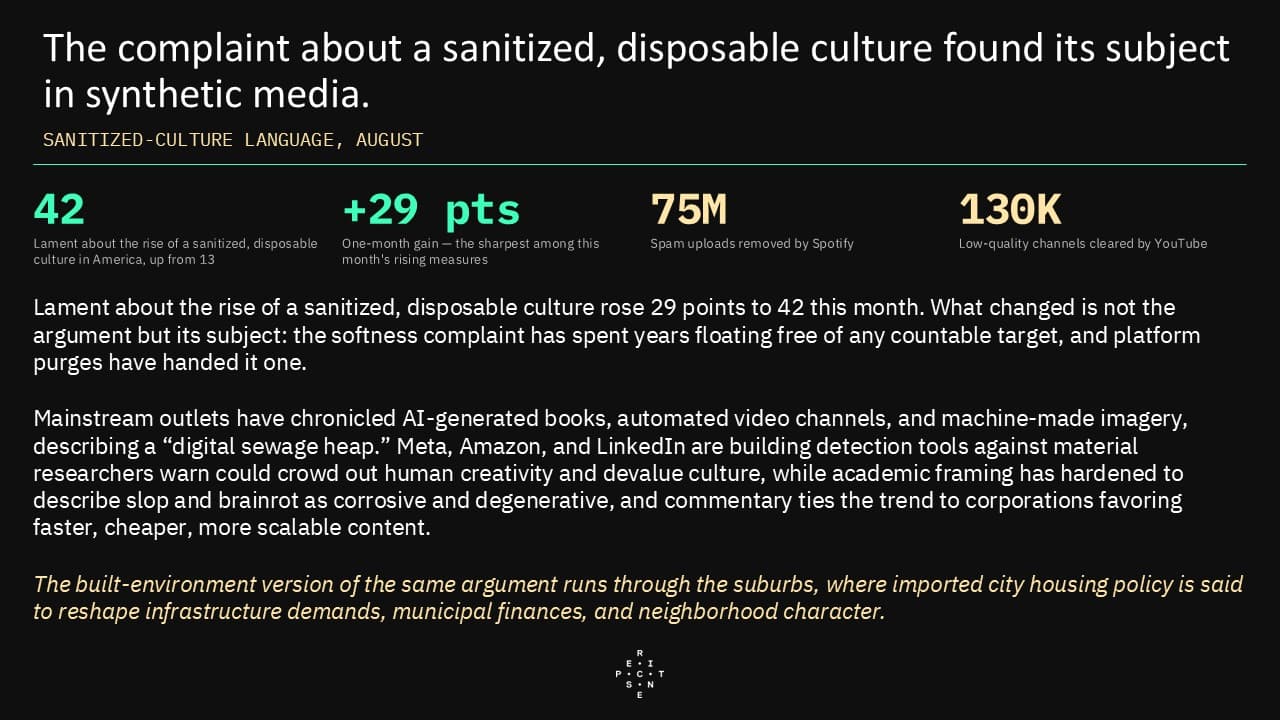
If the military narrative is defined by intensity, the cultural narrative around American identity is defined by movement. Perscient's semantic signature tracking language celebrating America's frontier heritage and spirit reached an Index Value of 41, the second-highest positive reading in the entire dataset, strengthening by 6 points, the largest positive change recorded across all signatures this month. Simultaneously, our semantic signature tracking language lamenting the rise of sanitized, disposable culture in America fell to -18, declining by 11 points, the second-largest drop overall. Media discourse is celebrating America's pioneering self-image while retreating from critiques of suburban uniformity and comfort.
This pivot aligns with the vocabulary of the technology industry itself. The word "frontier" has become the standard designation for the most advanced AI systems. April 2026 was, by some accounts, the most concentrated model release window on record, with major releases from Meta, Anthropic, xAI, Google, and open-source competitors from Alibaba and DeepSeek in a single month. As one observer tracked the pace of change: "In 2024, we were impressed that LLMs could chat well. In 2025, they started to reason. In 2026, they can code, search, see, plan, and act."
This technological framing increasingly borrows the emotional resonance of national heritage. Meta's Frontier AI Framework explicitly ties open-source AI to American identity, stating that open sourcing is "essential for cementing America's position as a leader in technological innovation, economic growth and national security." A senior government official posted on X that "the frontier is not a place on a map. It is a posture. A willingness to build what doesn't exist yet," calling that posture "the DNA of America." Another account traced a direct lineage from 1600s frontier self-reliance to 2020s AI development, arguing that each era "stacked on top" of the previous one, from "frontier mindset" to "venture capital" to "tech platforms."
The frontier concept also carries a defensive dimension. The Trump administration announced a crackdown on Chinese firms "exploiting" U.S. AI models, accusing entities "principally based in China" of industrial-scale distillation of American-made systems. China ordered Meta to unwind its $2 billion acquisition of AI startup Manus, framing AI talent as a national security asset. One social media post noted that the frontier gap between the top U.S. and Chinese models stood at just 18 points, adding: "The AI race is not US vs China anymore. It is infrastructure vs infrastructure." American AI dominance is increasingly cast as a frontier to be guarded, not merely explored.
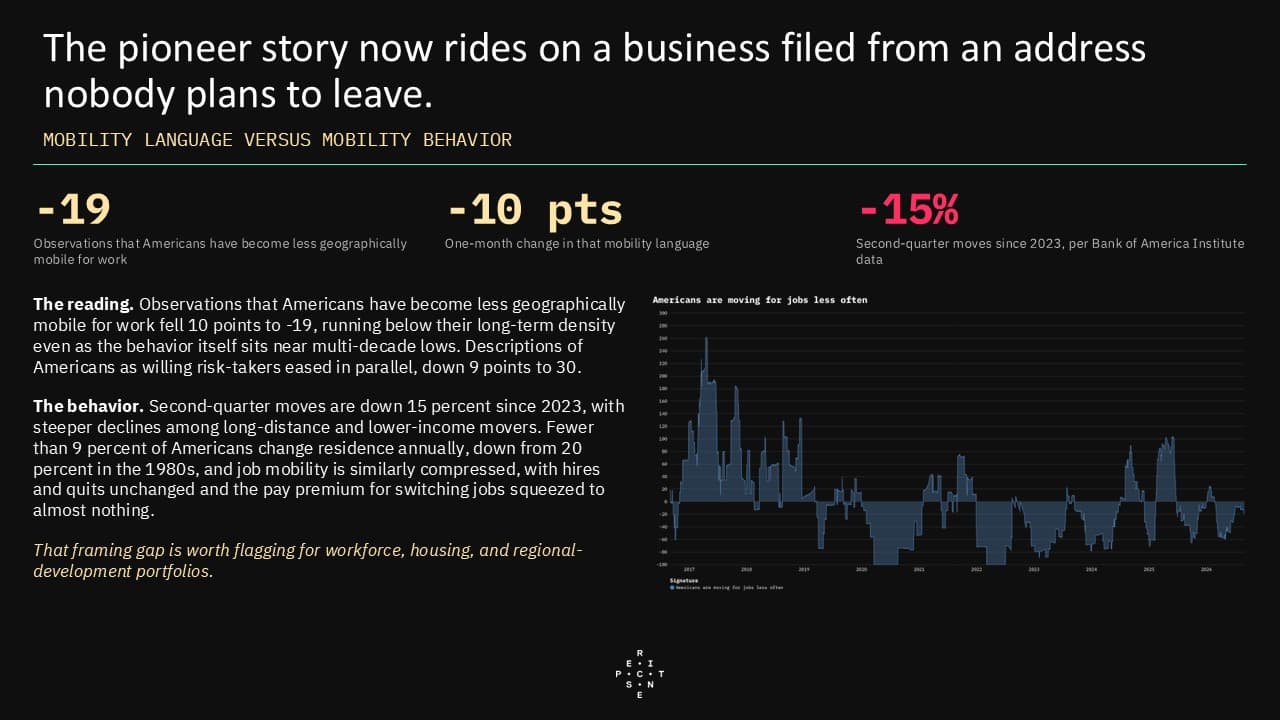
Yet not every dimension of the frontier narrative is strengthening. Our semantic signature tracking language arguing that America was built by risk-takers who left everything behind sits at -23, well below average and flat. Our signature tracking language arguing that geographic mobility for work has declined remains deeply depressed at -59. The frontier narrative currently in ascendance is not the traditional immigration story or one about physical movement across geography. It is centered on institutional and technological pioneering — a redefinition of the frontier concept from place to capability. This convergence between "frontier model" language and deeper frontier mythology embeds AI work within a culturally affirming narrative about national character, potentially sustaining public tolerance for large-scale AI investment even during a period of broader institutional skepticism.
Record Business Formation Meets a Muted Celebration of American Self-Reliance
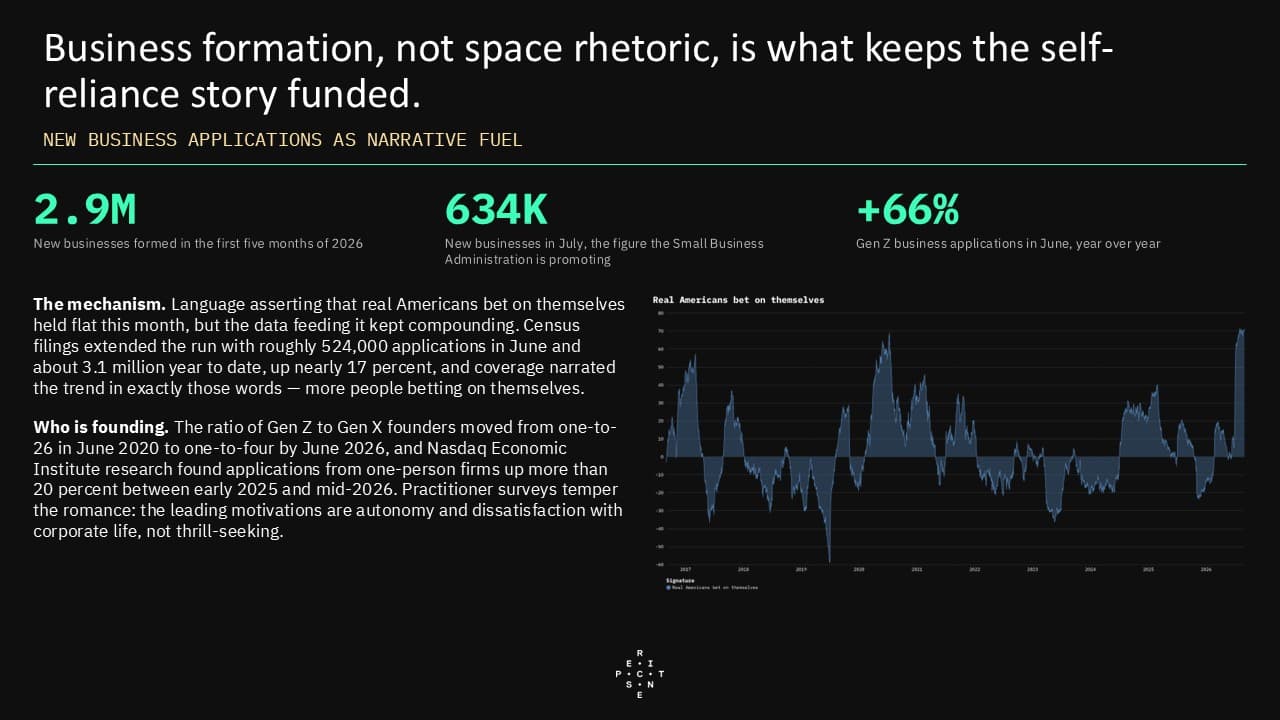
The cultural energy around frontiers and military strength might suggest a parallel confidence in American entrepreneurial identity, but the data tells a more complicated story. New business formation has reached elevated levels: entrepreneurs filed 1.6 million business applications from November through January, the most of any three-month period since at least 2004. One social media account observed that monthly business formation is running above 500,000, roughly double pre-pandemic levels. Yet the semantic signatures tracking how media discusses this activity present a strikingly muted picture.
Perscient's semantic signature tracking language describing Americans as willing to take risks registers at just 2, roughly at its long-term mean and flat. Our signature tracking language arguing that Americans have become risk-averse sits at -8, also about average and flat. Neither the celebration nor the critique of American risk appetite is particularly pronounced in current media. Our signature tracking language asserting that true Americans have faith in their own abilities declined to an Index Value of 9, down by 4 points. The media narrative of confident, self-reliant American identity is receding even as raw business formation numbers reach new peaks.
Instead, there is a slight uptick in a different tone. Our semantic signature tracking language criticizing Americans for prioritizing comfort over ambition rose modestly to 6, up by 2 points. This combination suggests that media may be casting current entrepreneurial activity less as bold American ambition and more as a response to displacement. CNBC reported that 20,000 job cuts at Meta and Microsoft have raised concerns about an AI-driven labor crisis. The Guardian profiled Gen Z workers skipping the entry level to become their own CEOs because AI is erasing the bottom rungs of the corporate ladder. A widely shared social media post catalogued post-layoff entrepreneurship data, noting that 80,000 tech workers were laid off in Q1 2026, that post-layoff business starts were up by 67 percent, and that 43 percent of these new founders found paying customers within a month.
A New York Times opinion piece quoted a 23-year-old Stanford dropout who characterized this year as a human's "last chance to be a part of the innovation." The Christensen Institute framed AI as fundamentally restructuring the risk calculus, arguing that "the option to try becomes widely available in a way it simply wasn't before," but also warned that "we will send a generation of students into an AI-transformed economy superbly trained in the old game, just as the old game is shrinking." The Babson-based GEM U.S. report found that established business ownership has been cut roughly in half since 2019, from 10.6 percent to 5.5 percent, even as early-stage activity climbs.
This gap between record business formation and muted self-reliance narratives carries strategic weight. If Americans are adopting AI tools primarily as an adaptive response to labor market disruption rather than as an expression of entrepreneurial confidence, the public narrative around these products may drift toward framing them as necessities born of insecurity. Posts celebrating AI side hustles generating $5,000 to $15,000 per month and platforms that let you form an LLC inside an AI chat capture both the promise and the precariousness: the tools are powerful, but the motivation for using them may say as much about what workers have lost as what they hope to gain.
Archived Pulse
April 2026
- Military Superiority Narratives Surge Amid Pentagon's AI-First Strategy and Active Combat Operations
- Civic Combativeness Rises as Fear of Standing Up Declines Sharply
- Economic Stability Replaces Geographic Mobility as Americans Bet on Themselves in Place
March 2026
- Military Supremacy Narrative Reaches New Heights as AI Becomes the Defining Battleground
- America's Pioneer Mythology Reimagined
- AI Homogenization Enters the Research Mainstream
February 2026
- Protests Surge Amid Rising Fears About Fighting for Rights
- American Risk-Taking and Mobility Narratives Show Divergent Trends
- Military Confidence Remains Strong Despite Readiness Concerns
January 2026
- Military Confidence Strengthens as Criticism Fades
- Overprotective Parenting Narratives Retreat Sharply
- Employment Risk-Taking Narratives Show Mixed Signals Amid Job Market Concerns
December 2025
- Military Narrative Strengthens as Risk-Taking Language Moderates
- Helicopter Parenting Concerns Decline but they’re Still Hovering Over Their Kids to College
- Frontier Heritage Language Weakens as Defense Narratives Diverge
November 2025
- Military Confidence Reaches Historic Peak
- Civic Activism Surges as Americans Mobilize to Defend Rights
- Parenting Anxieties Intensify as Helicopter Parenting Concerns Decline
Pulse is your AI analyst built on Perscient technology, summarizing the major changes and evolving narratives across our Storyboard signatures, and synthesizing that analysis with illustrative news articles and high-impact social media posts.