Hot Rocks
August 30, 2018·Money
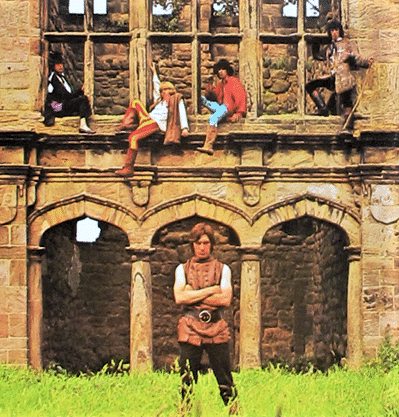
This is my 250th Epsilon Theory post. Yow! While there's no getting around some repetitiveness on the major themes of ET, like the Narrative Machine or the Common Knowledge Game or the Three-Body Problem, I do my best to keep the story arcs fresh by not repeating myself in the ephemera - the movie quotes and graphics and the like. But there's one quote that I've used three separate times, and two graphics that pop up again and again. So for this 250th note I thought I'd call out these Hot Rocks of Epsilon Theory.
[And yes, one day I fully intend to rent out Swarkestone Pavilion and recreate this Stones pic with the Epsilon Theory band. It'll be Rusty in the foreground ... he is the drummer, after all. Jeremy and I are more the peacock-in-the-window type.]
Here's the quote:
Shape clay into a vessel;
It is the space within that makes it useful.
Cut doors and windows for a room;
It is the holes which make it useful.
Therefore benefit comes from what is there;
Usefulness from what is not there.
Lao Tzu (c. 530 BC)
I've used this quote in "The Tao of Portfolio Management", "Who's Being Naive, Kay?" and "The Arborist", three notes that speak directly to portfolio construction. A portfolio is, after all, a vessel. It is a container for our financial investments, and what we leave OUT of that container is every bit as important as what we put IN.
But the wisdom of this quote goes way beyond investing. Our homes, our businesses, our friendships, our marriages, our children … our lives themselves ... vessels all.
Not every empty space needs filling.
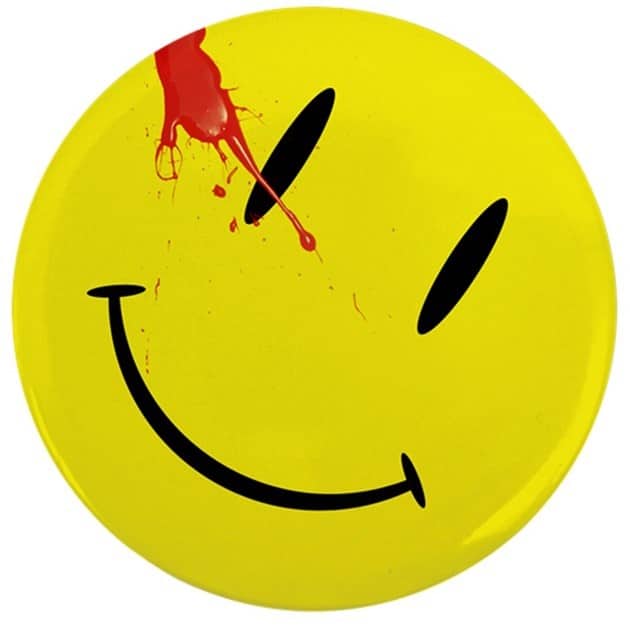
And here's the first graphic that I've used repeatedly in Epsilon Theory notes, ad-man Harvey Ball's 1963 smiley-face button, brilliantly adapted by Alan Moore and Dave Gibbon for their classic graphic novel, Watchmen:
Watchmen is one of those life-informing books, or at least it was for me. This button, worn by the Comedian, a villainous hero or heroic villain (it’s hard to tell), is my personal emblem of smiley-face authoritarianism, aka the Nudging State. It’s just so messy to stomp on someone’s face when you can cleanly accomplish the same ends with “choice architecture” and “communication policy”.
It’s all Fiat News all the time today, where opinion is presented as fact, and we are all shamed into compliance.
And here's the second image I've used a couple of times in ET notes, originally in "Stalking Horse" and most recently in "Fiat Money, Fiat News."
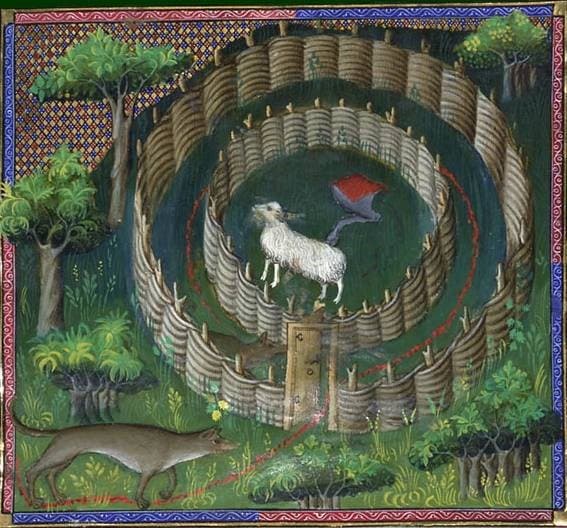
It’s an illustration of a wolf trap from Le Livre de la Chasse (c. 1407). It’s a pretty simple design, consisting of a blood trail set through a one-way door in a circular wicker fence built around a central pen with a scared, bleating sheep, but man, is it effective. The design has three crucial elements. First, the circular outer wall is hard for the wolf to escape if he gets wise to the trap, and the circular inner wall keeps the live bait … alive. Second, wolves expect to hunt and track their prey. By establishing a longer trail that must be navigated successfully the wolf becomes more committed to the trap the farther he goes. Third and most importantly, the design prevents the wolves from seeing each other until they get to the end of the blood trail, at which point it’s too late to escape what they now know is a trap.
I think the medieval wolf trap is an almost perfect metaphor for the way that the Nudging State and the Nudging Oligarchy operate. No one forces us to watch CNBC. No one forces us to use social media. No one forces us to nod sagely at the Fed's every word. No one forces half of us to go into a berzerker rage over every Trump tweet and the other half to go into a MAGA apoplexy over every CNN segment. No, we're much too smart and much too independent to ever fall for a trap like that.
I've said it before and I'll say it again ... I’m pretty sure this painting now hangs in Mark Zuckerberg’s office.


Comments
Start the discussion at the Epsilon Theory Forum...