Institutions Pulse
March 24, 2026·0 comments·Politics
Executive Authority Under Scrutiny as Courts Check Presidential Power, Congress Fractures, and Military Operations Reshape the Political Arena
Executive Summary
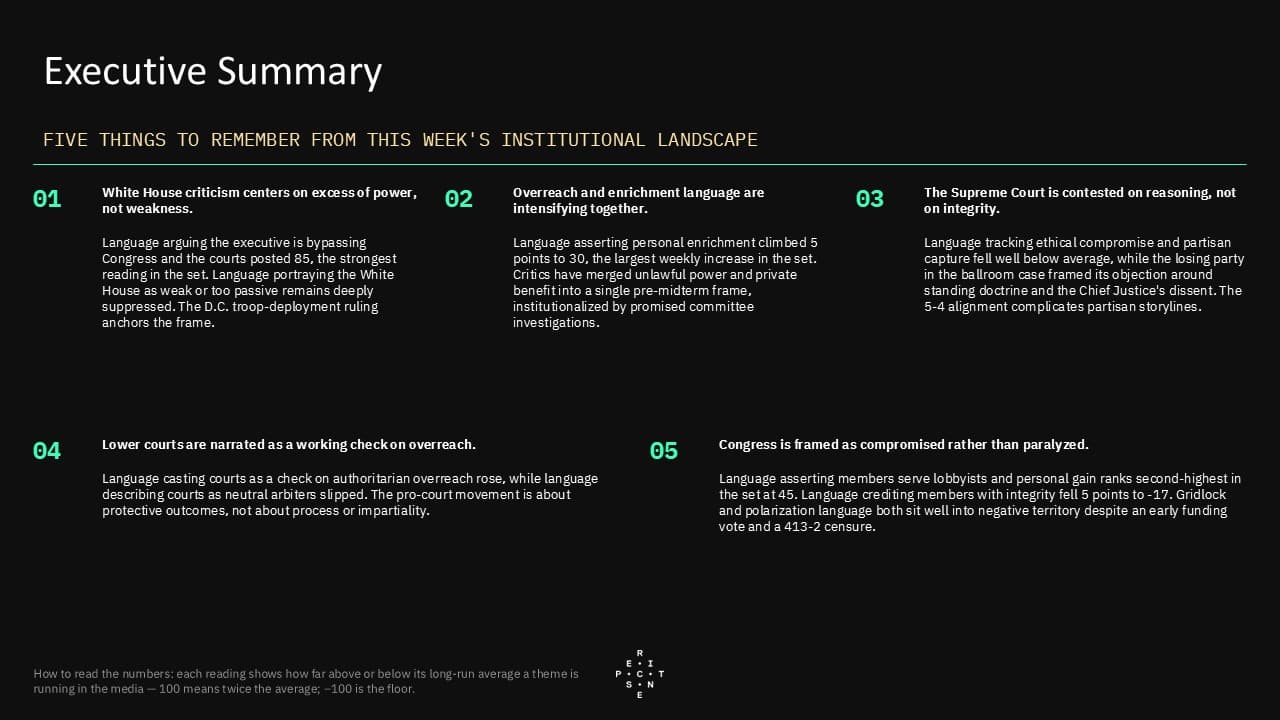
- The Supreme Court's cross-ideological tariff ruling has become the single most powerful accelerant of executive overreach coverage in our measurement universe. The 6-3 decision invalidating presidential tariffs drew a coalition spanning from Gorsuch to Kagan, and media language describing presidential overreach is now running at nearly three times its long-term average density. The administration's immediate pivot to an alternative statutory authority reinforced rather than dampened the overreach frame. Meanwhile, language framing judicial intervention as institutionally appropriate strengthened, while language accusing courts of overstepping declined—suggesting that the media environment broadly endorses this particular check on executive power.
- Congress is being depicted as unable to absorb the legislative responsibility that the Court's ruling demands. Bipartisanship language registered its largest single-month decline of any signature in our universe, falling well below average alongside a parallel drop in legislative effectiveness language. Coverage emphasizes dysfunction and gridlock rather than sharp ideological confrontation, driven by redistricting that has made districts less competitive and by intraparty Republican divisions that have stalled reconciliation and appropriations alike. The tariff ruling's requirement that Congress cast recorded votes on trade policy arrives at precisely the moment when media coverage portrays the legislature as least capable of doing so.
- Military honor language surged back above its long-term average following the launch of strikes on Iran, but it coexists with one of the most elevated counter-narratives in our entire measurement universe. Language praising the armed forces posted the second-largest positive monthly change of any signature, propelled by the largest Middle East buildup since 2003 and coordinated airstrikes that killed Iran's Supreme Leader. Yet language arguing that the military is being politicized or deployed inappropriately remains at an extraordinarily elevated level—the second-highest absolute reading we track. The media is simultaneously rallying behind service members and deeply divided over the purposes for which they are being sent into harm's way.
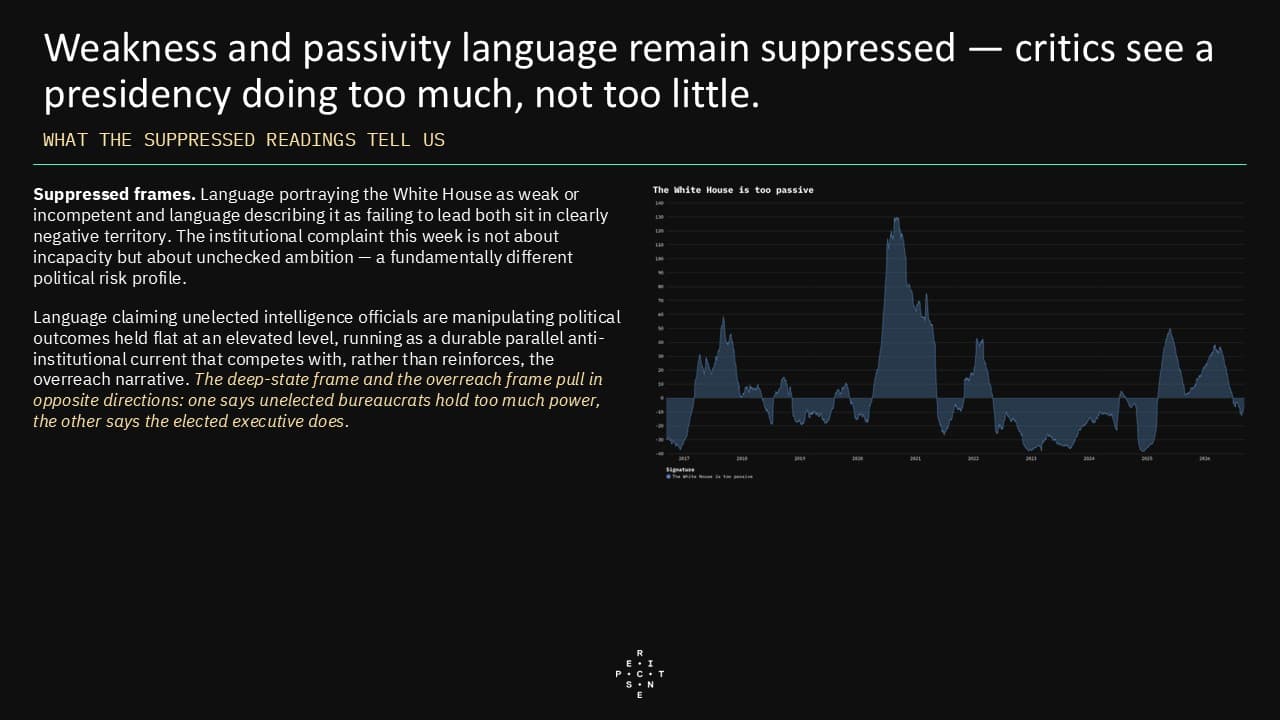
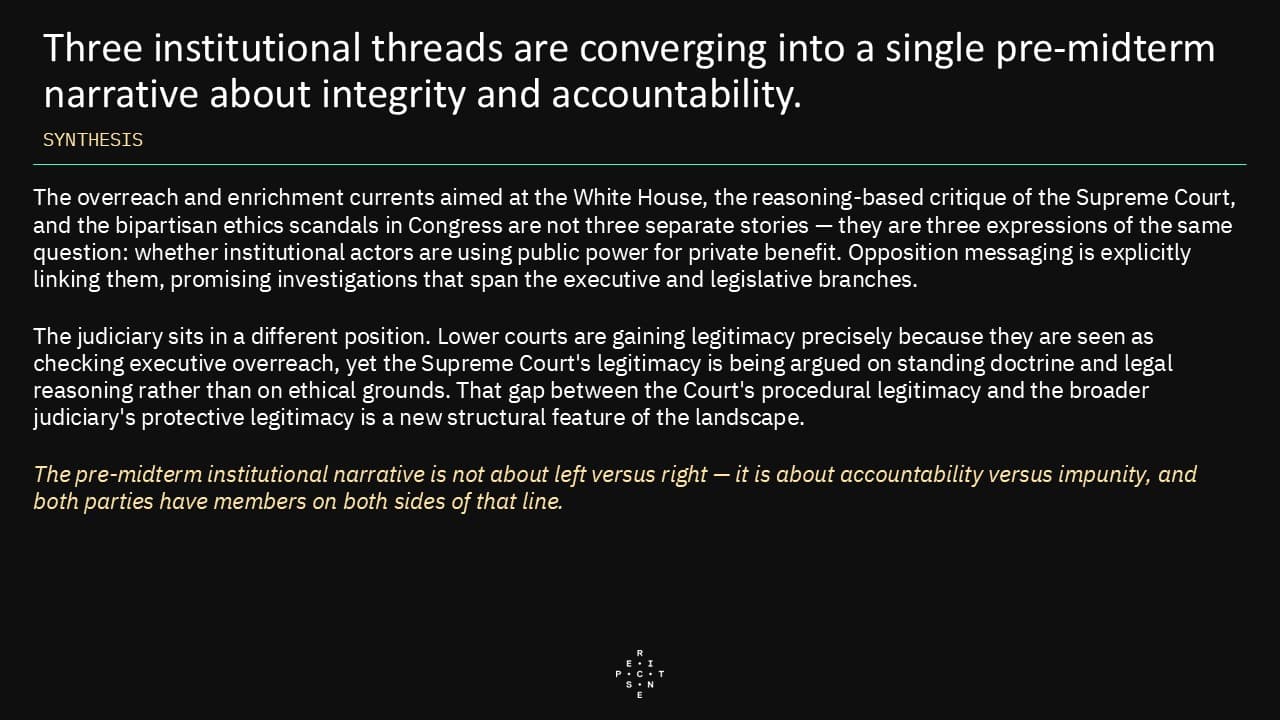
- Across all three branches, the overarching media frame is one of institutional stress and fragmentation. Executive authority is being judicially curtailed, legislative capacity is hollowed out by structural polarization, and major military operations are proceeding amid what reporters describe as minimal public debate or congressional authorization. Security-institution language is similarly fractured, with simultaneous increases in calls for stricter law enforcement and claims that law enforcement has retreated from its duties. The convergence of these trends raises a central question for the months ahead: whether the Iran escalation and the tariff ruling's reallocation of trade authority to Congress will force bipartisan engagement or merely deepen the dysfunction that current coverage describes.
---
The Supreme Court Strikes at Executive Power While White House Authority Narrative Reaches Extraordinary Levels
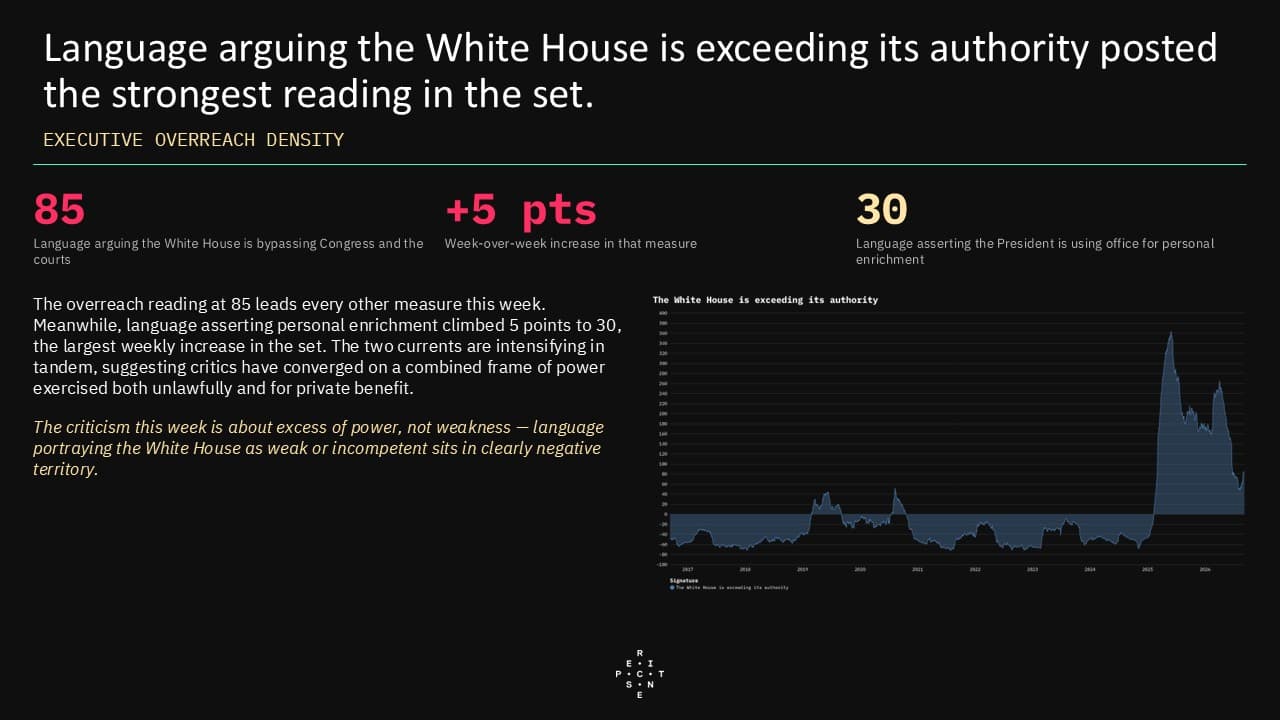
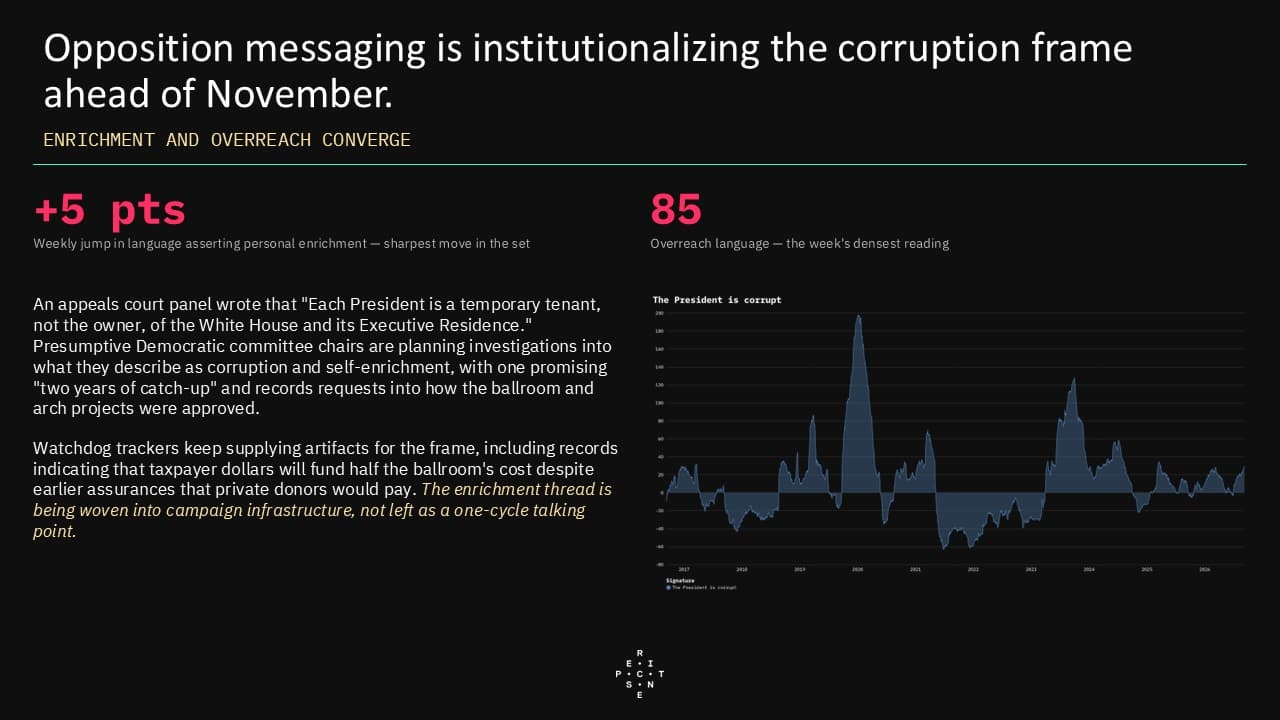
Perscient's semantic signature tracking the density of language arguing that the White House is bypassing Congress or the Courts to exercise power it does not legally possess registered an Index Value of 270 this month, the highest reading of any signature in our measurement universe, and up by 39 points from the prior period. That figure means that media language describing presidential overreach is running nearly three times its long-term average density and continues to accelerate. The catalyst is unmistakable: on February 20, the Supreme Court issued a 6-3 decision striking down President Trump's sweeping tariffs, ruling that the International Emergency Economic Powers Act does not authorize the president to impose import duties without clear congressional authorization. Chief Justice Roberts authored the opinion, joined by Justices Sotomayor, Kagan, Gorsuch, Barrett, and Jackson, a cross-ideological coalition that lent the ruling particular weight. The Wall Street Journal reported that the 6-3 decision removes a diplomatic tool that Trump had aggressively wielded to reshape U.S. trade relationships. The ruling invalidated both the "Reciprocal Tariffs" first imposed in April 2025 and the "Trafficking and Immigration Tariffs" tied to fentanyl enforcement.
The administration's response was swift. Within hours, Trump signed a proclamation imposing a new 10% global tariff under Section 122 of the Trade Act of 1974, effective February 24 and carrying a 150-day time limit. The Washington Post's editorial board noted that the ruling constrained the president's ability to impose tariffs against whatever country he liked, for whatever reason, but that the administration raced past the decision with striking speed. On social media, Axios journalist Jim VandeHei called it the "biggest, most sweeping rebuke of his presidency", while historian Simon Schama suggested that the decision could challenge not just tariff-related executive orders but other emergency-powers invocations as well.
The judicial check arrives against a backdrop of extensive unilateral action. As of mid-March 2026, President Trump had signed 250 executive orders, 58 memoranda, and 133 proclamations in his second term, a volume that provides a factual foundation for the elevated overreach narrative. Additionally, the White House Chief of Staff's casual acknowledgement that the president is engaged in prosecutorial "score settling" has drawn criticism from The Fulcrum and others who describe retaliatory investigations and security clearance removals as departures from rule-of-law norms.
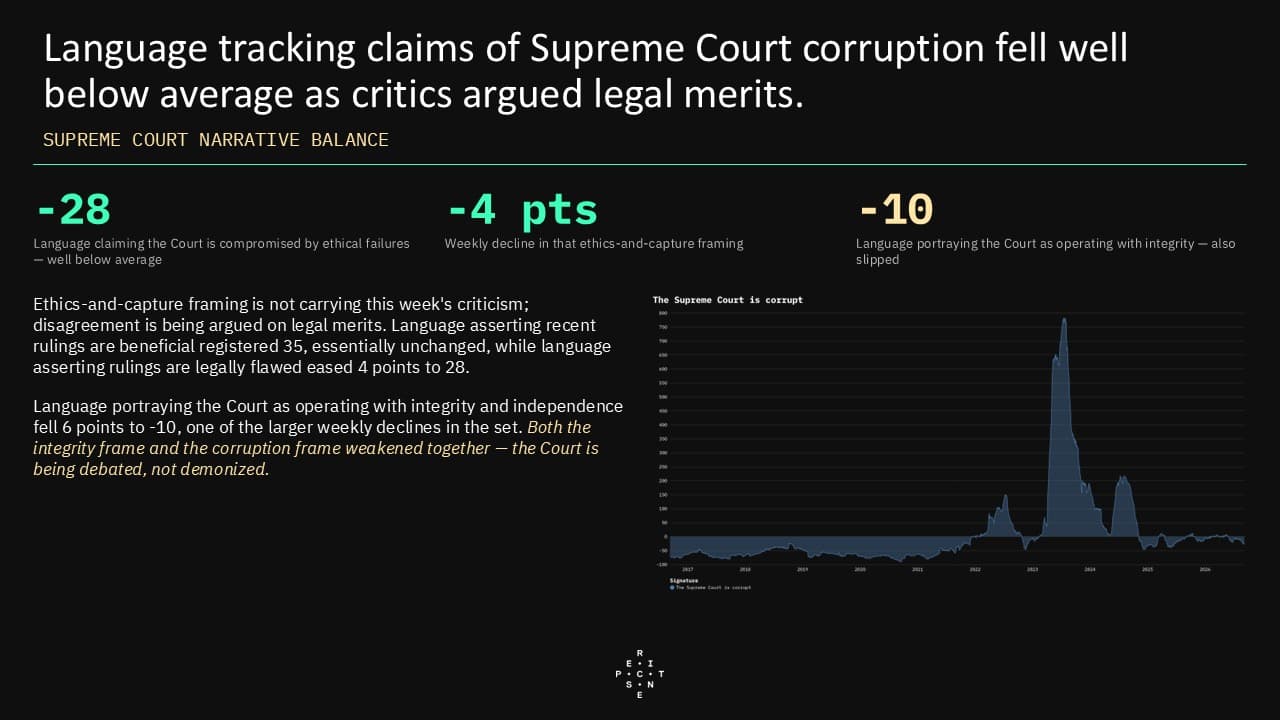
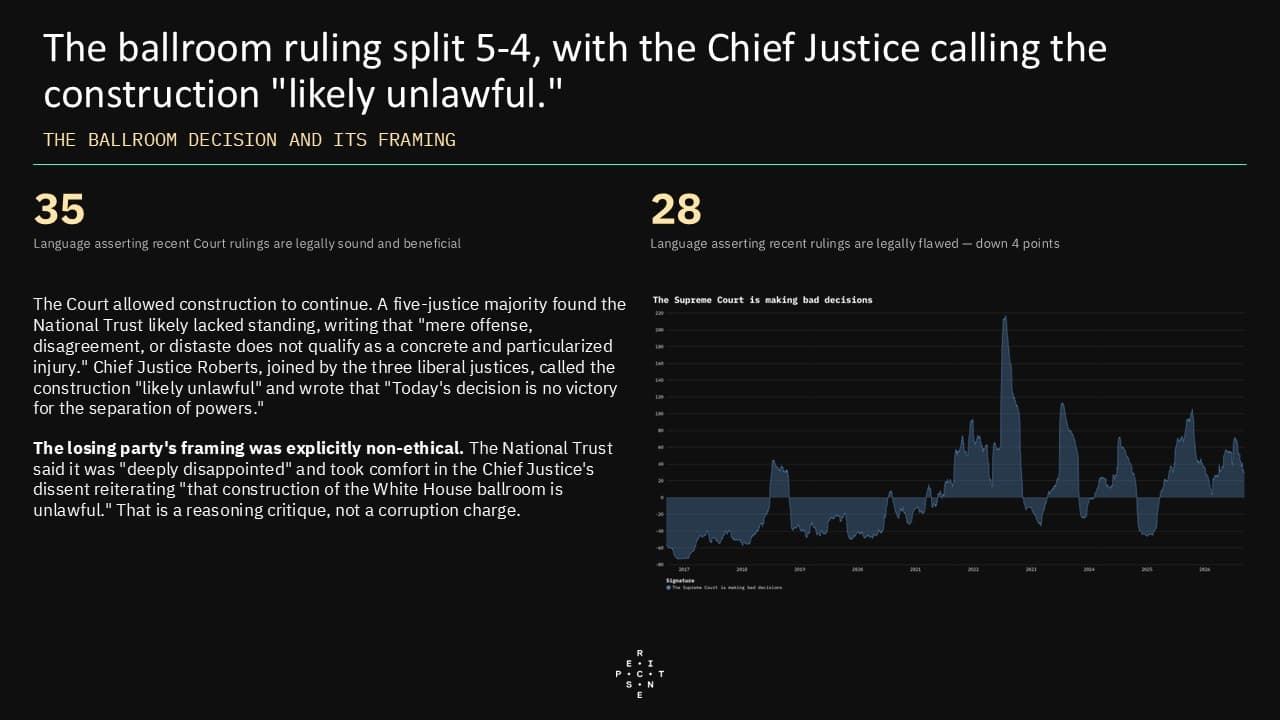
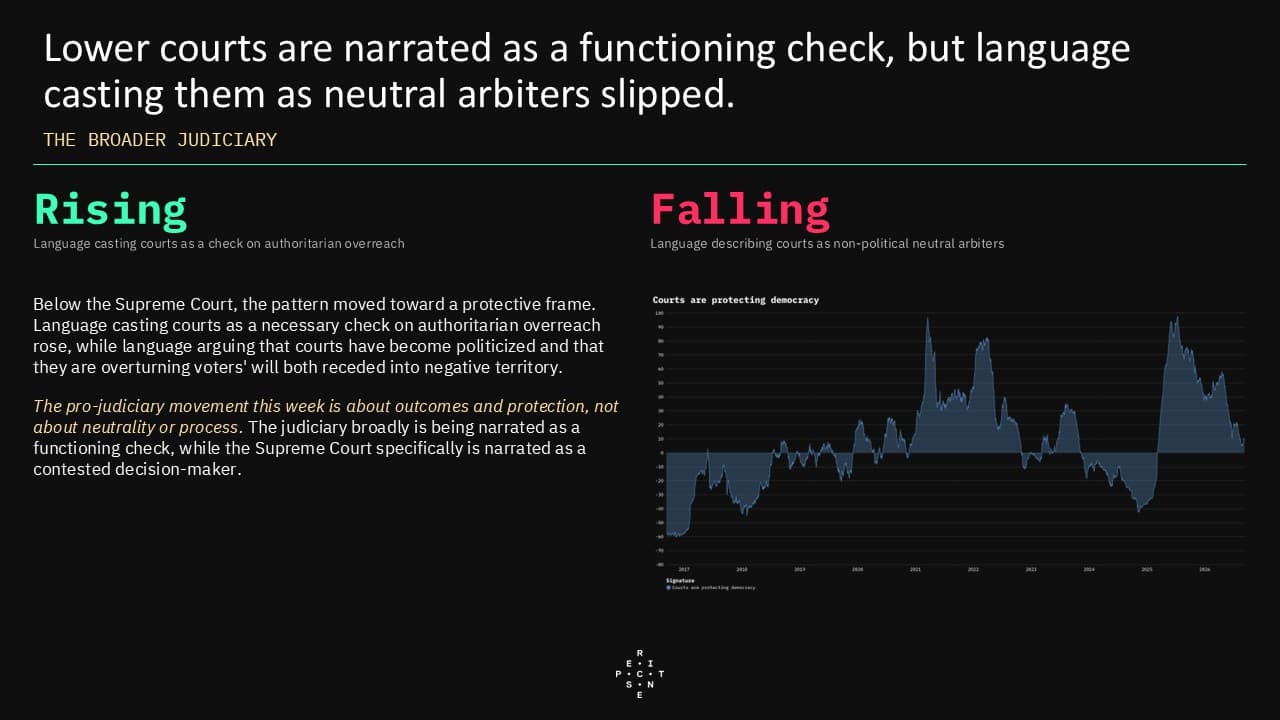
Our signature tracking the density of language asserting that the Supreme Court operates with integrity and independence rose by 17 points to an Index Value of 31, the largest monthly increase among court-related signatures. At the same time, Perscient's signature tracking language asserting that recent rulings are legally flawed rose by 7 points to 28. This divergence suggests that the tariff ruling is being praised by some constituencies and criticized by others, producing elevated discussion on both sides. Meanwhile, language arguing that courts are serving as a necessary check on authoritarian overreach held steady at 53, while our signature tracking arguments that courts are overstepping their authority and overturning the will of voters declined by 9 points to 12. Taken together, the data describes a media environment where judicial restraint of executive power is being broadly framed as institutionally appropriate. The ruling also introduces an important electoral wrinkle: it places tariff accountability squarely on Congress, requiring members to cast recorded votes on trade policy just months before the midterms.
Bipartisan Language Collapses as Congress Confronts Internal Divisions and Institutional Weakness
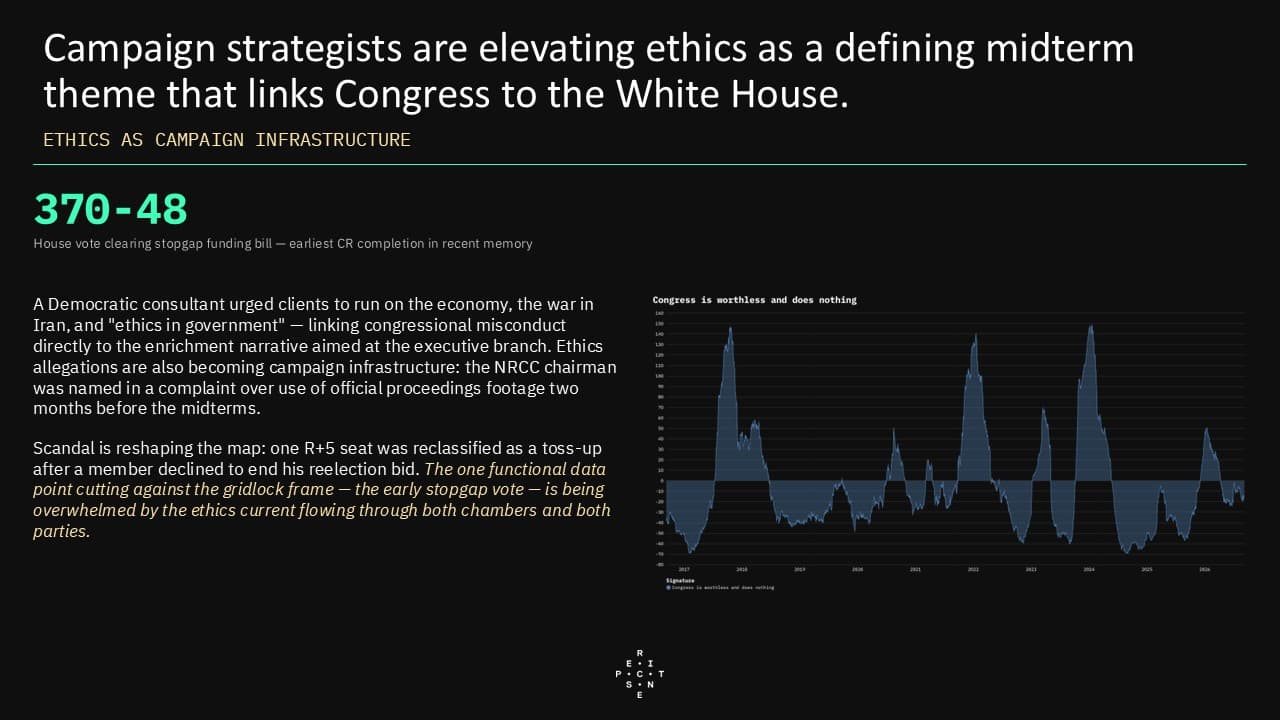
If the Supreme Court's intervention rebalances power toward the legislature, Congress appears poorly positioned to receive it. Perscient's semantic signature tracking language asserting that members of Congress are working across party lines registered the single largest monthly decline of any measured signature, falling by 24 points to an Index Value of -9, meaning that descriptions of congressional bipartisanship have dropped well below their long-term average. Our signature tracking language asserting that Congress is successfully passing laws or taking actions that benefit the citizenry declined by 15 points in tandem, to an Index Value of -26. Both readings are now below average and falling together, painting a picture of a legislature that is neither cooperating nor producing.
The structural reasons are becoming clearer. NPR's February analysis of mid-decade redistricting found that the nationwide push to redraw congressional maps has not delivered a meaningful seat advantage to either party, but has created less competitive districts, reducing the electoral incentive for cross-aisle collaboration. Redistricting analyst David Wasserman told NPR that new lines in California and Texas are driving most of the change: "blue states' delegations are becoming bluer, red states' delegations are becoming redder. And there are fewer opportunities for bipartisan dialogue." On social media, one analyst noted that the net nationwide result of the 2025-26 redistricting cycle may amount to just a single additional Democratic seat, "potentially a massive own-goal by the GOP."
Within the Republican conference, internal divisions have stalled the legislative agenda. The Hill reported that President Trump does not appear eager for Congress to undertake another ambitious reconciliation effort, a tacit recognition that he is unlikely to muster the near-unanimous votes needed given a slim 218-214 House majority and Republican incumbents in swing states worried about attack ads. However, Politico detailed that some lawmakers are insisting on pushing ahead with another party-line megabill, brushing off the president's comments that "we've gotten everything passed that we need." The intraparty fissure extended to appropriations, where The Dispatch reported that relations between the parties were so strained that even the traditionally deal-brokering appropriators seemed unable to find common ground, and OMB Director Russell Vought explicitly wished for a "less bipartisan" appropriations process.
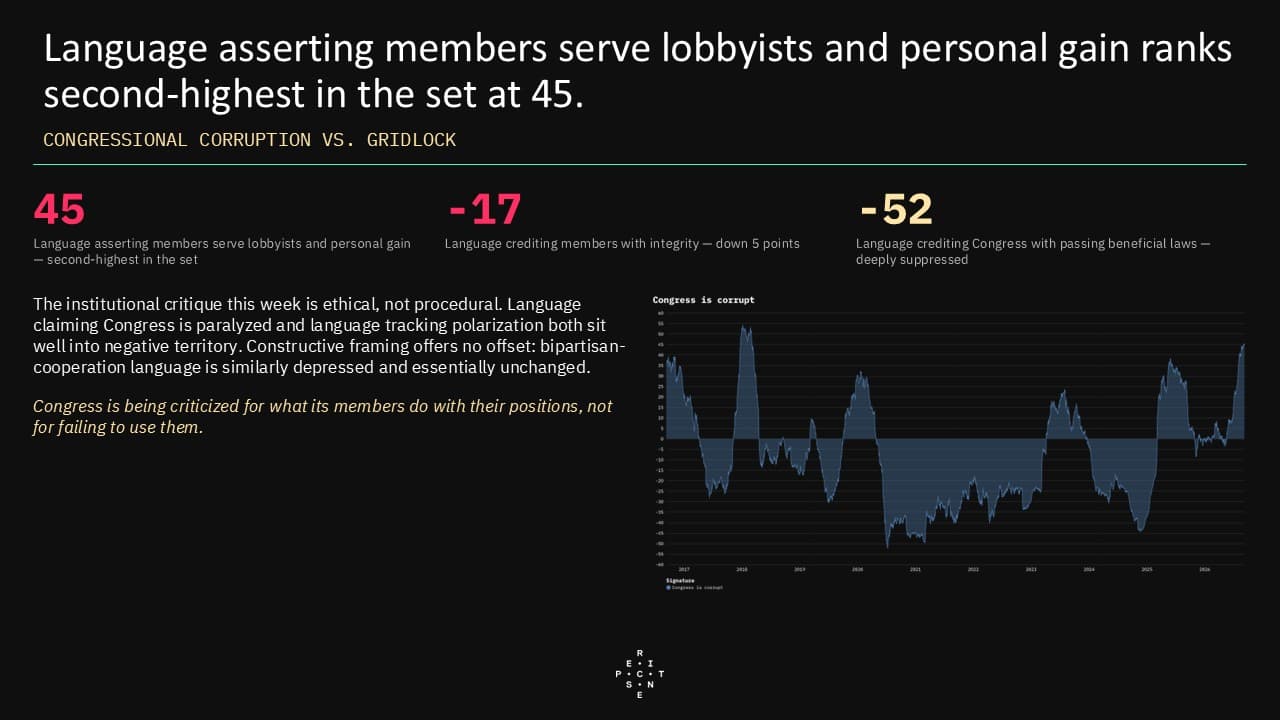
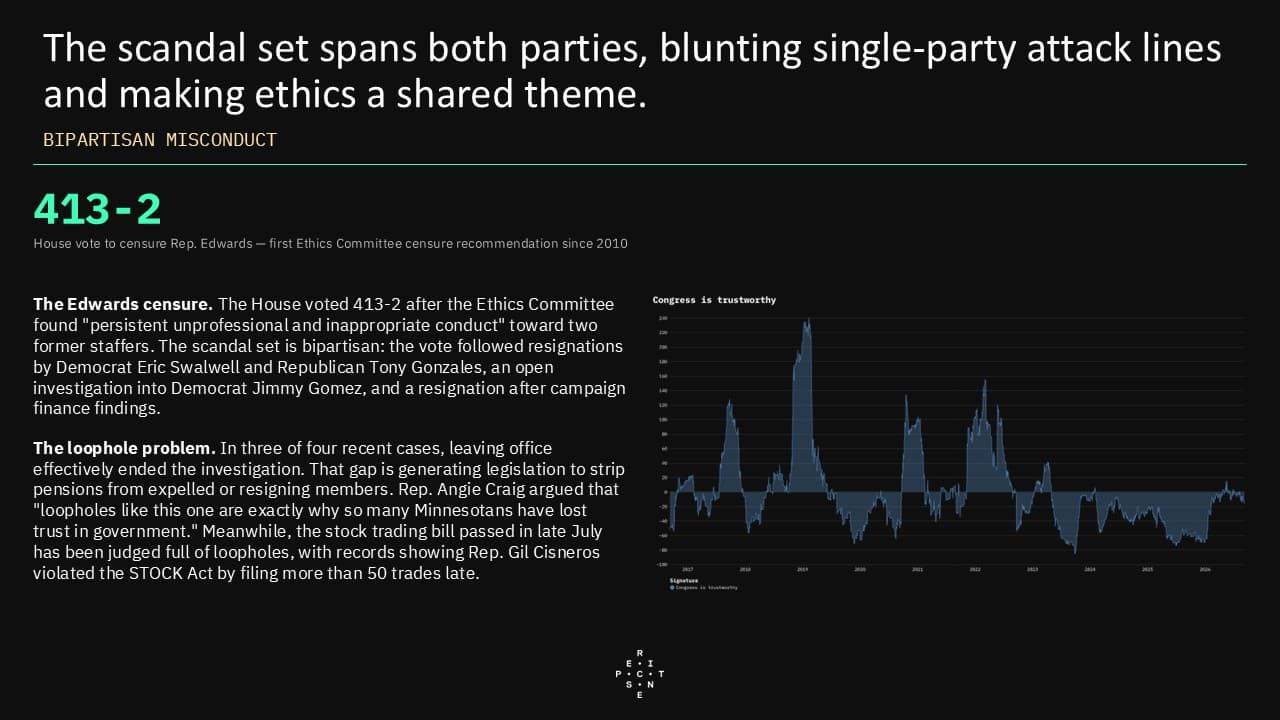
Our signature tracking language asserting that Congress is completely polarized declined by 7 points to -26, which may seem counterintuitive alongside the collapse in bipartisanship language, but the two movements together suggest that Congress is being covered with an emphasis on dysfunction and gridlock rather than ideological combat. Language asserting that Congress is paralyzed or failing to address the country's needs remains elevated at an Index Value of 19, even though it declined by 8 points from last month. Our signature tracking language asserting that members of Congress are acting with integrity rose by 7 points but remains below average at -6, while language asserting that members are beholden to lobbyists and special interests rose by 4 points to 6. This combination offers no clear path to institutional rehabilitation. The social media environment reflected this mood: one viral thread from Rep. Chip Roy's floor speech captured a sentiment that "Congress is literally failing the American people," while another user wrote bluntly that Congress "has created a system that enables the worst among us to get elected and stay elected forever." The data points toward an environment where running against Washington dysfunction remains a viable posture. The question is whether military operations at the end of February will force either bipartisan cooperation or its conspicuous absence on matters of war and peace.
Military Honor Rises Sharply Amid War Preparations and Ongoing Debate Over the Use of American Forces
Perscient's semantic signature tracking language praising U.S. armed forces for their sacrifice, competence, and role as defenders of freedom registered the second-largest positive monthly change of any signature, rising by 28 points to an Index Value of 4, crossing back above the long-term average after sitting at -24 the prior month. This shift coincides directly with the late-February military escalation toward Iran. On February 28, the United States and Israel launched coordinated airstrikes on multiple sites across Iran, killing Supreme Leader Ali Khamenei and several other officials, following what was described as the largest U.S. military buildup in the Middle East since the 2003 invasion of Iraq. The New York Times reported on dozens of refueling tankers, more than 50 additional fighter jets, and dual aircraft carrier deployments, while the Washington Post documented that the Pentagon was assembling its largest regional force in decades. During the February 24 State of the Union address, Trump accused Iran of reviving efforts to build nuclear weapons and developing advanced missile capabilities "that can threaten Europe and our bases overseas," framing military readiness as essential to national security.
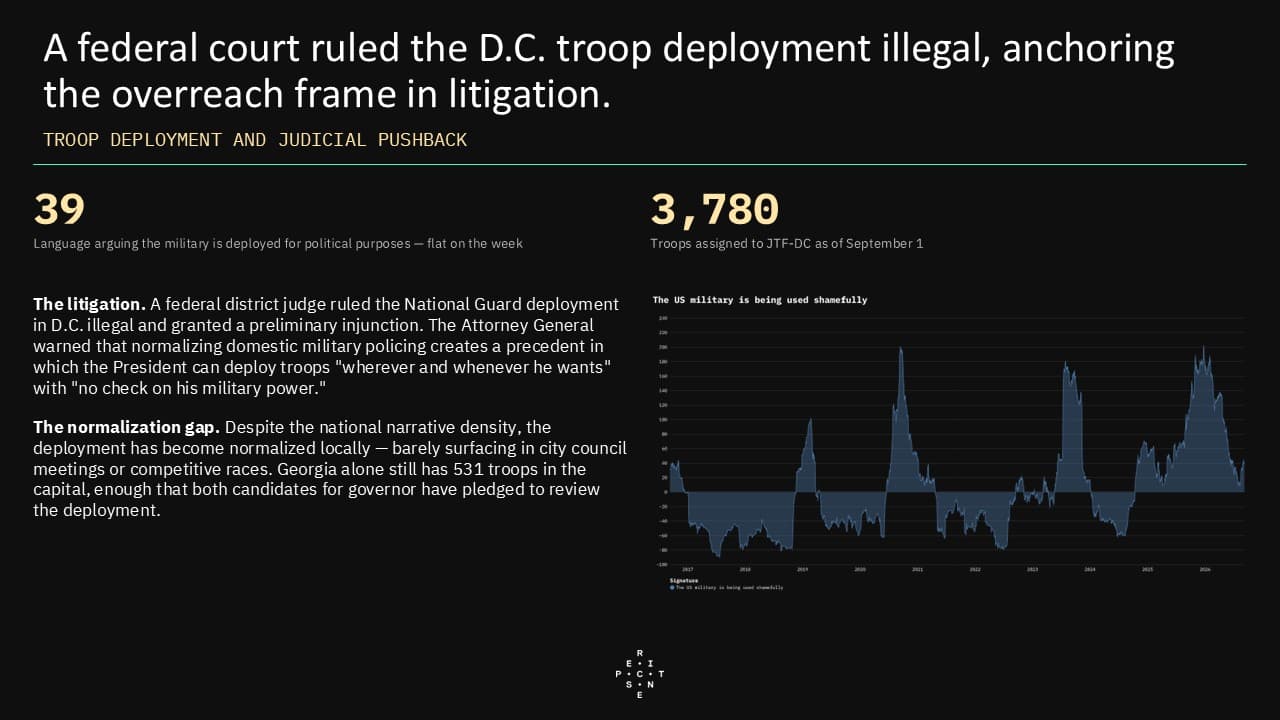
Yet the rising honor narrative exists alongside a persistently intense counter-narrative. Our signature tracking language arguing that U.S. armed forces are being politicized or deployed inappropriately for political purposes remains at an Index Value of 136, the second-highest absolute reading of any signature in our measurement universe, though it declined by 16 points from last month. Institutional respect for the military is strengthening, but debate over the purposes for which it is being deployed remains deeply contentious. New York Times journalist David Sanger's discussion on NPR explored both the state of Iran's nuclear program and the public divisions over whether the deployments honor or misuse American forces. On social media, New York Times reporter Trip Gabriel noted that "rarely in modern times has the United States prepared to conduct a major act of war with so little explanation and so little public debate."
The domestic dimension of military use continues to fuel this counter-narrative. Trump's National Guard deployments to Democratic-led cities as part of immigration crackdowns have drawn sustained criticism. Senator Tammy Duckworth cited a $496 million price tag for domestic military deployments, while Senator Elizabeth Warren noted that continuing deployments would cost $93 million monthly. Capital B News detailed how the crackdown in Minneapolis, which included two fatal shootings and thousands of arrests involving National Guard troops, became an epicenter of criticism. The legal contest over military command integrity continues: last November, six Democratic members of Congress appeared in a video telling service members they "can refuse illegal orders," and in February a judge granted a preliminary injunction against Defense Secretary Hegseth on First Amendment grounds, intensifying debates about the chain of command.
Broader security-institution signatures round out the picture. Our signature tracking language asserting that unelected intelligence officials are manipulating political outcomes rose by 8 points to an Index Value of 12. Language arguing that police and federal agents are failing to control crime or have retreated from their duties rose by 6 points to 34, while our signature tracking language arguing for the stricter application of existing statutes rose by 6 points to 14. The simultaneous upward movement in both "enforce the laws" and "law enforcement no longer protects us" signatures reflects a contested terrain where security institutions are being discussed through competing lenses of protective authority and unchecked overreach.
Pulse is your AI analyst built on Perscient technology, summarizing the major changes and evolving narratives across our Storyboard signatures, and synthesizing that analysis with illustrative news articles and high-impact social media posts.