
Investment Diligence and the Cornelius Effect
October 18, 2018·Jobs and School

Earlier this week Ben wrote a note about the Curse of Some Talent. There is a related idea that comes with a story. This is one of my favorite stories. It recounts a seminal event from the earliest days of Saturday Night Live.
The inaugural cast was a gifted one. If, like me, you weren't there, it included John Belushi, Gilda Radner and Dan Aykroyd, among other generational talents. It also included Chevy Chase. His stint would be brief. After one full season in 1975 and a few episodes in the 1976 season, Chevy left the show. He claimed that he did so because his fiancée wasn’t willing to live in New York, which may have been true. The cast and many others, however, believed he left to quickly cash in on the platform and fame their young repertory company had provided him. He was a star, and they weren’t (yet). He was Chevy Chase, and they weren’t. And by all accounts, his behavior quickly started to reflect that belief.
And then, just as quickly, he was gone.
Chevy was replaced by a 26-year old actor named Bill Murray, only six years removed from having been arrested at O’Hare for possession of 10 pounds of marijuana. True to form, he was only caught because he made a joke about smuggling weed to the passenger sitting next to him.
Bill and Chevy overlapped a bit during Chevy’s transition, and did not get along. But John Belushi and Chevy really did not get along. And when Chevy came back to host the show in 1978, Bill, being the force of nature that he was, was enlisted by John and the rest of the cast to confront Chevy. The entire week of rehearsals was a mess of accusations and rancor. It escalated into insults, first about Murray’s complexion, and then about…well…Chevy’s prowess, to put it delicately. The confrontation culminated in a physical altercation at one of the final rehearsals. Upon being separated, a furious Murray pointed at Chevy and delivered the real pièce de résistance:
Medium Talent.
God, what an amazing line. It was the most cutting possible blow. Unanswerable. It wasn’t so absurdly critical that it could be brushed off as a mere insult. Instead, Murray found the thing that a star quickly elevated would most fear, and laid it bare for everyone to hear. To be fair, Cornelius Crane Chase is talented and funny. Far more, probably, than you or I. Do his natural gifts exceed those of 99% of Americans? 99.9%? 99.99%? Almost certainly. But at least in the opinion of his castmates, that wasn’t enough. And while I don’t know enough about the craft of comedy to issue my own opinion, I know enough to agree with Bill Murray, Jane Curtin and John Belushi on the subject.
Alas, the investment world, too, is cursed with the problem of Medium Talent.
I am an investor of Medium Talent. Ben is a Medium Talent. Most of the investors I’ve ever worked with were Medium Talents. Almost every fund manager I’ve ever invested with, and almost every analyst I’ve hired. Unlike Bill Murray, I don’t mean this as an insult. The term simply describes the reality in which, beyond some baseline threshold, further increases in talent, intelligence and skill are not the factors which influence outcomes. What’s more, it describes the basis on which our expectations for ourselves and others continue to rise despite the declining relevance of increases in those traits. Maybe this phenomenon already has a name. In honor of Chevy, however, let’s call it the Cornelius Effect. Here’s a No Talent sketch of what I mean:
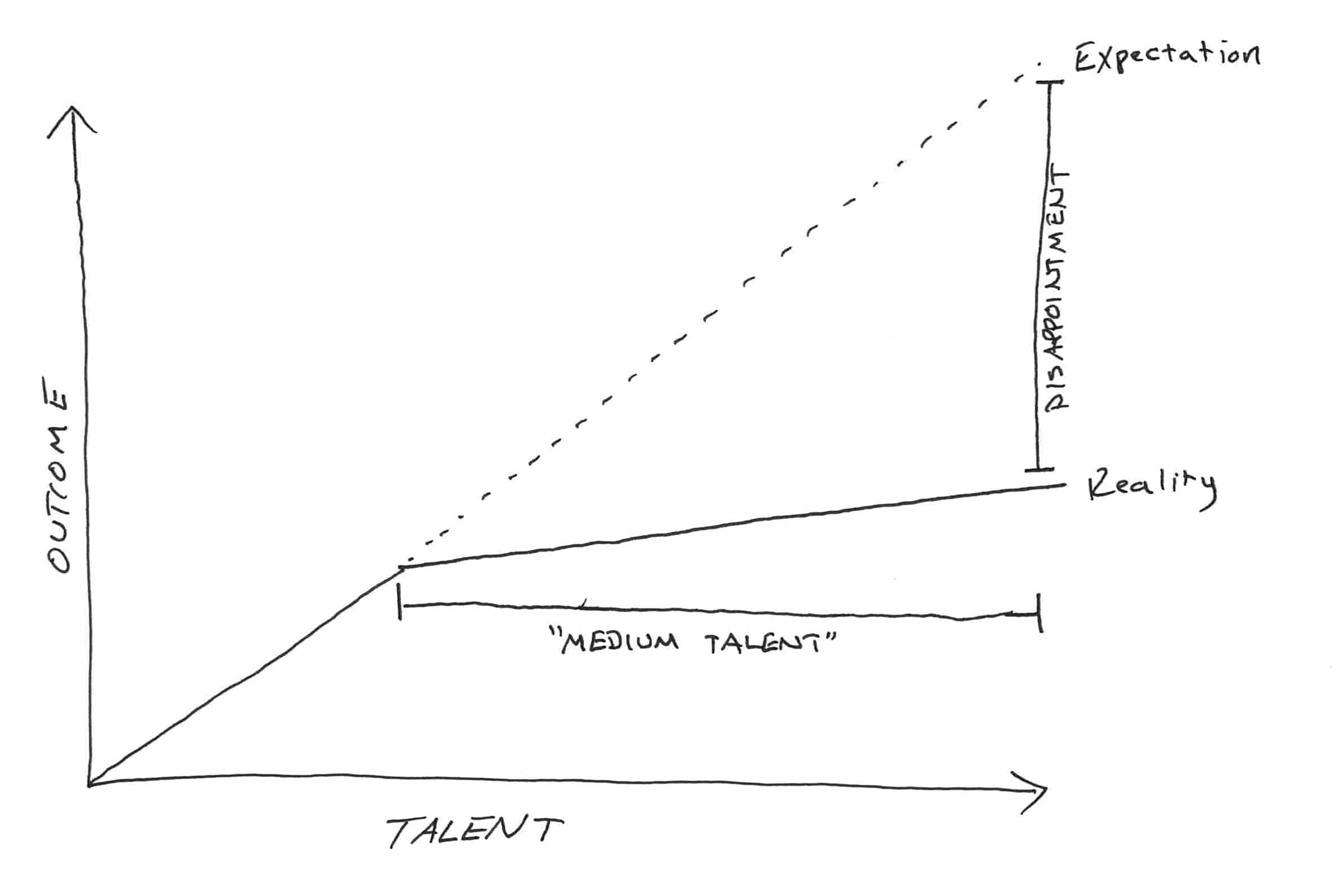
The Cornelius Effect pervades the identification of talent across many – although certainly not all – fields. It is ubiquitous in financial markets. It governs how we hire analysts. It governs how we hire fund managers. It governs how we hire financial advisers. It governs how we invest in management teams.
If your organization is like any investment organization I have been a part of or have performed due diligence on, each of those talent identification processes can be distilled into a simple philosophy: hire or invest with the smartest-seeming person everyone seems to like. Oh, we almost always make some attempt to find useful proxies for these traits that permit us to feel like we’re evaluating some other characteristics as part of a targeted process. This is a cartoon. As an industry, we hire based on our perception of intelligence. Maybe you think you or your organization don’t do this. And maybe you really don’t. But I’d ask you to really think about your last few decisions before you draw that conclusion.
Up to a point, emphasizing intellectual talent is kind of what we should be doing. The work isn’t trivial, and simple measures of intelligence are still a far better indicator of outcome than the skill inventories so many HR departments emphasize. You know, the kinds that search for resume keywords of skills that the average human could pick up in a week or so? It is also certainly the case that there ARE some legitimate investment activities which require a bit more horsepower. But in context of the very high average intelligence of people in this industry, the threshold of intellect at which the traits we are seeking out should shift to traits related specifically to our process – or theirs - is low. Much lower than most people think. By and large, if you are hiring managers, advisers and staff by trying to find the smartest PM/FA/consultant/analyst you can find, this practice will lead you to constant surprise and disappointment.
I’ve got a lot more to say about how the Cornelius Effect ought to influence our diligence processes for these advisers and professionals, but all of these concepts orbit around the belief in emphasizing process over the idea that we’re going to find someone with the answers. When we are hiring, doing this requires us to have a clear-eyed view of the part of our process which we believe is truly value additive, and for which aspect of that process this individual would be responsible. When we are selecting a fund manager or adviser to work with, we must first develop a clear (or as clear as it is really possible to be in this muddy mess of markets) mental model of what it is about their process that should theoretically be capable of producing better outcomes. Our diligence questions then become less about ascertaining just how blindingly brilliant and knowledgeable they are, and more about judging whether they have the intellectual and temperamental traits necessary to execute that process.
The alternative is to be stuck with the constant disappointment of Medium Talent.