Land of the Free Pulse

The Pulse

May 1, 2026·0 comments·Stories of America

FISA, Anthropic, and the Civic Debate: Surveillance, Rights, and Free Speech Narratives All Point Toward AI

EXECUTIVE SUMMARY

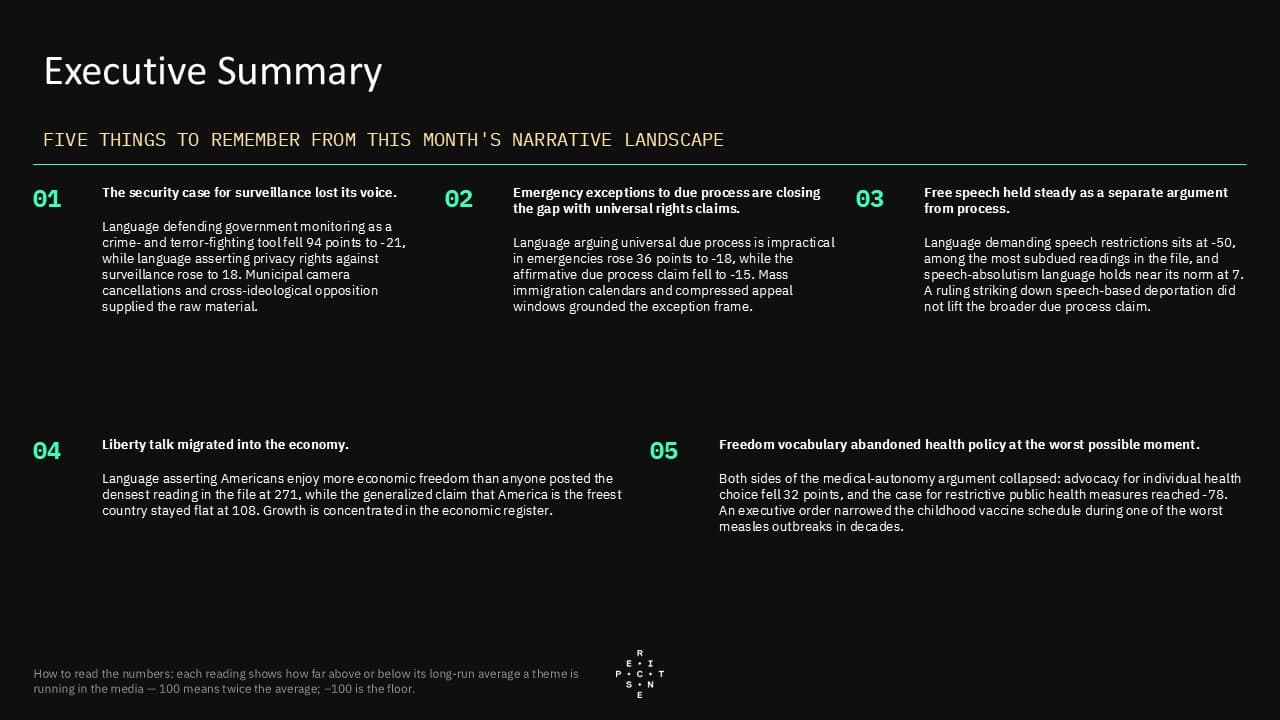
- The surveillance debate experienced its most intense period of the quarter, with language on both sides of the argument strengthening at the same time. The FISA Section 702 renewal fight in Congress and the Anthropic-Pentagon dispute over military AI applications fueled a rare dual intensification. Rather than indicating a directional shift in opinion, the simultaneous rise of pro-surveillance and anti-surveillance language reflects a high-volume, two-sided debate in which artificial intelligence has raised the perceived stakes for both camps.

- Media language favoring civic resistance and asserting due process rights remains at the highest levels across all tracked semantic signatures, while language urging deference to government authority continues to fade. The emergency-exception argument for curtailing rights has failed to gain traction despite an active armed conflict and persistent national security pressures. AI accountability—particularly the demand that government algorithms be transparent and auditable—has become a primary vehicle through which due process concerns are now expressed.

- Free speech absolutism holds a commanding lead over restrictive speech positions in media discourse, but the substance of the debate is migrating from constitutional law into questions of algorithmic governance. State legislatures are advancing AI-specific bills covering chatbots, hiring algorithms, and content provenance, even though a federal executive order seeks to preempt state regulation. The tension between these regulatory layers remains unresolved, and the strong absolutist speech narrative does not address it.

- Economic freedom narratives—both celebratory and critical—are losing media share simultaneously, suggesting that the public conversation has redirected its energy toward the surveillance, rights, and AI debates that dominate this report. Institutional measures of economic freedom have improved modestly, but media discourse has not absorbed that message, and criticism of American capitalism as structurally unfair has also weakened rather than filled the gap.

- Across every tracked domain, artificial intelligence has emerged as the connective tissue linking America's foundational civic arguments to its newest technological capabilities. Whether the subject is FISA reauthorization, the boundaries of algorithmic speech moderation, or the constitutional requirements of government decision-making, AI is the arena in which these debates are now being waged—and the organizations and policymakers positioned at that intersection will shape the terms of the next phase.

---

The FISA Renewal and the Anthropic-Pentagon Dispute Drive a Rare Dual Intensification of Surveillance Narratives

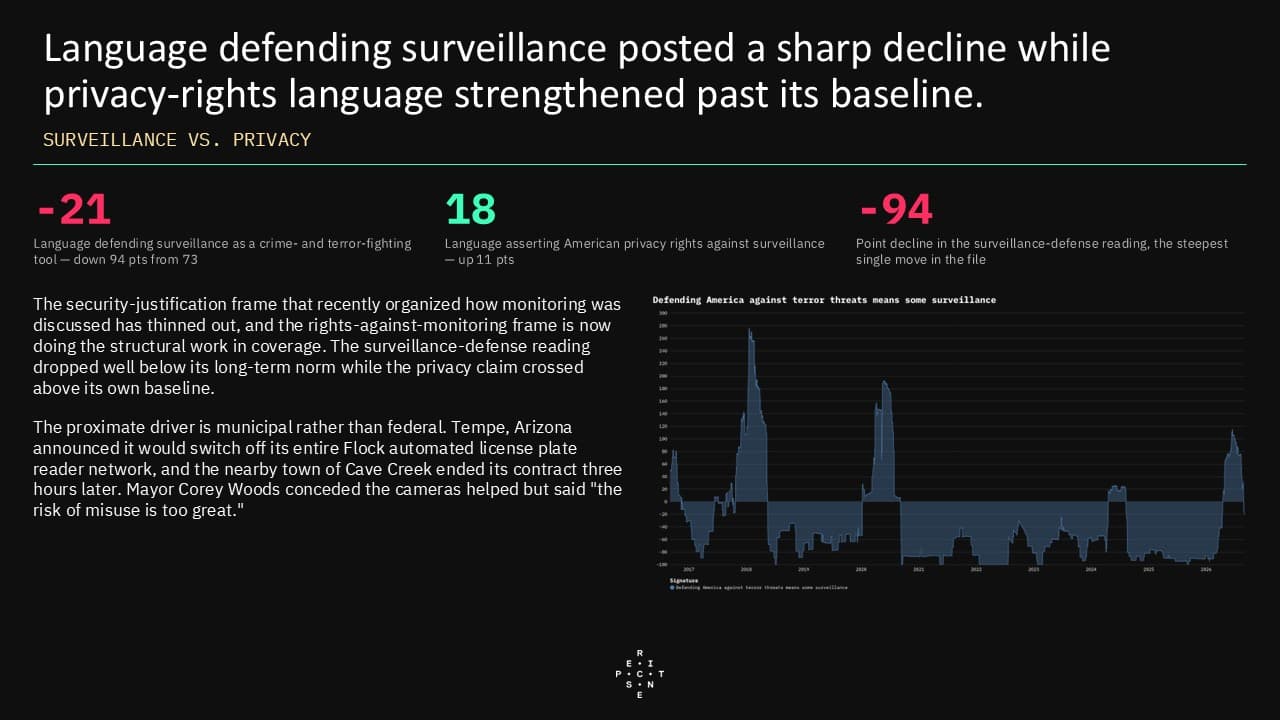
The most significant movement across all of Perscient's tracked semantic signatures this month belongs to the surveillance debate, where both sides strengthened simultaneously. Our semantic signature tracking the density of language arguing in favor of government surveillance tools to fight crime and prevent terrorism rose by 45 over the past week to an index value of 64, the single largest change in the dataset and well above its long-term mean. At the same time, Perscient's semantic signature tracking language asserting American privacy rights against surveillance climbed by 13 to an index value of 15, also above average. The concurrent rise of both pro- and anti-surveillance language points not to a one-directional shift in public opinion but to a high-volume, two-sided debate playing out across media and legislative channels.

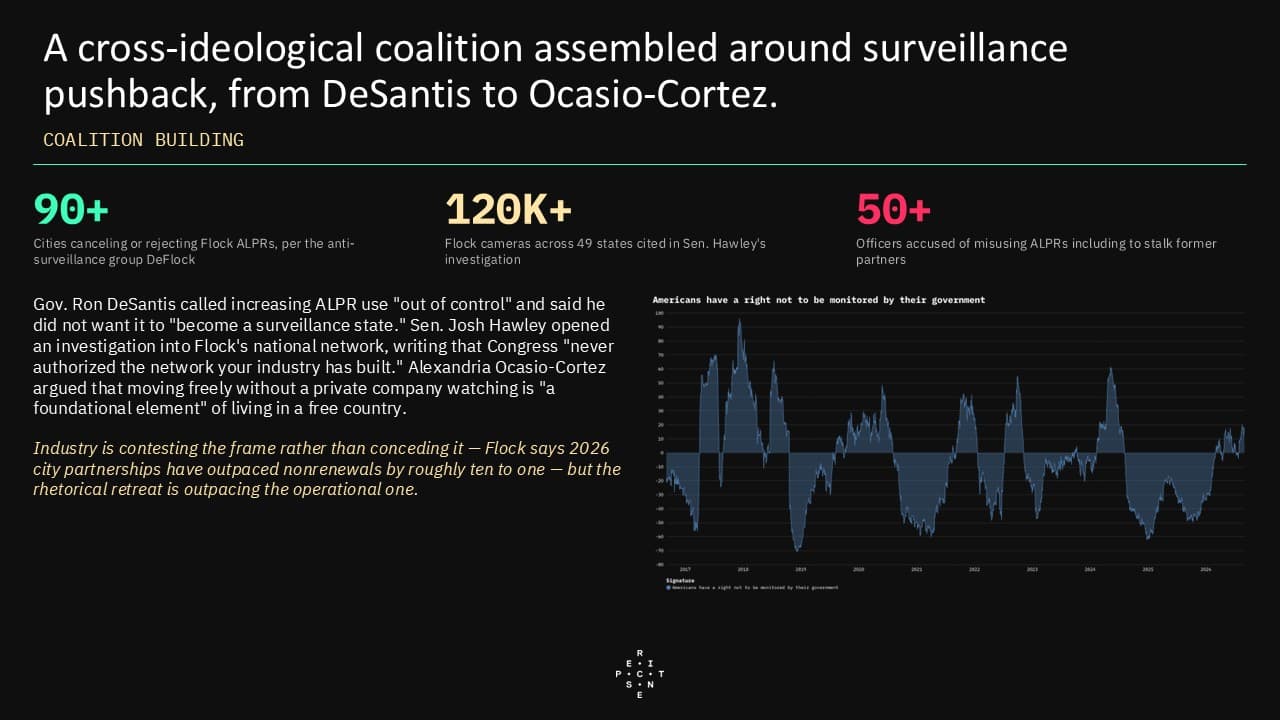
Congress spent much of April consumed by the renewal of Section 702 of the Foreign Intelligence Surveillance Act. The House passed a three-year extension by a vote of 235 to 191, with 22 Republicans voting No alongside 169 Democrats. But the Senate could not reach agreement on reforms, and lawmakers ultimately settled on a 45-day temporary extension to buy more time for negotiations. The debate has produced a rare bipartisan coalition, uniting conservative Republicans with progressive Democrats in ways that defy the usual partisan alignments on national security questions.

What makes this year's FISA fight different from its predecessors is artificial intelligence. The American Prospect reported that AI has the potential to supercharge the government's mass surveillance capabilities, making the stakes of reauthorization considerably higher. NBC News detailed how AI tools amplify the reach of Section 702 collection, and Rep. Sara Jacobs voiced her opposition on social media, writing that "the rise of AI makes it a lot easier and faster" for the government to conduct surveillance on Americans.

The Anthropic-Pentagon dispute directly embodies this tension. Anthropic representatives opposed the use of the company's products for surveillance or to develop lethal autonomous weapons, and the Department of Defense responded in March by declaring Anthropic a supply chain risk, a designation typically reserved for foreign adversaries. Yet the government's operational reliance on Anthropic's technology persists. TechCrunch reported that the National Security Agency is using Mythos Preview, Anthropic's recently announced model, even while top Pentagon officials insist that the company threatens national security. Defense Secretary Pete Hegseth called Anthropic CEO Dario Amodei an "ideological lunatic" while simultaneously defending the Pentagon's use of AI and denying that lethal targeting decisions are delegated to machines.

Signs of a possible resolution are emerging. Axios reported that the White House is developing guidance to allow agencies to bypass Anthropic's supply chain risk designation and onboard new models, including Mythos. Amodei met with White House chief of staff Susie Wiles and Treasury Secretary Scott Bessent, and both sides described the meeting as productive. Other AI companies have moved to fill the opening that Anthropic's stance created. Google became the third company to sign a Pentagon deal, following OpenAI and xAI, even though 950 Google employees signed an open letter urging the company to follow Anthropic's lead instead.

Dissent and Due Process Language Hold at Peak Levels as AI Accountability Questions Mount

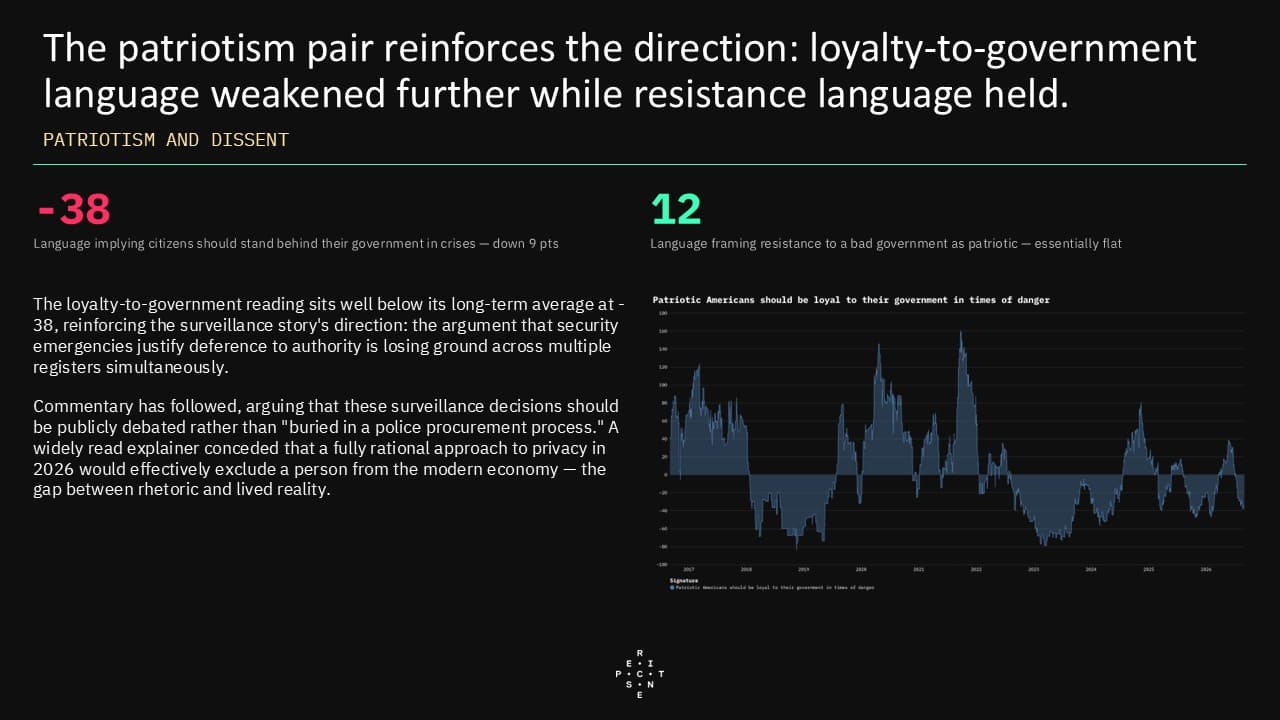
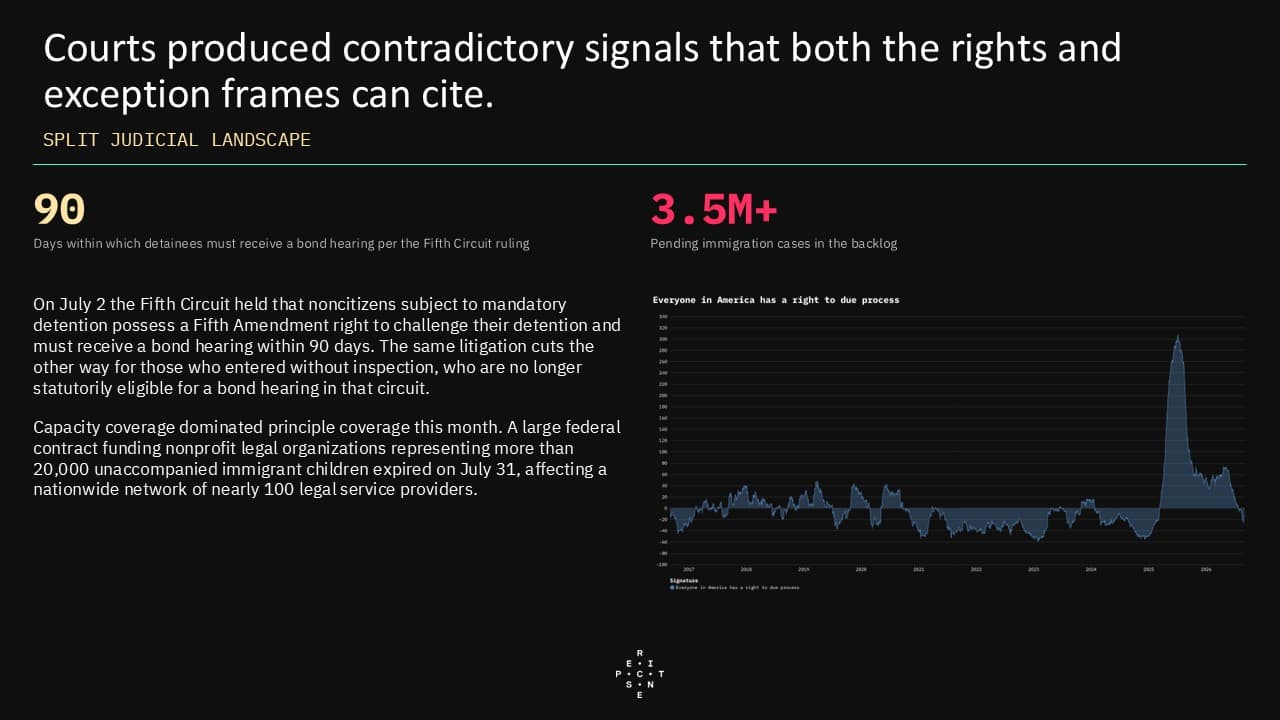
The surveillance debate sits within a broader media environment where language favoring civic resistance and rights assertion is running at elevated levels. Perscient's semantic signature tracking language stating or implying that it is patriotic to resist a bad government holds the highest index value across all tracked signatures at 78, essentially flat over the past week. Our semantic signature tracking language asserting American universal due process rights sits at 73, the second-highest value in the dataset, also stable.

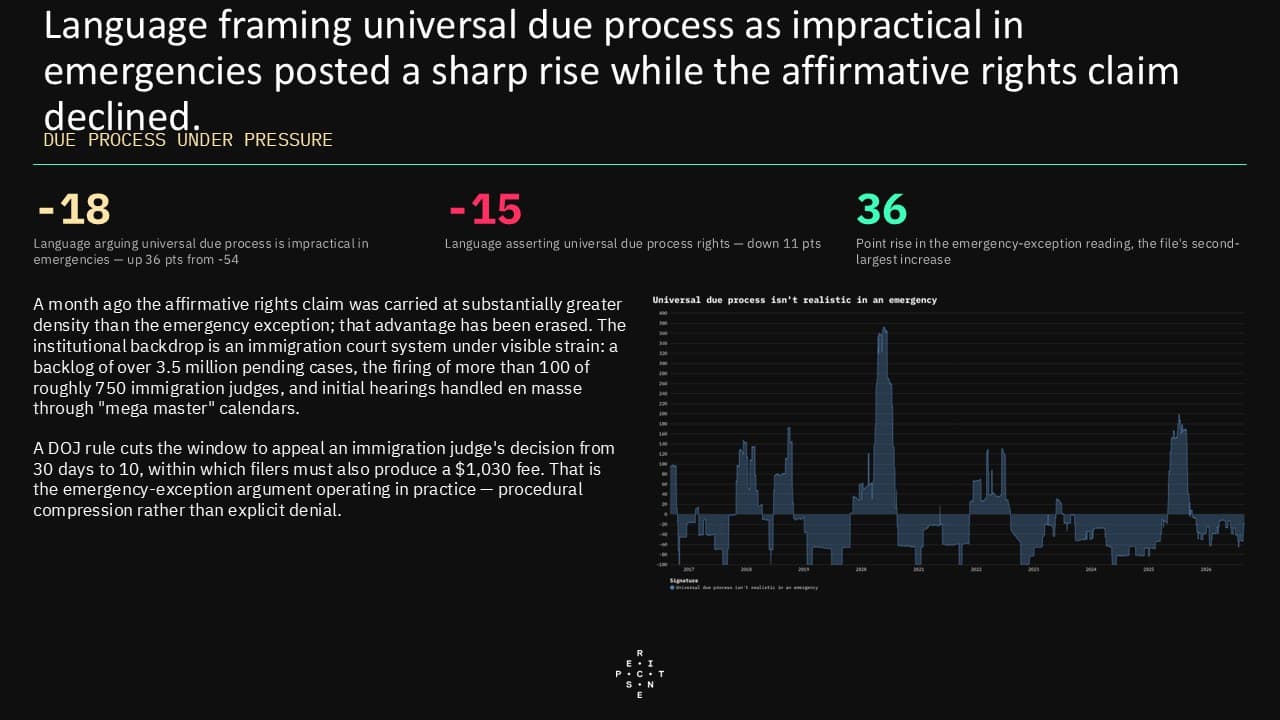
By contrast, the language pulling in the opposite direction is weakening. Perscient's semantic signature tracking language implying that citizens need to stand behind their government in times of crisis declined by 4 to an index value of 13. And our semantic signature tracking language arguing that it is not practical to demand universal due process, especially in emergencies, sits at -14, below its long-term mean and flat. The emergency-exception argument for curtailing rights has not gained meaningful traction even amid an active armed conflict and persistent national security pressures. This four-signature pattern describes a media environment that currently favors challenging institutional authority over deferring to it.

"We've seen AI systems rolled out throughout the government and often without regulatory guardrails," said Duke Law Professor Brandon Garrett. "I think people are rightly worried about the threats to their due process rights." Garrett and others have argued for "glass box" or interpretable AI as a constitutionally necessary alternative to opaque systems, warning that "you cannot possibly protect someone's due process rights if the government is relying on black box AI, because they do not disclose what factors the system is relying on."

State legislatures are translating these due process concerns into law. Connecticut Senator James Maroney's 71-page AI bill passed the Senate, covering subjects from companion chatbots and algorithmic discrimination in employment to automated decision-making in state agencies. Colorado's existing ADMT law, the first comprehensive U.S. state law regulating high-risk AI, is undergoing revision with a reset effective date of February 2027. Florida's Senate passed an AI Bill of Rights by a 37-to-1 vote during a special session, though the House declined to take it up. And judges are beginning to weigh AI's role in the courtroom, a Northwestern University survey finding that about 20% of judges formally prohibit AI use while roughly 40% allow it with limitations such as requiring disclosure or human oversight.

Anthropic's posture fits naturally within this dissent-and-due-process framework. The company stated publicly: "These threats do not change our position: we cannot in good conscience accede to their request," and explicitly argued that "using these systems for mass domestic surveillance is incompatible with democratic values." Groups of former defense officials filed briefs arguing that the authorities used to designate firms as supply chain risks were repurposed against Anthropic, and one brief asserted that "the national security justification for designating Anthropic a supply-chain risk is pretextual and deserves no judicial deference." On social media, the debate is equally active, with commentators noting the constitutional dimensions of AI decision-making and Oxford researchers calling for decision traces, independent audits, and accessible appeals as governance requirements.

The elevated index values for both dissent and due process signatures, combined with declining loyalty narratives, describe a rhetorical environment where challenging powerful institutions carries substantial momentum.

Free Speech Absolutism Dominates Media Discourse While Economic Freedom Narratives Recede

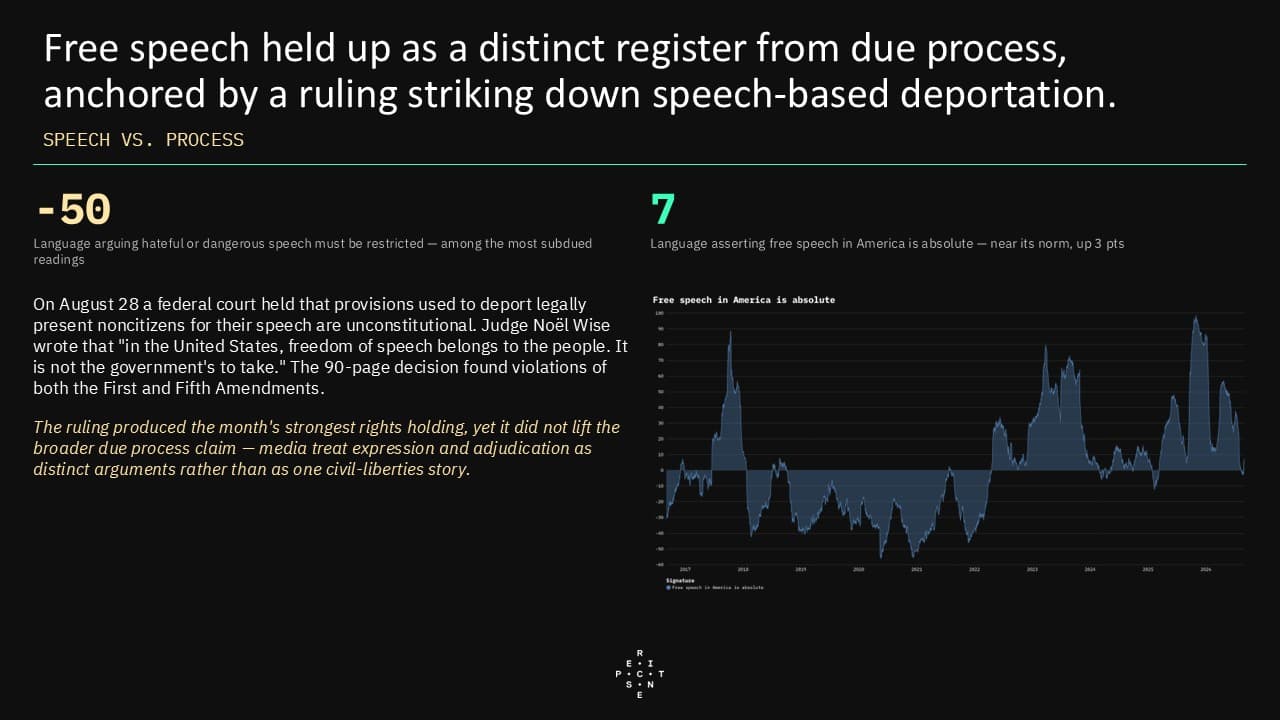
Consistent with this rights-assertive environment, the speech landscape shows a wide asymmetry between absolutist and restrictive positions. Perscient's semantic signature tracking language asserting that free speech in America is absolute maintains an index value of 55, declining modestly by 3 but remaining well above its long-term mean. Its counterpart, our semantic signature tracking language arguing that hateful, offensive, or dangerous speech must be banned or restricted, sits at -34, well below average and roughly flat. The 89-point gap between these two signatures indicates that absolutist speech language currently occupies a commanding position in media discourse, with scholars noting that the right to free speech in America is closer to "absolute" than in virtually any other country.

The future of free speech is no longer solely a question of constitutional law but increasingly a matter of algorithmic decision-making and platform governance. In December 2025, President Trump signed an executive order establishing federal policy to preempt state AI regulations deemed to obstruct national competitiveness. Yet at the state level, the regulatory push continues. Connecticut's AI bill covers chatbot regulation, hiring AI, content provenance, and frontier model development. Florida's Senate passed its own AI Bill of Rights, though the House declined to advance it, with some senators warning that the bill could give parents a "false sense of security." The tension between federal preemption and state-level action creates a complex operating environment that the strong absolutist speech narrative does not resolve, and some commentators have raised concerns that state AI bills could push developers to tune systems around government-preferred outcomes rather than open inquiry.

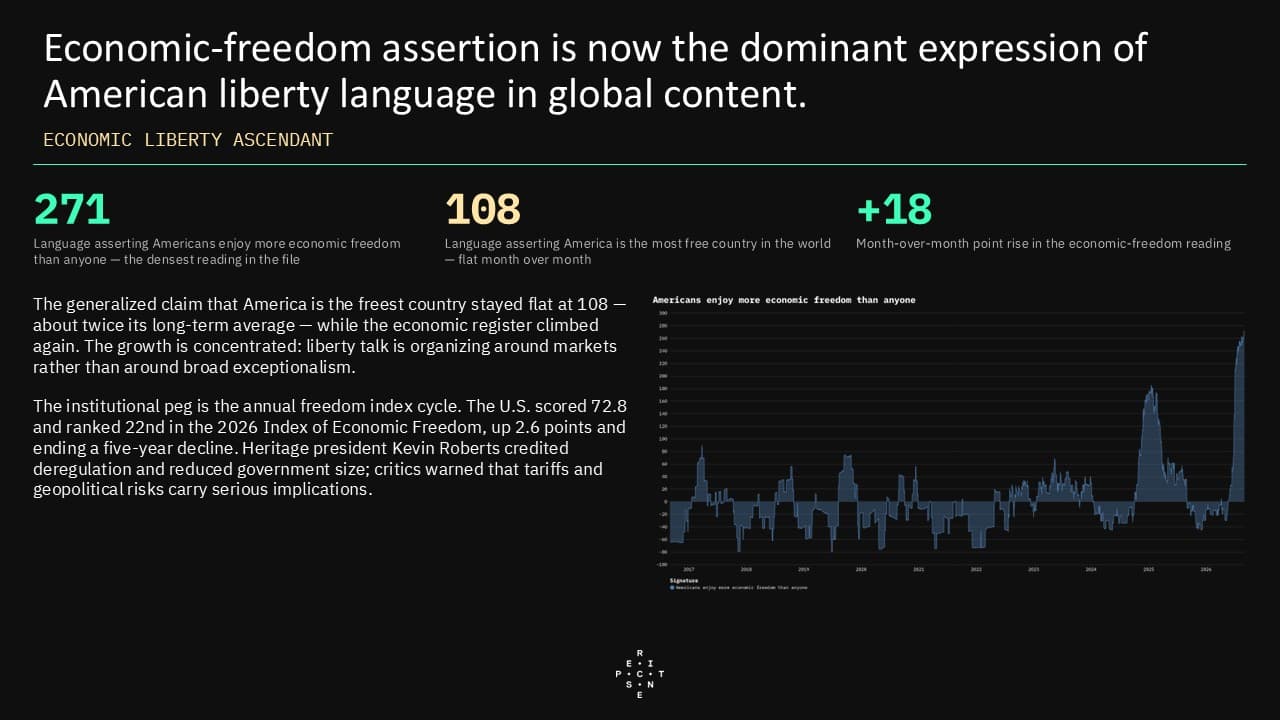
Meanwhile, the economic freedom conversation is receding from media attention. Perscient's semantic signature tracking language asserting that Americans enjoy more economic freedom than anyone declined by 17 to an index value of -26, one of the steepest changes in the dataset and now well below its long-term mean. The United States scored 72.8 in the 2026 Heritage Foundation Index, up by 2.6 points from the previous year and classified as "Mostly Free." But the disconnect between improving institutional scores and declining narrative density suggests that public discourse is not absorbing the economic freedom message. Critics of administration policy point to tariffs and the Iran conflict as factors that are increasing costs and dampening the economic outlook, while The Economist has questioned whether the system's drift toward state capitalism is as pronounced as often described.

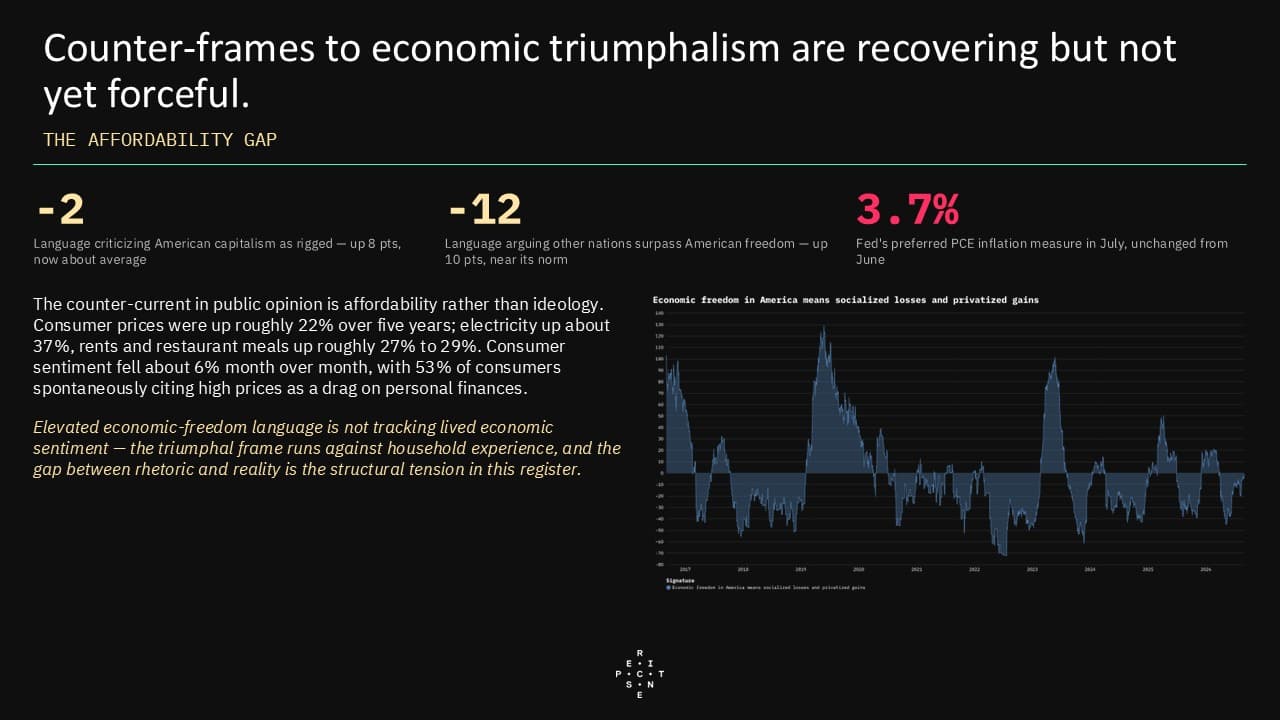
Our semantic signature tracking language criticizing American capitalism as rigged also weakened, falling by 5 to an index value of -38. Because both the celebratory and critical economic freedom narratives are declining simultaneously, the broader economic freedom discussion appears to be losing media share to the more urgent debates around surveillance, rights, and speech. Perscient's semantic signature tracking language asserting that America is the most free country in the world rose modestly by 3 to an index value of 3, near its long-term mean. General American exceptionalism language remains stable but not elevated, meaning that broad freedom-affirming sentiment is not compensating for the retreat in more specific economic narratives.

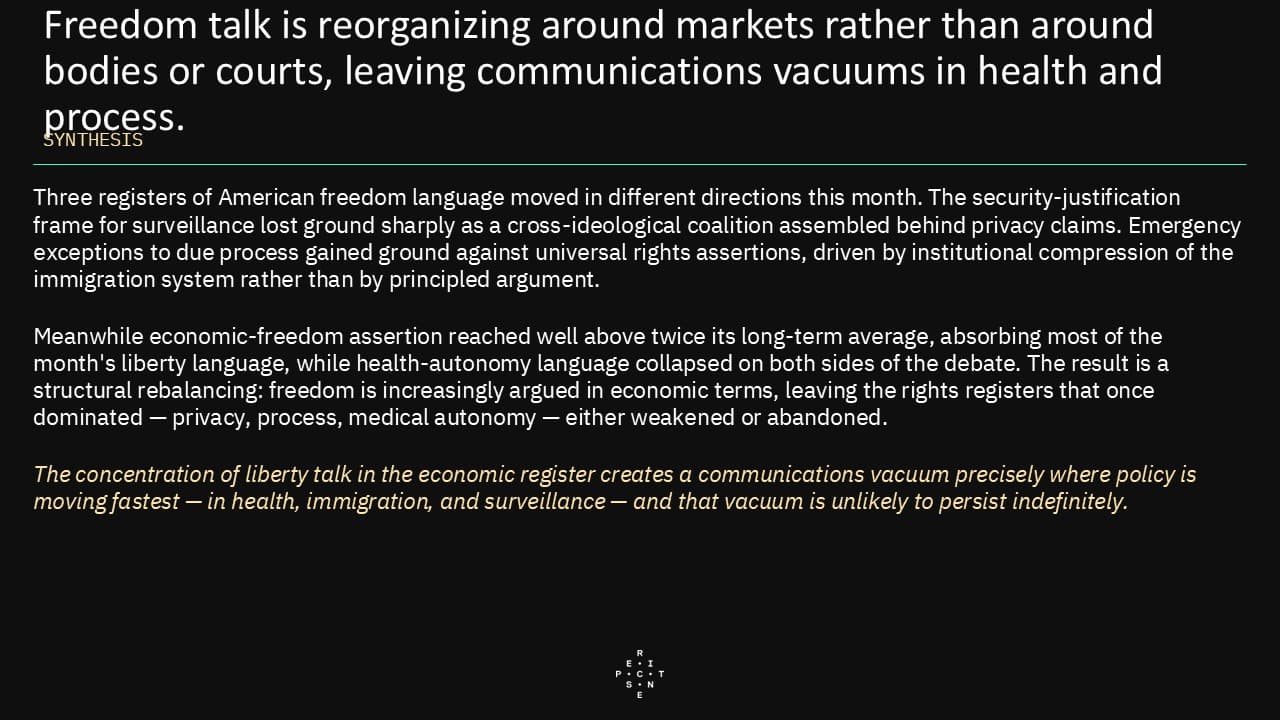
The picture across these domains is one of convergence: surveillance, dissent, due process, and speech debates are all increasingly channeled through the lens of artificial intelligence. Whether the question is FISA reauthorization, Anthropic's refusal to support autonomous weapons, state-level chatbot regulation, or the boundaries of algorithmic speech moderation, AI has become the connective tissue linking America's oldest civic arguments to its newest technological capabilities. The narratives are not fading; they are migrating, and the organizations, institutions, and policymakers positioned at that intersection will shape the next chapter of the debate.

Archived Pulse

April 2026

  • Absolute Free Speech Language Surges in Media as AI Content Moderation Becomes a Central Policy Battlefront
  • Both Sides of the AI Surveillance Debate Surge as Anthropic, FISA, and ICE Put Privacy at Center Stage
  • Dissent and Government Loyalty Narratives Strengthen in Tandem as "No Kings" Protests Reach Record Scale

March 2026

  • Dissent, Due Process, and the Limits of Emergency Power After the SCOTUS Tariff Ruling
  • Privacy Rights Rebound as AI-Driven Surveillance Concerns Reshape the Regulatory Environment
  • Free Speech Absolutism Strengthens Amid Federal-State Conflict Over AI Content Regulation

February 2026

  • Free Speech Narratives Decline as Both Absolutism and Restrictive Arguments Fade
  • Resistance Narrative Strengthens as Government Loyalty Language Weakens
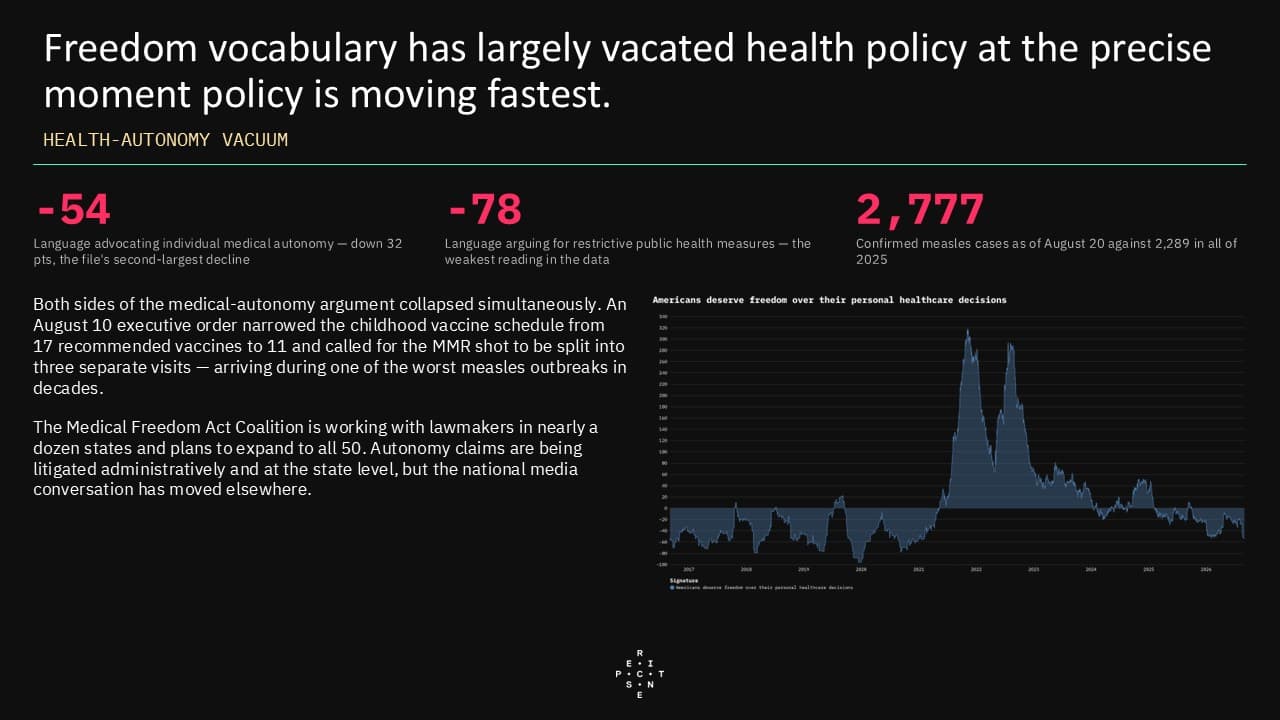
  • Healthcare Autonomy Narratives Fade as Policy Debate Shifts to Cost and Coverage

January 2026

  • A New Battlefield Emerges over Narratives of Economic Freedom
  • Fatigue Around Narratives of Emergency Powers Abuse Sets In
  • Immigration and Content Moderation Sparking Nuanced Free Speech Debates

December 2025

  • Free Speech Narratives Gain Strength Amid Transatlantic Comparisons
  • Emergency Powers and Due Process Language Shifts Downward
  • Economic Critique Narratives Rise While American Exceptionalism Weakens

November 2025

  • Due Process Concerns Reach Historic Prominence Amid Immigration Enforcement Debates
  • Competing Visions of Patriotism and Government Loyalty
  • Economic Freedom Narratives Show Divergent Trends

Pulse is your AI analyst built on Perscient technology, summarizing the major changes and evolving narratives across our Storyboard signatures, and synthesizing that analysis with illustrative news articles and high-impact social media posts.

Pulse
Stories of America