
Life in the Gyre
July 2, 2019·Media

I been watchin' you watchin' her watchin' herself in the mirror.
High Tone Woman, from Somewhere Down in Texas by George Strait (2005)
I wanted to write something about Andy Ngo.
Andy is an independent journalist who was badly beaten by members of Antifa last weekend. He writes for Quillette, a provocative, liberal centrist publication that you will probably see (oddly) described as conservative. His public actions haven't made him a saint in the eyes of everyone, but he didn't deserve to be physically assaulted.
I wanted to write about how most media outlets weren't talking about the attack in the way they would if Ngo's politics were different. Because that's how it felt to me. So I looked at our database of media coverage of other attacks on journalists that have taken place in the last year or so.
What I felt to be true, well, wasn't.
Clear eyes. The attack on Andy - in no small part because of the graphic video capturing it - has gotten more coverage in the first three days of its aftermath than almost any attack on a journalist in the United States in 2019. More than coverage of journalists in D.C. being knocked down by Capitol Police, or a longtime Sacramento Bee cameraman receiving similar treatment. More than a journalist who took similar injuries from objects flying out of a car (hurled with epithets) when covering dueling pro-choice / pro-life rallies. More than the recent injuries to journalists covering the Memphis police protests. In fact, the only event in 2019 with comparable coverage was the attack on the press pool - and a BBC cameraman in particular - at a Trump rally in February.
We will be the first to say that quantity of coverage isn't necessarily what is most important. Is there a cohesive narrative indicative of a collaborative desire of missionaries to tell readers how to think about this event? Can we spot the affected language we call Fiat News - opinions parading as fact - in news stories about it? Is there a detectable bias embedded in the qualities of the language used to discuss this event relative to similar ones? Yes. Yes. And yes.
And while demonstrating each of those things is what drew me to the topic, when I saw the narrative structure, it wasn't what struck me. What jumped out at me was just how much of the coverage of this issue was about others' response to coverage of the issue. In other words, more than just about any topic we have researched, somebody looking for news about these events was just as likely to instead find 'news' that would tell them how the curious case of Andy Ngo was really a symbol of virulent right-wing whataboutism equating childish antics to Nazism, or how it was really an example of mainstream left-wing hypocrisy and indifference to violence and bad behavior if perpetrated against the 'right kind' of people. And then it was media outlets trumpeting the content of media outlets making the opposite claim. In other words, if you felt what I felt and wanted to have a mirror engagement with the confirmatory story, or a rage engagement with the people getting it wrong, you had a host of articles to choose from.
How many?
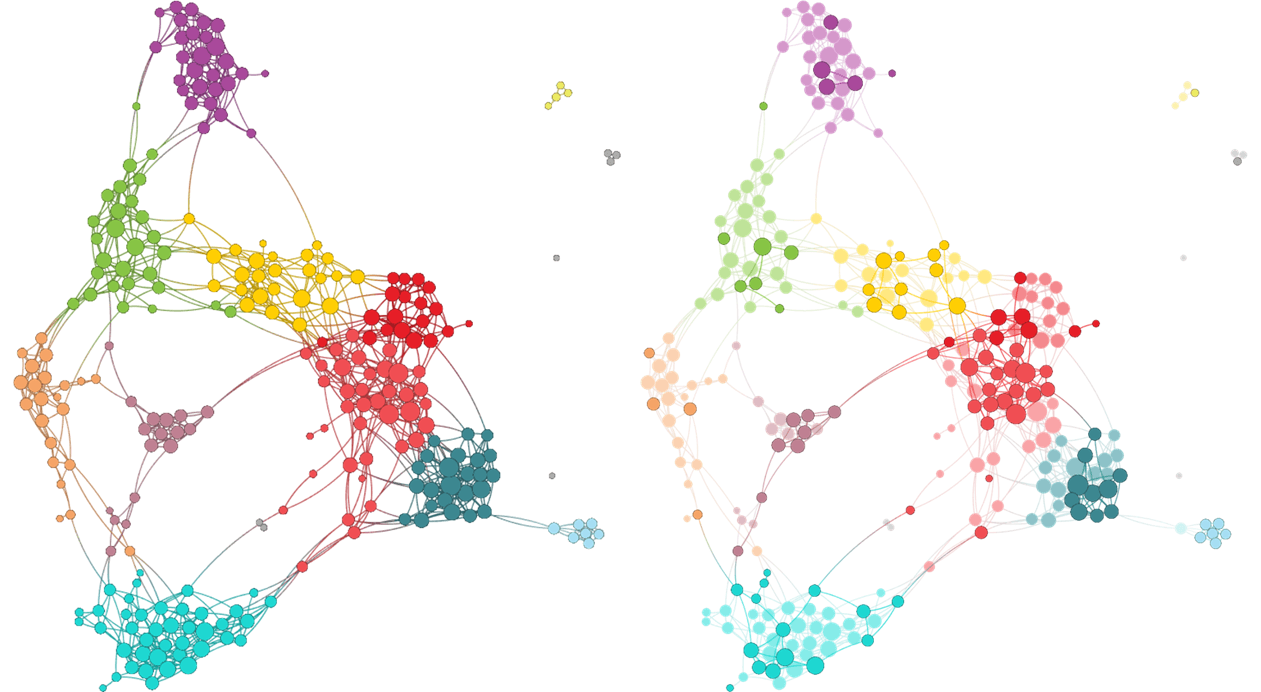
By our estimate, roughly 40% of the 273 articles in our data set written about Andy Ngo between June 29th and July 1st have principally been about the coverage of the event and responses to that coverage by other outlets and people.
Source: Quid, Epsilon Theory
Missionaries have been shaking their fingers at us to tell us how to think about issues for a long time now. That is not new. But increasingly, what we are being told isn't just how to think about issues. We are being told what other people think, how others are covering the events and how everyone else is all wrong. We aren't even allowed to figure how we're going to start fighting about some dumb thing. By the time we've read a single fact about a story, the ring is built, our gloves on, Michael Buffer already halfway to his car, and the bell still ringing.
It isn't that there isn't truth in these claims. I still believe personally that most large outlets were aggressively dismissive of Ngo's victimhood for political reasons, and I think there's substantial evidence in language of their coverage to indicate it. I think a lot of people of a different political persuasion would still think - in good faith - that it is ridiculous that we are even talking about this when psychotic, racist white nationalists are out there running people over.
The problem is that when the information we consume ceases to be information about things that happened, and is transformed into information about how important people perceived those things or how the other side is being hypocritical about their coverage or opinions of those things, we descend another layer into the Panopticon - watching the crowd, watching the crowd watch itself. The more of this kind of information we unwittingly consume, the more we unwittingly live our lives in a world in which our reality is defined by the second and third levels of the Common Knowledge Game. Even when we think - even when we know that we are right.
We can't avoid being in the Widening Gyre. But we can avoid being of it.
It's not all political theatre.
Let me give you an example. When I was preparing this essay, the New York Times was so sure that I needed to see this article that they paid for the pleasure of putting it on my screen:

What is it?
Well, it's a promoted tweet from last year, which probably means that the New York Times has a marketing and social media department that has determined that paying for 30-something dads who search for "real metal Tonka trucks" and "foam airplanes with long wings" on Amazon and post dad jokes on Twitter to see this article has a positive ROI.
The article itself, of course, includes zero descriptions of how parenting is any different from what it used to be. The descriptions are of how specific parents have said that they feel they have to do different things for one reason or another. This isn't the kind of Fiat News we'd usually see in your classic feature piece, trying to guide in a newsesque way in how you think about some Big Social Issue. Instead, it's news that provides you with reminders that this is how other people are thinking correctly about this.
It sounds melodramatic, but under any reasonable interpretation, the New York Times is literally trying to sell subscriptions to parents by preying on their fear that they will miss an article that will tell them how other parents are defining what parents are supposed to do. It's a less obtrusive version of Black Mirror's Fifteen Million Merits, with more nudges and less Big Brother. Click-bait, sure, but more subtle and far more powerful. Don't mute your audio, or else you'll be subject to a penalty.

But no, it also isn't always gentle nudges. The media-as-principal has determined that vanilla Fiat News isn't enough, that guiding how you think will be most effective by telling you how other people are thinking about things, how they are getting it wrong, etc. The pattern is everywhere.
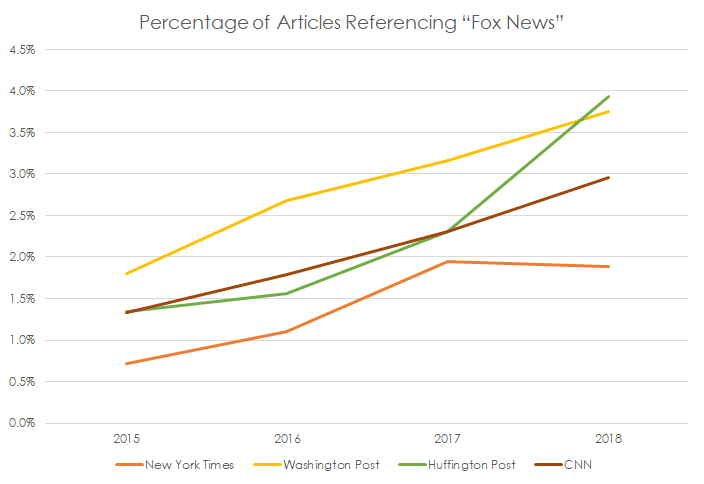
It is evident in the editorial selection of news articles and how they are written. Here, for 2015-2018, are the percentages of articles in the New York Times, Washington Post, CNN and Huffington Post - the most socially important left-leaning news publications in the US - which specifically reference Fox News.
Source: Quid, Epsilon Theory
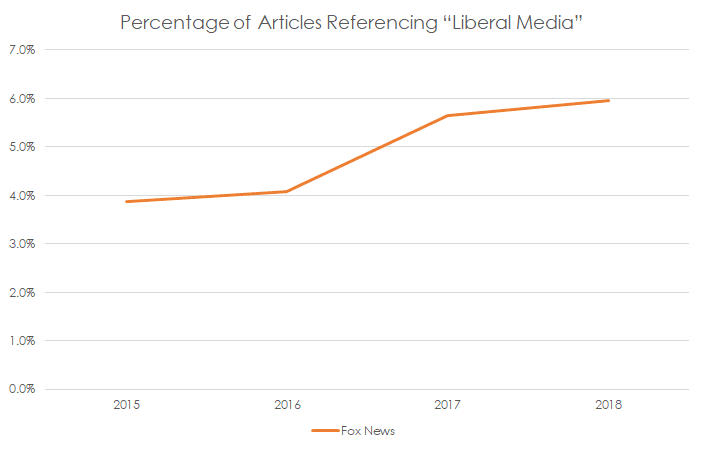
Fox itself, probably as influential and powerful in right-leaning circles as each of those outlets combined in their own milieu, is selling the same thing. The growth is not so dramatic, but part of that is - I think - because the narrative of a general left-wing bias in media was already well-established as the network's raison d'etre.
Source: Quid, Epsilon Theory
What does this mean? It means that, relative to only four years ago, you are twice (or more) as likely to encounter a 'news' article telling you what tragedy the opposing political side isn't treating the same as they did a different one, a response 'news article' which snidely references the first with as many scare quotes as possible, and then a set of third articles which just cover all of the most virulent social media posts the dueling articles spawned.
Oh, think that last one was a throwaway joke?
Yeah, that's happening, too.
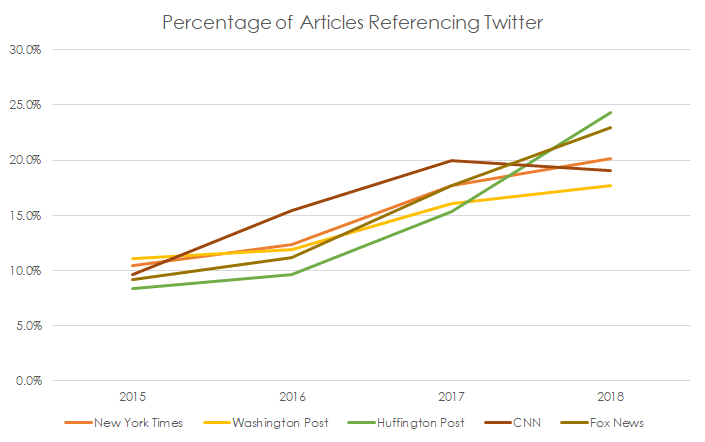
If your response to this is, "Yeah, but that's just reflective of growth in Twitter and social media in general - it's just an indication that it is being embraced more broadly by public figures," well, yeah, no kidding. Y'all, the point isn't necessarily to convince you that people are doing something wrong here. It's to show that this is happening. To argue that we can stop predicting and start observing. Some statement or dispute on social media is now newsworthy. A public figure condemning X on Twitter but not condemning Y is now a news event. A random jackass replying to AOC with a racist remark is now a fully fleshed-out feature piece about the New Right Wing, and a search that yields a community college professor who liked a post about punching Nazis is now a wholesale indictment in print of the Lunatic Left.
The peril of this new Panopticon? Fewer of the facts we are provided are divorced from opinions, sure. But fewer still are untarnished by the light shining back on all of us, telling us what the crowd thinks and what it ought to think. Missionaries are taking our Common Knowledge into their own hands.
And it's working.
Think for a moment about the coverage of the events on America's southern border. When is the last time you read such a story that was not at least partly meta-commentary about contrasting media treatment of the events? OK, give yourself a little test. How many asylum-seekers have been detained so far in 2018? Just an estimate. Roughly what percentage have come from Guatemala? What about other countries? What are most of them fleeing? How do the conditions and US border policies as currently enforced compare to those of other developed countries?
Cool, cool. OK, now who tweeted out a border photo-shoot in a white outfit? What did some political leaders compare the detention camps to? Who took issue with those characterizations? What biased newspapers and networks have been ignoring and downplaying the current situation in the detention centers? Which biased outlets ignored it during the Obama Administration?
I think I know which set of questions the average news-following American would be able to answer and which they wouldn't. There's a reason: because the latter, increasingly, is what is produced and consumed. And whether that tendency plays the role of the chicken or the egg in all this, this is happening because it's increasingly the content that gets shared. In our query of detention facility-related news this year, here are 5 articles from the top one-half of 1% in shares across social media:
Bank of America will no longer do business with companies that run detention centers [CNN]
Wayfair employees plan walkout to oppose furniture sales to migrant detention facilities [Boston Globe]
Alyssa Milano Promotes Fundraiser for Illegal Alien After Mocking Veteran's Border Wall Crowdfund [Breitbart]
Ocasio-Cortez presses case that U.S. is running 'concentration camps' at border amid Republican outcry [Washington Post]
Many in media changing their tune on border 'crisis' after claiming it was 'manufactured' [Fox News]
I'm not saying that these topics aren't newsworthy.
But the fact that the 'what everyone else is thinking/saying/doing' articles spread like viruses - when reporting of simple facts does not - matters. It is changing the kind of information we get through incentives alone. There is nothing - nothing - a media outlet can do to better position its franchise than to frame every story as being about the hypocrisy or bad behavior of some opposing group. It is squelching the already short supply of pure, unadulterated, fact-based news we have available to us.
Second- and third-degree Common Knowledge posing as news is doing something else, too:
It is killing good faith. It is killing our collective willingness to believe the benevolent / benign intentions of our fellow-citizens.
Some of that is happening through the subtler - if we can even call it that - Fiat News-like stories above. Some of it is happening through much more transparent means. Consider, for example, the below image, which began to make the rounds yesterday (collected by Heather Heying) about the Andy Ngo affair.

It would be an extremely, er, powerful assertion from the American Spectator - except it was never made. The American Spectator never published this article. You could say it was fake news of the type meant to mislead some number of people on simple facts, but I don't think so. This image exists to break down any lingering belief that the information being circulated outside of our curated on-narrative sources comes from a place of good faith. Here's the real one below.

I am not ignorant to the fact that much of what we do on this website is the identification of what we see as common knowledge and active narratives. But the danger isn't in thinking about the second- or third-degrees of the Common Knowledge Game. We should do that. We must do that. The danger lies in treating the second- and third-degree information that we receive as first-degree fact, rather than how we or someone else would like us to interpret the import of those facts.
And the more we allow others to do that interpretation for us, even when it seems sensible - no, especially when it seems sensible - the less sovereignty we retain over our own thoughts, and the further the gyre of our divided politics widens.


Comments
Great piece, Rusty. I think it’s incredibly important to understand the mechanics of fiat news and “virality.” This piece does a nice job of laying that out.
Nice piece, Rusty. I am definitely guilty of this. It’s SCARY how well you nailed my understanding of the current boarder crisis.
On another note, I can’t help but think of the Mexican standoff scene from Reservoir Dogs while reading about the Panopticon and how society seems to be handling it.
I started to make these comments under the election index, but didn’t. Now seems a good time.
I am reminded of Daniel Boorstin’s book, The Image: A Guide to Pseudo Events in America. Pseudo events are the ones that cover the stories surrounding an event instead of the event itself. Think of all those Super Bowl articles and videos that are about how many people are covering the Super Bowl. How many hot dogs will be sold.
The plot of stories around the debates were largely about the coverage of the debates., not the debate content. I did mental math at the time and come up with more than 40%. The stories about debate coverage had higher individual scores than any of the specific content subjects. The debate was a pseudo-event, designed to be covered, not taken seriously.
The book is surely dated. I’ve not gone back to look at it. But it is informative for the day in which we find ourselves.
I wonder how much of this echoing and commentary is meant primarily for publicity and the creation of buzz. Brett Stephens today decries the Jacobin’s in the latest Kaepernick nonsense https://www.nytimes.com/2019/07/04/opinion/nike-kaepernick-america.html and I have to think he and Nike are delighted at the publicity. They’re not selling sneakers to those of us who find outrage over the Betsy Ross flag risible, inane and unpatriotic.
What I would like to know is where I can find the raw facts reported least passionately and most consistently? Any recommendations from other readers?
Thanks, Nick!
LOL I hadn’t thought of that but now I’m instantly regretting not using its imagery here.
Those pseudo events are a subset of what we refer to more generally as abstractions. Not that they don’t refer to a real thing, but that they have meaning attached to them as a cartoon that is then applied in some abstraction layer to the main event itself. The pernicious difference between that approach and other methods of abstraction and Fiat News is that by selecting which “pseudo event” you are covering you can heavily skew the perception and narrative of the main event without ever having said anything false.
Without getting too much into it, there is enough intellectual inconsistency in Kaepernick’s / Nike’s explanations of this versus the prior protest issues that lead me to a pretty skeptical / cynical place, too. (In short, I didn’t have a problem with the anthem protest because I chose to believe his intentions. This…is different) It is pure meme, and Nike is absolutely exploiting it. They’re owning a particular cartoon, even if it’s a divisive one. It’s working for them, and they’ll keep doing it. So, too, will conservative publications, for whom this is gold.
All of these folks profit from our discord. The monetization of the widening gyre, if you will.
We have done some work on this, although the list is lamentably flawed. You will be able to find anecdotes of terrible Fiat News behavior from each of these, but they have generally been more fact-based and less prone to Fiat News than average. Bear in mind that the opinion pages of these are still a no-man’s land for facts:
Continue the discussion at the Epsilon Theory Forum...