
Looking for Laffer-Likes
December 31, 2018·Money
Ed Meese jumped in, as he usually did when he saw that his boss was discomfited and at a loss.
“What about the revenue feedback from the tax bill” he asked. “You haven’t taken account of that in these scary numbers.” His tone was slightly annoyed.
Meese was referring, of course, to the Laffer curve. The whole California gang had taken it literally (and primitively). The way they talked, they seemed to expect that once the supply-side tax cut was in effect, additional revenue would start to fall, manna-like, from the heavens.
-The Triumph of Politics, by David Stockman
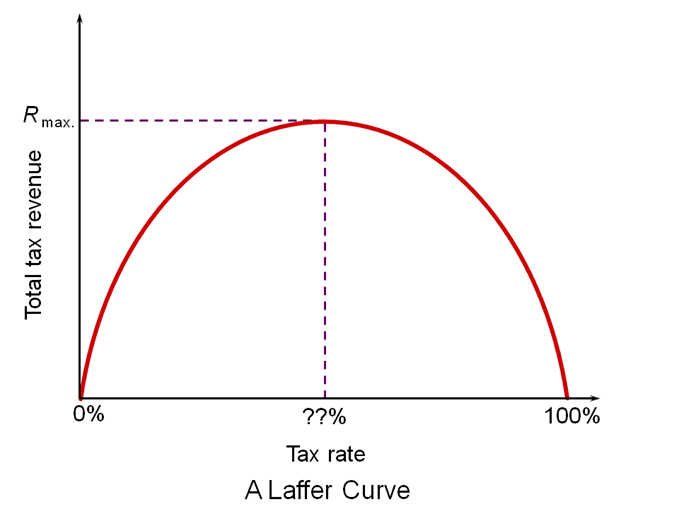
Some years ago, back when Republican, conservative and Reaganite were circles in a Venn diagram that actually overlapped, I considered myself all three. And so, the chart above is familiar to me. It probably is to you, too.
Now, I’ve never cared all that much about tax receipts. I am almost always in favor of lower taxes because I believe that the freedom to decide what we do with our money is among our most powerful and important freedoms. I also believe that the more money the state has, the stronger its belief that it has a mandate to control and direct economic activity, things at which it is especially lousy.
But there really was a cadre of politicians and thinkers who believed in the Laffer Curve. Like, really believed. Literally believed. It was still fondly preached in some business school courses into the 2000s, I can attest, and maybe still is today. Its adherents believed - very much in earnest - that if we reduced tax rates, not only would it lead to greater economic activity, but to higher tax revenue as a result of that activity. This is…well, it’s not true. I believe that the first derivative of it is true, especially at higher marginal rates like we experienced prior to 1981, and certainly prior to 1964. And for freedom- and efficiency-minded people, that’s what probably matters anyway. But that wasn’t the argument. There were people for whom the expectation of increased receipts was a legitimate belief and a reason for lowering taxes.
Why? Because it was a story they wanted to believe anyway? Yes, yes, sure.
But more importantly, because it provided what looked like the safe harbor of fact within a foggy sea of complexity.
Predicting how changes to tax policy will influence economic activity and tax receipts is extremely messy work. For better or worse, the Laffer curve gives us an anchor. We know that a 0% tax rate will not yield tax revenue. We also know that a 100% tax rate – barring enslavement, corruption or criminality – will yield effectively zero revenue. Our instinct when we lack a good prediction framework (whether a systematic or discretionary mental model) will be to lean on the rare bits we do understand, like tax behaviors at extreme levels, to help us make predictions about what happens at the margin.
And in all sorts of cases like this, this temptation to head in the direction of our safe harbors leads us astray. These are the Laffer-Likes.
Some may immediately spring to your mind. But as we turn the page on 2018, there are two Laffer-Likes that are front-and-center in a lot of investors’ minds and in the narratives of the media, the sell side and the buy side: (1) the increasing passive share of financial markets and (2) the prevalence of algorithmic trading.
We’ve waded into the debate on active vs. passive investment management before, mostly by calling it a stupid debate that isn’t really about the thing that people say it’s about. Our view hasn’t changed, so I won’t add any wood to that fire. No, the Laffer-Like here is about what happens to financial markets and asset prices when the market becomes increasingly passive. How is this changing price discovery? Does it change how active strategies will work? Does it break traditional mean-reverting patterns in the dominance of traditional styles like value and growth? Will it create long periods of low volatility followed by bouts of extreme volatility? Will it create bad behaviors by management teams?
These are all fair questions. Good questions. Questions investors ought to be asking.
They are also nearly impossible questions to answer definitively. We will be tempted – and it will feel very reasonable to us - to consider what we can know. One of the few things we can truly know is that a market that is fully passive is not a market in any sense. It isn’t active in setting prices, testing prices or responding to information. When the market becomes more passive, it should be no surprise, then, that we see these descriptions in active fund manager quarterly newsletters or annual outlook pieces: “Passive investing is creating a pro-momentum market that doesn’t process information about companies!”
It is a statement of indisputable fact when uttered about a market of extremes in passive management. It is also a statement of very limited utility when applied to most other circumstances. The truth? Despite the increase in passive management, I would very comfortably contending that the amount of information influencing asset prices is still as broad and deep as it has ever been. That information may not all be the company-level fundamental information self-designated ‘real’ investors would prefer, but for better or worse, we are a world awash in information that influences the brains and behaviors of active investment decision-makers. Said another way, we are a long way off from passive extremes and the broken dynamics they would bring about in markets.
What should we be thinking about instead? Think about what classes of investors have been more or less likely to move to passive strategies. Think about how that may have influenced the incentives, objectives and behavioral makeup of both of those universes, and the behaviors you would expect to be more or less prevalent among active investors as a result. Think about how that might influence broad market shifting behaviors (e.g. moving to cash) in certain market events. In other words, stop with the “passive investing means that information isn’t what moves asset prices” copouts, and start thinking about why the information that moves asset prices is different, and why the composition of the people responding to that information is different.
Much of the same could be said for the other Laffer-Like bogeyman of the day, the dreaded algorithm, which in modern usage is just a fancy word for, “anything that causes price activity that isn’t what I think it should be based on the finite number of things I care about and monitor in my own investment activities.” We know a lot about the effects of the extreme straw men for “algos” that we create, and extrapolate that to represent behaviors at the margins. It is perilous, but also deserves more than an In Brief mention. We will be talking much more about this one in 2019.
In the meantime, as we go through our end-of-year / beginning-of-year thought experiments and considerations, we might spare a moment to think about our own Laffer-Likes – the complex systems about which our jobs require us to develop a view, and about which our only firm foundations live in the extremes, and not at the margin of our work.
It is among the most common ways that we delude ourselves by draping our predispositions in non-explanatory facts. It is also among the ways in which we make ourselves vulnerable to right-sounding stories and narratives.