
Media Pulse

The Pulse

April 15, 2026·0 comments·Media

Social Media Youth Harm Enters a New Phase of Legal Accountability as Media Consolidation Pressures Mount and Meme Culture Reshapes Public Discourse

Executive Summary

- Two jury verdicts in March pushed Perscient's semantic signatures tracking youth harm to extreme density levels, marking the first time that juries have held technology companies liable for harms experienced by young social media users. Media discourse broadened well beyond general mental health to encompass body image distortion and ideological radicalization, and legislative momentum accelerated across at least 19 states. The simultaneous intensification of multiple youth-focused signatures suggests that the legal and regulatory reckoning for social media platforms is still widening rather than plateauing.

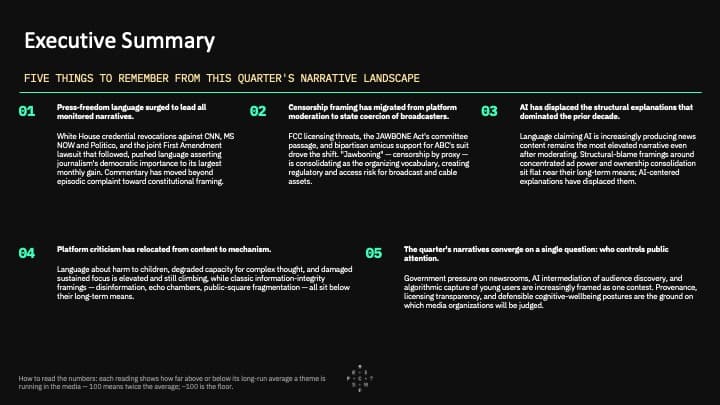
- Traditional media faces converging pressures from corporate consolidation, threats to press freedom, and the erosion of local and investigative journalism. The FCC-approved Nexstar-Tegna merger—now challenged by eight attorneys general—drove the sharpest one-month increase among traditional media signatures, while narratives about the importance of independent journalism and the decline of investigative reporting also strengthened. The simultaneous rise of these signatures reflects growing concern that ownership concentration is undermining the editorial independence and geographic reach that sustain democratic accountability.

- Meme culture's perceived role as a substitute for substantive discourse posted the single largest one-month increase across all 44 signatures Perscient tracks; at the same time, the narrative that platforms deliberately exploit outrage posted the largest single-month decline. This striking directional divergence suggests that media criticism is pivoting from structural critiques of platform engagement mechanics toward alarm about the shallow, memetic cultural content those platforms amplify.

- Platform fragmentation narratives gained strength alongside persistent concerns about algorithmic curation and the cognitive effects of short-form content, while the echo-chamber-drives-polarization narrative faded to near its long-run average. The dominant framing of discourse dysfunction appears to be shifting: rather than arguing that social media traps users in ideological bubbles, commentators increasingly emphasize that users are scattering across dozens of smaller platforms while consuming ever-shorter, algorithmically curated content—a combination that may degrade the quality of public discourse even more effectively than polarization alone.

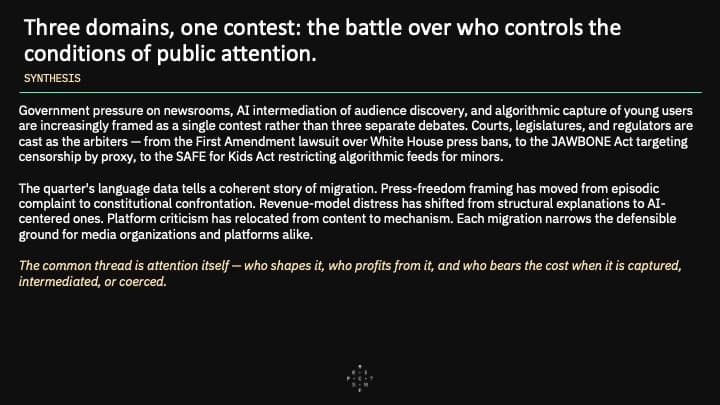
- Taken together, the quarter's narratives reveal a paradox at the heart of the modern information environment: the channels through which news and opinion reach the public are simultaneously consolidating at the ownership level and fragmenting at the user level. Corporate mergers concentrate editorial control in fewer hands while audiences disperse across an expanding constellation of niche platforms, and the content filling those spaces—memes, short-form video, algorithmically curated feeds—is increasingly perceived as corrosive to both individual cognition and collective deliberation.

---

Courts, Legislatures, and Regulators Drive the Youth Harm Narrative to Elevated Levels Across Multiple Dimensions

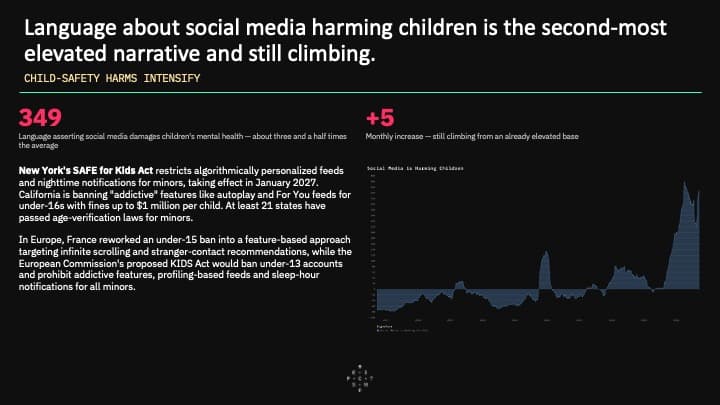
A pair of jury verdicts in late March has fundamentally altered the legal environment for social media companies and their obligations to young users. Perscient's semantic signature tracking the density of language asserting that social media platforms are damaging children's mental health, development, or wellbeing rose by nearly 75 points to an index value of 425, more than four times its long-term average and one of the most pronounced one-month increases across all 44 signatures we track. On March 25, a jury in Los Angeles Superior Court ordered Meta and Google to pay $6 million in damages over defective product design, concluding that Instagram and YouTube bore responsibility for worsening the depression and anxiety of a woman who had compulsively used both platforms as a child. Meta was assigned 70% of the liability. The day before, a separate jury in New Mexico ordered Meta to pay $375 million for failing to protect minors from child predators on Instagram and Facebook; the state's attorney general argued that the company had prioritized growth over safety. Together, these verdicts mark the first time that juries have held technology companies even partially liable for harms experienced by young users after sustained social media use.

The Los Angeles case, a bellwether for more than 2,000 pending lawsuits, drew on internal Meta documents that revealed deliberate strategies aimed at attracting and retaining younger audiences. As Legal Examiner reported, the plaintiff's legal team showed jurors internal communications in which CEO Mark Zuckerberg and other executives described the company's efforts to keep kids and teens on its platforms. Social psychologist Jonathan Haidt wrote on X that the verdict meant that "we are in a new world: a new era in the fight to protect children from online harms." The comparison to Big Tobacco litigation of the 1990s gained further traction after additional bellwether trials in the social media mental health MDL were set for June 2026.

The legal developments are complemented by a broadening of the youth harm narrative beyond general mental health. Our semantic signature tracking language asserting that social media produces body image issues in young adults increased by 26.3 points to an index value of 111, aligning directly with trial testimony. The plaintiff in the Los Angeles case testified that using social media affected her self-worth, leading her to develop depression and body dysmorphia as she continuously compared herself to others and relied on beauty filters to alter her appearance. Meanwhile, Perscient's signature tracking language claiming that social media is radicalizing or pushing young men toward extremist ideologies strengthened by over 10 points to 159. The simultaneous rise of these three youth-focused signatures indicates that media discourse about social media's effects on young people is broadening from a narrow mental health framing to encompass body image distortion and ideological radicalization.

Legislative responses are keeping pace. The Massachusetts House passed legislation on a 129-25 vote to prohibit children under 14 from creating social media accounts; parental consent would be required for 14- and 15-year-olds. As of April 2026, at least 19 states have enacted laws addressing minors' access to or treatment on social media. At the federal level, the Kids Off Social Media Act would prohibit platforms from knowingly allowing children under 13 to create accounts, while Congressman Josh Gottheimer announced the bipartisan Parents Decide Act on April 2, aimed at strengthening parental control over children's device access. Australia enacted the world's first nationwide ban on social media access for children under 16; comparable frameworks are advancing in Brazil and France, though the ban's effectiveness has already drawn scrutiny from civil liberties organizations noting that 70% of targeted children remain on social media sites.

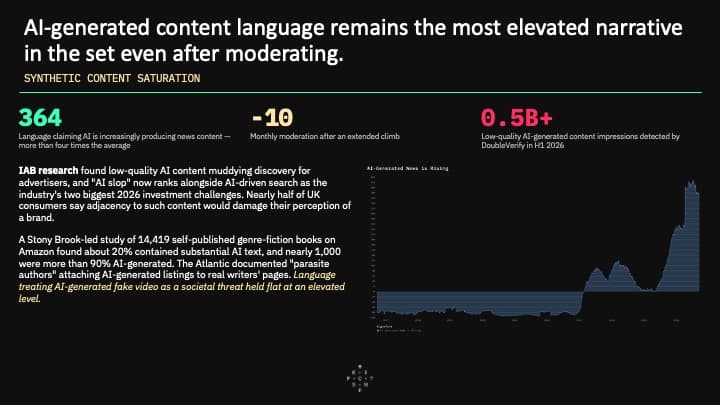
The youth harm narrative extends beyond platform design to emerging technologies. Our semantic signature tracking the density of language claiming that AI-generated fake videos represent a significant societal threat sits at 618, the single highest index value in the entire dataset. UNICEF has emphasized that children are more likely to use generative AI than adults, calling for urgency around AI literacy.

Simultaneous Increases in Press Freedom, Consolidation, and Investigative Journalism Narratives Reflect Deepening Institutional Pressure on Traditional Media

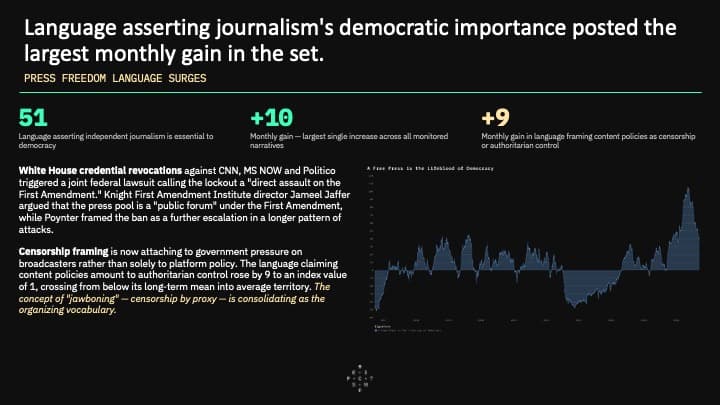
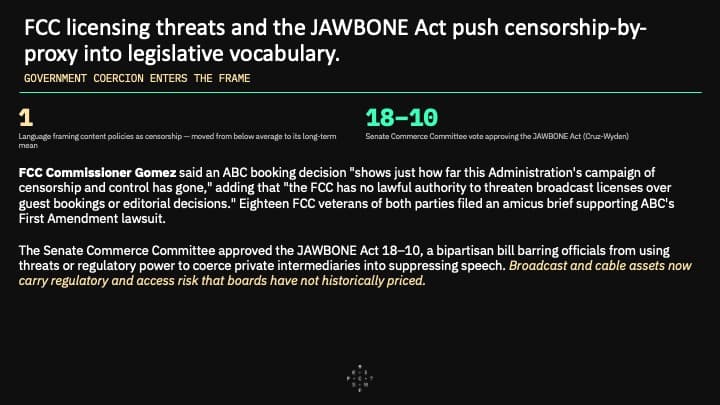
A parallel set of pressures is bearing down on traditional media institutions. Perscient's semantic signature tracking language asserting that corporate mergers and ownership concentration in news organizations are endangering diverse perspectives climbed by 37.3 points to an index value of 120, the largest one-month increase among traditional media-related signatures and well above its long-term mean. The primary driver is the Nexstar-Tegna merger: after the FCC approved the $6.2 billion deal, one company will now own television stations reaching roughly 80% of U.S. TV-watching households. Eight attorneys general sued to block the transaction on antitrust grounds, and a U.S. judge extended a temporary order halting the merger for further review. The Committee to Protect Journalists published an analysis in April documenting what it called a worrying politicization of the FCC under its current chairman, arguing that the agency has wielded its authority over broadcast licenses so that "a concentrated number of companies now control an expanding share of what Americans watch."

Our semantic signature tracking language asserting that independent journalism is critically important to democratic society increased by 26.3 points to 103. The concurrent strengthening of these two signatures reflects growing concern that ownership concentration may be undermining editorial independence. Sixteen leading press freedom groups, civil liberties organizations, and labor unions urged the FCC not to proceed with plans to loosen media ownership limits, writing that "allowing for even more media consolidation poses too great a risk to our democracy." Don Lemon warned against authoritarianism and media consolidation at the GLAAD awards, while journalist Carole Cadwalladr wrote that "the capture of US media orgs is accelerating."

Perscient's semantic signature tracking the density of language asserting that in-depth investigative reporting is in danger of disappearing climbed by 26.3 points to 79, a substantial increase from the prior month's 53. The threats documented in April alone span multiple continents: Russian security forces raided Novaya Gazeta and detained investigative journalist Oleg Roldugin; Hungary charged investigative journalist Szabolcs Panyi with espionage; and in the United States, the president publicly threatened to jail a reporter who refused to reveal a confidential source. The Atlantic's general counsel described an "age of capitulation" in which law is increasingly used to pressure newsrooms, warning that routinely settling weak defamation cases quietly chills investigative reporting.

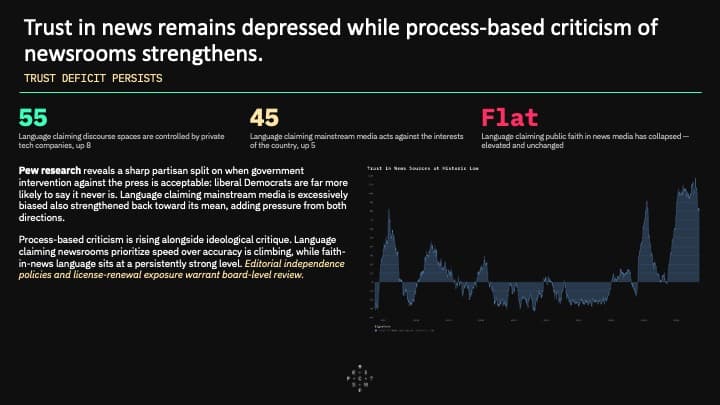
Our signature tracking language asserting that community newspapers and regional journalism are vanishing rose by 12.4 points to 44. CPJ reported that where media consolidation occurs, cost cuts and shortcuts follow: local news is replaced by "news duplication" across multiple stations, and the growth of "news deserts," combined with the recent federal defunding of public broadcasting, has made it increasingly difficult for Americans to access local, fact-based news sources. Ad Fontes Media noted in its April chart that local news consistently provides high-reliability, low-bias reporting and that its disappearance represents a material loss for the information ecosystem.

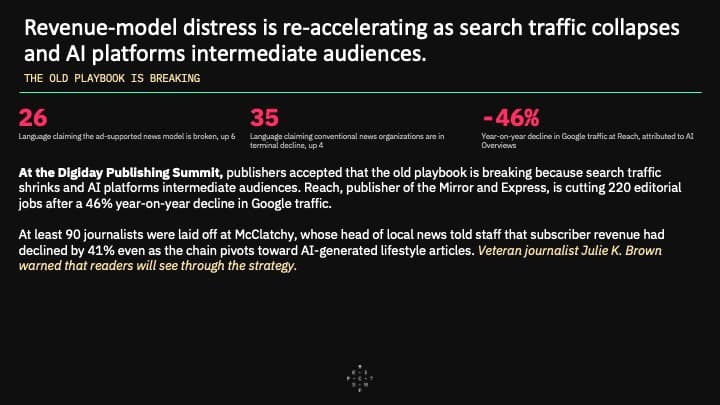
Amid these losses, ProPublica and The Texas Tribune selected five new partner organizations in Texas to participate in the second year of a local investigative initiative that supports accountability journalism. Our signature tracking language asserting that conventional news organizations are in terminal decline strengthened modestly by 5.4 points to 102, roughly double its long-run average, while our signature tracking language claiming that public faith in news media has reached low levels held steady at 115, suggesting that the erosion of trust has not deepened further but persists at an elevated level.

Meme Culture's Rapid Ascent Coincides with Declining Outrage Narratives and Accelerating Platform Fragmentation

Alongside the institutional pressures on traditional media, Perscient's semantic signature tracking language asserting that memes are being used as substitutes for substantive discussion posted the largest one-month increase across all 44 signatures, rising by 77.9 points to an index value of 192, nearly three times its long-term average. The New York Times captured the cultural moment with an April 6 magazine piece titled "Forget the A.I. Apocalypse. Memes Have Already Nuked Our Culture," arguing that internet "brain rot" has escaped our phones to permeate everything from jokes and slang to White House policy messaging.

Academic research published in early 2026 examined how memes, "originally intended for humour, are now utilised to shape public perception and influence political narratives," functioning as "potent tools for political communication" and instruments for reinforcing ideological divides. The literature describes a dual potential: memes can foster in-group identity and serve as interpretive tools for marginalized communities, but the low reputational cost of circulating memes allows for plausible deniability, a pattern exploitable by bad-faith political actors. On social media, users noted bluntly that "memes & internet jokes are genuinely being used rn for propaganda and controlling public response & perception."

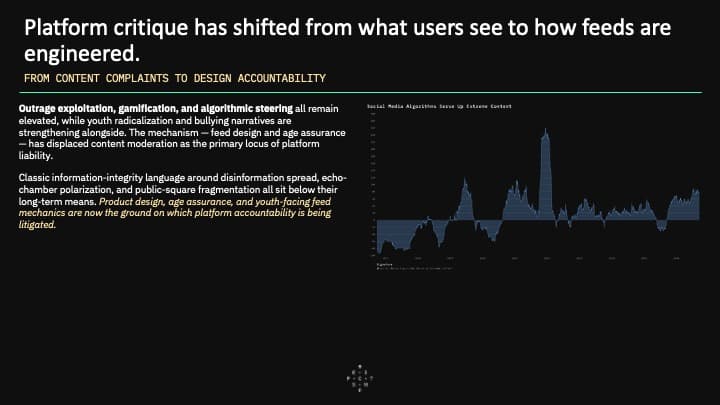
In striking contrast, our semantic signature tracking language asserting that social media companies deliberately exploit anger to increase user engagement declined by 59.4 points to 108, the single largest one-month decrease across all signatures. This directional divergence suggests a reframing of media criticism: from structural critiques of platform engagement mechanics toward concerns about the cultural content those platforms amplify.

The environment in which this content circulates is itself splintering. Perscient's semantic signature tracking language asserting that users moving between platforms is fragmenting public discourse climbed by 29 points to 37. The typical social media user now moves between 6.8 different social networks every month. Pulsar's 2026 analysis described an environment that no longer resembles "a solar system with a few massive suns" but instead an explosion of specialized platforms, noting that services like Discord and Bluesky reflect "growing fatigue with algorithmic feeds, as users migrate toward spaces where community rules and shared interests matter more than viral reach." Rising privacy concerns and declining trust in Big Tech are driving the launch of new platforms in 2026, and users are distributing their attention across many smaller, interest-based communities rather than concentrating it on one or two dominant networks.

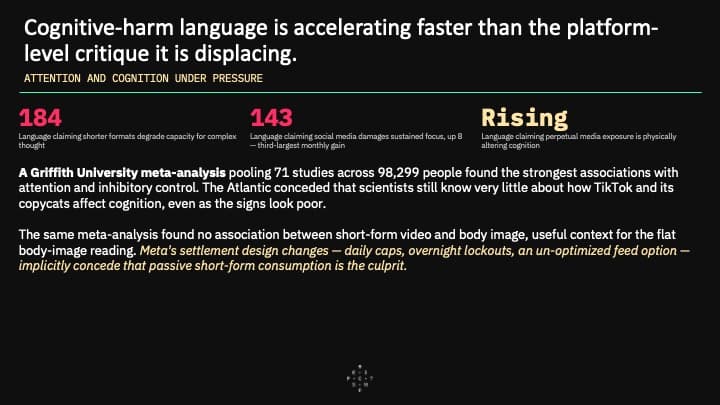
Yet even as users scatter, algorithmic curation remains a central concern. Our signature tracking language claiming that algorithms control or determine what media people consume rose by 11.1 points to 184, suggesting that algorithmic mediation of content is a structural feature of the environment regardless of how many platforms comprise it. Our signature tracking language asserting that shorter content formats degrade the human capacity for complex thought remained flat at 213, more than three times its long-term average, reinforcing a sustained narrative about the compression and simplification of media content. An internal TikTok research finding circulated widely on X, claiming that consuming short-form content decreases analytical skills, memory formation, conversational depth, and empathy.

Meanwhile, our semantic signature tracking language asserting that social media echo chambers are driving political polarization fell by 14.1 points to negative 11, near its long-run average. This suggests that the dominant framing of discourse dysfunction may be shifting: away from "polarization via echo chambers" and toward "fragmentation via platform migration" and "shallowing via memes and short-form content."

Archived Pulse

March 2026

  • The College Sports Upheaval Reaches the White House — and the Broadcast Boardroom
  • The 2026 Winter Olympics Reignited the "Stick to Sports" Debate at Record Levels
  • Private Equity Fever Cools While Sports Media's Structural Transformation Draws Regulatory Attention

February 2026

  • Rising Concerns About Press Freedom and Democratic Accountability
  • Traditional News Industry Faces Existential Pressures While Local News Disappears
  • Media Consolidation Accelerates as Short-Form Content Reshapes Attention

January 2026

  • The Deepfake Reckoning Reaches a Tipping Point
  • Trust in News Media Continues to Erode Amid Structural Upheaval
  • Social Media's Impact on Children Drives Legislative Action Amid Deepfake Concerns

December 2025

  • Deepfake Concerns and AI-Generated News Content Dominate
  • Social Media Harms to Children Drive Policy and Platform Changes
  • Young Men and Online Radicalization Narratives Gain Attention
  • Influencers Challenge Traditional Media Power Structures
  • Trust, Misinformation, and Algorithm Concerns Intensify Across Media

November 2025

  • Deepfakes Reach Critical Mass as Detection Becomes Near-Impossible
  • AI-Generated News Content Proliferates Across American Journalism
  • Newsletter Renaissance Accelerates as Substack Transforms Media Distribution
  • Attention Spans Collapse Under Weight of Short-Form Content
  • Social Listening Emerges as Alternative to Traditional Polling Methods

Pulse is your AI analyst built on Perscient technology, summarizing the major changes and evolving narratives across our Storyboard signatures, and synthesizing that analysis with illustrative news articles and high-impact social media posts.

Pulse
Media