
Men of God in the City of Man, Part 3: Memetics
July 5, 2023·Politics
Download a PDF of Men of God in the City of Man, Part 3: Memetics (paid subscribers only)
Listen to an audio recording of Men of God in the City of Man, Part 3: Memetics
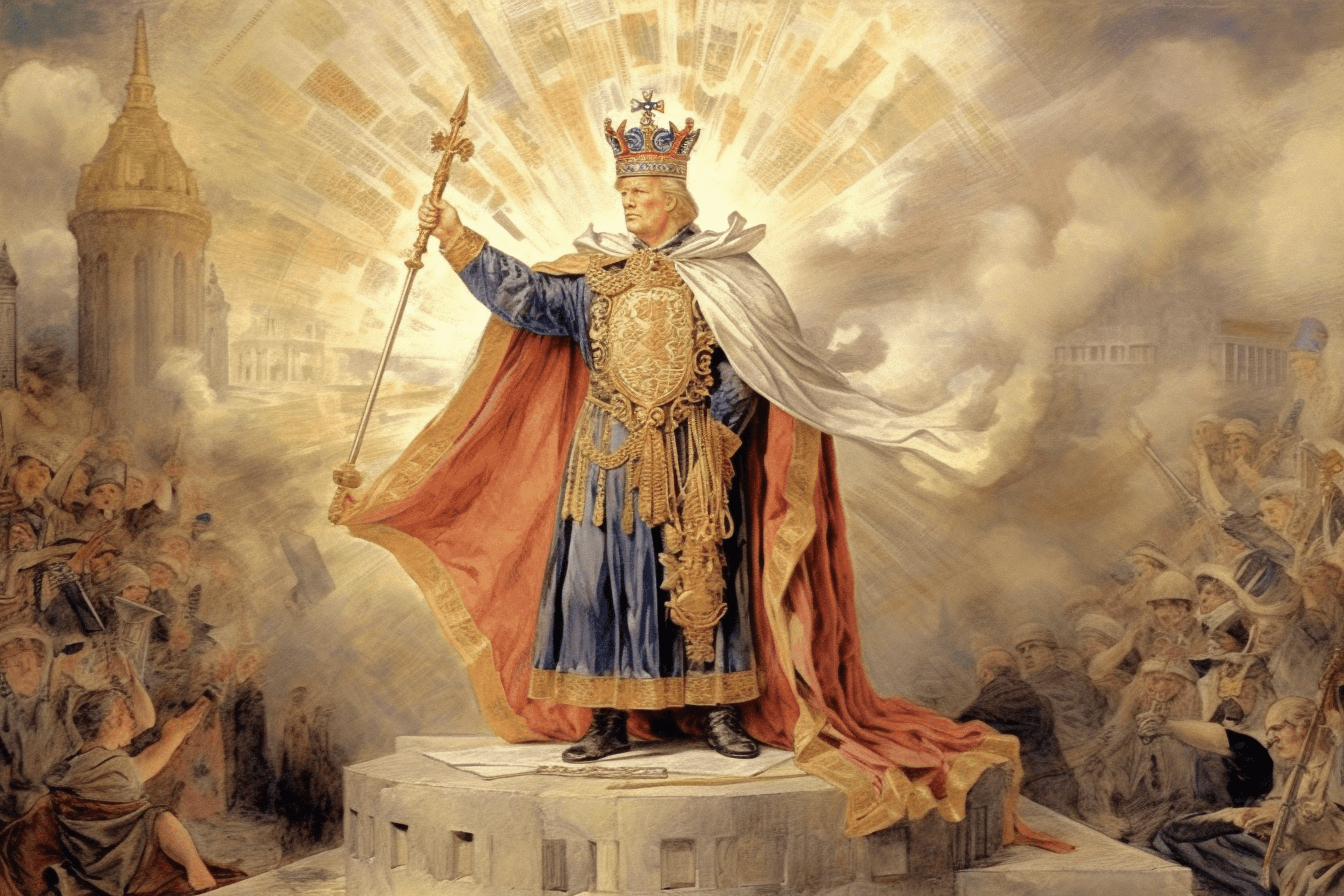
Men of God in the City of Man is a nine-part essay series that tells the story of a powerful narrative virus whose ultimate unintended target was nothing less than faith in American democracy as an institution. Part 1 introduced the idea of the narrative virus as a mechanism for astroturfing (fake grassroots) campaigns, and the idea that the danger may not come so much from forcing new Common Knowledge, but changing what some of the population needed to be true. Part 2 is the story of the carriers of its chief ultimate symptom: a rabid belief in rampant electoral fraud. Part 3 is the story of the creators of the narrative virus and the memetic building blocks they brought to bear.
I am deeply indebted to the work of Jim Beverley, Matthew Taylor and Paul Djupe in various areas of this essay series. I have attempted to source their work where possible, but if you see something unsourced that makes a clever observation about our subject matter, please do me the favor of assuming it is the work of their dutiful scholarship.
In the same way that what makes us human can be expressed in heritable building blocks, so too can what makes us humans.
The former idea we call genetics. The latter we call memetics.
It is a clever idea – not ours – and it captures a useful concept. As Dawkins observed originally when coining the term in The Selfish Gene, there are informational building blocks to culture, norms and common knowledge in the same way that there are to the human body. Memes reproduce, they mutate and they survive on the basis of their capacity to survive to the point of reproduction. At scale and over time, maladapted memes fail in the same way that maladapted genes fail. They succeed in much the same fashion as well.
As many critics have observed, a model which seeks to fashion "culture" from some combination of memes is likely to be a pretty poor model. Instead, we think that it is better to think of memes not as the building blocks of culture writ large, but as the building blocks of narrative – of stories and framing of information consumed. In other words, we think it is far better to think of memes as the building blocks of what everybody believes everybody else believes about their culture. As a narrower system for conceptualizing the birth, death, mutation, transmission and evolution of ways in which groups of humans will tend to respond to those stories, we think it holds up far better.
Still, even narrowed in scope, it is rather silly to suppose that we can demand the same degree of precision from a thing like memetics, which must be qualitatively defined from unstructured data in the process of quantifying its change, as we might from genetics.
I can say without qualification, for example, that there is a base pair location on my Y-chromosome identified as 22885457 on the GRCh38 reference build in which a mutation has taken place – the expected thymine in this location is instead guanine. I know that this is a single nucleotide polymorphism that exists in no other male human who has undergone a sequencing of his Y-chromosome, which distinguishes my genetic makeup from any other tested human. Is it a marker for a new sub-clade of the last 400-600 years that might be established with additional testing of living men from more recent generations? Or is it a sort of ephemeral splash of genetic volatility, an especially vulnerable region of the chromosome for which mutation is not at all an unexpected outcome from generation to generation?
No idea. But these are testable questions.
On the other hand, where and when a narrative of a "Trump is a King Cyrus President" that is built on the Meme of "Hope for Broken Vessels" mutates into the narrative of "I'm not voting for Trump to be my Sunday School teacher" are not unquantifiable questions, but measuring the transition in relative linguistic density of some embeddings model built on the basis of these ideas is in no way the exact science that identifying the identity of a nucleobase in a particular position of a particular region on a particular chromosome is.
So some skepticism is warranted. Still, I think memetic analysis is the best method we have to understand exactly how these narratives spread, and how they produced the electoral fraud symptom of the virus we discussed in Part 1 and Part 2.
I think you can build an adequate model of exactly how that happened through just five memes. Okay, technically six, but since you'll have to wait until Part 7 to unlock the last one, let's call it five.
These five memes are old stories that I believe were consciously and unconsciously inserted into narrative viruses in various distinct packages. Five memes which interacted with their environment, mutated, adapted and reproduced over time to produce an outcome that I think no one intended: the common knowledge that American elections could no longer be trusted. As we describe these memes in this Part 3, we will discuss their creators, their philosophical basis and the narrower applications underlying their design. In Part 4, we will discuss how they were integrated, melded and alloyed by their environment into the memes which produced the very real political outcomes we have observed over the last several years.
As I remarked in Part 1, not one of these has even the slightest direct relationship to an unwavering belief in widespread electoral fraud. Yet that is precisely the chief symptom their mutation would produce.
The Five Foundational Memes of Charismatic/Election Fraud Syncretism
Rediscovering the Old Ways
Keeping Ancient Covenants
Mountains to be Conquered
Hope for Broken Vessels
A Faithful Remnant Returns
Rediscovering the Old Ways
While our concept of the meme is not as a building block of culture but as a building block of narrative, we still intend to convey a certain universality to the human susceptibility to them. One of best examples of this distinction is the first of our five foundational memes.
The Old Ways are not a uniform thing. They will be and mean something different in almost every culture and society. Could we construct each of these distinct ideas from a cobbled together pantry of memetic ingredients in the Dawkinsian mode? Eh. Maybe. Honor the family, honor the ancestors, love and protect the homeland, that sort of thing. Lots of raw materials with a lot of universal power. On the whole, however, I'm not sure our model would be very useful. More to the point, we would lose a lot of accuracy in trying to capture the interaction effects of everything that constitutes each culture's conceptualization of "The Old Ways." Jewish and German cultures both incorporate love and protect the homeland memes. In context they are, shall we say, not the same.
That's why, for our purposes, anyway, it is much more useful to think about the idea that lives one layer of abstraction higher: that we ought to Rediscover the Old Ways. That meme, as a narrative building block rather than a cultural building block, is ubiquitous, maybe universal, even if the Old Ways humans long to rediscover are often dissimilar.
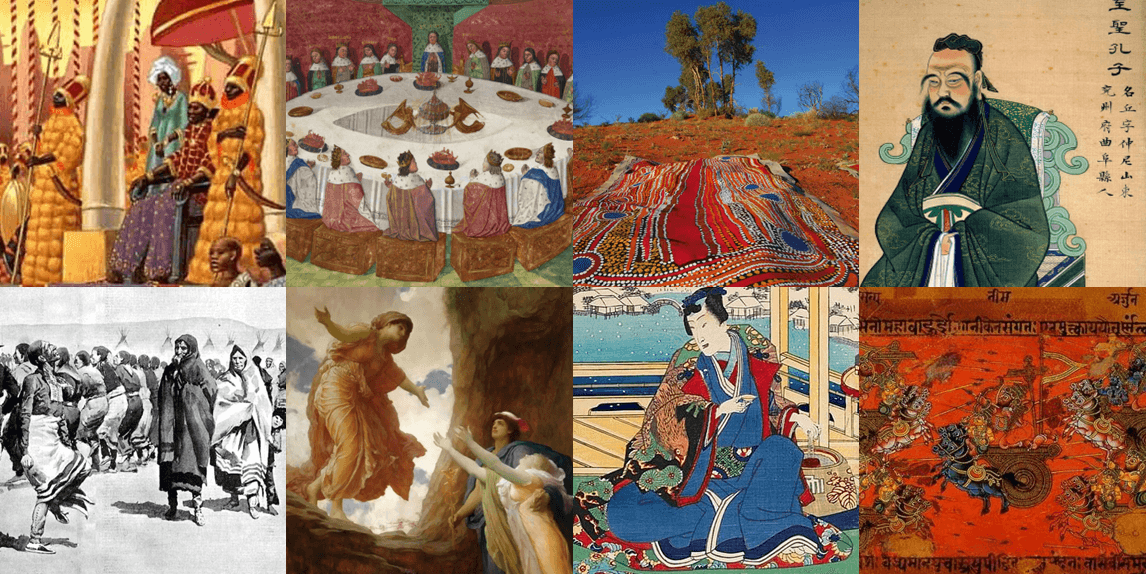
Rediscovering the Old Ways is The Eleusinian Mysteries. It is Confucius, the Pauite's Nanissáanah, the Jukurrpa of the Warlpiri. It is Camelot, Genji, the Epic of Sundiata Keita and the Mahabharata.
It is Christian restorationism.
In fact, of all those examples, Christian restorationism may be the most apt. Christianity's scriptures, contemporary historical texts and apocrypha give excellent descriptions of the practices of early Christians. Over the centuries, nearly every schism and reformation, every thesis nailed to a door and every movement in the faith was, as its heart, an attempt to Rediscover the Old Ways of the early church described in the New Testament from whatever corrupted place the Church and its denominations had taken it. More important than whether each of these ever was such an earnest attempt in reality (sometimes even an ardent defender of the faith just has to marry Anne Boleyn), however, the language used to energize and inspire the movement would have accessed the same sources of memetic power.
The Protestant Reformation was an early church restoration movement. Methodism was an early church restoration movement. Seventh Day Adventists were an early church restoration movement. In the relatively short history of the United States, there have been perhaps a dozen or so major restorationist or Christian primitivist movements, many of which could not be more different in theology or temperament. Such was the nature of the new world, I think, that restoration to the original way of things was very much a part of fabric of American American culture from the very beginning. It remains so today.
So it is that in Pentecostalism, I think we can observe one of the most thorough concepts of restorationism in religious history. Whereas the emphasis of prior restoration movements and emergent "denominations" tended to focus on some narrow set of features or grievances with the evolution of their contemporary church, Pentecostalism sought to restore a wide array of practices, doctrines and, importantly, even emotional responses and experiences that its adherents felt would have been present in the early church. Especially within the Oneness non-trinitarian sub-movement of Pentecostalism, the embrace of restorationism was explicit and intentional, as opposed to the post-hoc description applied to many such movements.
Yet even that pales, I think, in comparison with the scale and dimensionality of restorationism that took hold in the late 1960s in connection with the growth of the charismatic movement. Whether it was the communal focus and emphasis on authentic living of the Jesus People, or the apostolic model and cell church philosophy of Bob Mumford's shepherding movement, or the house church movement in the United Kingdom at the same time, the charismatic movement embraced an exaggerated and performative narrative of restorationism on dimensions far more practical and everyday than the polity and theological bases which tended to underlie prior restorationist movements. The blue jeans, hug-your-neighbor informality of a non-denominational church might feel like "adapting to modern audiences" and in reality world may often be precisely that. But in narrative world, the original idea was quite the opposite: the rediscovery of Old Ways in which "doing church" was a thing that was fully integrated into believers' lives in the way it would have been in the communal New Testament church.
There are two of the rediscovered ways of the early church, however, that have been the most powerful, the most affected by subsequent mutations of the meme, and the most important to the topic of this essay series: (1) the gift of prophecy and office of the prophet, and (2) the office of the apostle.
Neither of these Old Ways re-emerged ex nihilo.
There have always been those who called themselves prophets, and it would not be uncommon in any era for a certain kind of religious leader to fancy himself an apostle to his era. Neither can we say that they emerged only at and following the Azusa Street Revival in the early 1900s, the event that effectively kicked off the entire Pentecostal movement. My third great-grandfather was a wacky holiness millenialist cult leader in Corsicana, Texas in the 1880s, a quarter century before Azusa Street's William Seymour confused a lot of racists in Los Angeles. My rather eccentric ancestor had been converted to all sorts of...restorationist views by his four-fingered brother's visit to a faith healer, prophet and apostle in Brooklyn, New York named Henry T. Williams. He left with four fingers and a dream of five. He came home with four fingers and a lot of fun ideas about the end of the world.
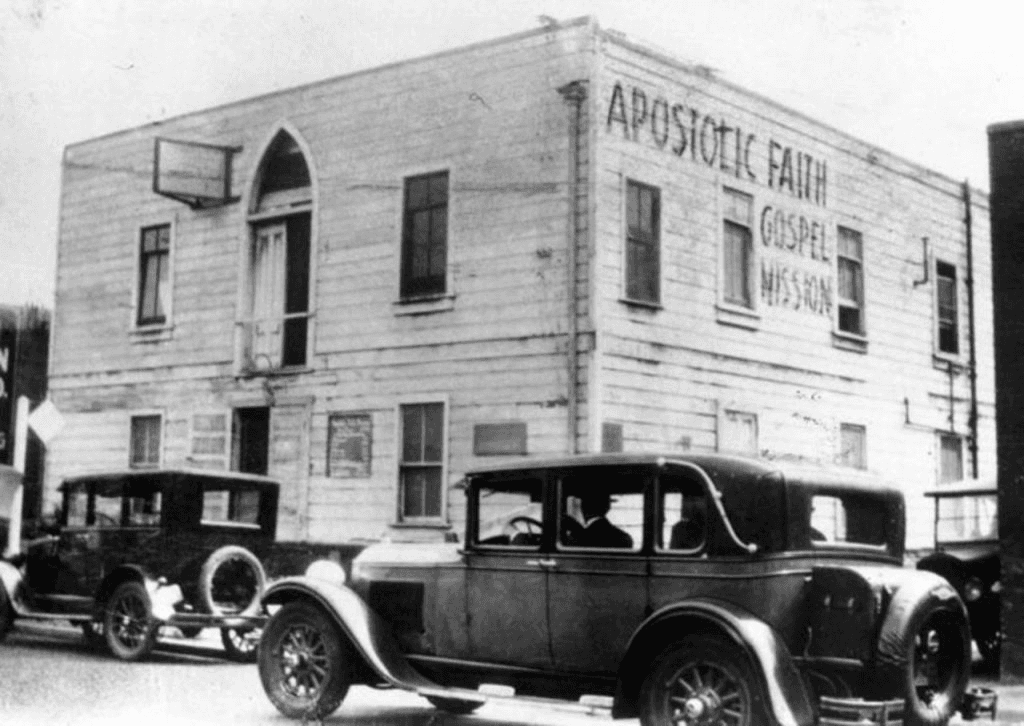
The restoration of the offices of the apostle and the prophet was a theme in Oneness Pentecostalism in the teens and 20s. Even in trinitarian Pentecostalism. For goodness sake, the church where Azusa Street started in 1906 was called the "Apostolic Faith Gospel Mission."
Likewise, the offices of the apostle and prophet (or at least the terms) would have been associated with many of the Pentecostal and charismatic faith healers and revivalists of the 40s, and 50s. Certainly they were features of the charismatic movement's restorationist surges in the 1960s. But in the same way that this essay series is not intended to be a Survey of World Religions, neither is it intended to be a thorough history of 20th charismatic restorationism in the United States. For that reason, we will leave it to others to argue how much credit to give to Bill Hamon, Cannistraci, Che Ahn, the Kansas City Prophets, five-fold ministry independent churches, Latter Rain adherents, the Network or a bunch of other early apostolic-prophetic networks that you probably haven't heard of and don't need to know anything about.
Because in narrative space it doesn't matter.
Before C. Peter Wagner, the apostolic-prophetic movement was an idea and a thing that some knew was happening. After Wagner, the New Apostolic Reformation was a narrative, painstakingly built on the meme of Restoring the Old Ways.
He is the first narrative virologist in our story.
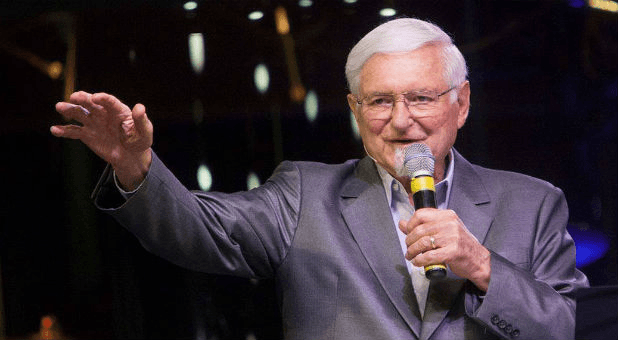
Charismatic author and apostle C. Peter Wagner
The New Apostolic Reformation ("NAR") is almost as dumb a thing to write about as I argued Christian nationalism was back in Part 1.
Feel free to google it. It's a bit of a hot mess. I think a lot of people who care about what they see happening in the Christian church at its intersection with politics find themselves gazing in from the outside at a weird community and doing their best to explain it. Most very badly. Any explanation that presupposes that the NAR is an organization, affiliation or anything beyond a particular narrative attached (by Wagner) to a nascent charismatic restorationist movement is missing the point entirely. The first rule of NAR is you don't talk about NAR. That's kind of the point of an apostolic reformation, y'all. It is, by definition, a description of a movement to decentralize the governance of the church, or at the very least, to re-centralize it from denominations, boards, messengers, presbyteries, dioceses and conventions to the office of the apostle.
Let's back up.
The office of apostle is a Biblical office. It is not wacko stuff, except inasmuch as you regard all Christianity as wacko stuff, which is your prerogative. The office of apostle is described principally in three places in the New Testament:
So, then, you are no longer foreigners and strangers, but fellow citizens with the saints, and members of God’s household, built on the foundation of the apostles and prophets, with Christ Jesus himself as the cornerstone.
Ephesians 2:19-20 (CSB)
And he himself gave some to be apostles, some prophets, some evangelists, some pastors and teachers...
Ephesians 4:11 (CSB)
And God has appointed these in the church: first apostles, second prophets, third teachers, next miracles, then gifts of healing, helping, leading, various kinds of tongues.
1 Corinthians 12:28 (CSB)
For most of the history of the church, it has been broadly accepted doctrine that the office of the apostle existed only in the early church and when the apostles who had seen Jesus died, so too did the office (Paul gets grandfathered in for seeing Jesus in a vision). Similarly, with the general acceptance of cessationism among most mainline and evangelical denominations, the loss of the gift of prophecy was generally assumed to carry with it the loss of the office of prophet. Even within the largest Pentecostal denomination, the Assemblies of God, teaching that apostles and prophets should govern modern-day churches has long been strictly verboten.
Wagner's definition of the apostle, which happens to be the one originally adopted by his International Coalition of Apostles (ICA) network, works out to this:
An apostle is a Christian leader, gifted, taught, commissioned and sent by God with the authority to establish the foundational government of the church within an assigned sphere of ministry by hearing what the Spirit is saying to the churches and by setting things in order accordingly for the growth and maturity of the church and for the extension of the kingdom of God.
Official ICA Definition of Apostle, as reproduced by C. Peter Wagner in Apostles Today (2012)
Wagner's Apostolic Reformation was, at its heart, an attempt to reorganize the governance of the church to better match the models of the early church provided in the New Testament, presuming theologically that the arguments in favor of their elimination were incorrect. That meant structuring organization of the church around individual apostles where those activities had previously been overseen by groups. It also meant a transformation of the office of the local pastor (not technically a Biblical office, but too inside baseball for this essay) from governor to shepherd, and of the role of other gifted Christians to ministry, essentially relieving them of the big decisions around the strategic direction of the church. It also meant organizing more of the direction of the church around the apostle's presumed reliance on those occupying the office of prophet.
Perhaps more importantly, when Wagner first publicly introduced his Apostolic Reformation terminology in his 1999 book Churchquake, it took place in connection with the rapid establishment of apostolic alliances, in particular his own ICA. To be clear, networks of loosely connected "apostles" had existed before, as early as the late 1970s or early 1980s, but the breadth and scope of Wagner's vision – and the theological basis (or pseudotheological basis, depending on your take) for it – made them a fundamental component of introducing a proper apostolic polity across the church. He argued that these alliances were necessary for accountability, for the proper recognition of apostolic anointing and for the development of broader strategies for the implementation of whatever God was telling the prophets, and what they, in turn, were telling the apostles.
In short, Wagner is the narrative virologist responsible for introducing the Restoring the Old Ways meme, not because he was first to agitate for a return to an apostolic polity or the first to recognize a return of a prophetic movement in the charismatic-Pentecostal church in America, but because his narrative was not of a movement but a reformation. He described a complete reordering of the American Protestant church, from top to bottom, from the sources of authority and doctrinal and interpersonal dispute resolution to the nature of interaction among churches in different regions. In doing so, he attached it to the innately memetic imagery not only of dusty-shoed apostles, but of every one of the long line of great reformers in the history of the Church.
When he did it, he also attached it to the memetically powerful words of prophets like Bill Hamon, who for much of the 1980s had been agitating for something very much like this, a cohesive story to attach to their prophecies about a new period of authority for those claiming to have prophetic gifts. He gave fellow apostles, exhausted by their ostracization from "polite" Christian company, a mechanism to describe how this would come to pass in an American evangelical church that largely still thought of charismatics and Pentecostals as a bunch of weirdos speaking gibberish and punching people in the forehead to make them fall over.
Everything had to change. We have to Rediscover the Old Ways.
Whether you believe the prophets are actually prophets, they were right about the movement exploding. The movement exploded. The size of the networks of churches and parachurch ministries associated with these apostolic networks today is unfathomably large. Think of a number of how many churches consider themselves part of an apostle's strategic network. Then double it. You're still nowhere close. Che Ahn's Harvest International Ministries alone counts 25,000 such associations. Other apostolic networks, like those operated by Chuck Pierce, John Kelly and Cindy Jacobs, boast massive figures as well, to say nothing of the alliances which link the networks to one another.
But that wasn't all.
You see, when you say that everything has to change, even to people who believe that it should be done because it is right, there is always a question hiding underneath the surface.
"Why?"
Why do we do this? Why should we do this? What will the result of embracing this apostolic-prophetic model be? How does this advance the kingdom of God?
And when you ask that question of people operating in the office a prophet, one who is asked "why" may feel called to provide an answer. Maybe something like the greatest harvest of souls ever. Maybe something like finally changing the culture of our nation. Maybe something like bringing the church to the place where Jesus can finally return.
And what would happen if those prophetic voices operated in a new media environment in which the size of apostolic alliances was making scalable media platforms available to decentralized voices? What might happen to the theology and practices of local charismatic, Pentecostal and even evangelical churches with members who saw themselves as part of the broader apostolic-prophetic movement? And what would happen if those emerging narratives encountered the choppy waters of the broader secular cultural context?
But now we're dipping our toes into the waters of epimemetics, friends. We aren't quite ready for that just yet.
Keeping Ancient Covenants
Old ways are one thing. Old covenants are another.
The former is an inward-facing meme, a visceral sense of the relationship a people should have to past versions of itself. The latter is an outward-facing meme, a visceral sense of the relationship a people should have to their commitments to others, whether those others be gods, nations, ancestors or the future. Of course, it is often true that saying "these are our covenants" is another way of saying "we are a people who keep our covenants," so even outward-facing memes are often built on descriptions of identity.
Like inward cultural commitments, the covenants and agreements that a people say that they have will differ. The meme isn't a feature of those covenants, but rather the cultural capital invested in the idea that such ancient covenants ought to be kept. And so, like Rediscovering the Old Ways, this remains a near-universal human meme, despite the disparities in the underlying cultural norms.
It manifests in stories across many cultures.
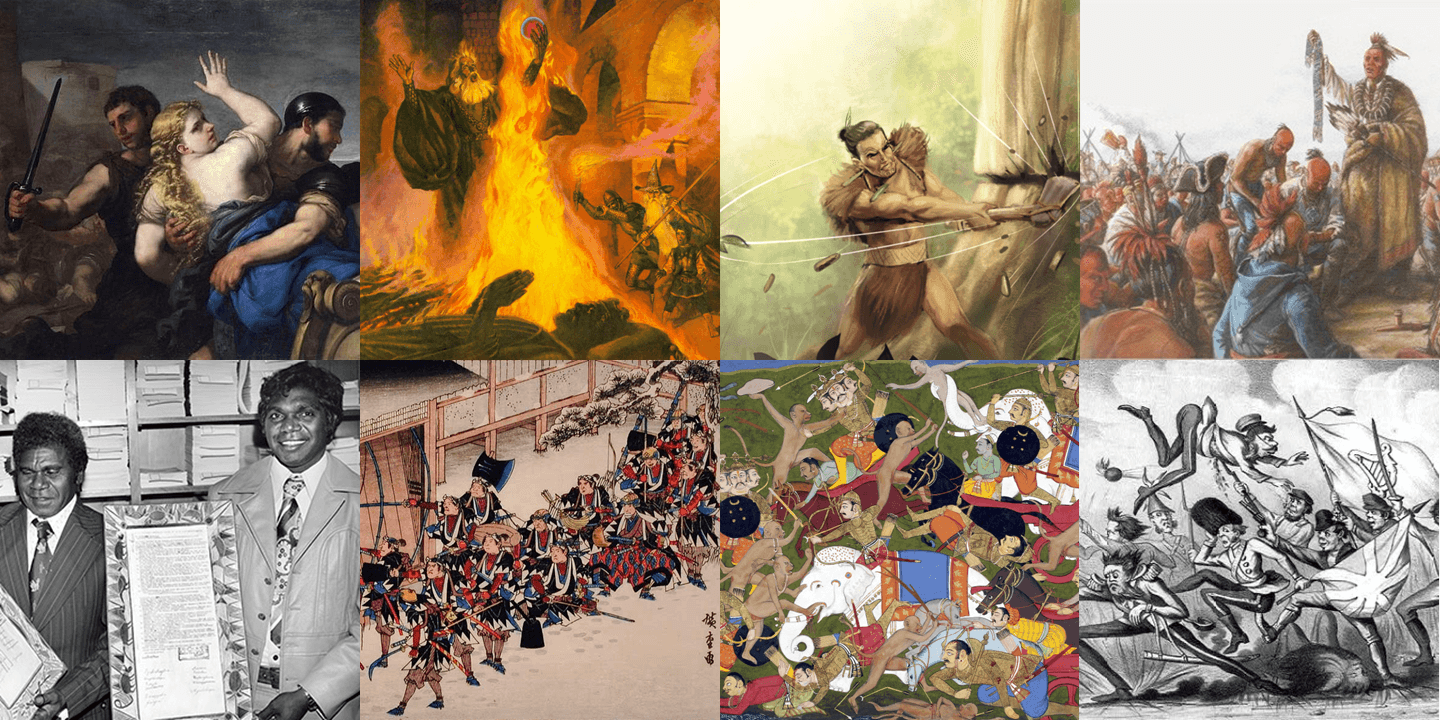
Keeping Ancient Covenants is the Oath of Tyndareus. It is Pippin of the Shire. It is the Great Peace among the tribes of the Iroquois Confederacy and the Yirrkala Bark Petitions. It is Rata me te Rākau, Japan's Forty-Seven Rōnin, India's Ramayana and Ireland's Fenian Brotherhood.
It is a City Upon a Hill.
You probably know the expression from former President Ronald Reagan's famous speech.
I have quoted John Winthrop's words more than once on the campaign trail this year—for I believe that Americans in 1980 are every bit as committed to that vision of a shining city on a hill, as were those long ago settlers
Former President Ronald Reagan, in his speech on the eve of the election in 1980
Probably less so from former President Barack Obama, who used it in a commencement address to UMass-Boston.
I have been guided by the standard John Winthrop set before his shipmates on the flagship Arabella three hundred and thirty-one years ago, as they, too, faced the task of building a new government on a perilous frontier. "We must always consider", he said, "that we shall be as a city upon a hill—the eyes of all people are upon us".
Former President Barack Obama, in an address to University of Massachusetts – Boston on June 2, 2006
The expression comes from a speech by John Winthrop, which he gave to hundreds of the Puritan immigrants who would join him on the expedition to the United States. Except it was not so much a speech as a sermon, probably delivered at the Holyrood Church in Southampton rather than onboard the Arabella (the more romantic and traditional setting).
For we must consider that we shall be as a city upon a hill. The eyes of all people are upon us. So that if we shall deal falsely with our God in this work we have undertaken, and so cause Him to withdraw His present help from us, we shall be made a story and a by-word through the world...we are commanded this day to love the Lord our God, and to love one another, to walk in his ways and to keep his Commandments and his ordinance and his laws, and the articles of our Covenant with Him, that we may live and be multiplied, and that the Lord our God may bless us in the land whither we go to possess it.
Sermon delivered by John Winthrop, commonly referred to as A Model of Christian Charity
The City on a Hill as a meme is far less "source of inspiration to the world", and far more "visible symbol of whether we have kept our covenant with God." It is a meme built as much out of fear and trembling as optimism and faith, and so all the more powerful for it. Fear and faith are both powerful human ideas, after all. In one narrative masterstroke, Winthrop conflated the definition of success in the venture with successful completion of the traditional Judeo-Christian concept of the covenant with God.
Nearly all of the early ventures to these shores took similar memetic forms. Robert Hunt's prayers at Cape Henry, Virginia in 1607 were deeply covenantal, committing that "from these very shores the Gospel shall go forth, not only to this New World, but to all the world." The Virginia Company's charter was rife with this language, even if Hunt and financial backer Richard Hakluyt were likely among the few venturers and adventurers without transparent commercial aims among their top priorities. The Mayflower Compact is much the same.
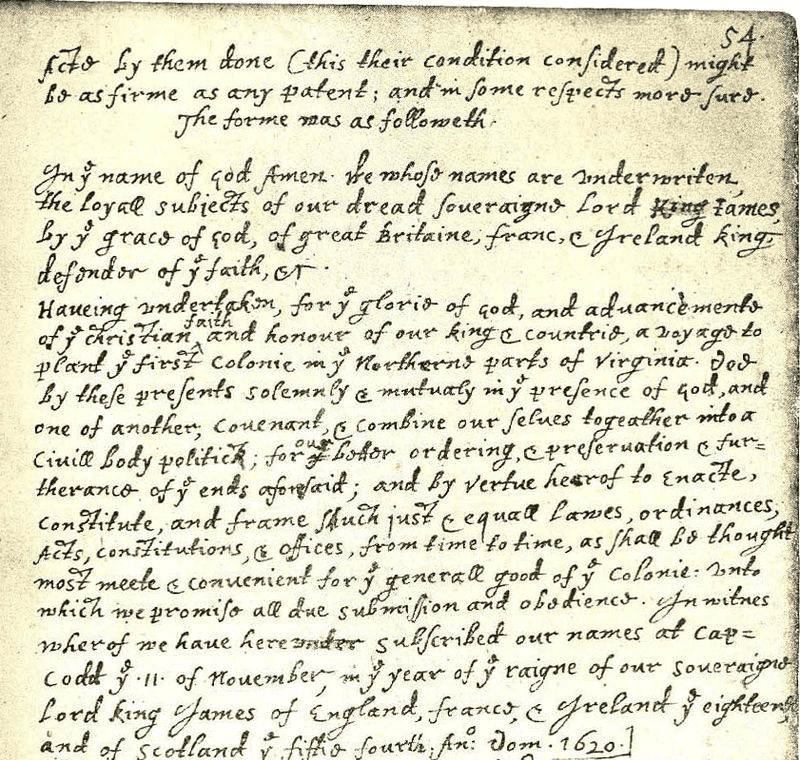
William Bradford's hand-written transcription of the original Mayflower Compact
All of this happened.
Nonetheless, there is a modern truthy movement which leans on similar memes of enlightenment to pretend that America has not been a Christian nation for practically all of its history. It is a preposterous claim on the surface and, unsurprisingly, survives not at all past even the most cursory examination. Of course most of who we call Founding Fathers were effectively deists, or at the very least Unitarians. Of course Jefferson fiercely denied the trinity, and John Adams too, if a bit less forcefully, which might have them invited to more progressive Christian churches but excluded forcefully from anything remotely evangelical. Of course Benjamin Franklin would have chuckled at doctrines of inerrantism and quickly abstracted the conversation into "Christiany" concepts like the providence of God and the good that religious duty and temperance serve in a plural society, etc.
But much of that is private knowledge. Widespread private knowledge in some cases, to be sure. Yet culture is not built of private knowledge but common knowledge – what everybody knows that everybody else knows. And for 400 years, whatever the degree of secularism of America's government and its laws, whatever the degree of secularism of the people's private faith, everybody knew that everybody knew that America was very obviously a culturally Christian nation. For better or worse, its norms, taboos, history of movements, language and even what days you can buy a car, have been steered in large part by this dominant cultural trait.
Yet it is also possible to go outside and find with little difficulty a person who will earnestly complain of America's remarkably puritanical, prudish and censorious nature relative to any other western democracy and in the same breath reject the idea that America is culturally Christian. Again, preposterous stuff.
But while "America has always been a Christian nation" oughtn't to be particularly controversial, it is, mostly because it is another one of those arguments where nobody means quite the same thing by the thing they are discussing, which is sort of the point, I guess. Most such discussions consist of people talking past one another, with one person making an argument about the prevailing culture and another about the nature of its government and laws. Or else one person argues from the prior that "Christian nation" means "founded on something that would have looked like theologically conservative evangelical doctrine", and the other means "a country where everyone is religiously Christian." One person is arguing whether America IS while another argues whether it OUGHT TO BE or MUST BE, using the same language. It's a big, dumb, waste of time minefield.
It is also linguistically dead.
Memetically empty.
There's nothing powerful in "we were founded as a something nation" or "we have always been a something nation," no matter what the something is. We built this city on rock and roll, too. Big deal.
But America has a covenant with God? We are to be a City on a Hill?
Now that's a thing.
The latter narrative formed from the meme is more expansive, more inclusive, an expression of willful exceptionalism and the transmission of responsibility for it through generations. The former is perhaps more powerful and more jarring, even if it is less broadly applicable. Both, however, express an understanding that faithfulness will be rewarded, and that abandonment of the covenant will be punished.
Again, Keeping Ancient Covenants is an old and familiar idea across cultures.
Pippin: "Here do I swear fealty and service to Gondor, and to the Lord and Steward of the realm, to speak and to be silent, to do and to let be, to come and to go, in need or plenty, in peace or war, in living or dying, from this hour henceforth, until my lord release me, or death take me, or the world end. So say I, Peregin son of Paladin of the Shire of the Halflings."
Denethor: "And this do I hear, Denethor son of Ecthelion, Lord of Gondor, Steward of the High King, and I will not forget it, nor fail to reward that which is given: fealty with love, valour with honour, oath-breaking with vengeance."
The Lord of the Rings (The Return of the King), J.R.R. Tolkien (1955)
Yet in the same way that there is a silly movement to pretend that America has not been a culturally Christian country since its inception, there is an equally silly movement to pretend that the dedications and prayers to God made at its founding set it apart from other nations, giving it an almost Israel-like covenant with God.
If only it were true.
Don't mistake me. You are welcome to think what you like, but I still consider American exceptionalism a thing. I proudly fly my Betsy Ross flag from a farm that existed decades before the first July 4th. I treasure my ancient copy of Thomas Jefferson's Garden Book and have planted my orchard with three of the four cider apples that appeared in his. Alas, the Taliaferro cultivar is lost. I believe the dedications at Cape Henry happened. So did the Arabella and the Pilgrims. But as powerful as the language we use to describe these events is in memetic terms, these types of "covenants" were not the exception in the colonial activity of the 15th, 16th, 17th and 18th centuries. They were the rule! And why not? Again, we are talking about one of the most powerful ideas across many human cultures, one that we revisit in hundreds of our most treasured stories, legends and tales!
Consider, for example, that there is a beautiful cobblestone road encircling a 12th century cathedral in Saint-Malo in the heart of Brittany. If you enter the church and walk to the nave, face to the south. You will see a beautiful image in stained glass of Jacques Cartier kneeling to be blessed before his journey to Canada. In a chapel attached to the Saint-Julien wing you will find a reliquary with some of Cartier's remains. In the floor, you will find a stone mosaic marking the spot where Cartier knelt. There is an even smaller chapel not far away in the seaside town of Rothéneuf, with a marker denoting it as the place Cartier prayed earnestly to God before his voyage.
You might then go to Quebec City to visit the charming little Cartier-Brébeuf Park along the St. Charles. There you would find a monument right at the location where, on May 3, 1536, Cartier erected a 35-foot high cross in gratitude and to give glory to God for the successful overwintering of his small fleet during their second voyage of discovery. Or drive four hundred or so miles to the east to Gaspé to discover a museum where, only a couple years before, Cartier had erected a similar cross to claim Canada for his King and God during the momentous first voyage.
Consider, alternatively, that long before Australia was an English penal colony, (and a year before English sailors raised a dedication at Cape Henry), the southern continent was actively sought for colonization by many powers. The Portuguese Pedro Fernandes de Queirós, acting on behalf of Spain, was among the most eager to find and claim the great land for Spain and the Church. Landing on the largest island in what is now Vanuatu (and thinking it the Australian mainland, some 1,200 miles to the southwest), Queirós immediately named it the Southland of the Holy Spirit, or Australia del Espíritu Santo. He proceeded to give a proclamation:
“Let the heavens, the earth, the waters with all their creatures and all those present witness that I, Captain Pedro Fernandez de Quiros…in the name of Jesus Christ...hoist this emblem of the Holy Cross on which His person was crucified and whereon He gave His life for the ransom and remedy of all the human race…on this Day of Pentecost, 14 May 1606…I take possession of all this part of the South as far as the pole in the name of Jesus…Which from now on shall be called the Southern land of the Holy Ghost…and this always and forever...and to the end that to all natives, in all the said lands, the holy and sacred evangel may be preached zealously and openly.”
Pedro Fernandes de Queirós, as recounted by Michael de Looper in Understanding Our Christian Heritage
Deeply Catholic, to be sure, and thus less likely to appeal to the average charismatic or evangelical Christian, but not that much. These richly memetic, covenantal proclamations, prayers and dedications are everywhere – everywhere! – in the exploration and colonization of the new world, whether Cabral in Brazil or Balboa in Panama or Reverend Richard Johnson in Sydney Cove. Frankly, there is no country, America included, for which a protestant tradition of commitment to the Gospel among European settlers was so exaggerated as New Zealand, where Samuel Marsden and his fellow ministers preached to the Māori in 1814, decades before any substantial English settlements emerged.
But that's reality world.
In narrative world, none of that matters.
In narrative world, the conjuration of the Keeping Ancient Covenants meme doesn't need the framing of its historical analogs to be true. It just needs the modern usage to be truthy.
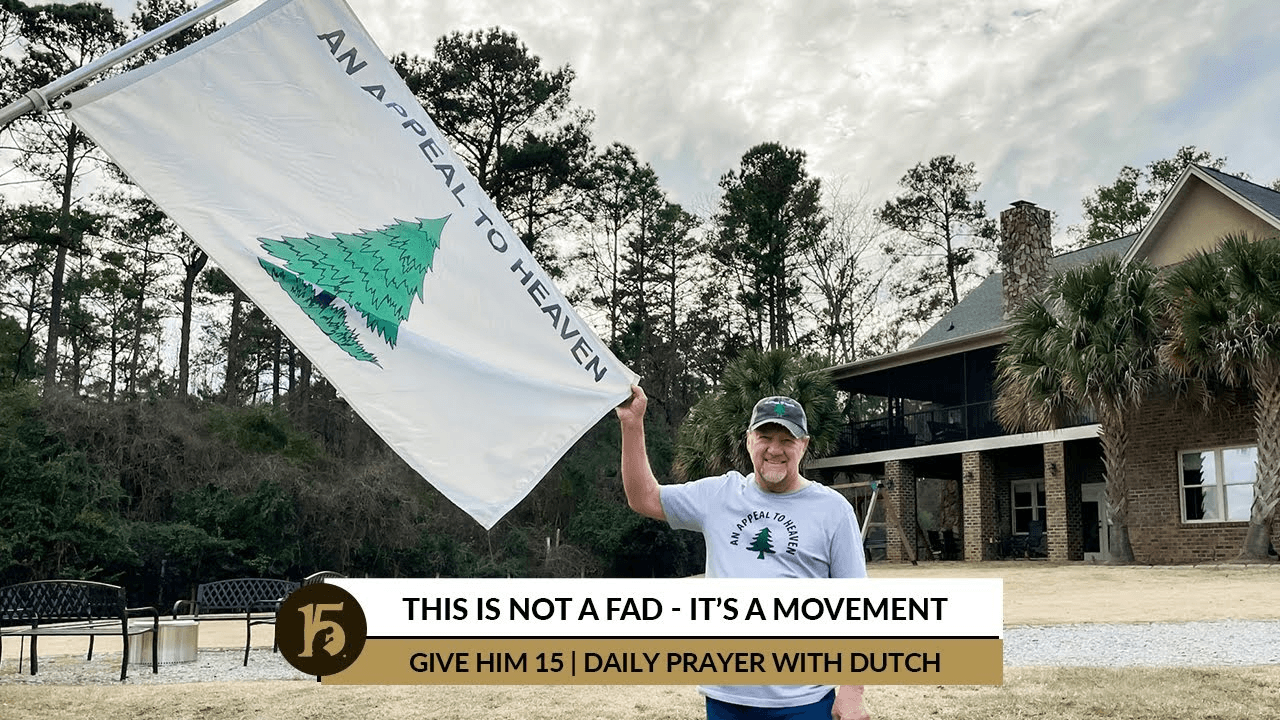
Apostle Dutch Sheets pictured at home with various Appeal to Heaven accoutrement. Source: GiveHim15, Dutch Sheets Ministries
Meet our second narrative virologist, a minister by the name of Dutch Sheets.
Ah, that's right. You met before, back in Part 2.
Dutch Sheets calls himself an apostle, and he isn't the only one. If Wagner's rule of thumb is correct – that an apostle must both have followers who consider him to be an apostle and peers who do the same – then Sheets meets both standards. He has a massive following and is widely respected within the charismatic Christian community, having written probably the most influential text on spiritual warfare in the charismatic-Pentecostal canon – his 1996 book, Intercessory Prayer. It is hard to overstate the influence of this work on how charismatic churches, and indeed many evangelical churches, did prayer. If you have ever wondered at the origin of extemporaneous evangelical prayer practices as they differ from that of mainline, orthodox and other traditions, this book is a one-stop shop for understanding them. As a result of this reputation and Dutch's demeanor, which is typically kindly and soft-spoken, he has been affectionately called "Papa Dutch" within this community for more than a decade.
Like many apostles in this community, Mr. Sheets also issues prophecies, although for the last decade his tendency has been to promote the dreams and visions of others. Perhaps this represents a tighter embrace of the charismatic restorationist idea of the early church model, in which those occupying the office of prophet are to be separate individuals working to help the apostles to know God's plan. I rather suspect, however, that it has more to do with a string of overly specific prophecies in the mid-2000s that proved to be grievously inaccurate.
For example, upon Barack Obama's election in 2008, a couple years before he called the former president a Muslim and less than a year after he confidently prophesied a John McCain victory (before pretending that he hadn't), Sheets prophesied seven different judgments on the nation for its selection of Obama. It was an impressive prophecy not only in that everything Sheets prophesied was wrong, but wrong in an exaggerated, could not possibly be more wrong if you possessed a Gray's Sports Almanac 1950-2000 and knew the exact future and were going out of your way to be wrong sort of way. A charismatic Christian version of Jim Cramer, if you will.
- More economic woes: Starting the day after Sheets published this prophecy through the present day, the stock market in the US underwent one of the largest bull markets in history. GDP bottomed in mid-2009 and then set off one of the longest periods of economic expansion in history.
- More violence in an already violent nation: For the period between 2008 and the present, 2008 was the high-water mark for violent crimes per capita in the United States, at 458.6. It reached a low during the Obama administration at 361.6 and drifted slightly higher during the Trump administration’s years, although still well below 2008 levels.
- Disease and death: Average life expectancy in the United States rose from 78.19 in 2008 to an estimated 79.05 years in 2022.
- Natural disasters (weather-tornadoes, hurricanes, floods, drought; fires, earthquakes; etc.)
- Tornadoes: Per the NOAA, there were 1,011 tornadoes in the prime tornado season in the United States in 2008. In the fourteen years that followed, in only one year did the number exceed that of 2008.
- Hurricanes: Per the National Hurricane Center, the number of recorded hurricanes affecting the United States in the 2010s was 24% lower than in the 2000s.
- Floods: In eight of the years between 2009 and 2020, flood damage in the United States was below 2008 levels. It was admittedly far higher in 2017, although to be clear, that took place during the administration of the US President that Dutch Sheets prophesied would bring God’s favor back to America.
- Drought: An analyst’s opinion here would differ by the assumptions they chose. If monitoring all D0-D4 drought categories published by the University of Nebraska, the percentage of America under drought conditions in the period following 2008 was much lower than in 2008. If monitoring only D3 and D4 categories, the percentage has been higher than 2008.
- Fires: In 2008, the National Interagency Fire Center registered 7,790 distinct wildfires. On this basis, there has been only one year in the last 14 that exceeded that number. On an acreage basis, 226,503 acres were burned in 2008. The average acreage burned in subsequent years was about 286,084 per year.
- Earthquakes: Per the NCEI/WDS Global Significant Earthquake Database, there has been little seismic activity of any significance in the United States since his prophecy. Basically it amounts to a few Aleutian quakes that triggered some brief tsunami warnings and a $1 billion 6.0 in Napa in 2014.
- Terrorism: While data is not as universally available and reliable, for the period between 2015-2019, at least, GTD reports that 97 individuals were killed in the United States by Islamic terrorists. By comparison, 131 were killed by Far-Right Groups. No single large terrorist attack has occurred at any scale comparable to 9/11 since the prophecy.
- War (Perhaps on our own soil): War has not taken place on American soil and the US is involved in fewer wars today than when the prophecy was made. According to the U.S. Department of Defense’s Defense Manpower Data Center, annual Active-Duty military deaths have declined by nearly a third between 2008 and 2020. More to the point, by the end of the Obama administration for which Sheets prophesied America would be punished, U.S. Active-Duty military deaths had fallen by a full 50% since 2008.
- The stacking of the Supreme Court against the sanctity of life and God’s influence on America will occur: Former President Obama ended up getting two U.S. Supreme Court appointees in – Associate Justices Sotomayor and Kagan. Only four presidents since the 1869 change to the size of the court had fewer: Garfield, McKinley, Coolidge and Ford. Fourteen have had more.
If you're keeping score at home, that's 0 correct, 10 extremely and objectively wrong and 2 mostly wrong.
And when the track record starts to look that ugly, you have a few choices: (A) you can start modifying your public prophecies to be vague and heavily symbolic, (B) you can transition more of your promotion of prophecy to the dreams and visions of others, or (C) you can start heavily promoting the Eisegetical notion that prophecies are always conditional even if the prophet doesn't say that they are, and that failure to come to pass may simply mean that the church was not faithful to God's conditions. Mr. Sheets went with a bit of Column A, a bit of Column B and a bit of Column C.
But mostly Column C.
You see, since roughly the year 2000, above all other messages and ministries, prophecies and teachings, Dutch Sheets has promoted the narrative that God made an Israel-like ancient covenant with early America, that this covenant still exists, that faithfulness to this covenant will result in a third Great Awakening (and perhaps hasten the return of Christ), and that failure to be faithful to this ancient covenant will result in judgment.
While some of the ideas were present in his teaching and statements at various conferences and other events, we see the seeds of the idea most clearly in his 2000 book, Watchman Prayer.
While ministering recently in D.C., the Holy Spirit kept bringing to me the phrase "the divine shift." While I was meditating on this phrase, the Holy Spirit began to teach me that a kairos season is simply a phase of the process. In other words, through the working of the Holy Spirit in and through the Church, as well as His masterful aligning even in the unsaved world, chronos (the general passage of time) becomes kairos...
After God made promises to Abraham concerning the nation that would come from him through Sarah, there was a 24-year chronos season requiring faithfulness, commitment and patience. Though not perfectly, Abraham and Sarah made it through this time until the divine shift occurred, transforming chronos to kairos in Genesis 18:10...
After his dramatic conversion in Acts 9, Saul – later named Paul – went into a lengthy season of chronos. It was those twelve years of faithful study, equipping and transformation on the Potter's wheel that allowed the Holy Spirit to cause the divine shift in Acts 13, changing chronos to kairos...
Your city may seem far from revival. Do not grow weary in your doing of good. He is faithful who promised, and He has given you your city. The watchman anointing is in place in the Body of Christ. Walk in it! Let the sieges continue! The shift is coming!
Watchman Prayer, Protecting Your Family, Home and Community from the Enemy's Schemes, by Dutch Sheets (2000)
You may note that the notions of covenant and faithfulness in his examples are individual in nature, and that the unit of interest is principally the family, the church and the city. Not necessarily America per se. That is true! In the mid-to-late 1990s, you see, the charismatic restoration was in full, and at times excessive swing, exposing millions more Americans to prophets, prophecies and all other manifestations of the movement. It happened in Kansas City. In Toronto. And then in Pensacola. Throughout this time, the Azusa Street-derived idea that revival was a thing that started in a church, grew in a city, then spread outwards from the bottom up was suffused through charismatic writing, preaching and prayers. Apostolic networks were generally (though not universally) regional, and discussions of strategy focused very explicitly on "the city" as an entity.
"The City" is still a trope of a sort within the charismatic community. A CCLI Top 100 song (meaning one of the most played in charismatic and evangelical churches) for much of the past three years entitled God of Revival makes this ordering plain in its bridge: "Come awaken your people, come awaken this city. Oh God of revival, pour it out, pour it out. Every stronghold will crumble. Hear the chains hit the ground. Oh God of revival, pour it out, pour it out.
In September 1998, as recounted later in his book The Prophetic Destiny Of A Nation, Dutch Sheets had been supporting Peter Wagner at an event in Rochester. During worship, he claims to have had a vision of Jesus riding a white horse across the map of the United States, starting revival and cleansing fires in Washington D.C. and criss-crossing the nation. In the dream, Jesus later asked Sheets to join him, going to so far as to place the apostle in front of Him on the horse. These seeds grew, and by mid-2000, Dutch Sheets had begun to weave the ideas of Ancient Covenant into the narrative virus. That is, by my judgment, just about when the scope of the apostolic movement began to move away from the city and toward the nation. The covenant duality, however, remained present: faithfulness will be rewarded. Faithlessness will be judged. From October 2000:
During our Wednesday night service on October 4, 2000, the Holy Spirit moved upon me with the greatest prayer burden I have ever experienced...This time of intense, overwhelming travail for our nation lasted for three and a half hours. During that time, I wept off and on harder than I even knew was possible.
The Lord began to speak to my heart about the upcoming presidential election, which is the most critical in decades. There must be a turning in this nation toward righteousness, and this will only happen if God's man is elected into office...
During this intense time on Wednesday night, God led me to Daniel 10 where the account is given of great warfare in the heavenlies between the forces of darkness and light. He showed me that the outcome of the current battle regarding this election will be determined by the prayer of the Church. If there is enough prayer and fasting, God's person will be elected, righteousness will prevail and God's plan will be established. If there is not enough prayer, God's person will lose the election and the turning of this nation will be drastically delayed.
Dutch Sheets, in a letter published October 2000
Around the same time, a lot of things were also happening in Dutch Sheets's ministry that he didn't publish letters about. He claimed, as he would recount later in Peter Wagner's 2001 book Destiny of a Nation, that he had received no fewer than "25 remarkable confirmations" prior to the 2000 election that God was "giving [him] authority – keys – to impact the nation."
If this language is not familiar to you, it refers to Jesus speaking in Matthew 16:19. In it, Jesus tells Simon Peter that He "will give you the keys of the kingdom of heaven, and whatever you bind on earth will have been bound in heaven, and whatever you loose on earth will have been loosed in heaven." For nearly all of church history and through nearly all church traditions, the description referred to ecclesiastic authority, as an extension of the then-familiar Jewish legal concept of binding and loosing. To forbid and permit. Even in the rise of various charismatic and Pentecostal movements, the understanding might have been extended to grant certain authority over the principalities and powers against which spiritual warfare might be conducted Biblically. Even Wagner's early talk of apostolic reformation was similarly constrained.
This was neither of those things. As innocuous as the "impact the nation" language above may sound, Sheets is very clearly and explicitly saying that in 2000, he was teaching and promoting the idea that the keys to the Kingdom of God given by Jesus to the Christian church would permit them to simply decree the outcome of an election as God's ruling authority on Earth. That is, in fact, precisely how he recounts it in his own retelling of the events leading up to the 2000 election in his 2003 joint book with Chuck Pierce, Releasing the Prophetic Destiny of a Nation.
We truly have been given keys of authority from God to legislate from the heavenlies (in the realm of the spirit), opening doors that can't be closed by satan or any person, and closing doors through which evil and destruction might otherwise enter.
As I stated earlier, our prayers were effective, and I believe God gave us His choice as president. Then came the hanging chads and the amazing battle for the state of Florida, which would of course determine the final outcome. On December 2, 2000, after so much confirmation and prayer, I became convinced that it was time for an extremely bold act of prayer and prophetic declaration. I, along with two other people, went to the White House grounds late that Saturday night...
We then proceeded to decree that the door to the White House was open to George W. Bush, and that he would enter it as president of the United States.
Presumptuous? Arrogant? Some would no doubt feel that it was. However, by that time, I was thoroughly convinced God had confirmed again and again that we had this authority in the spirit and that we were to exercise it.
Releasing the Prophetic Destiny of a Nation, by Dutch Sheets (2003)
The ruling authority over the future of America having been thus established, the memetic pattern continues, such as in this example from 2002. Keep the Ancient Covenant. Faithfulness rewarded. Faithlessness judged.
While In Washington, DC this week, the Holy Spirit impressed upon me the need for another urgent call to prayer for our nation...
The next branch of government that must be shifted is the Judicial Branch. I am certain this was the Lord speaking to me and, like Nehemiah and his gates, I knew immediately that our journey toward revival in America was absolutely dependent upon seeing our gates, the courts, restored...
Having said this, however, I want to reiterate the seriousness of what I feel. This judicial issue is a major key to determining whether revival or further spiritual decline occurs for America. We will either see this gate properly restored or America will turn farther away from God...
We have made great progress in the past few years toward the turning of this nation back to God. We are so close to revival, in fact, I believe, though it is not yet visible, we are in the beginning stages.
Dutch Sheets, in a letter published October 2002
And in 2003. America is like Israel. Keep the Ancient Covenant. Faithfulness rewarded. Faithlessness judged.
The outcome of the spiritual war we are entering into is probably going to be the single most important deciding factor in whether or not we see revival and the healing of America in our generation. The war of which I speak is for the turning of the courts, with its obvious connection to many critical issues, perhaps the most important of which is abortion...
Though I believe we have made much progress in turning this nation, and actually believe the awakening for which we have cried out has in some ways begun, in no way has it reached the momentum point that it cannot be stopped. We are like Israel that came out of Egypt – great deliverance and restoration has begun, but there are many jumping off points on the journey to our destiny. We have come to one. This is the giant, in fact. If we don't face and defeat this one, we will wander in the wilderness of unbelief and apathy until we die.
If we do not win this battle, we will lose the war. We have reached the pivotal point; all we have gained is on the line. This is winner take all, do or die, sink or swim – add your own cliche – but this is it! There will be no grace extension for our generation if we falter on this one.
Dutch Sheets, in a letter published June 2003
I will not continue the laundry list, but suffice it to say that the next several years were a continuation of this thread. Yet something else happened in 2003. That's when Dutch Sheets and fellow prophet-apostle Chuck Pierce went on a 50-state tour, both feeling led that they had received a word from the Lord to do so.
Now, even among the self-described weird charismatics, apostles and prophets, Chuck Pierce is a weird dude. Still, I'm in zero position to judge anyone. What I will do is leave his Form 990 if you want to consider the sums he pays himself, his children and the spouses of his children in connection with his Glory of Zion International ministry. I'll leave this and maybe this and you can decide for yourself.
As described in Releasing the Prophetic Destiny of a Nation, the framing of the 50 States Tour, as Chuck Pierce saw it, was to prophetically identify and affirm in each state's apostolic-prophetic intercessor community four particular calls of God:
- A Call to Restoration
- A Call to Covenant
- A Call to Holiness
- A Call to Harvest
Restoration. Covenant. Holiness. Harvest.
Biblical ideas, to be sure. Unequivocally so. There's nothing untoward whatsoever about a Christian minister promoting a single one of these ideas. Still, are you seeing a pattern? Seeing anything memetic? Seeing anything that feels like the meme to Keep Ancient Covenants? Once we Restore the Old Ways, recognize our Covenant with God, and are Faithful to that Covenant, we will be rewarded with a Harvest.
Importantly, however, this is also the text marking when the New Apostolic Reformation virologists – Sheets and Pierce chief among them – began to aggressively insert the idea that the scope of the authority of the Christian church was not simply command over spirits or to bind and loose on an ecclesiastic or even spiritual level, but to issue decrees at a much larger and material level, starting with the nation. For goodness sake, there is an entire sub-heading of the book entitled "How God is Moving the Church from Fellowship to Army."
This is when the New Apostolic Reformation began a broad-based shift from a mode through which the apostles would govern the Church to a mode through which the apostles would act as God's appointed rulers of Earth.
We see it in Wagner's work. By the time he wrote his book Dominion! in 2008, Wagner had fully transitioned. He makes this plain in a speech given in a 2008 conference:
Dominion has to do with control. Dominion has to do with rulership. Dominion has to do with authority and subduing. And it relates to society. In other words, what is talked about…what the values are in heaven need to be made manifest here on Earth. Dominion means being the head and not the tail.
Dominion means rulings as kings.
Peter Wagner, in a message given to an apostolic-prophetic conference in 2008
Pierce and Sheets labored simultaneously to promote this idea while it was being packaged in other ways (that we will discuss shortly). Thereafter it was deeply integrated as part of the Epimemetic processes that will be described in Part 4. Suffice it to say that by 2009, the transition of the scope of the apostolic-prophetic movement from city to nation had reached a fever pitch. Among other things, that is when C. Peter Wagner (along with Pierce) put forward Sheets as the leader of a new vision: the mobilization of the New Apostolic Reformation not to produce cultural change by praying for revival at the city level, but to provoke a Third Great Awakening by satisfying the church's obligation to change the culture at a national level. Not from the bottom-up, by the power of the Gospel and the Holy Spirit to change hearts. By the decrees of the Church, which, if you've been following along to understand the polity under which the Church would be governed, can be understood as the decrees of the apostles.
My dear friend and partner in ministry Chuck Pierce stated prophetically to me that there was a major shift coming to the Apostolic Reformation. He then challenged me to hear from the Holy Spirit as to what this new phase looked like and what my leadership role in it was to be. Chuck felt that this new assignment for my life was what Dr. Peter Wagner had seen in a dream concerning me. In Peter’s dream I had moved into the driver’s seat of a vehicle in which he and I were riding. We were left to interpret what that “vehicle” represented. The three of us now believe it was the Apostolic Reformation with all three of its components.
The plan involves taking the apostolic, prophetic and prayer movements to a much more practical level, resulting in regional transformation. Most of us in the Apostolic Reformation have been transformed by the movement individually, as have our congregations and networks. However, if we are honest, we must acknowledge that for most of us this has not resulted in regional cultural change. For this to occur, we must expand from relational apostolic networks primarily, to functional apostolic alliances, as well. God has given us (Dr. Wagner, Chuck Pierce, Robert Henderson, and me) a blueprint to accomplish this.
This new phase is not just for the apostolic leader of a local congregation or network, but for all of us who consider ourselves a part of this movement. If our stream has realized anything in the past 15-20 years, it is that the walls must come down between the pulpit and pew. We are all called to ministry! If you consider yourself a part of this Apostolic Reformation and are ready to see it move into its reforming stage, we invite you to align yourself with the United States Apostolic Alliance.
Statement Attached to the About Us Section of the (now defunct) United Stated Apostolic Alliance Website, as Accessed in February 2009
By 2010, nearly everything published by Sheets had transitioned from exhortations and teaching about prayer to invocations of the Keeping Ancient Covenants meme. The form of the narrative brought to bear was consistent: America has an Israel-like covenant with God established by those who colonized it and the Founding Fathers. If we are not faithful to that covenant, which means we failed to promote a Christian national culture, we will be judged as a nation. If we are, which means we succeed in spreading a Christian national culture, the greatest revival in history will come to the nation.
As the years went on, Sheets's emphasis on introducing new (and old) symbols of the Keeping Ancient Covenants meme was constant. Among others, he reintroduced the Appeal to Heaven flag of Washington's early Continental Army, a symbol built on Locke's (enlightenment) argument that men who have had their legitimate rights denied by a tyrant have at some point no further appeal than the appeal to the grantor of their rights.

A fun game with images of Jan 6 and Jericho Marches: spot the "Appeal to Heaven" flags
He would continue to tour various historical locations of America's covenants with God, praying with intercessors, flying "Appeal to Heaven" flags and performing what most evangelical observers would call new age rituals as part of "Keeping Ancient Covenants." He "plowed America" to activate its "revival roots." He told stories of intercession against the Spirit of Leviathan that had found its way into a "deep well" where Huguenot refugees had first landed on these shores. He published dreams and prophecies that told the prophets that "Ancient Paths" were being "unlocked." He visited the "ancient markers" and the "ancient boundaries" established as part of the early covenant between God and America. He talked about interceding in prayer at the headwaters of the Alleghany River as a metaphor for God's covenant with America from its foundation, and recounted dreams of playing football with Thomas Paine.
When I say these obscure personalities were men who were in the business of telling very old stories, I meant it. These are very old stories. OK, maybe not Thomas Paine cosplaying as Aaron Rodgers, but you get my point. If memes are the stock-in-trade of the writer, they are the lifeblood of the prophet. That, and untaxed revenues, I suppose, which for Dutch Sheets Ministries rose from $1.1 million in 2019 to $7.4 million in 2021 as Sheets fully embraced the promotion of election denialism as his ministry's principal purpose.
And when I said that the charismatic Christian patois is strange to the evangelical ear, I meant that, too. Ask the average American Baptist, conservative Presbyterian or other reformed evangelical what they think about "places of power", "ley lines" and "Ancient Paths", and I promise you'll get more than a snort. Yet for all that, the Keeping Ancient Covenants meme evolved, mutated and became something that very successfully infected many who might have snorted the loudest.
But once again, that's an epimemetic story, and we're getting ahead of ourselves.
Mountains to be Conquered
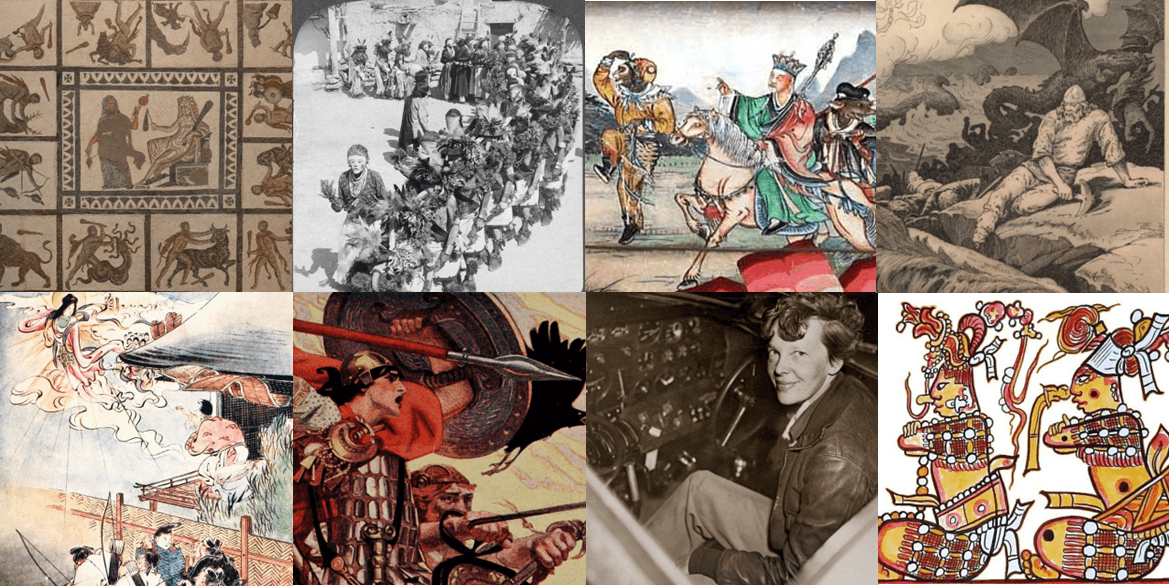
Sometimes the Dawkins meme IS enough.
There is not a major culture in the world, I think, unless we're going to drill down into some narrow subcultures, which does not embrace heroic competitive struggle. Whether literal or figurative, reframing any issue, conflict or fight as a heroic struggle is perhaps one of the oldest memetic techniques in the book. Even the purposed absence of physical struggle can be a wonderful exemplar of the meme. Satyagraha still seeks to win.
So what is Mountains to be Conquered?
Mountains to be Conquered is the Twelve Labors of Hercules. It is China's Journey to the West. It is the Hopi Kachina Dancers, the Prose Edda. It is Kaguya-hime (and Scarborough Fair, for that matter), and Cú Chulainn and Hunahpu and Xbalanque. It is the celebrity of Amelia Earhart, Charles Lindbergh and Edmund Hillary.
It is Dominion Theology.
OK, so the story of Dominion Theology may or may not be familiar to you. Yet. In truth, it wasn't until the early 2000s that a narrative virologist found just the right flavor of this particular meme to make it stick. But the origin story of modern dominion theology starts a little bit earlier, and it IS a story worth telling, at least for anyone who wishes to understand this particular narrative virus.
And yes, we could start with Augustine or The Latter Rain or a million other places. But the strain relevant to our story began in 1975 in Colorado, with a lunch meeting between the two founders of evangelical parachurch organizations: Loren Cunningham and Bill Bright.
Some 15 years before, Cunningham had founded an organization called Youth With a Mission (YWAM). YWAM was the culmination of a vision Cunningham had received when he was (wait for it...and believe me when I say that I wouldn't use a parenthetical this lengthy unless the payoff for waiting was really going to be worth it) a Pentecostal barbershop quartet member on a mission trip to the Bahamas. The vision was of youth across denominational, cultural and national lines coming to Christ en masse. Cunningham being charismatic by persuasion, his was a literal vision. Incidentally, it was not so different from the figurative vision of the less charismatically persuaded evangelical Bill Bright, the founder of Campus Crusade for Christ (CCC). While CCC dabbled increasingly in explicit conservative politics over time, both CCC and YWAM were ministries that could be accurately described as fundamentally evangelical in nature. And I don't mean in the ambiguous, amorphous American sense of the word evangelical that I fumbled for three interminable paragraphs in Part 1. I mean in the literal, historical usage. That is, both Bright and Cunningham above all would have described the primary purpose of their ministries as spreading the Good News of the Gospel of Jesus Christ.
It was not the last time the two men had similar visions at the same time. As Cunningham tells the story of a certain lunch between these two long-time friends in Colorado, both men came to the lunch itching to share something with the other. When they began, each realized quickly that they were planning to share practically the same thing. What's more, shortly thereafter, they would hear the American-Swiss Presbyterian evangelist-with-a-calling-for-youth Dr. Francis Schaeffer independently describe the idea in nearly identical terms.
That idea was that God was calling them to direct the strategy of their evangelism not only toward the transformation of human hearts, but toward the transformation of culture. In particular, their contributions coalesced into a strategy concerning Seven Spheres of Society. The Seven Spheres represented a rubric for thinking about and doing evangelism. In other words, it represented the idea that evangelism meant sharing the Gospel in a way that meant neither abandoning nor neglecting any of the spheres of culture and society which the Gospel ought to be capable of transforming. These are those seven spheres, as described by YWAM today, which mostly overlap with the ideas that Cunningham, Bright and Schaeffer report having arrived at separately and independently in the mid-1970s:
- The Sphere of Family
- The Sphere of Economics (Science, Technology & Business)
- The Sphere of Government
- The Sphere of Religion
- The Sphere of Education
- The Sphere of Media (Communication)
- The Sphere of Celebration (Arts, Entertainment & Sports)
Now, in Christian terms, evangelism is literally gospelism, which is to say the sharing and spreading of the Good News of Jesus Christ. The commission to evangelize you may know better, even the unwashed heathen among you, as the Great Commission. It comes from Matthew 28:19, where Jesus commands his followers to "make disciples of all nations." The idea that this commandment includes a cultural mandate, an implicit commandment to influence and transform society, was not a new invention of Cunningham, Bright and Schaeffer. In a theological sense, the cultural mandate was of particular interest to neo-Calvinists a century prior and, depending on whom you asked, Calvin and Calvinists themselves for centuries prior. In political terms, the cultural mandate would have been thoroughly embedded into just about any Ecclesiocratic, theocratic or Theonomic philosophy of the role of the Church in society – including some of the strains of Christian nationalism that emerged and faded in Europe and America over hundreds of years of history. It also found its way into the social-justice oriented doctrine of Christian churches serving oppressed peoples, of which the black Church in America was by no means the least!
Once again, however, that is reality world.
In narrative world, framing matters. And in the midst of the Jesus People movement, a charismatic awakening and the presence of a stark cultural counterpoint to be found in the intensely secular government of the USSR, the framing of evangelism in "yes, but how do we make the Gospel matter" terms was a novel thing in its contemporary context, even for a country in which pining for the good old days had been an art form for years. It was by no means canon, nor was it a hard theological premise broadly adopted, but over the 80s and 90s, a general consensus of some kind of cultural mandate within the Great Commission began to emerge. Attached to the idea of a degradation of American Christian culture or the risk of becoming like the atheist Soviets, it emerged among Christians, ministers and churches that had zero opinion on the debates of Augustine's two cities or Luther's response, or on Kuyper's variant conceptualization of independent spheres.
You are free to call this Christian nationalism if you like. You'd be wrong, of course, not least because the idea of a cultural mandate was as easily embraced by theologically liberal churches as conservative ones, if not more so. Besides, there is a much simpler word for people who have values that want to engage with and influence their culture in what they believe to be a productive and healthy direction: citizens. I mean, this idea is literally what we mean by civics. We all do it, we all should do it, and if it pisses you off that people who love Jesus do it, too, that's more of a you problem, not a them problem. After all, atheists are far more politically engaged than evangelical Christians. More to the point, for some thirty years, the Seven Spheres were all about influencing culture from the bottom up. These were not recipes for theocracy, Ecclesiocracy or Theonomy; indeed, Francis Schaeffer was chief among those rejecting the Rushdoonian notion of a Triumphal Church heralding the return of Christ. They were simply strategies, similar to a million similar secular strategies, for taking part in influencing the cultural and social development of a nation, the civic duty of any engaged citizen in a republic.
Then something else happened.
Around the same time that Peter Wagner was heralding the New Apostolic Reformation and only months after Dutch Sheets claimed that his keys of the kingdom granted him the authority to decree the outcomes of elections, when the cultural mandate of the Great Commission had become common knowledge among practically all evangelical Christians, even if was not acknowledged formally, a novel mutation of the meme inserted by a new narrative virologist emerged.
It was a fond farewell to the Seven Spheres.
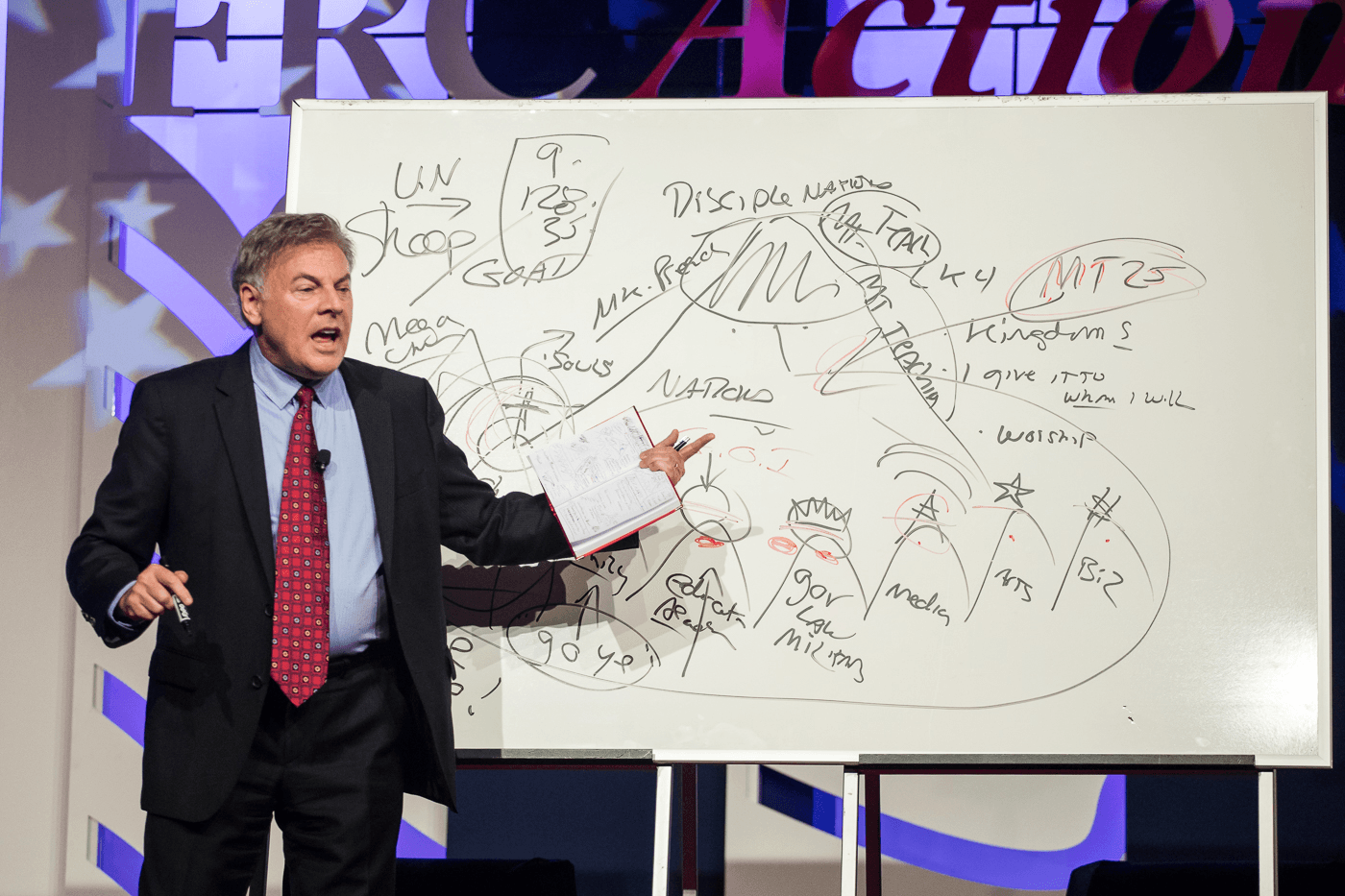
It was a boisterous hello to the Seven Mountains.
The man at the whiteboard above is Lance Wallnau.
In the same way that I suspect you had probably never heard of "Flashpoint", the "Victory Channel" or the "Reawaken America Tour," I am guessing Wallnau, our next narrative virologist, is not familiar to you.
Even among this otherwise obscure group, Wallnau at the turn of the century was unassuming. He was a business-book-on-tape guy in a party of televangelists, would-be apostles and prophets. I don't say that to demean; it's what he was and what he did. For the most part, Wallnau was a lot more Dave Ramsey than he was Paul Cain. Even today, most of his online store is devoted to leadership, strategy and business training materials approached from a charismatic Christian point of view. His LinkedIn profile aggressively promotes endorsements not of his teaching but of his executive coaching.
After walking the well-worn path between would-be charismatic televangelists and doctor of ministry degree mills (his led him to the "Phoenix University of Theology"), Wallnau emerged into influence that far outstripped his more commercial ambitions in the early 2000s. That's when, as Dr. Matthew Taylor recounts in his Charismatic Revival Fury podcast, Peter Wagner first heard him describe a thorough repackaging of Cunningham, Bright and Schaeffer's Seven Spheres into the Seven Mountains Mandate.
In reality world, this might seem like a Spinal Tap it-goes-to-11 sort of thing, a change in labels that didn't change anything real. Seven Spheres are now Seven Mountains. Big deal. Must just be an excuse to sell more conference tickets and books.
But in narrative world, it wasn't just a labeling thing. It did change something. Wallnau's argument in unveiling the Seven Mountain Mandate, unlike that of Cunningham, Bright and Schaeffer in their original formulation of the Seven Spheres, was not that the Church ought not to neglect various areas of society in which evangelism might bring the light of the Gospel. It was the argument that the Church was explicitly to seek authority and dominion over those areas of society, whether as part of God's charge to Adam, Jesus's charge to the Church, or the belief in a charge to the church to ‘reign' for a figurative millennium and hasten Christ's return. I think there are two reasons Wallnau's framing mattered to the larger story we are telling:
- It explicitly accessed the old, deeply memetic human narrative of Mountains to be Conquered; and
- In framing the "Cultural Mandate" as a conquest, it replaced the mandate to influence culture and society from the bottom up with the mandate to take dominion over culture and society from the top down.
Perhaps more importantly, to those who felt entirely comfortable with the idea that Christians have every bit as much right to influence their culture as anyone else, it conflated that benign and civically positive idea with the idea of Christian dominion.
As we have described, in the late 1990s, Wagner had framed the apostolic reformation as an ecclesiastic religious polity – a decentralized, Christian primitivist means for governance of the church. As early as the 2000 election, the role of the apostle had been shifted by Sheets and Pierce, in particular, to ecclesiocratic, or at least apostle-led theonomic governance of Earth. With the promulgation of the Seven Mountain Mandate, ecclesiocratic and theonomic ideas – that is, ideas that the church should and would rule the Earth before Christ's return, whether directly or through the forced and explicit enforcement of God's laws through human systems of government – were absorbed into a meme that had attraction not only to fringe charismatic-Pentecostal prophets and apostles, but to every kind of evangelical denomination in America.
As the prominent, mainstream, very not-weird and very non-charismatic evangelical author and scholar Joe Morecraft put it: "God is blending Presbyterian theology with Charismatic zeal into a force that cannot be stopped!"
And he was right. By the mid-2000s, unsurprisingly, charismatic conferences were fully embracing the Wagnerian apostolic-prophetic reformation, embracing the shift in scale from city to nation, grifting just a bit on the promise of opportunities to make money from all this, and fully embracing Seven Mountains terminology.
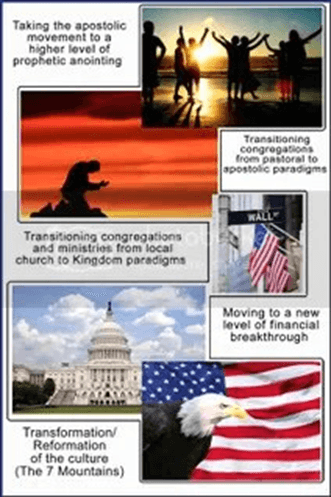
Advertisement for the 2009 Church in the Workplace – Reclaim 7 Mountains of Culture International Conference, Dutch Sheets, Keynote Speaker
The merger of ecclesiocratic and theonomic ideas with Seven Mountains memetics was, by 2009, practically complete. Leadership of the mountains was a requirement.
Through Lance Wallnau, the direction of God came strongly concerning the requirement for those of God’s Kingdom to pursue high places of influence and leadership within the “Seven Mountains of Culture
Dutch Sheets, as quoted in the March 2009 report from the US Alliance for Reformation
Under Sheets's leadership, Christ for the Nations Institute frequently promoted Wallnau's language and framing, and was more than happy to integrate it into ecclesiocratic and theonomic prescriptions for society. Consider, for example, this newsletter they published in 2013.
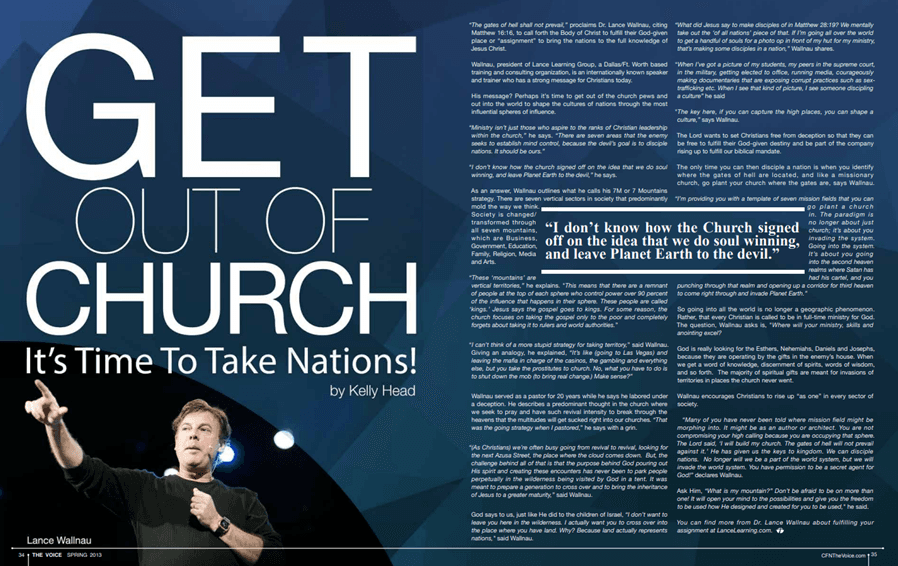
They weren't the only ones.
Peter Wagner himself embraced the ideas very publicly and boldly in his 2008 book Dominion! Bill Johnson, the senior pastor at Bethel Church, the charismatic worship music powerhouse in Redding, California, co-wrote a book with Wallnau in 2013 called Invading Babylon: The 7 Mountain Mandate. A few years later, before he dreamt of Trump holding a scepter that proved he was still president two years after being voted out of office (don't worry, we'll get back to this in Part 8), prophet Johnny Enlow wrote a book called The Seven Mountain Prophecy: Unveiling the Coming Elijah Revolution.
The memetic power of the idea quickly became part of the evangelical mainstream, too.
Consider, for example, the description of the 2021 National Day of Prayer, an event first set up in 1952 by Harry Truman. This is, in theory, an ecumenical event, crossing lines between charismatic and evangelical, evangelical and mainstream, and to a lesser degree, even protestant and Catholic. But today? It is suffused with Wallnau's reframing, a testament to the universal power of the Mountains to be Conquered meme.
Yes, we are richly blessed to have a law that has proclaimed a day of prayer for our nation each year since the first observance as the law was signed in 1952! Decades later, America still needs our prayers. We need to be praying for all people, every day, for all seven mountains of influence and more, because people are still in need and the Church is still called to a prayer, care, share lifestyle. First and foremost, people need to hear the message and experience the love of our Lord Jesus Christ. All have sinned and fall short, but God’s arm is not short, and we have been sent to show and share His message of LOVE, LIFE, and LIBERTY.
Introduction and Description to the 2021 National Day of Prayer, by Kathy Branzell
Yet in so many ways, this, too, is epimemetics, and beyond our scope for this essay. Don't worry. Friday is only two days away.
For the time being, in promoting the imagery of the Seven Mountains Mandate over the inert memetics of Seven Spheres, Lance Wallnau seized upon a fundamental human meme of conquest. In so doing, the nascent aims of the apostolic-prophetic movement from only a few years prior were empowered to achieve influence far beyond the fringe they occupied. As a result, the simple, entirely reasonable desire of tens of millions of Americans for "a more Godly country" was coopted into and conflated with the ecclesiocratic demands of an eccentric group of would-be prophets and apostles.
Hope for Broken Vessels
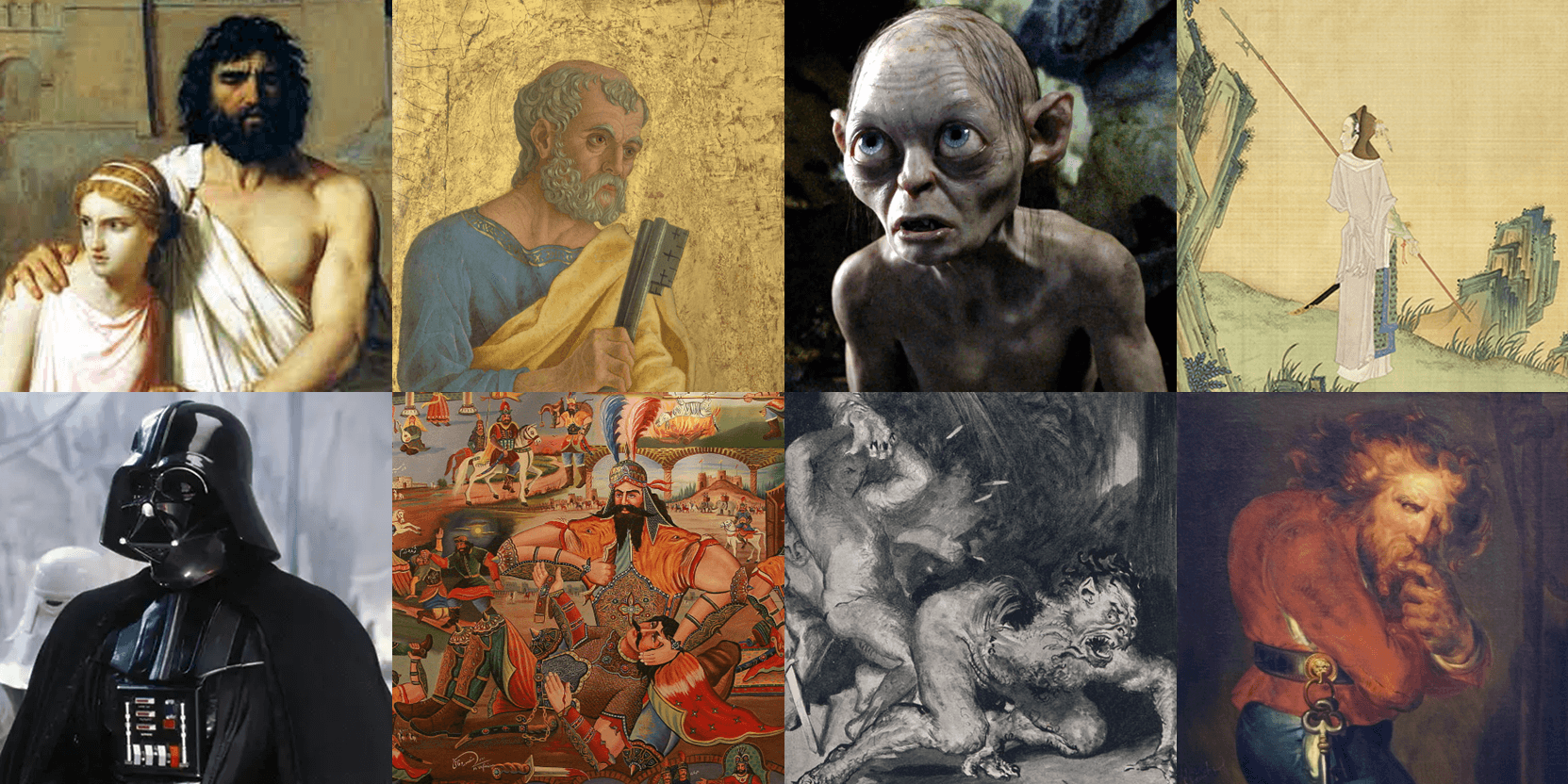
As we have noted for each of these memes so far, not all will be universal to every culture, and certainly not in the same form or context. But some will come close.
This is one of those memes that comes close.
The meme of Hope for Broken Vessels is the fundamental building block of stories, legends and entire art forms across the globe. And why wouldn't it be? Hopelessness is the death of civilizations. Structurally embedded memes of hope that redemption can be achieved, or even that great good can be done by flawed and broken things is an almost indispensable quality of any culture that would survive for very long.
Hope for Broken Vessels is the flawed hero. It is the New Testament's Peter, Greece's Oedipus, the Anglo-Saxon's Beowulf, China's Hua Mulan. Or Sun Wukong. It is Persia's Rostam and France's Quasimodo. Yet the usefulness of broken vessels needn't be a full redemption story. So it is also England's Gollum and America's Darth Vader. Hope for Broken Vessels is an authentic Japanese kintsugi bowl, or else a Turkish or Navajo rug.
Hope for Broken Vessels is the Old Testament's King Cyrus.
Now, obviously Cyrus the Great, one of the most powerful and famous emperors in the millennia of recorded human history, is not only a character from the Bible. But that is the text from which the narrative relying on this meme was drawn, so it is the account we mean in referencing the meme.
Ezra records Cyrus's deeds from the perspective of Israel in the greatest detail.
In the first year of King Cyrus of Persia, in order to fulfill the word of the Lord spoken through Jeremiah, the Lord roused the spirit of King Cyrus to issue a proclamation throughout his entire kingdom and to put it in writing:
This is what King Cyrus of Persia says: “The Lord, the God of the heavens, has given me all the kingdoms of the earth and has appointed me to build him a house at Jerusalem in Judah. Any of his people among you, may his God be with him, and may he go to Jerusalem in Judah and build the house of the Lord, the God of Israel, the God who is in Jerusalem. Let every survivor, wherever he resides, be assisted by the men of that region with silver, gold, goods, and livestock, along with a freewill offering for the house of God in Jerusalem.”
Ezra 1:1-4 (CSB)
Cyrus was no follower of Yahweh, the God of Israel. There is some scholarly debate over whether he was truly a devout Zoroastrian or rather more pluralistic (or practical, given the number of threads his empire had to hold together) in his religion. But basically: not a Jew. And yet, from the prophet Isaiah – or a second writer, as it is in chapter 45 – we see two things. We see a recognition that Cyrus would not know God, and we see a recognition of Cyrus as God's anointed to act for the benefit of God's people.
For the less religiously inclined among you, "his anointed" translates to another word: messiah.
The Lord says this to Cyrus, his anointed,
whose right hand I have grasped
to subdue nations before him
and disarm kings,
to open doors before him,
and even city gates will not be shut:
“I will go before you
and level the uneven places;
I will shatter the bronze doors
and cut the iron bars in two.I will give you the treasures of darkness
and riches from secret places,
so that you may know that I am the Lord.
I am the God of Israel, who calls you by your name.
I call you by your name,
for the sake of my servant Jacob
and Israel my chosen one.
I give a name to you,
though you do not know me.Isaiah 45:1-5 (CSB)
Does the idea of God using a profane man who did not know Him for the benefit of His people sound like a familiar formulation? At the very least, the Biblical account of Cyrus is a foundational narrative built from the Hope for Broken Vessels meme. It should also remind you of some of the stories that you probably heard when charismatic – and evangelical and even some mainline – Protestant Christians described how they found it possible to throw their support behind a man whose exploits would have made Oval Office-era Bill Clinton in flagrante delicto blush.
Jeremiah Johnson speaking on Sid Roth's It's Supernatural, a streaming network promoting the content of seers, prophets and others with a Messianic Jewish emphasis. Source: Sid Roth's Supernatural
Our next narrative virologist is a younger prophet by the name of Jeremiah Johnson. No, unfortunately not the Robert Redford character that spawned the famous meme. This Jeremiah founded his Heart of the Father ministry right out of college in 2010. Less than five years later, he was publishing prophecies that were being published in Charisma Magazine.
In a famous such prophecy from July 15, 2015, Johnson was perhaps the first to publicly connect the King Cyrus memetic profile to Donald Trump.
I was in a time of prayer several weeks ago when God began to speak to me concerning the destiny of Donald Trump in America. The Holy Spirit spoke to me and said, "Trump shall become My trumpet to the American people, for he possesses qualities that are even hard to find in My people these days. Trump does not fear man nor will he allow deception and lies to go unnoticed. I am going to use him to expose darkness and perversion in America like never before, but you must understand that he is like a bull in a china closet. Many will want to throw him away because he will disturb their sense of peace and tranquility, but you must listen through the bantering to discover the truth that I will speak through him. I will use the wealth that I have given him to expose and launch investigations searching for the truth."
Just as I have raised up Cyrus to fulfill My purposes and plans, so have I raised up Trump to fulfill My purposes and plans prior to the 2016 election.
Jeremiah Johnson, from the July 28th, 2015 edition of Prophetic Insights, as published on Charisma and as excerpted by James Beverley in God's Man in the White House
The use of the "Trump as a trumpet" language by Johnson is an allusion to a 2007 prophecy by a man named Kim Clement that we will meet in Part 5. The confirmation of prophetic words is a key component of their ascension into common knowledge within the apostolic-prophetic movement. For that reason (unless you happen to believe what they are saying true), prophets commonly make explicit references to the language and imagery of both contemporary and older prophecies to aid their credibility and adoption. Johnson's language referring to Trump as a "bull in a China shop" would show up in others' prophecies in the future, too. Again, these are men and women who are in the business of telling old stories. Finding memetic threads to tie things together is an effective way to conduct that business.
True to form, a couple weeks after Johnson's prophecy, our friend Lance Wallnau chimed in with a similar idea, in a post to Elijah List and Facebook he called "Is Donald Trump Being Used as a Trumpet?" Johnny Enlow would do the same in January 2016. And Jill Steele.
About four months after his Facebook post, Wallnau would once again reference language from Johnson's prophecy. This time, he did so not on social media, but in a statement made directly to Donald Trump during a meeting with a group of black pastors on November 30, 2015 (Wallnau is white). He told the would-be president that day that he thought he was a King Cyrus figure. Wallnau would later write a book about the concept, establishing himself not as patient zero but certainly as the principal superspreader of this newly formed narrative virus.
"Common Grace" tells us that God acts in history in unusual ways to raise up unlikely deliverers for the sake of his purposes and his people. He disrupts nomination processes. In 1860, the pious evangelical Salmon P. Chase was a better Christian than the men he ran against, but the wily Lincoln got the nomination on the third ballot. Chase could not understand why God had denied him, but in the end the Springfield lawyer proved to be the most suitable vessel for the coming chaos.
From my perspective, there is a Cyrus anointing on Trump. He is, as my friend Kim Clement said three years ago, "God's Trumpet." Once I heard the "Cyrus" word, I predicted openly that he would win the nomination.
Lance Wallnau, from God's Chaos Candidate (2016)
It is hard to describe to someone who is not engaged in the American evangelical or charismatic church how important the insertion of this meme into the narrative virus was in 2015 and 2016.
At the time, Donald Trump was under narrative assault as a philandering, profane, self-absorbed narcissist. To be clear, I'm not saying any of those descriptions are false, just that the media efforts to promote these ideas were astonishingly widespread. And as skeptical as many non-Christians are of the authenticity of evangelical hang-ups on these issues, I can tell you that Christian leaders and ordinary people alike were deeply, deeply divided on whether they could in good conscience give him their support.
That was even more true after the release of the Access Hollywood video on October 7, 2016. All of evangelical America was writing about it. Social media was overwhelmed by it. Churches were talking about it. Franklin Graham was desperately explaining why it shouldn't affect anyone's vote. Lance Wallnau was claiming Satan was behind the tape's release, then warning Christians that they should "be careful how [they] touch the anointed vessel of God."
The idea that Trump had a "Cyrus anointing", in Wallnau's words, was an unequivocally charismatic-Pentecostal framing. That the words came from what Wallnau described as a series of words from the Lord was reliant on belief in charismatic-Pentecostal theology about the existence of modern-day prophets. That is, the mass of cessationist evangelicals had zero reason to buy into anything that Lance Wallnau was saying about God and Donald Trump.
But that's reality world.
In narrative world? Oh, there were two stories surrounding the vote within the American evangelical church. One was that the election was all about the Supreme Court. Period. The other was that the church was ready for someone who would fight back in the culture wars. We were ready for someone who would own the libs, who could stand up to the biased media who would never give us a fair shake. We wanted someone who would be a "bull in a china shop", as Jeremiah Johnson put it, or a "wrecking ball", as another Lance Wallnau vision put it, to "political correctness." Our bodies were so ready for some reason, any reason, for God's sake just give us a reason to justify voting for such a narcissistic cretin.
The Cyrus narrative, built on the foundation of the Hope for Broken Vessels meme, was exactly what was needed to open the floodgates of charismatic and evangelical support that had been held back.
The man sitting across from me at lunch represents the gold standard of evangelical believers in Texas. We were discussing his future. He is retiring from a huge corporation where he oversees a $3 billion budget. As our conversation turned to politics, he surprised me. His voice lowered as he leaned toward me, sharing how much he wrestled over the moral conflict of voting for either candidate, Hillary or Trump. "I wanted to tell you," he confided, "I was not sure what I would do till I heard you speak about Cyrus and Trump. As I heard what you said, I had peace."
Lance Wallnau in Charisma News, Prophecy: God Sent Donald Trump to Wage War Against Destructive Spirits
Two other things happened at the same time.
First, news outlets, Christian writers and observers began to see Johnson's and Wallnau's words not as something they believed, but as a prophecy. They integrated his "prophecy" of Trump's ascendance with others that had come (and would come) from the now very large, very national, and very focused on Seven Mountains dominionism apostolic-prophetic movement. We will tell the story of this more fully in Part 5.
Second, evangelical ministers outside of the charismatic-Pentecostal fringe began adapting the language of Johnson and Wallnau to appeal to the palates of those who didn't believe in modern-day prophets or archaic imagery like "Cyrus anointings." Robert Jeffress, one of the two or three most influential southern Baptists in the country, said after a 2016 meeting with Trump that “[he wasn't] voting for Trump to be the teacher of my third grader’s Sunday-school class.” Dr. James Dobson reframed Trump's absence from any church community, indifference to prayer and utter lack of Biblical knowledge as evidence of his being a "baby Christian." In each case, little more than a repackaging of the King Cyrus anointing. And it worked. Boy did it work.
Why?
Because it was built on the foundation of the nearly universal meme of Hope for Broken Vessels.
A Faithful Remnant Returning
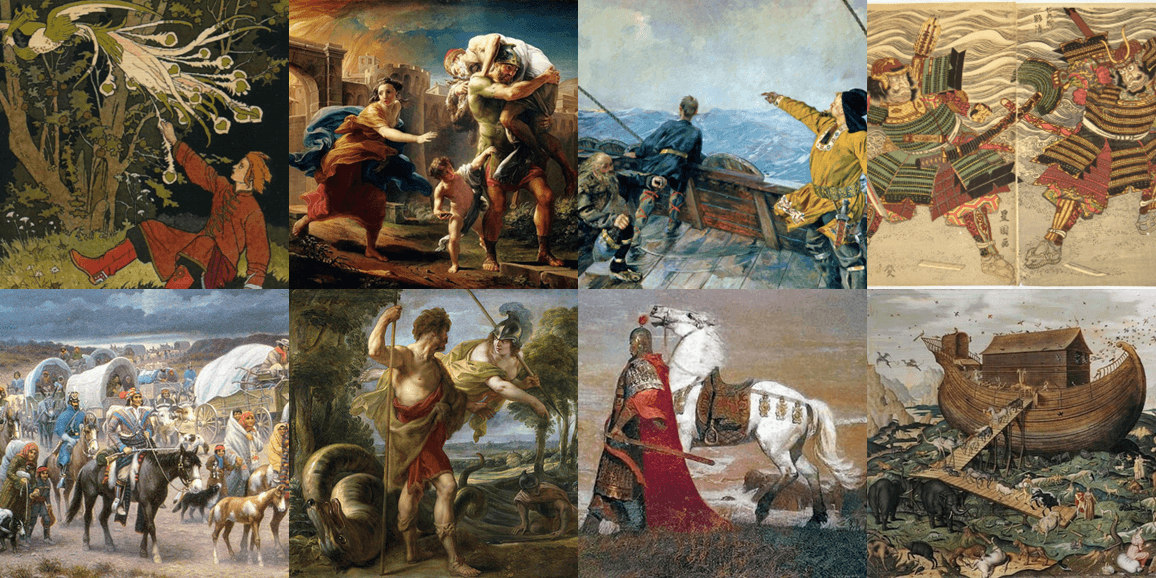
Because the idea of a meme is one of a reproducing and inherited thing, the most well-adapted will be those which play a role in the survival of cultural values over time.
Since peoples and cultures inevitably come under stress from both without and within, the most successful memes will often be those which are, by design, about surviving those stresses. They will be about maintaining the features of a culture, remaining faithful when many others have forgotten.
In the best cases, they will incorporate the innate human attachment to hope. Hope that the culture may survive. Hope to one day see A Faithful Remnant Returning.
A Faithful Remnant Returning is Aeneas. It's Cadmus. It is Yue Fei of the Southern Song dynasty, the Saga of the Greenlanders, the Tale of the Heike. It is the stories of the Trail of Tears. It is Noah's Ark and the Firebird.
It is a Holy Remnant.

Source: Glory of Zion International, YouTube
I don't have a specific narrative virologist to introduce to you here, largely because the meme of A Faithful Remnant Returning is so suffused into the charismatic-Pentecostal vernacular that it is very difficult to pin anyone down as the point of origin. But practically no one leans on this memetic imagery more than Pierce, pictured above. As I mentioned before, even among a group of folks who would strike most of us as being pretty unusual, Pierce is a weird dude. So let's get weird. Get in, losers, we're talking about THE END OF THE WORLD.
Alright, full disclosure. Charismatic-Pentecostalism, as a movement, is not usually super fussed about theology.
I don't mean that as a criticism, necessarily, nor do I mean it to imply that there is a lack of focus on scripture. What I mean is that the general revolutionary vibe and emphasis on novel revelation through prophecy has inevitably resulted in a fair bit of lazy scholarship in any traditional sense. For example, the entire theological notion within the apostolic-prophetic movement of the Church as God's appointed ruling authority on Earth hinges upon Sheets and Pierce ‘discovering' that the Greek word ekklesia was used as both a reference to churches that met as well as the governing bodies of Greek towns and cities at the same of the early church. In other words, they discovered that the word for "assembly" could refer to multiple kinds of assemblies (yeah, no kidding, guys) and eisegetically concluded that this meant that the church was literally to act as a legislative governing body over the whole of creation. The entire notion is like if someone from the year 2320 "discovered" that we used the word "school" to refer to both a group of fish and a place where young people learned, then decided in turn that 21st century children must have been able to breathe underwater.
At any rate, when it comes to theological concepts like Eschatology (i.e. how the world will end) and preterism/futurism (i.e. how much of what the Bible says about the end of the world has already happened), you will not find a lot of very detailed theological work among modern-day prophets and apostles. If you cornered most of our narrative virologists on where they stand on eschatology and preterism in those terms, I suspect in most cases you would get vague, non-committal answers.
Historically speaking, probably most evangelical and certainly most charismatic and Pentecostal ministers and personalities would have implicitly or explicitly ascribed to what is called premillennial eschatology. This simply refers to the belief that Jesus Christ will return to Earth before a thousand years of Godly peace. This period would be preceded by "tribulations" and, sometimes before and sometimes after those tribulations, a rapture. If you've ever watched those terrible Kirk Cameron Left Behind films, you're watching dispensational premillennial eschatology in action.
Postmillennial eschatology, on the other hand, posits that the return of Christ would come after this millennium of Godly peace. It might be a literal millennium, it might be a figurative one. In some cases, Christ's return is even conditional on this state, implying that there is a mandate to the church to bring about the conditions that would result in the Second Coming.
In both models, there is a question of how many of the things described in Eschatological prophecies, the Book of Revelation in particular, referred to the events of the 1st Century or else to things that might happen much later (read: today). Generally speaking, of course, you can probably see how postmillennial eschatology is a bit more sensitive to the question of which prophecies have already been fulfilled. After all, there is very often an implicit expectation that Christians have a role to play in determining Christ's return under postmillennialism, so which prophecies remain outstanding becomes a matter of greater import.
Still, as noted, charismatic-Pentecostals were by and large historically on the premillennialist train. You may remember what I noted earlier about Dr. Schaeffer, for example, who steadfastly resisted the idea of a triumphal Church governing the Earth before Christ's return as a reason for embracing ecclesiocracy or apostolic theonomy. This theological perspective is much of the reason why.
Yet within the apostolic-prophetic movement, in connection with the emergence of Dominion Theology, connected to the ideas of Seven Mountains and embedded in the Covenant memetics prescribing the hope of a great end time harvest of souls for Christ, was a quiet flip in the traditional eschatology of much of the charismatic-Pentecostal church, and certainly the core of the apostolic-prophetic movement, toward postmillennialism. In short, the predominant narrative of the 1990s was a Church suffering through tribulations, groaning for Christ's return. In the 2000s and 2010s, that had become, at least in the charismatic-Pentecostal tradition, a narrative of a triumphal Church and a great end-time millennial harvest to herald the ultimate return of Christ to meet his bride.
More importantly, perhaps, the power of these memes moved the canonical charismatic-Pentecostal eschatology firmly in the direction of something between partial preterism and futurism. That is, the combined memetics of the apostolic-prophetic virologists created common knowledge that there was a faithful remnant who could and would fulfill the remaining eschatological prophecies of scripture to bring about the necessary conditions for the postmillennial return of Christ.
If "faithful remnant" has a Jewish feel to you, you're on the right track. The Old Testament is one of the richest veins of A Faithful Remnant Returning memes of any culture's collective creative output. The story of the Jewish people for thousands of years is a recurring cycle of small groups of the faithful as others rebel against God. Sometimes those in rebellion against God are gentile nations. Sometimes they are the Jewish people themselves. But the terminology at a dozen places in the Old Testament nearly always uses this terminology for the faithful holding on: a remnant.
Then Zerubbabel son of Shealtiel, the high priest Joshua son of Jehozadak, and the entire remnant of the people obeyed the Lord their God and the words of the prophet Haggai, because the Lord their God had sent him. So the people feared the Lord.
Haggai 1:12 (CSB)
Then all the commanders of the armies, along with Johanan son of Kareah, Jezaniah son of Hoshaiah, and all the people from the least to the greatest, approached 2 the prophet Jeremiah and said, “May our petition come before you; pray to the Lord your God on our behalf, on behalf of this entire remnant (for few of us remain out of the many, as you can see with your own eyes), 3 that the Lord your God may tell us the way we should go and the thing we should do.”
Jeremiah 42:1-3 (CSB)
Israel, even if your people were as numerous as the sand of the sea, only a remnant of them will return. Destruction has been decreed; justice overflows.
Isaiah 10:22 (CSB)
For they will sow in peace: the vine will yield its fruit, the land will yield its produce, and the skies will yield their dew. I will give the remnant of this people all these things as an inheritance.
Zechariah 8:12 (CSB)
As common as the phrasing is throughout the Old Testament, however, references to a faithful remnant are even more common among the narrative virologists of the apostolic-prophetic movement, especially coupled with the harvest imagery of the verse above from Zechariah.
Here's a famous remnant prophecy from David Wilkerson, charismatic founder of the Times Square Church.
Here's an event last year in Nashville linking the belief in a final Great Awakening and Triumphal Church with the efforts of a holy remnant.
Here's narrative virologist Mario Murillo writing and prophesying about the remnant as the source of the next great revival.
Here's narrative virologist Cindy Jacobs writing about how the remnant changed the 2004 election. And again, writing with fellow apostle-prophet James Gall about the coming triumph of the remnant church.
The youth ministry at narrative virologist Che Ahn's Harvest Rock is literally called Remnant.
Dutch Sheets (along with his brother Tim) leans on this meme as much as anyone not named Chuck Pierce. Like here, here, here, here, here, here, here, here, here, here, here, here, here, here, here, here, here, here, here, here, here, here, here, here, here and here (and a thousand other places).
Finally, as promised, here's a righteous remnant prophecy from Chuck Pierce. How about a memetic twofer about the "remnant's covenant war?" Or the "triumphant reserve." Or a video prophecy about "tapping America's remnant roots." There are dozens – hundreds – of these. They're everywhere.
So why is this language so common in this faith tradition?
For one, a lot of the Old Testament is prophecy, and as you saw in the verses above, a lot of that prophecy leans on remnant phraseology. That is, A Faithful Remnant Returning is universally memetic, but it has particular influence within this vernacular. There is also a strong tendency among charismatic-Pentecostals to implicitly adopt replacement theology or supercessionist beliefs. This is the belief, perhaps only slightly less literally applied across nearly all Christian faith traditions, that the Christian church has either replaced what the Bible means by Israel, or at a minimum that the references and promises now refer to both literal Israel and figurative Israel (i.e. the Christian church). If you read the links from the various charismatic-Pentecostals narrative virologists above, you'd have found a lot of prophecies referencing those verses about a Jewish remnant as explicit models for promises that apply to a modern faithful remnant within the church.
Those promises?
They should be familiar at this point: a Great Awakening. The greatest harvest the world has ever seen. A Triumphal Church.
Whether intentional or explicit – again, these are not theologically persnickety folks, as a rule – I think it is unequivocally the case that the apostolic-prophetic movement of the 2020s has fully embraced the belief that America has an Israel-like covenant with God, that faithfulness to that covenant will produce a thriving, ruling church and a great awakening of souls, and that an apostolic-prophetic remnant within the church will be what unlocks this eschatological promise.
But there's a memetic power in A Faithful Remnant Returning that goes beyond theological concepts. It is, at is core, a fundamental human story about continuation in the face of opposition.
Consider what might happen if this apostolic-prophetic movement arrived at prophetic conclusions about a presidential candidate and his role in bringing about various eschatological conditions for Christ's return. Consider what might happen if they encountered resistance to that prophecy. Consider the role that a narrative of a "faithful remnant" might play in sustaining belief in the face of that resistance. Consider what it might be possible to believe if the memetics of A Faithful Remnant Returning were powerful and widespread enough.
But that's not memetics. That's epimemetics, and that's not for today.
It's a lot to take in, I know. You just trudged through half of a book disguised as an essay. Let me bring all of our threads back together:
- By inserting the meme of Rediscovering Old Ways into the emerging narrative virus, a leader of the apostolic-prophetic movement named Peter Wagner created a powerful story of an apostolic reformation that would result in the reorganization of the church and how it heard from God, incorporating a more palatable embrace of the return of Biblical prophecy.
- By injecting the memetic power of Keeping Ancient Covenants, Dutch Sheets and Chuck Pierce framed America's "Christian heritage" in much more powerful terms, promising blessings for faithfulness and judgment for faithlessness.
- Just as Pierce, Sheets and Wagner began to shift the nature of the apostolic authority they saw to govern the church and spiritual realm to act as God's ruling authority on Earth, Lance Wallnau then transformed the inert Seven Spheres theology of a cultural mandate embedded in the Great Commission of the New Testament into the powerful Seven Mountains framework, a pure expression of the Mountains to be Conquered meme.
- Wallnau, alongside Jeremiah Johnson, together played a leading role in the creation of the Trump as Cyrus narrative, effectively inserting the meme of Hope for Broken Vessels into a narrative that permitted the meme to express itself far beyond the quirky confines of the charismatic-Pentecostal church.
- Decades of charismatic-Pentecostal replacement theology and partial preterism facilitated vulnerability to memes expressing the idea of A Faithful Remnant Returning, ascribing value to persistence in the face of opposition, not just from fellow Christians but especially from fellow Christians who have NOT been faithful to the apostles and prophets.
Now, there is a sixth core meme of this virus. But as it doesn't really make an appearance until the very end of our story, you'll have to wait until Part 7.
In the meantime, we are still left to wonder: how does our group of five core memetic archetypes create a narrative virus capable of turning Roger Stone into a spiritual warrior and influencing a bunch of evangelical conservatives who didn't believe in prophecy into believers in a preposterous theory of a stolen election?
We need more than memetics to explain that – we need epimemetics.
And that's exactly what we will get with Part 4 on Friday.


Comments
Nine parts. I can only imagine how many hours of discussion went into this. Looking forward to all of it.
@rguinn I was wondering: did you use the narrative machine retrospectively, whether wholly or in part, to identify the sources here?
As someone raised Catholic and currently attending an evangelical Baptist church I audibly guffawed at this paragraph. Absolute perfection.
As a socially liberal and fiscally conservative Presbyterian who is probably more agnostic now and (yes a run-on sentence) am fully ingrained with the fact that our country’s laws are based on Presbyterian polity, I too laughed out loud at this statement.
Levity, a good carrier for important considerations.
Rusty,
Curious to see what attention, if any, the doctrine of biblical innerancy will get in this series.
As a teenager, I was baptized in and eventually pastored at a wonderful Foursquare church in Oregon. Additionally, for several years during that time, I lived with 4 Calivinist buddies of mine.
During my years-long exposure to both charismatic Pentecostalism and Calvinism, I found over and over again how fundamentally problematic the doctrine of biblical inerrancy and literalism is for all churches, regardless of whether it’s the reformed Eric Metaxas/Wayne Grudem/John Piper type or the charismatic Pentecostal Benny Hinn type.
In my experience, the “charismatic norms” (like prophesy), can be a really beautiful thing. But it’s when the charismatic norms (like prophesy) are connected to the doctrine of biblical inerrancy/literalism that things can go super sideways and do anything but “edify”. As I see it, inerrancy is the core virus that has been wreaking havoc in the churches (you name the tradition) and the world for centuries.
Anyway, really looking forward to reading these notes.
Three of the mentioned fellows will make at least a cameo appearance, but it isn’t necessarily a focus of the series. I agree that it would also be fascinating to see how that narrative - the soul of American evangelicalism, really - emerged and became common knowledge, but that would be a different series.
In part, although as I think you’ll discover as we go along, our aim was to be thorough enough not to have to be stingy in our source selection.
Man, fascinating stuff. Can’t wait to read the rest.
I was raised mainline Protestant in NY in the 80s. Never even heard of Charismatics until I moved to TX as an adult.
I think I understand why it is the fastest-growing branch of Christianity. Vs the stuff I was raised with, my first impression as an outsider is the level of passion and… hmm… immediacy.
I’m assuming that this is the basic story we’re discussing, I had not heard it yet. It explains what some prophets need(ed?) to be true and why.
This was a great and insightful read, @rguinn.
“Like the Widening Gyre, the most effective vectors for effective astroturfing campaigns may focus not so much on changing common knowledge but on changing What We Need to Be True.”
Inoculation against direct responsibilities is one of the fundamental traits of human beings’ proto-centralized religions. In a context of apparent lack of control, agency was projected outward.
Witchcraft was the reason for pain without feeling guilty and gods’ (God) wrath for pain when feeling guilty in ancient cultures.
In this context of apparent lack of control (post 2008), changing what we need to be true is an escape from direct responsibilities when focusing on the excuses that explain the individual or collective failure as an out-of-control external factor (spiritual: evil-witchcraft- the devil or kind of real threats: immigrants - woke - deep state), that apparently has agency and goes directly against you as a cosmic good vs. evil fight. So, it’s the perfect context for this phenomenon to emerge in the American-style, spirit-filled charismatic Christianity.
Low locus of control (direct control over outcomes) + belief in miracles (indirect control over outcomes) + best in class already system of memes (Christianity).
You’ve got it nailed. Only I think that we will discover that there are many more areas of our society and culture which exhibit very similar traits in very different wrappers.
Really interesting start…as someone who has walked among the movements you reference, I’m looking forward to your reflections and observations.
I’ll just observe here that the role of discernment has always been the weak link when it comes to Pentacostal/Charismatic movements.
Continue the discussion at the Epsilon Theory Forum...