Men of God in the City of Man, Pt. 5: Epidemic
July 10, 2023·Politics
Download a PDF of Men of God in the City of Man, Part 5: Epidemic (paid subscribers only)
Listen to an audio recording of Men of God in the City of Man, Part 5: Epidemic
Men of God in the City of Man is a nine-part essay series that tells the story of a powerful narrative virus whose ultimate unintended target was nothing less than faith in American democracy as an institution. Part 1 introduced the idea of the narrative virus as a mechanism for astroturfing (fake grassroots) campaigns, and the idea that the danger may not come so much from forcing new Common Knowledge, but changing what some of the population needed to be true. Part 2 is the story of the carriers of its chief ultimate symptom: a rabid belief in rampant electoral fraud. Part 3 is the story of the creators of the narrative virus and the memetic building blocks they brought to bear. Part 4 is the story of the way in which the special environment into which those memetic building blocks were introduced changed the way that they expressed themselves on major social and cultural institutions. Part 5 is the story of how these pieces began to emerge as a narrative epidemic within one community in 2016.
I am deeply indebted to the work of James Beverley, Matthew Taylor and Paul Djupe in various areas of this essay series. I have attempted to source their work where possible, but if you see something unsourced that makes a clever observation about our subject matter, please do me the favor of assuming it is the work of their dutiful scholarship.
When I talk to people about the ideas in this essay series, many of my fellow conservative friends respond that none of this is why they voted for Donald Trump. They didn't care about wacky things like prophecies and anointings. They wanted a supreme court that would finally end abortion. They wanted to be rid of corruption in Washington and take a sledgehammer to political correctness and (later) wokeism. Whether they voted joyfully or with their noses held, they say, it was worth it.
What do I tell them?
That I believe them. 100%.
I think hundreds of millions of Americans voted earnestly, as is their right and civic duty, for precisely those reasons. Same thing for those who voted the other way, for convictions of similar strength. This essay series isn't about why Orange Man Bad or Trump Voter Bad. It's not even about why people voted for anyone at all, or why their reasons for doing so were ridiculous. I voted for Gary Johnson, y'all. I'm not just living in a glass house. I've got glass floors, glass furniture and glass towels in my bathroom. Neither is this essay series about the belief that there are very reasonable, common sense things we ought to do ensure our elections are as fair and representative as possible, from (free) voter ID requirements, to serious scrutiny of the timing of formal investigations of candidates, to assessment of the degree to which media amplified or squelched stories based on the political predispositions of their editorial staff, to tighter limitations and controls on ballot harvesting activities.
No, this essay series is about nothing more or less than why widespread belief in literal, comic book villain-style election theft emerged...and why it hasn't gone away despite every fact in the real world showing the belief to be an utter fantasy. It's about how a previously isolated fringe somehow spawned mainstream belief in claims that We have analysis of packets showing the machines were taking input from China or There were thousands of fake ballots in a box under the table! or Venezuelan voting machines perpetrated vote switching on a massive scale!! or Thousands more people voted than were registered!
Because in the end, no matter how much some of us may want to retcon things we said and thought over the last few years, Stop the Steal was never about media bias or voter ID requirements. From top to bottom and from beginning to end, it was built on preposterous fabrications about electoral fraud promoted by preposterous people with a preposterous collection of made-up ‘evidence'.
Before we get there, however, we must tell the story of 2016.
It is not a story about politics or faith. Not really, anyway. It is a story about language. It is a story about a story – a story of a narrative virus that produced a localized epidemic. When the narrative virus first emerged as an epidemic, however, the seeds of distrust in elections were not among its symptoms. Instead, its chief symptoms were new common knowledge about the intersection between God and American elections.

Kim Clement posing for the cover of his 1984 Christian funk album "Kim Clement and Friends"
The Alpha Variant
A filthy bathroom of a seedy bar in Durban, South Africa in 1974.
Live rock music echoes in the background. A young man sways at a sink, trying to regain focus. Another man enters. We never see his face. The young man stares into the bathroom wall, worrying with whatever consciousness he can muster about whether he went too far this time to find the old high again. He never sees the knife. He doesn't feel the bag of whatever heroin he has left when it is pulled from his jacket. We don't hear his cries of pain over the guitars and drums, but we see him bleeding, lurching through the door, collapsing on the street. He is left for dead.
After a brief pause, an older man enters the scene and takes pity on him. The older man summons medical care and accompanies the injured young man until he is safe. When the younger man asks the older why he stopped to help, the older man shares his belief in the God of lost sheep.
The young man was Kim Clement. And this is a true story.
After Clement was rescued from his heroin overdose and subsequent mugging in 1974, his religious conversion was rapid. Kim served in drug rehabilitation ministries. He led music therapy for children suffering from a range of disabilities and illnesses. By the late 1970s, Clement would co-found one of the first racially mixed churches in apartheid South Africa, the Lyric Christian Center. He released jazz, funk and (yes) disco-infused worship albums, the cover of one of which I selected to headline this section. Don't pretend you've ever heard it, and don't pretend you aren't envious of that magnificent shirt. Starting from that charismatic multi-racial church in Durban, Kim Clement launched a global dual ministry through which he led churches in worship and issued prophecies.
Once he made his way stateside, that quickly became his calling card within the American charismatic-Pentecostal church: Kim Clement was The Singing Prophet. Literally. Clement would sit or stand at the keyboard and sing, then prophesy, then sing a prophecy. His was a very Old Testament style, very thus saith, often archaic, often arcane, and very often speaking as God in the first person. The style obviously included a fair bit of imagery and metaphor, as archaic-style prophecy tends to do, but in comparison to those who would come as part of the apostolic-prophetic movement in the United States, his proclamations left a lot less wiggle room. That is, he frequently gave names and dates for the predictions he made.
Kim Clement was the first person to prophesy that Donald Trump would become the President of the United States.
Sort of.
If you ask most people closely connected to the prophetic-apostolic movement when it was that a Trump presidency was prophesied (and by whom), they will almost universally refer you to three different Clement prophecies: one made on February 10, 2007 in Scottsdale, Arizona, one made on April 4, 2007 at Bethel Church in Redding, California and one made on June 17, 2007 in San Jose, California. Here are the key excerpts, with some of the key elements that will be important to our story highlighted in bold.
There will be a praying President, not a religious one, for I will fool the people, says the Lord. I will fool the people, yes I will. God says, the one that is chosen shall go in and they shall say, he has hot blood. For the Spirit God says, yes he may have hot blood, but he will bring the walls of protection on this country in a greater way and the economy of this country shall change rapidly, says the Lord of Hosts. God says, I will put at your helm for two terms a President that will pray but he will not be a praying President when he starts...
Kim Clement, in Scottsdale, Arizona (February 10, 2007)
This that shall take place shall be the most unusual thing, a transfiguration, a going into the marketplace if you wish, into the news media. Where Time Magazine will have no choice but to say what I want them to say. Newsweek, what I want to say. The View, what I want to say. Trump shall become a trumpet, says the Lord! I will raise up the Trump to become a trumpet and Bill Gates to open up the gate of a financial realm for the Church, says the Spirit of the Living God!
Kim Clement, at Bethel Church in Redding, California (April 4, 2007)
I will not forget 911. I will not forget what took place that day and I will not forget the gatekeeper that watched over New York who will once again stand and watch over this Nation, says the Spirit of God. It shall come to pass that the man that I place in the highest office shall go in whispering My name. But God said, when he enters into the office he will be shouting out by the power of the Spirit for I shall fill him with My Spirit when he goes into office and there will be a praying man in the highest seat in your land.
Kim Clement, at Bethel Church in Redding, California (April 4, 2007)
Now, God says, a president that I will bring into the White House and they will say he is ungodly, he does not know God...
For two terms, God said, do not fear for the Lord says there will be no unnecessary, unnecessary stuff...
Kim Clement, in San Jose, California (June 17, 2007)
Over the years, Clement made a lot of prophecies. That prodigious prophetic output alone confounds efforts to search for past predictions that might fit the present; however, the quantity of prophecies isn't the only complicating factor. Even from someone like Clement, who tended toward more specific and definite language, the vernacular of modern prophecy remains vague, archaic and indeterminately figurative. Predict that a "mighty storm shall come" to a region, for example, and there are a hundred ways to call your prediction ‘correct'. Could be a literal hurricane or a tornado. Could be a political scandal. Could be a revival at a church. Could be a series of protests. Could be an influx of immigrants. That vagueness is helpful to the prophet, but it is no help to anyone trying to research whether the prophet ever said something applicable to an event taking place in the present. If you wanted to know if anyone had predicted a political scandal, "a mighty storm" probably wouldn't top your search terms.
In the same way, "Trump shall be a trumpet" could mean a million different things. And friends, believe it or not, there might be more than a couple men who "don't know God" and "don't pray" involved in the world of politics. These generalities are all but infinitely transferable.
For this reason in particular, after they were uttered in 2007, the three Clement prophecies above sat mostly dormant in archives for the better part of a decade. There are other reasons, too. But I don't want to spoil Part 6.
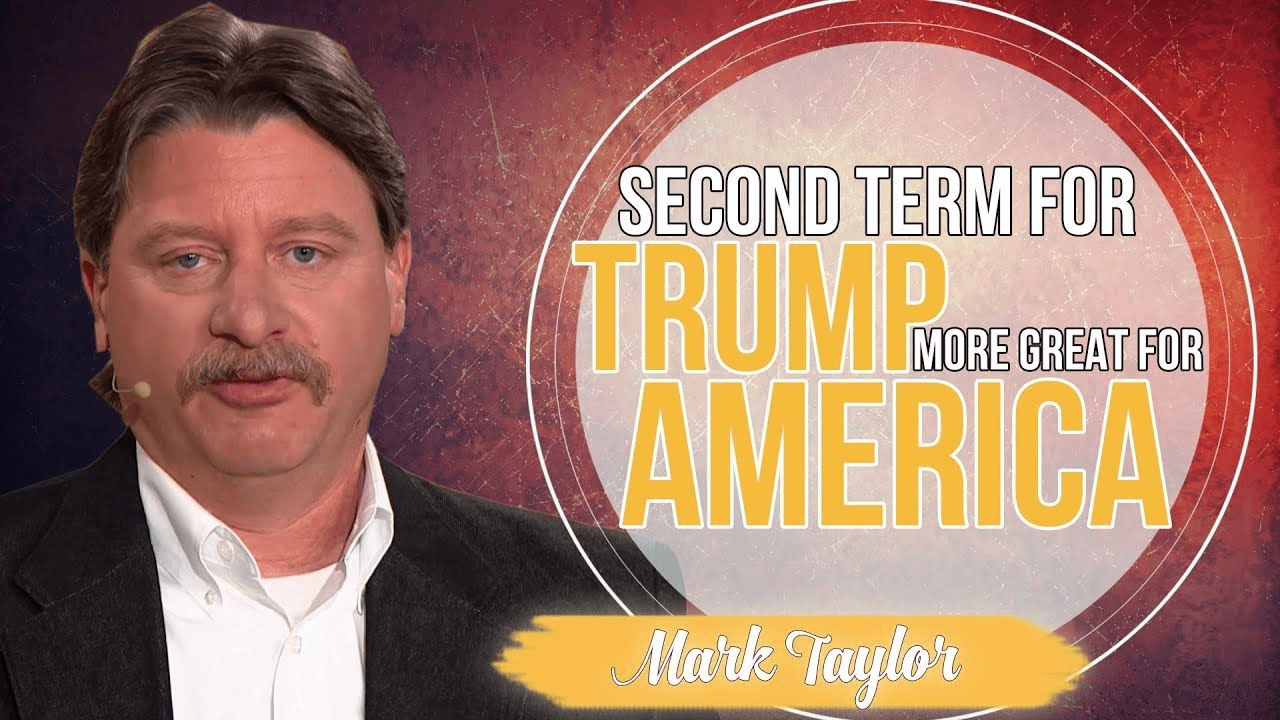
Source: Mark Taylor
The Beta Variant
A normal middle-class, if slightly messy, living room in Orlando, Florida in 2011.
A firefighter's bunkers and boots sit in the corner of the room, sooty and collecting dust. A tired man lounges in a recliner, but not at ease. He is dazed and clearly nauseated. There is a gentle glow emanating from a TV playing Fox News. A small red container of Zoloft sits on a side table next to the recliner, and a familiar voice begins to discuss international trade. It is the voice of Donald Trump. A deep voice off-stage intones, "You are hearing the voice of a president."
Is this, like the story of Kim Clement, the dramatic start to a true story? I have no idea. But it is the start to the story told by Lieutenant Mark Taylor in his 2017 book The Trump Prophecies.
Taylor had been through the wringer.
By early 2011, he had spent two hard decades in the fire service in Central Florida. Like many first responders, Taylor endured post-traumatic stress from a variety of horrors encountered in the line of duty. In his written account, he recalls various stories that would become the stuff of recurring nightmares, like the time he found a child who had died on his knees awaiting rescue at a window in his bedroom. PTSD was only the half of it. You see, Taylor suffered from thwarted ambitions, too. Some years before, he had invested a great deal of time and treasure into the development of a novel extrication device. It had both first responder and military applications, and it seemed from early interest that this might be his ticket out of the world and life that had been causing him so much anxiety and pain. At the height of his exhaustion from the fire service, he had two major initial orders for this device nearly in place, only for both to fall through at the last moment.
So it was that in April 2011, Mark Taylor found himself in a very "Why, God?" state of mind. As our scene imagined, the Zoloft he had been prescribed for his PTSD was causing nausea and malaise, and he halfheartedly watched Fox News just for the noise in the background. Now, Taylor was a charismatic Christian and was connected to prophetic and apostolic ministries. He had friends who had helped him interpret dreams before; however, he never considered himself a prophet. All the same, when Trump came on the television that day, he felt compelled to write down the words he says he heard from God. I excerpt the key elements below.
The Spirit of God says, I have chosen this man, Donald Trump, for such a time as this. For as Benjamin Netanyahu is to lsrael, so shall this man be to the United States of America! For I will use this man to bring honor, respect and restoration to America. America will be respected once again as the most powerful and prosperous nation on earth, (other than lsrael). The dollar will be the strongest it has ever been in the history of the United States, and will once again be the currency by which all others are judged...
The Spirit of God says, I will protect America and lsrael, for this next president will be a man of his word, when he speaks the world will listen and know that there is something greater in him than all the others before him. This man's word is his bond and the world and America will know this and the enemy will fear this, for this man will be fearless. The Spirit says, when the financial harvest begins so shall it parallel in the spiritual for America.
The Spirit of God says, in this next election they will spend billions to keep this president in; it will be like flushing their money down the toilet. Let them waist (sic) their money, for it comes from and it is being used by evil forces at work, but they will not succeed, for this next election will be a clean sweep for the man I have chosen... Even mainstream news media will be captivated by this man and the abilities that I have gifted him with, and they will even begin to agree with him says the Spirit of God.
Commander-in-Chief, by Mark Taylor (April 28, 2011 per author)
First of all, yes, there is some stuff here that clearly didn't go right, by which I mean just about everything except the prediction that Trump would become president. For example, Taylor is very clearly saying that God told him that this was about the 2012 elections, and the last paragraph is an explicit claim that the money being spent on President Obama's re-election was a waste. The financial predictions, the currency predictions, the "man of his word" predictions, the "mainstream media...will even begin to agree with him" predictions, all on the spectrum between wrong and wrong. Similar to the Dutch Sheets predictions of judgment from Part 3, most of Taylor's 2011 prophecy is so wrong that it would be difficult to be more wrong if being provably, objectively wrong were your sole objective.
In spite of all that, he absolutely, positively did predict that Donald Trump would become the president.
Did he really do so in 2011? It would be hard to prove either way. But short of spoiling the story, I think we can say that there were enough recipients of the prophecy who corroborate having received it as early as 2013 that it does not seem unreasonable. In any case, it was certainly circulated on a small scale within prophetic, prayer and intercessory networks well in advance of Trump toying with pursuit of the nomination.
Still, through mid-2015, Taylor's prophecy was not widely known. Taylor himself freely admits having delayed its wider circulation. He did so in part because he had never thought of himself as a prophet, and didn't know what to do with it. He also had doubts, some of which were confirmed when Barack Obama won reelection in 2012. Most importantly, it didn't go anywhere because nobody had any idea who Mark Taylor was, and the networks to whom he did provide it did not overlap nearly enough with the more influential networks within the charismatic-Pentecostal movement.
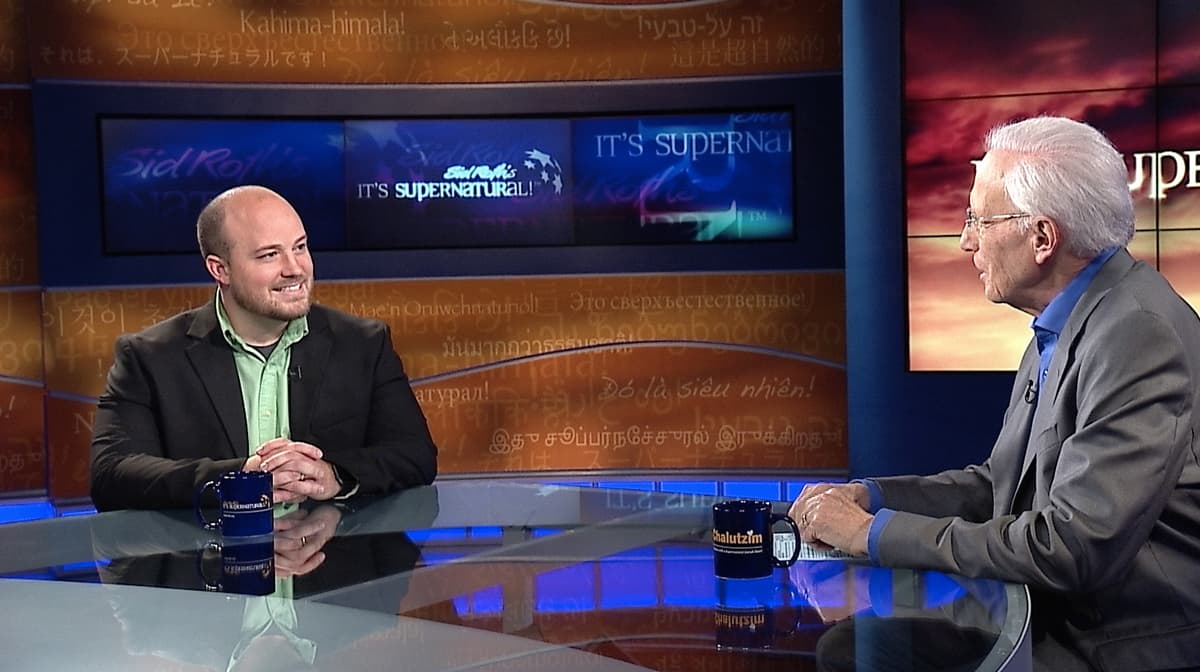
Jeremiah Johnson, then based in Lakeland, Florida, discusses prophecy on the Sid Roth's It's Supernatural program on December 17, 2017
The Gamma Variant
A sanctuary in a medium-sized, informal church. There are chairs, not pews, and little art or symbols other than a cross behind the baptismal pool and a lectern at the front of the stage. A small statured man, balding but clearly still young, kneels and bows in prayer on the steps of the stage. You see him rock slightly.
The man freezes for a moment. He looks around, somewhat frantically. It isn't clear what he is searching for.
The man suddenly runs off stage, out of the sanctuary. He returns a moment later with a roll of paper towels, presumably from the church's restroom. You see him furiously scribbling something on them.
You've met Jeremiah Johnson before, back in Part 3 of this series.
Johnson, like Taylor, was not a leading figure in the apostolic-prophetic movement. He was a rising star, to be sure, planting a church that grew rapidly almost immediately after he finished his undergraduate degree. It was a big deal for a 20-something to lead a church with a few hundred people, for him to travel as frequently as he did to deliver prophetic messages to other congregations in the region. But in comparison to the Big Names who ran Big Conferences, the men and women who oversaw massive multi-national apostolic networks, who sat on the boards of massive apostolic alliances, Johnson was a regional curiosity.
That is, until Charisma, the flagship magazine, podcast network and blog of the charismatic-Pentecostal movement we discussed in Part 4, published one of Jeremiah's prophecies in July 2015. This was a month after Trump had entered the primaries. Around this time, a buck would get you a hundred that Trump would end up in the White House.
The Holy Spirit spoke to me and said, "Trump shall become My trumpet to the American people, for he possesses qualities that are even hard to find in My people these days. Trump does not fear man nor will he allow deception and lies to go unnoticed. I am going to use him to expose darkness and perversion in America like never before, but you must understand that he is like a bull in a china closet. Many will want to throw him away because he will disturb their sense of peace and tranquility, but you must listen through the bantering to discover the truth that I will speak through him. I will use the wealth that I have given him to expose and launch investigations searching for the truth. Just as I raised up Cyrus to fulfill My purposes and plans, so have I raised up Trump to fulfill my purposes and plans prior to the 2016 election...
Prophecy about Donald Trump as Cyrus Figure, dated July 15, 2015 and published in Charisma on July 26. (Text accessed via God's Man in the White House by James Beverley)
As was told in Part 3 of this series, by the time Johnson's Charisma piece emerged in July 2015, the charismatic-Pentecostal community was a decade and a half into the steady influence of three separate, powerful memes. The allure of the Meme of Rediscovering Ancient Ways had transformed the nascent model of apostolic-prophetic leadership into common knowledge. Everybody knew that everybody knew, within this community, that there were now prophets who heard from God and modern-day apostles who could work together to chart out the church's direction on the basis of that knowledge. The Keeping Ancient Covenants meme, promoted tirelessly by Dutch Sheets and Chuck Pierce in particular, promoted the promise that leveraging the prophetic and apostolic to keep America's historical covenant with God would surely result in the reward of a harvest – a Third Great Awakening.
The Mountains to be Conquered meme had similarly coalesced into common knowledge of a cultural mandate for an apostle-led Christian church to, as Peter Wagner put it succinctly, rule as Kings (or as Sheets puts it less succinctly, to rule as the ekklesia, God's chosen legislature on Earth). The growth of these ideas is measurable. To wit, the Elijah List website remains the largest database of prophetic and apostolic statements referencing these ideas – we have catalogued thousands of posts there over the last 20+ years. While the memetic language of Mountains to be Conquered was present since almost the beginning of Wagner's new apostolic reformation, the steady rise of language associated with these ideas within the apostolic-prophetic community's written output accelerated rapidly in 2014 and 2015.
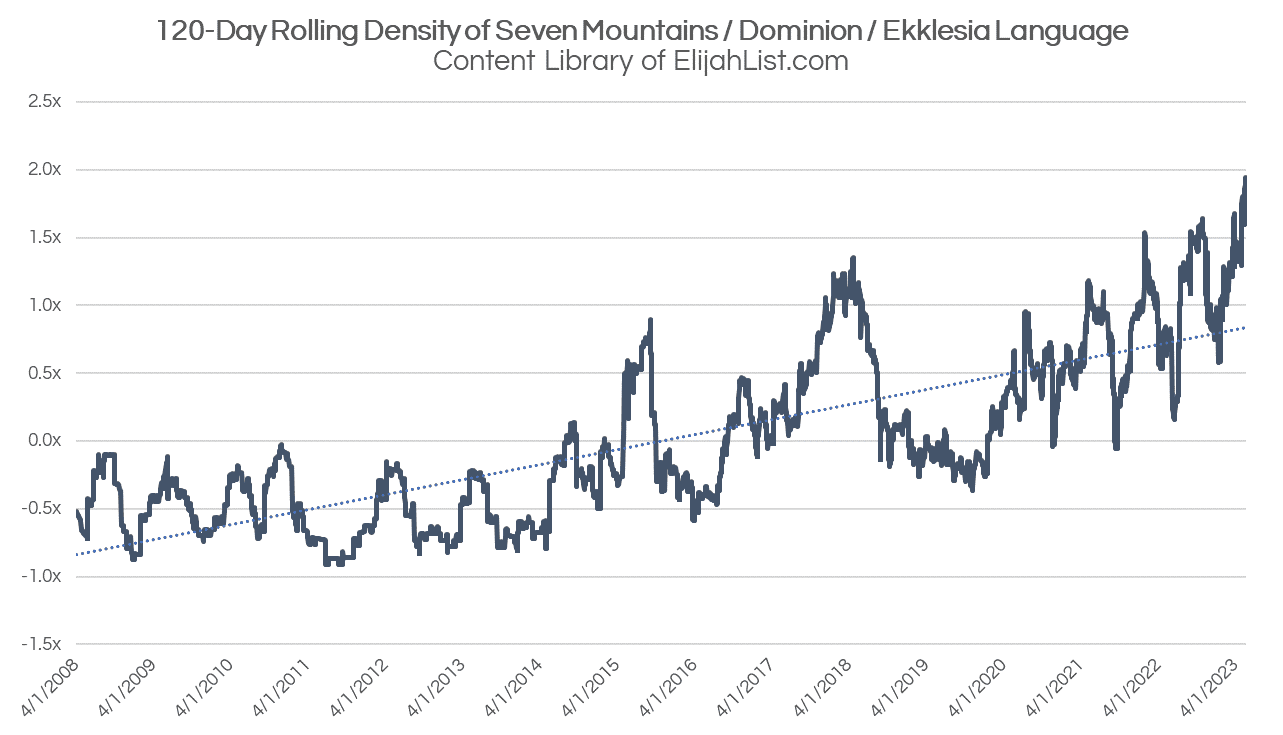
Source: Epsilon Theory, ElijahList.com
The common knowledge which emerged from the merger of these three memes was that establishing effectively Theonomic or Ecclesiocratic rule over America was, perhaps, the manner in which the covenant to unlock that Third Great Awakening would be fulfilled.
This was the strategic backdrop, a pre-existing set of views for how the war would be won.
Jim Goll, referenced earlier in this essay series in context of the Kansas City Prophets, describes this idea as the Fourth Wave of the charismatic-Pentecostal movement.
This Fourth Wave emphasizes societal change by channeling these empowered Believers to impact the seven cultural mountains of religion, government, education, business, family, media, and the arts and entertainment. Fresh intercessory strategies will now arise for effective ministry in the marketplace. The supernatural power of the Holy Spirit will not be able to be contained within the "four walls of the church" but rather explode into every sphere of life.
James Goll: "The Fourth Great Wave Has Begun!", ElijahList.com (April 28, 2016)
And it positively jumps out of the data on the language used by charismatic-Pentecostal prophets.
Using the same Elijah List dataset, since 2008, the first election after this strategic backdrop became the prevailing narrative within the apostolic-prophetic movement, "Great Awakening" related language has reached peak density 2-6 months prior to every presidential election. Each time, a burst of "prophecies" emerge promising that a correct electoral outcome would trigger a new Great Awakening, an End Times Harvest, and that an incorrect electoral outcome would produce judgment. It might even be "America's last chance."
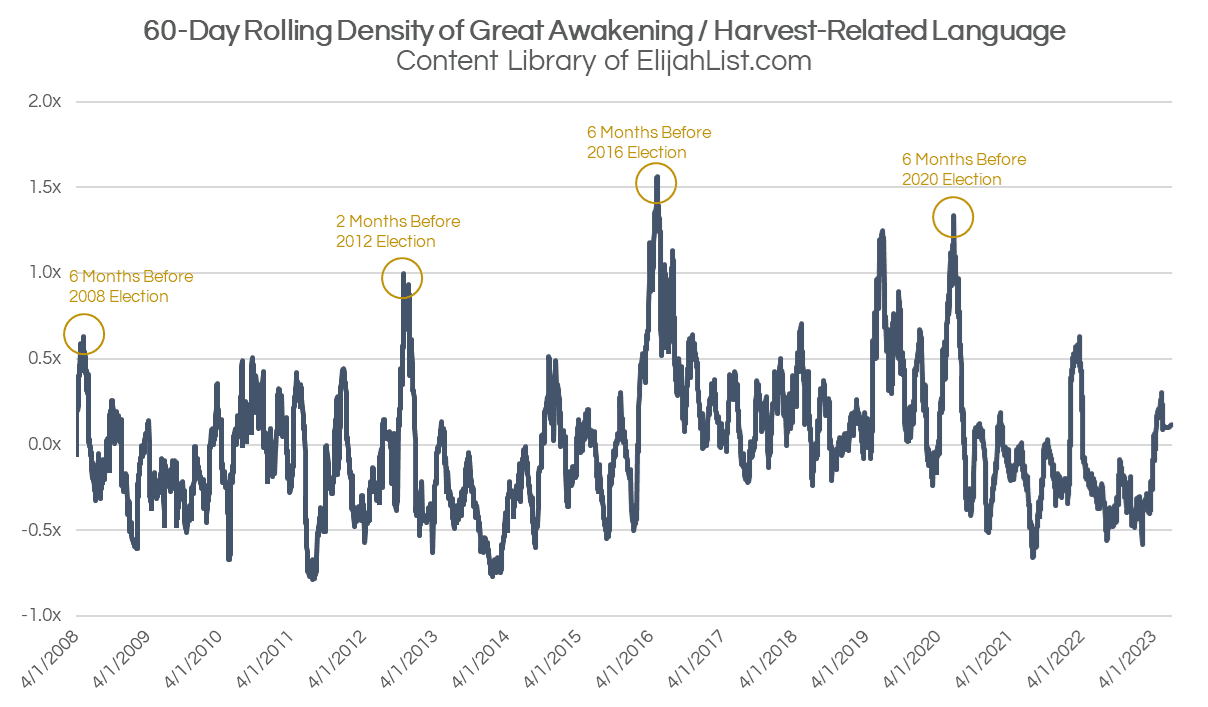
Source: Epsilon Theory, ElijahList.com
This tendency wasn't only present in posts and prophecies being issued from this community. You would have seen it in nationwide conference programming, too. Like Che Ahn's Harvest Rock Church's mid-summer "Revival and Transformation of Society – Taking the 7 Mountains of Culture" conference in 2008. Or just weeks apart from that, the Texas Ablaze: Signs, Wonders, Miracles Crusade, in which believers "at the threshold of a powerful spiritual awakening" would unlock it by, as Bill Johnson would tell them, "co-laboring with God for cultural transformation." Or a couple weeks before that, at the Voice of the Prophets conference, thrown by the Global Awakening apostolic network, in which participants would "seize [their] prophetic destiny" and "manifest the words that have been spoken over this nation of Heaven represented on earth" in a "cultural shift."
And that was just a sampling from 2008, when the integration of the three core strategic memes was in its infancy.
By 2016? This is what we mean by common knowledge. It is what everyone knows that everyone knows. It shapes us. It auto-tunes us. It enforces the narrative. It punishes deviation. It rewards compliance. For something like belief in prophecy, it acts as confirmation. As a source of truth. No, the weird formatting of this paragraph was not an accident or error. Each of those words is a different link. Knock yourself out.
Yet when a narrative is truly ascendant, present in the minds and mouths of everyone within a network, it can starve the room of oxygen for any others. I'll just add a little trend-line to the chart below in case you find it helpful to see an example of just how this happens in practice.
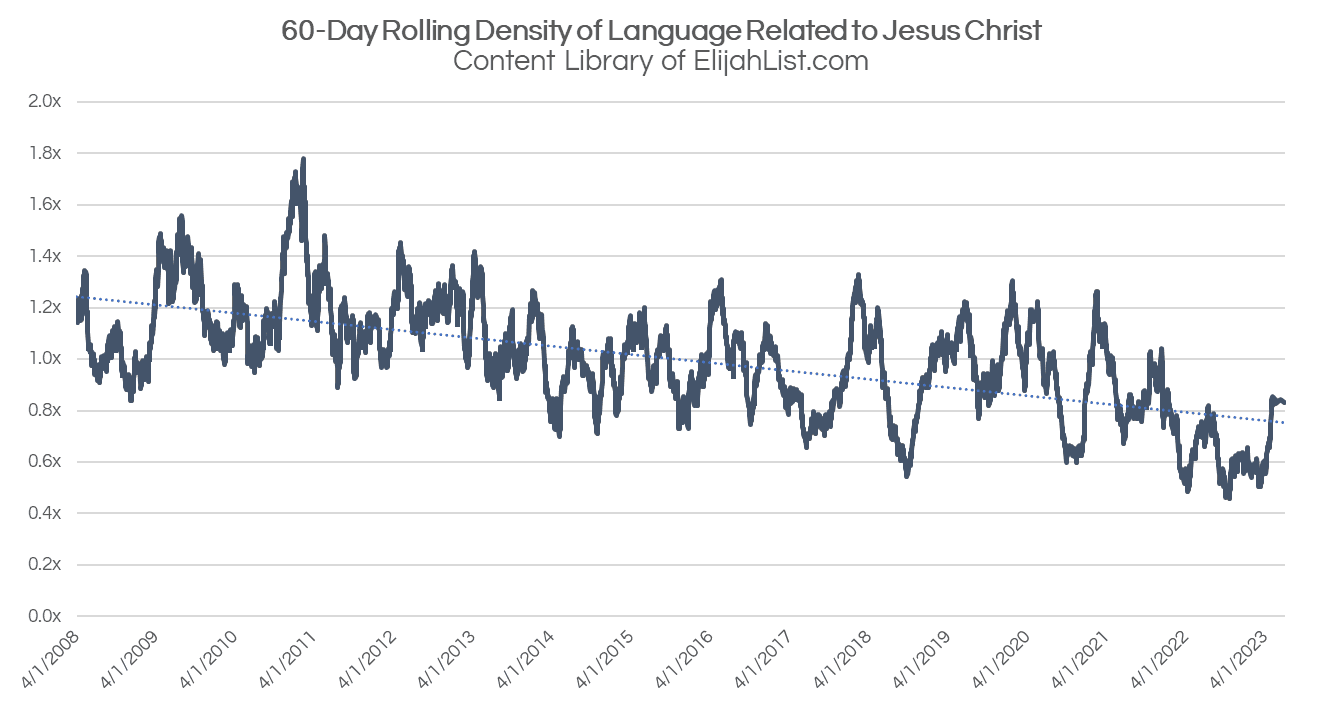
Sources: Epsilon Theory, ElijahList.com
While the merged language of our incomplete narrative virus – the stuff of Jim Goll's Fourth Wave, if you will – was powerful, the ideas were still general. Seven Mountains, Ancient Covenants, the Old Ways Restoration of an apostolic reformation – these things provided a general strategy for what the narrative virologists from Part 3 thought the church or Christians ought to do, but rarely pointed in the direction of a real-world tactic they could employ to achieve the strategic objectives they called for. There was no clear call to action, no focal point toward which they could direct the growing energy of the movement beyond prayer, personal evangelism and involvement in apostolic, intercessory prophetic networks.
Jeremiah Johnson's July 2015 prophecy changed that.
His was the first message that everybody in the charismatic-Pentecostal community heard – and knew everybody else had heard – that provided a tangible, real-world vector for the achievement of these political aims. A path from A to B for all manner of aims of the apostolic-prophetic movement.
In reality world, it did so by laying a foundation which connected a tangible action within the capacity of every charismatic Christian American – supporting and voting for Donald Trump – to the latticework of narratives that had been built over the prior 20 years. In narrative world, it did so by activating the other two memes we described in Part 3. First and foremost, Jeremiah Johnson's statement brought the Cyrus framing into the open, activating the power of the near-universal meme we have referred to as Hope for Broken Vessels. That the story of Cyrus and Israel's captivity is itself a story of Jewish prophecy made this framing an irresistible temptation, I think. Beyond the literal Cyrus comparisons, all of the explanations of "bull in a china closet" behavior were further scaffolding to a Trump-as-Cyrus narrative that would be built from the underlying meme. The memetic embeddings in Johnson's message went further than that, however. In language like "Many will want to throw him away...but you must listen", Johnson first engages the meme of a Faithful Remnant Returning. It was an artful way of saying that only the Christians who were listening to what God was telling the prophets would be part of what God wanted to do through Donald Trump.
If you clicked on the few dozen links I attached above to every word in the section describing the pre-election Third Great Awakening chatter in 2016, you would have found that practically every other link contained references to God "raising up a Joshua company" or "a holy remnant" or a "company of prayer warriors." Through social media and the increasing connectivity between the networks of charismatic-Pentecostal traditions embracing the apostolic polity, the shrewdest prophets had the ability to mold each prophecy precisely to the zeitgeist. We were learning, in other words, to tailor narrative viruses.
Still, it was only a seed. An early variant. This was going to take some time.
Jeremiah Johnson, even through Charisma's reach, remained an unknown. And it wasn't as if everyone were champing at the bit to get dragged again. Lord knows enough ‘prophets' had been pilloried after prophesying against Barack Obama's presidency not once, but twice. Fortunately, something else happened at almost the exact same time: A narrative Missionary emerged. Someone with a platform large enough to tell everyone what this meant and how they should think about it.

Lance Wallnau sitting on an oxblood wingback chair in his backyard.Source: Lance Wallnau Ministries
Yep, Lance Wallnau again. Just as Charisma posted Johnson's statement on their website, Lance Wallnau piped up on Facebook. He didn't reference Jeremiah's prophecy directly; in fact, he only referenced Kim Clement's original reference to "Trump" being used as a "Trumpet."
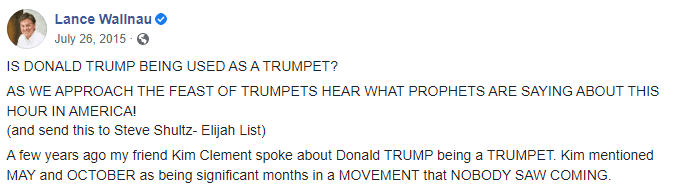
But for many, hearing the same thing from multiple people – and being told it was something Kim Clement had said years ago – got their wheels turning. Like influential men's leadership speaker Os Hillman – who had thoroughly embraced the Seven Mountains model some years before and was a friend and colleague of Wallnau's – connected all the dots in asubsequent Charisma post. From Clement to Johnson to Wallnau, the most connected charismatic Christians now had a prophecy with linguistic and memetic connections to the earlier statements of a beloved leader within the community (Clement) with confirmation of much of the same language from more established, credible personalities (Wallnau and Hillman).
A day later, the Christian Post published an Op-Ed from Larry Tomczak repeating the claim. "Right Wing Watch", a well-researched but aggressively antagonistic organization (not only toward theocratic tendencies but anything vaguely Christian and conservative), also picked up on it shortly after Joe Kovacs at World Net Daily had published a brief outlining Johnson's words and their virality on Christian social media. There was a bit of both praise and criticism on Christian blogs for a few weeks. Intercessory prayer networks and prophetic networks likewise chattered about it for at least a couple months.
Behind the scenes over the coming weeks, Wallnau was continuing to build the edifice of a Cyrus narrative, both directly and indirectly. On October 3, 2015, Wallnau recounted a meeting at Trump Tower, asserting in an additional point of connection to the "bull in a china closet" language in Johnson's prophecy that "Trump is Heaven's Miley Cyrus wrecking ball to the spirit of Political Correctness." Only a few weeks later, on November 30, Wallnau would again visit Trump Tower, this time with a group of black pastors. Wallnau would tell Trump at this time that he believed the future president was a modern-day King Cyrus.
Throughout late 2015 and early 2016, however, beyond Hillman and Wallnau, the only influential missionary within the apostolic-prophetic movement who very publicly embraced the Trump-as-Cyrus narrative was Rick Joyner, leader of the massive South Carolina-based Morningstar Ministries. He would go even further, positing in an October 2015 video delivered through the Morningstar TV streaming service, that perhaps Donald Trump – humble to God through his arrogance to man – was not only a King Cyrus figure but a King David figure. Other noteworthy charismatic figures, like Dr. Michael Brown, were much more circumspect.
Even in the most aggressively pro-Trump cases, including Jeremiah Johnson's prophecy, there was widespread reluctance to prophesy that Trump would actually win the presidency. Mark Taylor had done so, thus far only to a limited audience. Johnson, Wallnau, Johnny Enlow and the others who would "confirm" the Cyrus language during this period, however, limited their predictions to Trump being a "bull in a china shop" to the election, whatever that might mean. They prophesied that God had called him there to "shake things up" or to reveal the secrets of the deep state.
This is man who is going to be used of God to bring to light a lot of dirt. For many years to come you’re going to hear him as a man who started in the forefront and in the media to expose the secrets of darkness in society and in government here in America.
Rich Vera, on Sid Roth's It's Supernatural (March 7, 2016)
As a rule, however, they were all very careful to say they weren't promising Trump would actually win. After that, the Cyrus meme and charismatic chatter about candidate Trump largely faded for several months.
The Delta Variant
A man stands in a courtroom. The wood paneling and ill-fitting, too-large, too-gray suits abounding throughout the room can only mean one thing: it must be the late-1980s.
Others stand around him, lawyers, media and other interested parties, as the jury foreman stands to read the verdict. "On the eight counts of mail fraud, we the jury find the defendant, James Orson Bakker, guilty. On the fifteen counts of wire fraud, we the jury find the defendant, James Orson Bakker, guilty. One one count of conspiracy, we the jury find the defendant, James Orson Bakker, guilty."
As the characters freeze in place, the wood disc in stage center rotates, giving us a scene on the courthouse steps. Media members point dozens of microphones at a big-haired, middle-aged women with heavy makeup. She speaks into the array of devices. "I have a song for you." Then she sings, "On Christ the solid rock I stand. All other ground is sinking sand. All other ground is sinking sand."
She smiles and adds, "It's not over until it's over," before being rushed by lawyers into a car.
This is definitely a true story...and it also has nothing to do with our story. Not directly, anyway. But I'm not sure if you knew that Jim Bakker was not only out of prison following his conviction on only a fraction of the corrupt schemes he cooked up over a couple decades of criminal activities he pursued as a televangelist, but back in the game.
But I felt like you should know.
Because it was on Jim Bakker's show on June 9th, 2016 that the Trump Prophecy, the actual thing firefighter Mark Taylor wrote down and distributed to friends and well-wishers back when Trump Vodka could still be found on store shelves (or at least in their stock room), was unveiled to the broader public.
OK, that's...not entirely true. About a month and a half earlier, on April 18, 2016, Mark Taylor was a guest on Rick Wiles's TruNews podcast, part of the charismatic Christian podcast and video streaming network TruNews. Less than a week later, a link to the TruNews podcast with some light commentary made it to Charisma. A couple weeks after that, Donald Trump became the presumptive GOP presidential nominee after Cruz and Kasich dropped out. With the risk of outright predicting a Trump win substantially reduced by his nomination, Wallnau re-emerged to retroactively adjust some of his earlier hedging.
‘And right away I look at it, I say ‘Oh my gosh! This guy Trump, the wrecking ball, isn't just gonna rearrange the political landscape, this guy's gonna go all the way to the White House. I believe he's the 45th President of the United States. He's gonna be a Cyrus.
Lance Wallnau, on the Strang Report podcast with Stephen Strang (May 6, 2016)
Others within the apostolic-prophetic community followed as soon as the nomination was formally announced, some to claim that they had actually predicted this would happen long ago. For example, apostle and founder of the POTUS Shield prophetic network Frank Amedia claimed God told him Trump would win the nomination in the summer of 2015. But the floodgates really began to open after Mark Taylor's Jim Bakker Show appearance.
In true Epimemetic fashion, a smattering of prophets who had previously protested against any claims that they were prophesying a Trump presidency adapted their message to a new environment and stepped out with more explicit claims. As Taylor's long-standing prophecy were connected to the statements of Johnson, Wallnau and Clement, the expressions of the Cyrus meme and the Ancient Covenants meme were transformed almost immediately.
Practically overnight, common knowledge within the apostolic-prophetic movement within the charismatic-Pentecostal church went from "I feel like God's telling me he's going to use Trump to really shake this election season up and piss off the media and some politically correct people" to, essentially, "Our prophets have told us that God will unleash a third great awakening by fulfilling our nation's ancient covenant with God, which requires us to conquer the mountains of culture and society, to rule in God's name and through God's laws. Our apostles will guide a faithful remnant in doing so, against great opposition, by embracing a prophesied leader, a Cyrus chosen and anointed by God who will break down the entrenched interests that have kept that remnant from their due influence and the nation from upholding its covenant.
After all, as we showed above, it isn't a coincidence that the highest concentration of "Ancient Covenants / Great Awakening" language on Elijah List in history began in late May to June of 2016. Lou Engle, founder of a variety of large nationwide prophetic and apostolic ministries, was among the most direct in connecting these powerful memes in this new way.
Brothers and sisters, we must judge these dreams as prophecy. If they are God then we are in a defining moment for the covenant of this nation to stand and the covenant of our forefathers to be released for a Third Great Awakening.
We cannot afford to be jaded about these elections. We cannot be neutral and let history forge its own way. The future will be made by someone who stands in the gap and asks God to release His divine choice into this nation who will uphold the covenant. This is critical.
"Lou Engle's Word About the Elections! A Call For a 40-Day Fast Starting Today!", published on Elijah List
The need to get on the Trump Train quickly was palpable. Henry Gruver joined Frank Amedia in the retroactive credit game, claiming on a podcast after the nomination was sealed that he experienced a vision of Trump clothed as a King back in March 2016. Hank Kunneman, Mike Thompson, Jill Steele, Patricia Greene, Kat Kerr, Dutch Sheets and Chuck Pierce – at various points over the next few months, they all joined the rising chorus of prophetic predictions of a Trump presidency. Or at the very least they joined their voices to prophecies about his anointing and selection by God to the role, with the question of the election outcome still left somewhat vague or in doubt.
Media missionaries within the charismatic-Pentecostal community likewise were beginning to frame what everybody knew that everybody knew in context of the new expression of the memes. Headlines like, More Christian Prophets Are Confirming That Trump Is Our New President!" and "Donald Trump Prophesied to Become Our Next President" emerged. Mark Taylor had largely moved on to prophesying an alliance of America and Russia to overthrow the illuminati, among various other things, but the message was out of his hands by this time.
When the narrative found its way into non-charismatic evangelical hands, however, its epimemetic adaptation to that environment was rapid. The underlying Cyrus memes were unchanged. The way in way they were expressed in language and narrative, however, had to change. Remember, modern prophecy is simply not a thing for most evangelicals. For your average Southern Baptist, "A retired firefighter, a singing South African prophet and a business book-on-tape guy from Ft. Worth" is a start to a good joke, not a way that you hear from God. A "calling," sure. "God's chosen", maybe. But all this "prophesied to be God's King Cyrus" stuff doesn't work for non-charismatic evangelicals.
I feel quite certain that the evangelical-adapted version of these memes was already bouncing around various circles by the summer of 2016. You might have observed scaled down versions yourself, like in May 2016, when Jerry Falwell, Jr. told Anderson Cooper that he wasn't voting for a "pastor-in-chief." But the first thorough public example I know of an evangelical-adapted narrative of the meme of Hope for Broken Vessels emerged very shortly after the Mark Taylor prophecies had merged with those of Clement, Johnson and Wallnau into charismatic common knowledge. On June 14, a man named Jerry Kaifetz penned a piece in WorldNetDaily that borrowed practically every argument, analogy and meme from the apostolic-prophetic sources that had promoted them. But he stripped them of phrasing and language that would have made them poorly adapted to the non-charismatic evangelical Christian mainstream. Kaifetz, another in a distinguished list of names of people you probably had no reason to know before, is a long-time writer and leader within the Independent Fundamental Baptist movement (IFB). If you're not familiar with the IFB, think of the purest form of non-charismatic evangelicalism you can imagine – then turn it up to 11.
We are electing a president, not a national pastor. The American electorate is not a pulpit committee...
God has a history of using men whom today's anti-Trump evangelicals would reject in resounding fashion. Take, for instance, the Persian King Cyrus...
I don't know how I could more clearly see Donald Trump represented in the person of King Ahasuerus, with Esther, of course, being America's conservative voters. Just as back in the Persian Empire, survival was the only issue that counted...Sound familiar?
Jerry Kaifetz, in God has a history of using men like Trump, WorldNetDaily (June 14, 2016)
From this point, this precise framing would emerge seemingly everywhere, but especially from more traditional evangelical strongholds. For example, in September 2016, candidate Trump conducted a meeting with a group of non-charismatic evangelical leaders (along with a handful like theologian Wayne Grudem who might be described as charism-curious). Robert Jeffress, senior pastor at First Baptist in Dallas and one of the most influential evangelical leaders in America, ended the meeting saying that he was "not voting for Trump to be the teacher of my third grader's Sunday-school class." Around the same time, the National Religious Broadcasters hosted a debate among various Trump-supporting and Never-Trump evangelicals. At the event, long-time Christian evangelical broadcaster and author Janet Parshall delivered as clear a conjuration of the meme of Hope for Broken Vessels as anyone could hope for.
We are not electing a messiah.
Can God use a Persian and a pagan king like Cyrus to rebuild the walls of Jerusalem? Can God use an adulterer and a murderer and call him the ‘apple of his eye?' Can God take a Jewish intellectual who was the ISIS of his day, and use him to author over half the New Testament and grow His church?
Noah was a drunk. Abraham lied, Jacob was a liar, Moses was a murderer, Samson was a womanizer, Rahab was a prostitute, Elijah was suicidal, Isaiah preached naked, Jonah ran from God, Job went bankrupt, Peter denied Christ.
God has a track record of using flawed and broken people even when it doesn't look right to us.
For me, I choose to keep the Republic.
Janet Parshall, comments delivered at the Evangelicals Debate the 2016 Election: Trump, Clinton, or Other? event on September 16, 2016 (emphasis mine)
The slightly amusing part of this quote, at least to me, is that when God calls Cyrus "His anointed" in Isaiah 45, the plain meaning in the Hebrew is transliterated as mashiach. As in messiah. Saying that God is raising up a new Cyrus in context of an election is literally saying that you are "electing a messiah."
More to the point, check the language in Kaifetz's headline, then read the penultimate statement from Parshall in the quote above. I don't know if one of them took the "God has a record of using people like" language from the other – in fact, I rather doubt it. To the contrary, the presence of narrative enforces this kind of linguistic consistency with zero effort at all on the part of the speaker. That's the power of meme. But the real power here is in the epimemetic forces of overlapping social networks in context of one-to-many communication. We took all of the energy of years of charismatic promotion of Cyrus prophecies and channeled it into a sensible-sounding, powerful, unassailable rhetorical position for evangelical leaders who couldn't care less about what the so-called prophets and apostles of the charismatic-Pentecostal church thought.
The suffusion of the adapted framing throughout the evangelical church was such that even opinion journalists within the mainstream media ended up asking the question, Does the ‘Cyrus prophecy' help explain evangelical support for Donald Trump? As a shorthand, if a headline asks a question, the answer is nearly always no. This may skew closer to a maybe. Again, I think the vast majority of voters cast votes for Trump or Clinton for reasons wholly unrelated to anything we are discussing here. It's not like evangelicals voting for GOP candidates is some miraculous new property of American elections. But did hundreds of thousands, maybe even a million or two, hold their noses and vote for a candidate they might otherwise have found unacceptable because these framings had sufficient memetic power to change what their vote meant? What they were supporting? Wallnau, true to form for an evangelist, claims a few million more than that in connection with the publishing of his top-selling pre-election book, God's Chaos Candidate. He may not be wrong. It's impossible to say.
But it also doesn't matter. This isn't an essay series to come up with new and exciting condescending reasons to explain why people did or didn't vote for Donald Trump. We are telling the story of the energy behind stolen election fantasies, and there are features of 2016 election prophecy that must be included in that story.
As you might recall, Trump won. That's when the celebrations for many of our narrative virologists, carriers and others began. So, too, did the next phase of electoral and political prophecy in the American charismatic-Pentecostal church. And this time, the scope of the narrative's spread would not be confined to the charismatic fringe and some adjacent affected leaders within the evangelical church.
It was time for the narrative epidemic to go full-blown pandemic.


Comments
Nine parts. I can only imagine how many hours of discussion went into this. Looking forward to all of it.
@rguinn I was wondering: did you use the narrative machine retrospectively, whether wholly or in part, to identify the sources here?
As someone raised Catholic and currently attending an evangelical Baptist church I audibly guffawed at this paragraph. Absolute perfection.
As a socially liberal and fiscally conservative Presbyterian who is probably more agnostic now and (yes a run-on sentence) am fully ingrained with the fact that our country’s laws are based on Presbyterian polity, I too laughed out loud at this statement.
Levity, a good carrier for important considerations.
Rusty,
Curious to see what attention, if any, the doctrine of biblical innerancy will get in this series.
As a teenager, I was baptized in and eventually pastored at a wonderful Foursquare church in Oregon. Additionally, for several years during that time, I lived with 4 Calivinist buddies of mine.
During my years-long exposure to both charismatic Pentecostalism and Calvinism, I found over and over again how fundamentally problematic the doctrine of biblical inerrancy and literalism is for all churches, regardless of whether it’s the reformed Eric Metaxas/Wayne Grudem/John Piper type or the charismatic Pentecostal Benny Hinn type.
In my experience, the “charismatic norms” (like prophesy), can be a really beautiful thing. But it’s when the charismatic norms (like prophesy) are connected to the doctrine of biblical inerrancy/literalism that things can go super sideways and do anything but “edify”. As I see it, inerrancy is the core virus that has been wreaking havoc in the churches (you name the tradition) and the world for centuries.
Anyway, really looking forward to reading these notes.
Three of the mentioned fellows will make at least a cameo appearance, but it isn’t necessarily a focus of the series. I agree that it would also be fascinating to see how that narrative - the soul of American evangelicalism, really - emerged and became common knowledge, but that would be a different series.
In part, although as I think you’ll discover as we go along, our aim was to be thorough enough not to have to be stingy in our source selection.
Man, fascinating stuff. Can’t wait to read the rest.
I was raised mainline Protestant in NY in the 80s. Never even heard of Charismatics until I moved to TX as an adult.
I think I understand why it is the fastest-growing branch of Christianity. Vs the stuff I was raised with, my first impression as an outsider is the level of passion and… hmm… immediacy.
I’m assuming that this is the basic story we’re discussing, I had not heard it yet. It explains what some prophets need(ed?) to be true and why.
This was a great and insightful read, @rguinn.
“Like the Widening Gyre, the most effective vectors for effective astroturfing campaigns may focus not so much on changing common knowledge but on changing What We Need to Be True.”
Inoculation against direct responsibilities is one of the fundamental traits of human beings’ proto-centralized religions. In a context of apparent lack of control, agency was projected outward.
Witchcraft was the reason for pain without feeling guilty and gods’ (God) wrath for pain when feeling guilty in ancient cultures.
In this context of apparent lack of control (post 2008), changing what we need to be true is an escape from direct responsibilities when focusing on the excuses that explain the individual or collective failure as an out-of-control external factor (spiritual: evil-witchcraft- the devil or kind of real threats: immigrants - woke - deep state), that apparently has agency and goes directly against you as a cosmic good vs. evil fight. So, it’s the perfect context for this phenomenon to emerge in the American-style, spirit-filled charismatic Christianity.
Low locus of control (direct control over outcomes) + belief in miracles (indirect control over outcomes) + best in class already system of memes (Christianity).
You’ve got it nailed. Only I think that we will discover that there are many more areas of our society and culture which exhibit very similar traits in very different wrappers.
Really interesting start…as someone who has walked among the movements you reference, I’m looking forward to your reflections and observations.
I’ll just observe here that the role of discernment has always been the weak link when it comes to Pentacostal/Charismatic movements.
Continue the discussion at the Epsilon Theory Forum...