Men of God in the City of Man, Pt. 6: Pandemic
July 12, 2023·Politics
Download a PDF of Men of God in the City of Man, Part 6: Pandemic (paid subscribers only)
Men of God in the City of Man is a nine-part essay series that tells the story of a powerful narrative virus whose ultimate unintended target was nothing less than faith in American democracy as an institution. Part 1 introduced the idea of the narrative virus as a mechanism for astroturfing (fake grassroots) campaigns, and the idea that the danger may not come so much from forcing new Common Knowledge, but changing what some of the population needed to be true. Part 2 is the story of the carriers of its chief ultimate symptom: a rabid belief in rampant electoral fraud. Part 3 is the story of the creators of the narrative virus and the memetic building blocks they brought to bear. Part 4 is the story of the way in which the special environment into which those memetic building blocks were introduced changed the way that they expressed themselves on major social and cultural institutions. Part 5 is the story of how all of these pieces finally came together to create a narrative epidemic within one community. Part 6 is the story of how that epidemic went pandemic.
I am deeply indebted to the work of James Beverley, Matthew Taylor and Paul Djupe in various areas of this essay series. I have attempted to source their work where possible, but if you see something unsourced that makes a clever observation about our subject matter, please do me the favor of assuming it is the work of their dutiful scholarship.
Our story thus far has been of a narrative virus that had become epidemic within the charismatic-Pentecostal church in the United States. Built of powerful memes and transformed by the Epimemetic revolution of social networks, it may have influenced the 2016 Presidential Election. It might even have changed its outcome.
And yet, for all that, it is still worth noting how little of the charismatic-Pentecostal media engine and how few of its key personalities were really brought to bear in the lead-up to 2016. Not everyone was willing to prophesy that Donald Trump had been chosen by God to be a King Cyrus figure. Fewer still were willing to prophesy outright the victory of Donald Trump. More importantly, only a fraction of the perhaps 100 million Americans who believe to one extent or another in modern-day prophecy probably put much stock in those who did. That was in part, I think, because most of those prophecies took place very late in the process – most after he had secured the nomination.
Now that Trump was installed as president, however, and with the community in a triumphal state – it is not an exaggeration to say this was the greatest and most public ‘victory' in the history of the apostolic-prophetic movement, perhaps even the charismatic movement more broadly – there was no way to stay on the sidelines and stay relevant.
No matter how skeptical you might have been.
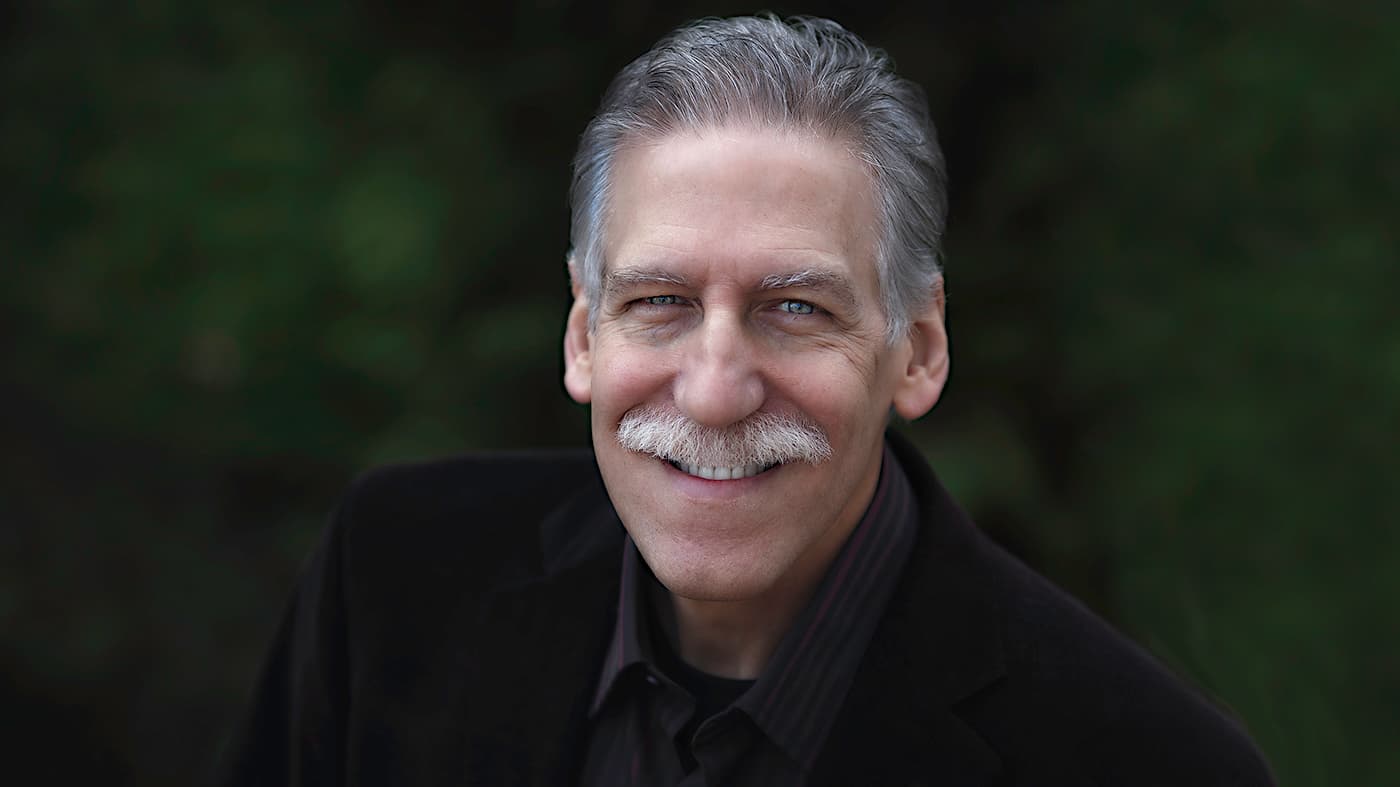
Dr. Michael Brown. Source: AskDrBrown.com
There is an unmistakable anti-intellectual strain in the charismatic-Pentecostal church.
It's not that there aren't perfectly bright or thoughtful folks within this faith tradition. But Pentecostalism and, to a lesser extent, the charismatic movement, represent at once an embrace of experiential faith and of new revelation through prophecy. It should not be surprising, then, that passion for theology, while by no means wholly absent, has never really been a meaningful part of the charismatic zeitgeist in the way it has with other Christian faith traditions. If you spend much time in these churches, you will become accustomed to hearing expansive interpretations of Titus 3:9 ("But avoid foolish controversies and genealogies and arguments and quarrels about the law, because these are unprofitable and useless"). With apologies to Wayne Grudem, to whom I referred earlier in this essay as charism-curious, systematic charismatic theology is not really a thing.
This is one of the reasons why I think that the transition of the apostolic-prophetic movement from almost uniform Pre-Millennial Eschatology (i.e. that Jesus will return before a literal millennium of Kingdom rule of the earth) into almost uniform Post-Millennial, partial preterist eschatology (i.e. the belief that Jesus will return only after the church has satisfied some remaining prophecies and established a figurative millennium of Kingdom rule of the earth) has taken place over a period of 20-25 years with little notice or attention among scholars. The change didn't come because modern-day apostles and prophets were poring over historical Eschatological and theological treatises and arrived at some new collective insight. The Keeping Ancient Covenant and Mountains to be Conquered memes that produced visions of a triumphal church in the apostolic reformation of the early 2000s were effective, their messages were repeated by the prophets, and they became common knowledge. The theological shift was an effect of this narrative virus, not a cause.
If there is an intellectual strain, or at the very least an anti-anti-intellectual strain, within the American charismatic-Pentecostal church, it probably resides wherever Dr. Michael Brown is sitting. Brown, pictured above, holds a PhD in Near Eastern Languages and Literature from NYU. He has taught at Fuller and other seminaries of varying reputation. He has charismatic street cred, having been directly involved in a leadership capacity with the Brownsville revival in the 1990s. He even has a bit of Kim Clement in him – the only difference is that Dr. Brown's religious conversion from a heroin and LSD addiction took place in 1971, and he was the one playing drums in the rock band. He was also born Jewish.
The Jewish component of his background naturally occupies a fair bit of Brown's writing, teaching and attention; however, because outside criticism of the charismatic-Pentecostal church was often woefully inaccurate in describing realities inside, and because inside criticism was at times practically non-existent, Dr. Brown has often taken on the role of gentle correction when things get out of hand. His 2022 book, "The Political Seduction of the Church: How Millions Of American Christians Have Confused Politics with the Gospel" stakes out rare charismatic points of opposition to emerging strains of Christian nationalism. It also holds many of the prophets and apostles to account for their actions in 2020 and beyond. Don't mistake me, to the average atheist, agnostic or Christian of any mainline denomination, many of Dr. Brown's beliefs would still seem plenty weird. And I think he'd be charmed to be told that. Within that context, there are few more reasonable voices from within this community.
Yet back on November 9th, 2016, even Dr. Brown added his voice to a chorus that quickly established the new common knowledge: God had intervened in the 2016 election to install Donald Trump. He published it in the Christian Post and on his website. And he wasn't alone. Dr. James Beverley's meticulous research in his book God's Man in the White House lays out just how quickly this became something that everybody knew that everybody knew, not just within the charismatic-Pentecostal church but throughout the wider evangelical tradition as well.
Paula White's claim that the election showed "God's hand and purpose in this" made it to Time Magazine‘s coverage. Michele Bachman's claim that "The Lord did this" made its way across religious and secular media. Politico would later publish a piece entitled "Millions of Americans Believe God Made Trump President." Stephen Strang's podcast claimed that Trump's election was God's answer to the prayers of the church. Bethel's Bill Johnson claimed on Facebook in a much-reprinted statement, "the outcome is from the Lord." Even a group of Jewish leaders hoping for a third temple claimed divine intervention. There were others that missed Beverly's cut. Non-charismatics like Franklin Graham happily chimed in that God let Trump win. Young-earth creationist Ken Ham opined in the Christian Post that Trump's victory was proof that God is in control. Strang couldn't leave it with just a podcast, and led the Charisma News site with a claim that it represented a "modern-day miracle." World Net Daily ran a poll asking readers if they believed it was God's intervention. Even among mainstream outlets that weren't covering the evangelicals / prophecy / intervention angle, describing Trump's win as figuratively miraculous was among the most common framings. Within our broad news dataset, we counted 211 pieces on mainstream media and blogs published on November 9th alone that described his win as a miracle.
Were all of those outlets describing it as an actual miracle, a supernatural outcome ordained by God? Of course not. It's a figure of speech we use to describe something uncommon and unexpected. But surprises of that magnitude in elections of this scale are rare. The narrative that Trump's rise and ultimate victory was a shocking outcome that "few could have predicted" was by no means confined to any sub-group of Americans. By November 10th, it was something everybody knew that everybody knew.
Especially the people who had prophesied it.
Especially when our narrative virologists ensured that all of the prophecies would benefit from their association with the even more miraculous-seeming prediction from 2007!
The smattering of prophets who predicted a Clinton victory quietly deleted them – and hoped they could sneak it by a news media that was increasingly eager to hold them to account. The rest ran a victory lap for...quite some time. Mark Taylor did multiple interviews. USA Today ran a survey piece on some of the prophets. Lance Wallnau, Mike Thompson, Jeremiah Johnson, Rick Joyner – anyone who had even remotely suggested that God might have a purpose for Trump, was being invited to podcasts and interviews. Those who could were hastily penning books to catch up with Wallnau. For the first month after the election, the prophets were everywhere, reinforcing the narrative of God's intervention in the 2016 election.
And more.
You see, there is a funny thing that happens in narrative world when a shocking prediction turns out to be true: everything else that was attached to the prediction becomes absorbed into its truth. The greater the surprise, the greater the "truthiness" attached to everything associated with the prediction. This isn't rocket science. When Old Major's prophecies of the rebellion come true, faith in Sugarcandy Mountain cannot help but swell in sympathy. If you can nest a lot of everything else in a wildly unlikely prediction that goes your way, you're playing with house money. And there was a lot of everything else attached to most of the Trump prophecies.
So it was that for the next three years, once the celebratory wave and attempts to retroactively claim similar prophecies ("God told me he would win back in 2015, honest!") had faded, the time was ripe to prophesy and preach about everything else. About what's next. In other words, now that God had come through on his promise to make Donald Trump His Cyrus President for America, it was time to prophesy about all the other promises that had been attached to this miracle: a Third Great Awakening, the long-deserved downfall of the Prophets of Baal of the secular media, and the unveiling of widespread evil and corruption in government, mostly by Democrats.
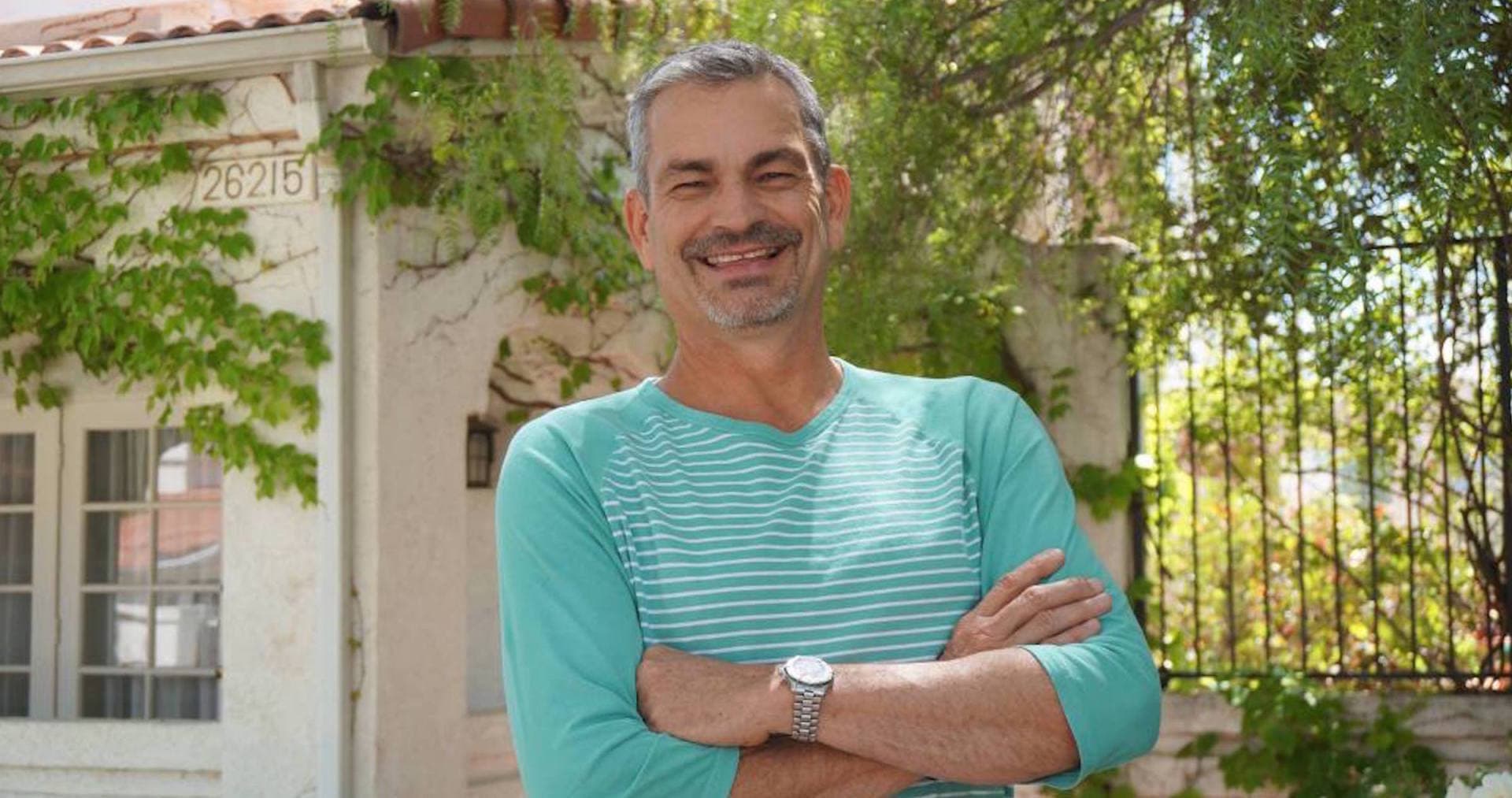
Prophet Johnny Enlow. Source: Restore7 Ministries
Ushering in a Third Great Awakening
As President-elect Trump moved toward his inauguration in January 2017, the apostolic-prophetic world was abuzz with "what's next" prophecies for the next four, or more commonly, eight years. In near unison, the prophetic output at this time was heavily laden with the language of the core memes of our narrative virus. Among the most thorough such prophecies was issued by Johnny Enlow, who transformed those memes into a helpful sort of mnemonic device.
What we will see for the next 8 years is reflected in the acronym of our new president's last name.
Transformation– this is what happens to people and to the macro narrative itself.
Reformation– this is what happens to the 7 Mountains of society.
Union– this is the great angel over us and his specific assignment.
Momentum– we will shift into full-scale destiny momentum.
Prosperity– transformation and reformation are both a root and a fruit of prosperity...
He chose a man named Trump, and he is using his name, his age and almost every detail about him to broadcast a message to those who have ears to hear.
Johnny Enlow, 2017: The Ride of the Reformation Glory Train, Elijah List (January 6, 2017)
Enlow was not alone.
As we observed in earlier essays, there has rarely been anything like the density of "Great Awakening" language that emerges whenever an election is on the way, but for the period between 2016-2020, there was a marked elevation in this language from charismatic-Pentecostal prophets and apostles from any prior non-election period.
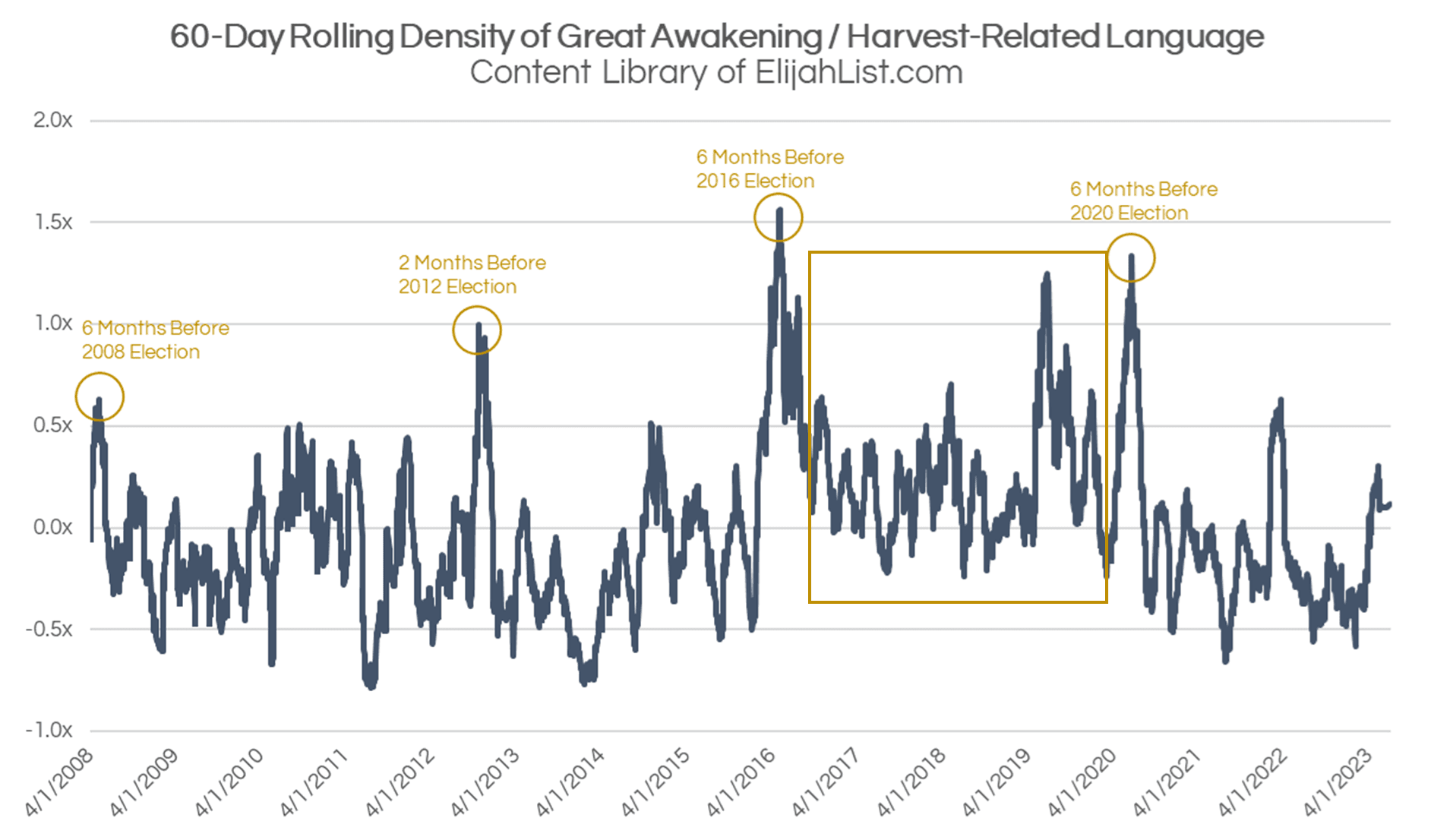
Source: Epsilon Theory, ElijahList.com
Following Johnny's example, on January 18, 2017, Jane Hamon kicked us off with a full bingo card – every one of the five core memes from Part 3 is present here.
[T]his apostolic/prophetic reformation will bring a greater divide between those churches who have determined to promote casual, comfortable, politically correct Christianity (in name only) and those who have decided to be the "army of the Lord," willing to pray and yet also willing to engage culture to bring change.
In the US and other nations, we will see this reformation spirit bring change to government and governing. With the unanticipated "comeback election" of Donald Trump, we have the potential to see a reforming of the Supreme Court and other courts in the US, a reformation in the economy, a reformation in foreign policy and a realignment of nations, and many other areas of governance.
Jane Hamon, God Says: I Will Turn Things Around! This is a Comeback Year!, Elijah List (January 18, 2017) (Emphasis mine)
You would have taken similar energy from apostolic network leader Cindy Jacobs and her recounting of the meeting of the Apostolic Council of Prophetic Elders, on January 24th, 2017.
For the Lord says, "My people are entering into an overcoming season that will produce great breakthroughs. For the enemy has come in like a flood, but I, the Lord, am releasing great victories. I will stem the tide of violence. I will bring peace to the land. I will bring an awakening! I will release revival!"
Cindy Jacobs, ACPE Prophetic Roundtable: 2017 – The Breakthrough Year – Part 1 of 2, Elijah List (January 24, 2017) (emphasis mine)
The founder and operator of the Elijah List network, Steve Shultz, could barely contain his agreement and excitement about the coming harvest as a result of Donald Trump's election.
As for myself, I was surprised as tears rolled down my cheeks as Mr. Trump became President Trump. It's as if the Hopes and Fears for this last, very long season, were suddenly culminating as a direct result of unified prayers from the Saints of God....Yes, there will be trials and probably some tragedies in years to come, but more and more of God's peace is coming for a great season of Harvest that is planned.
Steve Shultz, "Why I'm so Filled with HOPE – After the Inauguration of Donald J. Trump!", Elijah List (January 27, 2017)
And from Ben Peters, a California-based prophet.
With a Kingdom-friendly administration, led by many Kingdom-minded department heads, such as in education, energy, state department, etc... Along with a powerful move of God's Holy Spirit bringing another Great Awakening, we will see God's involvement in every sphere of society in ways we've never seen in our life-times.
Ben Peters, Unexpected Benefits of the Revolutionary Trump Presidency, Elijah List (February 3, 2017)
And from Jim Goll, former Kansas City prophet.
New Reformers are being called and sent forth at this 500 year demarcation of the beginning of the Great Reformation, and they are being anointed to change the equilibrium of the Church and the very shape of nations."
Jim Goll, Properly Discerning the Times! It is a Significant Time of Suddenlies!, Elijah List (February 22, 2017)
And from prophetess Tania Hall, student of the Remnant Meme.
As we partner with Heaven by making prophetic decrees, we are building the Church. As we pray for renewal and revival, our prayers are being powerfully activated...
A last days Joel's army is being called forth...God is raising a company of radical Believers that are hungry for Kingdom power and glory.
Tania Hall, The Prophetic Decrees that Call Forth Joel's Army, Elijah List (March 20, 2017)
And from Hank Kunneman, whom we have seen before in this essay series.
God says, "[W]atch what I'm about to do through this president in America...
I will do this for My harvest because the earth is being shaken and the Northern Hemisphere is about to receive a great awakening."
Hank Kunneman, Movement and Great Change! Prophecy Over America, Israel, the Youth, European Union and More!, Elijah List (March 22, 2017)
And, of course, from Dutch Sheets.
We say there is a third Great Awakening coming. It is going to give us back what You planted in this soil – the destiny You called us to...We will together hold up the rod of authority – the authority of Jesus’ name and blood. The authority of the cross, after which Jesus could say, “All authority is given unto Me,” is where our authority comes from.
Dutch Sheets, History is Holding Insights We Now Need, Give Him 15 (August 16, 2017)
The idea of this Great Awakening that would emerge as a result of the Donald Trump presidency – or at least as a result of the "covenant-fulfillment" that his election represented – was not confined to prophecies published via the mesh networks of charismatic-Pentecostal apostles and prophets. It made its way into books as well, during a prolific period of publishing. Much of this output was focused on the meme of Keeping Ancient Covenants.
For example, during this period, Mario Murillo published his 2019 book, "Vessels of Fire and Glory: Breaking Demonic Spells Over America to Release a Great Awakening." He then wrote the foreword for Jeremiah Johnson's set of revival-oriented predictions laid out in "Trump and the Future of America." Earlier that year, Lou Engle released his book, "Nazirite DNA", which he described as "the ground preparation, even the forerunner, for the greatest spiritual awakening she has ever seen." Around the same time, he published "Pray! Ekballo!: A Prayer Revolution For The Great Harvest". In his words, "It is a revolution birthed from one verse of the Bible that, if attended to, could spark a worldwide reformation of evangelism and missions, mobilize tens of thousands of missionaries and reformers, and bring back the King!
There were plenty of others who joined the chorus of charismatic prophets, apostles and teachers who embraced the covenant-reward promise of a Great Awakening over Trump's first term. The Arnotts, legacy participants in prior revivals, wrote about it in 2018, in "Preparing for the Glory: Getting Ready for the Next Wave of Holy Spirit Outpouring." And yes, there's a lot of this, and, uh, some other stuff in Mark Taylor's "The Trump Prophecies: The Astonishing True Story of the Man Who Saw Tomorrow...and What He Says Is Coming Next.
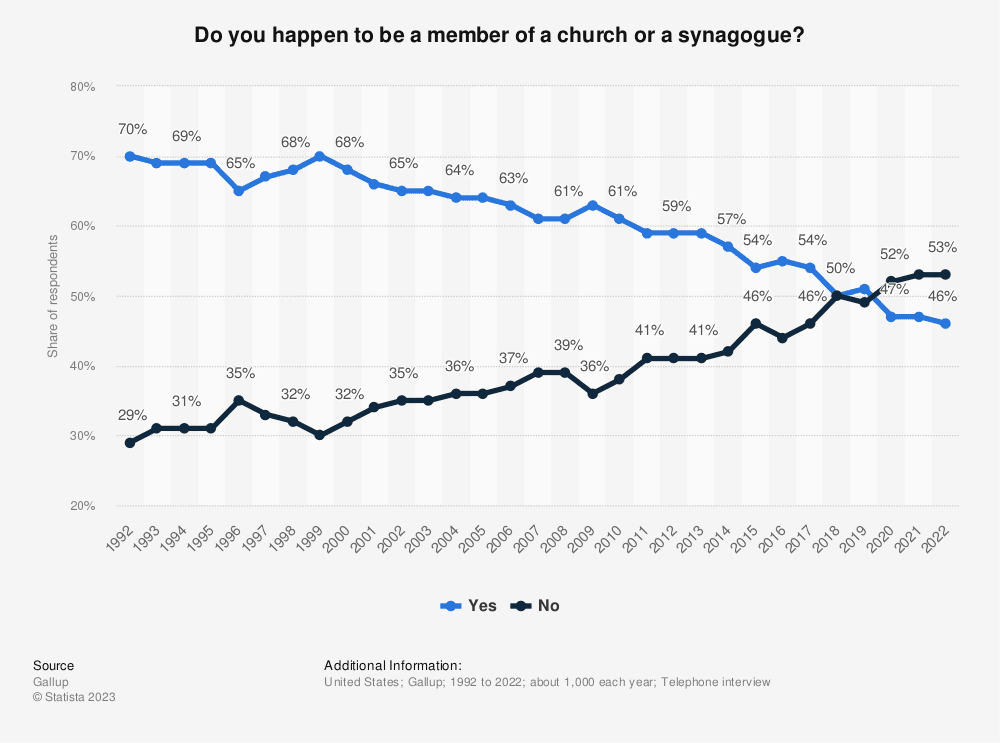
Unfortunately, as accurately as Mark Taylor and those who followed him may have been when it came to who would win the presidency in 2016, the prophetic halo effect did not apply to the first of the major promises attached. At least not yet. By no reasonable and measurable definition did a "Great Awakening" take place in the church during the period between 2016 and 2020. Quite to the contrary, for the entire period over which Gallup has asked Americans whether they belong to a church or synagogue (i.e. since 1992), there has not been a single four-year window over which the DROP in "yes" responses was greater than it was between 2016 and 2020. And save the gripes about "membership" not being a good proxy. Christian church attendance looks even worse. Belief looks worse. Claims of conversions look worse. Every description of belief, engagement, salvation and identity shows a vastly less Christian America in 2020 than it did in 2016.
Humbling the Liberal News Media
There is a long-standing antipathy toward the news media in most of the evangelical church that pre-dates the beginning of our story. This aversion may be even stronger within the charismatic-Pentecostal tradition. That Clement, Johnson, Wallnau and just about every other early Trump prophet also included language alluding to the conquest of the media, whether peaceful or belligerent, was not out of line with that tradition. To be fair, I don't think the animosity is entirely unearned, but neither is the accuracy of the dispute really within the scope of this essay series. Far more important to us is how, in the warm waters of a mutually media-antagonistic Trump presidency and aided by the credibility gained by correct prophecies about Trump's 2016 victory, the expression of powerful memes that were attached by charismatics to the media in prophecy became more powerful still.
Lance Wallnau, for example, asserted just before Trump's inauguration that many of the members of the media have been planted there by Satan himself. He adds his belief that only a grassroots movement – a Faithful Remnant – can turn the tide.
The parable of the "tares" tells us that satan plants people "while men slept" (Mt 13:25). Where does satan plant them? He plants among the fields of harvest, at the gates of influence, where popular culture is formed through News Media, Hollywood and Academia...
This is a GRASSROOTS movement I suspect...Only 10-15% will have the courage or clarity to actually "get onto the field" and take the hard yards.
Lance Wallnau, The Year of the Clashing of the Swords and Taking New Ground!, Elijah List (January 4, 2017)
Around the same time, in one of his first post-inauguration statements, Morningstar's Rick Joyner characterized the media, quoting Bob Jones approvingly, as a terrorist organization.
One thing Bob told me often was that the most dangerous terrorist organization was the media. He's proven right on that one, too...
As they get more desperate and more shrill, know that their end is getting closer. At the same time, those providing the water, the truth with integrity, are going to grow and be able to put out such fires with increasing skill and speed and turn the fires of outrage into fires of revival.
Rick Joyner, Rick Joyner: Bob Jones' Media Prophecy Coming to Pass Before Our Very Eyes, Charisma News (January 31, 2017)
Wallnau himself wasn't willing to go quite so far as terrorism claims, but he did settle on beseeching the creator of the universe to send hornets to chase Bill Maher.
In the name of Jesus, Father, I cover [Trump] in the blood of Jesus. I pray that you will cause every enemy that comes against him to be broken. Every weapon that is formed against him to be broken…whether it’s CNN or MSNBC or Rachel Maddow or Bill Maher or Kathie Griffin or any comedian, talk show person, president of a network. CAUSE HIS ENEMIES, LORD, TO FLEE in seven different directions. I thank you, Lord, you’re releasing your hornets right now.
Lance Wallnau, A New Movement of Joy!, Facebook account (July 6, 2017)
You'd think there wasn't much room left after you've already pulled out the "terrorist" card and indirectly compared various media outlets and personalities to the greatest threats to Old Testament Israel (the hornet thing is an allusion to Exodus 23:28). You'd be wrong. Much later, as Donald Trump stepped up his very public opposition to and rhetoric about the "enemy of the people" over the course of his presidency, so, too, did the prophets and apostles. Here, Dutch Sheets recommends that his followers offer up a peculiar prayer.
Knock the Baal prophets off their newsroom thrones! Let this nation be loosed from their decrees and their twisted narratives! We’ve got their number! We won’t be gaslighted! We know what they are doing because You have revealed it all. Let all their evil, wicked plans and deeds be placed in the light for all to see!
Dutch Sheets, Victory is Coming for the Church and for America!, Give Him 15 (November 21, 2020)
In case the idea of a "prophet of Baal" does not ring a bell beyond sounding generally sinister, know that it is a reference to a Biblical story of Elijah told in 1 Kings 18. In short, Elijah and the prophets of Baal conduct a not-so-friendly competition to see whose God is real. The rituals of the prophets of Baal fail. Elijah, on the other hand, succeeds in calling down fire from heaven. At the conclusion of the demonstration, Elijah orders his people to make sure the Baal prophets don't escape, then has them executed. I want to be clear about this: a lot of time when prophets and apostles from this faith tradition speak in violent terms of spiritual warfare, they really are referring to spirits or entities which they believe exist outside the world of the visible. They are not calls for violence. However, the prophets of Baal were and are not spirits. They were humans, as are the people Sheets is referring to here. Short of outright, literal calls for the execution of members of the liberal media, there really is nowhere to go from here.
OK, nevermind. I'm going to give it to "Hordes of Hell rallying under Leviathan" by a nose.
The hordes of Hell in media have rallied in mass under Leviathan but I will crush them under the forces that I have released under My trusted archangel Gabriel. He will be instrumental in devastating media outlets that do not position themselves as lovers of truth and goodness.
Johnny Enlow, I Played My Trump Card, I Will Win the Hand, Elijah List (May 18, 2017)
And yet, from beginning to end of the Trump presidency, beyond this competition to come up with the most negative term to associate with the media, most of the key prophetic voices continued to lean on the memetics and imagery of the earliest prophecies that had already been subsumed into common knowledge. That Trump will be a trumpet, that through him God would transform the media to say what He wanted them to say, that through Trump as a wrecking ball, God could defeat this long-time stronghold of darkness and his followers conquer it as yet another key mountain of culture.
In MEDIA, the enemy is not dead, but is in absolute disarray and absolute implosion.... President Trump is the bull in this China shop overthrowing the establishment...Major reform is already in the works. Johnny Enlow, Greater Than 100 Revivals is Here, Elijah List (November 1, 2017)
As the Holy Spirit brings awakening to the Church and affirms our identity as the children of God, we will come into new positions of influence and authority. We will see His Kingdom come in politics, education, arts and entertainment, media, family, government, and religion! Che Ahn, Reformation that Shapes Centuries, Elijah List (May 29, 2017)
Even though the liberal media, the fake news (some will quit and some will be removed), continues to lie about Trump and his efforts to make America great again, God is in charge of His time on Earth and He will have His way... Trump was chosen before he was born and cannot escape being great and will continue to recognize God as the creator of all things. Kat Kerr, God Bless America and Planet Earth – Another Incredible Suddenly!, Elijah List (August 17, 2018)
The Spirit of God says, "The news media, the news media, you have become a stench unto my nostrils, there is no spirit of truth in you. I the Lord God will clean out the news media and bring back truth." Mark Taylor, Satan's Frequency (July 7, 2017)
Did any of this happen? Have the prophecies of a transformation of media, buoyed by the halo effect of their association with prophecies of Trump's victory, come to pass?
Yeah, no, not at all. Look, media is still a hard business. But between Trump's inauguration and today, the New York Times Company's stock more than tripled, mostly on the back of a remarkable pivot to digital subscriptions that paved a similar path to stability for other (largely liberal) publishers over this period. MSNBC went from the #12 primetime cable channel to #3. Some liberal media brands failed. So did some conservative media outlets. Fox News got slapped hard in a massive settlement, and it looks like OANN and Newsmax are next. As we track it with our Fiat News model, the amount of opinion being injected into news has continued to rise, not least in connection with Trump's presidency itself. And there's practically nothing in our large news dataset that would indicate that claims and complaints of a "liberal media" have changed – at all. Depending on the language you use to define it, we see 12,000-13,000 articles in the last year alone within the LexisNexis database that discuss the liberal bias of media. Other than a bit of a fall from grace for CNN, there isn't really anything you could point to to make the case that any of this came to pass. Again, yet.
Right or wrong, however, most of the prophetic and apostolic references to the media framed it as just one more corrupt part of the establishment infrastructure that was going to be exposed during the Trump presidency. More than anything else, I think, this was the narrative that would become most embedded into the coming narrative of a stolen election. As further testament to the epimemetic forces at play, it grew almost in tandem with Trump's own statements about fraud, corruption and the enduring influence of the Deep State. In other words, what Trump was saying invariably became what the prophets were saying.
Exposing Corruption
How much did Trump's election change the tendency of prophecies to predict the "exposure" of evil, secret plans and darkness within American society and government? Between Trump's inauguration and Biden's inauguration (set apart with the orange bars in the chart below), the density of language associated with those topics was about 93% higher than it was during the period before Trump was elected. For reasons that will become clear in Part 7, the density rose further still during and following the 2020 election, through June 2023 averaging nearly 300% of pre-Trump levels.
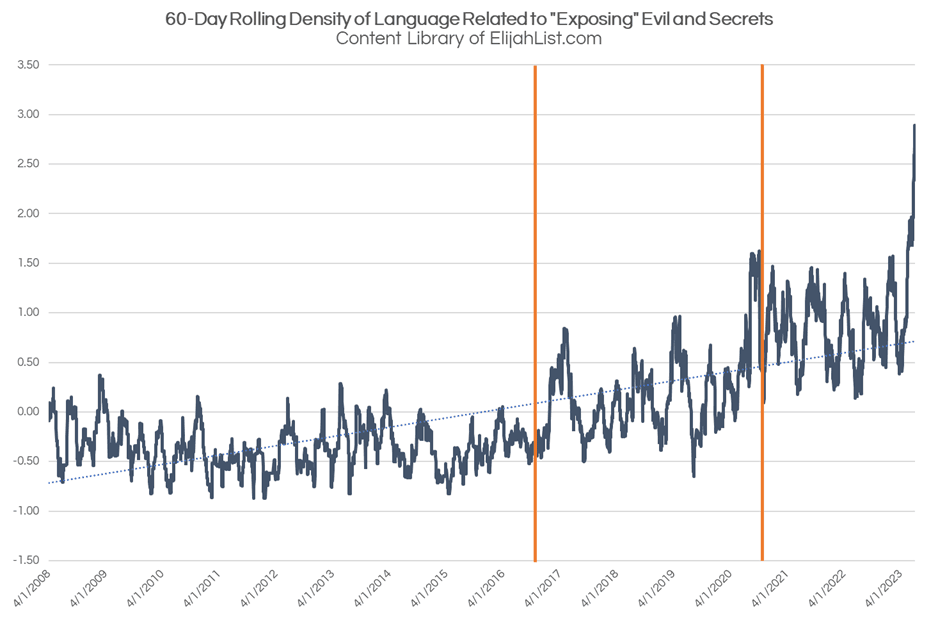
Source: Epsilon Theory, Elijah List
It is difficult to find a single noteworthy individual with a public presence from within the apostolic-prophetic movement who did NOT begin to prophecy or speak about President Trump's role in uncovering hidden darkness and corruption. Was the existing imagery of Trump as a wrecking ball too perfectly suited to the memes of our narrative virus and the conventions of modern prophecy? Did the prolific work in early 2017 by some leading prophets spur echoes from others who consciously or subconsciously used and repeated similar words and phrases, creating a self-perpetuating cycle of prophecy and ‘confirmation?' Probably a little bit of both, but I'm not sure. Either way, from the operators of multi-national apostolic alliances to small-town internet prophets submitting their ideas to prophetic social networks and email chains, everyone got in on this particular angle to the original prophecies.
I saw a vision of a huge lid over a pit of toxic waste being lifted off – and the stench and fumes being quite intense. I believe this represents hidden darkness in government, in business and in media being exposed...
Johnny Enlow, Hang On for 3 Months! Much Needed Exposures Coming in Government, Businesses and the Media, Elijah List (March 29, 2017)
In using Donald Trump in this season I am exposing and undoing MUCH in the body of Christ and the earth.
Lana Vawser, "I had a Vision and I saw Ephesians 3:20 On Fire across the United States of America", LanaVawser.com (Text accessed via James Beverley) (February 12, 2017)
[O]ur president has a ‘breaker anointing' on him to break the establishment and drain the swamp.
Ramiro Pena, quoted in Chuck Pierce Releases Shocking Prophetic Word, Elijah List (June 2, 2017)
The SURGE will be like a light that shines down, and when the enemy comes in by night trying to enter in, to move up in the land, trying to create a strategy, he will be exposed. You will hear of him being exposed throughout this nation.
Chuck Pierce, Surge! The Enemy Will Be Exposed!, Elijah List (September 11, 2017)
"For I have released out of My heavens," says the Spirit of God, "a boomerang. And what you have thrown at the administration, I speak to you and I speak to the media, it shall come back and it shall expose you.
Hank Kunneman, A Christmas Season of Shalom and a Boomerang to the Enemy (December 9, 2017)
I believe that God raised up President Trump at this specific time to uncover some things. He wanted to expose the Deep State. He needed someone that could uncover corruption, and an anti-Christ and anti-Church spirit, as well. That spirit has been trying to suffocate and silence the Church for many years. It has been trying to rewrite covenant history in America, and to rewrite or reinterpret laws.
Tim Sheets, Stopping Witchcraft Against America – Part 1, Give Him 15 (June 26, 2020)
The enemy has tried everything to take us under a false kingdom of darkness to overpower us and take our nation out of its destiny. Yet, it has only exposed the deep state of darkness and is being drained, exposed and removed!
John Mark Pool, We're in a Season of Exposure, Closure and Victory!, Elijah List (June 29, 2017)
As the story unveils and as we fully awaken to what we were up against and what He saved us from we will see the immensity of it all. It goes way beyond simple politics, but rather into being rescued from a ring of demonic criminals with tentacles at the tops of every one of the 7 mountains of society.
Johnny Enlow, 5779: A Great Day of Deliverance (Trump, Justice, Elections, Israel, Church & the Economy), Elijah List (September 21, 2018)
If you're reading along closely, phrasing like "a ring of demonic criminals" probably rings some other bells in your head. Sound a bit like QAnon? Unfortunately, that sound will become deafening once we reach Parts 7 and 8. Convergent evolution – the environment-driven emergence of similar phenotypic properties in different species with distinct phylogeny – is a thing in memetics every bit as much as it is in genetics. Most of our prophets and apostles had nothing directly to do with Q. There is no shared lineage. The two movements were, however, driven by the evolution of separate narrative viruses made from similar memetic stuff and similar epimemetic pressures to a place that made them look awfully similar at times...and probably produced some unintentionally direct overlap in the end as a result.
In the meantime, however, the point is that for three years of Donald Trump's presidency, the apostolic-prophetic movement was buoyed by one of the most successful prophecies ever made. It was getting unprecedented access to actual figures in power in society and government. In a media environment in which the prophets could finally hear what the others were saying, a growing confidence gave way to momentum, maybe even something nearing consensus about the other promises of the initial prophecies: of Trump acting as a wrecking ball that would exposure corruption and evil, that he would usurp the power of an anti-Christian, anti-conservative media, and that the faithful remnant that supported him would enjoy a bountiful harvest, a Great Awakening in their time.
But there was one other promise of the initial prophecies that had yet to really rear its head again. By the fourth year of Trump's presidency, it would make its appearance in a big way: that God had promised Trump not one but two successive terms.
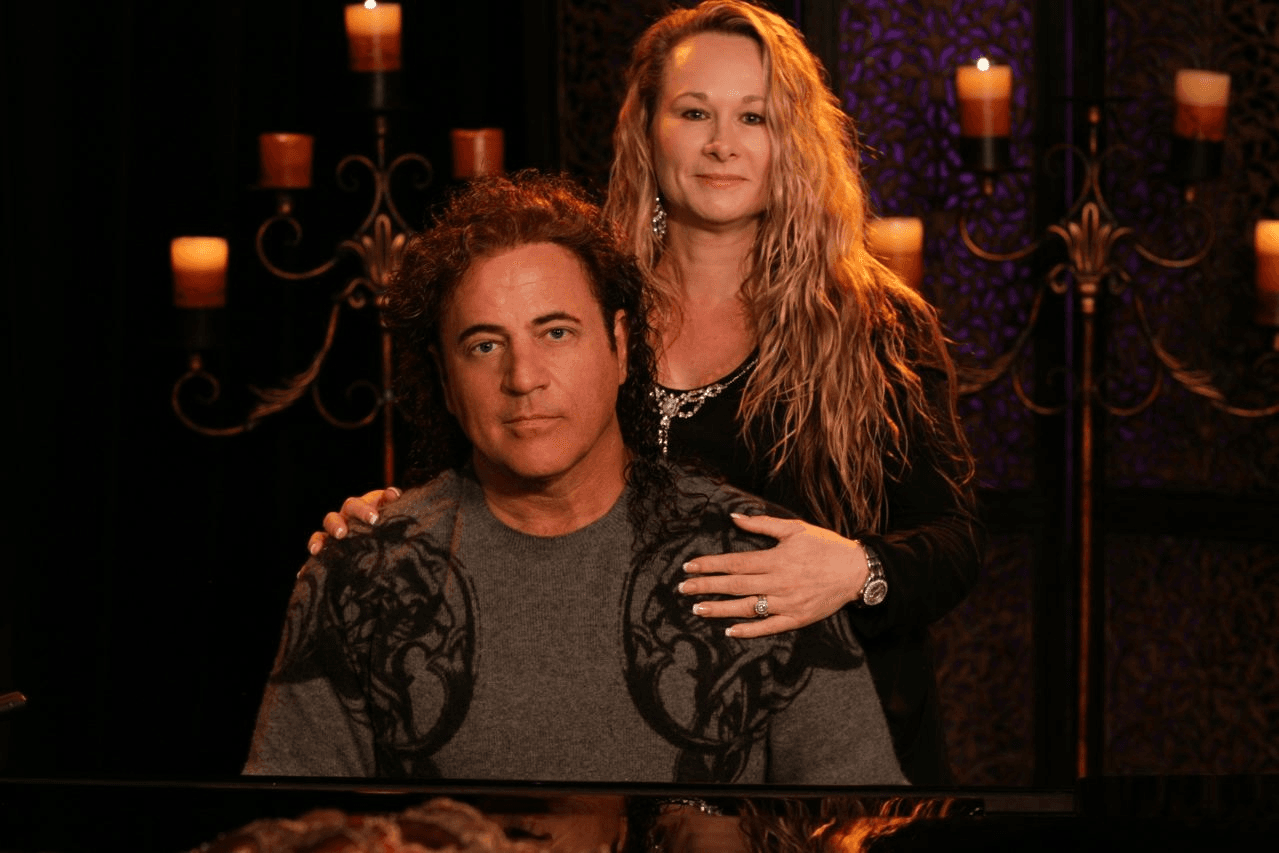
Kim and Jane Clement
Two Terms
You will have to forgive me. I played the role of an unreliable narrator in Part 5. At the very least, when I told you the story of Kim Clement and his prophecies, I didn't tell you the whole truth.
When I said that Kim Clement – the singing prophet, you may recall – was the first person to prophesy that Donald Trump would become President of the United States, what I meant was that the version of Kim Clement's prophecies that everyone read and heard would have made him the first. That is, if you squinted very hard and made a lot of very friendly assumptions, you could frame the words in such a way that they predict a Trump presidency.
That's because the most widely distributed versions were cleverly edited to do exactly that.
Let's take a closer look at the most commonly circulated video (which has been reposted in various forms over the last few years) containing all those Clement quotes that kept coming up in the prophecies of others more than a decade later.
On the left-hand side of the table below, I've taken the liberty of giving you a transcription of the key prophetic claims within each video. Same ones as you saw back in Part 5. On the right side, I have added in bold the additional context that came immediately before or after the words in the spliced video from Clement's full original statements.
Date, Location and Source | Spliced Video | Original Text |
|---|---|---|
April 4, 2007 in Bethel, California | This that shall take place shall be the most unusual thing, a transfiguration, a going into the marketplace if you wish, into the news media. Where Time Magazine will have no choice but to say what I want them to say. Newsweek, what I want to say. The View, what I want to say. Trump shall become a trumpet, says the Lord! I will raise up the Trump to become a trumpet and Bill Gates to open up the gate of a financial realm for the Church, says the Spirit of the Living God! | This that shall take place shall be the most unusual thing, a transfiguration, a going into the marketplace if you wish, into the news media. Where Time Magazine will have no choice but to say what I want them to say. Newsweek, what I want to say. The View, what I want to say. Trump shall become a trumpet, says the Lord! I will raise up the Trump to become a trumpet and Bill Gates to open up the gate of a financial realm for the Church, says the Spirit of the Living God! In 1967 there was a great revolution, but God said, the revolution that you are going to experience starting in 2007 is going to be greater than anything that's ever happened. |
April 4, 2007 in Bethel, California | I will not forget 9/11. I will not forget what took place that day and I will not forget the gatekeeper that watched over New York who will once again stand and watch over this Nation, says the Spirit of God. It shall come to pass that the man that I place in the highest office shall go in whispering My name. But God said, when he enters into the office he will be shouting out by the power of the Spirit for I shall fill him with My Spirit when he goes into office and there will be a praying man in the highest seat in your land. | I will not forget 9/11. I will not forget what took place that day and I will not forget the gatekeeper that watched over New York who will once again stand and watch over this Nation, says the Spirit of God. It shall come to pass that the man that I place in the highest office shall go in whispering My name. But God said, when he enters into the office he will be shouting out by the power of the Spirit for I shall fill him with My Spirit when he goes into office and there will be a praying man in the highest seat in your land. And God says, even a greater move of the Spirit shall take place and your enemies will finally be subdued by the year 2009. |
February 10, 2007 in Bethel, California | There will be a praying President, not a religious one, for I will fool the people, says the Lord. I will fool the people, yes I will. God says, the one that is chosen shall go in and they shall say, he has hot blood. For the Spirit God says, yes he may have hot blood, but he will bring the walls of protection on this country in a greater way and the economy of this country shall change rapidly, says the Lord of Hosts. God says, I will put at your helm for two terms a President that will pray but he will not be a praying President when he starts. I will put him in Office and then I will baptize him with the Holy Spirit and My power... | And God says, in the next two terms there will be a praying President, not a religious one, for I will fool the people, says the Lord. I will fool the people, yes I will. God says, the one that is chosen shall go in and they shall say, he has hot blood. For the Spirit God says, yes he may have hot blood, but he will bring the walls of protection on this country in a greater way and the economy of this country shall change rapidly, says the Lord of Hosts. God says, I will put at your helm for two terms a President that will pray but he will not be a praying President when he starts. I will put him in Office and then I will baptize him with the Holy Spirit and My power... |
Why do you think someone might have in mind to trim "in the next two terms" from a prophecy delivered in 2007? Why do you think they might want to trim a reference to the harvest and revolution starting in 2007? Why do you think they might trim an associated reference to enemies being subdued by 2009?
Because if you don't cleverly edit the videos to omit those references and qualifications, then there are only three possible interpretations: (1) it is a false prophecy because it's wrong, (2) it is a false prophecy because prophecy doesn't exist and isn't a thing, or (3) these prophecies are about Barack Obama.
There is a tendency among prophets and apostles within the modern movement to explain away inconvenient things like "details" and "dates" and "names" as being flexible and unimportant to whether the prediction was "true." In most cases, this tendency is the result of a particular interpretation of 1 Corinthians 13:9 that is common within the charismatic-Pentecostal tradition.
For we know in part, and we prophesy in part, but when the perfect comes, the partial will come to an end.
1 Corinthians 13:9 (CSB)
Many modern continuationist theologians (i.e. those who believe spiritual gifts like prophecy remain active) have taken the translated phrase "in part" to accommodate "partial incorrectness." Their cessationist counterparts (i.e. those who believe the gift of prophecy, among others, is no longer active in the church) generally characterize "in part" more literally as "incomplete." A prophecy where something was right but a lot of things were wrong would thus not necessarily be characterized as incorrect by many in the former group. Our cessationists would disagree, but then, they would also disagree that prophecy could be happening in the first place. For those fascinated by this kind of sparring among linguistic exegetes, an interesting public debate on this topic took place between John Piper and John MacArthur about ten years ago.
All the same, the "some correct details + lots of wrong ones = still possibly a true prophecy" construction certainly remains the modern practical convention within the apostolic-prophetic movement. One popular adjacent phrasing you will often hear in charismatic-Pentecostal churches advises recipients of teaching and prophecy to "spit out the bones." Bill Johnson of Bethel Church delivered one of the more well-known sermons on the topic. The idea is that human influence (bones) will inevitably creep into in any kind of teaching, and that rather than reject godly ideas within that teaching (meat), Christians ought to swallow the meat and spit out the bones. It sounds sensible enough, but when it comes to prophetic output, you can understand how adoption of this standard also creates a stable structure in which uttering as many predictions as possible becomes provably optimal.
In narrative world, of course, none of this really mattered. There was enough truthiness in Clement's words, I think – and enough desire for them to be interpreted in a particular way – that no manner of selective editing or shenanigans would likely have changed how they were perceived and interpreted.
But a few years into the presidency, a renewed focus on a specific "additional" component of Clement's prophecies emerged: that two of them specifically reference "two terms."
With the 2018 midterms in the rear-view mirror, the "two terms" common knowledge of the apostolic-prophetic community came into focus rather suddenly. While the focus of the movement in early 2019 was necessarily focused on framing the impeachment proceedings in terms of the demonic-influenced corruption that God chose Trump to overcome, there was also a smattering of 2020 election discussion in mid-2019.
The Lord then spoke to me and said, "What I intend to do through him will require two full terms. I need for you to run with him in the spirit for this to happen."
Robert Henderson, Praying for President Trump from the Courts of Heaven, Elijah List (April 1, 2019)
It came down to two familiar sources, however, to aggressively and influentially resurface Clement's old "two terms" remarks and reinject them to the apostolic-prophetic zeitgeist. The first to do so was apostle and prophet Dutch Sheets, adapting the language to a dream that was sent to him referencing Trump's desire that he "finish his eight years well." This language would be a recurring feature in both live and printed Dutch Sheets Ministries events.
At the end of the dream set in the oval office, President Trump asked if he could pray for each one there. He said, “Let this man and these leaders convene a holy convocation that I might finish my eight years well, and that the ancient markers of our founding fathers would be restored..."
The destiny God has for this nation is as a stronghold, a beacon, a refuge, a voice of the Gospel to ends of the earth. That is our nation’s destiny. We are a nation under God. That which He destined for America, He is going to re-establish that. The greatest outpouring of Holy Spirit in the history of planet earth is coming and it’s going to hit America like a tidal wave! There’s going to be a third Great Awakening.
Dutch Sheets, Finding the Ancient Markers, Give Him 15 (June 3, 2019)
The second was Stephen Strang, who reserved almost an entire chapter in his book God, Trump and the 2020 Election for Clement's prophecies about two terms. He then republished the ideas on a Charisma blog and read them on a Charisma podcast around November 6, 2019.
As we covered earlier in this essay series, Bethel's Kris Vallotton would issue his prophecy threatening an angry God only weeks later.
I believe the Lord is going to give him another term…because the Lord wants it. The Lord wants it.
You don’t want to be the one resisting a movement...there’s these moments where God says get out of the way and suddenly you realize, I don’t have an angry God, but sometimes God gets angry.
Kris Vallotton, “Sovereign Providence”, Bethel Church (December 8, 2019)
Others would follow in short order.
God also stated, "You don't need a pastor in the White House right now" and that Trump will win two terms.
Kat Kerr, from an interview with Steve Shultz on Elijah List, as paraphrased by James Beverley in God's Man in the White House
Great will be the spiritual battle leading up to this election, but My people will see the one I have chosen re-elected as they partner with Me in intercession.
Katie Barker, America You Will Be Known Again As ‘One Nation Under God', Elijah List (December 13, 2019)
But I also knew intuitively the Lord was speaking about a sweep in the 2020 elections which would give Trump's political party the majority in both the House and Senate.
Jon Hamill, Heaven's Gavel Has Fallen!, Elijah List (January 28, 2020)
The Chiefs win (ed: yes, he's talking about the Super Bowl) is to let you know that the commander in chief is going to keep winning in 2020.
God loves you unconditionally, but you are displeasing Him if you are not recognizing His intentionality with putting Donald J. Trump as your president.
Johnny Enlow, Chiefs Win! A Stunning Prophetic Message, Elijah List (February 4, 2020)
I believe Donald Trump will win the 2020 election, but he cannot do it without supernatural intervention.
Jeremiah Johnson, Trump and the Future of America, as quoted by James Beverley in God's Man in the White House (January 2020)
As we've witnessed in his time in office, many have tried to take him out – the Mueller investigations, the impeachment and now the coronavirus. No one has succeeded because Trump – like him or not – has a destiny from God. The Lord will succeed with His instrument. Even now, that same spirit is trying to take him out. But I believe the prophetic words spoken over him – that he will have two terms.
Darren Canning, Three Dreams of Donald Trump, Elijah List (October 2, 2020)
As the election grew closer, each of the core memes of our narrative virus – save one – had reached their zenith.
A narrative epidemic within the charismatic fringe of the evangelical church had become an American pandemic.
Confidence in the apostles and prophets within the charismatic-Pentecostal church, while not without opposition, was as high as it had ever been. With the vastly greater reach afforded to these leaders with the emergence of the internet and social networks, the Rediscovering Old Ways meme had grown rapidly. It had also evolved. Prophets now had ready access to the full volume of what other prophets were saying. Consciously or subconsciously, their statements began to reflect one another, their uses of language rose and fell together in response to the epimemetic pressure of this new environment.
Likewise, the idea of a living Ancient Covenant between God and America had become common knowledge not only within the charismatic-Pentecostal movement, but in many areas of the broader evangelical church as well. The belief that America's faithfulness – which through epimemetic adaptation now included electing Donald Trump to be president once again – would result in a Third Great Awakening found its way into the rhyming and confirming output of practically every major American prophetic figure.
The triumph of the Mountains to be Conquered meme was similarly complete. By the 2020 election, there was practically no major apostolic or prophet voice and only a precious few leaders within the charismatic-Pentecostal church that rejected the idea of a cultural mandate for Christians to conquer various spheres of cultural influence. Seven Mountains and ekklesia phraseology dominated prophetic utterances and widely publicized teachings. As elsewhere, epimemetic adaptations facilitated the expansion of these meme-rich messages into evangelical circles which were already flirting with entirely different, if somewhat compatible, strains of Christian nationalism.
Perhaps most importantly, the meme of Hope for Broken Vessels had been thoroughly attached to Donald Trump through the Cyrus imagery, not just by prophets and apostles but through epimemetic adaptation by non-charismatic evangelicals and even secular media as well. The belief among charismatic Christians in Trump's status as God's prophesied, or at the very least chosen, leader was nearly ubiquitous. Buoyed by the promise of prior prophecies, belief that the 2020 election was part of that promise was almost as widespread.
But the Faithful Remnant Returning meme? Our narrative virus was just getting started with this one. To be sure, the impeachment trials and constant opposition to Trump played out like a confirmation, an encouragement for the messages that integrated this meme's power. Remnant language was not missing.
But to realize its full potential and transform the integration of all five of these memes one last time, A Faithful Remnant Returning needed to manifest in a group of apostolic-prophetic leaders keeping the faith against all odds. To reach its apotheosis, it required a scenario in which other Christians and conservatives had quailed and lost the faith. It begged for a chance for all of the darkness and evil and secret opposition to Trump to be brought out into the open. It needed an opportunity for the Joel Army, the Joseph Army, the remnant who kept the faith to show its quality.


Comments
Nine parts. I can only imagine how many hours of discussion went into this. Looking forward to all of it.
@rguinn I was wondering: did you use the narrative machine retrospectively, whether wholly or in part, to identify the sources here?
As someone raised Catholic and currently attending an evangelical Baptist church I audibly guffawed at this paragraph. Absolute perfection.
As a socially liberal and fiscally conservative Presbyterian who is probably more agnostic now and (yes a run-on sentence) am fully ingrained with the fact that our country’s laws are based on Presbyterian polity, I too laughed out loud at this statement.
Levity, a good carrier for important considerations.
Rusty,
Curious to see what attention, if any, the doctrine of biblical innerancy will get in this series.
As a teenager, I was baptized in and eventually pastored at a wonderful Foursquare church in Oregon. Additionally, for several years during that time, I lived with 4 Calivinist buddies of mine.
During my years-long exposure to both charismatic Pentecostalism and Calvinism, I found over and over again how fundamentally problematic the doctrine of biblical inerrancy and literalism is for all churches, regardless of whether it’s the reformed Eric Metaxas/Wayne Grudem/John Piper type or the charismatic Pentecostal Benny Hinn type.
In my experience, the “charismatic norms” (like prophesy), can be a really beautiful thing. But it’s when the charismatic norms (like prophesy) are connected to the doctrine of biblical inerrancy/literalism that things can go super sideways and do anything but “edify”. As I see it, inerrancy is the core virus that has been wreaking havoc in the churches (you name the tradition) and the world for centuries.
Anyway, really looking forward to reading these notes.
Three of the mentioned fellows will make at least a cameo appearance, but it isn’t necessarily a focus of the series. I agree that it would also be fascinating to see how that narrative - the soul of American evangelicalism, really - emerged and became common knowledge, but that would be a different series.
In part, although as I think you’ll discover as we go along, our aim was to be thorough enough not to have to be stingy in our source selection.
Man, fascinating stuff. Can’t wait to read the rest.
I was raised mainline Protestant in NY in the 80s. Never even heard of Charismatics until I moved to TX as an adult.
I think I understand why it is the fastest-growing branch of Christianity. Vs the stuff I was raised with, my first impression as an outsider is the level of passion and… hmm… immediacy.
I’m assuming that this is the basic story we’re discussing, I had not heard it yet. It explains what some prophets need(ed?) to be true and why.
This was a great and insightful read, @rguinn.
“Like the Widening Gyre, the most effective vectors for effective astroturfing campaigns may focus not so much on changing common knowledge but on changing What We Need to Be True.”
Inoculation against direct responsibilities is one of the fundamental traits of human beings’ proto-centralized religions. In a context of apparent lack of control, agency was projected outward.
Witchcraft was the reason for pain without feeling guilty and gods’ (God) wrath for pain when feeling guilty in ancient cultures.
In this context of apparent lack of control (post 2008), changing what we need to be true is an escape from direct responsibilities when focusing on the excuses that explain the individual or collective failure as an out-of-control external factor (spiritual: evil-witchcraft- the devil or kind of real threats: immigrants - woke - deep state), that apparently has agency and goes directly against you as a cosmic good vs. evil fight. So, it’s the perfect context for this phenomenon to emerge in the American-style, spirit-filled charismatic Christianity.
Low locus of control (direct control over outcomes) + belief in miracles (indirect control over outcomes) + best in class already system of memes (Christianity).
You’ve got it nailed. Only I think that we will discover that there are many more areas of our society and culture which exhibit very similar traits in very different wrappers.
Really interesting start…as someone who has walked among the movements you reference, I’m looking forward to your reflections and observations.
I’ll just observe here that the role of discernment has always been the weak link when it comes to Pentacostal/Charismatic movements.
Continue the discussion at the Epsilon Theory Forum...