Men of God in the City of Man, Pt. 7: Mutation
July 14, 2023·Politics
Download a PDF of Men of God in the City of Man, Part 7: Mutation (paid subscribers only)
Men of God in the City of Man is a nine-part essay series that tells the story of a powerful narrative virus whose ultimate unintended target was nothing less than faith in American democracy as an institution. Part 1 introduced the idea of the narrative virus as a mechanism for astroturfing (fake grassroots) campaigns, and the idea that the danger may not come so much from forcing new Common Knowledge, but changing what some of the population needed to be true. Part 2 is the story of the carriers of its chief ultimate symptom: a rabid belief in rampant electoral fraud. Part 3 is the story of the creators of the narrative virus and the memetic building blocks they brought to bear. Part 4 is the story of the way in which the special environment into which those memetic building blocks were introduced changed the way that they expressed themselves on major social and cultural institutions. Part 5 is the story of how all of these pieces finally came together to create a narrative epidemic within one community. Part 6 is the story of how that epidemic went pandemic. Part 7 is the story of how mutations in the narrative fundamentally changed the path of that pandemic.
I am deeply indebted to the work of James Beverley, Matthew Taylor and Paul Djupe in various areas of this essay series. I have attempted to source their work where possible, but if you see something unsourced that makes a clever observation about our subject matter, please do me the favor of assuming it is the work of their dutiful scholarship.
What we need to be true is a complicated thing.
Sure, there's the old Upton Sinclair trope about getting a man to understand something when his salary depends upon his not understanding it. But the idea that this kind of thing can always be boiled down to finances? Eh. Disagree with me all you like, but I think it's a lot more complicated than that. People are more complicated than that. Movements of people are WAY more complicated than that.
When we need something to be true, I think that it is usually because we have oriented our lives around one or more of three things that are dependent on that something:
Money
Reputation and Belonging
Identity
On the surface, money feels like the easiest to explain. I'm not so sure.
Some of that difficulty can be mechanical. It can be challenging, for example, to track the financial implications of a world event on individual non-profits, especially religious non-profits. You see, the majority of religious non-profits are classified as churches. And churches do not need to report a publicly accessible Form 990. Non-church religious non-profits do, but most ministries have gotten wise to the game and have structured themselves as a church for that very reason. Kenneth Copeland did it long ago with Eagle Mountain. Hank Kunneman did it. Greg Locke did it. There's no telling how all of this flowed through their financials, because they don't have to tell.
We are also limited by the natural temptation to assume that the financial growth of a non-profit, especially one attached to a faith that considers love of money the root of all evil, is evidence of greed and thus inherently bad. For every Kenneth Copeland who explains to an Inside Edition reporter that he must fly in his Gulfstream V because commercial airliners are "tubes filled with demons", there are a thousand ministers working in obscurity with excellent oversight and barely enough compensation to get by. Even for more stable ministries, growth of the mission does not always correspond to a greed-driven explosion in the lifestyle of its steward.
But we still have to talk about money. Not because it exposes anyone as a hypocrite, but because when doing a New Thing causes rapid growth in a faith-based non-profit's operations, a few things happen. For any non-profit, this New Thing will inevitably become a part of the core mission. For a faith-based non-profit, the financial growth itself may well be seen as a confirmation or blessing from God in response to the embrace of that New Thing. In both cases, the New Thing often becomes something we need to be true simply because the new operational scope of our organization is dependent on it.
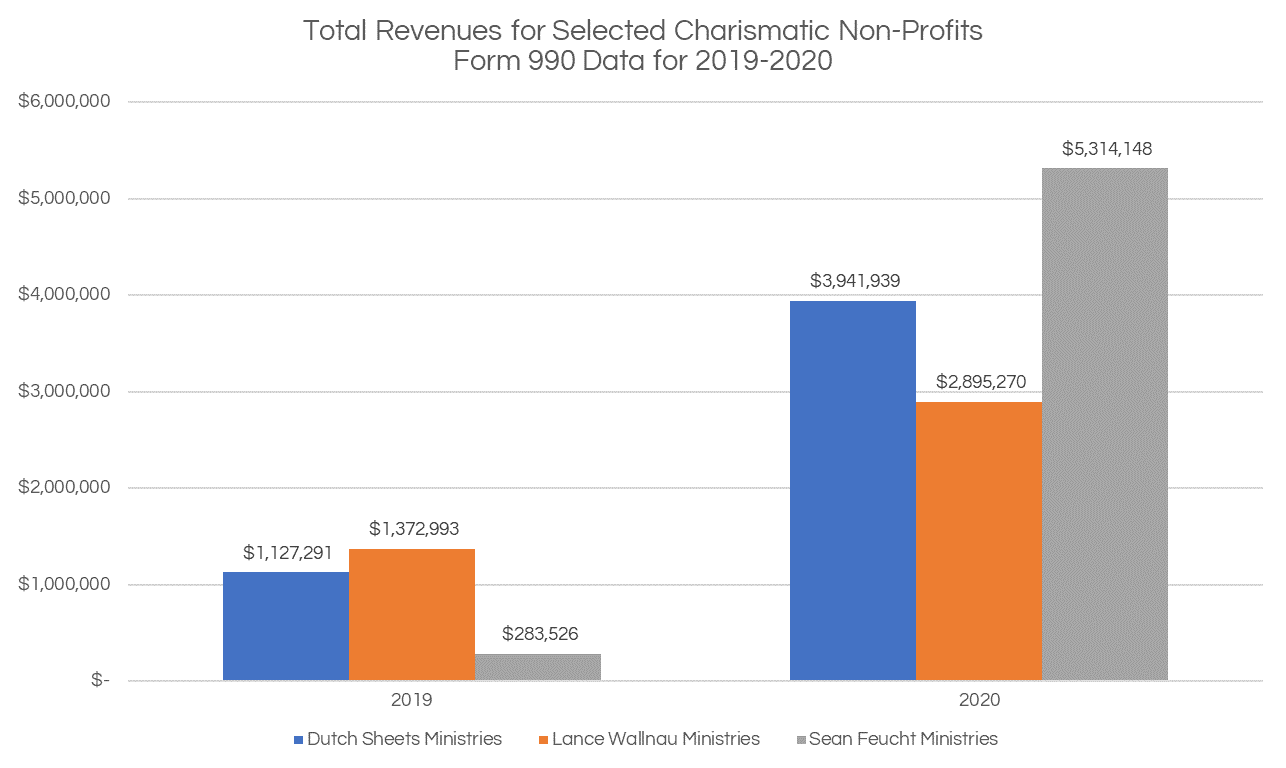
Of the para-church ministries that remain that were and will be a material part of our story, that New Thing was promotion of stolen election claims and/or promotion of often adjacent opposition to COVID policies. The change that came through this expanded missional scope was transformational. Making the ministries about the reelection of Donald Trump and all of the things that was supposed to unlock in the spiritual and physical world was also phenomenally profitable. Total revenues for Lance Wallnau Ministries grew by 111% between 2019 and 2020. Dutch Sheets Ministries grew by 250%. Its growth would have been 555% if we carried it forward to 2021. Sean Feucht Ministries, which you may remember from Part 2 and which will feature at the conclusion of Monday's Part 8, went from practically nothing to $5.3 million, which amounts to over 1,700% year-over-year growth for those keeping score at home.
Source: Epsilon Theory, Internal Revenue Service
Note that these figures almost certainly include the PPP funding that Lance Wallnau Ministries and Sean Feucht Ministries both took during this period. Note as well that it doesn't appear that any of the stewards of these ministries gave themselves massive compensation bumps in response. Or at least there's no clear evidence of it, Rolling Stone coverage notwithstanding. In any case, for any of these or other similar ministries, moving back from faith-based political advocacy as a de facto primary mission would have been a tough sell.
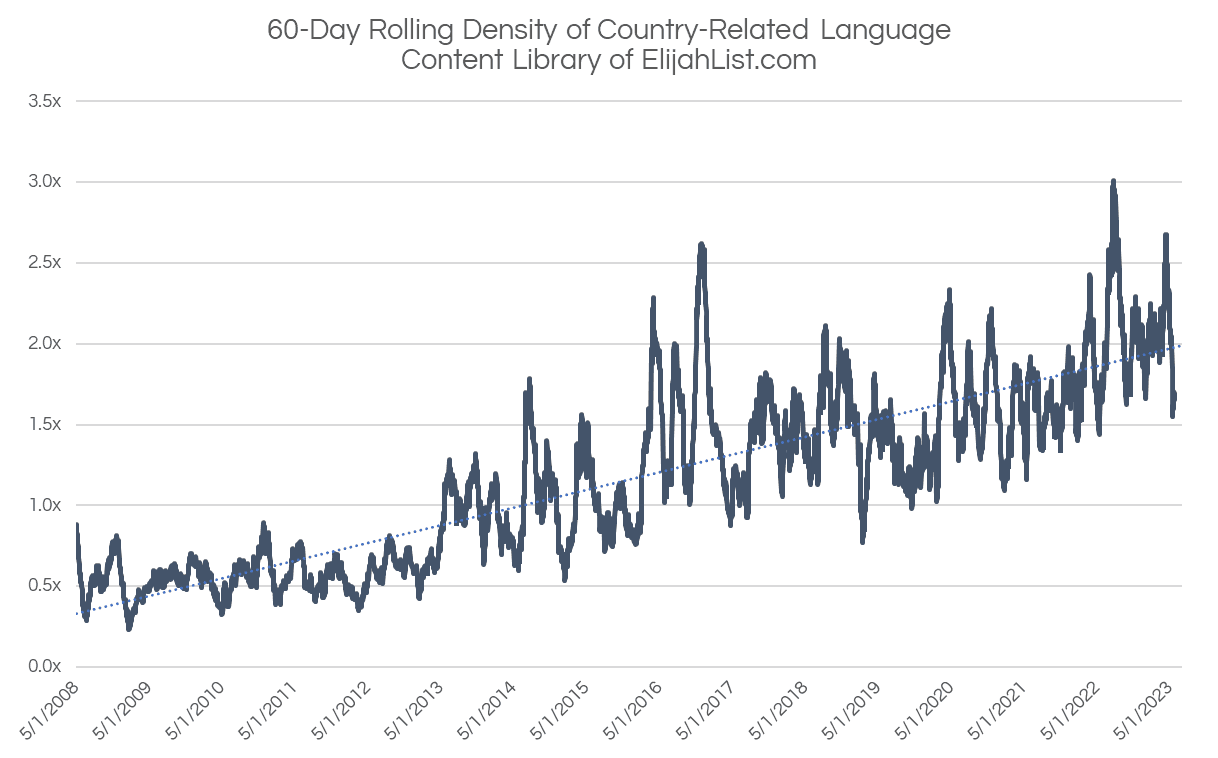
But again, what we need to be true is rarely just about the money. Belonging and reputation matter to these people, too, just as they matter to all of us. And it is difficult to describe just how strong – and how uniform – common knowledge about Donald Trump and the 2020 election was within the charismatic-Pentecostal church in the months leading up to the election. If your prophecies weren't about the country, about America and its Ancient Covenant with God, then you were on the outside. You either weren't hearing and confirming what the other prophets were saying, or else you weren't being heard or being confirmed by them.
Source: Epsilon Theory, ElijahList.com
More specifically, if you weren't issuing prophecies about Donald Trump and the importance of his reelection to God's plans, then you simply didn't belong. Some ministries did it more than others. Dutch Sheets Ministries, for example, was such a core producer of the Keeping Ancient Covenants Meme that its own content was even denser than the universe's average. Of the 2,468 posts on the GiveHim15 website through June 22, 2023, roughly 70% referred explicitly to America. Roughly 86% used language referring to the nation or country. A ministry that launched two decades before to teach the methods of intercessory prayer had become a de facto political advocacy organization.
The period between 2016 and 2020 transformed many religious non-profit organizations in similar ways. Talking about Trump, and in particular, talking about and praying against opposition to his prophesied two-term election effectively became the raison d'etre for a huge swath of the apostolic-prophetic movement within the charismatic-Pentecostal church. And if it wasn't that, at the very minimum it was such a core component that it would be hard to imagine what these organizations would talk about, prophesy about, issue ‘decrees’ about or counsel prayer about if it were not the mandate given by heaven to former President Donald J. Trump.
But we haven't even spoken of the identity invested in the narratives of Trump's purpose and promise, and identity may be the most powerful of the three dimensions which influence what we need to be true. We all organize some portion of who we are and how we wish to be perceived around some real thing taking place in the world. Maybe we invest a bit into political party and political outcomes. Maybe into our favorite sports team. Maybe we invest it into some personal thing, a thing we like about ourselves, or a thing other people have told us they like about us. When we do so, more of our worldview requires us to see what we believe as true, and less of us is capable of accepting a scenario in which that thing is demonstrated not to be true.
And sometimes we invest ourselves in a story. A story we tell so well, a story into which we vest so much of our credibility and creativity and ingenuity and relationships that the very thought of it unraveling simply cannot be considered.
That's exactly what happened in 2020.
And y'all. It did not go well.

In case you have memory-holed the period between the end of 2019 and the end of 2021 – and I wouldn't blame you if you had – perhaps a brief refresher on the real-world circumstances that accompanied everything our narrative virologists had to say during this period is warranted.
In December 2019, articles of impeachment for President Trump were drafted. He underwent the impeachment process and was acquitted by the Senate in early February 2020. The COVID pandemic emerged in late January and by March dominated most attention and news coverage. Thereafter, COVID travel and gathering restriction policies emerged. The summer months saw a variety of modified election laws or practices which generally expanded access to mail-in balloting. They also saw an extended period of civil unrest following the death of George Floyd. Add in turmoil in financial markets and the economy more broadly, and you had a busy year.
For those who had prophesied that Trump would have (or that God wanted Him to have) a second presidency – which comprises almost the entire public-facing apostolic-prophetic movement – this kind of year did not seem to bode especially well. As the crises stacked up, a set of dominant narratives framing what this meant from the major prophetic and apostolic voices of the charismatic church emerged in rapid succession. These narratives, combined with the memetic landscape built over the better part of two decades, along with the events that would take place over 2020, would set the stage for the post-election period that followed.
Bear in mind that this is, in the end, not a story about the election. It's not even a story about electoral fraud or Christian nationalism or anything like that. It is a story about a story. It is about the words, the language, the memes and narratives from which that story was assembled.
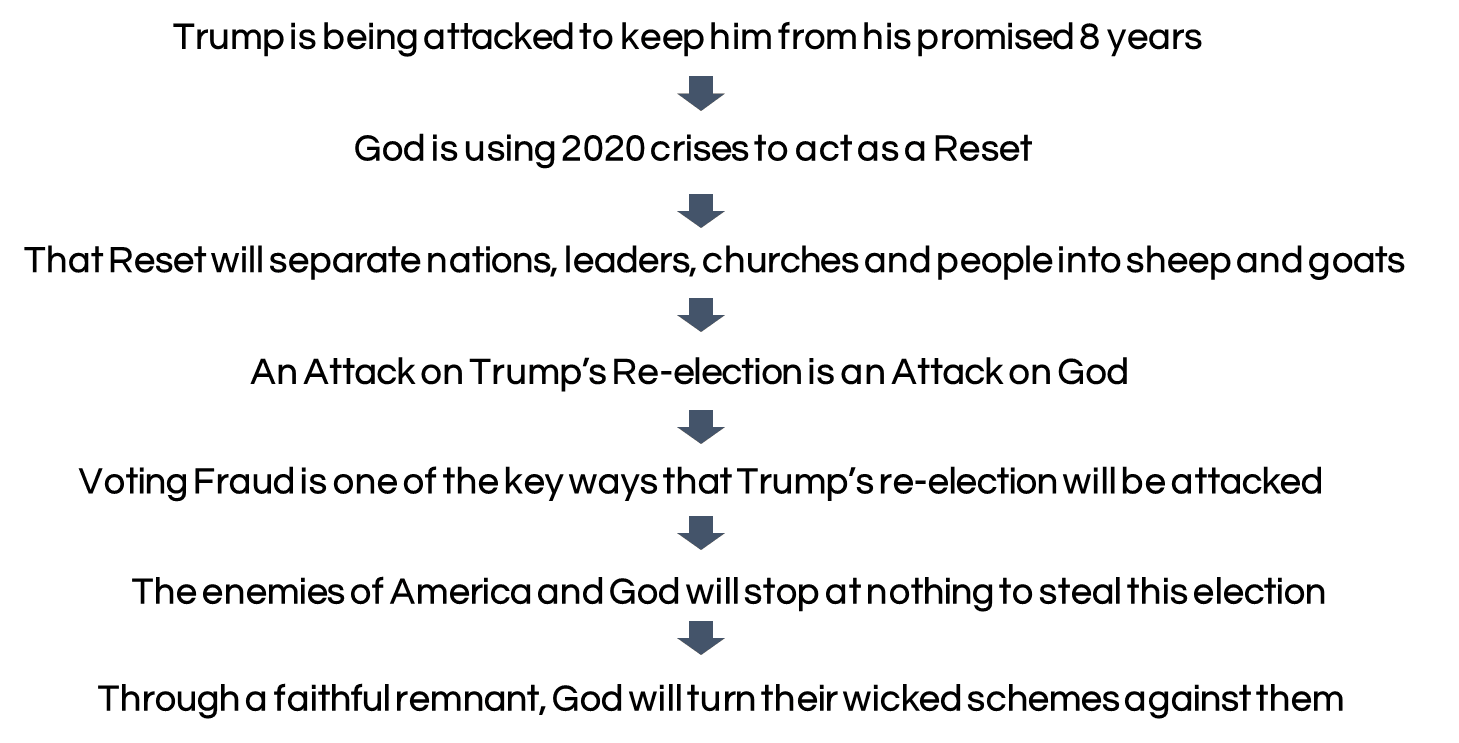
Trump is being attacked to keep him from his promised 8 years
From the beginning of 2020, as events that might be unfavorable to President Trump's re-election unfolded, the main voices in the apostolic-prophetic movement moved aggressively to frame them as being designed or manufactured very intentionally to harm Trump or his chances at a second four years. It shouldn't be surprising, I suppose, that prophetic messages relating to a literal impeachment would be framed in this way (since it is, by its nature, an attempt to get the guy out of office).
A repeating headline that described the Nationals World Series win was one that referred to them as "giant slayers." No team has ever had to defeat such powerful teams in order to win the World Series of baseball. In all the playoff series they had to face elimination games, and they often won in remarkable and dramatic ways. The overwhelming favorites and "giants" of the National League were the Los Angeles Dodgers, whose primary color is blue. It is not coincidental that Nancy Pelosi, Adam Schiff, and Kamala Harris lead a contingent of California "blue" politicians who are in an unending coupe (sic) attempt against the "red" president.
Johnny Enlow, The Big ‘World Series' Message, Elijah List (November 11, 2019)
These demonic inquisitors, they’ll needle this data out, they’ll tease out everything they can to perplex and harass and destroy this president’s efficiency and effectiveness.
Lance Wallnau, in a since-deleted YouTube video (January 31, 2020)
Still, I think the response from this community to impeachment proceedings was interesting, not least in that it revealed a near-uniform tendency on the part of the apostolic-prophetic movement to frame events not only as attacks, but in the terms of the memetic and Epimemetic structure of the narrative virus that had already become a pandemic. How do we know this framing was dominant and acting in sympathy with impeachment news? Well, for one, because the weeks in mid-late November that accompanied heightened speculation about the forthcoming articles of impeachment saw the single largest 1-month increase in the density of language related to "exposing" the deep state's schemes in the history of the Elijah List dataset. As with many things in the "confirmation-focused" new world of modern prophecy that tended to produce strong mirroring of identical language and phrasing, this tendency did not abate.
God is also using [Trump] to expose darkness. If you are in the Deep State, your activities are being found out. Some of the corruption that has existed in our government is now being exposed. It’s not so much that President Trump was so discerning and started seeing it, knowing where it was, and exposing it. It’s more that the darkness hated him, and through others’ attacks against him, they are exposing themselves.
Dutch Sheets, Give Him 15 (June 9, 2020)
But it wasn't just the impeachment proceedings that got this treatment. COVID and its lingering economic and social effects were framed as the result of "enemies trying to stop his re-election", too. Lance Wallnau was early in describing COVID mostly in terms of enemies in the spiritual world (and also perhaps a bit early in describing how the church ended the pandemic).
There is a breaking up of the power of this virus as time goes by. It’s not having the effect that people were predicting. You’re not having the 2,000 – 3,000 a day deaths. So what you have is what you’re beginning to see, where the church, and I really do believe this, the authority of the body of Christ beginning collectively to come into a place where this thing is breaking up. The enemy sent this virus in order to take the United States out. What I’m saying to you, it shocks me, is how the Lord has allowed all the gains that Trump had to be taken down.
Lance Wallnau on Lance Wallnau Pentecost Broadcast (May 31, 2020)
In recounting a dream he claimed some months before, Robert Henderson described a similar effect, if something a bit further along the spectrum of physical, human attacks, rather than only 'spiritual' attacks.
The attack on the economy was designed to discredit President Trump and cause him not to be re-elected. I had no idea it was going to become the global issue it was. I knew that the attack that was coming, one of its main agendas, was to stop him from being reelected and that we had to take hold of this thing. And that aggressive thing you’re talking about, and actually be able to shift things, so the economy would not be damaged to the point he would not be reelected.
Robert Henderson on Lance Wallnau Pentecost Broadcast (May 31, 2020)
Mario Murillo ventured even further along that spectrum.
This lockdown is vital to the Left. They need it. They need it because their plan is to topple Trump and make socialism appealing.
Mario Murillo, WHAT YOU CAN AND MUST DO NOW, Mario Murillo Blog (April 29, 2020)
Frequently.
If Democrats campaign on the lie that Trump wrecked the economy—it proves they are wrecking the economy to get Trump… The Democrat Party must be stopped. Their crimes against the Constitution, our way of life, our freedoms of religion and free speech are all being trampled.
Mario Murillo, IF DEMOCRATS CAMPAIGN THAT TRUMP WRECKED THE ECONOMY, Mario Murillo Blog (May 21, 2020)
This narrative framing even made its way to the George Floyd protests and riots during the summer.
This [Floyd protests] is the devil manifesting because God’s kingdom is manifesting.
Lance Wallnau on Lance Wallnau Pentecost Broadcast (May 31, 2020)
Given the gravity of the many events of 2020, it was certainly true that most of the charismatic-Pentecostal church in America and indeed much of the evangelical church would have seen those events as influenced by demonic forces, or at least as the result of a fallen world. Either conclusion would have been considered worthy of intercession and prayer. The point is that common knowledge within the apostolic-prophetic movement was that these were a targeted attacks on Trump's re-election.
God is using 2020 crises to act as a Reset
As a chief vector of that targeted attack (the coronavirus pandemic) set in, prophet-apostle Chuck Pierce describes having remembered something the Lord had told him in the fall of the last year. As Pierce describes it, God had informed him that the next Passover would be a real Passover. At the time, he did not know quite what God meant. March of 2020 gave him what he felt was the answer.
I kind of had to step back and say, “Well, what in the world is going to happen with that?” So, when I saw this thing coming out of Wuhan, China, I knew right then that this is the Passover where the economic system of the world gets realigned. How we enter into Passover this year as a nation is going to be very important.
Chuck Pierce via Give Him 15 (April 1, 2020)
The virus will start shifting after Passover. You will start seeing nations rearranged and how they’re aligned with each other.
Chuck Pierce via Give Him 15 (April 2, 2020)
This is a major global reset.
Chuck Pierce via Give Him 15 (April 4, 2020)
As we have covered at length in this essay series, Chuck Pierce and Dutch Sheets work together a lot. In mesh network terms, theirs are heavily but not perfectly overlapping sets of working relationships. Sheets publishes Pierce's thoughts with regularity, and it is not uncommon that Pierce's words and prophecies reflect some of what Sheets has said before. In this case, Pierce seems to have arrived at a preferable version of Sheets's phraseology for the idea of a reset. The latter had published his a bit over a month earlier, when he called 2020 a "hinge year."
God’s divine reversal isn’t finished, however. The exposing of evil will continue, as will the turnaround. This year, 2020, is the hinge year. If we persist, the door into America’s great revival and resurrection will swing open fully this year. And we will.
Dutch Sheets, Give Him 15 (March 4, 2020)
Johnny Enlow wrote about the hinge year concept publicly a couple weeks after Sheets. He claims that he prophesied it previously, although I cannot locate anything in written or video content to attest to it. That doesn't mean he didn't, of course, as a great many of these texts, blog posts and statements were deleted after the fact. Take particular note of the "Haman's Gallows" language. It will come up again.
We are crossing over into a day of great deliverance. I prophesied that 2019 and 2020 would be "hinge years" in history where we would experience the greatest rescue operation since the children of Israel's original Passover, where they were then led through the Red Sea of deliverance from multi-generational oppressors. Not coincidently, we literally are entering into another Passover in early April. Life will be known as before and after these days. You are living in the greatest shift since the Protestant Reformation 500 years ago – and this shift is bigger.
In the storm, Haman's gallows, originally prepared for the nation's destruction, are being put around Haman's own neck. ENJOY THE SHOW.
Johnny Enlow, The Storm Is Here – But We Are Crossing Over!, Elijah List (March 19, 2020)
By this time, the hinge and reset language were effectively merged. Certainly, their underlying memetics were already merged in narrative world. Common knowledge among the prophets was now that this was a pivotal year, and that actions taken this year would have long-term consequences. As had become a pattern since the members of the various prophetic and intercessory networks could immediately know what everyone else was saying with the advent of social networks, it became the core idea from a dozen or more new prophecies from major personalities across the movement within a month. Lana Vawser. Chris Overstreet. Frankly it was everywhere. OK, James Goll got fancy and called it the Reset Season. Same difference. Rolling density of this language in April and May was some 15x higher than that of normal periods.
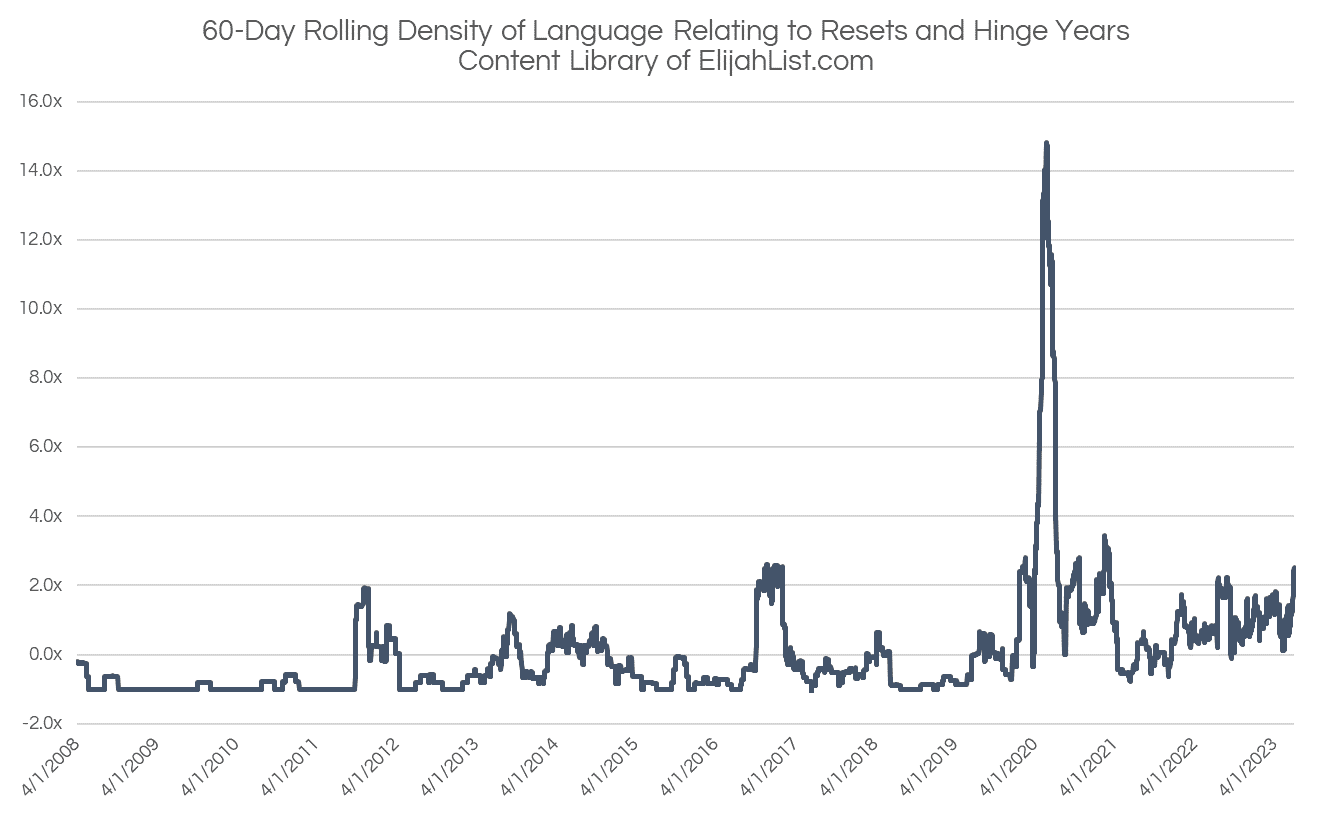
Source: Epsilon Theory, ElijahList.com
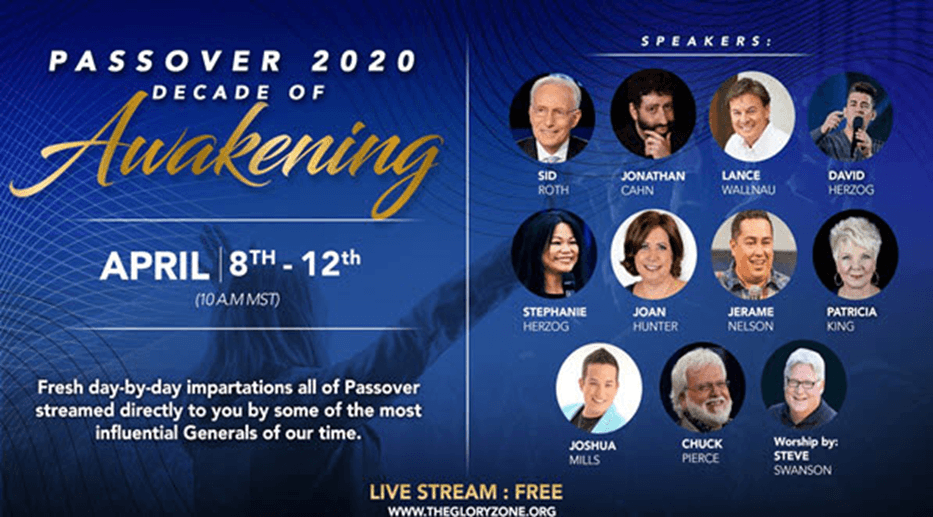
Chuck Pierce's framing and language made its way to an large Passover event – coincidentally sponsored by Elijah List – that would involve a lot of our regular suspects, including Pierce himself. The message at this event was that God was ordaining this Passover as a True Passover: a prayer for protection and God's favor in the midst of many trials and dangers.
That Reset will separate nations, leaders, churches and people into sheep and goats
That 2020 was a pivotal reset or hinge year was not the only message conveyed at this event, nor across the various livestreams, prophecies, and other conference events that managed to sneak by (or which happily ignored) restrictions on public gatherings that spring. One meme incorporated into the Reset narrative within the apostolic-prophetic community at that time was that it would facilitate the separation of sheep from goats. For those unfamiliar with Christian Scripture, this was an allusion to Matthew 25, in which all men stand before Jesus and the throne at the end of time. They are separated into sheep and goats. The sheep are "blessed by [the] Father" and "inherit the Kingdom prepared for [them] from the foundation of the world." The goats "go away into eternal punishment."
Now, in the original telling of this story, the basis on which the separation between sheep and goats is made is who fed the hungry, clothed the needy, visited the imprisoned, welcomed the stranger and cared for the sick. In 2020, the prophets changed the parameters of that evaluation somewhat. They also changed the scale, introducing the ideas of sheep and goat nations as well.
This is the reality for all sheep nations, and there will be 153 of them. It not going higher than 70% is indicative of nations that remain goat nations, and the fact that Jesus said, "The poor you always have with you."
It is about a time ("last days" go on for a very long time) when not just individuals get saved, but entire nations seek for solutions from the activated reformers from the house of the Lord.
Johnny Enlow, Chiefs Win! A Stunning Prophetic Message, Elijah List (February 4, 2020)
God is separating sheep and goat nations. Sheep nations are those that honor Him as best they can with laws that follow His biblical guidelines. A significant portion of the populace honors Him openly and the government does not stop it. There are efforts made to choose life. They also honor Israel.
Chuck Pierce via Give Him 15 (April 2, 2020)
Sheep Nations are aligning with Israel and Godly principles are being positioned for huge favor while other nations are in the valley of decision during this crisis...What the enemy has meant for harm God will use for good.
Advertising Copy for Passover 2020 Decade of Awakening Event, hosted by David Herzog Ministries
The "plague" must come crashing down, the economy must have its engine started back up, and we must head for our Promised Land that is in the 7 mountains of the nations. It is time for the Lamb's Agenda for nations to be next. The big reset is primarily about that.
Johnny Enlow, 2020 – A Passover to Remember, Elijah List (April 8, 2020)
Sheep and goats can still be people, to be sure, just like in the original version. But as with sheep and goat nations, the guidelines for being a sheep and a goat have moved somewhat. After having participated with Pierce in the Passover event, Lance Wallnau hosted another event of his own – a Pentecost livestream that welcomed fellow prophets Mario Murillo, Robert Henderson, Jeremiah Johnson, and Mario Bramnick. The event was over an hour of Reset, Sheep and Goats. Sheep and goat nations. Sheep and goat leaders. Sheep and goat citizens.
You can’t just pray for a mayor to rise up now and then. You’re going to have to understand that those mayors are working for or against the Kingdom of God from this day forward. Politicians are either aligned for or against the Kingdom of God.
Lance Wallnau on Lance Wallnau Pentecost Broadcast (May 31, 2020)
The sentiment pre-dated the language, of course. We've published Bethel's Kris Vallotton's December 2019 prophecy twice already in this series, so we won't do it again. But prophecies, sermons and blogs threatening the wrath of an angry God on anyone who got in the way of the Trump Train started to pick up increasingly powerful language as 2020 went along.
It is clear what Joe Biden will do—his every move will be anti-Christian—so how can you believe you are innocent and not do everything in your power to stop him? The only way to stop Biden is to vote for Trump. No one else, no matter how saintly you esteem them to be, has any chance of winning. And if Trump loses, America will belong to the enemies of God...How can they call themselves Christians and do such an anti-Christian act as voting for Biden?
Mario Murillo, HOW CAN YOU CALL YOURSELF A CHRISTIAN?, Mario Murillo Blog (April 17, 2020)
An Attack on Trump’s Re-election is an Attack on God
At this point in 2020, we see an apostolic-prophetic movement that had carefully nursed a narrative that attacks against Donald Trump and the various world crises of 2020 were being purposefully designed by the enemy and perverted by to prevent his re-election. In context of the emerging prophecy that this would be a reset year in which nations and citizens would be divided into sheep and goats, it was a now a very short intellectual leap to make to the following conclusion: that any attack on Trump and his re-election campaign was a direct attack on God.
I pray [against] every vex and hex and spell and jinx, and occult apparatus that has been operating against this country with the Deep State so as to stumble Your people and trap them in their words…Lord, I pray that You would move upon those individuals who have sought to do You the most mischief by doing him the most harm. For when they attacked who You anointed they were attacking You.
Lance Wallnau, from Facebook as accessed by RightWingWatch (May 2020)
Unless we obey God and rally every believer in America to the unquestioned cause of righteousness and freedom, a moral winter is coming to America that will make the coronavirus look like a mild cold.
Mario Murillo, IF DEMOCRATS CAMPAIGN THAT TRUMP WRECKED THE ECONOMY, Mario Murillo Blog (May 21, 2020)
Voter Fraud is one of the key ways that Trump’s re-election will be attacked
While discussions of voter fraud or voter suppression had been present for much of the aftermath of the 2016 election (in both directions, obviously) and the 2018 midterms, they reached a fever pitch as the roll-out of expanded mail-in balloting made its way across the country in response to the COVID-19 pandemic. This is probably also a good time to introduce Lara Trump, wife of Eric, who led a series of frequent charismatic, spiritual warfare-oriented prayer calls that were livestreamed to a huge audience in the lead-up to the election.
We see that never before have we had this level of cheat-by-mail voting, where the voting laws, Father, were changed haphazardly by judges, by governors, by secretaries-of-state, against our constitution. So Father God, we appeal to you. We appeal to heaven, to the righteous one, against the lawlessness that is in our land. We ask that You would take Your righteousness and Your blood as we paint the blood of Jesus Christ over our nation. We ask, oh God, that you would come against this lawlessness of cheat-by-mail voting and we ask that you would bring it down.
― Call to Prayer, Hosted by Lara Trump (November 1, 2020)
All the ballot initiatives the Democrats are pushing now in every state, uh, that’s because there could be fraud that is done there.
― Lance Wallnau, May 25, 2020 Livestream
The enemies of America and God will stop at nothing to steal this election
The aggressiveness of the language from prophetic and other charismatic voices asserting a coordinated attempt to steal the election would only accelerate as the election neared. An "As One" conference convened immediately before the election was marketed almost wholly on the basis of precisely this claim.
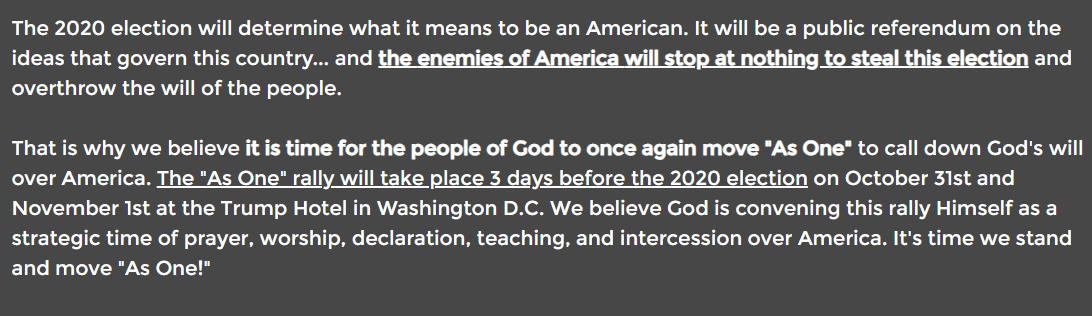
You know, I’ve been thinking about how the enemy is going to try to steal this next election…more likely than not, Trump will have a landslide that will be reversed, gradually and progressively, as a thousand lawyers begin to churn up ballots and boxes and late votes coming in…these people that are under the influence of demons actually believe that the problem is Donald Trump, that he won’t leave office. They are the ones who will not accept defeat. They will not be denied. They must have power. And once they have it, they will never let an outsider get it again.
Lance Wallnau, Prophetic Warning – How They'll Try To Steal The Election (Sep 4, 2020)
The minute the finger underlined November three times, instead of tapping it I saw a fist ball up and it hit the calendar and literally the calendar exploded...the next thing I saw armed protesters, I saw fighting in the streets i saw people pummeling one another, I saw businesses shuttered...I saw Washington, D.C. burning, I saw Washington, D.C. blazing, I saw fires everywhere, I saw people being rounded up, I saw Chinese and Russian soldiers on the ground...I also saw no sign of President Trump. I saw no sign of leadership in Washington, D.C.
Dana Coverstone, The Calendar Dreams (October 10, 2020)
Through a faithful remnant, God will turn their wicked schemes against them
From the first appearances of the reset language and its integration with the common knowledge of Trump as being the prophesied Cyrus ruler, there was another common thread, however. You might remember in Part 3 – the essay about the core five memes of this narrative virus – that I mentioned that there were actually six memes. It is finally time to introduce you to the final meme, one that is perfectly suited to emerge from the warm waters of the prophetic narratives of 2020: Haman's Gallows.
That is not to say that it isn't a common meme. It's every bit as global a meme as any we discussed in Part 3. Haman's Gallows is Duryodhana's house. It is Sisyphus and Thanatos, and then Thanatos and Sisyphus again. It is Goliath's sword. It is Antonio's pound of flesh, Fahai and the Green Snake. It is every time a weapon is turned against the one who thought to wield it for themselves. And it lies deep within the memetics of Judeo-Christian scripture. I suspect that some of these verses will be familiar to you, even if you belong to another (or no) faith.
But Joseph said to them, “Don’t be afraid. Am I in the place of God? You planned evil against me; God planned it for good to bring about the present result—the survival of many people. Therefore don’t be afraid. I will take care of you and your children.” And he comforted them and spoke kindly to them.
Genesis 50:19-20
No weapon formed against you will succeed,and you will refute any accusationraised against you in court.This is the heritage of the Lord’s servants,and their vindication is from me.
Isaiah 54:17 (CSB)
And I also say to you that you are Peter, and on this rock I will build my church, and the gates of Hades will not overpower it.
Matthew 16:18 (CSB)
We know that all things work together for the good of those who love God, who are called according to his purpose.
Romans 8:28 (CSB)
Haman's Gallows itself is a reference to a series of events in the Book of Esther. In short, the story tells of the evil Haman, who had conspired to build a ridiculously tall gallows to kill Mordecai, a Jew who refused to bow to him as a senior adviser to King Ahasuerus. He'd actually wanted to kill all of the Jews until the Queen Esther interceded. She unveiled Haman's plot against her people, shortly after which the king condemned Haman to die on the very same gallows he had built for Mordecai.
When someone references the meme of Haman's Gallows, there is always a good party, always an evil party, always a weapon that gets turned around on the evil one. And there's always an Esther. The Esther of the story is usually the teller of the story, or maybe the reader if the intent is to inspire. And the Esther reference, if it is a literal Haman's Gallows story, will always reference Esther 4:14.
If you keep silent at this time, relief and deliverance will come to the Jewish people from another place, but you and your father’s family will be destroyed. Who knows, perhaps you have come to your royal position for such a time as this.
Esther 4:14 (CSB)
You see, a Haman's Gallows story is very often a story of A Faithful Remnant Returning, too. Among charismatic users of the phrase, you will find, being there ‘for such a time as this' is an adequately reproduced trope that the Greek word for it – kairos – is used just as often to reflect a particularly opportune moment. Only once in the history of the Elijah List dataset did the 30-day rise in the density of "kairos" language in submitted prophecies exceed that of September 14, 2020. The other date? In early 2015, when Dutch Sheets was first promoting the specific version of the Keeping Ancient Covenants meme that would become his Appeal to Heaven movement (which we referenced previously in Parts 3 and 4).
Indeed, the entirety of Dutch Sheets's Passover 2020 message delivered for Chuck Pierce's Glory of Zion International streaming service was built around Genesis 50, that God took what the enemy meant for evil in 2020 and would turn it to good. He was far from alone. Again, I include the quotes below not in some attempt at scholarly support of an argument about how election fraud beliefs emerged, but because the language itself is the thing our story is about.
"Remember the story of Esther? Even as Haman's evil plans backfired against him, being hung on the very gallows that he had prepared for Mordecai, so it will be with the enemy. The very evil that he's plotted against My people will be turned around and used for their good, backfiring against the enemy.
Angie Stolba, Mayday!' A Month of Turnaround, Elijah List (April 5, 2020)
In March, we realized the enemy had a huge agenda for this season which involved death and destruction, not just of personal lives, but also against God's people; against the shift happening in nations that would expose evil and the coming awakening so often prophesied. Part of the plan involved first shutting down churches to break apart the corporate prayer anointing and alignment with Heaven...
The Lord declares, "Every place you see chaos, lawlessness and disruption will be a target for the outpouring of My Spirit. What the enemy meant for evil will be turned for good! The places where the voices of My people have been silenced will be at the forefront of revival! I will supernaturally turn hearts. The persecutors will become the propagators of My revival message.
Jane Hamon, Contending – From Crisis to Comeback, Elijah List (August 10, 2020)
The enemy has tried to oppress God's covenant people from all sides. We are being transformed and set up for divine increase – it's just happening right in the trenches. This is the kairos time where we will follow God. We are not waiting on the timing of man. We will fear God, not man.
Danielle Dixon, Modern-Day Intercessors, Watchmen and Gatekeepers – Arise, Elijah List (June 8, 2020)
There is so much shaking and tension taking place all across the globe right now. And yet, the Spirit of God is moving among His people in new ways. I feel strongly that we have reached a kairos moment—an opportune, God-appointed moment in time. I believe it is time for us to rise up, take a stand on God's Word, and partner with Heaven's agenda to bring reformation to society and revival to our land!
Che Ahn, Calling All Spirit-Led Activists! 5 Prayer Points to Reform Our Nation, Elijah List (October 16, 2020)
But these were more general allusions to the Haman's Gallows meme. As we approached the election, this now-mature narrative was focused and channeled toward the claims of electoral fraud to come.
In the year of 2015, I had a vivid and unusual dream that I have not felt to share publicly until now. I dreamt I was reading from Esther 7:10 where it says, "So they hanged Haman on the gallows that he had prepared for Mordecai. Then the king's wrath subsided." As I read those words, the name Haman suddenly began to glow and transform into another word...The name Haman transformed into the word "S-o-r-o-s."
Christy Johnston, The Mantle of Esther, Elijah List (October 12, 2020)
Lord, we cancel every assignment of the enemy to overthrow this election in 2020 from the White House all the way down to a state level and city level....we say, “No weapon formed against our President will prosper! No weapon formed against the ancient path that this nation was established on and has always followed will prosper.”
Ken Malone, Taking Authority Over Election Fraud, Give Him 15 (October 15, 2020)
This particular narrative reached its peak, fully integrated with the others which emerged in 2020, in the multi-day conference held by Dutch Sheets in October 2020, appropriately called Reset 2020. The language of the event managed to weave together threads from each of the core memes of the narrative virus, plus each of the evolutions in narrative that took place over the events and crises of 2020. The result was a near-perfect synopsis of the state of mind of the apostolic-prophetic movement on the eve of the 2020 election.
It being a conference run by one of the largest apostolic ministries with some of the deepest roots in the prophetic movement, Reset 2020 was rich with the language of the Rediscovering the Old Ways meme and A Faithful Remnant Returning. Dr. Don Lynch, graduate of the Peter Wagner's Wagner Leadership Institute, delivered the following invocation for the convocation of an ekklesia, an apostolic order and a high priest.
An authentic ekklesia has been called into assembly by apostolic order, to hear and agree with the announced intentions of the King. You see, our confession is we have an apostle who is our high priest and we must mutually agree that he is both apostle and high priest. So we do not come now to debate among ourselves. We do not come to an animistic altar hoping to obligate the God of our own design to help us. We come in agreement with a standing King for the accumulated purposes, the prophetic dream pictures that we have now seen are a scroll sealed, but about to be opened. We agree that the word of the Lord for America has been reserved and preserved for this Reset moment.
Dr. Don Lynch, Reset 2020 – Day 2 (October 10, 2020)
The meme of Keeping Ancient Covenants and the prophesied promise of eight years were likewise present throughout the conference.
I saw Jesus in the northern region of the United States. He said there will be an unlocking of original covenants in the land that will cause the nation to shift into righteous covenant. As the unlocking occurs it'll pave a way through 2019 leading into 2020 and four years following 2020 for continued and increased righteousness in the White House.
Dutch Sheets, Reset 2020 – Day 2 (October 10, 2020)
The meme of Trump as King Cyrus was reaffirmed by the Faithful Remnant to fulfill those Ancient Covenants.
And the Holy Spirit said "There are a thousand messenger angels that have gathered in this convocation with golden bowls, and what you do to reconstitute the vision for the nation will go into those bowls, and I will send them to Middletown, Ohio, and on October the 9th, which is the last day of the great day of the feasts, you will commission them to leave Middletown, Ohio and go to Washington D.C, and they will pour out a fresh anointing on my Cyrus. They will pour out a fresh anointing on my Cyrus. And they will pour out a fresh anointing on the United States of America", and Lord, we decree that the sleeping church who is trying to be cute and diverse and embracing and tolerant, we'll wake up and we'll come back to the well that was dubbed by the ancient fathers.
Unknown Speaker, Reset 2020 – Day 2 (October 10, 2020)
The entire concept of the ekklesia – that is, Sheets's theological concept and not the literal meaning of the word or the way it would have been understood by the early church – is to rule, so the memetics of Mountains to be Conquered were interspersed throughout the language of the program.
My ekklesia will arise. She is arising now, taking her place on the Earth, taking the authority I have given her to take dominion on the Earth, to rule and reign with Me. I have already given my angels charge. The spirit of Jezebel is finished in my courts. Ekklesia take your place. I have called order to this nation. My glory will fill the Earth. Prodigals are returning back to me.
Unknown Speaker reading a word from Angie Hale, Reset 2020 – Day 2 (October 10, 2020)
Dreams of unrelenting attempts by left-wing mobs who would stop at nothing to steal the election from Donald Trump were presented.
The leaders of those who oppose [Trump] inform the media in live coverage that the president has had a mental breakdown. They insist that he must be removed so that they can take over...At that time the cloud of witnesses appear. George Washington and Ronald Reagan order the angel army to take the left-wing mob into custody. Ronald Reagan then steps forth and salutes President Trump
Clay Nash, Reset 2020 – Day 2 (October 10, 2020)
We just decree that this evil attempt to overthrow President Trump will fail. We just decree that the evil thread that has been woven through our government now is going to be unraveled. The evil agendas – the demonic agendas – at every level in every office in both parties, that the spiritual forces that are trying to rule our government are being overruled now by the authority of King Jesus.
Dutch Sheets, Reset 2020 – Day 2 (October 10, 2020)
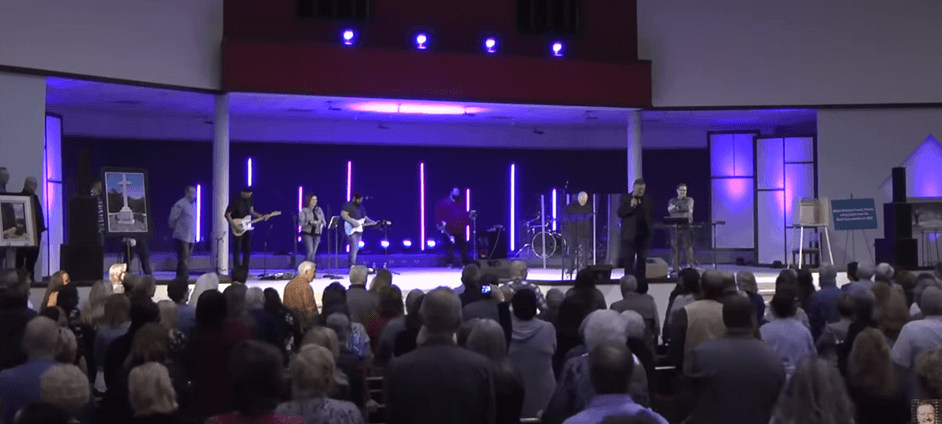
So, too, were the claims that these attempts and agendas to overthrow Donald Trump, remove him from power and take over would be achieved through voter fraud. At one point, Sheets actually brings to the stage a Palm Beach Country voting booth from the 2000 election (which, you may recall from an earlier essay in this series, Sheets claims to have achieved for Bush through legislative decree).
I believe this voter fraud thing that's going on is real. I believe it is a plan to try and steal this election.
Dutch Sheets, Reset 2020 – Day 3 (October 11, 2020)
Source: YouTube, Dutch Sheets Ministries
They then decree that the attempts would fail.
We have the authority here today to cancel the voter fraud…Lord, we cancel every assignment of the enemy to overthrow this election in 2020, from the White House, all the way down to the state level and city level. We say now that this plan of the enemy is canceled in Jesus's name, and we decree the fire of God. We'll begin taking out every false idol in every state that would try to overthrow this election
Unknown Speaker, Reset 2020 – Day 3 (October 11, 2020)
But the whole thing about the meme of Haman's Gallows is not just about recognizing a threat and neutralizing it. The meme conveys the intrinsically powerful idea of evil aims being turned to the good of those at whom they were directed.
We say that evil will not reign in the White House! Evil will not reign in the White House! We declare, we declare that corruption will not only be exposed, but will be led to the gallows!
Unknown Speaker, Reset 2020 – Day 1 (October 9, 2020)
The God of peace is rising on behalf of President Trump and He is crushing Satan underneath his feet.
Unknown Speaker, Reset 2020 – Day 2 (October 10, 2020)
Nothing will stop the great harvest of the two-thirds of the earth that are gonna be swept into the Kingdom of God in this hour.
Dutch Sheets, Reset 2020 – Day 3 (October 11, 2020)
As they concluded one of the last, more representative hurrahs of prophecy from the charismatic-Pentecostal movement about Donald Trump's re-election, the convocation was unapologetic in its confidence, unmoved by how much of its identity had become entwined with a whole array of predictions, claims and consequent implications. It will be an important frame of reference for the days to come.
I then presented to [Trump] a white stone.
And then I read to him Revelation 2:17: “To him who overcomes I will give some of the hidden manna. I will give him a white stone a new name written on the stone, which no one knows but the one who received it.”
And he then quoted to me, “There was a man sent from God and his name was John.”
Donald. John. Trump.
Thank the Lord for the white stone anointing! The vote of heaven has been cast!
Dutch Sheets, Reset 2020 – Day 3 (October 11, 2020)
That's what the mutation of a narrative looks like.
All the memes – of covenants and old ways, of mountains to be conquered, of faithful remnants and Cyrus anointings, transformed as they were by a rich, new social medium across which narratives might be transmitted and adapted – comprised a narrative that thus far remained a falsifiable expression of belief. That is, excepting the general vagueness that accompanied the apostolic-prophetic vernacular, the narrative still boiled down to statements and predictions which either would or wouldn't come true. Oh sure, people would quibble, but prophets had to deal with being wrong before.
The events which took place over the course of 2020 built a narrative of opposition to Trump and of a pending vector for that opposition – electoral fraud. Still a narrative.
But it was then that the meme of Haman's Gallows was summoned, the promise that God would not only thwart those attempts, but use those attempts to steal the election against the perpetrators. He would expose the evil forces.
It was then that this idea was merged with the memes of A Faithful Remnant Returning, the language from the apostolic-prophetic movement that took strength from being a company of voices crying in the wilderness for "truth" once again, a convocation willing to act as the rearguard when others quailed.
It was then that our narrative virus became more than a narrative.
It was then that it became a matter of identity.
It was then that it became something that they needed to be true.
It was then that the election happened.
And it was then that things really got weird. Just in time for Part 8.


Comments
Nine parts. I can only imagine how many hours of discussion went into this. Looking forward to all of it.
@rguinn I was wondering: did you use the narrative machine retrospectively, whether wholly or in part, to identify the sources here?
As someone raised Catholic and currently attending an evangelical Baptist church I audibly guffawed at this paragraph. Absolute perfection.
As a socially liberal and fiscally conservative Presbyterian who is probably more agnostic now and (yes a run-on sentence) am fully ingrained with the fact that our country’s laws are based on Presbyterian polity, I too laughed out loud at this statement.
Levity, a good carrier for important considerations.
Rusty,
Curious to see what attention, if any, the doctrine of biblical innerancy will get in this series.
As a teenager, I was baptized in and eventually pastored at a wonderful Foursquare church in Oregon. Additionally, for several years during that time, I lived with 4 Calivinist buddies of mine.
During my years-long exposure to both charismatic Pentecostalism and Calvinism, I found over and over again how fundamentally problematic the doctrine of biblical inerrancy and literalism is for all churches, regardless of whether it’s the reformed Eric Metaxas/Wayne Grudem/John Piper type or the charismatic Pentecostal Benny Hinn type.
In my experience, the “charismatic norms” (like prophesy), can be a really beautiful thing. But it’s when the charismatic norms (like prophesy) are connected to the doctrine of biblical inerrancy/literalism that things can go super sideways and do anything but “edify”. As I see it, inerrancy is the core virus that has been wreaking havoc in the churches (you name the tradition) and the world for centuries.
Anyway, really looking forward to reading these notes.
Three of the mentioned fellows will make at least a cameo appearance, but it isn’t necessarily a focus of the series. I agree that it would also be fascinating to see how that narrative - the soul of American evangelicalism, really - emerged and became common knowledge, but that would be a different series.
In part, although as I think you’ll discover as we go along, our aim was to be thorough enough not to have to be stingy in our source selection.
Man, fascinating stuff. Can’t wait to read the rest.
I was raised mainline Protestant in NY in the 80s. Never even heard of Charismatics until I moved to TX as an adult.
I think I understand why it is the fastest-growing branch of Christianity. Vs the stuff I was raised with, my first impression as an outsider is the level of passion and… hmm… immediacy.
I’m assuming that this is the basic story we’re discussing, I had not heard it yet. It explains what some prophets need(ed?) to be true and why.
This was a great and insightful read, @rguinn.
“Like the Widening Gyre, the most effective vectors for effective astroturfing campaigns may focus not so much on changing common knowledge but on changing What We Need to Be True.”
Inoculation against direct responsibilities is one of the fundamental traits of human beings’ proto-centralized religions. In a context of apparent lack of control, agency was projected outward.
Witchcraft was the reason for pain without feeling guilty and gods’ (God) wrath for pain when feeling guilty in ancient cultures.
In this context of apparent lack of control (post 2008), changing what we need to be true is an escape from direct responsibilities when focusing on the excuses that explain the individual or collective failure as an out-of-control external factor (spiritual: evil-witchcraft- the devil or kind of real threats: immigrants - woke - deep state), that apparently has agency and goes directly against you as a cosmic good vs. evil fight. So, it’s the perfect context for this phenomenon to emerge in the American-style, spirit-filled charismatic Christianity.
Low locus of control (direct control over outcomes) + belief in miracles (indirect control over outcomes) + best in class already system of memes (Christianity).
You’ve got it nailed. Only I think that we will discover that there are many more areas of our society and culture which exhibit very similar traits in very different wrappers.
Really interesting start…as someone who has walked among the movements you reference, I’m looking forward to your reflections and observations.
I’ll just observe here that the role of discernment has always been the weak link when it comes to Pentacostal/Charismatic movements.
Continue the discussion at the Epsilon Theory Forum...