
Narrative Means Never Having to Say You're Sorry
June 27, 2019·Politics

Being a full-time missionary - someone who leans on the power of memes and narrative to nudge others into some particular way of looking at the world - often requires a certain amount of sociopathy. Not always, of course. We've written several times about when and how we think narrative can be marshaled to serve worthier causes than the interests of a nudging oligarchy. To wit:
Still, it is no coincidence that when we run down our list of professions we collectively associate with corrupt, dishonest people, nearly every one is intrinsically dependent on selling you a story. And every one that isn't is perceived as being corrupt because they are either seen as the source of that corruption in others (e.g. Lobbyists) or as the agent of structures seemingly designed to fail to live up to promised service standards (e.g. HMO Managers, Nursing Home Operators).
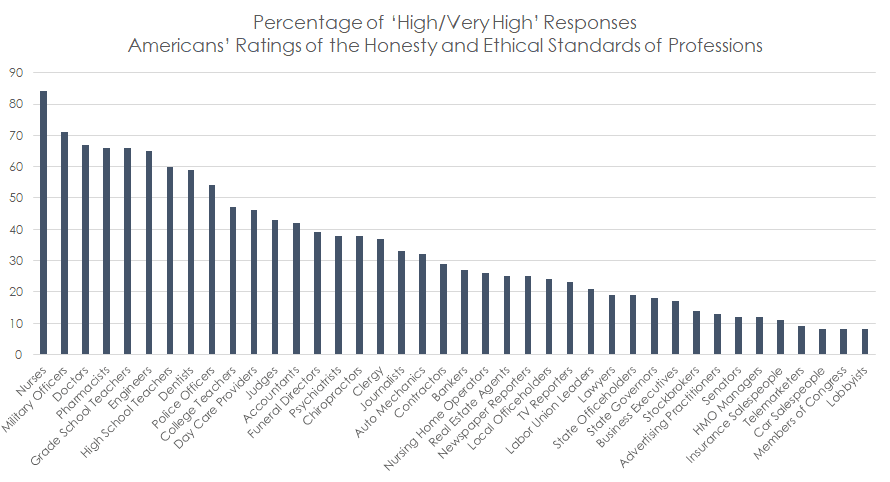
Source: Composite of 2016-2018 responses to Gallup's Americans' Ratings of the Honesty and Ethical Standards of Professions Survey
Not all storytellers are missionaries, of course. When we refer to missionaries, we are referring to a game theoretic concept. We mean the people who seek to steer and influence common knowledge - the things that we all know that everyone knows. That, or they're people who are in a position where they can't help but influence common knowledge, because their pronouncements are the kind that everyone knows that everyone else has heard. Presidents. Congressmen and women. CEOs. Celebrities. Tech visionaries. Major media personalities and outlets. Within just the investment community, there are similarly prominent voices. Fed Chairs. Activists. Celebrity PMs.
The sort of elective sociopathy that it takes to succeed as a self-interested missionary almost always rests on two malignant abilities: the willingness to stretch the truth, and the fortitude to stick with a story no matter how it goes wrong (or who it hurts). We've written a lot about the former.
We have written less about the latter, although it is a crucially important human tendency to monitor in ourselves and others all the same. The unwillingness to admit error is part of an equilibrium-maintaining strategy in a narrative-driven competitive game, and our susceptibility to it is a testament to the human animal as a living embodiment of Gell-Mann Amnesia. In short, we are built to empower unrepentant liars. More disconcertingly, in a widening gyre, those who cultivate the skill are more likely to rise to power of all varieties (yes, even more than normal).
When a missionary permits common knowledge about himself or his ideas to break - the veils of abstraction around their identity or the narrative they've promoted nearly always break, too. All of the once-removed models for how we saw and thought about the person and what they meant, the justifications we conjured for their behavior or actions, the cultural significance of believing the reports about them - all disappear almost immediately. Even when the same evidence or factual knowledge exists, absent an admission of error, we still find it brutally difficult to shed the abstractions which color our interpretations of whatever they are purported to be guilty of, especially if we have powerfully positive or negative opinions about the person.
Don't believe me?
Here's a fascinating little study on this topic from Richard Hanania at Columbia University's Arnold A. Saltzman Institute of War and Peace Studies (h/t to Rob Henderson). The gist is this: if your standard is the public perception and credibility of the offender, apologies don't work. They hurt.
Admission of error is the enemy of narrative.
Yes, there are consultants and others who counsel these people to admit error, but that isn't because the apology will aid their public perception or any narrative that they are promoting. It is almost always because our taboos require the act of penance to permit others to do business / interact with that person again in an economic sense, which - since we're talking about influential and famous people here - will almost always happen.
If we want to see more clearly through narrative abstractions, well, we can't eliminate our sensitivity to those stubborn memes, but there are more lessons here for us as citizens and investors. There are things I think we CAN do:
- We can seek to be wise enough to be more skeptical in general of those not given to admitting error.
- We can seek to be wise enough to be more merciful in general to those who do.
It isn't easy. It will make us vulnerable. We will get burned. But it IS one of those rare places where the often-conflicting philosophies of Clear Eyes and Full Hearts align.



Comments
The Lance Armstrong story/narrative is so complicated. I would have picked someone simpler like Michael Milken.
Continue the discussion at the Epsilon Theory Forum...