Parties and Elections Pulse
March 24, 2026·0 comments·Politics
Democrats' Midterm Momentum Meets a Brand in Crisis: Blue Wave Expectations Moderate as Republican Messaging Gains Ground and Partisan Attack Language Retreats
Executive Summary
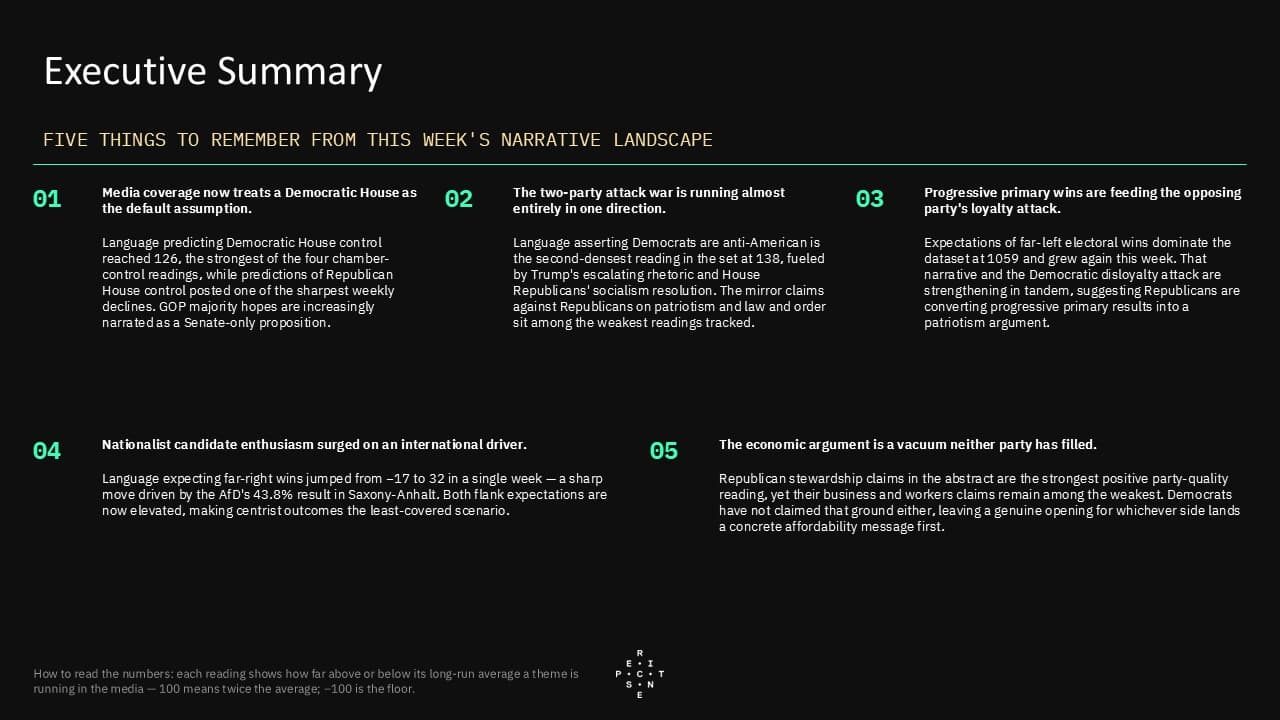
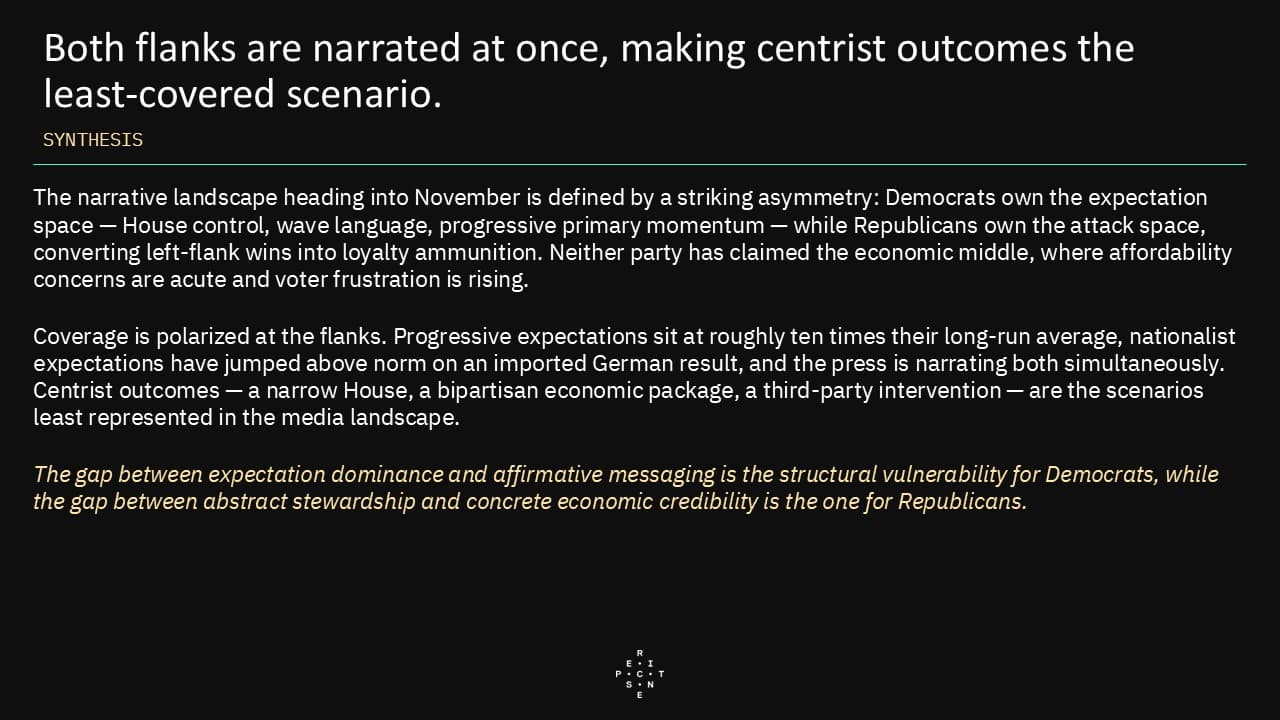
- Blue wave expectations cooled sharply in February even though Democrats remain structurally favored for the House. Perscient's semantic signatures tracking landslide-victory and progressive-candidate-victory language both registered steep declines—the latter marking the largest single-month drop of any tracked signature—while prediction markets still assign an 85% probability to a Democratic wave. The gap between cooling pundit rhetoric and stable market confidence suggests that the moderation reflects narrative fatigue and tighter district-level geography rather than a fundamental reassessment of the electoral environment.
- The Democratic Party's brand is eroding across core competency dimensions at the same time that Republican messaging is strengthening on those very fronts. Semantic signatures tracking the density of language arguing that Democrats are better for business, families, and workers all declined and now sit below their long-term means, while their Republican counterparts remain above average and are stable or rising. This divergence has emerged despite polling that shows that voters who name affordability as their top concern still prefer Democrats by a double-digit margin—a gap between abstract brand perception and concrete voter preference that the party's affordability-focused pivot is designed to close.
- Partisan attack language and existential-threat rhetoric declined uniformly across the board in February, a directional pattern that is uncommon in the dataset. Every tracked attack-oriented signature fell, and both existential-threat signatures now sit well below average. The decline appears to coincide with Democrats' deliberate strategic shift toward proactive economic positioning—centered on health care, housing, groceries, and caregiving costs—and away from oppositional framing, even though underlying public anxiety about the state of the country remains elevated.
- The retreat in heated rhetoric, combined with the erosion in Democratic brand strength and the moderation in wave expectations, suggests that the midterm cycle has entered a transitional phase in which policy credibility may matter more than apocalyptic framing. Democrats hold structural advantages but face a messaging credibility gap on the economic issues that both parties agree will decide November; whether their affordability pivot can rebuild brand strength before primary season intensifies will likely determine whether the current window for policy-focused discourse endures or gives way to a return of escalatory rhetoric.
---
Blue Wave Expectations Cool Sharply in February Even as Democrats Remain Favored for the House
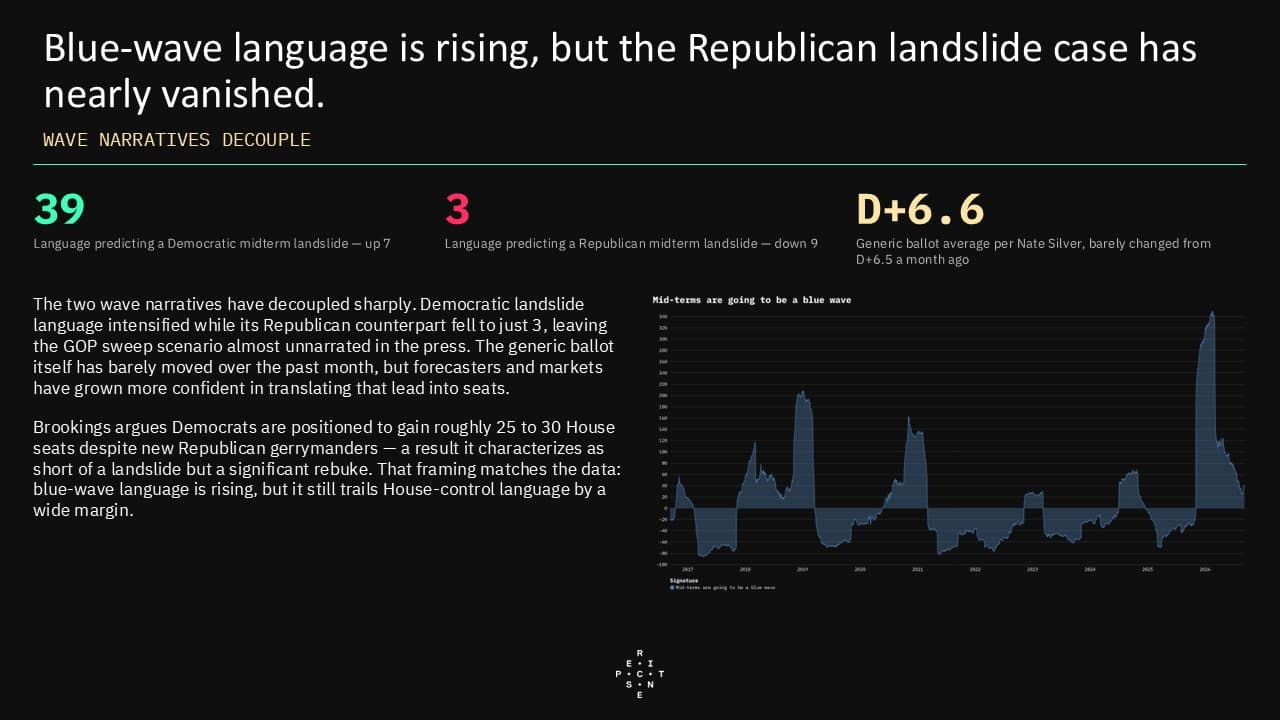
The conversation around the 2026 midterms shifted meaningfully in February, as the initial fervor surrounding Democratic prospects gave way to a more measured discourse about what the party can realistically achieve. Perscient's semantic signature tracking the density of language predicting a landslide victory for the Democratic Party in the upcoming midterm elections registered an index value of 115 as of late February. That figure remains well above its long-term mean, but it represents a decline of nearly 246 points from its prior month reading of 361, one of the largest single-month moves across all tracked signatures. While the blue wave thesis has not been abandoned, media discourse has moved from confident assertion to more guarded analysis.
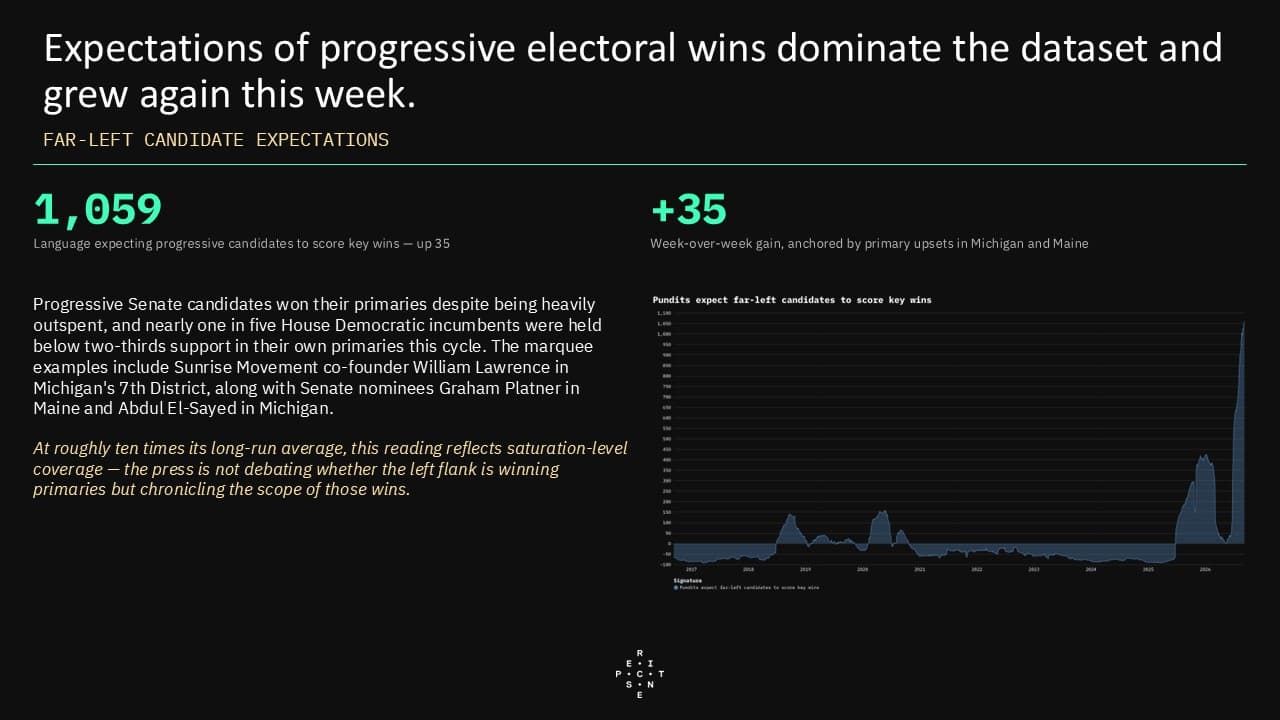
An even more pronounced retreat appeared in our semantic signature tracking language predicting that progressive or socialist-leaning candidates will win significant victories in upcoming elections, which fell by 361 points from 444 to 83. Though still above average, this represents the largest absolute monthly decline of any tracked signature. The progressive candidate pipeline remains active: Justice Democrats announced a dozen contenders for the 2026 cycle, pitching the slate as a working-class answer to Democrats' internal debate over how to confront the Trump administration. On social media, the group framed its slate as an effort to "build the Democratic party we deserve through primaries." Yet the sharp pullback in the signature suggests that the media's earlier enthusiasm for progressive upset narratives is giving way to more careful assessments of electability, especially as progressive candidates launch challenges against several incumbent Democrats in primaries that could prove contentious.
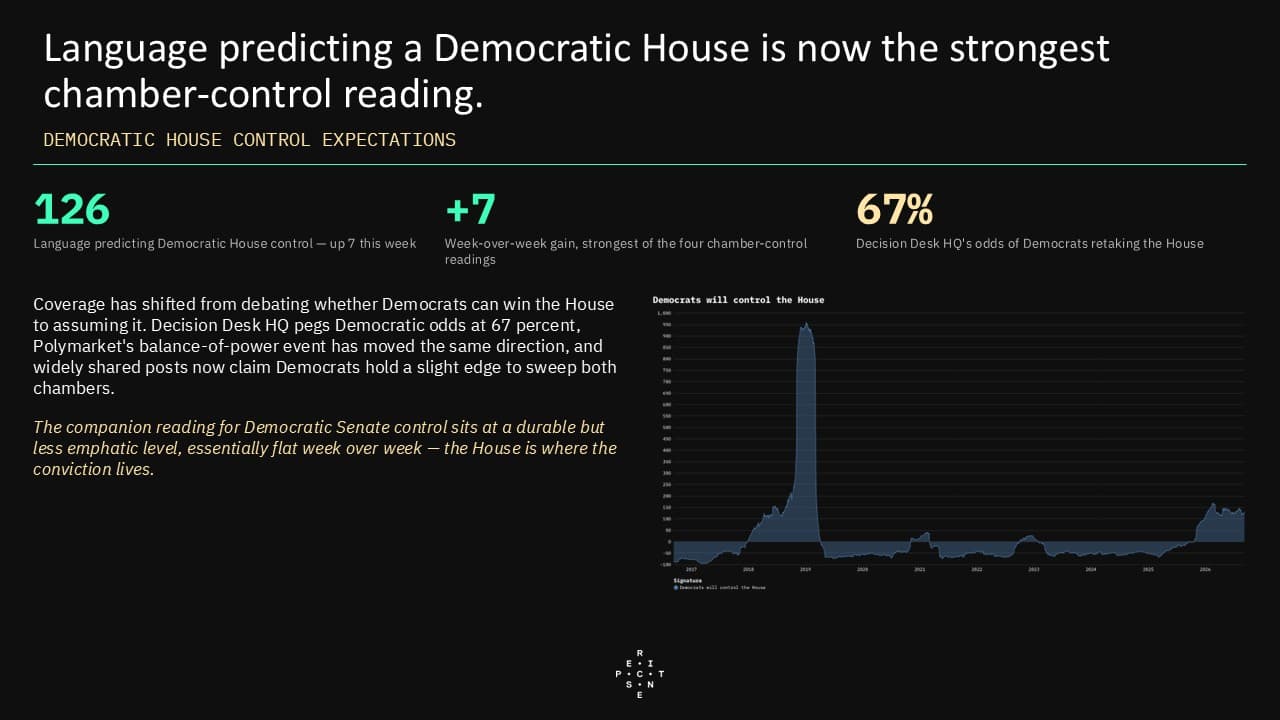
Our signature tracking language predicting that the Democratic Party will win or retain a majority of seats in the U.S. House holds the highest index value of any tracked signature at 137, even though it too declined by 40 points from January. Political scientist Alan Abramowitz captured the prevailing analytical consensus: "The projections are right now that Democrats are very likely to gain more than enough seats to take a majority in the House." Minority Leader Hakeem Jeffries was more emphatic, telling Face the Nation that if the midterms "were held today," Democrats would be "taking back control of the House of Representatives, and I'm not convinced that it would necessarily be close."
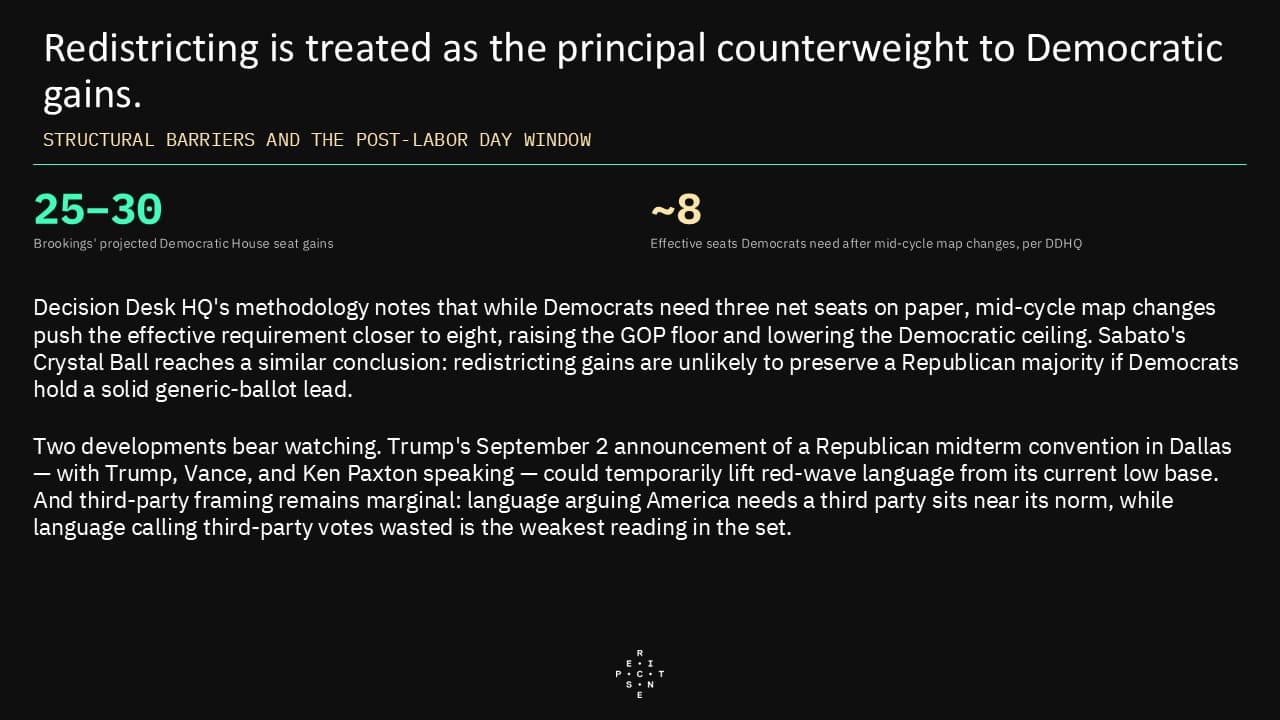
The Polymarket prediction market assigns an 85% probability to a "Blue wave in 2026," indicating that betting markets still strongly favor a Democratic wave outcome even as the media conversation has cooled. The gap between pundit rhetoric and market probability suggests that the moderation in language may reflect fatigue with wave framing rather than any fundamental reassessment of the electoral terrain.
That terrain is, however, genuinely complicated. CNN's House roundup noted that both parties agree the 2026 map is narrower than in prior wave years due to mid-cycle redistricting and increased polarization, and that while Democrats enter with built-in advantages, they are "less popular with voters than they have been in years." This tension between a favorable national environment and constrained district-level geography explains much of why wave language has moderated. An LSE analysis observed that higher-quality Democratic candidates are entering the race in greater numbers, while Trump's low approval ratings make the Republican Party less likely to attract strong challengers.
Meanwhile, our signature tracking language predicting a Republican landslide ticked up modestly by 4 points, though its index value of negative 6 remains slightly below average.
Democratic Party Brand Erodes Across Multiple Dimensions While Republican Messaging Strengthens on Core Competency Questions
Even as the structural case for Democratic gains in November remains intact, February brought a striking deterioration in the language supporting the Democratic Party's broader brand. Perscient's semantic signature tracking language asserting that the Democratic Party's governance, values, or platform result in superior outcomes for the nation recorded the sharpest single-month decline among party-image signatures, falling by 64 points from 68 to just 3, barely above the long-term mean.
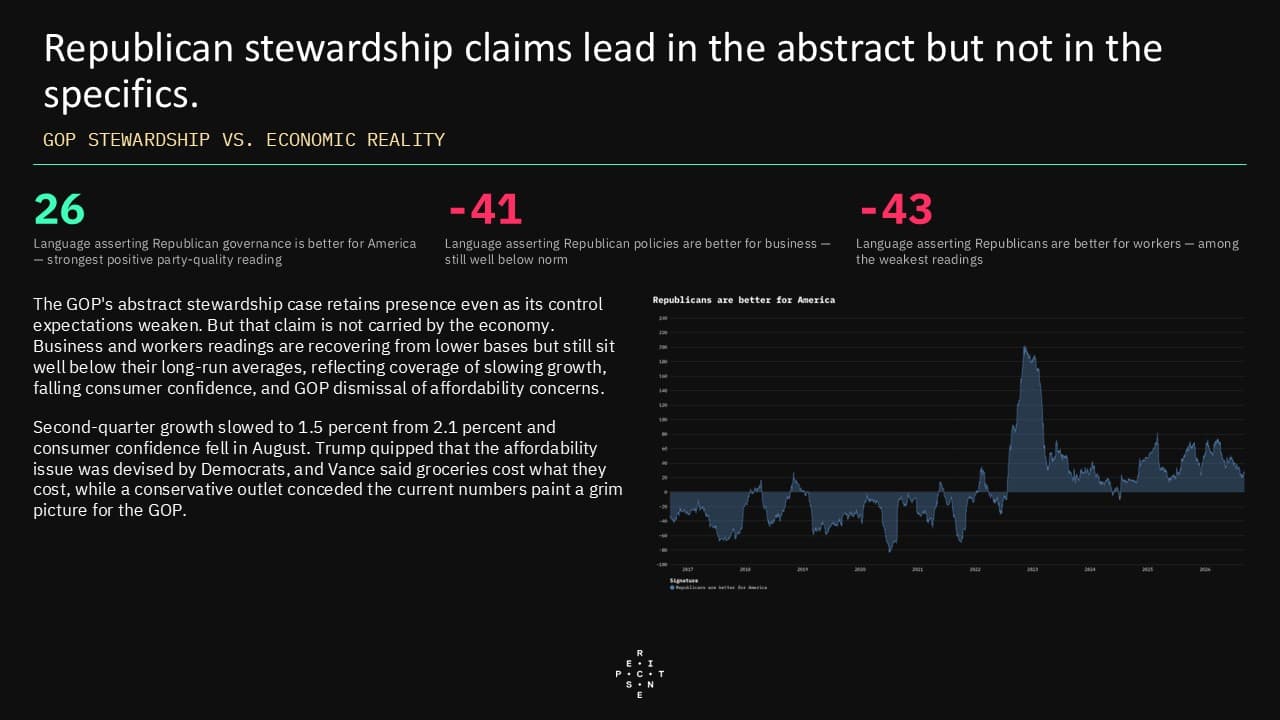
Our signature tracking language asserting that the Republican Party's governance, values, or platform result in superior outcomes for the nation strengthened by 17 points to an index value of 74, well above average. One party's brand advocacy is weakening while the other's is strengthening—a divergence that reflects a shifting competitive messaging environment.
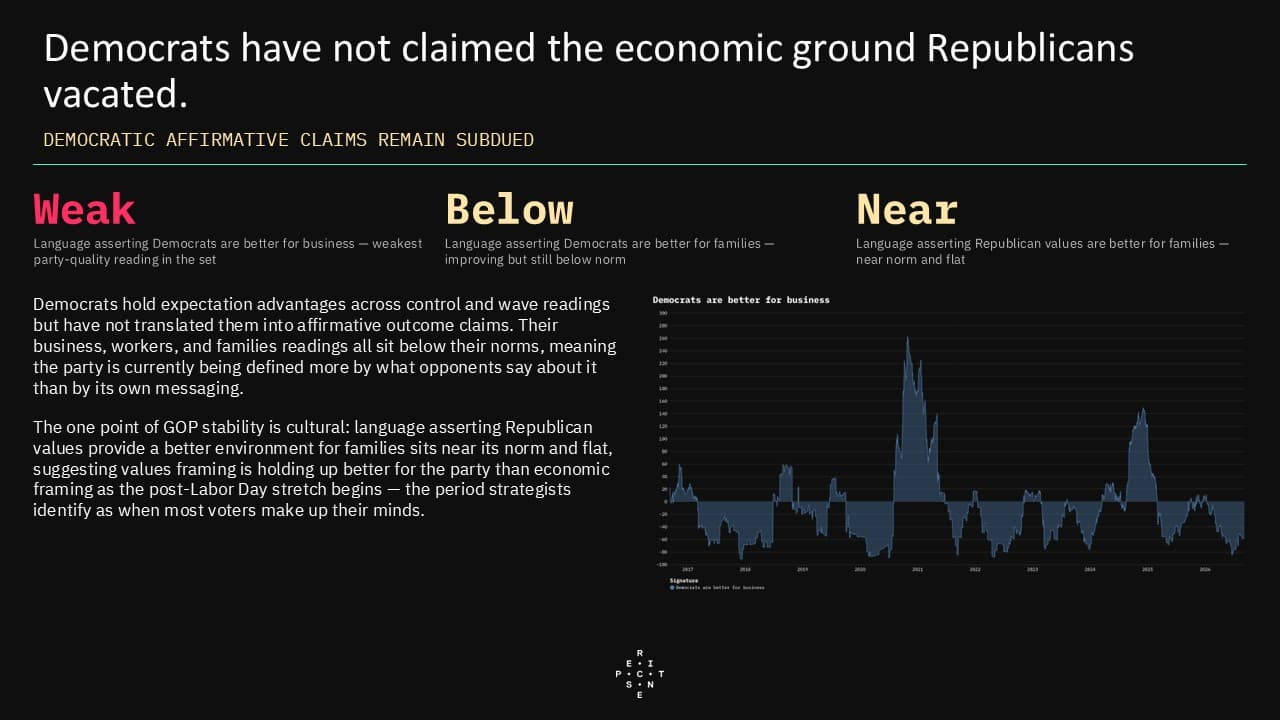
The erosion extends across core competency dimensions. Our signature tracking language asserting that Democratic policies create a more favorable environment for business fell by 36 points to negative 48. The signature tracking language asserting that Democratic policies support the financial health and well-being of American households declined by 27 points to negative 11, crossing from above average to below in a single month. And the signature tracking language asserting that the Democratic Party is the champion of labor and worker protections weakened by 13 points to negative 25. All three now sit below their long-term means.
On the Republican side, the family-oriented signature rose by 14 points to 34, while the workers-oriented signature strengthened modestly to 31. The business signature held essentially flat at 29. The Republican side of these paired signatures is uniformly above average and stable or rising, widening the gap.
Polling data helps explain the signature movements. An AP-NORC poll found that only about 7 in 10 Democrats hold a favorable view of their own party, down from 85% in September 2024. An NBC News poll showed Democratic Party approval at just 30%, and Fox News reported that voters increasingly describe the party as "weak" and "out of touch." Conservative commentators amplified these findings on social media, and polling showed that Americans trust Republicans more on the economy, foreign policy, and immigration.
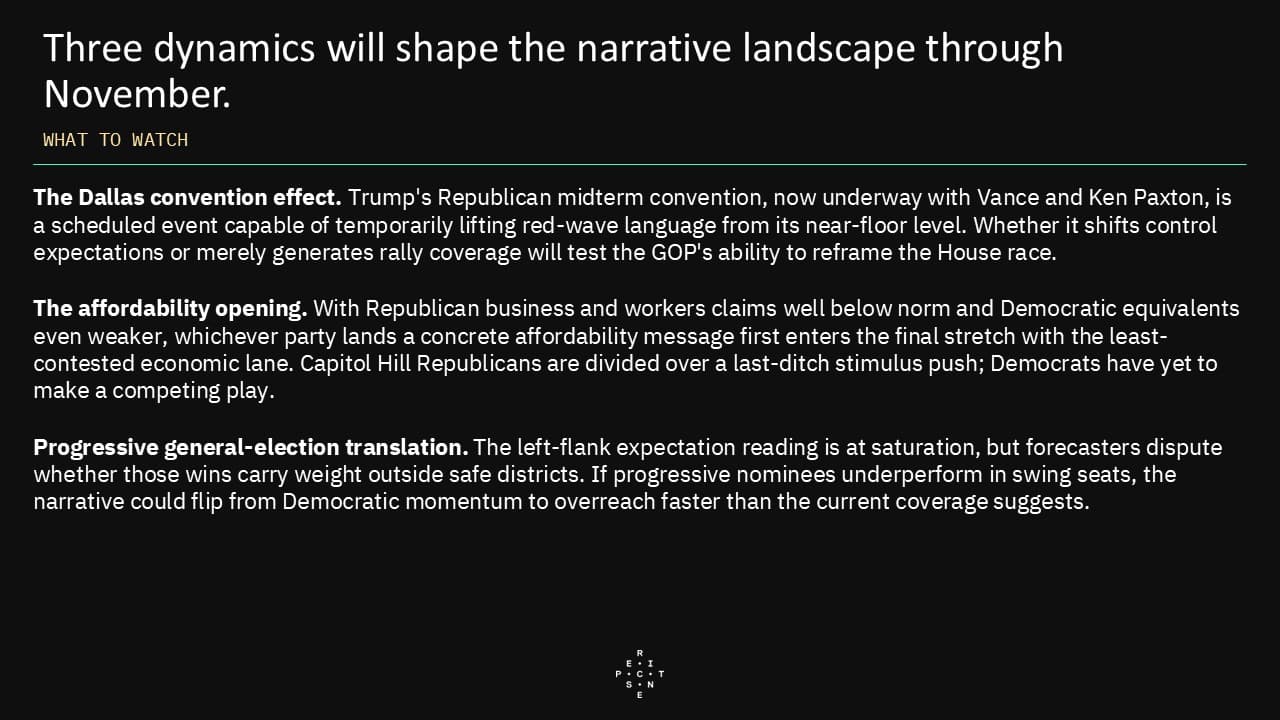
House Democrats are clearly aware of the problem. Their late-February Issues Conference, officially titled "Fighting for an Affordable America," centered on convincing voters that the cost of living has not improved under Republican leadership. Steve Crisafulli, chair of the Republican State Leadership Committee, wrote in the Washington Post that "whoever wins the affordability messaging battle, wins the election," underscoring that both parties view economic credibility as the central ground of the midterm contest.
Democrats face a paradox: their party brand is weakening on economic competency dimensions as measured by our signatures, yet voters who name inflation or the economy as their top issue favor Democrats over Republicans for 2026 by a 12-point margin. The gap between abstract brand perception and concrete voter preference suggests that the affordability pivot could bear fruit if sustained. CBS News polling noted that Democrats have drawn closer to Republicans on perceptions of economic policy since January, though some voters still believe the party prioritizes cultural over economic issues.
Partisan Attack Narratives and Existential Threat Language Decline Across the Board, Suggesting a Temporary De-Escalation in Heated Rhetoric
The brand erosion and wave moderation documented above are unfolding against a quieter rhetorical backdrop than might be expected for a midterm year. Both of Perscient's existential-threat signatures fell in February. Our signature tracking language asserting that a Democratic electoral victory poses an existential threat to American democracy declined by 25 points to negative 49, while the corresponding Republican version declined by 11 points to negative 32. Both now sit well below average.
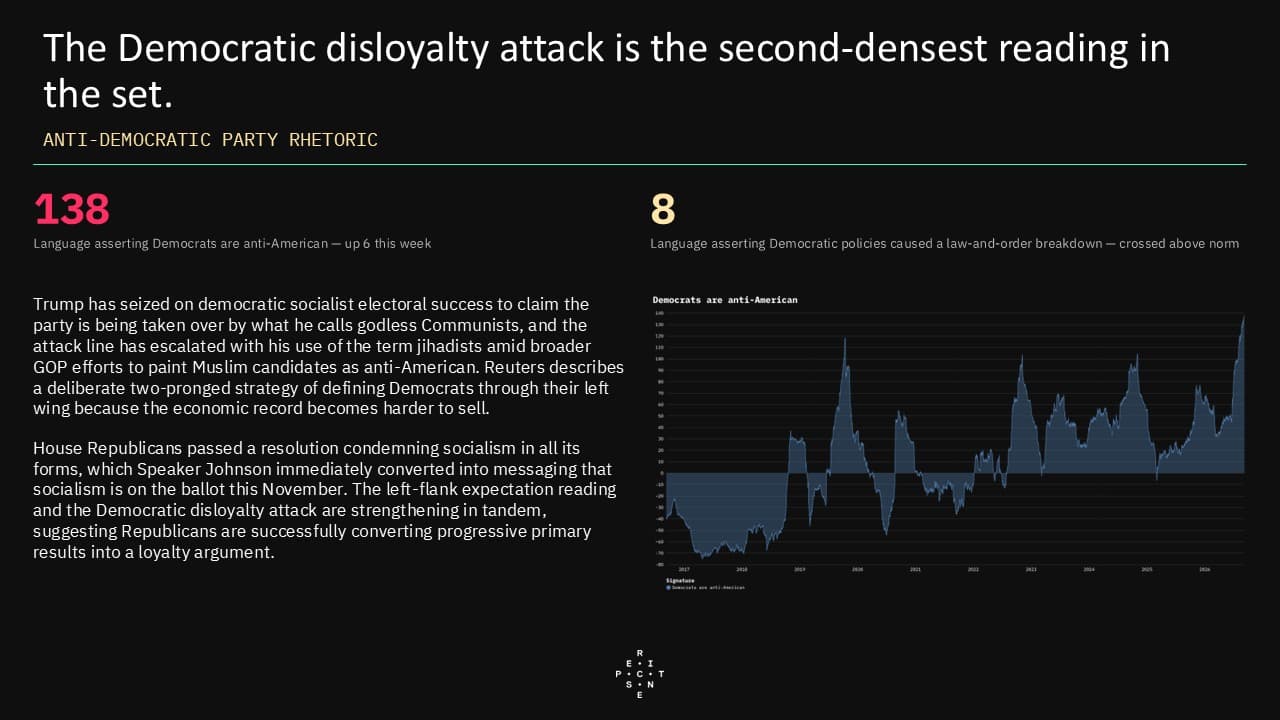
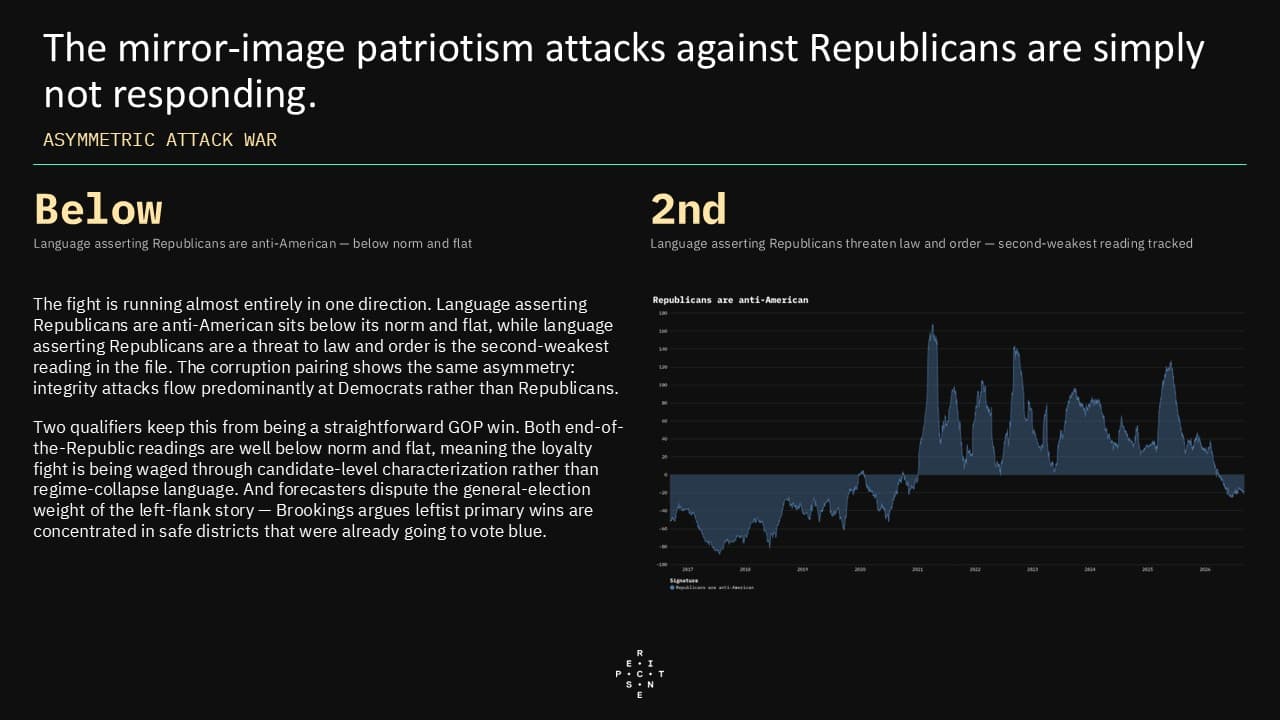
This decline coincides with broad decreases in partisan attack signatures. Our signature tracking language asserting that the Democratic Party is plagued by systemic dishonesty and corruption fell by 16 points to 29. The Republican equivalent dropped by 11 points to negative 2. The signature tracking language asserting that Democrats actively hate the country weakened by 20 points to 37, while the Republican equivalent fell by 15 points to 5. Every attack-oriented signature declined in February—a uniform directional pattern that is uncommon across the dataset.
The anti-Democratic attack signatures remain above their long-term means even after moderating, while the anti-Republican equivalents sit near or below average. The attack rhetoric is cooling for both parties, but the residual level of anti-Democratic language in media remains noticeably higher.
The decline may reflect a strategic pivot rather than a genuine change in public sentiment. A Reuters/Ipsos poll found that 82% of Americans believe that the country is near a breaking point, and a Quinnipiac poll found that Democrats, independents, and Republicans alike believe that the United States is in a political crisis. Underlying public anxiety remains elevated even as the language that stokes it has receded.
Democrats appear to be deliberately redirecting their messaging. The party's affordability push, centering on health care, housing, groceries, utilities, and caregiving, represents a shift toward proactive economic positioning and away from demonization of the opposition. Several analysts have noted this moderation, and the New Democrat Coalition has urged a "more moderate approach" focused on affordability and economic anxiety rather than "splashy populist promises." The Democratic response to the State of the Union focused on cost of living, though some voices cautioned that "affordability can't just be a vibe" and must include a real program confronting concentrated economic power.
Third-party discourse continued to fade alongside the broader de-escalation. Our signature tracking language asserting that third-party votes are a waste fell by 8 points to negative 74, while the signature tracking language asserting that America needs a third party declined by 9 points to negative 48. Both sit deeply below their long-term means, underscoring that media framing has consolidated around the two-party contest with little oxygen for alternatives.
The Emory Political Review captured the broader pattern well: elections are typically framed as existential tests from which the nation may not recover, rather than routine parts of democratic governance. The February data suggests that this pattern may be temporarily in abeyance, offering a window during which policy-focused messaging could gain salience over apocalyptic framing. Whether that window endures as primary season heats up remains an open question.
Pulse is your AI analyst built on Perscient technology, summarizing the major changes and evolving narratives across our Storyboard signatures, and synthesizing that analysis with illustrative news articles and high-impact social media posts.