Policies and Issues Pulse

Pulse

March 24, 2026·0 comments·Politics

Iran War, Housing Crisis, and Fading Economic Populism Reshape the American Political Environment Ahead of the 2026 Midterms

Executive Summary

- The U.S. military strikes on Iran have generated the largest single-month narrative surge in Perscient's dataset, and polling confirms that the conflict is the most unpopular American war at its onset in modern memory. Independent voters are driving the backlash, with approval of Trump's handling of Iran at just 24% among that group. The absence of any rally-round-the-flag effect, combined with persistent wrong-track sentiment and growing election integrity concerns, has created serious midterm headwinds for Republicans and shifted the generic congressional ballot toward Democrats.

- Housing affordability remains the most intense sustained media narrative by a wide margin, while health care coverage has collapsed despite worsening real-world conditions — exposing a stark gap between media attention and material impact. The homeownership crisis carries the highest absolute intensity of any narrative in the dataset, and its structural embeddedness appears to make it more resistant to displacement by breaking news. Meanwhile, the expiration of ACA premium subsidies has caused insurance costs to surge for millions, yet media coverage of health care reform plummeted — likely crowded out by the Iran conflict. This divergence suggests that health care could reemerge as a potent midterm issue once geopolitical coverage subsides.

- Economic populism narratives centered on wages, wealth inequality, and class grievance have all fallen below their long-term means simultaneously, even though objective conditions — including the lowest labor share of national wealth since 1947 and accelerating billionaire wealth accumulation — would typically fuel such language. The synchronized decline points to a broad media retreat from class-based economic framing, creating a potential messaging vacuum heading into the midterm cycle.

- Culturally oriented populist narratives focused on deep state conspiracy and threats to free speech have proven more durable than their economic counterparts, remaining above their long-term means. This divergence suggests that the midterm environment may be shaped less by traditional bread-and-butter economic debate and more by questions of war, government overreach, and democratic integrity — and that whichever party can credibly reconnect voter attention to kitchen-table concerns may command the stronger narrative advantage heading into November.

---

U.S. Strikes on Iran Ignite a Dramatic Anti-War Media Narrative With Midterm Implications

The U.S. and Israel's military strikes on Iran, dubbed "Operation Epic Fury," have reshaped American media discourse in the final days of February. Perscient's semantic signature tracking the density of language arguing that the U.S. must stop its involvement in foreign wars rose by 146.0 points over the past month to an Index Value of 167, the largest single-month increase of any signature in our dataset.

Polling data reinforces the scale of opposition. A Reuters/IPSOS poll found that just one in four Americans supported the attacks on Iran, making this, as pollster G. Elliot Morris has noted, the most unpopular a U.S. war has been at its onset. An NPR/Marist national survey pegged Trump's overall approval at just 38%, with net support for military action against Iran at negative 15 points. A new Emerson College poll found that 42% of likely voters approve of Trump's job performance and 51% disapprove, with no indication of the "rally-round-the-flag" effect that has historically accompanied the initiation of U.S. military operations abroad.

Independent voters are driving a particularly pointed rebuke. Approval among Independents of how Trump is handling Iran fell to just 24%, against 63% disapproval. Democrats now hold an 18-point advantage on the generic congressional ballot among Independents, 49% to 31%. Senator Elizabeth Warren framed the issue bluntly: "The American people voted for lower prices, not another war in the Middle East," while Representative Greg Casar argued that "politicians have been sending other people's kids to die in reckless, endless wars" for his entire adult life. Representative Rashida Tlaib called for a War Powers resolution and a rebuilding of the anti-war movement.

The constitutional dimension adds weight. Fifty-nine percent of voters believe that Trump should have received congressional approval before taking military action. As Reuters noted ahead of the State of the Union, Trump addressed Congress "at a fraught moment for his presidency, with his approval ratings slumping, anxieties rising over Iran and Americans struggling with costs." Beyond Congress, so-called "forever wars" are particularly resisted by Trump's own MAGA base, which has consistently signaled a preference for domestic priorities over foreign entanglements. On the generic 2026 congressional ballot, 49% of voters plan to support the Democratic candidate, while 42% support the Republican.

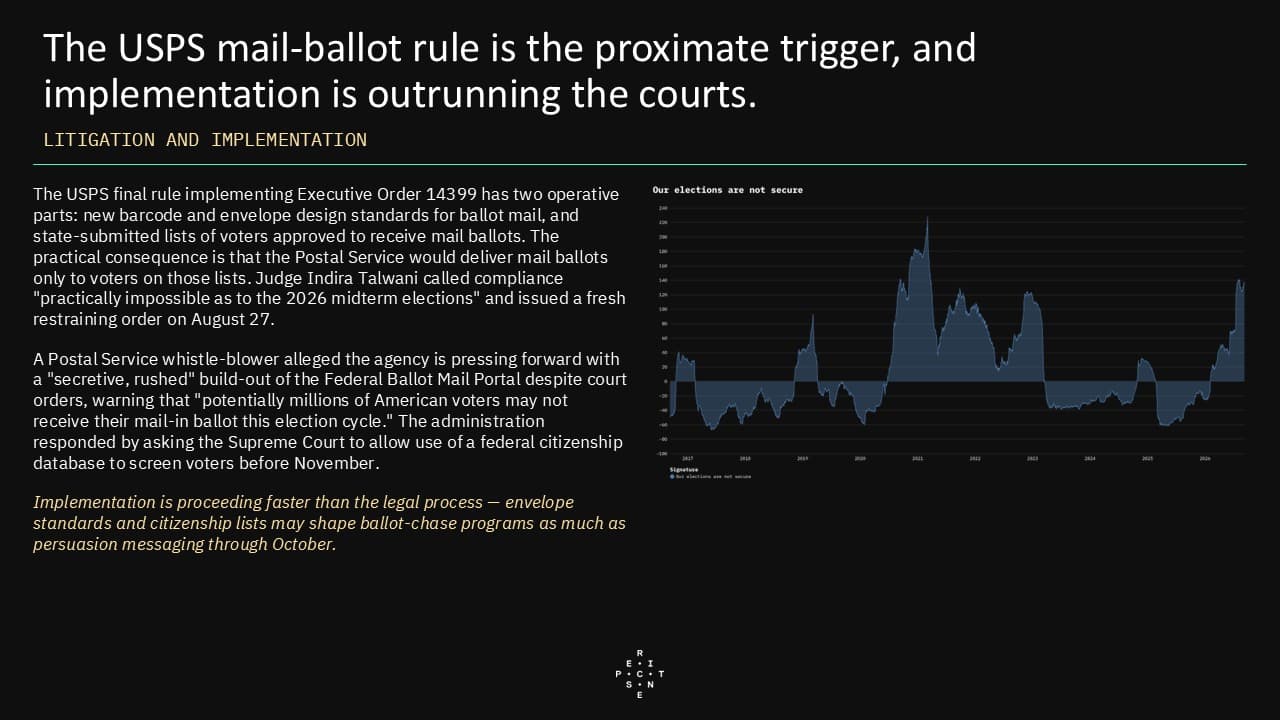
Our semantic signature tracking the density of language arguing that the country is on the wrong track remains well above its long-term mean at an Index Value of 31, though it moderated by 19.5 points this month. Perscient's semantic signature tracking language arguing that our elections are not secure strengthened by 15.5 points to an Index Value of 41. Federal intervention in electoral administration and cuts to CISA have left many state officials reporting that they are without support. The combination of a broadly unpopular new war, persistent wrong-track sentiment, and intensifying election integrity debates creates a volatile environment as the midterm cycle accelerates.

The Homeownership Crisis Dominates Media While Health Care Fades Despite Real-World Pain

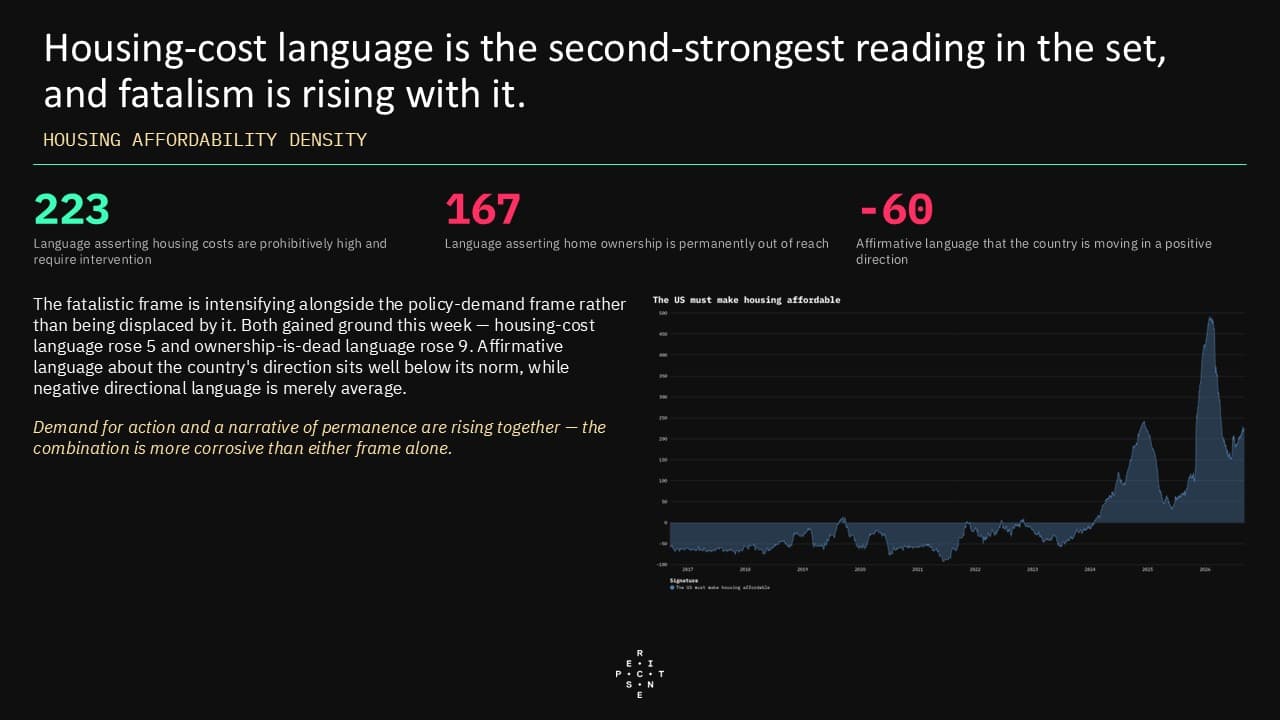
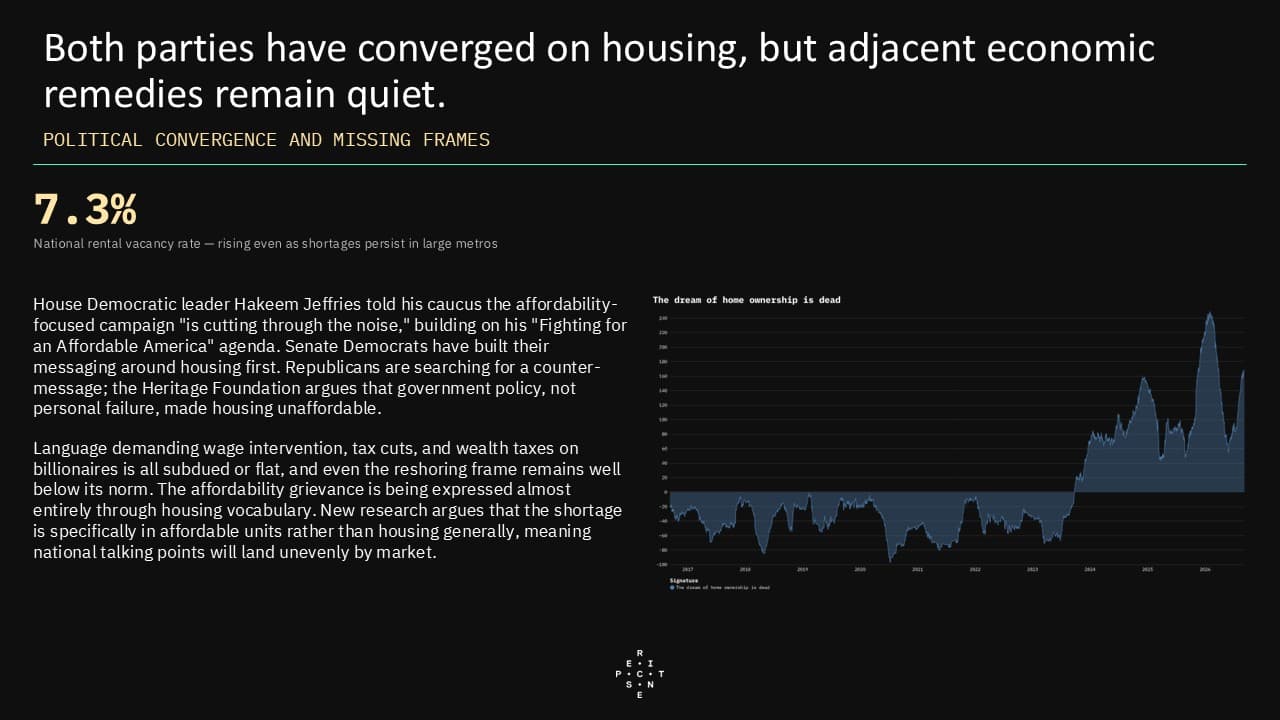
Even as the Iran conflict has commanded attention, the structural issue generating the most sustained media intensity remains housing. Perscient's semantic signature tracking the density of language arguing that the dream of homeownership is dead carries the highest absolute Index Value of any signature in our dataset at 195, nearly triple its long-term mean. The signature declined by 57.3 points from the prior month, but even after that pullback, no other issue comes close in sustained media attention relative to its historical baseline.

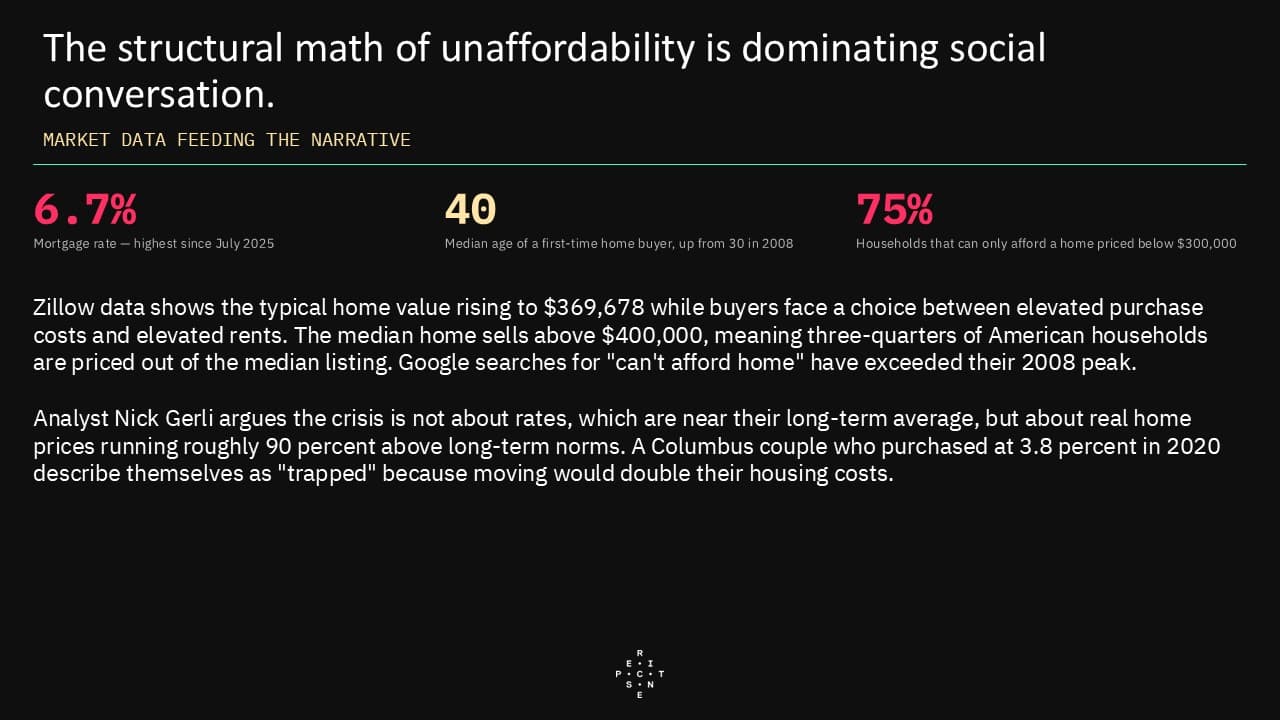
Sixty-five percent of U.S. households cannot afford a median-priced new home in 2026, and NAHB estimates a nationwide shortage of roughly 1.2 million housing units. The Washington Post reported that expert estimates of the shortfall range from 2 million to 20 million homes. A New York Times/Upshot poll found that only 36 percent of young people said that the home they would like was "within reach," compared with 76 percent of those over 65. Over half of respondents in a Bright MLS survey said that people simply "do not earn enough money to afford a home," while 50.1% said that mortgage rates are too high.

The issue extends beyond economics into family formation. The fertility rate has hit a record low of 1.6 babies per woman, and AEI research has linked the affordability crisis directly to young people's reluctance to marry and start families. As one widely shared post put it: "Our parents bought homes with single incomes and now you can't even rent a 2 bedroom without dual incomes. This isn't a personal failure, it's a system failure." Congress has begun to respond, and both chambers are working on proposals including modular housing incentives and easier access to home loans, though the White House has offered few specifics on its own housing plan.

In sharp contrast, Perscient's semantic signature tracking the density of language arguing that the U.S. must fix health care fell by 88.6 points to an Index Value of 41, the largest single-month decline of any signature in the dataset. On average, the more than 20 million subsidized ACA enrollees are seeing their premium costs rise by 114% in 2026, according to KFF. Obamacare enrollment has dropped after the enhanced federal premium subsidies expired, causing monthly payments to jump for millions. The Wall Street Journal documented cases of Americans now facing insurance bills larger than their mortgages, and the Congressional Budget Office estimates that 4 million people could ultimately become uninsured.

A KFF poll found that two-thirds of Americans think that Congress did the "wrong thing" by failing to extend the enhanced subsidies, and health care costs ranked as Americans' top affordability concern, ahead of groceries and utilities. Democrats have signaled that they will make the subsidies fight central to their midterm messaging. Governor Josh Shapiro noted that 70,000 Pennsylvanians lost coverage in just the first two weeks of 2026, adding that "18 of the 20 counties with the biggest drops in enrollment are all counties the President won."

The gap between health care's real-world gravity and its declining media presence likely reflects the Iran conflict crowding out domestic policy coverage. But given the share of voters who say that health care costs will play a major role in their midterm decisions, that narrative could rebound once the war news cycle moderates. The persistence of the homeownership signature alongside health care's decline suggests that housing affordability has become a more structurally embedded media concern, less susceptible to displacement by breaking events.

Economic Populism Narratives Weaken Simultaneously, Creating a Potential Messaging Vacuum

The decline in health care coverage is part of a broader pattern. Three closely related semantic signatures fell in tandem this month: Perscient's signature tracking language arguing that the economy is rigged against the working class dropped by 15.5 points to an Index Value of -8; our signature tracking language advocating that the U.S. must increase wages fell by 18.5 points to -28; and the signature tracking the density of language arguing that billionaires must pay their fair share declined by 19.4 points to -38. All three now sit below their long-term means.

This synchronized retreat suggests a broad pullback in media language around class-based economic grievance, even as the material conditions that typically fuel such language remain firmly in place. Workers recently took home their smallest share of the nation's wealth since 1947, as former Labor Secretary Robert Reich noted, while an Oxfam report found that billionaire wealth increased three times faster in 2025 than in prior years. Senator Chris Van Hollen pointed out at the State of the Union that "CEOs are making 285 times what their workers make" while "Trump just gave a $1 trillion tax cut to the 1%." The divergence between these objective conditions and the fading media language around wealth inequality is one of the more consequential gaps in this month's data.

The decline may partly reflect the same crowding effect observed in the health care signature: the Iran conflict and associated geopolitical coverage appear to be absorbing the media bandwidth that would otherwise sustain domestic economic arguments. Academic research supports this, noting that it is not economic structures themselves that fuel populism so much as the perception that society is organized unfairly, a perception that requires sustained media reinforcement to remain salient.

Yet while economic populism has faded, other strains of populist language are holding their ground. Our semantic signature tracking language consistent with the argument that a deep state controls the government remains above average at an Index Value of 42, while Perscient's signature tracking the density of language arguing that free speech is under attack by censors also rose modestly. The culturally oriented populist signatures focused on government power and institutional distrust are proving more durable than those centered on wages, wealth inequality, and economic fairness. One former CIA officer's widely shared discussion of the origins of the "Steady State" working against Trump illustrates the continued resonance of deep state framing across right-leaning media.

On the economic front, however, CNN analyst Harry Enten has noted that Trump's economic net approval sits at -18 points, 26 points lower than at this point in his first term and 53 points lower among Independents. Democrats hold a nine-point generic ballot advantage, a reversal from the 14-point edge Republicans enjoyed on the economy during the Biden years. Commentator Lee Fang has argued that the conditions are ripe for a "new left-coded populism" driven by AI-fueled job anxiety and the exposure of elite corruption.

But for now, the media environment tells a different story. The interplay between weakening economic populism and strengthening institutional distrust suggests that the midterm environment may be shaped less by bread-and-butter economic debate and more by questions of war, government overreach, and democratic integrity. Whether either party can successfully redirect voter attention toward the kitchen-table issues that still dominate private concern will likely determine which side commands the narrative advantage heading into November.


Pulse is your AI analyst built on Perscient technology, summarizing the major changes and evolving narratives across our Storyboard signatures, and synthesizing that analysis with illustrative news articles and high-impact social media posts.

Pulse
Politics