Pricing Power (pt. 2) - Intellectual Property
February 7, 2019·Money

Arthur: It is King Arthur, and these are my Knights of the Round Table. Whose castle is this?
Guard: This is the castle of my master, Guy de Loimbard!
Arthur: Go and tell your master that we have been charged by God with a sacred quest. If he will give us food and shelter for the night he can join us in our quest for the Holy Grail.
Guard: Well, I'll ask him, but I don't think he'll be very keen. Uh, he's already got one, you see?
Arthur: What?
Galahad: He says they've already got one!
Arthur: Are you sure he's got one?
Guard: Oh, yes, it's very nice-a.
Monty Python and the Holy Grail
When an inflation regime shifts, there’s only one question that really matters for your business model: do you have pricing power?
With apologies to the Monty Python troupe, I want to write about three forms of pricing power that often go unnoticed, but will be incredibly powerful as the great economic pendulum swings from deflation, falling rates and a wealth creation zeitgeist to inflation, rising rates and a wealth distribution zeitgeist.
Because if you don’t see that this is where we’re going – a sea change reversal of the supply-side narrative that dominated our political zeitgeist for the past 35 years, now becoming the MMT narrative that will dominate our political zeitgeist for the next 35 years – then you’re just not paying attention.
I think that both supply-side economics and MMT economics are BS “theories”, no more than post hoc rationalizations of the preferred policies of the Nudging Oligarchy in the former and the preferred policies of the Nudging State in the latter. I think that supply-side policies have been a disaster for anyone who values justice and an equality of opportunity, just as I think that MMT policies will be a disaster for anyone who values justice and a liberty of mind.
But what I think and $2.75 will get you a subway token.
These are the cards we’ve been dealt. Let’s play them as well as we can.
I'm focusing on the financial services ecosystem in these notes. Why? Because this industry has already been totally wrecked by financial asset inflation, a tide that lifts all boats and squeezes all margins regardless of skill or smarts.
It’s a wrecking inflationary flood that is coming soon to all service industries.
Pricing Power #2 – Intellectual Property
The skinny of "Pricing Power #1 - Client Ownership" is that pricing power in a services industry is found in your proximity to the client relationship, not the product that the client is buying. The problem, of course, is that it's really really hard to scale client relationships, or at least it's hard to scale the relationships that are worth scaling.
The skinny of "Pricing Power #2 - Intellectual Property" is something of the reverse. If you ARE on the product side of your industry, then the only way to maintain pricing power is through narrative-rich if not mythic intellectual property. Conversely, relationship owners always think that they can scale their nice little businesses with technology and IP. They are always wrong. With one exception, which I'll hold off for a big reveal at the end.
IP is useful in preserving pricing power on the product side of financial services in the same way that giant castle walls are useful in preserving medieval power in a Monty Python movie. I suppose that's pretty obvious. If you own something special that others can't legally own, too, then you can charge more for it, or at least keep others from undercutting your price by offering a similar but less special product. But I'm saying something beyond that.
The usefulness of IP in preserving pricing power is much less a function of the better mousetrap that the IP helps you build, and much more a function of how neatly the IP fits within the dominant zeitgeist in your industry.
For financial services (and I suspect most other industries), that dominant zeitgeist looks like this:
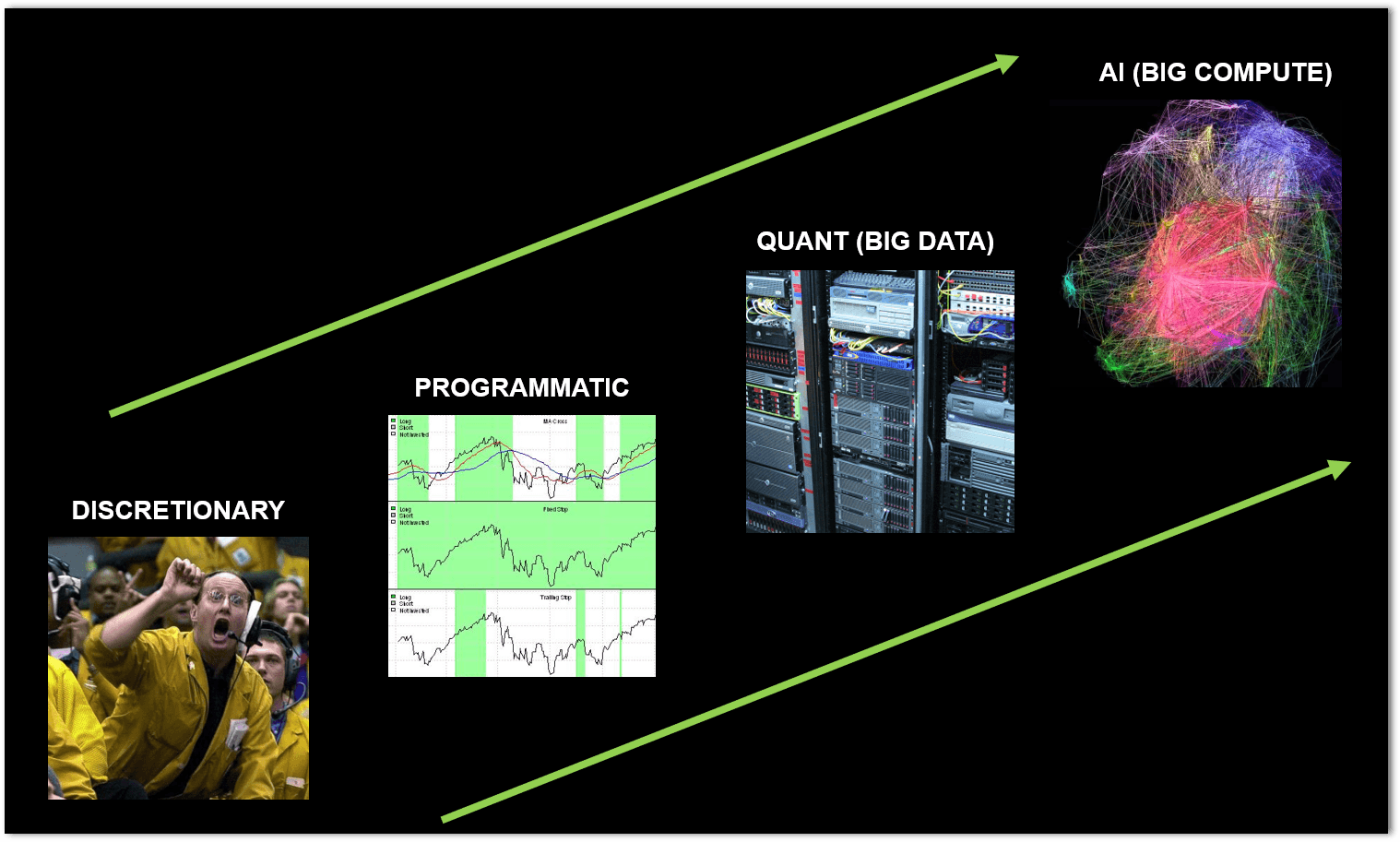
If you're not moving up and to the right in the STORY that you tell others (and yourself) about your product-oriented IP, you cannot maintain pricing power in a dislocated market.
Why not? Because the WHY of your IP doesn't fit the expectations that your customers have for how IP works to protect your product. If you don't fit the zeitgeist, no one will believe that your castle walls exist. Even if they do.
Case in point: there was a day not so long ago when the strong common knowledge (what everyone thinks that everyone thinks) about hedge fund titans like Soros and Druckenmiller and Cooperman and Einhorn and Lampert and Cohen and Paulson and Jones and all the rest was they they had really strong castle walls. Seriously, read some of the articles that have been published about these guys and their firms over the years ... popes and saints have not had more wondrous admiration. They were smarter and more attuned to markets than the rest of us mortals in some superhuman way, and they hired other superhumanly smart and plugged-in people to create veritable superteams at their hedge funds. THIS was their IP, and it commanded a premium price for their products.
Ten years ago, everyone knew that everyone knew that these guys had found the Holy Grail.
Since then ... well, none of these guys got stupid. All of these guys, and I've met a lot of them, actually ARE superhumanly smart and plugged-in. None of these guys stopped hiring superhumanly smart and plugged-in people. But NO ONE thinks of human brains as defensible IP any longer. No one. And so these guys no longer have pricing power on their investment products. At all. And so they become "family offices", which is the accepted euphemism for "shutting down because I can't support my operational cost structure on the back of the few suckers loyal investors who are price insensitive committed to a commodity product to our proprietary process."
Instead, the mythic IP today belongs to firms like Two Sigma or D.E. Shaw or Bridgewater or Point 72 (Stevie Cohen's reinvention of SAC in a quant wrapper ... Stevie gets it) or any number of quant shops that employ algorithms! or Big Data! or stat arb! to drive their investment process. Everyone knows that everyone knows that THIS is where the serious IP lives today. Everyone knows that everyone knows that it's worth the extra fees to get inside the castle walls with these guys.
They've found the Holy Grail.
But here's the thing ... have you looked at the actual performance of the quant shops with mythic IP over the past few years?
[whispers] it's not that great.
But. It. Does. Not. Matter. All of these guys are doing just fine with their AUM and operational cost structures, thank you very much.
Trust me, no one is having much fun when performance is mediocre, but here's the crucial difference: mediocre performance for a Quant manager means extending the lease on the X5 for another year and taking the kids to Disneyworld instead of Paris ... somehow you'll survive. Mediocre performance for a Discretionary or merely Programmatic manager, on the other hand, is a death sentence.
Similar product performance. Entirely different business results.

Run away!
That's what zeitgeist-compliant IP can do for you. It can shield your product-oriented business when your entire industry is being disrupted. You live to fight another day.
Of course, ten years from now we'll be talking about the mythic quant shops in the same way we're talking about Druckenmiller and Einhorn and Lampert today ...
But that's the role of IP on the product side of the financial services industry. It's a life preserver if you stay in front of the zeitgeist wave.
On the client-facing side, though, it's a money pit. It's a siren call. Technology IP is how you think you're going to be able to scale your business. But somehow it just never works out as planned.
Case in point: there was a day not so long ago when the strong common knowledge (what everyone thinks that everyone thinks) was that robo-advisors would inherit the financial advisory earth. After all, margin compression in a disrupted industry like financial services is not only an asset management problem, it's a wealth management problem, too. Fee structures have been slashed in the wealth management world - not as severely as in the asset management world, but slashed all the same. To support their operational cost structure, a financial advisory group need clients with a higher and higher average asset base on which they can charge their lower and lower average fees, and as a result every big name wealth management shop has raised their minimums to take you on as a client. Today it's not enough to be kinda sorta rich and get the dedicated relationship service of a big name advisory group. You've got to be seriously rich. And liquid. If you're kinda sorta rich today, which goes by the term of "mass affluent", you get the junior squad. Or better yet, you get the machine.
Now let me be really clear here. I think the robo-advisors - at least all the ones that I'm aware of, operating on their own brands or on a white label basis for one of the big name advisory groups - give perfectly fine financial advice. I do NOT think that you are getting shortchanged in the quality of your investment advice versus the high-touch concierge relationship service of a senior wealth management team.
But you will feel like you are.
No one has loyalty to a robo-advisor. There is no relationship here, beyond whatever halo effect is generated by the brand label on the machine. And believe me, halo effects are the first and immediate casualty of a market correction. If there's not a human being there to hold your hand, filled with gravitas and concern and smart answers to your smart questions ... you are outta there when a bear market hits. I don't care how much you swore up and down that you were a long-term investor and trusted the process and yada, yada, yada. You are gone. Because there's always another advisor to choose from. You're still a long-term investor. Just with a new advisor.
Why is this non-stickiest of non-sticky relationships between human investor and machine advisor a business model problem?
Because it costs so much money to acquire an advisory client.
My guess is that it costs a standalone robo-advisor north of $400 to acquire a new customer. Maybe I'm wrong. I'm guessing this based on filings from publicly-traded banks and wealth management firms, which is admittedly a bit of an apples and oranges thing. I'm guessing this based on what I've seen on VC funding for robo-advisors, allocations for customer acquisition, and total reported customers, which is admittedly a spotty thing. So maybe I'm wrong. But I don't think so.
High customer acquisition costs plus low customer stickiness is obviously a high-risk business model. I liken it to a beautiful tropical orchid grown inside a greenhouse here in New England during the winter. It's an expensive proposition, and if you accidentally leave the greenhouse door open and let the cold February air inside ... well, you've got a dead orchid. Your bet here is that you can keep the greenhouse powered and intact forever and ever. Or at least powered and intact until you can sell the orchid to someone else. That's the game. Same as it ever was. Fortunes have been made on worse bets. But there's no pricing power here. Just a Greater Fool game.
Can you grow a hardier orchid? Maybe.
There's not much a financial advisor can do to reduce the customer acquisition cost, but maybe there's something you can do to strengthen the client relationship. Not with technology IP, but with content IP. And not with content IP in the way that asset managers and wealth managers typically think about "content", as if it were some widget that can be mass produced on command, but with content IP that is authentic and honest and worthy of supporting a client relationship.
Frankly, that's the most valuable use case, to employ one of those horrid VC terms, of Epsilon Theory. We arm financial advisors to have better conversations with their clients. Not so you can have MORE clients, but so that you can have STRONGER clients.
Everyone wants to use technology IP to scale client relationship BREADTH.
A better game?
Use content IP to scale relationship DEPTH.
That's where pricing power rests in a disrupted industry.

Next up … beware the Beast of Caerbannog. Sure, it looks like a cute little bunny, but those teeth! … the pricing power found in collaboration with the State.


Comments
Market downturn?
“Run Away! Run Away… :)” {Apologies to Monty Python}
Perhaps a way for robo-advisors to stop knee jerk sell actions by clients is behavioural “nudges” like exit fees or phased withdrawals to keep the investor on track. The problem given past fee excesses by the industry this will look very self serving. Another approach are loyalty bonuses but this will eat margins. Nevertheless, you are right Ben given how much money has flown into passive at the market valuation tops, the next correction will test investor resolve and market liquidity. We might see an “Beast of Caerbannog” asset fire sale spiral in stocks widely held in indices.
Family owned stock with poor free float, not in indices as they do not aid index companies create ETF product or indices, may be better havens when market crunch hits.
Continue the discussion at the Epsilon Theory Forum...