
SpaceX is Breaking Capitalism (& Indexing)
May 11, 2026·Money
Here’s a nice story.
Once upon a time, companies went public to raise money. You’d go on a road show to pitch your story and drum up interest, you'd float a big pile of stock, and then you’re off to the races to go build your company. It’s the point of the Securities Act of 1933. On signing, FDR commented:
“If the country is to flourish, capital must be invested in enterprise. But those who seek to draw upon other people’s money must be wholly candid regarding the facts on which the investor’s judgment is asked.”
This isn’t a far-off fairy tale. The average IPO during the dot-com boom was for a paltry $100 million. Even at the peak of insanity in 1999, when 482 new companies launched, the average IPO size was still only $128 million ($250mm inflation adjusted).
It’s not that large companies didn’t exist: The S&P 500 added Office Depot in 1999 with a valuation of $8.4 billion. The companies tracked by the S&P 500 were worth roughly $12 trillion back then versus about $60 trillion right now. But most companies IPO’d as small caps — to raise actual capital — and aged up into the world’s largest index.
No longer. Private companies can now raise money privately for as long as humanly possible, then use the IPO market as the cash-out window. Private investors capture the compounding; public investors inherit the operating concern.
Even the less visible IPOs now follow this pattern: Arxis, a defense contractor/industrial/medical mashup that’s hardly a household name, just floated about 10% of their shares to a valuation of $11 billion, an almost quaint number for an IPO these days. But even Arxis is just part of the Private Equity train – it’s a speedy 6-year roll up of over 30 companies mashed together by PE firm Arcline.
Why Give a Hoot About SpaceX?

SpaceX is a private company owned by Elon Musk (~42%), insiders, and private investors. According to the leaked S-1, Elon and other insiders own super-voting shares, meaning Elon has approximately 79% control. SpaceX launches stuff into space for money, and charges people for using their orbital assets (Starlink). They’re good at both of these things, and based on the very, very limited info we have pre-IPO, they lose about $5B a year since the acquisition of xAI on about $18.5B in revenue, give or take. SpaceX’s bankers think the company is worth ~$1.75T, and are floating around 5% (~$75-85B) although these numbers seem to change weekly.
I love space! I watch every launch! And if people want to own SpaceX because they love space and Elon and believe he’s putting 1 million humans on Mars before he dies, that’s awesome! I think reasonable people can disagree about whether the firm is, right now as an operating business, worth more than, say, all of Australia, or worth more than the entire REIT space, or worth 9 times the entire airline industry (which the valuation would imply). But by all means, let's get it into public hands!
But the real reason there’s so much attention on SpaceX is that everyone seems to believe there’s some sort of winner-take-all moment right now. As if getting in early on SpaceX is a once in a lifetime moonshot for the average mom and pop investor.
Poppycock. That might be true if you got A-round shares. Now, best case, the public gets 5% of trading shares (which vote as .5% compared to Elon). That’s bag liquidity for the insiders, not “raising capital.”
The NASDAQ Problem
Most people think of Nasdaq, or S&P, or MSCI ,or any major index provider as a maker of lists. While there’s some truth to that, the reality isn’t so simple because the numbers are so big.
S&P estimates that $13 trillion is algorithmically tracking the S&P 500, with a potential total ecosystem of about $20T (including benchmark huggers). The NASDAQ-100 ecosystem (primarily the Invesco QQQ’s suite of products and derivatives) is another $1.5 trillion or so. So while they may just be making up lists of stocks based rules, those rules matter, because they push Capital-T-Trillions of dollars around.
Nasdaq is flipping the expected script with their recent rule change consultation and ultimately a new Nasdaq-100 methodology (effective May 1, 2026), all of which are designed to lure SpaceX to list on Nasdaq, so they can get into the index.
First, under the new rules, simply because an IPO is big enough to crack the top 40, the company can skip the 3 month aging-window and be included in the 100 in just 15 days. Second, because SpaceX is floating such a minuscule amount of the firm, they abandoned the old floor of how small the float could be and included any megacap at 3X their implied float, up until 33% is floated, (at which point the math stops and it's just at full weight). Yes, this is better than just ignoring float altogether, but no, it's not as good as a consistent rule (like most other indexes apply).
In hard terms: SpaceX will likely have around a 0.44% weight, times $1.5 Trillion ecosystem. That's a $6.2 billion Market-on-Close order by index-trackers, 15 days after the IPO. That’s just under 10% of the available shares, and everyone knows this trade is coming. Any price discovery that happens on SpaceX price in the 15 days between IPO and inclusion day will just be warehoused speculation. Actual price discovery won’t happen until well after that dust settles.
To make matters worse, we have no clue about what happens next. At some point, the other 95% of SpaceX that will eventually hit the tape. There are rumors of price-dependant employee unlocks, accelerated unlocks, 90 day windows, 180 day windows. It’s safe to assume some number of shares will be unlocked between the IPO and the Nasdaq-100 rebalance on September 21, 2026. If another $75B in shares get sold by insiders? Well there’s doubling of the weight the Nasdaq-100 will need, so that's another big one-day buy in September of $6 billion.
Every share that gets unlocked and floated ratchets up the weighting.
Float Sold | % Float | Nasdaq-100 Weighting Value | Approx NDX Weight | Implied NDX Ecosystem Holdings |
|---|---|---|---|---|
$87.5B | 5.0% | $262.5B | ~0.44% | ~$6.2B |
$175.0B | 10.0% | $525.0B | ~0.88% | ~$12.4B |
$350.0B | 20.0% | $1.05T | ~1.75% | ~$24.7B |
$583.3B | 33.3% | $1.75T | ~2.9% | ~$40.9B |
Assumptions: $1.75T SpaceX valuation, roughly $60T Nasdaq-100 modified market-cap denominator, and roughly $1.41T of total Nasdaq-100 ecosystem exposure. Below 33.3% free float, Nasdaq weighting value is capped at the lesser of listed market cap or 3x free-float market value. At 33.3%, the cap ceases to bind.
I feel extremely confident that flows of this size will impact pricing (probably overperforming into inclusion, underperforming after inclusion, but honestly who can predict with Iocaine Powder problem like this) because extremely good academics have published numerous papers observing this exact effect of changing seasoning dates for index inclusions. So index investors should be annoyed, honestly, because not one word of the above is about whether SpaceX is a good idea for you, the Nasdaq-100 ETF shareholder. It's just about convincing SpaceX (and the Megas to follow) to list on Nasdaq.
As famed investor George Noble put it in his Substack:

“This is the most SHAMELESS structural manipulation of a major index I’ve ever seen.”
S&P Piles on
Not to be left out of the headlines, America’s most storied index (and by far the world's most tracked), the S&P 500, decided to play this game too. The S&P is the least passive of our index celebrities – its not a rulebook that decides who’s in, it’s a committee. A big part of both the rulebook and the committee process has always been to give some assurance to investors that there were adults in the room. From 1989 to 2019, I could sleep at night knowing that David Blitzer, chair of the world’s most important Committee, was running a tight ship, and wasn’t going to let shenanigans hurt investors.
And the rules are common sense: companies had to wait a year to even be considered. They had to have 10% free float, and they needed to be real companies. The differentiating gem of the S&P 500 has been the financial viability standard (currently, positive GAAP earnings for the past four quarters).
And so of course now they’re thinking about abandoning all that. For those special status megacap companies like SpaceX, they’re proposing cutting the window to 6 months, getting rid of any free float requirements, and just ignoring any measurement of financial viability.
This is admittedly less of a hair-on-fire restructuring of the rules than the Nasdaq-100 recently proposed, and because the S&P already adjust constituent weight by float, it would suffer far less of the “cliff liquidity” issue. And while David is no longer the benevolent bow-tied overseeing nerd in charge, I know S&P CEO Catherine Clay to be as straight-shooter as they come, so I have high hopes for continued clear thinking when the committee actually makes decisions.
But still… I’d like to suggest “No” as a good response to this request for comments. No, let’s NOT abandon financial viability as a reasonable line in the sand for the worlds most important index.
The SPV Front Runners
At the risk of deceased equine abuse, both of these questionable index moves come while the non-indexed part of the ETF market is scrambling to paint the SpaceX logo on everything, in the hope of capturing hype-addled market junkies. While it’s theoretically possible to have private shares on the balance sheet of a ’40 act fund (or indeed, up to 15% of nearly anything illiquid), what most firms do is use a very, very lightly regulated trust called a “Special Purpose Vehicle.” SPVs themselves can be either completely benign, fee-less, and covenant-less holding shells, but they more often have layers of carry, fees, carve outs, and conditions that we lowly end investors don’t even get to ask about. (A good rule of thumb? Never invest in a vehicle where you aren’t allowed to ask questions about fees.)
ERShares XOVR is the poster child for this opaque SPV approach, as Sumit covered most recently, It currently says it holds 22% of the fund in a Special Purpose Vehicle holding SpaceX exposure of some kind, which is both in violation of the liquidity rules, and hard to prove, given their utter lack of transparency on valuation, fees, holding companies, carry and a host of other issues. I’ll simply point you to Morningstar’s Jeff Ptak and his attempt to explain the inexplicable valuations from XOVR over the past year:
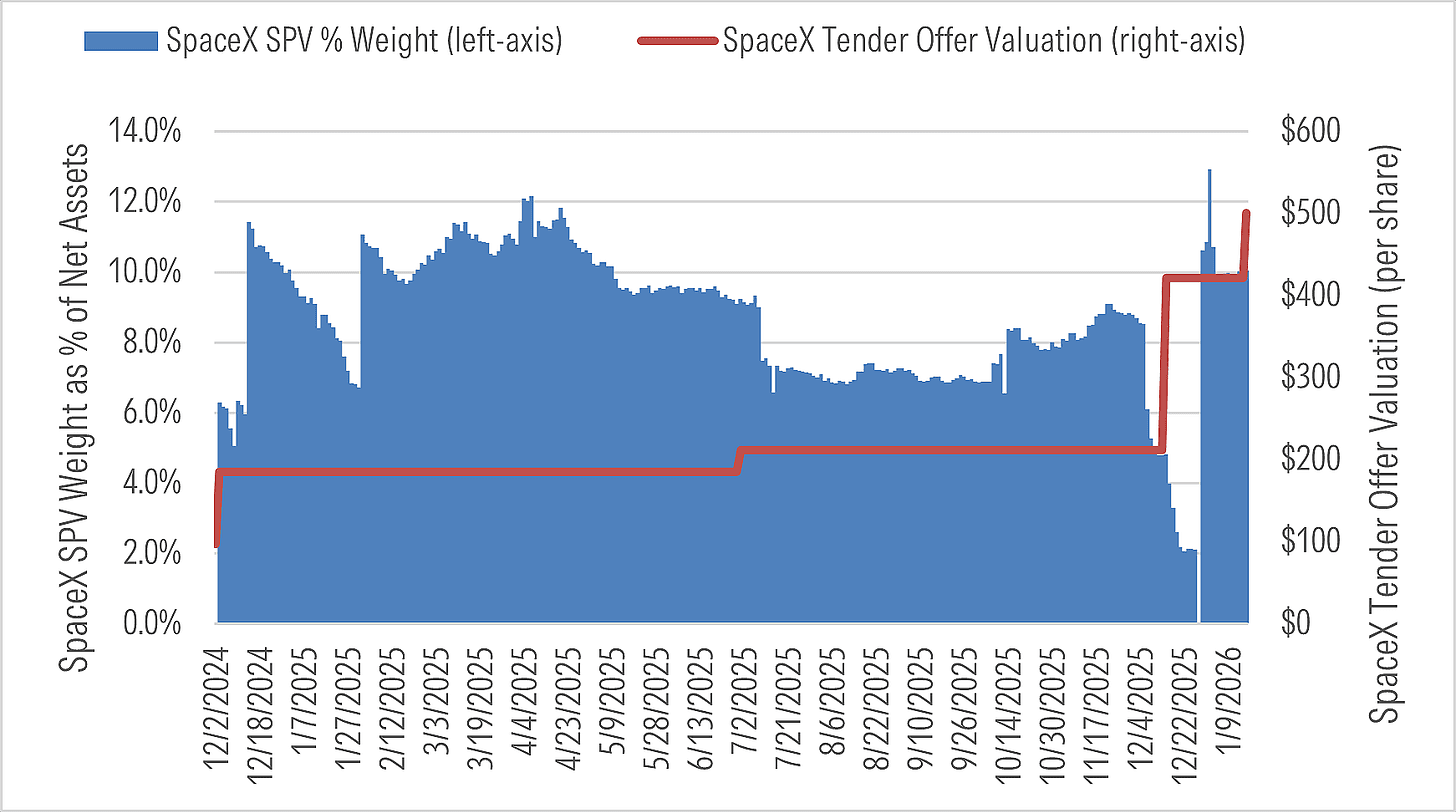
“For all the manager’s attempts to cast it as a “reset”, it seems like there are only a few possible explanations for the present circumstances:
- They got crushed by fees
- They got massively diluted
Either way, absent some better explanation, it sure seems like the manager misrepresented the economic substance of XOVR’s participation in SpaceX equity.”
In other words: Shenanigans.
XOVR isn’t the only one playing this game: Baron has SpaceX in some of their funds, as does pretty much every space ETF. Heck, Defiance has a 2X version of XOVR already and before SpaceX has even launched, we’ve got filings for “Income Blast” ETFs based on SpaceX! Exactly as FDR intended!
The main point is: there are no lack of ways to get your SpaceX fix, whether it's now or later. You don't really need your big index provider to jump the gun.
It’s Pay Attention Time
So what do you, constant reader, do about all this?
Have an opinion.
Whether you’re sitting in target date funds or day-trading your portfolio, this is going to be a big year for IPOs. You can absolutely just ostrich-up, stick your head in the sand, and allow the system to evolve. In that case you will be at the end of this wild chain of events, hanging on to your S&P or Nasdaq-100 exposure, however this new seemingly in-cahoots Issuer-Indexer regime decides you get to play.
Or, you could make an active choice to avoid – or double down – on these spasms of market capitalism. If you’re fired up about SpaceX (or think you understand the flow mechanics well enough to call the entry and exit), there are lots of people trying to sell you that dream. And if you're skeptical? You can pick ETFs that will avoid all this until the dust settles.
But no matter what you do, you’re making an active bet in choosing your passive provider in 2026. This has always been true to some extent: indexes evolve. Nasdaq has changed their rules at least 5 times that I can think of since the 1980s. Heck the S&P 500 didn’t even introduce full float adjustment until 2005!
But IPO inclusion should be a choice, not an auto-buy. You get to make your own decisions, and in this increasingly trustless world, you can no longer just assume that anyone’s got your best interests in mind.
Originally published at ETF.com