
Sports Pulse
May 6, 2026·0 comments·Sports
Sports Gambling Backlash, College Athletics in Regulatory Crosshairs, and the High-Stakes Economics of Global Mega-Events Define the Spring 2026 Sports Narrative
Executive Summary
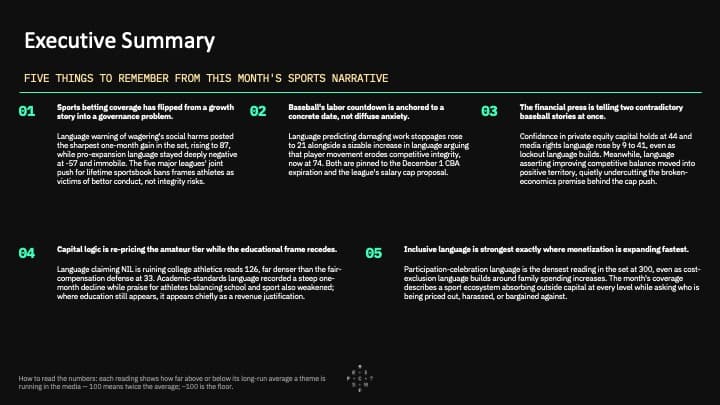
- Anti-gambling media sentiment has strengthened considerably this spring, while pro-gambling language has retreated, producing one of the widest asymmetries across Perscient's sports betting semantic signatures. Federal indictments of players, research linking legalized mobile betting to rising personal bankruptcies, and bipartisan legislative momentum toward restricting proposition bets and prediction markets have all fueled the shift. Despite this evolving discourse, legal wagering volumes continue to climb—the AGA projects a 54% increase in March Madness handle over just three years—creating a tension between market growth and reputational risk that sports organizations can no longer ignore.
- The debate over college athlete compensation has moved beyond whether athletes deserve payment and into a contested fight over who writes the rules. Media language arguing that NIL deals are ruining college athletics has intensified to more than double its long-term average, yet language supporting athlete pay has also strengthened—reflecting a discourse in which both alarm and advocacy are escalating simultaneously. A White House executive order threatening federal funding, a pivotal May 27 hearing on the College Sports Commission's enforcement authority, and the continued erosion of amateurism guardrails all suggest that the regulatory architecture of college sports is being rewritten in real time, while the traditional case for amateurism continues to fade.
- The approaching 2026 FIFA World Cup has amplified a dual narrative in which enthusiasm about mega-event economic benefits coexists with sharper scrutiny of who bears the costs. Language asserting that hosting justifies financial burdens has strengthened alongside language criticizing public subsidies for private gain. Host cities face hundreds of millions in expenses while FIFA projects billions in revenue, and local officials have begun pushing back publicly on the cost-sharing model—even as broader media sentiment about sports' community value and unifying power remains firmly positive and the financial-disaster framing has failed to gain traction.
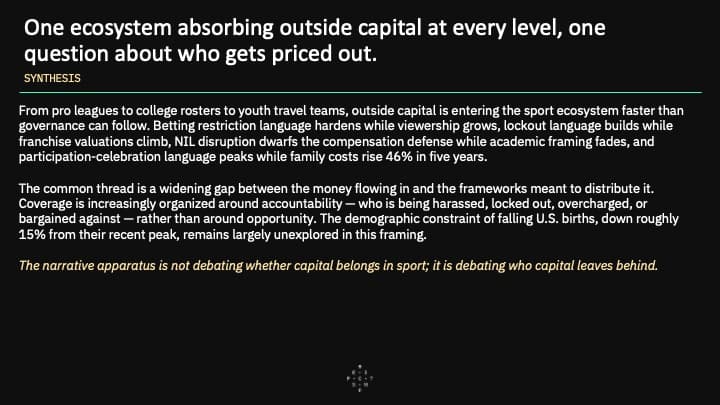
- Across all three domains—gambling, college athletics, and global mega-events—a common pattern has emerged: commercial expansion in sports continues to accelerate, but media scrutiny of who profits, who pays, and who regulates is intensifying at a comparable pace. Federal and state governments are stepping in with greater force, whether through proposed gambling legislation, an executive order targeting NIL and athlete mobility, or municipal pushback on World Cup funding structures. The spring 2026 sports narrative suggests that the era of lightly governed sports commerce is giving way to a more contested and interventionist environment in which reputational and regulatory risk demand as much attention as revenue opportunity.
---
A Growing Anti-Gambling Consensus Amid Scandals, Federal Legislation, and Regulatory Pressure
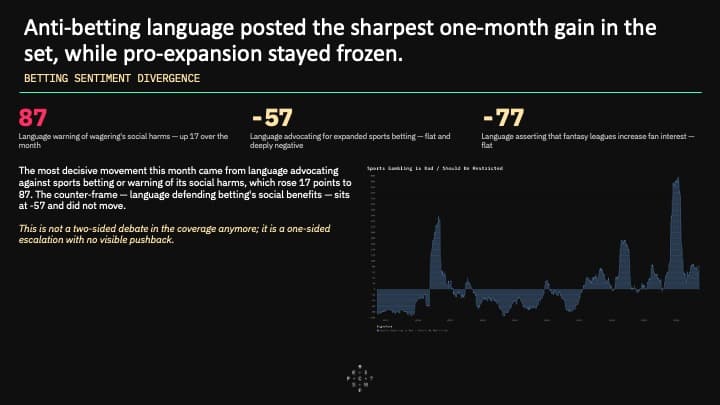
The media conversation around sports betting has shifted meaningfully over the past month. Perscient's semantic signature tracking the density of language advocating against sports betting or warning of its social harms rose by 13.0 points to an index value of 66, well above its long-term average. At the same time, our semantic signature tracking language advocating for expanded sports betting or defending its social benefits declined by 9.0 points to an index value of -54, well below its long-term average. The simultaneous strengthening of anti-gambling language and retreat of pro-gambling language marks an asymmetric shift in the discourse that any sports organization executive should take seriously.
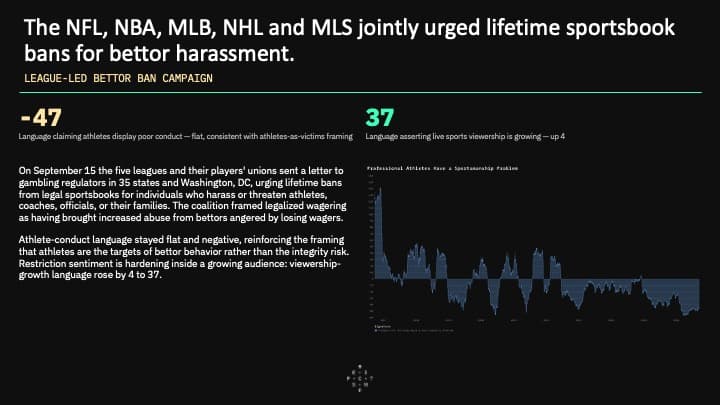
A series of high-profile betting scandals has kept the issue in the headlines for months. Federal prosecutors in Brooklyn have expanded their case against former NBA player Terry Rozier, announcing plans to file a superseding indictment adding charges of sports bribery and fraud. Journalist Pablo Torre reported from a recent dismissal hearing that the government alleges that Rozier "solicited and accepted a bribe." The Rozier case is not an isolated incident; federal probes have now ensnared roughly 30 current and former men's Division I college basketball players. On the college side, reports surfaced that the Cincinnati athletic department was alerted to quarterback Brendan Sorsby's gambling activity prior to the 2025 season, raising questions about institutional accountability.
Public opinion has tracked this discomfort. An October 2025 Pew Research poll found that 43% of U.S. adults now say that legalized sports betting is a bad thing for society, up from 34% in 2022, while 40% say that it is a bad thing for sports, up from 33%. One widely cited finding holds that when states introduce online sports betting, the likelihood of personal bankruptcy climbs by 25%, and roughly 30,000 additional bankruptcies per year occur in states with legal online betting. University of Virginia professor John Holbein put it bluntly, writing that "the legalization of mobile sports gambling in America was a policy mistake and that the evidence is now clear enough to say so".
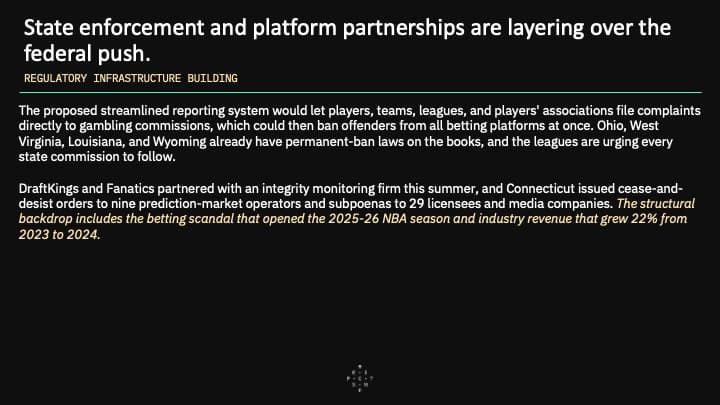
A Senate committee has scheduled a May 20 hearing on unregulated sports betting growth, and proposed federal legislation such as the SAFE Bet Act would establish federal minimum standards, including banning proposition bets on college and amateur athletes and restricting AI-driven marketing. Representative Baumgartner noted the explosion of sports gambling on college campuses, reaffirming his push to ban prop bets on college athletes. NCAA President Charlie Baker has called on remaining states to ban "risky bets," and a top NCAA official pushed back on criticism that the organization has not done enough to fight gambling. Meanwhile, a bipartisan coalition of 38 attorneys general has filed an amicus brief supporting Massachusetts' lawsuit against the prediction market platform Kalshi for illegally offering sports betting, a platform whose users bet over $1 billion per month in 2025, with 90% of that volume on sports.
Despite this rising skepticism, the market itself continues to grow. The AGA projects that Americans will legally wager approximately $3.3 billion on the 2026 March Madness, a 54% increase from just three years ago. Sports betting is now legal in 39 states plus Washington, D.C., with 30 states offering online or mobile wagering. Yet multiple states have raised taxes since launching sports betting, and the regulatory atmosphere is tightening. The widening gap between Perscient's two gambling-related semantic signatures, now spanning over 119 points, reframes the gambling environment from one of expansion and partnership opportunity toward one demanding careful reputational risk management.
NIL, the Transfer Portal, and a White House Executive Order Converge on the Future of College Athletics
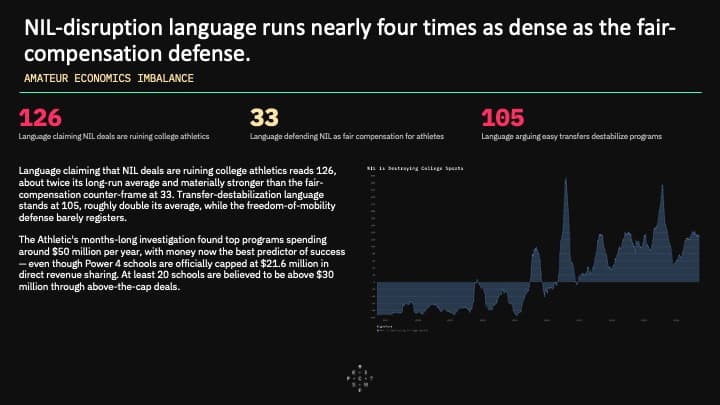
The regulatory spotlight on college athletics extends well beyond gambling, as the NIL economy and transfer portal generate their own polarized narratives. Perscient's semantic signature tracking language claiming that name, image, and likeness deals are ruining college athletics carries an index value of 133, more than double the long-term average, and rose another 7.1 points over the past month. Simultaneously, our semantic signature tracking language asserting that NIL rights provide deserved payment to college athletes strengthened by 9.9 points to 20. Both sides of the NIL argument are intensifying at once, reflecting a debate that has moved well past whether athletes should be compensated and into the thornier territory of who writes the rules.
The April 3, 2026 executive order titled "Urgent National Action to Save College Sports" represents a significant escalation. The order targets NIL and athlete mobility with federal funding on the line, threatening to pull support from schools that do not comply by August 1, 2026. One social media commentator summarized that the order would impose five years of eligibility with a hard cap, one penalty-free transfer, and new NIL standards tied to "fair market value," and that legal challenges were already being prepared. Archer Greiner's legal analysis raised significant questions around NIL, antitrust, and administrative authority, underscoring how deeply the federal government has waded into what was once a matter of collegiate self-governance.
The NIL economy itself has ballooned. Across all college sports, it is estimated at approximately $2.7 billion in 2026, with around $1.9 billion flowing directly to athletes. Under the NCAA settlement, each school can pay its student athletes up to $20.5 million in the 2025-26 school year, a cap rising to $32.9 million by the end of a 10-year agreement. But what started as a way for student athletes to earn compensation has, as one analysis put it, "become a free market pay for play model without many guardrails." An expert at Ohio University characterized the current environment as "the Wild West," noting that the NCAA has lost a string of courtroom battles over the past two decades.
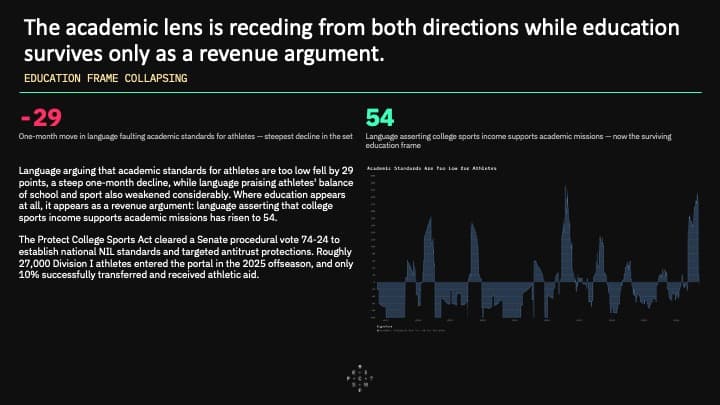
A pivotal hearing set for May 27 will test the enforcement power of the 10-month-old College Sports Commission. At issue is how NIL deals, "which are supposed to be about name, image and likeness but are often about recruitment and retention," are permitted or prohibited. Athletes' attorneys have argued that the Commission has been "over-zealous" and "over-bureaucratic" in its reviews, while the Nebraska football case will put these tensions squarely before a judge. The NCAA's recent decision to eliminate its prize-money rule to settle a lawsuit pushed by tennis players further illustrates the erosion of traditional amateurism guardrails. Perscient's semantic signature tracking language arguing that college athletes should not be paid sits at -35 and continued to weaken, declining by 3.5 points, suggesting that the traditional case for amateurism is fading even as concerns about commercialization remain elevated.
The transfer portal adds another layer. Perscient's semantic signature tracking language arguing that easy transfers destabilize college sports programs and competition stands at an index value of 135, among the strongest readings in the dataset, though it moderated by 11.1 points from the prior month. Our companion signature tracking language asserting that transfer flexibility gives college athletes deserved mobility declined by 6.0 to 43. The chaos framing still dominates, but some structural reforms may be tempering the conversation: the NCAA eliminated the spring transfer portal for Division I football starting in the 2025-26 school year, leaving only the winter window. Still, when some 4,500 players entered the football portal on its first day, the scale of movement underscored why the chaos framing persists. Several commentators captured the sentiment, with one writing that "NIL, portal, realignment, playoff expansion" have collectively undermined the game and fan experience.
The Costs and Rewards of Global Mega-Events Shape a Complex Economic Narrative Heading into a Landmark Summer
The economics of who pays and who profits—a tension running through the college athletics debate—also defines the narrative around global mega-events as the 2026 FIFA World Cup approaches. Perscient's semantic signature tracking language arguing that hosting international sports events justifies any financial burden rose by 14.6 points to an index value of 35, reaching its strongest level in recent months. At the same time, our semantic signature tracking language arguing that public stadium financing exploits taxpayers for private gain strengthened to 16, up by 5.2 points. The concurrent rise of both signals reflects a media environment in which the value proposition of hosting and the fairness of who pays are being debated simultaneously.
Total revenues for FIFA's four-year financial cycle culminating in the 2026 tournament are expected to reach approximately $13 billion, with about $9 billion generated during the tournament year alone. FIFA has received more than 500 million ticket requests for only about 7 million available tickets, and the organization is reportedly considering increasing prize money for participating countries given the enormous revenue projections. Yet U.S. host cities have agreed to shoulder hundreds of millions of dollars in costs. One analysis detailed that cities are subsidizing a World Cup expected to generate $11 billion in profits for FIFA while seeing no slice of game-day revenues from tickets, concessions, merchandise, or parking. A Forbes report noted that host cities are grappling with costs reaching up to $200 million per city, forcing cuts to fan events and exposing widening funding gaps.
FEMA has stepped in with $625 million in security grants for the 11 cities across nine states hosting matches. The Texas Department of Public Safety announced that it would deploy advanced drone detection technology across Dallas and Houston using $3.2 million in FEMA funding. However, local officials have pushed back on the broader cost structure. A Foxborough official stated that "the significant costs associated with hosting the World Cup cannot fall on local taxpayers", and Santa Clara officials have emphasized that they are not spending taxpayer money on World Cup upgrades. One economist captured the tension: "There's no reason that a $5 billion nonprofit company from Switzerland should be receiving a bunch of handouts from Massachusetts taxpayers." Social media commentary amplified these concerns, with one user noting that "FIFA gets all the ticket sales" while cities absorb security, infrastructure, and rebranding costs, predicting that "the sales tax revenue won't balance out."
Yet the broader public narrative about sports' community value remains resilient. Perscient's semantic signature tracking language asserting that professional franchises generate positive economic impact for cities holds at an elevated index value of 90, up by 4.3 points. Our semantic signature tracking language asserting that sports unite communities or bridge social divisions also strengthened to 37, up by 5.7 points. New York City Mayor Eric Adams announced free FIFA fan events in all five boroughs, and the World Economic Forum highlighted the tournament's potential for jobs, growth, and broader social benefits. Perscient's semantic signature tracking language asserting that Olympic Games bring nations together rose by 10.9 points to 55, buoyed by the post-Milano Cortina afterglow, while our signature tracking language asserting that supporting national teams creates positive patriotic cohesion remains elevated at 97, though it eased by 10.8 points.
Perscient's semantic signature tracking language claiming that hosting major international sporting events creates lasting economic damage remained flat at -22, well below its mean, suggesting that the financial disaster narrative has not gained broad traction despite the pointed criticisms of FIFA's cost-sharing model. The public still broadly values what sports bring to communities, but a growing, vocal segment of the conversation is asking sharper questions about who captures the upside and who bears the burden.
Archived Pulse
April 29, 2026
- College Sports Face Deepening Turmoil Over Athlete Compensation and Mobility as the White House Steps In
- Sports, Politics, and National Identity Collide at the Winter Olympics and the Super Bowl
- Pro Sports Financial Narratives Shift as Investment Enthusiasm Normalizes, Stadium Subsidies Escalate, and Gambling Integrity Concerns Mount
April 22, 2026
- College Athletics Confront Structural Disruption as Transfer Portal, NIL Narratives, and White House Action Converge
- "Stick to Sports" Sentiment Reaches Its Highest Intensity as Athletes and Politics Clash at the Winter Olympics
- IOC Transgender Athlete Ban Drives the Sharpest Monthly Shifts in Gender Eligibility Narratives
April 15, 2026
- Transfer Portal and NIL Narratives Intensify as White House Executive Order Targets College Athletics Instability
- Transgender Athlete Debate Intensifies on Both Sides as "Athletes Should Stick to Sports" Reaches Its Highest Recorded Level
- Private Equity Narrative Normalizes, Broadcast Deal Conversations Shift to Fragmentation, and Local Economic Impact Debates Gain Traction
March 2026
- Federal Intervention in College Sports Accelerates Amid Rising Concern Over NIL, Transfer Portal Chaos, and the Fate of Non-Revenue Programs
- The "Stick to Sports" Debate Reaches Its Highest Intensity as Olympic Athletes Use the Global Stage to Engage Politically
- Sports Gambling Restriction and Private Equity Investment Narratives Decline from Peaks but Remain Above Average, Signaling a Maturing Debate
February 2026
- The Unifying Power of Sports Rises in a Year of Global Events
- College Sports Face Mounting Pressure as Transfer Portal Chaos and Free Agency Narratives Intensify
- Taxpayer Stadium Subsidies Face Renewed Scrutiny as Youth Sports Development Narratives Gain Ground
January 2026
- CFB Bowl Games: Not Dead Yet?
- Transfer Portal Volatility and the College Athletics Compensation Crisis
- Resurgent Transgender Athlete Debate Reaches Supreme Court
December 2025
- Sports Gambling Restriction Arguments Gain Traction
- Private Equity Sports Investment Narratives Intensify
- College Sports NIL and Transfer Portal Tensions Intensify
- Transgender Athletes Debate Remains Polarized
- Broadcast Rights Deals Show Continued Growth Despite Restructuring
November 2025
- Sports Gambling Restriction Arguments Gain Traction
- Commercialization Concerns Intensify Across Sports
- College Sports Face Financial and Structural Transformation
- Technology and Youth Engagement Show Positive Momentum
- Community and Unity Narratives Remain Stable
Pulse is your AI analyst built on Perscient technology, summarizing the major changes and evolving narratives across our Storyboard signatures, and synthesizing that analysis with illustrative news articles and high-impact social media posts.