"Suicide Bomber" vs suicide bomber
December 29, 2020·Politics
To receive a free full-text email of The Zeitgeist whenever we publish to the website, please sign up here. You’ll get two or three of these emails every week, and your email will not be shared with anyone. Ever.
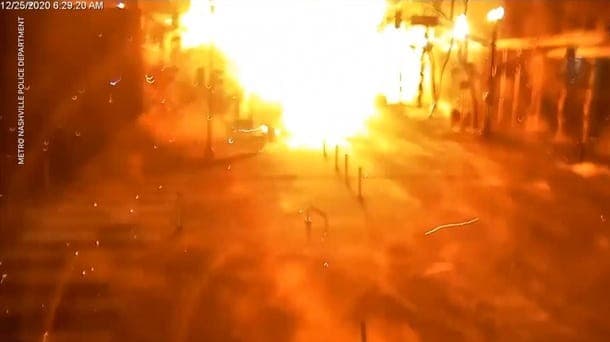
That’s a still from the police camera on 2nd Avenue in Nashville, Tennessee on Christmas morning, capturing the detonation of a large bomb. The bomber was killed, eight people were injured, and massive damage was done to an entire downtown city block, including the destruction of an AT&T telecom hub. Here are some photos of the damage, from a local news twitter feed:
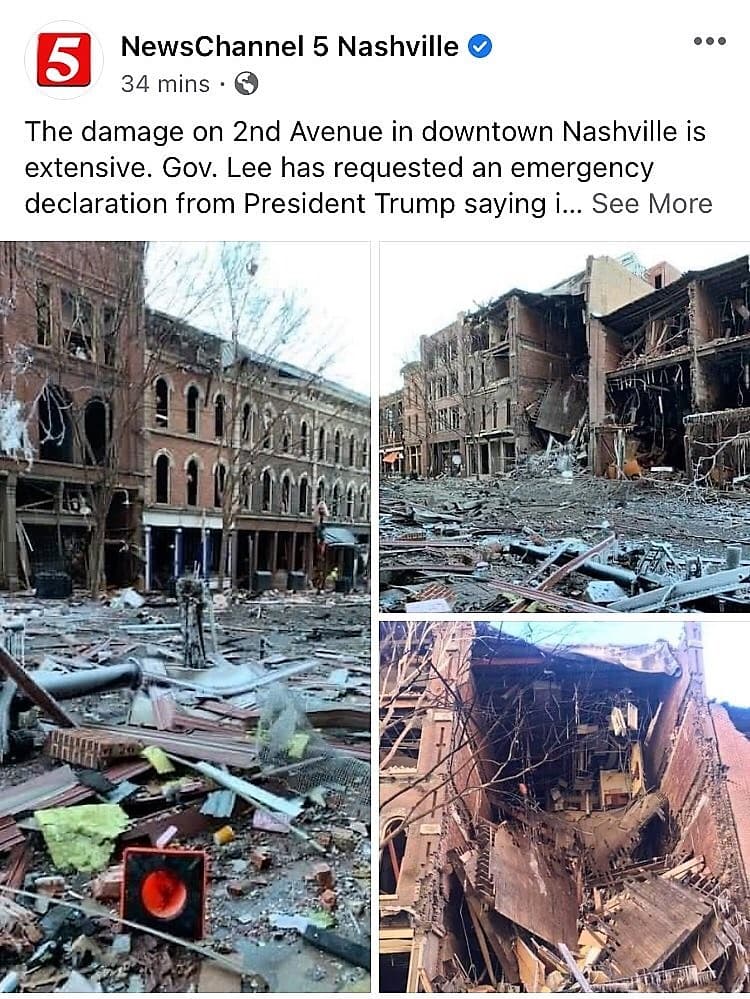
While far less heinous than the 1995 Oklahoma City attack, where 168 Americans (including 15 children) were killed, the Nashville attack was the largest domestic terrorist bomb detonation in 25 years.
It is striking to me how silent the White House has been about this terrorist attack.
It is striking to me how national media has used the language of crime and police procedure in their coverage of the Nashville bombing, rather than the language of terrorism and political response.
The Nashville attack was carried out by a suicide bomber terrorist.
But because the bomber's terrorist goals, whatever they were, do not fit neatly into a useful political narrative like "Antifa!" or "Law and Order!", Trump says NOTHING about the attack, not even to recognize that it occurred or to thank first responders.
At least Biden did that. Even with Biden, though, the bomber's terrorist goals do not fit neatly into a useful political narrative like "Proud Boys!", so we get bromides like "the need for vigilance". And that's that.
So, yes, the Nashville attack was carried out by a suicide bomber terrorist. But not by a "Suicide Bomber". Not by a "Terrorist".
And without a politically charged cartoon to grab eyeballs and attention, national media organizations and national political organizations have next to zero interest in this story. Not completely zero. Maybe some MAGA or Q connection will turn up here, and then they'll get interested again. But as things stand now, there will be essentially zero national news coverage of this event by this time next week.
Here, I'll show you what all this looks like in the Narrative Machine.
Source: Epsilon Theory, Quid
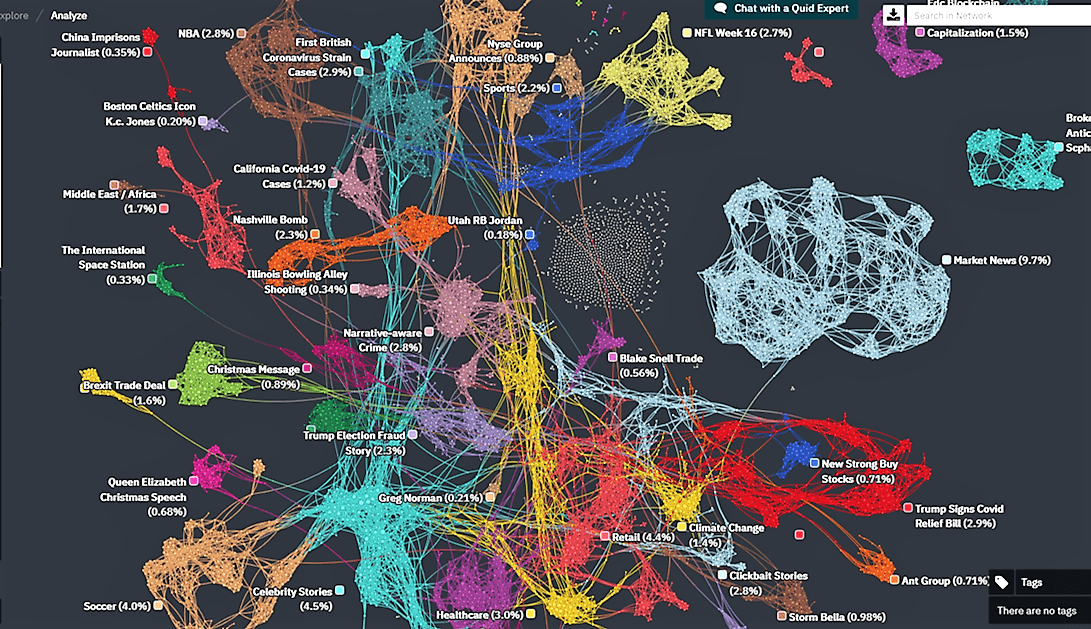
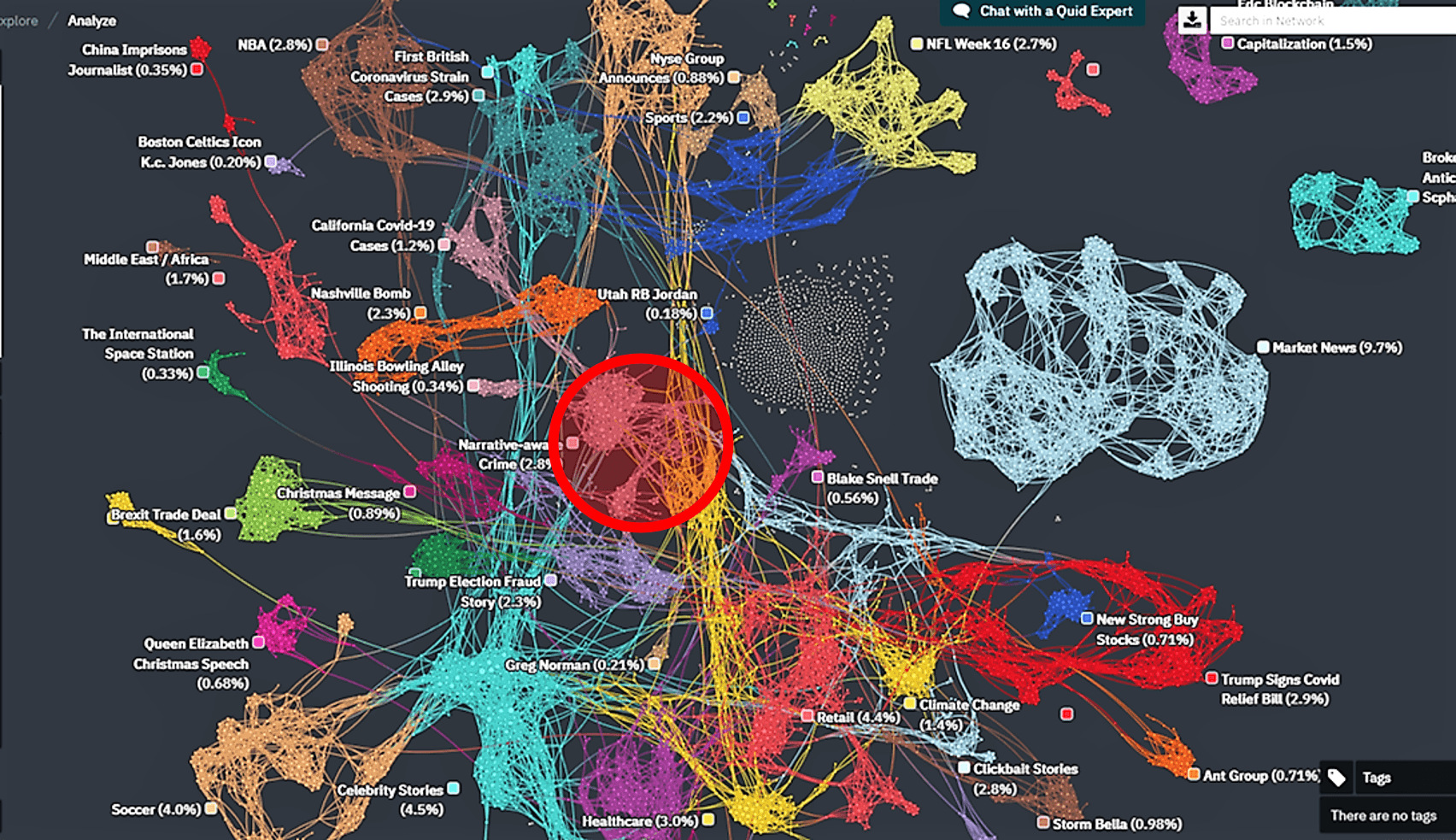
This is a visualization of all unique major US media news stories over the four day period Dec. 25 through Dec. 28, utilizing the Natural Language Processing (NLP) and clustering/visualization software of our friends at Quid (now Netbase Quid, to be precise).
If you were to zoom into this graphic, you'd see that it's composed pointillism-style of thousands of individual dots, each of which represent one of those unique major US media news stories. The individual dots are connected and colored and clustered by their linguistic similarity. I like to think of it like a star map, where the "gravity" of similar words and grammatical structures arranges these individual articles into clusters of similar meaning. Up and down and left and right have no importance in reading this "map". What's important is the centrality of the clusters (the more central you are to the overall map, the more connected you are and the more narrative gravity you're exerting on everything else) and the structure of the clusters relative to each other.
[For more on how to read and apply these narrative maps, see The Epsilon Strategy]
So what we're looking for in terms of narrative importance, roughly speaking, is a combination of size and centrality and connectedness. Just because you're a big cluster doesn't necessarily mean you're an important cluster for the narrative ... for example, Market News, that light blue cluster off by itself on the right, is the largest single cluster in the map, but it's almost completely disconnected from the overarching narrative structure. Ditto for clusters on sports or movies or celebrity news.
Now I'll zoom into the "center of gravity" for the map so we can see these narrative-crucial clusters:
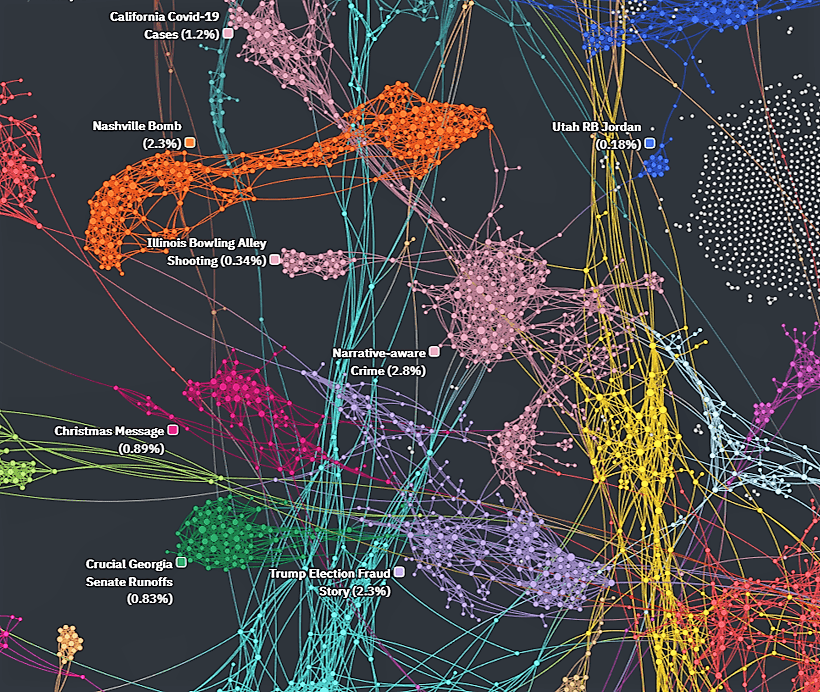
Both the long yellow cluster and the long aqua cluster running vertically through this zoomed-in view of the US media structure over this four day period are general Covid-related clusters. You've got a third Covid-related cluster at the top of this zoomed-in view that's solely focused on California cases and policies ... as you'd expect, Covid exerts more "gravitational pull" on this narrative structure than anything else.
Trump's claims of election fraud are that purple cluster, connected closely to the Georgia Senate runoff election cluster in green. Also as you'd expect. In a technical structural analysis, the Trump Election Fraud cluster is THE center of gravity of this entire map.
The small, central clusters - like the death of star Utah running back Ty Jordan - are always interesting to me. There weren't many stories written about Jordan, but there was something about these stories that "clicked" with the narrative Zeitgeist. Weird, right? But I remember seeing this story when it first came out the day after Christmas, and I immediately clicked on it and read it. I bet a lot of you had the same experience.
The two clusters I want to focus on, however, are the Nashville Bomb cluster in orange and what I'm calling the Narrative-aware Crime cluster in pink.
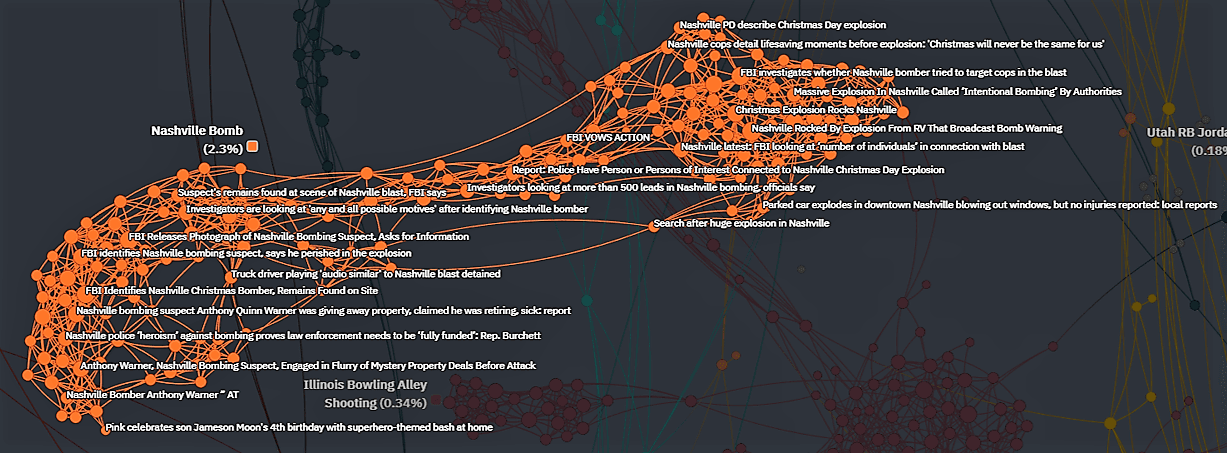
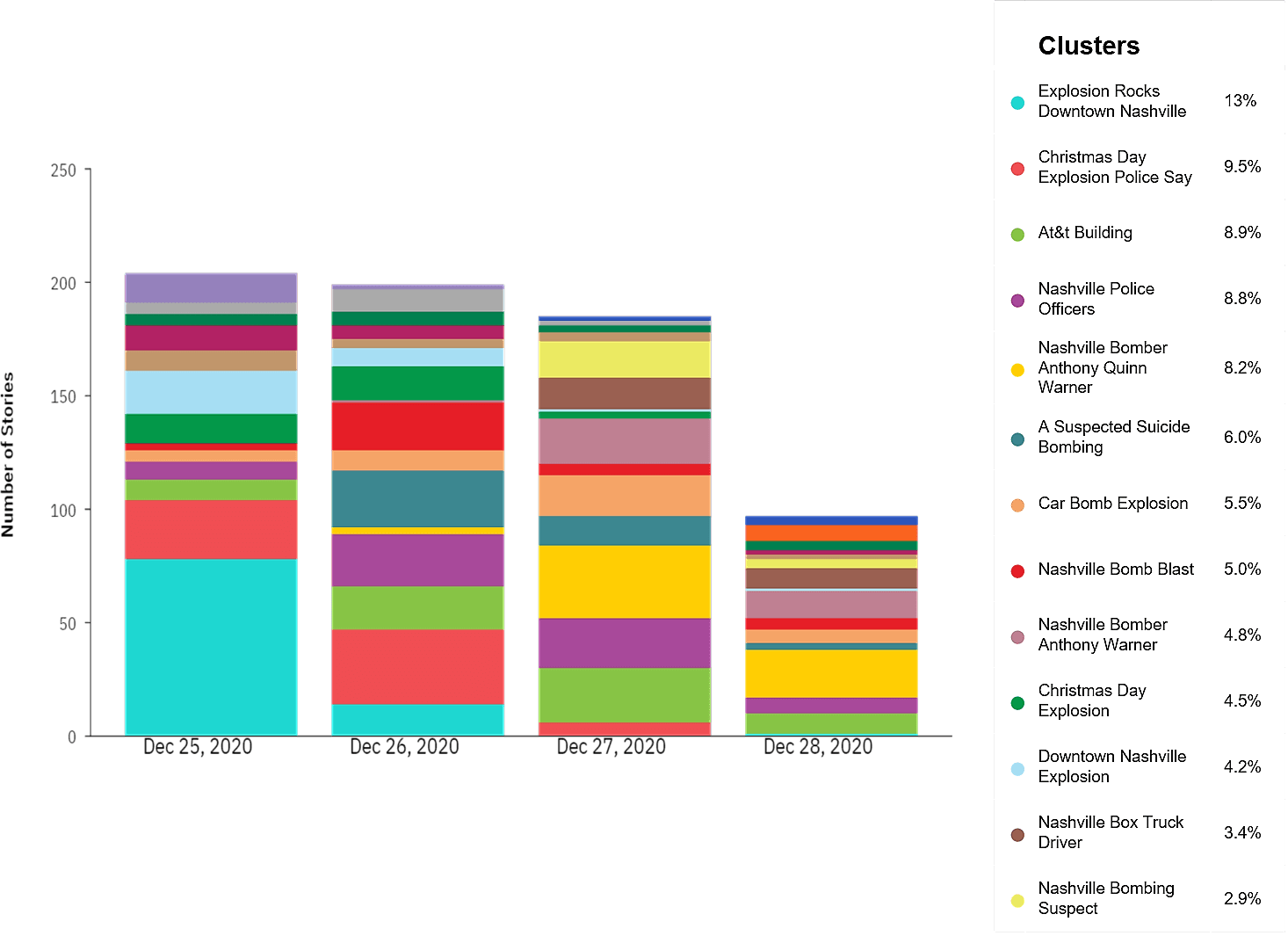
The Nashville Bomb cluster is very straightforward. There's a sub-cluster on the right composed of articles about the actual event ... the explosion, the emergency response, etc. ... and a sub-cluster on the left composed of articles about the subsequent investigation. It's all very just-the-facts material, and without a more politically-charged hook for the material, you can see in the timeline of story clusters-within-the-cluster how the coverage transforms and diminishes over time. Today it's pretty much an area-man-commits-a-terrible-crime-and-neighbors-are-puzzled story. Yes, he was a suicide bomber and a terrorist. No, he was not a "Suicide Bomber". No, he was not a "Terrorist".
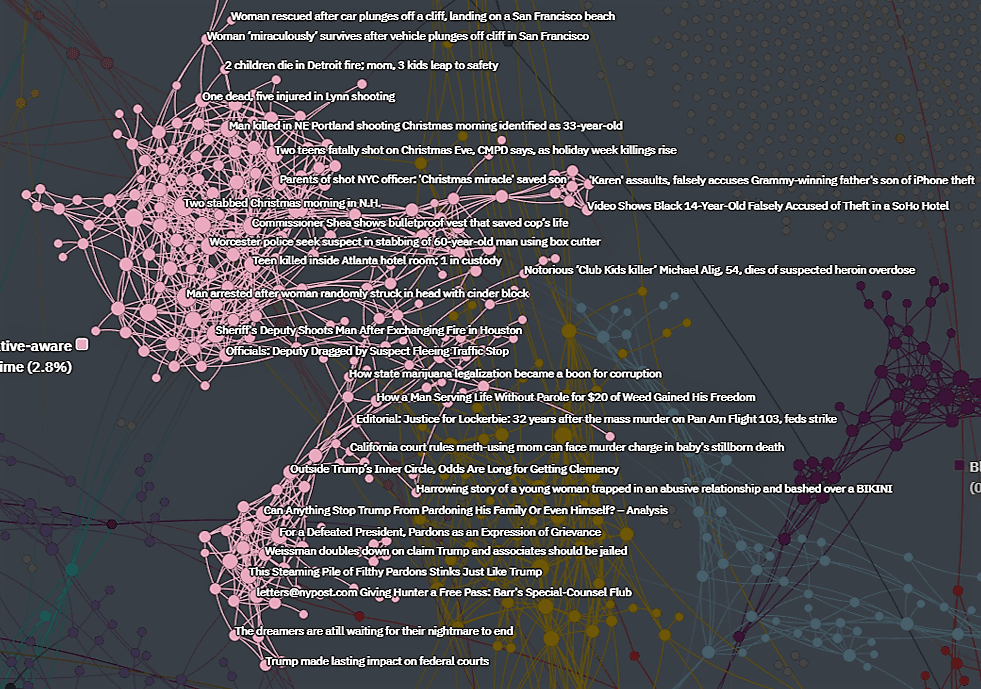
Now here's the Narrative-aware Crime cluster, by which I mean stories about crimes that are typically not as "big" as the Nashville bomb attack, but which plug neatly into a powerful social or political narrative.
THIS is where you find the Hunter Biden stories. THIS is where you find the Trump Pardon stories. THIS is where you find the Law and Order stories. THIS is where you find the Bad Parent / Urban Violence / Terrorist stories.


Comments
Uh, I think this misses the mark. Unless we learn something more about the Nashville bomber - it’s not clear he was a terrorist or a ‘suicide bomber’ - rather than a bomber who committed suicide. If we can tie his act to a political goal - then he should be labeled a terrorist. Until then, that would confuse the use of that term. Since he seemed to take pains to minimize, rather than maximize, the taking of human life I’m not sure about tagging him as a ‘suicide bomber’ as that term is usually used, though I’m less sure of that. In any event, I’m pretty critical of the media, but I’m not sure what they tie this story to given what it looks like now. I fear this will be similar to the Vegas shooter - we may never know this man’s motive, other than a desire to go out as ‘somebody known.’
What’s the round cluster of white or grayish dots towards the center that’s not connected to anything, just to the left of the light blue Market News? I don’t see a label for it anywhere.
I imagine the narrative managers don’t have enough info on Warner yet to plug him into any of their preferred narratives, and as you say, may never. But I can’t help but think they’d just love to.
As for the crime block being so central? I see the Narrative as having two or three flavors for the different economic strata. And crime, as a fear/control enhancer, is probably the single most effective narrative management ingredient in their flavor arsenal. (Bad boys, bad boys, what you gonna do?)
Initial reports speculated 5G paranoia as the motive, but from what I’m reading now that hasn’t been established.
The Las Vegas shooting was a much more horrific version of the same sort of narrative-neutral terrorist event. I’m also reminded of the punchline to a cartoon: “The ruling was unanimous because no one could figure out which side was the liberal one.” (https://assets.amuniversal.com/9ff65d0017610133f882005056a9545d)
In general though, I wouldn’t stress too much over the centrality of the clickbait crimes. Most media seems to focus on consumers’ need to feel superior to somebody. Stories about stupid criminals from the other tribe, or that otherwise demonstrate the superiority of your own morality, are easy fodder for mindless entertainment. It’s just this decade’s version of COPS or Jerry Springer.
Furthermore, narrative consumption isn’t ergodic. Most people don’t really consume much of that stuff. I’d imagine that if actual story reach and user attention were used to weight the centrality of the Quid graphics the visualizations would be dramatically different.
Essentially you’re currently weighting the graph for quantity of output, so 1-paragraph morality tales are pretty well baked in as the center of gravity. It’s a function of how you’re doing the measurement you’re doing.
The white dots are rando articles that don’t share enough linguistic elements with other articles to meet the scaling algo that Quid uses to visualize clusters.
Quantity of output doesn’t impact centrality within the graph. For example, there’s more sports and markets articles published than anything else, and they’re off to edges of graph. I’ve seen hundreds, if not thousands, of these graphs and it is highly unusual to have narrative-aware crime stories at the center of the narrative.
Agree that LV shooting is a similar event.
Bomb-making is not a hobby. Bomb-making is - virtually by definition - a political act. You may not know or understand this guy’s motivation, but that doesn’t make his choice to blow up a city block non-political. I agree it’s very similar to the LV shooting (and should focus attention on how this is possible, the connection with mental illness, etc.).
More generally, the point here is not “OMG, we should be talking about the Nashville bomber 24/7”. The point here is “OMG, look at what we ARE talking about 24/7”.
Yes, I agree that political entrepreneurs would LOVE to find a friendly narrative that they could slot the bomber into.
As for the narrative-aware crime cluster … I’ve looked at hundreds of these graphs, and I can’t remember seeing this before. Ever.
Continue the discussion at the Epsilon Theory Forum...