The Clash of Civilizations
December 29, 2014·Politics
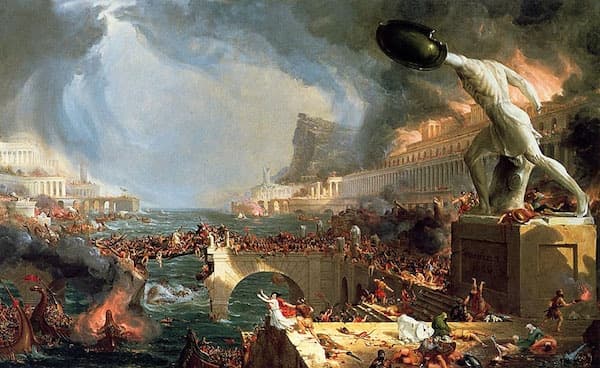
Thomas Cole, “The Course of Empire: Destruction” (1836)
In the emerging world of ethnic conflict and civilizational clash, Western belief in the universality of Western culture suffers three problems: it is false; it is immoral; and it is dangerous.
Samuel P. Huntington, “The Clash of Civilizations and the Remaking of World Order” (1996)
The West won the world not by the superiority of its ideas or values or religion … but rather by its superiority in applying organized violence. Westerners often forget this fact; non-Westerners never do.
Samuel P. Huntington (1927 – 2008)
The argument now that the spread of pop culture and consumer goods around the world represents the triumph of Western civilization trivializes Western culture. The essence of Western civilization is the Magna Carta, not the Magna Mac. The fact that non-Westerners may bite into the latter has no implications for their accepting the former.
Samuel P. Huntington (1927 – 2008)
Islam's borders are bloody and so are its innards. The fundamental problem for the West is not Islamic fundamentalism. It is Islam, a different civilization whose people are convinced of the superiority of their culture and are obsessed with the inferiority of their power.
Samuel P. Huntington (1927 – 2008)
Q: What do you think of Western civilization?
A: I think it would be a good idea.
Mahatma Gandhi (1869 – 1948)
Adrian Veidt: It doesn't take a genius to see that the world has problems.
Edward Blake: No, but it takes a room full of morons to think they're small enough for you to handle.
“Watchmen” (2009)
Our civilization is flinging itself to pieces. Stand back from the centrifuge.
Ray Bradbury, “Fahrenheit 451” (1953)
Upon learning of Cardinal Richelieu’s death, Pope Urban VIII is alleged to have said, “If there is a God, then Cardinal de Richelieu will have much to answer for. If not … well, he had a successful life.”
Henry Kissinger, “Diplomacy” (1994)
Corrupt politicians make the remaining ten percent look bad.
Henry Kissinger (b. 1923)
Poor old Germany. Too big for Europe, too small for the world.
Henry Kissinger (b. 1923)
The most fundamental problem of politics is not the control of wickedness but the limitation of righteousness.
Henry Kissinger, “A World Restored: Metternich, Castlereagh and the Problems of Peace, 1812-22” (1957)
Order should not have priority over freedom. But the affirmation of freedom should be elevated from a mood to a strategy.
Henry Kissinger, “World Order: Reflections on the Character of Nations and the Course of History” (2014)
A more immediate issue concerns North Korea, to which Bismarck’s nineteenth-century aphorism surely applies: “We live in a wondrous time, in which the strong is weak because of his scruples and the weak grows strong because of his audacity.”
Henry Kissinger, “World Order: Reflections on the Character of Nations and the Course of History” (2014)
In the end, peace can be achieved only by hegemony or by balance of power.
Henry Kissinger (b. 1923)
Isaac: Has anybody read that Nazis are gonna march in New Jersey? Ya know? I read it in the newspaper. We should go down there, get some guys together, ya know, get some bricks and baseball bats, and really explain things to 'em.
Party Guest: There was this devastating satirical piece on that on the op-ed page of the Times, just devastating.
Isaac: Whoa, whoa. A satirical piece in the Times is one thing, but bricks and baseball bats really gets right to the point of it.
Party Guest: Oh, but really biting satire is always better than physical force.
Isaac: No, physical force is always better with Nazis.
“Manhattan” (1979)
Lots of quotes this week, particularly from my two favorite war criminals – Sam Huntington and Henry Kissinger. Everyone has heard of Kissinger, fewer of Huntington, who may have been even more of a hawk and law-and-order fetishist than Kissinger but never sufficiently escaped the ivory towers of Harvard to make a difference in Washington. Like me, Kissinger bolted academia at his first real opportunity for a better gig and never looked back, which is probably why I always found him to be so personally engaging and fun to be around. Sam Huntington … not so much.But Huntington’s “Clash of Civilizations” argument is not just provocative, curmudgeonly, and hawkish. It is, I think,demonstrably more useful in making sense of the world than any competing theory, which is the highest praise any academic work can receive. Supplement Huntington’s work with a healthy dose of Kissinger’s writings on “the character of nations” and you’ve got a cogent and predictive intellectual framework for understanding the Big Picture of international politics. It’s a lens for seeing the world differently – a lens constructed from history and, yes, game theory – and that’s what makes thisa foundational topic for Epsilon Theory.
Huntington and Kissinger were both realists (in the Thucydides and Bismarck sense of the word), as opposed to liberals (in the John Stuart Mill and Woodrow Wilson sense of the word), which basically just means that they saw human political history as essentially cyclical and the human experience as essentially constant. Life is fundamentally “nasty, brutish, and short”, to quote Thomas Hobbes, and people band together in tribes, societies, and nation-states to do something about that. As such, we are constantly competing with other tribes, societies, and nation-states, and the patterns of that competition – patterns with names like “balance of power” and “empire” and “hegemony” – never really change across the centuries or from one continent to another. Sure, technology might provide some “progress” in creature comforts and quality of life (thank goodness for modern dentistry!), but basically technology just provides mechanisms for these political patterns to occur faster and with more devastating effect than before.
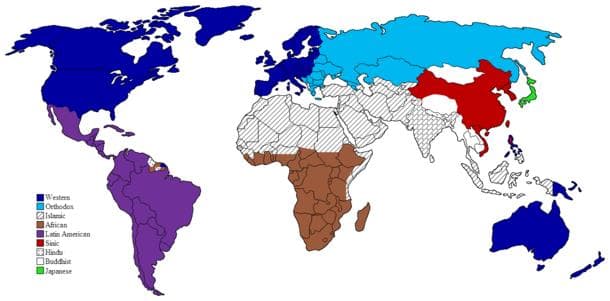
The central point of “Clash of Civilizations” is that it’s far more useful to think of the human world as divided into 9 great cultures (Huntington calls them civilizations, but I’ll use the words interchangeably here) rather than as 200 or so sovereign nations. Those cultures – Western, Orthodox (Russian), Islamic, African, Latin American, Sinic (Chinese), Hindu, Buddhist, and Japonic – are persistent and profoundly influential in ways that national borders and national institutions aren’t. Huntington argues that these 9 cultures are the most meaningful current expressions of the human animal’s inherent social imperatives, and that the logic of competition between these cultures explains and illuminates human history far better than competing notions, particularly those (like Marxism and liberalism) that assume an up-and-to-the-right direction to the arrow of history.
Marxism and liberalism are inherently optimistic visions of human society. Things are always getting better … or they will be better just as soon as people wake up and recognize their enlightened self-interest … as ideas of proletariat empowerment (Marxism) or individual rights as instantiated by free markets and free elections (liberalism) inexorably spread throughout the world. For realists like Huntington and Kissinger, on the other hand, this is nonsense. Free markets and free elections are good things (as is proletariat empowerment, frankly), but these central concepts of liberalism only mean what we Westerners think they mean if they exist within the entire context of Western culture. To insert the practices and institutions of liberalism into the Sinic culture, for example, might look awfully pretty to the Western eye and fill us with righteous pride, but it’s just a veneer. It won’t stick. The West may very well want to impose the practices and institutions of free markets and free elections for its own self-interest, and China may want to adopt the practices and institutions of free markets (but not free elections) for its own self-interest, but the logic of self-interest is a VERY different thing than the triumphalist claim that the liberal ideas of Western free markets and free elections are “naturally” spreading throughout the world.
A brief aside here on the distinction between personal beliefs and useful models. I’m not saying that I believe that authoritarian regimes and jihadist despots have some sort of moral equivalence to liberal governments, or that human rights don’t matter, or any of the other tired bromides used to tar realists. On the contrary, I personally believe that everyone in the non-Western world would be better off … MUCH better off … if their governing regimes gave a damn about individual rights and liberties in the same way that ANY governing regime in the West does. I believe that the principles of liberalism are the best ideas on social organization that the human animal has ever devised, and I’d like to spread these ideals into every corner of the globe. And you know what? On a personal level, Sam Huntington and Henry Kissinger believed exactly the same thing. Kissinger fought in the Battle of the Bulge. He won the freakin’ Bronze Star for his work tracking down Gestapo agents in Hanover. Does that sound like a moral relativist? Huntington served in the Jimmy Carter administration, for god’s sake. Talk about personal sacrifices …
But what a realist recognizes is that our personal vision of how we would like the world to be is not an accurate representation of The World As It Is, and – as Huntington wrote – it’s false, immoral, and dangerous to pretend otherwise. The World As It Is today includes the birth of an Islamic Caliphate, effectively erasing Western colonialist borders from Iraq to Syria to Libya as it spews anti-modern carnage. The World As It Is today includes the violent sundering of Ukraine along Orthodox/Western cultural lines. The World As It Is today includes an insane Sinic theocracy in North Korea with nuclear weapons. The World As It Is today includes a Japonic culture that is, in a very real sense, dying. Is a realist happy about any of this? Is a realist satisfied to shrug his shoulders and retreat into some isolationist shell? No, of course not. But a realist does not assume that there are solutions to these problems. Certainly a realist does not assume that there are universal principles like “free and fair elections” that can or should be applied as solutions to these problems. Some problems are intractable because they have been around for hundreds or thousands of years and are part and parcel of the Clash of Civilizations. They’re not going away no matter how hard some American President stomps his feet or how many drones he releases or how stern an op-ed piece is printed in the New York Times or how warm and fuzzy we feel when we see a picture of an Iraqi woman proudly displaying her finger freshly inked from voting. Yes, I know I’m an a-hole for criticizing the whole “purple revolution” thing. Doesn’t mean I’m wrong.

Kissinger wasn’t kidding when he said that there were two and exactly two solutions to international problems: 1) hegemony (i.e., empire) over the opposing Civilization, or 2) balance of power with the opposing Civilization. The problem, of course, is that Door #1 is awfully expensive. For example, if you’re not prepared to push Germany into recession and risk a lot of lives – and I mean a LOT of lives – by expanding the NATO umbrella over Ukraine, then there’s no way you’re going to reverse a basic balance of power reality like “Russia gets a warm water port on the Black Sea, no matter what the petty satraps in Kiev think about that”. Sorry, but that’s the “solution” if you’re not happy with Russia’s annexation of the Crimea and Eastern Ukraine, and I have yet to meet anyone who’s willing to pay that price. Are there aspects of The World As It Is where you ARE prepared to pay the high price of empire to prevent a balance of power equilibrium? It’s a short list for me, but yes, there is a list, headed by the preservation of Israel and South Korea as (largely) Western outposts in the middle of non-Western cultures. Is nation-building in Afghanistan on the list? Don’t make me laugh.
I think the crucial issue here (as it is with so many things in life) is to call things by their proper name. We’ve mistaken the self-interested imposition and adoption of so many Western artifices – the borders between Syria and Iraq are a perfect example, but you can substitute “democracy in Afghanistan” if you like, or “capital markets in China” if you want something a bit more contentious – for the inevitable and righteous spread of Western ideals on their own merits. This is a problem for one simple reason: if you think Something happened because of Reason A (ideals spreading “naturally” and “inevitably” within an environment of growing global cooperation), but it really happened because of Reason B (practices imposed or adopted out of regime self-interest within an environment of constant global competition), then you will fail to anticipate or react appropriately when that Something changes.
And here’s the kicker: change is coming. The Clash of Civilizations is not going to get better in 2015. It’s going to get worse. Why? Because for the past five years we have had a US government that was willing to pay the high price of empire to extend its monetary policy hegemony over the entire world to save the infrastructure of modern Western civilization: the US banking system and its collateral assets. Five trillion dollars later, the Fed has now declared victory and is demobilizing the QE troops. Is it a lasting victory? I don’t know and it doesn’t really matter. It’s a useless question. In the immortal words of Bill Parcells, you are what your record says you are, and the Fed’s record looks pretty darn good. So they’re declaring victory and that’s how it will go down in the history books. The better question is: what now? What happens in the rest of the world now that the peace-keeping and price-raising and prosperity-bringing delivered by five trillion dollars in asset purchases … stops?
Part of the answer – a small part of the answer – is that other central banks with printing presses will try to take up some of the slack. The BOJ will continue to weaken the yen and monetize the government’s debt, and the ECB will do the same thing, although they will do less and will be forced to jump through bizarre hoops to preserve the pleasant fiction that they’re not monetizing government debt. I say that this is a small part of the answer to the question of “what now?” – even though if you listen to the prognosticators in financial media you would think that this is the entire answer – because monetary policy divergence, as important as it is, pales in comparison to political divergence. I don’t think it’s an accident that Ukraine starts ripping itself apart as the largest monetary experiment in the history of man starts to wind down. Or that ISIS starts to remap the entire Middle East. Or that North Korea attacks Sony. Or that the price of oil drops by half as OPEC faces its greatest existential threat. Did the Fed cause these events? Of course not. But they’re not unrelated. They’re all part of the fabric of global deleveraging. This is what happens when you have a global debt crisis and politicians respond to maintain the status quo by any means necessary – the political center does not hold. Whether you’re talking about the 1870’s or the 1930’s or today, it’s always the same story … domestic coalitions and sovereign nations and international alliances that were held together by mutual absolute gains in the good times are driven apart by relative gains and losses in the bad times, and those domestic coalitions and sovereign nations and international alliances that bridge two ancient civilizations are thrown into the centrifuge most of all.
The market flash points for 2015 are not limited to the obvious suspects, like Ukraine and ISIS. In fact, most of the obvious suspects are not terribly impactful on major markets, and some have the perverse effect of providing “good news” for markets the worse their situation becomes. For example, to the degree that Ukraine-related sanctions on Russia damage German growth rates, the market believes that this forces still greater ECB market accommodation and direct propping-up of financial asset prices in the Eurozone. The non-obvious suspects I’m looking at are countries that, like Ukraine, find themselves with one foot in one civilization and one foot in another but, unlike Ukraine, are much more central to global markets. Those countries are Greece, Turkey, Iran, Egypt, and South Korea. I wrote about Greece two weeks ago, so won’t repeat all that here. Turkey, Iran, and Egypt are all the same basic story – ancient civilizations that had their day in the sun many centuries ago and are now being consumed by the Borg-like entity that is Islam. Persia, the most potent of the three cultures, is completely lost. Egypt is lost but hasn’t realized it yet, like a chicken running around with its head cut off. Turkey, the least of the three, has adopted enough Western antibodies to provide some resistance, but it’s just a matter of time before it becomes the Sick Man of Europe once again. South Korea … judging from how little it is discussed in the Western press it sometimes seems like no one cares about South Korea, and that’s a mistake. No country on earth is split between more civilizations, and no country is as sensitive AND vulnerable to the clashes that are coming down the pike.
So … am I terrified by the Clash of Civilizations? Am I getting out of the market and running for the hills? No. Not yet, anyway. So long as the market is dominated by the Narrative of Central Bank Omnipotence, any of these flash points that I’ve mentioned will inevitably be seen through the lens of monetary policy accommodation, making bad news in the real world good news for major stock markets, particularly here in the US. Global growth will get even more pathetic, of course, but that’s positive for major government bonds. Of all the flash points above I’m probably most concerned about Greece, but even then the concern is more for what Greece ultimately means for Italian politics than for what it means to Europe or major global markets directly.
What scares me about the Clash of Civilizations is that the three leaders of the three biggest civilizations – the US (Western), China (Sinic), and Russia (Orthodox) – will misplay their hands and take on another civilization directly or, worse, take on each other, and that will vaporize the Narrative of Central Bank Omnipotence in a nanosecond. The existential risk here for markets is not that China/Russia/Europe/America might “collapse”, whatever that means. No, the existential risk is that the great civilizations of the world will be “hollowed out” internally, so that the process of managing the ten thousand year old competition between civilizations devolves into an unstable game of pandering to domestic crowds rather than a stable equilibrium of balance of power. Don’t take my word for it. Take the word of America’s finest diplomat since Benjamin Franklin, writing in his final book and delivering his most important warning.
Side by side with the limitless possibilities opened up by the new technologies, reflection about international order must include the internal dangers of societies driven by mass consensus, deprived of the context and foresight needed on terms compatible with their historical character. As diplomacy is transformed into gestures geared toward passions, the search for equilibrium risks giving way to a testing of limits. … Because information is so accessible and communication instantaneous, there is a diminution of focus on its significance, or even on the definition of what is significant. This dynamic may encourage policymakers to wait for an issue to arise rather than anticipate it, and to regard moments of decision as a series of isolated events rather than part of a historical continuum. When this happens, manipulation of information replaces reflection as the principal policy tool.
Henry Kissinger, “World Order: Reflections on the Character of Nations and the Course of History” (2014)
I can’t over-emphasize how important I think this passage is, and I’ll be returning to it again in future Epsilon Theory notes. For now, though, I’ll just introduce two key game theoretic concepts at the core of Kissinger’s warning.
First, the proliferation of the most dangerous game of all – Chicken. When Kissinger writes about how “the search for equilibrium risks giving way to a testing of limits”, he’s talking about how ordinary diplomatic maneuvers can deteriorate into brinksmanship, the hallmark of the game of Chicken. I’ve written a little bit about this game in the context of the Fed-inspired “Taper Tantrum” in the summer of 2013, when Bernanke et al misread the market impact of a change in the acceleration of monetary easing, but that little episode will look like a gentle spring shower compared to the market storm that could result from a full-scale game of Chicken between, say, China and Japan over trade, exchange rates, and offshore oil and gas reserves in the South China Sea. Chicken is such a dangerous game because it has no equilibrium, no outcome where all parties prefer where they are to where they might be. This constant cycling of one unstable outcome to another typically ends in disaster because the least worst outcome for each player – the “move” that each player makes to respond strategically to the other player’s most recent limit-testing actions – doesn’t remain constant but gets progressively worse over time. The game of Chicken is a mutual spiral into oblivion, and once you start down this road it’s really hard to stop because stopping means admitting defeat.
Second, the dumbing-down of all political games into their most unstable form – the single-play game. When Kissinger writes about how political leaders come to see “moments of decision as a series of isolated events”, he’s talking about the elimination of repeated-play games and shrinking the shadow of the future. Most games seem really daunting at first glance. For example, the Prisoner’s Dilemma is famous for having a very stable equilibrium where everyone is worse off than they easily could have been with some very basic cooperation. But there’s a secret to solving the Prisoner’s Dilemma – play it lots of times with the same players. Cooperation and mutually advantageous equilibria are far easier to achieve within a repeated-play game because reputation matters. The shadow of the future looms large if you’re thinking not only about this iteration of the game and the moves ahead, but also about the next time you have to play the game, perhaps for larger stakes, and the next, and the next. Imagine if you sat down at a poker table, were dealt one hand, and were then informed that everyone would have to get up and find another table with new players, at which point only one hand would be dealt there, too. That’s a series of single-play games, and it’s just as unpleasant as it sounds, whether you’re playing poker or you’re playing politics.
It won’t surprise many regular readers of Epsilon Theory if I say that I think much of what Kissinger warns about – “societies driven by mass consensus”, “gestures geared towards passions”, “manipulation of information” – has now reached, if not its full fruition, then at least a new quantum level of advanced and ubiquitous practice. And not just in the US, but also Russia and China and everywhere in between. Twenty-three years after Sam Huntington first presented his “Clash of Civilizations” argument, the conditions for that realist confrontation to be terribly severe are finally met. 2014 wrote an unpleasant story of nascent international splintering and conflict. Unfortunately, I think it was just an introductory chapter in a much longer book.