The Dude Abides: China in the Golden Age of Central Bankers
July 1, 2014·Money
In approaching a problem a Marxist should see the whole as well as the parts. A frog in a well says, “The sky is no bigger than the mouth of the well.”
Mao Zedong
Jake Gittes: How much are you worth?
Noah Cross: I have no idea. How much do you want?
Jake Gittes: I just want to know what you're worth. More than ten million?
Noah Cross: Oh my, yes!
Jake Gittes: Why are you doing it? How much better can you eat? What could you buy that you can’t already afford?
Noah Cross: The future, Mr. Gittes! The future. … You see, Mr. Gittes, most people never have to face the fact that at the right time and the right place, they’re capable of ANYTHING.
Chinatown (1974)
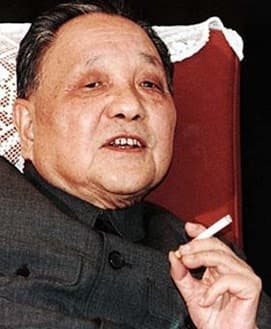
Deng Xiaoping was a survivor. That’s why I love this picture of the man, here 80-something years old, looking for all the world like Emperor Palpatine of Star Wars fame, still dying his hair jet-black and chain-smoking his Panda cigarettes. Purged not once but twice. Wife and daughter dead in childbirth. Friends mowed down by the Kuomintang. Eldest son tortured by Red Guards before being thrown out a 4th-story window.
You think this veteran of the Long March, who lived in caves and ate rats … when the war was going well, wasn’t willing to do ANYTHING to set the future course of the modern Chinese State? You think that Tiananmen Square kept this guy up at night?
Deng Xiaoping and his ally/mentor, Zhou Enlai, are the architects of modern China, of China as a Great Power. For 30 years Zhou tempered the Maoist ideology of permanent revolution, preserving the kernel of a stable army and stable government bureaucracy, setting the stage for a pragmatic successor to Mao. But it was Deng who was able to out-maneuver the Gang of Four and seize control of the Army and the Party after Mao’s death (and Zhou’s) in 1976, replacing that Maoist ideology of permanent revolution with a market-driven ideology of modernization and economic growth. Deng wasn’t interested in political purity, but in economic results. It’s not the color of the cat, as he famously said, but its ability to catch mice.
Deng’s political genius – the core attribute that made him such a consummate survivor – was his ability to sell his vision of economic modernization and growth as an end in itself to other political and military leaders. Permanent revolution is … tiring … and doesn’t really pay that well. Deng offered a vision of stability and wealth, and by 1979 that vision proved to be enormously successful in uniting what Clausewitz called the iron triangle of a Great Power – Army, Government, and People, acting as one for a common goal. Economic growth was, to paraphrase “The Big Lebowski”, the rug that tied the whole room together.
Importantly, Deng’s unifying vision of economic growth and modernization was socialist and nationalist in nature, not liberal and individualistic. Deng was no petty oligarch, stashing away billions in foreign bank accounts during his tenure as Paramount Leader, and this was a big part of what made his transformation of the Chinese nation so successful. Deng was authentic. He was a survivor and he was a patriot. He was a Dude, enforcing at the highest levels of the Party and the Army an understanding that economic growth was (primarily) in the service of the nation rather than (primarily) in the service of personal aggrandizement. Sure, there might be the occasional provincial governor egregiously lining his family’s pockets rather than kicking up to the central authorities in Beijing, but this has only been a problem for the Chinese government for … oh, the past 3,000 years or so, and it’s nothing that a few show trials and public executions can’t bring back in line. No, the important thing was that China’s top political and military leaders shared Deng’s vision of market-oriented AND socialist/nationalist ideologies existing hand-in-hand. And for a while there, they did.
Today, however, the Chinese State faces two existential threats, each stemming from or accelerated by the Great Recession and Western policy responses to that crisis of market confidence.
First, QE and other “emergency” Western monetary policies of the past five years threaten the grand political unification of Deng Xiaoping from without.
Second, massive wealth inequality and concentration driven largely by those same monetary policies threaten it from within.
The external threat to Chinese political stability comes from the explicit purpose of recent monetary policy: to paper over anemic real economic growth with financial asset inflation. It’s a brilliant political solution to the political problem of low growth in the West, because our political stability does not depend on robust real economic growth. So long as we avoid outright negative growth (and even that’s okay so long as it can be explained away by “the weather” or some such rationale) and prop up the financial asset values that in turn support a levered system, we can very slowly grow or inflate our way out of debt. Or not. The debt can hang out there … forever, essentially … so long as there’s no exogenous shock. A low-growth zombie financial system where credit is treated as a government utility is a perfectly stable outcome in the West because our elections and political powers don’t hinge on strong economic growth. They hinge on social issues and notions of identity. They hinge on the preservation of wealth, the preservation of benefits, and the preservation of rights. All good and important things in the Western political context. But for China? Not so much.
Chinese political stability under the unified coalition formed by Deng Xiaoping depends on robust and real domestic economic growth. Not the veneer of economic growth as can be constructed within capital markets. Not the liquidity-driven asset price inflation of Western monetary policy. Chinese political stability depends on the actual production of actual things by actual people working in actual factories, and the prospects for that real economic growth are made significantly worse the longer the West persists in favoring financial asset inflation and the ossification of a low-growth status quo. Why? Because the domestic Chinese market is not advanced or rich enough to support the politically necessary rates of Chinese economic growth. I’m sure it will be one day, but that day is not today. That day will not be with us for decades to come. And until that happy day for China arrives, real economic growth will depend on developed world export markets in the US and Europe. Those export markets are more uncertain and structurally weak from a Chinese perspective than at any point since Deng Xiaoping forged his coalition, and that’s a risk that the Chinese regime will do ANYTHING to redress.
The internal threat to Chinese political stability is even more destabilizing and pernicious than the external threat. I don’t care what you think about the specifics of Thomas Piketty’s book, if you don’t recognize that the growing concentration of global wealth within a tiny set of families is a big problem and getting bigger worldwide, you’re just not paying attention. No country in the world is more vulnerable to the political problems caused by wealth inequality and concentration than China. Why? Because socialism may well be, as Deng said, fully consistent with free market practices on a nationalist, mercantilist level, and it’s mostly consistent (or at least can co-exist) with a free market ideology focused on individual advancement and individual wealth creation in the 99%. But wealth creation and wealth accumulation in an era of massive and coordinated central bank liquidity is a totally different animal than wealth creation and accumulation when Deng consolidated power and struck his grand bargain in the late 1970’s. The unfathomable riches available today to the very top of the economic pyramid – the 1% of the 1% of the 1% – are so enormous that they threaten to obliterate the links that Deng created between Army, Party, and People.
Have there always been rich people and rich families in China? Of course. But the scope and meaning of “rich” is so different today in 2014 than it was in 1984, or 1994, or even 2004 as to be a laughable comparison. It’s not just that concentrated private wealth in the modern manner has created an entire class of hyper-privileged Chinese families with the ability to bypass State control. It’s not just that these hyper-privileged families wield political power independently of any State apparatus. Most importantly – and most damagingly for Deng’s political coalition – these hyper-privileged families largely arose from personal aggrandizement of positions within the core Chinese political institutions of Party and Army. The meaning of Party and Army has changed in China, from one of unquestioned political legitimacy as THE guardians of Chinese socialism to one of highly questionable legitimacy as a vehicle for personal wealth. For the majority of Party and Army office holders – those who did not make vast fortunes from their office, those who seek a patriotic return to the unquestioned political legitimacy of these institutions – this is an entirely intolerable development and they will do ANYTHING to change it back. Even among those Party and Army leaders who have managed to acquire great fortunes, there is a widespread recognition that – while the West may be able to accept, even celebrate, unlimited private wealth – China cannot. Not if it wants to remain a politically unified Great Power.
The common thread between the external and internal threats to Deng’s stable political architecture is Western monetary policy and its support of a particular system of global market liberalism. What does China intend to do about it? I believe that Chinese leadership increasingly sees itself as the turtle in the old fable of the turtle and “the compassionate man,” where the system is the pan of boiling water that the compassionate man (the West) sets up to turn the turtle into turtle soup. Through incredible focus and an application of all its resources the turtle walks on a narrow rod to cross the pan of boiling water, but having crossed once is now required to cross again. It’s the system that requires changing from the turtle’s perspective, and I believe that’s exactly what China will seek to do.
Changing the system does not mean withdrawing from the system or blowing the system up. Remember, China MUST continue to sell stuff into developed world export markets as a bridge to a more stable economic growth path based on domestic markets. Changing the system means changing the rules, the “correlation of forces” to use a good-old-fashioned Leninist phrase, so that China can still sell lots of stuff to the world in order to support its domestic factories and generate capital to build its domestic infrastructure, but in a way that can be controlled by the State and not usurped by these hyper-privileged families that have popped up over the past few years. China doesn’t want to be the turtle; it wants to be “the compassionate man” who sets out the pan of boiling water for other turtles to cross. China wants to control its own future, and to accomplish this, strong actions must be taken domestically and internationally.
Domestically, I expect two things.
First, the backlash against the privileged families, particularly those politically active second and third generation inheritors of both a mantle of authority and a vast fortune from Mao-era Party and Army leaders, will widen and grow. This is the right context for understanding the Bo Xilai “scandal” and trial. Murder a British “banker” who helped you quietly funnel more than $100 million into personal overseas accounts? No problem, and thank you for not stealing more. Use your control over a vast domestic fortune (billions of dollars seized from “organized crime” in Chongqing) to fund a personal political machine with national aspirations, in effect becoming a Chinese conflation of Michael Bloomberg and Rudy Giuliani? Sorry, Bub, time for you to go.
Second, and relatedly, the backlash against these Princes will be driven by a domestic media Narrative that China is engaged in an economic “struggle” with powerful outside forces, and that these hyper-privileged families are in effect siding with the enemy. Of course, the Princes can read the newspapers, too. Not only is the message loud and clear that you should keep your domestic wealth hidden and totally segregated from political purposes, but also that you’re only as rich as the wealth you can remove from China entirely. Hold that thought.
Internationally, I expect three things.
First, to construct the domestic Narrative of an economic struggle you need a foreign enemy, but it’s too risky (for now) to cast entire nations in this light. The next best thing? Japanese and American companies that sell expensive, industrially advanced stuff into China, and by “stuff” I mean both manufactured items and services. Recently companies like IBM and Cisco have reported a distinct slowdown in their Chinese business. My view? You ain’t seen nothing yet. As powerful as the “Buy American” marketing slogan has been in this country, the “Buy Chinese” slogan in China will be 100x more powerful.
Second, if there’s one historical lesson that all Great Powers know – particularly up-and-coming Great Powers like Germany in the 1890’s, Japan in the 1930’s, or Russia in the 1950’s – it’s that the only way to win the Great Game is to control enough natural resources so that the incumbent Powers can’t squeeze you dry. Resource independence isn’t a sufficient condition to change the rules of the system, but it’s certainly a necessary one. The resources that matter today are energy and technology, period, and this is the context in which we need to understand China’s actions in the South China Sea, in cyber-security, in Africa, and in its diplomatic relations with Russia. Achieving energy independence and technological parity – or at least reducing its vulnerability to being fatally suffocated if that’s what it comes to – is not a matter of choice to a China that sees itself under assault from the West within and without, but a matter of necessity.
Third, since Western monetary policy is the root of all evil from a Chinese perspective (okay, that’s a bit of poetic license, but not as much as you might think), the primary weaponry for China’s rule-changing efforts will also be monetary policy, particularly currency exchange rate policy. Here’s a chart that illustrates what I mean, and why I think that China is already embarking on the paths outlined above.
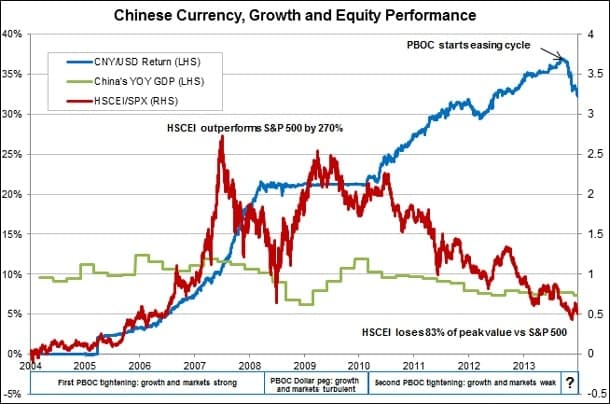
First, take a look at the price level ratio of the Chinese renminbi and the US dollar (dark blue line above) to see what I mean when I say that the rules of the global trade system pose a structural challenge for China, and that the Chinese government is starting to challenge those rules. From 2005 through 2007 China strengthened the renminbi versus the dollar by more than 20%, assuaging US political pressure that the Chinese currency was too weak and created “an uneven playing field” in international trade. This was an easy concession by the Chinese regime, as domestic growth remained plenty strong and their domestic stock market rocketed higher. Not coincidentally, vast fortunes were built by the most politically connected and powerful Chinese families over this 3-year period. But then 2008 happened, plunging all markets and all economies into chaos. China decided that discretion was the better part of valor during the Great Recession, so the renminbi was kept steady against the dollar until the end of 2009. At this point it looked like domestic GDP growth and global markets were in the clear, and so China returned to the exchange rate policy that had worked so well for them in the 2005-2007 period. Oops. In a QE dominated world … in the Golden Age of the Central Banker … renminbi strengthening has been an unmitigated disaster.
How so? Take a look at the HSCEI/SPX ratio (red line above). Measured from the beginning of 2004, the broad mainland Chinese equity market rose to a price level 2.5x greater than the broad US equity market by March 2009 and the initiation of QE1. Since then, the US market has done nothing but go up and the Chinese market nothing but go down, so that the Chinese market’s price level is now only 50% higher than the US market in 2004 terms, down more than 80% from its peak relative price level.
Similarly, Chinese GDP growth (green line above), after a brief recovery along with the rest of the world in 2009 in response to the Fed’s adrenaline shot straight into the flat-lining heart of US capital markets, has done nothing but drift down in an alarming and totally unprecedented way. I know, I know … Chinese GDP data is terribly untrustworthy and is largely constructed out of whole cloth. But that fact just makes this chart even scarier! If the manufactured data is this steadily disappointing, imagine what the real GDP growth rates look like.
So what is China’s response? Since the beginning of this year, China has forced the renminbi down in value, making the currency weaker and making exports cheaper, in effect administering their own shot of adrenaline to the heart of their economy. I think this is just the start of a multi-year weakening of the renminbi, a sea change in Chinese monetary policy that will inevitably create broad political tensions with the US and make Japan’s devaluation/inflation course infinitely more difficult to achieve. For more than 40 years China has been willing to accept the lead of the US in determining the rules of the road when it comes to international trade. Now China is looking to call the shots. Modern trade wars are not fought with tariffs and quotas, but with exchange rates, and what China is doing with their currency is the modern-day trade regime equivalent of firing on Fort Sumter.
Okay, Ben … interesting enough, but I’m not a forex trader. What does all this mean for portfolio construction, asset allocation, and risk management?
It means everything. It means that China intends to challenge the current system of global trade by forcing change in the monetary policy rules and relationships we have known for the past 40+ years. It means that ANYTHING is possible and NOTHING is off the table as the Chinese State combats an existential internal and external threat.
To use Mao’s phrase, the Chinese regime is not a frog in a well, seeing the limits of the sky in what the mouth of the well defines. If we want to be effective investors or allocators in the difficult years to come, we need to look beyond the mouth of the well, too. What’s beyond the mouth of the well? What are the specific policy choices China could make to restore political legitimacy to Party and Army while also driving real economic growth? Beyond forcing the renminbi down, staking out energy-rich geographies, “acquiring” technological know-how by any means necessary, and aligning with Russia on all of these issues … I have no idea. But I am certain that there is more to come, in both scale and scope. I am certain that whatever these policy choices may be, they will be outside every macroeconomic model, every sell-side report. I am certain that some historical correlations we treat today as ironclad market laws will be turned on their heads, wreaking havoc on portfolios that insist on treating the past as some immutable Truth with a capital T.
In this environment I think the most useful response from a portfolio construction perspective is to adopt what I call “profound agnosticism” about what the future holds. Or expressed with fewer $10 words, what’s required is to accept that no one has a working crystal ball right now. If ever there was a time when it makes sense to structure a portfolio in an adaptive fashion, where you start with a balanced allocation to a wide range of asset classes and then let the market tell you what’s working and what’s not, today is the day. I’ve said it before and I’ll say it again: the Golden Age of the Central Banker is a time for investment survivors, not investment heroes. China’s challenge to the Western status quo reinforces that claim 10-fold.
I’ll close with an observation of a less defensive sort, because the forthcoming Chinese challenge to the current monetary policy rules will present opportunities as well as dangers, and because a good risk manager is always looking for asymmetric risk/reward ratios in either direction. Here’s a 40-year price chart of 1 US dollar expressed in Hong Kong dollars. The vertical axis (number of $HK = 1 $US) is inverted because a higher number of Hong Kong dollars reflects a weakening of that currency.
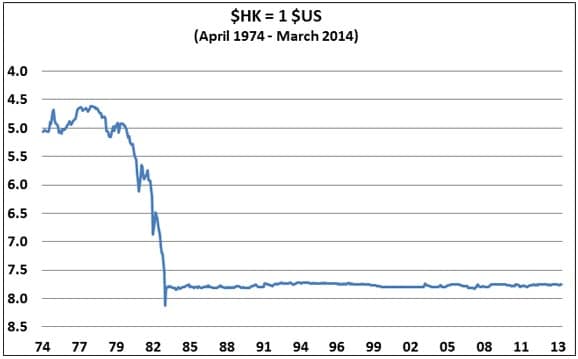
For the past 30+ years, the HK dollar – the world’s eighth most traded currency – has been pegged to the US dollar with rock-solid certainty. In the world of international trade, the HK dollar hard peg is the equivalent of the law of gravity, with all the certainty for future economic transactions that implies. As you can see clearly from the chart, there has been essentially zero volatility in the exchange rate since October 1983 and the creation of the currency board system.
To use a geological analogy, the Hong Kong dollar is the most stable tectonic plate in all of global economics, and the fault line between the Hong Kong dollar tectonic plate and the US dollar tectonic plate hasn’t had a tremor in 30 years. But here’s the thing. The stability of the Hong Kong / US dollar fault line is entirely due to politics. It’s stable because the Hong Kong government says that it’s stable. There is zero reflection of fundamental economic pressures in this exchange rate, because it is entirely a political creation. And if the politics change at a deep enough level, such that it is no longer in Beijing’s interest to maintain the hard peg, you will have a massive earthquake.
Very smart guys have predicted either an end to the hard peg or an end to the Hong Kong dollar altogether, and they’ve been entirely wrong. In 1995 Milton Friedman predicted that the currency could not survive the 1997 handover of Hong Kong to Beijing, a prediction that Jim Rogers has adopted as a policy prescription since 2007. In 2011 Bill Ackman famously went long the Hong Kong dollar, arguing that the fault line between the Hong Kong dollar and the US dollar could not withstand the inflation Hong Kong would be importing from the US (you can access a copy of Ackman’s 150-page slide presentation here). In investments as in comedy, timing is everything. So why do I think it’s different this time? Why do I think the clock is now ticking on an earthquake in the fault line between the Hong Kong dollar and the US dollar?
It’s different this time because China is under greater pressure, both externally and internally, to change the international rules of the road than at any time since Deng forged his domestic political coalition. It’s different this time because there are specific catalysts – the weakening of the renminbi, the creation of a domestic media Narrative that trumpets an economic “struggle” with the West, the claiming of vast swaths of strategic offshore territories, the acceleration of cyber-espionage, the strengthening of ties with Russia to create a new economic axis – that are forcing the Great Powers of the 21st century onto a collision course. It’s different this time because the hyper-privileged families of modern China need to get their wealth out of China ASAP, and parking it in Hong Kong (or in Hong Kong dollars) is no longer safe enough. I can’t tell you the timing, the odds, or the form of this or that earthquake-provoking event. My crystal ball is just as broken as anyone else’s. But I think where Epsilon Theory is useful is in providing the right lens for evaluating these events as they occur, and that this monitoring function can help investors and allocators alike interpret environmental risks as part of an adaptive framework.
PDF Download (Paid Membership Required): The Dude Abides



Comments
The first part of this is great …the last part things didn’t seem to work out quite that way…when i lived in Shanghai back in the years 2012 - 2015 , we thought that Xi would purge the corruption…that was the Narrative, to use your words…it turned out, he’s just another dictator wannabe…Communists do not know how to make money…but they love money so much, they want to take all that You have !
an anecdote for you about the early Deng years :
"Deng’s first concern after beating the gang of four and consolidating his power was how to get the economy going…
He turned to China’s last remaining Capitalist – Rong Yiren.
Rong’s family – extremely wealthy Shanghainese businessmen in the pre-communist days, had fled in 1949 to HK, Taiwan and the US where they continued their business enterprises.
Rong had stayed behind. He was the last of the major players still in China, all others being either killed or having run away. Rong made a deal with the communists – he would stay in China and run his factories, and share the profits with the communists, a deal which Mao initially agreed to.
Deng asked for advice on rebuilding China.
Rong’s advice ?
Invite overseas Chinese businessmen from HK and Taiwan to invest in China, bring their capital, technical and management knowhow and their marketing connections to China. They would work with China in traditional Asian style, relying on family networks and mutual trust. Investors from other countries would demand a harder contractual framework.
From his connections, Rong had learnt that both in both HK and Taiwan labor costs were rising fast, & the entrepreneurs were already looking at other locations – mostly Asian ‘Tigers’ (remember those?) for relocating their low wage assembly operations. The first thing was to set up a free trade zone where HK and Taiwan investors could open up cheap manufacturing to employ the labor.
That was Shenzhen, then an empty piece of land, on the border of HK.
It was businessmen from Hong Kong who first took the chance and gambled on China. Taiwanese quickly followed.
For much of the Chinese public, traumatized and broke after almost 20 years of horror and starvation, a chance to simply go to honest work and earn some money to eat was already a dream come true of sorts…
Of course, Rong’s family profited handsomely from this….They are the principal Shareholders of CITIC , which always has prime land in every major city of China. CITIC is also a key share-holder in Alibaba. Coincidentally, CITIC’s headquarters in Hong Kong are next to the new HKSAR government buildings on the waterfront……just saying……"
Continue the discussion at the Epsilon Theory Forum...