The Elton/Hootie Line
March 4, 2020·Politics
Epsilon Theory PDF Download (paid subscription required): The Elton/Hootie Line

We’re talking about things that are going to change the world and change the way people listen to music and that’s not going to happen with people blogging on the internet...There’s too much technology available. I’m sure, as far as music goes, it would be much more interesting than it is today.
- Elton John, Interview with The Sun (2007)

The records I used to listen to and still love, you can’t make a record that sounds that way. Brian Wilson, he made all his records with four tracks, but you couldn’t make his records if you had a hundred tracks today. We all like records that are played on record players, but let’s face it, those days are gone. You do the best you can, you fight that technology in all kinds of ways, but I don’t know anybody who’s made a record that sounds decent in the past twenty years, really.
You listen to these modern records, they’re atrocious, they have sound all over them. There’s no definition of nothing, no vocal, no nothing, just like – static. Even these songs probably sounded ten times better in the studio when we recorded ’em. CDs are small. There’s no stature to it. I remember when that Napster guy came up across, it was like, ‘Everybody’s gettin’ music for free.’ I was like, ‘Well, why not? It ain’t worth nothing anyway.’"
- Bob Dylan, in an interview with Rolling Stone (2006)
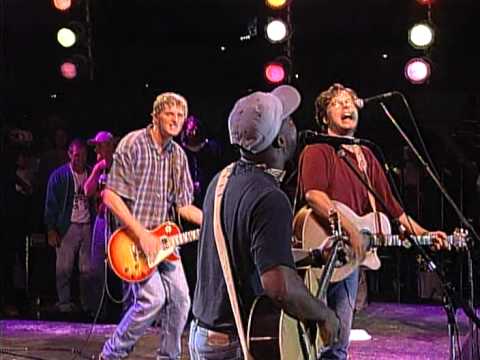
We’ve wanted to bring a party; it’s high-energy, and it’s about fun. The worst thing for me when I go to a concert is a whole bunch of ballads. You get bored.
- Darius Rucker, who absolutely does not want you to call him Hootie, to the St. Louis Post-Dispatch (June 2016)
This will not be fair to Hootie.
Or the Blowfish, for that matter. He didn't start it. He didn't really make it worse. For God's sake, he doesn't even want to be called Hootie anymore. That'll be Darius, if you please.
It is just bad luck that his was the best-selling album in the United States the year that a minor trend among heavy metal, punk and the occasional rap artist went mainstream. It's not his fault that Elton John topped the charts with a musical-inspired soundtrack album to The Lion King that stood in stark contrast the prior year.
That year was 1995. The year we crossed the Elton/Hootie Line.
The Elton/Hootie Line is not a demarcation of musical genre. It isn't the border between good and bad music, or between one media format and another. It hasn't got anything to do with Napster or the RIAA or anything like that.
The Elton/Hootie Line marks the last time that we allowed popular music to be quiet sometimes.
Loud and quiet are easy ideas to understand. There's not much gray area in the formal definition. It is trivial to measure the difference in air pressure against ambient levels caused by sound waves. Plot those measurements on a log scale, and you've got what you know as a decibel.
In practice, however, the human experience of loud and quiet relies heavily on context. Other qualities of a sound - its pitch, its timbre and the sustained level of its volume - influence the individual experience of loud and quiet. Many people might listen to a thrash metal album with a pressing, ostinato rhythm from a distorted electric guitar, crashing open hi-hats and double bass drum pedals and say, "that's louder", even if a sweet, gentle cello sonata was being played and heard at a nominally identical decibel level.
The most important context to loud and quiet, however, relates to how music is recorded and reproduced. For obvious reasons, the volume that instruments were played at passes through a mixing and mastering process that normalizes sounds for whatever medium will be sent to the consumer. Celine Dion belting an adult contemporary power ballad was a lot louder in the studio than what you'd hear if you were standing next to a pre-autotune Selena Gomez. But on Spotify, Apple Music or a CD? Not much difference. Er, with the loudness, I mean.
Through a combination of adjusting the gain, or sensitivity of the microphone used to record, and through both hardware and software tools used to adjust levels of tracks post-recording, their voices will hit a record at largely similar volumes. Yes, different genres of music have different levels of reliance on the lead vocal track that will drive marginal differences, but by and large the peak levels of vocals will reach roughly the same volume on most modern recordings.
Much of this normalized level is defined by the fact that there are limits to how loud something can be in a recording at a certain bitrate before it begins to distort. In other words, the loudest segments of a recording are going to be just a bit below where they'd create distortion.
That creates a problem for the engineer and producer alike: if the peaks - the loudest parts - of every recording are being normalized to similar levels for reproduction and you want to make your music stand out from the rest as energetic, powerful or exciting, how do you do it?
The answer: you crank up the volume on everything but limit or cap the peaks in the recording from getting so loud that they will distort.
And that's exactly what the music industry did. They cranked up the volume of anything remotely quiet, limited the peaks from distorting, and compressed the overall dynamic range of everything we listen to. (The software and hardware tools used to achieve this are literally called compressor/limiters)
Now, they didn't really start with Cracked Rear View in 1995, obviously. It was something that engineers and artists had experimented with many times over the years. Some pressings of Hotel California did it in 1976. Queen tried it on Sheer Heart Attack that same year. AC/DC and Ozzy, for example, released a number of records in the early 80s that were designed to crank things up. Metallica dabbled with several in 1983. The Who's soundtrack to Tommy that same year. Twisted Sister in 1985. It wasn't just a rock music phenomenon, although it's clear to see why those artists and engineers thought it was an appealing strategy to make their recordings stand out for their audience. Live music also often relies on compressor/limiters to handle uncertainty, bad microphone technique, blending with crowd noise, feedback and other issues. Even live music with a decidedly relaxed groove, like Bob Marley's live album Babylon by Bus, stands out on this dimension.
There were also some albums that still allowed some Dynamic Range after the Elton/Hootie Line had been crossed in 1995. Most were in what people outside of Texas call country music (e.g. Shania Twain's The Woman in Me and Garth Brooks's The Hits) and in corners of rap and hip-hop (e.g. Coolio's Gangsta's Paradise). By 1997, country music was the only holdout. Engineers for George Strait (PBUH) and his album Carrying Your Love With Me kept a light touch on their compressor/limiters. Same with Leann Rimes's Unchained Melody. But for basically any other charting album and every other genre, the line had been permanently crossed.
Just as we can measure loudness with decibels, we can measure the extent to which the dynamics of music have been compressed with a measure called Dynamic Range. It is a variant of crest factor, which measures the ratio of the peak value of a waveform to a representation of its general level (RMS). Basically, a Dynamic Range of 14 or more usually means music that has not been compressed very much. Dynamic Range of 11-13 might imply a moderate level of compression that we'd usually associate with the normal process of normalizing levels in a typical mastering setting.
Below that? Either you're listening to some weird Philip Glass album that's like 45 minutes of a sine wave, or your engineer is dialing up the compression. All to make the music stand out to you, dear consumer. You like energetic music, don't you? Exciting music? Stirring, thrilling, powerful music?
Making music sound more energetic and exciting through the use of heavy compression was initially a dominant and escalating strategy in an industry that was playing a Coordination Game. That doesn't mean that there wasn't competition, or even that it wasn't frequently cutthroat. It meant that the nature of that competition was not to take actions which harmed the ultimate product AND forced everyone else to do the same thing.
It was what game theory calls a Stag Hunt, something we've written about several times in context of politics and markets. The basic idea is that if both parties coordinate their hunt, they both end up taking home a stag. Lots of meat to go around. If one party decides to go off on his own to hunt a rabbit instead, the other party will miss out on the stag and any meat altogether.
It's a game that has two equilibria in repeated plays: when players are cooperative, pursuing a better outcome for both is an equilibrium. When one party defects and decides that they'd prefer to win a relative game more than they want to take home the most meat, they'll win for a while. But that isn't a stable equilibrium. Everyone else quickly realizes that the defector cares more about winning than getting a better outcome. The only way they can eat at all is to defect and settle for a rabbit, too. The worse outcome for everyone becomes a new equilibrium.
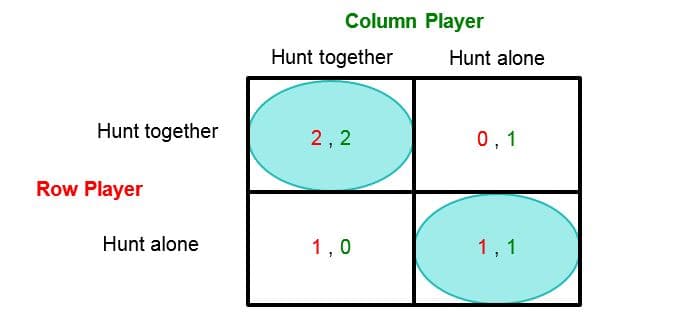
You see, when you heard it on the radio or on a CD player at your house, a Hootie and the Blowfish album that had been heavily compressed did feel more energetic. Pop in something else before or after, and even if it was more musical, more expressive and more interesting, it would be missing something. Once the top-selling albums all defected, NOT defecting to heavy compression would mean coming home from the hunt empty-handed.
And so they defected. All of them. Here is the Dynamic Range of the top-selling album by year for every year from 1968 to 2019. There was no going back.
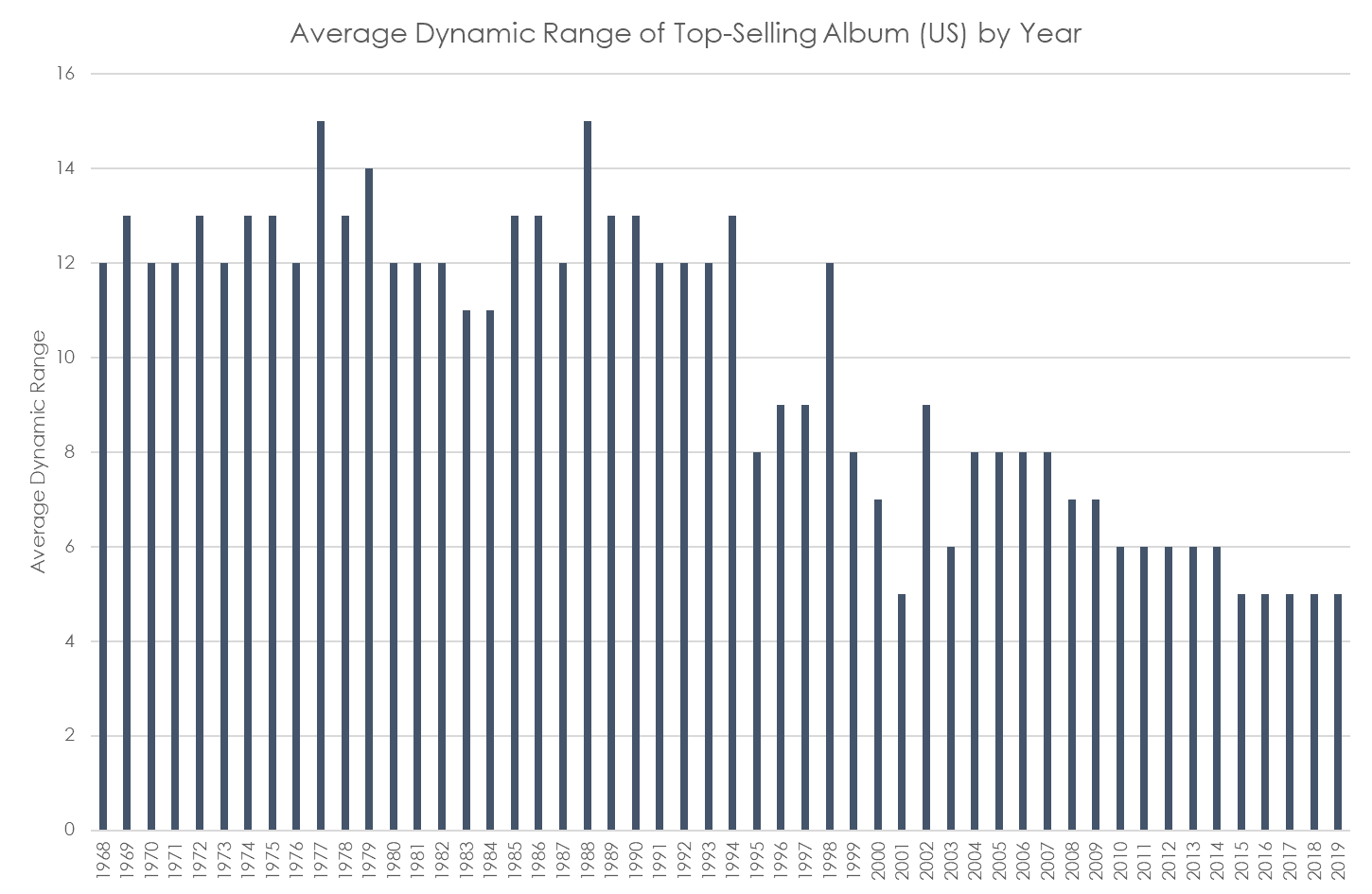
Source: Epsilon Theory, Billboard, Dynamic Range DB
For most listeners, even this probably understates the experience. In addition to the audio compression being applied at the studio, beginning in the late 1990s many users began to consume audio in forms that applied additional digital compression to reduce the size of a recording. MP3s, and later, streaming. One of the frequent side effects of reducing the file size of a digital recording is a further reduction in its Dynamic Range.
Once the game changed, something else happened, too: the process of creating commercial music changed. What I mean is that if you knew that your music was going to be heavily compressed, the music that you would write, perform and produce would probably be different.
It was.
The music being recorded changed in ways completely unrelated to audio compression at almost the exact same time. As we crossed the Elton/Hootie Line, we also saw dramatic compression in lyrical diversity. Colin Morris at The Pudding put together a fascinating analysis of exactly that a couple years ago: how much you could compress a song's full lyrical set using the Lempel-Ziv algorithm. You know it as the basis for most "zipping" programs you use because your IT department inexplicably limits your mailbox size at some absurdly small number.
Just like with zip files, we can compress the lyrics of a song based on repeated words and characters. The more compressible a song is, the more repetitive its lyrics. Here's what Colin found. Essentially, pop lyrics were at a pretty consistent level for most of the 80s and early 90s. Then, around 1995/1996, lyrical complexity plummeted.
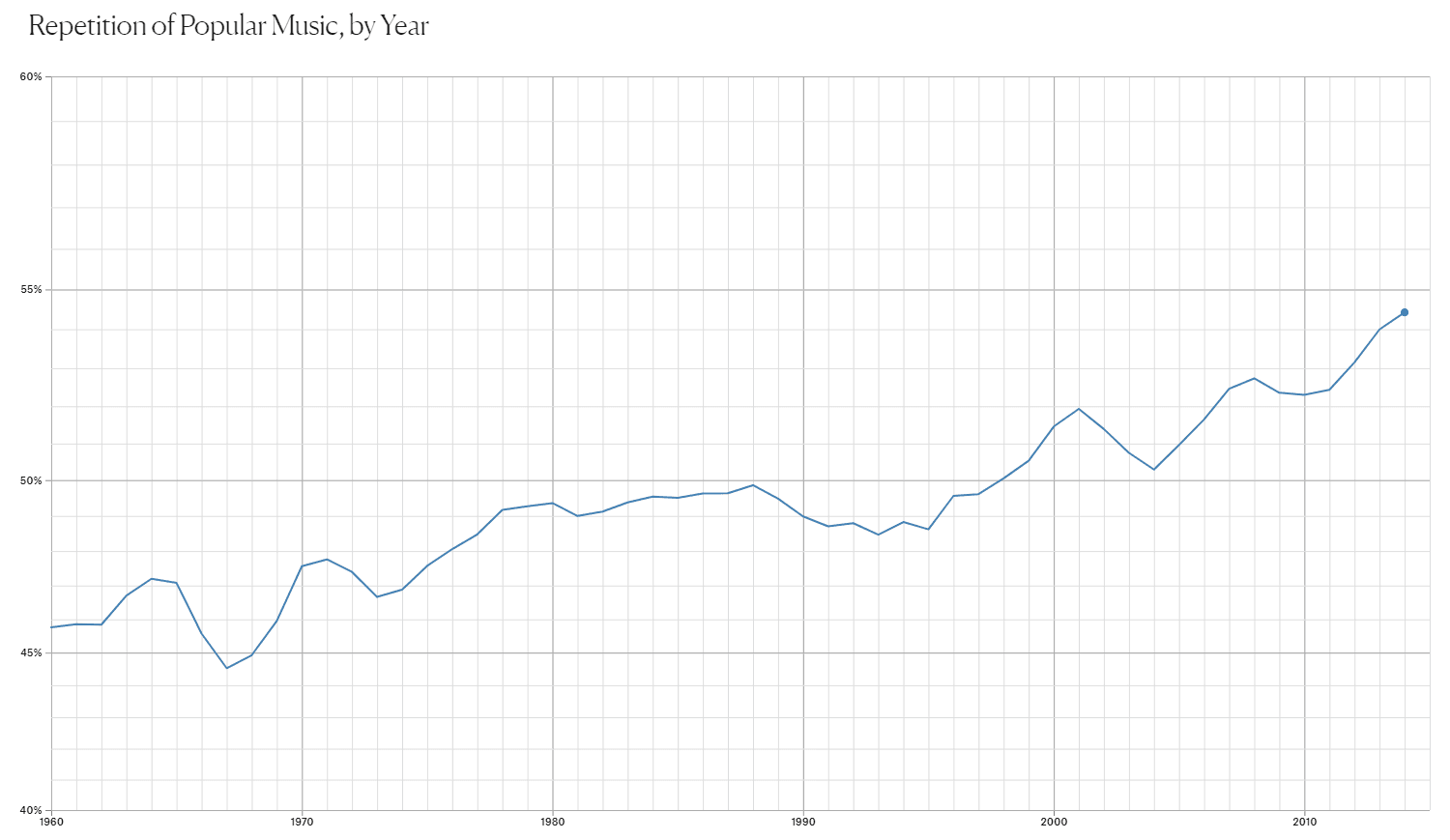
Oh sure, we may be mixing up cause and effect here. That's OK. I'm not really saying that there's some linear causal relationship between audio compression and lyrical compression. I'm saying that when you turn up the volume on anything, you're defecting from a working game structure. You're pushing the game from a Coordination Game to a Competition Game.
And it matters.
When we transform our interactions into Competition Games, it doesn't just mean that we're mean and yelling at each other all the time. It also means that optionality disappears. Degrees of freedom disappear. Creativity disappears. Diversity disappears. True risk-taking disappears. More of our decisions are optimized toward cartoons, abstracted versions of reality. More of our information is based on narratives and memes.
The Elton/Hootie Heuristic: When you turn up the volume, the signal to noise ratio drops.
Volume is a literal thing when it comes to music. But it's a thing in politics and media, too. It's extreme language. It's big metaphors. It's framing each issue in nearly existential terms. It's the Flight 93 Election, every election for the rest of our lives.
In 2016, Ben wrote a seminal Epsilon Theory piece about how Donald Trump turned up the volume of our political discourse in a way that would break us.
Trump, on the other hand … I think he breaks us. Maybe he already has. He breaks us because he transforms every game we play as a country — from our domestic social games to our international security games — from a Coordination Game to a Competition Game.
- Virtue Signaling , or...Why Clinton is In Trouble (Epsilon Theory, September 2016)
You can disagree about whether Donald himself is responsible. You can say he was an inevitable outcome of a prior defection in the Stag Hunt by a now almost entirely left-wing news media and academy. That's maybe a little bit closer to my personal view. It doesn't matter now. Whatever the proximate cause, the volume of our political discourse has been cranked to 11.
That volume manifests in our emotions about political opponents:
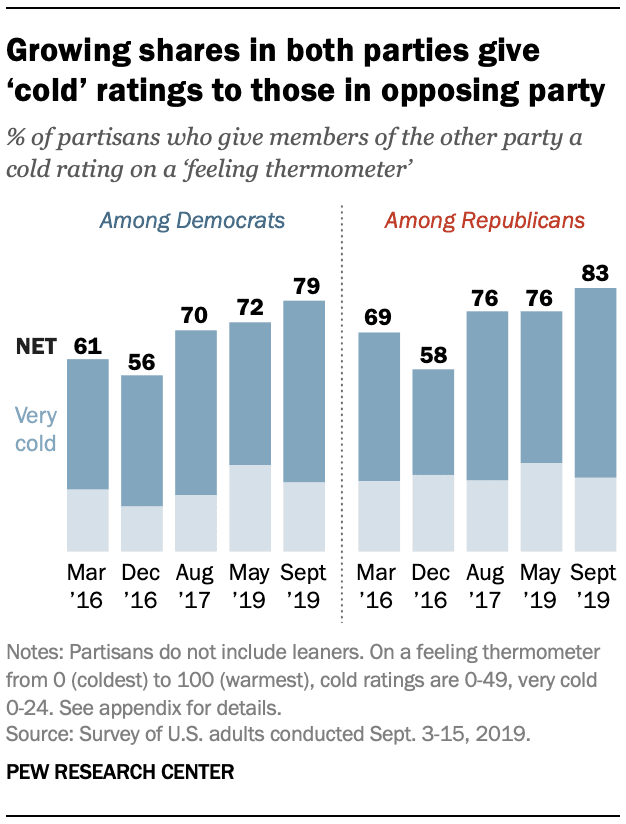
It manifests in extremes in the differences of our views, like the record gap in approval rating for President Trump observed between Democrats and Republicans in 2019. Like the research compiled indicating that out-group loathing was a greater political motivator than in-group preference. But turning up the volume also does something else. It compresses the range of acceptable political ideas, policies and discourse. Through political correctness, patriotic correctness and things like cancel culture, views which don't hew to the protective sphere of one political pole become socially impossible. There is rarely one governing narrative for any social sphere or institution, but views, opinions and actions which deviate from one of the compressed set of acceptable narratives are ruthlessly ostracized and eliminated.
But none of that is surprising. You already know that the volume has been turned up. You've seen the data showing our political polarization. You've seen the language framing each election and each issue in existential terms. You also already know that the compression is happening. Like us, you've probably despaired at the absence of nuance and any semblance of a political center. It's not important to see all that data again.
What's important is recognizing that the concepts of volume and the compression are linked. When you turn up the volume and make politics existential, you will ALWAYS limit the range of feasible views. You will ALWAYS end up with more institutional paralysis. You will ALWAYS make policy compromises far more difficult. You will ALWAYS constrain the emergence of good new ideas.
A loud political environment IS a compressed political environment.
That is just as true in media as it is in politics.
As with music, as with politics, the higher volume environment has created a tendency toward compression. What does that mean in this context? It means that when language becomes more extreme, when society becomes more polarized, narratives take on a more dominant role in defining and framing news coverage.
Consider each of the biggest news events of 2019 where it felt like the volume was turned to 11. Think about the nature of the articles you read. How long did it take for them to arrive at a discrete set of narratives, stories that everybody knew everybody knew about that event? How long did it take until you felt like you could predict exactly how each publication would frame updates about the event?
I'll work back from the answer: A week. In 2019, it rarely took more than that to crowd out off-narrative takes on a high volume story.
Consider this list of the major news events of 2019:
- Mueller Report
- Impeachment of Donald Trump
- Death of Jeffrey Epstein
- Celebrity Admissions Scandal
- Notre Dame Fire
- Hong Kong Protests (Ongoing)
- Australia Fires (Ongoing)
Imagine that you could take in every article written about these events in the first week after they took place. Now imagine that you could look at every article written in the second week. Now imagine that for each of those blocks of articles, you could measure how similar the language used was to every other article published that week. For the ongoing events that took place over multiple months, imagine you could compare the stories written in the first major news month for the event (e.g. June 2019 for US coverage of Hong Kong protests) and compare them with articles written in December 2019.
If what you wanted to identify was how much off-narrative news was permitted to exist, you'd set some threshold for that measure of linguistic similarity that represented an unusually low degree of connectedness to the rest of the coverage. Then you could look at the two periods to see whether the share of articles falling below that threshold rose or fell. If off-narrative news was being sloughed off, you'd expect it to fall.
So that's what we did. And that's exactly what happened. Specifically, we present below the Period 1 to Period 2 change in the percentage of articles whose normalized mean harmonic centrality in a network graph of stories about each topic fell into the bottom 10% of values we'd expect in average network of news of that size.
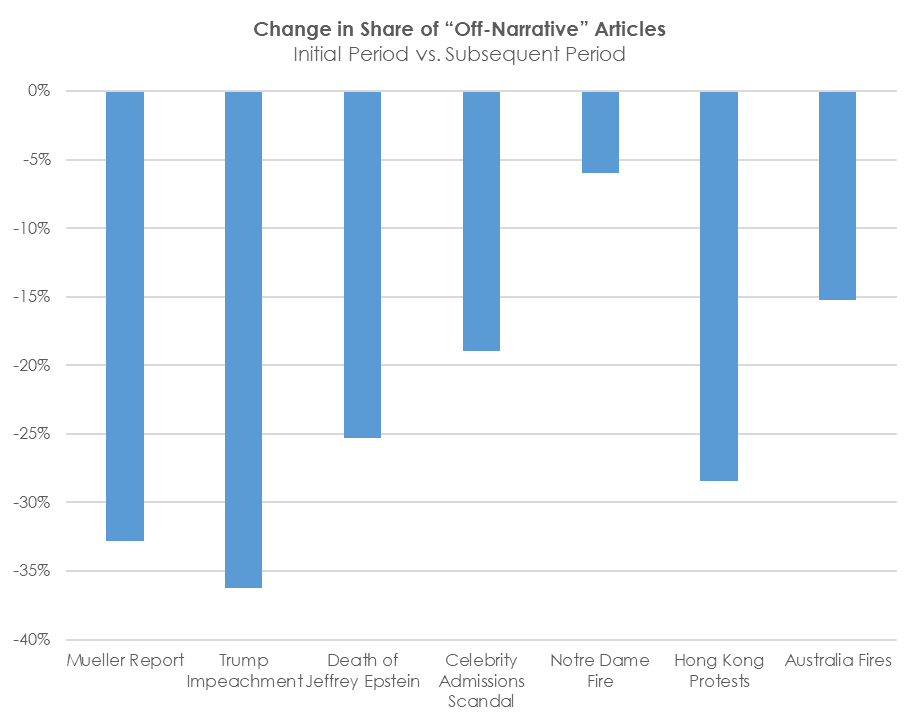
Around a week after a major event, more than 20% of the off-narrative angles got compressed into on-narrative takes. And while the point here is a more general one about the volume level of our volume in the aggregate, I don't think it takes much to observe that the more political articles appear to have been more subject to compression in off-narrative perspectives between the initial and subsequent period after the event.
A loud environment for information is also a compressed environment for information.
A few weeks back I wrote a piece called We Hanged Our Harps Upon the Willows. The intent of the piece was to reiterate our long-standing belief that the only answer to Competition Games is not to play. I think some readers thought it was an argument for not doing anything. For blogging and hiding in a walled garden.
That isn't it. At all.
Let me tell you how the Loudness War Competition Game was solved, because I think it's instructive not only for media, but for every kind of political, financial market and other Competition Game in our world today.
The Loudness War was solved when enough people who really loved music and had had enough of overcompression got together to create a sustainable environment...for vinyl records.
That's it. They didn't boycott the big labels. They didn't try to draft people into being installed as executives to shift the direction of music. They didn't push for regulatory standards on bitrates or streaming compression. They refused to sing their songs. They refused to play their games. They created a community. They grew it. They invested themselves in it. They paid way too much for vintage tube pre-amps. They converted artists to their passion. That conversion made other adjacent communities, like those built around digitally distributed music encoded with lossless codecs, stronger, too.
Don't get me wrong. If you're not acting intentionally, most music you will hear today is still hilariously simplistic and overcompressed. The point is that you now have a choice. But in most - not all, but most - of the battles we will fight today and in the future, this is what victory will look like: the creation of a sustainable, opt-in world for people who want to be free from a life in which we are obliged to invest our passion, treasure and energy in cartoons. In other words: epistemic communities.
Epsilon Theory is one. There are others.
Jonathan Haidt, Debra Mashek and the Heterodox Academy are building such a community, a response to compression and volume in academia.
Claire Lehmann and Quillette are building such a community, a response to compression and volume in media.
Eric Weinstein is building such a community. It responds to compression and volume across multiple social spheres.
Yes, even the Bitcoin community fits the bill in many ways.
So, too, do local institutions connecting people in narrow geographies that are too many to count. We've also expressed our admiration for organizations like Let Grow and Strong Towns in the past. They are involved at a national level in empowering our lowest-level institutions: families and towns.
If your response is to say that you have an issue with one or more of the ideas that have come out of these groups, well, all I can tell you is to join the club. Me too. That's not the point. The point is that they are organized on axes other than the prescribed axes that result from a compressed environment. They are places where creativity and autonomy of mind can exist, where quiet can exist, where cooperative, coordinated game play can be promoted.
They are arenas in which we are each free to seek out the signal amid the noise.
Find your pack.
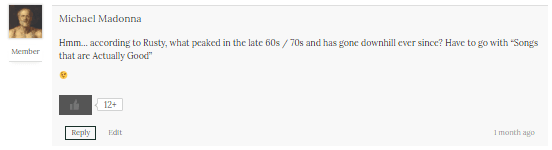
As regular readers will know, the graph included earlier in this note was referenced without identifying information in a brief competition held here. We asked subscribers to tell us what they thought the graph presented. No one guessed it exactly, but one long-time packmember came unnervingly close with what he later disclosed was a joke submission. All the same, we're declaring Michael Madonna the winner of this competition.
Epsilon Theory swag incoming.
Epsilon Theory PDF Download (paid subscription required): The Elton/Hootie Line