
ET Election Index: The First Debate, Part 2
Rusty Guinn
June 28, 2019·Politics
This content is related to the Epsilon Theory Election Index, a series we introduced here in hopes of better informing citizens and voters about the political narratives present in US national media.
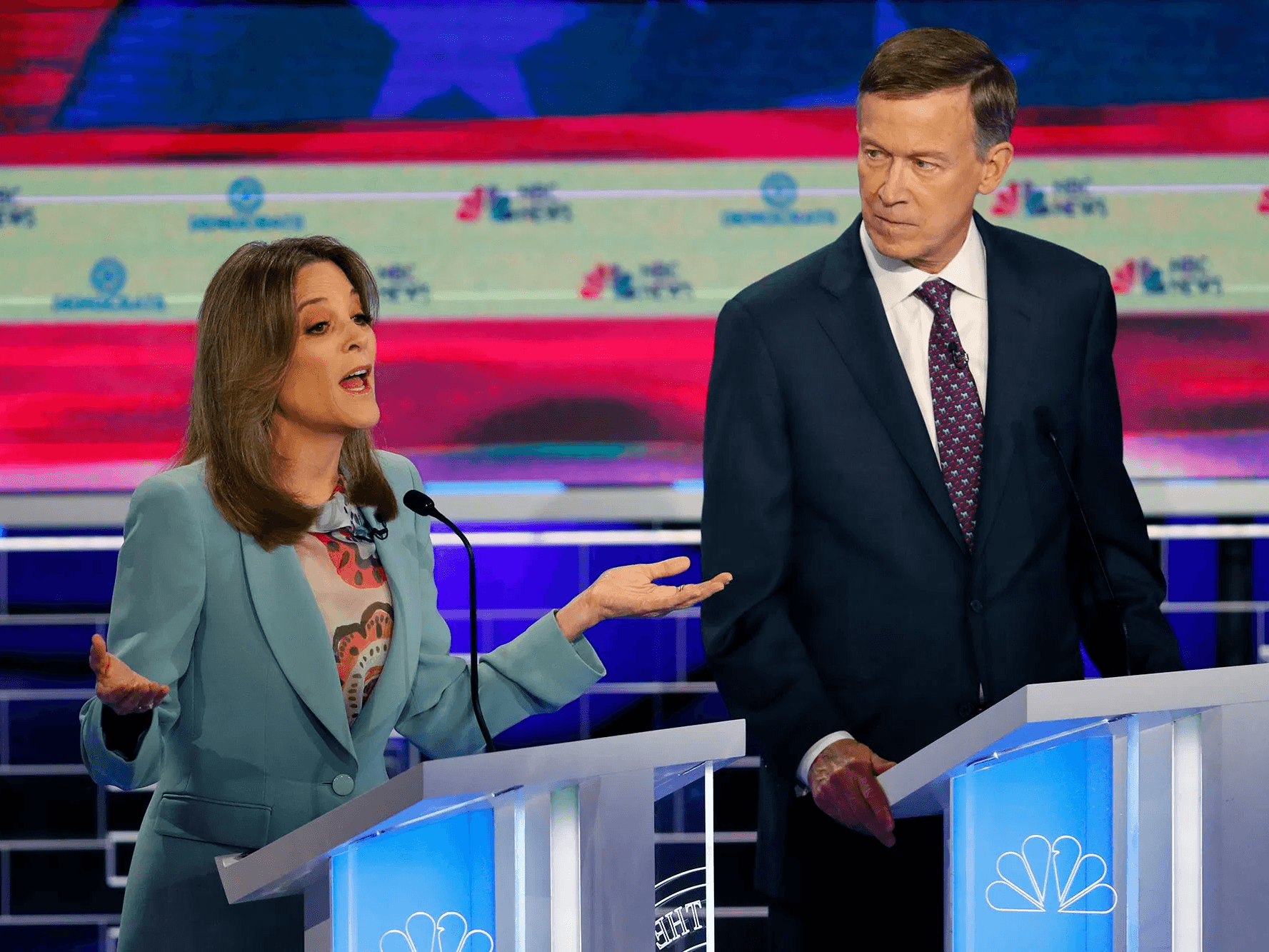
With both cattle call Democratic debates in the books, what's the narrative? What does everyone know that everyone knows? Below, as before, we examine our standard network graph, built on linguistic similarity to identify the internal consistency and attention on various topics and candidates
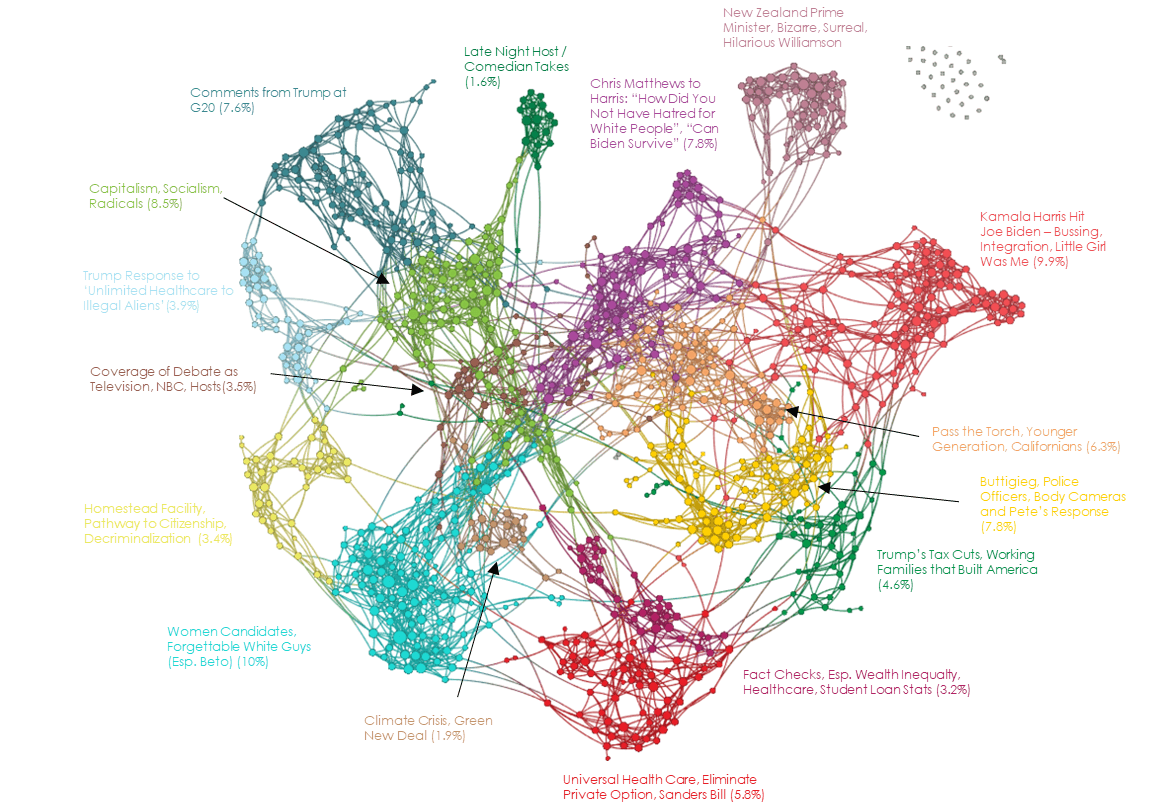
Source: Quid, Epsilon Theory
Our takeaways from this coverage:
- The narrative from the second part of the first debate boils down to two stories told frequently, with intensely linked language:
- That the debates and the election are about identity narratives, the credibility / authenticity attached to them, and the ongoing negotiation of each candidate's cartoon.
- That Kamala Harris dealt Joe Biden a body blow.
- Nearly the entire northeast quadrant of the graph is populated by social questions and identity: Buttigieg's comments about what a Christian is and questions about his handling of the shooting of a black citizen by a white police officer in his town, Swalwell's repeated references to generations and the passing of a torch, and above all, Harris's jabs at Biden over bussing and his past association with segregationists.
- As a related issue, we also note that the language (not topics, but affect) driving much of the clustering appears to be that of the verbal jabs and attacks delivered. Clusters typified by issue and policy response language (mostly on the far south axis of the visualization) are almost completely sundered and isolated from these much higher attention, more cohesive identity clusters.
- The Biden narrative sentiment post-debate has been as negative as we have noted in our pre-debate narrative analyses.
- In essentials, a lot of media wanted to talk about Harris and her jabs at Biden and a similar number wanted to talk about questions of identity and social fairness/equality. A very small number of articles, on the other hand, were devoted to discussions of policy. The overlapping language between those universes of articles was shrinkingly small.
- What has the narrative not been?
- Donald Trump, perhaps surprisingly. His tweets, reactions, and even any of the common linguistic references to Trump were almost completely divorced from the core content and narratives covering the debates.
- Climate Change. So far, the stories being told about the debate-side of the election have been almost silent on this topic, although in fairness, it was not a major topic for questions.
- Bernie Sanders. While front-and-center, with plenty of air time and a lot of prominent remarks, Sanders has captured almost none of the post-debate narrative. This is quite a turn from pre-debate media, which consistently published its most cohesive and high attention commentary about the Vermont Senator. Beyond this, despite it coming up as a topic, post-debate narratives don't seem to be organized around the wealth/income inequality issue in the same way that media before has been.
- Here are the five most on-narrative takes published about the first debate:
- This group of Democratic candidates seems to bicker more than last night's group [Miami Herald]
- If search interest is a guide, Harris's devastating attack on Biden worked [Washington Post]
- Kamala Harris Uses Her Story to Force Dems to Really Consider Race [The Daily Beast]
- DemDebate2: A Thursday Night Thumping For Joe Biden [Inside Sources]
- Socialism 2019: the Left at a Crossroads [Counterpunch]
Politics
ET Note
Politics

Comments
I think the entire two day debate can be summed up from one quote from Kamala Harris.
“Hey, guys, you know what? America does not want to witness a food fight, they want to know how we are going to put food on their table.”
I think that could fairly sum up a reasonable person’s takeaway! Unfortunately I think the broader narrative in media has been exactly the other side: a food fight.
Maybe I should have emphasized, “they want to know how we are going to put food on their table.”
Vote for me, I’ll give everyone million dollars.
No vote for me, I’ll give everyone a million and one dollars!
This quote from ET resonates with me: "In the Russian tradition of Stanislavsky, the actor says, ‘I will tell you a story about me.’ In the German tradition of Brecht, the actor says, ‘I will tell you a story about them.’ In the Vietnamese tradition, the actor says, ‘You and I will tell each other a story about all of us.’ " Le Hun.
Because it’s also a way to evaluate presidential candidates, who are actors of a different sort.
Night 2 was more entertaining theatre than Night 1. Stories about me (my achievements and adversities) are compelling and watching Harris attack Biden’s story about himself was great TV. But ultimately, Night 1’s theatre had more meaning. Warren et. al told a story of them, the workers for whom the economy does not work and the immigrant/asylum seeker. Not just in terms of policy but also vision. Bernie would have done way better had he been on Night 1.
I would have liked to see my preferred candidate deliver a story in the Vietnamese tradition, as he usually does on the trail, but he rarely got called on and his mic was cut off when he tried to interject.
Continue the discussion at the Epsilon Theory Forum...