
The Front
March 26, 2019·Media

Marie: You find something?
Hank: Oh, just this...this guy I'm looking at. You know, everything he buys and eats is organic, fair trade, vegan.
[Hank looks at a Los Pollos Hermanos napkin with notes on it found in Gale's apartment]
Since when do vegans eat fried chicken?
- Breaking Bad, Season 4, Episode 5 ("Shotgun")
We have made no secret of our disdain for Fiat News.
If you aren't familiar with our term, it's a simple analog to fiat money. Fiat News isn't outright lies. It isn't #FakeNews. It is news whose value has been debased by the persistent presentation of opinions as fact.
Because this kind of activity is intentionally subtle, most of our prior pieces have focused on the language used in those articles. We considered whether the authors are using terms which convey strong value judgments, or which beg the question by treating unproven conclusions and assertions as givens. While we haven't spent as much time on this topic (yet), we also recognize that Fiat News manifests in what is considered newsworthy by editors. The choices they make about what to cover convey a lot of information about what they believe is important, and in effect, what they believe you should believe is important. This is an unavoidable feature of relying on anyone else for information, of course, but the differences in coverage levels of various topics among publications make it clear that it is, in the most charitable interpretation, at least an unintentional mechanism through which Fiat News is transmitted. Even headlines - someone at a news publication summarizing the conclusions of someone else's article - can be a key point of Fiat News transmission.
But as the Zeitgeist transitions from one in which cooperative games are possible and rewarded to one in which any rational, remotely self-interested participant is forced into a competitive posture, something else has arrived. It isn't the subtle influence of opinion masquerading as fact. It is the army at the gates, with banners waving, bugles sounding, general on his horse in all his bloody state, saber pointed forward.
It is analysis journalism.
Sure, once upon a time, the news was the main event. It was why we came, and it was why they existed. It was a respectable family restaurant. But today, that above average service and delicious blend of herbs and spices is little more than a front. The real thing is what they do out of the service bay out back, slinging opinions and controversy, explainers and commentary. Yes, most news organizations are now largely a front for analysis journalism.
And we're just a bunch of vegans, pretending we're there to eat the chicken.
Let's talk Mueller Report, y'all.
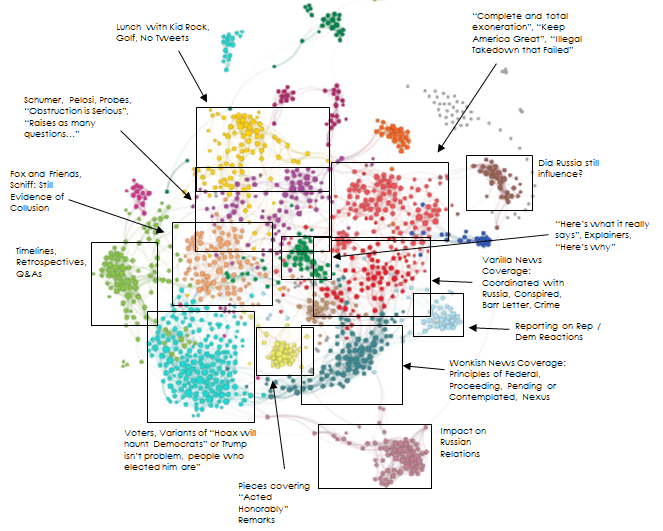
Regular readers, you know the drill. Below we present the Quid-based network graph of all stories from LexisNexis Newsdesk on March 24th and March 25th (through about 3PM ET) which referenced the terms Mueller, Russia and Trump.
Source: Quid, Epsilon Theory
Each dot here is a node which represents a single document from the LexisNexis Newsdesk database. News articles, opinion articles, basically everything published by most national news sources, major blogs and local publications with at least moderate circulation or web traffic. Quid, a developer of Natural Language Processing technology, compares all of the text in each of those documents to all of the text in every other document. It looks for similarities between each pair of articles and begins to cluster them by similarity in the use of language and phrases. Highly similar adjacent articles - whether within a single cluster or across multiple clusters - are connected by each of the lines you see between dots.
This is a visualization, so it is imperfect as a representation of a complex matrix of data. Still, in general, it is true that proximity visually is an indication of similarity of language. Up and down, left and right otherwise have no meaning outside of proximity. The tags are attempts from us to summarize the n-grams, phrases, keywords and context which serve to define each cluster.
See anything in the graph above? Well, let me tell you what I see.
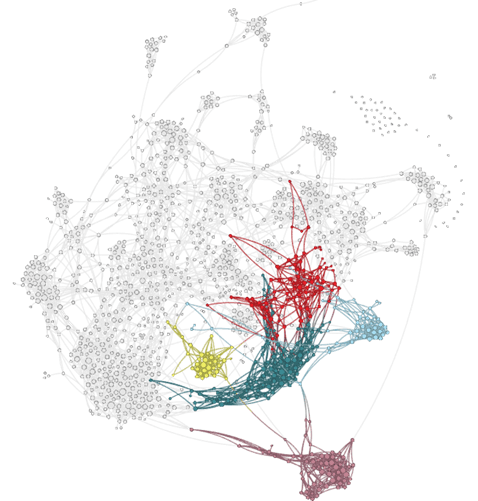
I see a network where about a quarter of the clusters indicate what we would think of as "News" content.
These are clusters typified by rote quotations from official statements, technical phrases (e.g. 'nexus', 'did not knowingly collude' or 'has found no evidence of') and the absence of strongly value-indicative expressions like, say, 'Trumpworld' or 'The liberal media', which serve to define the basis of similarity in other clusters. No, this isn't an objective determination - it is my opinion - but it is aided by the NLP analysis. You see, all of the clusters with these traits occupy the same, somewhat disconnected region of the overall network graph.
Source: Quid, Epsilon Theory
In all, these articles account for 22.5% of the total number of pieces published in the last two days. But the number of pieces published isn't all that useful. We want to know how influential certain types of language have been on the overall sea of information floating out there for public consumption in comparison to other types of content.
Having started from the highest level, let's now travel down to the lowest level, that of the individual article. Here's the question we want to answer next: In this whole mess of articles, which use the language that is most similar, most influential on the structure of all these clusters and the interrelationships between nodes?
Here are the Top 10:
#1 - How the Russia #Resistance nuked the Never Trump movement - Washington Examiner
#2 - Robert Mueller was never going to end Donald Trump's presidency - Vox
#3 - What we learned from Barrs summary of the Mueller report - The Guardian
#4 - The Last Mueller Report Speculation You'll Ever Have to Read - NY Magazine
#5 - After Mueller report findings, Team Trump plans to 'slam and shame the media' - CNN
#7 - White House Calls Mueller Report 'Complete Exoneration' - AP / KTLA Los Angeles
#8 - Trump upbeat in first tweets since Mueller report sent to DOJ - Washington Examiner
#9 - Mueller report found no evidence of Trump-Russia collusion: Justice Dept - Deutsche Welle
#10 - Adam Schiff: Still Evidence of Trump-Russia Collusion After Mueller Report; Huckabee Reacts - FoxNews
Your mileage may vary in your interpretation of these pieces. For my money, you've got six obvious opinion/analysis/explainer pieces, one Fox News video funnel blurb in which half of the story's text is opinion quotes from an on-air contributor, a Washington Examiner piece about Trump Tweets, and two God's honest news pieces. The AP / KTLA piece has some Fiat News tells, but yes, it is a news article. The best of the whole bunch is a nice piece of summary journalism from DW. Don't know what that is? It's Deutsche Welle, which is Germany's version of that weird CNN International channel you get when you stay at that hotel in London that still doesn't seem to have high definition channels for some reason.
Two. Two out of ten.
There are two intuitive ways to think about connectedness and similarity in language from a visualization like this. One is to look for the center of gravity. Where are the connections coming from? What sits at the center, seemingly a bit connected to everything else? The second is to look for the cluster where a lot of nodes are jammed together closely, indicative of strong cohesion within a particular narrative about that news topic.
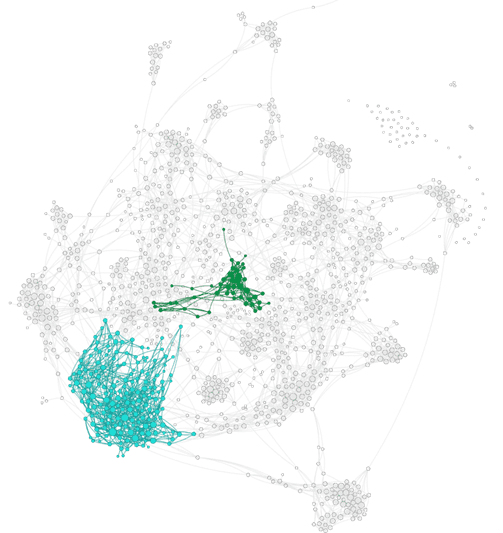
Again, trust your own perception, but below are the two clusters that jumped out at me from the visualization on this basis. And the matrix data support it. The gray cluster at the bottom left has the highest internal cohesion (i.e. our calculation of the average distance of its nodes to all other nodes in that cluster), and the green cluster has the highest interconnectivity to other clusters.
Source: Quid, Epsilon Theory
What is the green cluster which connects the most different clusters together? What sits at the middle of our media consumption?
Explainers. This cluster is full of them. Five Key Takeaways. Discussion of how Trump is spinning it from Mother Jones. A literal explainer. Foreign Policy's predictions about the implications.
What's the gray cluster that dominates the graph, with the highest number of documents and the highest internal cohesion among the stories being told within those articles?
These are stories connecting the Mueller Report and Barr Letter to voting, the 2020 election and the campaign trail. In other words, before the facts had really been reported for us to digest, just about every media outlet in America decided they needed to tell us how to think about what this would mean for the election cycle.
In addition to about half of those pieces in the top 10 (including the top few), this cluster of articles includes a Courier-Journal opinion piece about Bloodthirsty Democrats, a blog promoting the Russia probe as the birtherism of the left, the Hill's playbook for Democrats' next steps, NY Mag's take on the 2020 election impact, and local media discussing that minds haven't been changed.
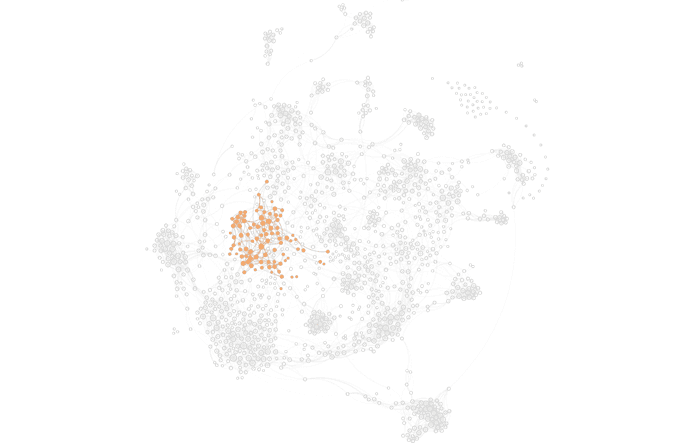
Maybe when you looked at the network you drew a different conclusion. Maybe the highlighted cluster below is what you saw. You're not wrong. When we apply Epsilon Theory's own attention metric, this IS the second most connected cluster, after the "voting and election impact" cluster. What is it? It consists largely of discussions of Congressman Adam Schiff's remarks on Sunday that there is "still significant evidence of collusion", and the retort to those remarks that Mike Huckabee delivered on Fox News. In other words, this cluster is so influential on the structure of the whole network because it literally represents the separate talking points of the two major parties. And it is pure opinion.
Source: Quid, Epsilon Theory
If you really explored this network, you would find that more than 22.5% of articles are ostensibly news pieces. There are news articles in a great many of these clusters. If you will forgive me, however, this is, uh, not fully exonerating. In other words, it is not a good thing when NLP software struggles to distinguish the language in your piece from outright opinion journalism.
Still, there is a difficult line to draw here. The freedom of the press does not, as we sometimes pretend, exist simply to protect the ability of media organizations to report facts that powerful people don't want coming to light (although it certainly DOES do that). But it also exists to protect the right of media organizations and individuals to express and publicize their opinions and judgments about those facts. There is nothing wrong, unethical or immoral about opinion journalism, explainers or analysis. Hell, I'll save commenters the trouble of pointing out that this, in fact, is a kind of analysis. Guilty as charged.
For those of us who consume information within the widening gyre, however, I think it is worth being vigilant, frequently checking in on:
- The overall quantity of analysis and opinions relative to true news, across media;
- The emphasis placed by individual publications on that mix;
- The demonstrated commitment of publications to keeping a bright line between their news and analysis content, especially on websites; and
- The areas and topics about which opinion and analysis journalism most actively seek to influence our perspectives (i.e. in this case, common knowledge about the 2020 election).
And then there's that whole Fiat News thing...



Comments
Good stuff Rusty, walkthroughs like this are helpful for moving up the learning curve on the quid maps. Although, I must say I still wouldn’t trust myself to come to a conclusion on my own. But your point about how journalism has turned a corner is important. This article from the NYT in 2016 crystalized for me that we had moved into a new world for news.
https://www.nytimes.com/2016/05/08/magazine/the-aspiring-novelist-who-became-obamas-foreign-policy-guru.html?_r=1
It used to be: News -> Reaction (personal) -> Spin -> Reaction (public). But now that the news bureaus have been so hollowed out that they lack the foundational knowledge to process data on their own (like me with Quid). As a result journalists had to depend on biased sources particularly when it comes to politics or finance. In some cases, the journalists don’t even know they are being played. The new world is: Pre-spun news -> Public reaction -> Personal reaction (heavily influenced by peers). We are all still adapting and I have found you & Ben to be wonderful guides and sources of moral support. Keep up the great work!
I think this piece by Rolling Stone’s Matt Taibbi (he of Goldman “Vampire Squid” fame) on how Russiagate has destroyed the credibility of the press is was pretty damning – https://taibbi.substack.com/p/russiagate-is-wmd-times-a-million . It chronicles how out of either ideology or desire for ratings/clicks (more likely both) news organizations abdicated their core value of fact checking.
key quotes :
We broke every written and unwritten rule in pursuit of this story, starting with the prohibition on reporting things we can’t confirm.
Years ago, in the midst of the WMD affair, (NY) Times public editor Daniel Okrent noted the paper’s standard had moved from “Don’t get it first, get it right” to “Get it first and get it right.” From there, Okrent wrote, “the next devolution was an obvious one.” We’re at that next devolution: first and wrong. The Russiagate era has so degraded journalism that even once “reputable” outlets are now only about as right as politicians, which is to say barely ever, and then only by accident.
I guess the reason is why there are so few news articles Rusty, as that these organizations don’t actually do news anymore. Maybe its too expensive and can’t be supported by current business models, maybe (a la Fox News/MSNBC) the only way to generate sustainable revenue is to be more entertainment/preaching to the choir/“analysis”.
Continue the discussion at the Epsilon Theory Forum...