
The Love/Hate Cartoon
April 7, 2019·Money

In case you were wondering, you and I play the role of Elmer in this cartoon.
I saw this chart below from a financial journalist – quite a good one, at that - last week.
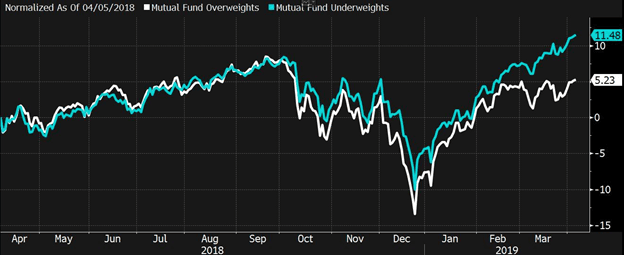
The basic idea is to show how the underweights and overweights of mutual funds performed. It is not dissimilar from many research products promoted by the sell side covering this or that universe of active investors. Equity and quant research teams at practically every sell side house regularly publish similar research about how the biggest long and short positions of different active manager classifications have done.
These recurring pieces and the news articles which inevitably follow them are…insanely popular. The are a golden goose of nearly infinite financial news features, a regular source of eyeballs and clicks. So naturally, they usually escape the fine scrutiny of financial media. As for the rest of us, they feed our schadenfreude about the plight of fancy, high-priced hedge funds and how they’re often just as dumb as the rest of us, or when their 'positions' work, our suspicions that they are the result of the tools of the super-rich who don't have to play by the same rules as the rest of us. They feed our condescending ‘retail money’ opinions about actively managed mutual funds, and how they’re just as dumb as we thought they were. The result is that they largely go unchallenged by nearly everyone. Mostly harmless, of course, but there are people - lots of people - who really look at these things.
I regret to inform you that just about every one of these pieces is a cartoon.
Abstractions of abstractions.
The most bizarre part of the whole affair, of course, is that it is the most ardent passive-or-die army – the people who should really know better - that seems so chuffed by the almost always negative conclusions of these pieces. Well, that just goes to show you why active management doesn’t work! No, it doesn’t. The problem with active management isn’t that active managers are especially dumb and prone to bad decisions. The problem with active management is that it asks us to pay fees to bet on a zero-sum game, which as Charlie Ellis reminds us, is definitionally a loser’s game.
Let’s cut through the cartoon to the question that will tell us what’s actually going on here: if active management is a zero-sum game, if all active positions net out to zero, why do all of these analyses manage to show large, residual biases in representations of a large bloc of the aggregate market?
There are three reasonable explanations for just about all of the deviations between these analyses:
- Data-Driven: The researcher uses the data accessible to them, which often has embedded availability biases. Periodicity is almost always imperfect and its potentially inaccuracies assumed away. Available data frequently excludes derivatives / non-securities, which can be meaningful for certain strategy and vehicle types[1][2]. The universe of managers with good and representative information, especially among alternative vehicles, is incomplete, and total asset information even more so. They call their drawing “the stocks active investors love and hate right now", but what you actually get is an artifact of the incomplete and biased data set available to the party performing the analysis.
- Methodological: Each such analysis reflects the scheme by which the tracked love/hate metrics are designed and weighted. Is it truly asset-weighted, or maybe they look at top 10 lists of holdings from funds of hugely variable size and simply count up how many filings referenced different names? How does it treat cash positions? How does it treat the implied positioning from option positions, if at all? They call their drawing “the stocks active investors love and hate right now", but what you actually get is a drawing of a methodology with a non-representative and biased weighting scheme.
- Sub-Category Biases Categories like long-only active managers have persistent structural biases relating to the practices of active management that are necessary to produce active risk. The universe of US large cap funds, for example, will almost always be overweight mid- and small-cap stocks because meaningful overweights to mega-cap positions are either psychologically challenging or difficult to achieve without a significant reduction in position count or loss of 'active-ness.' There are similar such biases across other categories. Some of those biases may be the result less of tautology (i.e. to be active you must be...active) than of behavioral tendencies which vary among different classes of investors. But in any case, if we're saying a class is consistently underweight, we have to know that somewhere out there, someone has got to be overweight. They call their drawing “the stocks active investors love and hate right now", but what you actually get is a drawing of the things they always love and hate for structural reasons.
If you raise these points, you will very likely get a response that "all models have flaws" or maybe that "data is never perfect"! Ignore it. You don't have to argue with someone explaining why it's OK that their model predicts that 70% of outcomes are worse than the median. If you believe at all in the principles that underlie a belief in passive management, the zero-sum game is your rock. If someone can't adequately explain why they are telling you a massive cross-section of financial markets is non-zero-sum, or if they can but can't explain why the dimensions of that cross-section aren't just a feature of persistent structural tendencies related to the definition of that cross-section, they simply don't have information that is of any interest to you. And if they can? Then by all means, listen. There's no reason why this kind of analysis can't be useful.
But in almost every extant form, it is just sales and marketing.
These artfully constructed reflections of available data, sets of subjective methodologies and persistent structural biases in the composition of various investor universes are sold to you and me as reflections of how certain investors are playing this market, so maybe you’d like to call our desk and bet with them? Or maybe against them?
You see, the cartoon IS the point. Creating more internal natural variation, a more robust sense of winners and losers that you can bet on or against, IS the point. Telling you the truth about zero-sum games defeats the purpose.
[1] My favorite example is the periodic breathless piece about the ETFs disclosed as part of one Bridgewater’s portfolios, something that can tell you how they're investing! Y’all. C’mon.
[2] It's true as well that shorts and some derivatives can create distortions in the nexus between a zero-sum framework and portfolio results, but as is noted here, the accurate availability of those positions is brutally bad, which is the problem.