The MacGuffin, Part 2: The Story Arc of SBF and FTX
November 18, 2022·Money
Download a PDF of The MacGuffin, Part 2: The Story Arc of SBF and FTX (paid subscribers only)
Download or listen to an audio recording of The MacGuffin, Part 2: The Story Arc of SBF and FTX.
Available at:



The MacGuffin, as Alfred Hitchcock famously put it, is the object of desire.
It is Prince Charming. It is the Princess Bride. It is the Way Out. It is the Way In. It is the Secret. It is the Answer to the Question. It is the Ring of Power. It is the Alien Technology. It is the Map. It is the Treasure. It is Whodunit.
It is the thing or emotion or idea or state of being around which the plot of a story revolves, and every movie you have ever seen, every scripted TV show you have ever watched, they all have a MacGuffin.
So does your life. Your life has MacGuffins, too.
One of the oldest and most powerful MacGuffins is the Magical Money Machine.
The Magical Money Machine is Draupnir of Norse mythology, the golden ring of Odin that would make eight perfect copies of itself every nine days. The Magical Money Machine is the straw-into-gold spinning wheel of Rumpelstiltskin, an evil protagonist in a story that dates back 4,000 years. The Magical Money Machine is the genie of the lamp, the purse that has a few gold coins in it every morning, the goose that lays golden eggs. The Magical Money Machine is a reasonably common MacGuffin in today's movies, like the supercomputer of Westworld and the superintelligence drug of Limitless. But the best place to find this MacGuffin today isn't in Hollywood but on Wall Street. Because once you start looking for the Magical Money Machine in financial media and financial advertising and, most prominently, in the stories that we financial professionals tell ourselves, you will find it EVERYWHERE.
Oh sure, we citizens of Wall Street know full well that of course there's no such thing as a Magical Money Machine, and when we talk with each other in public we laugh at the idea of a Magical Money Machine, like ‘oh, haha, get a load of these rubes who believe in this nonsense’. But in private we whisper our heart's truth, that there is such a device. Because the human truth is that deep down in every single one of us who makes our living in the financial world, we believe that there IS a Magical Money Machine and that if we just look hard enough or get lucky enough we will find it. I know that I do. Intellectually I know that the Magical Money Machine doesn't exist, that it can't exist, and yet ... this is the MacGuffin that has driven the story arc of my professional career. Actually, that's not completely true. The truth is that I've been searching for the Magical Money Machine for as long as I can remember, ever since I was a child. It is the MacGuffin of my life.
Once upon a time, Sam Bankman-Fried found a Magical Money Machine he called Alameda Research.
Or at least he thought he had found a Magical Money Machine. I've known that feeling (briefly!), and it's the best feeling in the world if that's your life's MacGuffin, as I suspect it is with SBF. Not for the money itself, mind you, but for what you can DO with it. And not even for what you can do with it, but just for knowing that YOU solved the biggest puzzle in the world.
But the feeling doesn't last because, alas, you did not actually find a Magical Money Machine. It does not actually exist. Most likely it never existed, and what you thought was a Magical Money Machine was just an artifact of luck and circumstance. Like being a private equity guy and mistaking cheap capital and infinite leverage for skill. Or like being a public markets guy and mistaking a bull market for brains. Then again, maybe it did exist, kinda sorta, for a couple of years until other really smart Wall Street types figured out your secret and they end up – in the lingo – ‘arbing away' your edge.
I think SBF had a Magical Money Machine hedge fund for a couple of years, and then it stopped being magical as more experienced Wall Street professionals got into the crypto world.
SBF was early to the professional crypto trading world (he launched Alameda in 2017), and there were plenty of persistent informational asymmetries in that early market for a smart guy like SBF to skin with a portfolio of systematic quant strategies. Also, and the importance of this really shouldn't be underestimated, commodity trading in general and crypto trading in particular has a much laxer regulatory framework, especially when it comes to what would be considered insider trading and ‘material, non-public information' in the stock market and the bond market. Basically, there's no such thing as insider trading when it comes to commodities, and let's just say there's a reason that all of these crypto trading shops are based in Asia and the Caribbean. So I think SBF and Alameda probably killed it in 2018 and 2019, but by the time Covid hit, Alameda was just one of many crypto hedge funds competing with each other over an increasingly difficult-to-navigate market.
Here's the thing, though: Alameda had no outside investors who would know that performance had declined from Magical Money Machine levels to non-magical levels! See, Alameda did not take on outside investors the way that most hedge funds take on outside investors, with an annual management fee (1-2% of the amount invested) and a performance fee (10-30% of the profits) on the capital account established for the investor within a limited partnership vehicle. No, Alameda didn't take investors (LPs) in their fund at all. Instead, you lent money to Alameda and they promised you at least a 15% annual return on your loan. Also, they promised that you could cancel your loan and get your money back anytime they had even a slightly bad month.
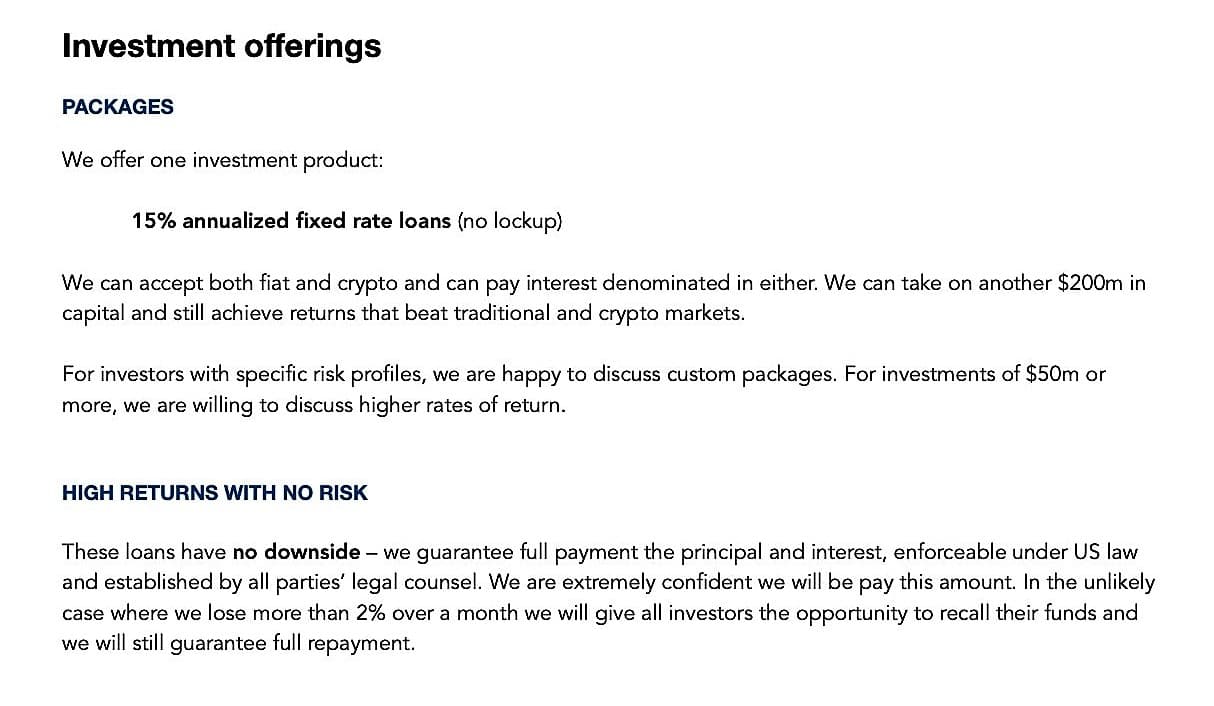
It's both a really interesting and really troubling offer! On the one hand, it creates an enormous mystique and reputation as a Magical Money Machine (nope, we're going to make crazy consistent profits with your money, so much so that we'll promise at least 15% annual returns, but we're not going to share more than 15% with you because you're lucky we're even talking with you). On the other hand, this IS the recipe for a Ponzi operation (oops, we didn't cover the 15% this year, but we can cover it with new client loans and some fudged accounting and no one will ever know) and most troubling of all, they are selling themselves as a Magical Money Machine. I mean, if the words "HIGH RETURNS WITH NO RISK" don't give you the heebie-jeebies as a potential investor (not to mention that this sort of language would be outright illegal for a US-registered or EU-registered investment vehicle) ... well, I don't really know what to tell you. Actually I do know what to tell you. If you ‘invested' money with Alameda on the basis of this deck, you allowed a MacGuffin to take over your decision making, and all of the bad things that are happening to you now stem from your failure to recognize and control your MacGuffins. I'm sorry, but you should not be responsible for managing other people's money.
Ultimately, I believe, Alameda became a Ponzi, using new funds to cover the returns they promised on client loans, all while maintaining a reputation as a Magical Money Machine.
The thing about people who slip over time into outright fraud, like Bernie Ebbers and Jeff Skilling and Elizabeth Holmes and Bernie Madoff and (IMO) Sam Bankman-Fried, is that they don't start off doing outright fraud. They have a couple of bad lab results (Holmes) or a couple of bad quarters (Ebbers and Skilling and Madoff), and they decide to fudge the data or the payments as a temporary thing. You know, just until we get back on track. Just until the Magical Money Machine starts being magical again. It's for the greater good! My god, what a tragedy it would be for the world if all the good we've accomplished and – more importantly – will accomplish in the future gets blown up over some bad luck we had. No, no ... the right and ethical thing is to fudge the data and the accounting. Not for me, mind you. For humanity!
Now smart guys like SBF (who I really do think is really smart) don't want to leave this recovery from a temporary setback to chance. No, they're looking for a new Magical Money Machine or an evolved Magical Money Machine to replace the not-so-magical-anymore machine.
SBF found an evolved Magical Money Machine in FTX, where he could channel the dark magic of FLOW.
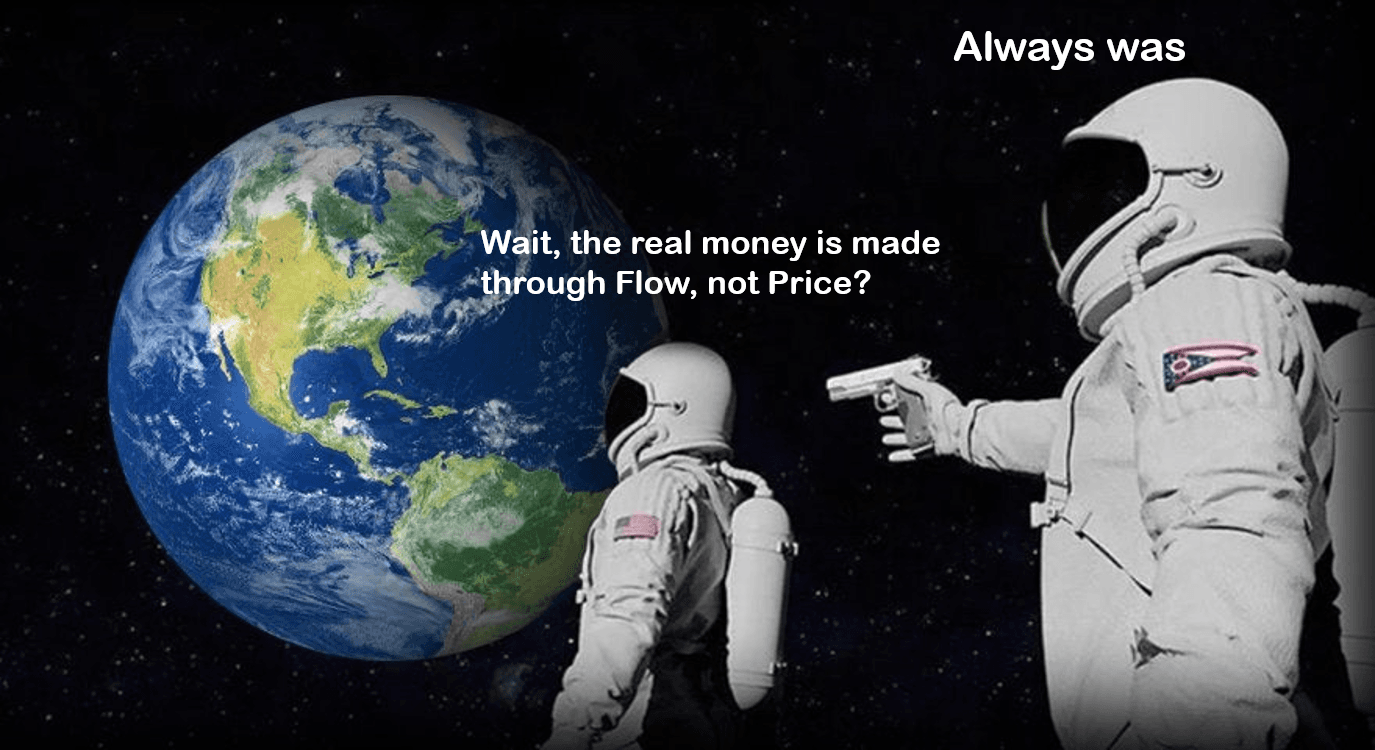
There is so much more money to be made in financial markets, with so much less risk, by being in the Flow business rather than the Price business.
The Price business is the hedge fund business. It is buying low and selling high. It is being right time after time and being timely time after time and being effective time after time in all that buying and selling. It's really hard! Especially if you don't have a Magical Money Machine that's right and timely and effective all the time.
The Flow business is the exchange business. It's the market-maker business, where you take a small transaction fee for being the middleman and bringing together a willing buyer and a willing seller. You don't have to be right to make money in Flow, because you're not expressing a buy/sell opinion. You don't have to be timely and you don't have to be effective, again those terms don't really have much meaning in an opinion-less Flow business. All you have to do to make a Flow business work – and when it works it really works – is to be there. You have to be the market-maker that people use. You need to provide ‘liquidity' (being the buyer or seller temporarily if there's no buyer or seller you can match with the seller or buyer knocking on your door). You need marketing and you need reputation.
Fortunately for SBF, he's already got all of the ingredients here. Alameda can provide the liquidity. They can be on the other side of any trades that need to be made, and then hold the exposure on the hedge fund books until it makes sense to get out of the trade. Certainly SBF can provide the reputation. He's got a Magical Money Machine, after all, and is the smartest guy in crypto. Plus he really wants to do good in the world, give his money away to worthy causes and all that. Marketing is easy ... just need to spend some money for that, and there's no shortage of blue chip investors like Sequoia, Ontario Teachers and Tiger Global willing to give SBF money for FTX at enormous valuations ($17-25 billion in 2021, $32 billion in 2022). So here we go!
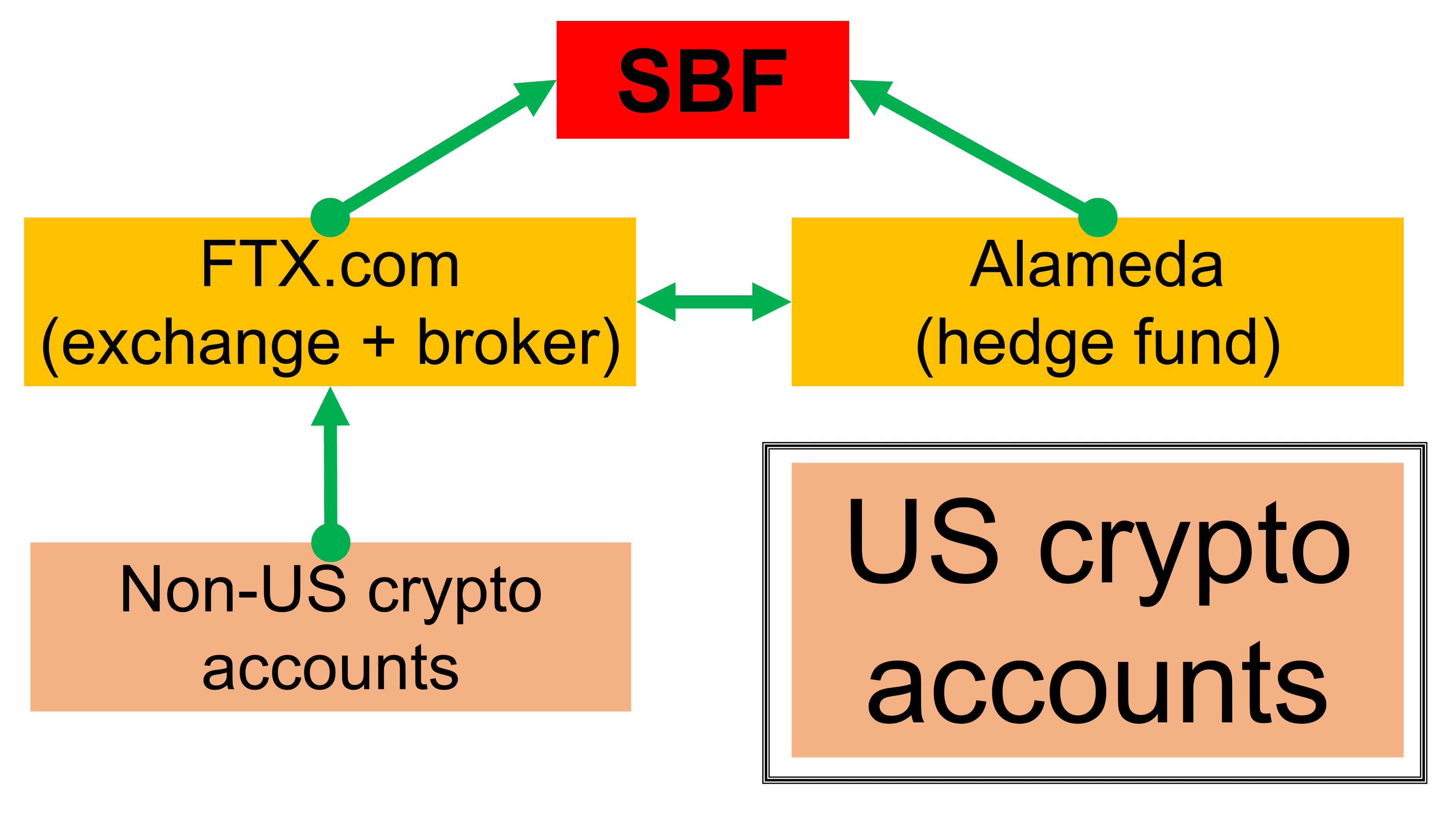
Okay, let's spend some time describing this chart. The big green lines show how cash flows between the different boxes. SBF loves the big green lines! The SBF box and the Alameda hedge fund we already know – that's Sam personally and his originally-but-not-so-much-anymore Magical Money Machine. The FTX.com is the new market-maker and flow business entity, but you'll see that I call it an exchange + broker. That's because while it acts as a market-maker for crypto trades and calls itself an "exchange", it is also a brokerage, meaning that it maintains or custodies the actual trading accounts that people would use to make those crypto trades.
Being a brokerage is a big source of revenue for SBF, as he can provide lots of services to those accounts, the most important one being margin – a loan that brokerages can extend to clients so that they can trade more. Not only does a brokerage charge you interest on that loan, but also once you take a loan from a brokerage, they typically have the ability to rehypothecate some or all of your assets, meaning that they can take the assets that you pledged to them as collateral for your loan and use them as collateral that they pledge for a loan they are taking. If they default on this loan that they have taken, their lender gets to keep your assets for a loan that you never received. Crazy right? Lots of institutional investors learned this lesson the hard way when Lehman declared bankruptcy and assets people thought were safe had been pledged away from underneath them. Anyway, hold this thought about rehypothecation because we'll come back to it later.
There are lots of new magic tricks that SBF can try now that he's got two boxes to play with – FTX.com and Alameda – instead of just the one.
The first new trick that SBF pulls is to make Alameda a ‘client’ of FTX. Why? Because now all of the Alameda problems can be papered over sooooo much more easily. Need some cash over at Alameda? No problem, just increase the ‘margin’ that FTX.com the brokerage extends to Alameda the ‘client’, which Alameda can use for whatever it wants. This is what's called a related-party transaction, and it wouldn't last a second in a US-regulatory set-up (or at least it wouldn't in an effective US-regulatory set-up), but no one is looking at this too hard in the Bahamas.
The second new trick that SBF pulls is to make FTX a ‘licensee' of Alameda, where FTX pays a fee (I've seen $400 million as the total amount paid to Alameda by FTX.com) for the ‘technology' that Alameda provided FTX the exchange. Again, related party and again, wouldn't be tolerated in an effectively regulated industry. More importantly, all of these related party transactions shouldn't be tolerated by anyone considering an equity investment into FTX. I mean, it is INSANE that the lead investors in FTX.com – Sequoia (one of the most blue chip of all blue chip venture capitalists) and Ontario Teachers (one of the most blue chip of all blue chip pension funds) – either knew about these related party transactions and didn't care or didn't know about them in the first place. I'm not sure which possibility is more damning, frankly, but these are the only possibilities.
But wait, there's more!
Remember how I said pretty much anything goes in commodities-world, at least from an insider information perspective? Well, imagine if you just invented a new commodity, called ... I dunno ... ‘Serum' or ‘FTT', and told the world "hey, this is a governance token for decentralized exchanges" or "hey, this is the token of an FTX affinity program, kinda like a tracking stock in our company but we're never going to use the words ‘stock' or ‘security' because haha", and everyone thinks "wow, that's pretty cool, especially the affinity program thing", and you dribble a few out so that people can start trading them back and forth and you watch the price of your newly created commodities go up and up. Which is great, because your new commodity is just basically entry lines in an Excel spreadsheet, and for every one of these tokens you dribble out for the crypto accounts to play with, you give yourself a bazillion of the tokens and use them as collateral for loans or as an asset for acquiring real stuff. Like, why not ‘pay" Alameda their $400 million ‘technology licensing fee' with FTT exchange tokens that Alameda can then ‘trade' on FTX.com for the real(er) money in FTX client accounts, or lend out for yield or use as collateral for bigger loans or otherwise use to buy real things like equity stakes in real companies? Who cares that these made-up tokens are obviously unregistered securities and it's illegal for US entities to transact in them when they can be washed through Alameda and FTX.com client accounts?
I am not making this up.
I mean, I know it seems like I'm making this up, because obviously this cannot happen in the real world. And yet it did. When SBF filed for bankruptcy on FTX.com, Serum was the largest "asset" listed at $2.2 billion, because they had a bajillion of these coins stashed away. The tradable market cap of Serum? $60-something million as of when I'm writing this (probably lower now), because only a minute fraction of a bajillion of these coins (~3%) were actually real, as in they were actually exchanged for value in the real world. A value, of course, that plummeted once this sleight of hand was revealed. That's the thing about Magical Money Machines and magic tricks alike, they're not nearly so impressive once you show everyone the trick.
But anyhoo, all of these magic tricks get revealed much later. Right now it's 2019 and everything is going much better for SBF now that he's got his flow business established. As a brokerage AND a market-maker AND a hedge fund, his situation is 1,000% better than just being a hedge fund.
There's just one problem. Accounts. Up to now it's been fantastic setting up all these companies in the Bahamas. No SEC or other pesky US regulators. We can say whatever we like in our marketing documents, like "HIGH RETURNS WITH NO RISK" in all caps. We can issue unregistered bullshit securities like FTT to our heart's content. But the downside for FTX.com the crypto exchange/brokerage is that they can't take US accounts. The Big Kahuna of capital and liquidity – the United States – is largely cut off to them. So SBF has gotta do something about that if he's going to make some real money.
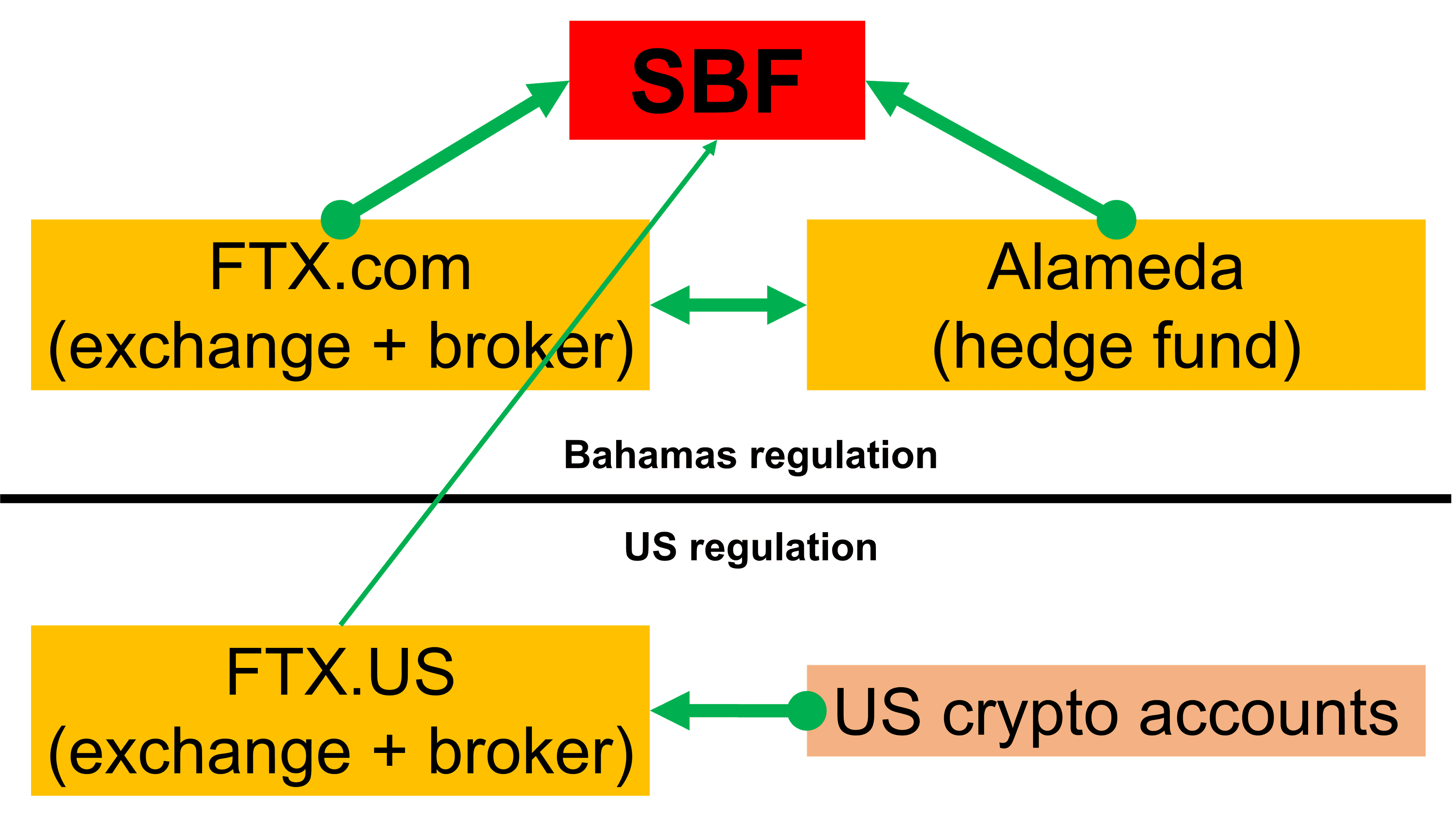
The answer is to set up a brand new crypto exchange/brokerage in the United States, named FTX US (not to be confused with the mothership, FTX.com, oh no we wouldn't want any confusion about the names! LOL) and subject to US regulatory authority through the Commodity Futures Trading Commission (CFTC). FTX US was launched concurrently with a massive Super Bowl/Larry David/Tom Brady-centered ad campaign in Jan/Feb 2022.


FTX US is an "affiliate" of FTX.com, meaning that they have overlapping but not identical ownership and management structures (SBF is the largest shareholder and CEO of both entities), but for regulatory purposes they are entirely separate entities, with FTX US subsidiaries holding the necessary commodity market-making licenses from the CFTC to operate in the US. Importantly, custody of the FTX US client accounts can't (easily) be transferred to FTX.com and neither can the client money.
This is why there's just a thin green line of cash between FTX US and SBF, and no green line at all (still) linking US crypto accounts and the mothership SBF entities, FTX.com and Alameda. Yes, FTX got funded at an $8 billion valuation and SBF is a significantly richer guy because of that, but he hasn't yet achieved his primary goal: get US crypto account flow into the loosely regulated FTX.com entity so that he can keep funding the Alameda Ponzi and the FTT/Serum/etc. token scams.
There are two tried and true methods for getting flow across that big bright line regulatory barrier between SBF's Bahamas-regulated entities (FTX.com and Alameda) and his affiliated US-regulated entity (FTX US):
- Cozy up to your US regulator and get a special dispensation.
- Acquire cut-outs to transfer the cash out of the US without anyone noticing.
SBF pursued both of these paths with gusto.
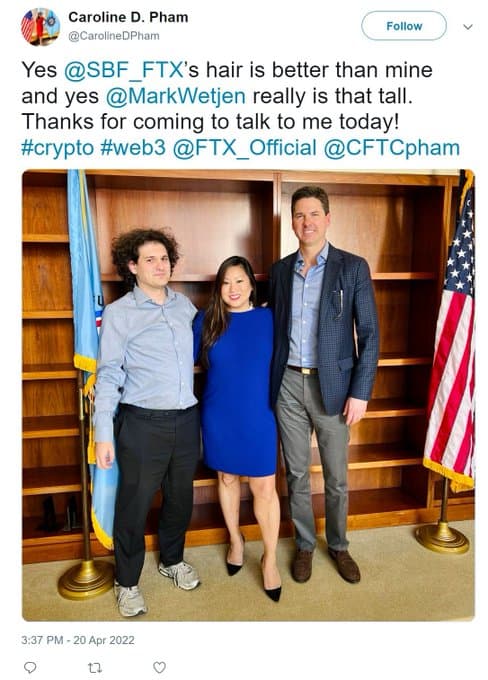
On the regulatory front, SBF went on a hiring spree for former CFTC commissioners and general counsels, and began an intense lobbying campaign on current commissioners. For example, that's current CFTC commissioner Caroline Pham tweeting a post-meeting selfie with SBF and former CFTC commissioner (now FTX chief lobbyist) Mark Wetjen. Pham would delete this tweet soon after posting, telling the NY Times that it had "become a distraction" and that the criticism leveled at her was unfair because a) she took fun-loving selfies with senior management from lots of big companies that she regulates, and b) SBF met with all the other commissioners, too.
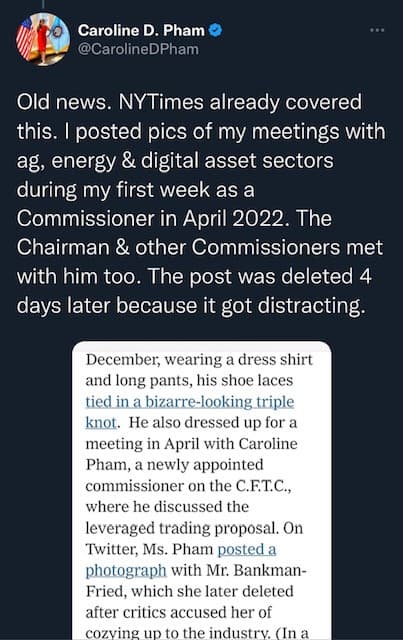
Haha! I'm not sure that Commissioner Pham is making a particularly effective defense against accusations of regulatory capture here, but whatever.
What was SBF looking for, both in these CFTC meetings and in subsequent SEC meetings with Chair Gary Gensler's staff and Gensler himself?
According to multiple reports, SBF was looking for permission to clear and settle his crypto futures trading in-house at FTX.
You know, I work with words for a living, and it is difficult for me to communicate what a TERRIBLE idea this is. But I’ll try anyway. The entire "we're going to use The Blockchain! TM and smart contracts and aLgoRItHms to make securities clearing and settlement more efficient" argument is just complete bollocks. There’s a good reason that clearing and settlement is less than perfectly efficient, that all the back-office work of delivering securities and confirming exactly who bought and sold what and how they are paying for it takes a day or two, and that’s to make sure that there are multiple sets of eyes on each stage of the process. You do not want clearing and settlement to be instantaneous. You do not want clearing and settlement to occur in someone else’s code. You do not want clearing and settlement to be handled in-house by the same firm that serves as market-maker and broker. Why not? Because it is a license to steal and defraud at a massive scale.
Clearing his own trades is exactly how Bernie Madoff was able to hide his Ponzi scheme for as long as he did!
You will never be able to convince me that SBF did not know this was Madoff’s superpower. You will never be able to convince me that SBF was not seeking self-clearing and settlement authority from the SEC and CFTC in order to further his own Ponzi scheme. If SBF had gotten this waiver and been allowed to clear and settle trades in-house at FTX, I don’t think he would ever have been caught. I think this would have made him bulletproof against any sort of effective oversight and regulation.
Now this next part is really important.
SBF was unsuccessful in getting the regulatory relief he was looking for, which is to the great credit of the CFTC and SEC.
All of these regulators have gotten a lot of heat from everyone looking at this debacle, including from me. And maybe they were about to cave and give SBF the no-action letter he was looking for.
But they didn’t.
I understand the withering criticism that Gensler at the SEC and the entire cast of characters at the CFTC have received. I think that the regulatory capture that has occurred around both of those institutions (and the Fed, too) over the past decade-plus is pathetic and (should be) criminal. In particular, I think that the hiring of regulators by the regulated for a client-facing or lobbying position is no less an act of corruption than an outright bribe. Ditto for speaking fees.
But in this case both the SEC and the CFTC did the right thing.
Or at least they did not actively do the wrong thing. Small victories, amirite?
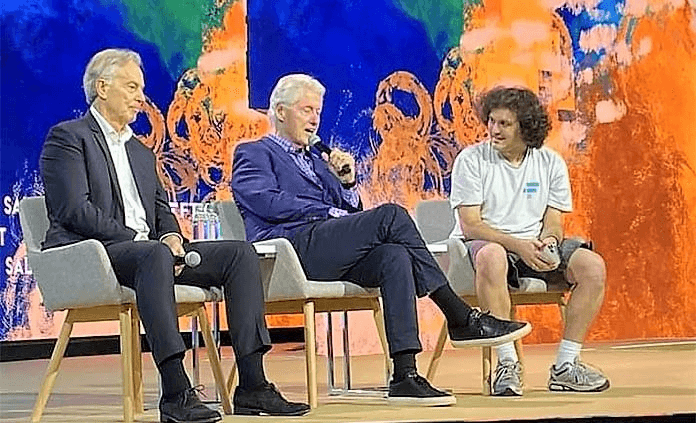
By the way, I think that SBF's political donations (and GOP donations by other FTX employees) were all in service to this lobbying effort to create an impregnable regulatory moat around FTX US and support the mothership vehicles of FTX.com and Alameda. I mean, SBF spent about 3 times his DNC donation total on the naming rights for the Miami Heat stadium ($135 million vs. $40 million), but I don’t see anyone claiming that this was a money laundering operation for Micky Arison. Political donations … stadium naming rights … Super Bowl commercials … conference sponsorships … it’s all one big marketing effort, that’s all.
EVERYTHING about SBF was an act, a virtuoso performance in effective Cartoon construction, from the curated sneakers and the tee-shirts carefully arranged on individual hangers in his Bahamian penthouse now on the market for $40 million.


SBF didn't ‘get away with it' because he had a patron in the White House.
SBF got away with it because everyone knew that everyone knew that Sam Bankman-Fried was a Boy Genius who had discovered a Magical Money Machine and was intent on doing a certain kind of Democratic-leaning, woke-ish Good in the World with his riches. It was Common Knowledge.
Sam Bankman-Fried was himself a MacGuffin to left-leaning establishment media and political powers-that-be.
And he knew it.
And he used it.
You don't need to create some sort of Ukrainian – White House money laundering scheme that makes zero sense and (if true) would be the most ineffective, worst yielding, idiotic money laundering scheme in the history of mankind in order to make this a tale of utter corruption and elite buffoonery. It's already there all on its own!
Besides, SBF's crowning achievement in fraud isn't in some White House money laundering scheme that never happened or in some regulatory agency corruption that he had not yet succeeded in achieving. No, what actually happened is much more evil than that, much more damaging to real people with real money and real hopes and dreams. This is Act III of the SBF story, and it's the acquisition of BlockFi.
BlockFi (and you can insert Voyager Digital, another SBF acquisition, in here, too) is a crypto trading company that operates legally in the United States. It's like FTX US, but without the market-making ‘exchange' functionality. Its pitch (and it has been pitched hard by people like Anthony ‘Pomp' Pompliano and Anthony ‘Mooch' Scaramucci and Mark ‘#Edge' Yusko) is that you open an ‘interest account' with your crypto assets on BlockFi, and you can ‘earn' a nice return on your money even if it just sits there. You know, just like a savings account at a bank! Except it's not a bank at all, of course, no matter how much its pumpers use the language of banking to describe what it does. No, BlockFi and Voyager (and Gemini Earn and all the other programs like this) are investment firms that are selling you an investment product. They take your money and they lend it out to market-maker/brokers like FTX and to hedge funds like Alameda, all of whom will promise a higher rate of return on those loans than BlockFi is promising you. The spread between the interest rate that BlockFi pays you and the interest rate that BlockFi gets paid is their profit. What could possibly go wrong?
Well, what went wrong was the collapse in May of the Terra/Luna crypto coin ecosystem, and the subsequent bankruptcy of some of the firms that BlockFi and Voyager (and FTX and Alameda!) had extended loans to, particularly a Singapore-based crypto trading firm named 3 Arrows Capital. When 3AC went belly-up, they were no longer good for paying back the billions (!) in loans they had taken out, and the collateral they had posted was worth nothing if it was Terra or Luna, and was worth a whole lot less if it was any other crypto asset. As a result, BlockFi and Voyager and all of these other crypto "banks" had to figure out what to do with their poorly underwritten loan losses. That's what went wrong.
I wrote about the Terra/Luna collapse here, in The MacGuffin, Part 1, and you'll see that SBF features prominently in that discussion. SBF's ‘solution' to what he described to Matt Levine as arguably a Ponzi scheme in non-FTX crypto world was two-fold.
First, the crypto industry obviously needed stronger regulation from his friends at the CFTC, and SBF had a lot of good ideas on what that regulation should look like. Now, of course, we know what those good ideas were – self-clearing and algorithmic settlement – and that they were not good ideas at all.
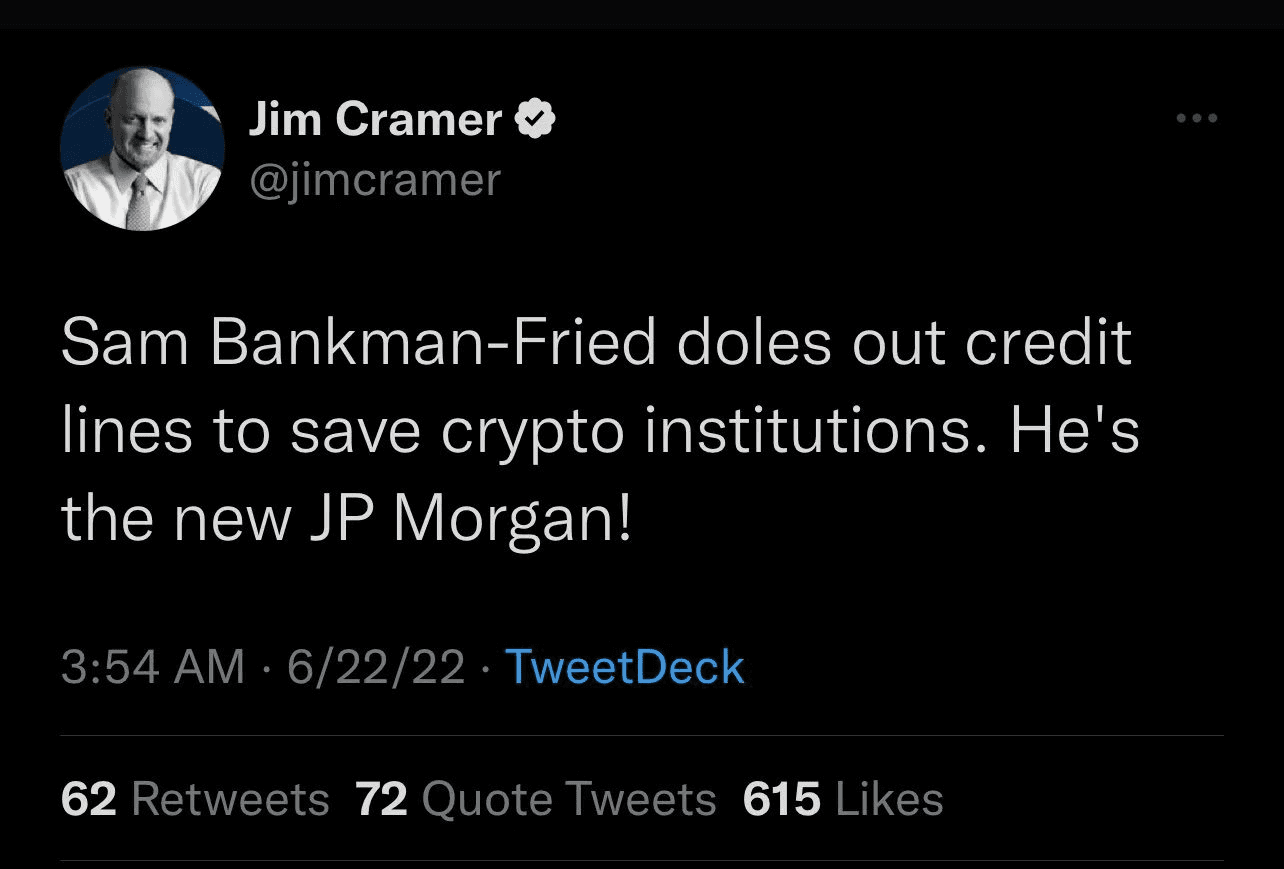
Second, the crypto industry needed a white knight, a savior with unlimited resources to ride in and bail out these crypto brokerages. After all, they had failed Through No Fault Of Their Own TM, and it was important for the owners of Magical Money Machines to step up for the greater good. Noblesse oblige and all that.
A not inconsequential amount of hilarity ensued.
Yep, you can always count on Cramer to have the precisely wrong opinion about everything, not just stocks. It's a gift, really, and I'm not even joking.
Anyway, the acquisition of BlockFi and Voyager by FTX US created a new corporate structure chart that looks something like this.
Look at all those new thick green lines!
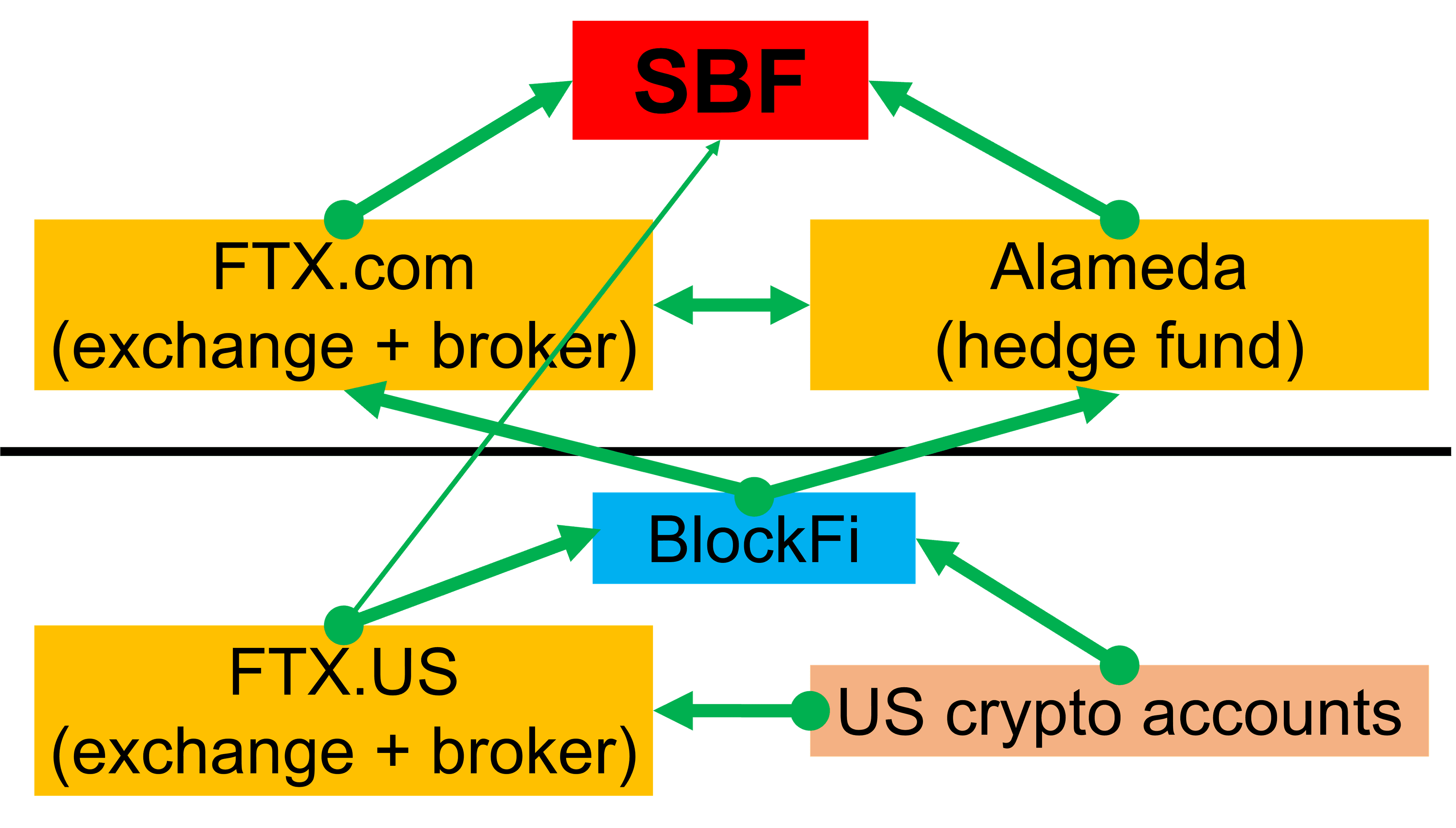
BlockFi and Voyager were sources of funding for SBF. They still had a lot of cash in them, despite the Terra/Luna/3AC collapse, and SBF was intent on getting every bit of that cash into the hands of – not just FTX US, which for now at least still had some sticky US rules to abide by – but FTX.com and Alameda. As importantly, SBF could also use BlockFi and Voyager as cut-outs to move money out of the regulated FTX US entity and into the non-regulated FTX.com entity. Neat, huh?
Here's how that works. I'm going to focus on BlockFi because I've got the numbers and the company statements, but I am highly confident that the same thing happened with Voyager
First we have to loot the company.
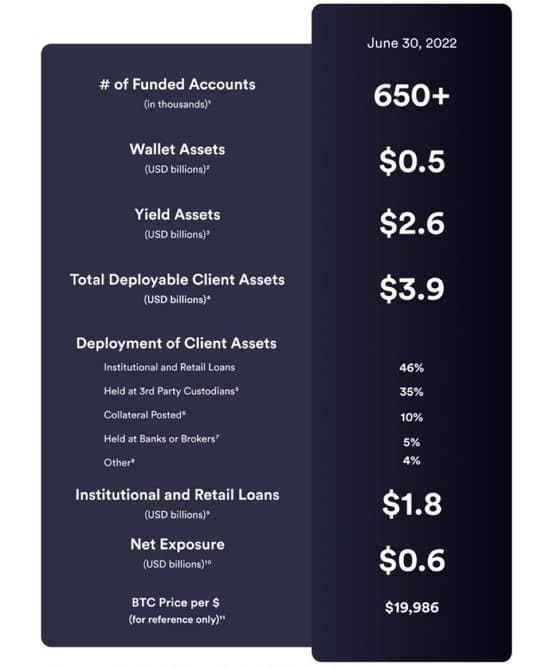
It's a not small amount of loot, as you can see from this September presentation showing BlockFi's June 30, 2022 numbers. Not all of this can be sucked into the FTX/Alameda vortex all at once, of course, but over time there's $1.8 billion in "Institutional and Retail Loans" that needs to come over. There's ~$400m in collateral that BlockFi can hand over in exchange for loans from FTX.com (heck, maybe we can lend them one of our tokens), and once that collateral is posted it can be used freely by SBF as collateral for whatever borrowing FTX.com and Alameda want to do, through the magic of rehypothecation. And last but not least, why not just hand over the client accounts altogether to FTX.com and FTX US as "3rd Party Custodians", even though they aren't arms-length 3rd parties at all and hardly even custodians.
But that's not all! We still have to figure out a way to use BlockFi as a conduit for all the ‘clean' assets in FTX US that we'd really like to get into the Bahamas. For that, we can use the $400 million line of credit that FTX US made available to BlockFi as part of the acquisition. BlockFi just needs to draw down the line, and then they've got $400 million in ‘clean' money from FTX US that they can use for anything that's allowed by their keen underwriting standards. Hey, I know, how about a loan to Alameda? Or maybe we just go ahead and make that loan before we actually draw down the line of credit? We know that SBF and crew are good for it!
Now, how do I know that BlockFi did all this? Loans to Alameda, custodied accounts at FTX.com, the full monte of blowing out the company for the SBF mothership? Because they told us.
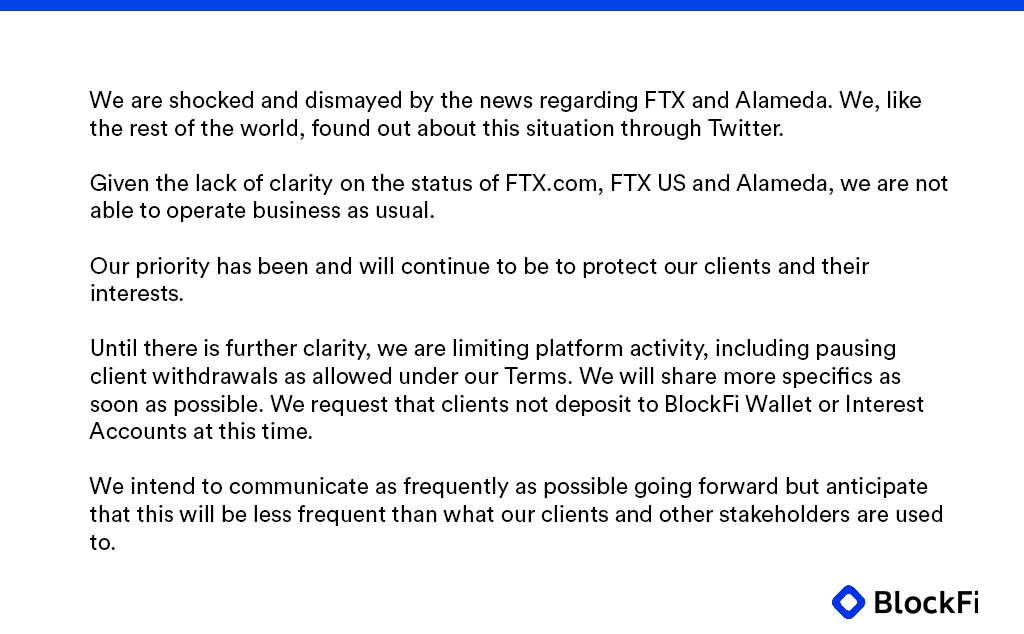
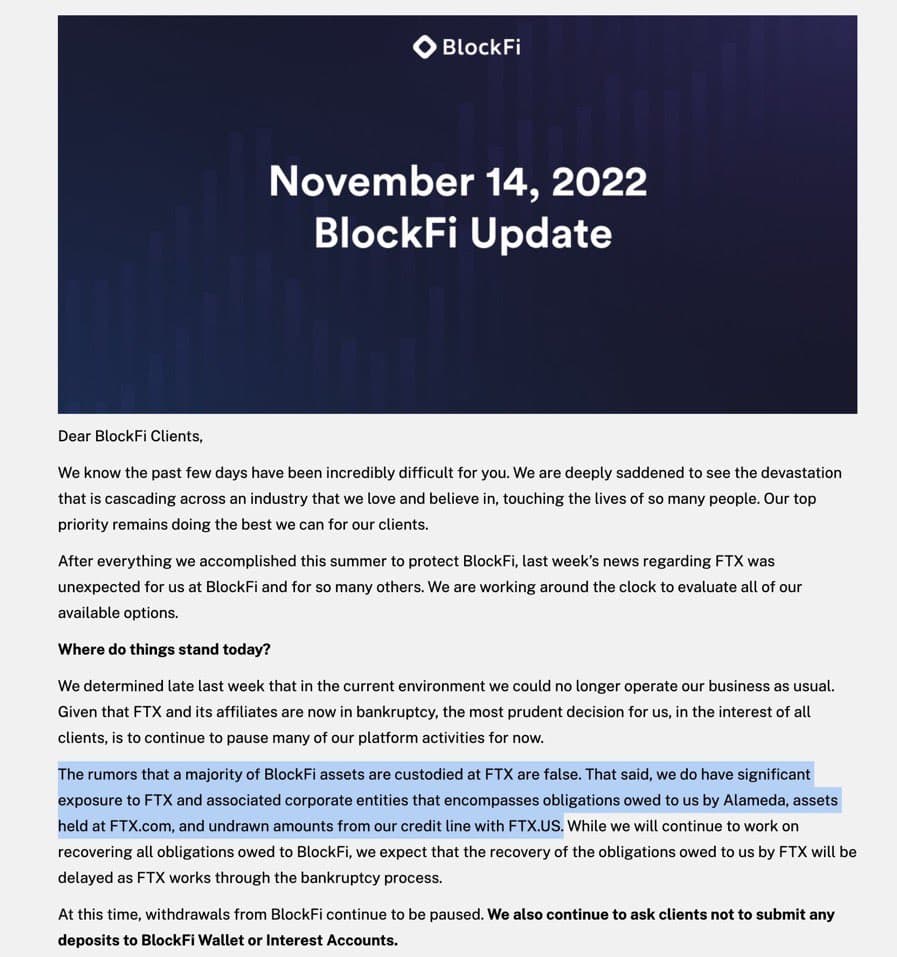
On the top is BlockFi's initial announcement that they were freezing client accounts and suspending all withdrawals. It's so weird that they say how disappointed they are in Alameda, some Bahamian hedge fund that had nothing to do with their acquisition. I mean, it was FTX US that did the actual change of control transaction, extending the line of credit and all that, so I can see how any sort of status question regarding FTX US would be of concern to BlockFi. But it's so weird that they say they need more clarity on FTX.com and Alameda before they can resume operations, especially because at the time BlockFi released this announcement, SBF was tweeting that FTX US was perfectly fine. So weird.
Next is BlockFi's last update before they filed for bankruptcy. Here they say it is not true, categorically false, in fact, and how dare you (in their best Greta Thunberg voice), to say that a majority of BlockFi assets are custodied at FTX. And ... it is undeniably true that 35% (the June 30, 2022 number) is less than 50%. Unassailable, really. 35% is less than 50%. Case closed. Rumors put to rest. Pay no mind to the "obligations owed to us by Alameda" and the "assets held at FTX.com".
Bah! This company was looted, and hundreds of thousands of Americans lost billions of dollars to these "obligations" and transfers of custody.
Yep, hundreds of thousands of Americans. BlockFi had 650,000 funded accounts, mostly in the US. Voyager Digital had 1.6 million funded accounts, mostly in the US. Interestingly enough, no one really knows how many funded FTX US accounts there are, as those numbers haven't been disclosed since FTX US launched.
Ultimately, millions of Americans will have seen their uninsured investment accounts go poof because of SBF's outright fraud and the pumpers' deniable fraud. The money is gone. Maybe a few pennies on the dollar will ultimately be recovered, but I doubt even that, frankly.
The money is gone. Lost to shitcoins and shitcos. Lost to $1 billion spent on advertising and marketing and political donations. Lost to bad loans and bad trades. Lost to Bahamian real estate. Lost to shell corporations set up by SBF personally. There's a reason that the top box in my charts is Sam Bankman-Fried himself!
The story, though ... well, the story still has a ways to go. We must have a resolution to Act 3.
Let the show trials begin!
I don't know what will happen to SBF. Will he go to jail? I expect so. Maybe. Eventually. He'll definitely be arrested, though, and this idea that a mere $40 million in political donations can ‘protect' him is just ludicrous.
Will the promoters and the pumpers go to jail? LOL. Not a chance. Why, Ben, they are victims here just like everyone else!
No, the promoters and the pumpers are already laughing about it.
They're already laughing at us.

Will the facilitators like Sequoia and Ontario Teachers be punished in any way, shape or form? LOL. Not a chance. Why, Ben, how can you even suggest such a thing!
No, we'll have Congressional Hearings TM, where some Sequoia partner will tell us that they were misled and defrauded by this evil genius, by this Lex Luthor and Professor Moriarty all rolled up in one, with machinations that escaped their crack superhero team of investigators.
And at the end of all this, we will get regulatory diktats so that This Can Never Happen Again TM.
And that wraps up this exciting episode of Law and Order, folks! Be sure to stay tuned for the Michael Lewis book and movie, starring Jonah Hill as SBF!
Sorry about your money. You really should be a little more careful next time.
Barf.
You know, a long time ago I wrote a note about financial ‘innovation', the too clever by half coyotes who pursue their personal MacGuffins of Magical Money Machines, the con men raccoons who pervert the coyotes' work and cheat us all with their petty theft, and the inevitable, inexorable government response. It's the most popular note I ever wrote, and every single thing I wrote there about Bitcoin and crypto has come true.
And here's the punchline:
The inevitable result of financial innovation gone awry, which it ALWAYS does, is that it ALWAYS ends up empowering the State.
Yeah, it's coming. New protections and incentives for the Wall Street incumbents. New barriers and obstacles for anything and everything crypto or Bitcoin or DeFi that wants to live free in the wild.
And yes, I understand that Bitcoin isn't crypto and CeFi isn't Defi. Do you understand that this doesn't make a damn bit of difference in what's coming? Do you understand that this same struggle has been going on for all of human history, that it has never had a different outcome, and that the most revolutionary guy who ever lived figured out two thousand years ago that His adversaries were trying to trick him into a public fight with Caesar about money?
Render unto Caesar what is Caesar's was good advice then and it's even better advice today.
It's time for Bitcoin to go underground.
Again.
The very good news about SBF and his crypto fraud is that this will set back institutional investment in all things Bitcoin and crypto-related for a decade. Last week this was just a bad investment for the big pools of capital that rule our world. This week it's a fraud. And that means that this week there is career risk for the managers of those big pools of capital. They are OUT.
I say that's very good news because it's terrible news for Bitcoin! TM, the Wall Street securitization of OG Bitcoin that's nothing more than just another casino table, one that's fully visible to the Eye of Sauron, aka the US Treasury.
Forget the Saylors and the Novogratzs and the Winklevii and all the other SBF-esque charter members of the Bitcoin! TM crew. Forget the trading accounts and the tokens and the stablecoins. Forget you ever knew the difference between a Bitcoin futures contract and a spot Bitcoin ETF. Forget all that.
And remember who you are.
We can choose our life's MacGuffin, and let me tell you, the Magical Money Machine is a poor choice. For the past ten years, not coincidentally as long as I've been writing Epsilon Theory, I've been catching glimpses of a new MacGuffin to pursue, a MacGuffin of belonging in the present and difference-making in the (very) long-term future. Haha! Sounds a little like Effective Altruism, I guess. But not really. Also sounds a little like the principles of OG Bitcoin, doesn't it? That's a lot closer to the truth.
Let us tell ourselves better stories. Let us choose better MacGuffins.
And watch how the story arc of our lives – and our society – will soar.


Comments
Pulling all of that together in a few days! If you need another side hustle, Forensic Accountant would suit you. Thanks for adding meat to the bones we had all started piecing together from Twitter, Bloomberg, and other sources.
And, for including the link to Part 4 of Things Fall Apart. Can’t read these foundational thoughts enough.
I hope all your readers get to the last handful of paragraphs, which for me are 100x more important than the fraud story. I find that the narratives which can be summed up by Number Go Up have commandeered the living metaverses of detractors of crypto/btc in an equal but opposite way of how it corrupted many of the supporters. “Forget all that” is 100% right, too bad it is so difficult! The slope of enlightenment for distributed trust systems will be applications that marry the digital and real world in communities where trust >>> money. After the last few weeks many people will think that a future which embraces and benefits from this kind of thinking has gotten more nebulous and further away, but as you hint in those concluding paragraphs it is truly the opposite.
100%. I hope they get there, too!
Great note Ben!
I think I’ve quoted your “too clever by half” note a few too many times to my friends and colleagues at this point.
In tech, I think Crypto (the legal Casino) was seen by a few too many engineers as sort of the “easy way out” to working for yourself.
For anyone looking for some of the OG blockchain coyotes, they went off to think about things like improved public goods funding or making voting mathematically optimal for the public good.
Reminds me of The Bezzle
Fantastic note Ben. Really well done. Please make a PDF available for easier sharing.
Ben,
I have been following your tweets on the topic and although you have pounded into me the importance of narrative and narrative control, looking at the tweets that are coming out I am constantly thinking back to the novel 1984 vs. the law of identity in philosophy. In philosophy the basic law of identity is A = A. In 1984 we are told not to believe what our eyes tell us and that 2 + 2 = 5…Big Brother told us…it’s common knowledge. The audacity of some of these guys that AFTER the fact are still trying to spin a controlled narrative of hey I’m the good guy amazes me.
Thank you for bringing some clarity to this muddy puddle of crypto for me.
HIGH RISK WITH NO RETURNS.
I am blessed with dyslexia, and as God is my witness, this is how my brain actually read that sentence.
Another great post, Ben!
Soooo blockchain voting by 2024 to stop the widening gyre and trustless elections from turning into Civil War 2.0? Or is that mere apophenia?
I’ve been around long enough to have personally witnessed this very similar scam.
Mark Ross Weinberg would borrow money from investors at usuries rates and speculate in commodities. His claim to fame was that he got advance notice of Jimmy Carters grain embargo on Russia from a relative (who I seem to remember worked at the White House, may have been his father) and made a small fortune. When the “rube” who invested would want his money back, Mark would claim that the investor was a “loan shark” and that Mark would sue for treble damages. It all went wrong when he borrowed from the mob who were, indeed, loan sharks. Years later he ran another scheme involving gold.
Continue the discussion at the Epsilon Theory Forum...