The Opposite of 2008

Epsilon Theory

March 2, 2021·27 comments·Money

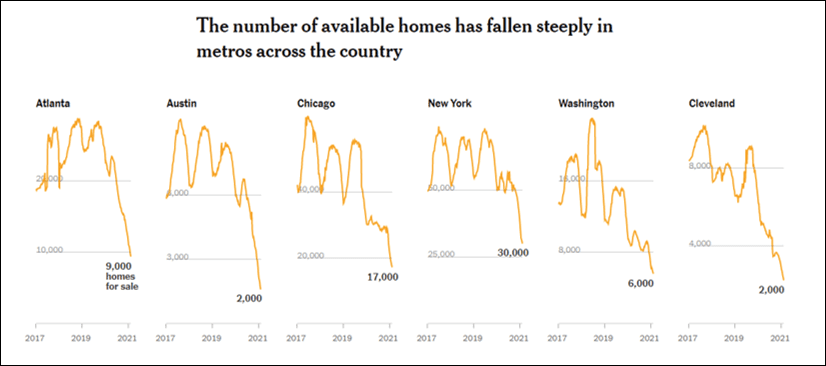
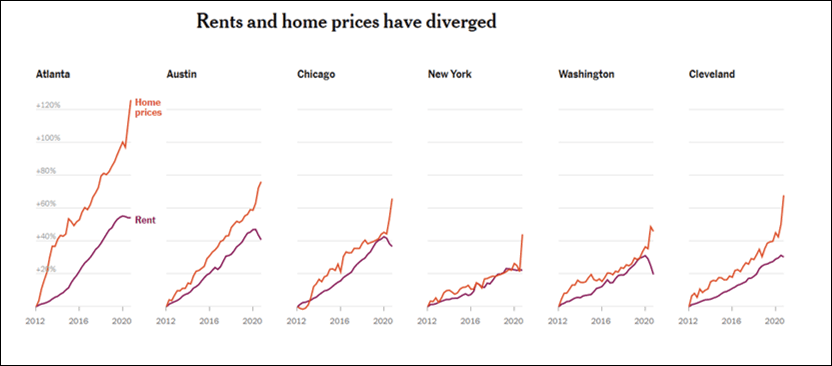
Housing supply has collapsed to historic lows. Home prices are accelerating at rates that would suggest an overheating economy demanding immediate rate hikes. Yet the official inflation data that should trigger alarm shows something different entirely. The gap between what's happening in the real estate market and what the numbers claim to measure has quietly widened to a dangerous point.

  • The supply side has inverted completely. In early 2008, metro areas saw dozens of homes listed and nobody buying. Today, there are virtually no homes for sale and everyone trying to buy. A zero-count where there should be thousands reveals something fundamental has shifted in how housing functions as an asset.
  • Home price appreciation is being erased from inflation calculations. The Fed uses "rent equivalents" to measure housing costs, not actual home prices. As home prices soar and rents stagnate or fall, official inflation statistics are actually showing housing as a deflationary force. The measurement itself obscures the real wealth transfer happening in the market.
  • Cash-out refis are about to explode like they did before the crisis. Home equity withdrawals fueled spending and risk-taking throughout 2005 to 2007. Refi rates are hitting their fastest pace in years. The same wealth-extraction mechanism that preceded the last crisis is being rebuilt, and nobody's watching for it.
  • The geography of opportunity has been redrawn along homeowner lines. If you own a home, you benefit from appreciation. If you need to move to find work, you're priced out of the new market. Blue-collar workers lose mobility. White-collar workers stay remote. The result is a hardening of class lines built directly into real estate.
  • The Fed is structurally incapable of seeing this coming fast enough. Even if inflation finally shows up in the official numbers, it will come too late. Supply shocks to housing ripple outward in ways that don't announce themselves neatly in quarterly data. By the time reaction becomes necessary, overreaction may be the only option available.

The Why of Epsilon Theory

  • Direct access to leading narrative-tracking technology across global news.
  • Deep analysis of how narratives shape markets, politics, and society.
  • An active online community of independent voters, investors and thinkers.
Subscribe to Premium
Already a member? Log in

Looking for Deeper Insights?

Unlock exclusive market intelligence, trade ideas, and member-only events tailored for investment professionals and active investors with Perscient Pro.

VISIT PRO
Spiral
inflation topic
Money
Money

Comments

rechraum's avatar
rechraumabout 5 years ago

Fun note, hit me in a few places:

  • Already looking forward to a day when we will build a digital city named Epsilonville or something and it will be one of the places I live.
  • Always love a Third Body Problem reference, frankly I get nostalgic because above all other ET notes it changed me because it was one of those rare unforeseen intellectual convergences of things I care deeply care about (in this case physics and markets).
  • Last but not least as much as I'm an ET fanboy...I remain uncertain on one of the key principles! Namely, what is the water in which we swim?? Is it the shift to inflationary expectations via extraordinary monetary/fiscal policy as Ben argues in ET or is it the similarly massive and hard to appreciate deflationary forces (Empty Planet demographics, technology/Replicator Scenario, conversion of physical economy/experiences to digital economy/experiences, etc)? I believe all these forces are certainly huge drivers just don't know which will win....and I cannot help but be fascinated by trying to naively predict outcomes even with the wisdom of 3rd body problem front of my mind!

jeffhenders0n's avatar
jeffhenders0nabout 5 years ago

No idea where this is going either, but here is my recent personal experience with housing. Due to a death of my father-in-law in Dec 2020 and the fact that our kids weren’t truly meshing with FL we made the decision to move back to IL to be closer to my wife’s mother and our older out-of-the-house kids. Our resident 8th graders (triplets) were also consulted and very enthusiastic about a return move. I am fortunate to be home office and my wife can the business she created last year up North. So, on Christmas Eve 2020 we decided to build back in our old neighborhood where a new phase had just opened and with the help of our friends in said neighborhood (also enthusiastic about our return, which felt great) we picked a lot and a model to build. Contracts were executed via Docusign on 12/28/2020.

Next, we consulted our RE Agent who helped us to find our FL house. She and her husband work as a team and stopped out to review our home, assess features/upgrades/etc., and gave us an initial estimated target for a listing price. This was January 16th 2021. A month later they called to say they thought we could now ask at least 10% more that what they told us a month earlier because with our type of home the demand was off the charts and the inventory nearly non-existent.

Now it is March 2nd 2021 and I just finished reading Ben’s note above. I then checked with the builder of our new home back in IL and confirmed that the base price of the home we have only been under contract for build since 12/28/20 is now > 10% higher, starting to approach what our total cost of build will be with our lot + elevation + upgrade choices.

Needless to say fairly shocking to me since I knew prices were rising but had no notion of how far and how fast it was happening. I have been working on my Renter Nation thesis and a portfolio of stocks for three years or so now and I have been slowly moving to include them in my portfolios, but with the crazy divergence happening now in rent vs home prices now I wonder what other ripple effects will be which means yes I am looking for thoughts which is why we are here after all.

Thanks,
Jeff


mgreene6's avatar
mgreene6about 5 years ago

The lack of a closed-form solution to this shift is actually one of the main reasons I started reading ET years ago. Your point on owner-equivalent rent and its insufficiency as a proxy for housing costs in the CPI basket is spot-on. It quite conveniently let’s the Fed absolve itself of any responsibility for its financial bubble-blowing impacting consumer buying power on the 40% of the basket represented by housing.

I look forward to spending some time on this subject in the forum. Thank you very much for creating it!


bhunt's avatar
bhuntabout 5 years ago

Amazing story, Jeff, and yet I’m hearing lots of similar experiences. Thank you for sharing this and good luck with the move back to Illinois!


bhunt's avatar
bhuntabout 5 years ago

Thanks for getting involved, Michael!


RetiredRgg's avatar
RetiredRggabout 5 years ago

South Carolina coast and western slope Colorado housing prices are rising to catch up with building costs. Check out lumber, cement, copper, pvc prices. Also immigration policy has hit labor force - framing crews, roofers all the manual jobs associated with the higher skilled trades. New build lead times to finish 1/1/2 to 2x longer than recent past.


tromares's avatar
tromaresabout 5 years ago

Hawaii real estate off the hook.

Median price for a single family dwelling on Kauai over $1M.

Homes in the medium to low end subdivision (for modern homes, not single wall plantation homes) in Kona that I live in are up 20 - 25% over a year ago, are sold in 3 to 5 days of being listed and generally are bid up from asking price. About 50% being bought site unseen.


Sandy_McIntyre's avatar
Sandy_McIntyreabout 5 years ago

I wrote an article in 2012 titled “Invest in Purchasing Power”. I fully agree with Ben’s view. Inflationary booms kill bonds. In preparing the article I came across a book that consolidated a series of Barron’s articles from the 1920s. This is an excerpt.

Consider this excerpt from a 1925 book titled Investing in Purchasing Power,
written by Boston investment manager Kenneth Van Strum:

What is a dollar worth?

About twenty years ago a certain Boston business man, feeling that he had reached a
discreet age for business retirement, sold his business and invested the proceeds in what
he considered to be gilt edged bonds. The yield from these securities was ample for his
needs and, he thought, would enable him to live for the rest of his life in the style to which
he had been accustomed.

Satisfied that he would be able to continue his old mode of living, he continued his daily
life heedless of the encroachment that the rising cost of living was having upon his plans
until one day it was brought forcibly to his attention. He was planning a trip abroad with
his family and was surprised to discover that the increased cost of the thousand and one
items used in daily life had so eaten into his reserves that it would be necessary for him to
draw upon his principal in order to make the trip.

By degrees he was forced to curb his standard of living until today the income from his
bonds is downright inadequate to assure him the comforts and pleasures he had in the
early years of his retirement. But what has happened to his investments? His bonds are
as high grade today as they were twenty years ago and they command the same income
in dollars. The answer is to be found in the increased cost of living and not in the fact that
he received any smaller dollar income from his investments.

There is an Investment Counsel in San Francisco by the name of Van Strum & Towne, founded in 1927.

When I was a Trust Officer in the late 1970s I saw exactly the same outcome. The beneficiaries of old money trusts had to change their lifestyles, fire the captain then sell the yacht. The intergenerational fighting was fierce, Income beneficiaries needed more income, capital beneficiaries were desperate for growth. Investing for growth and income is a tough discipline.


bostondad's avatar
bostondadabout 5 years ago

this may sound crazy - but isn’t this the best of all worlds, real-estate wise??
Multiple more people own a home than want to buy one - so rising prices is a win.
Most people who rent are poorer, and rents are falling - also a win.

and as we know, once mortgage rates rise by 100bps - the housing boom will be over.


Landvermesser's avatar
Landvermesserabout 5 years ago

If the implementation of UBI and similar things is sandbagged (delayed, reduced in size, etc.) enough, there may be an (engineered?) epidemic of defaults by individuals and small companies, putting more real assets in the hands of larger-scale players, putting them on better footing for inflation.
There was a narrative going around about private equity snapping up defaulted properties in 2008, but I don’t know how significant that ended up being.

Continue the discussion at the Epsilon Theory Forum...

bhunt's avatarmondano's avatarHenryvipt2activscii's avatarjeffhenders0n's avatarMusta1234's avatar
+5
27 replies