The Prediction Polka
December 20, 2018·Money
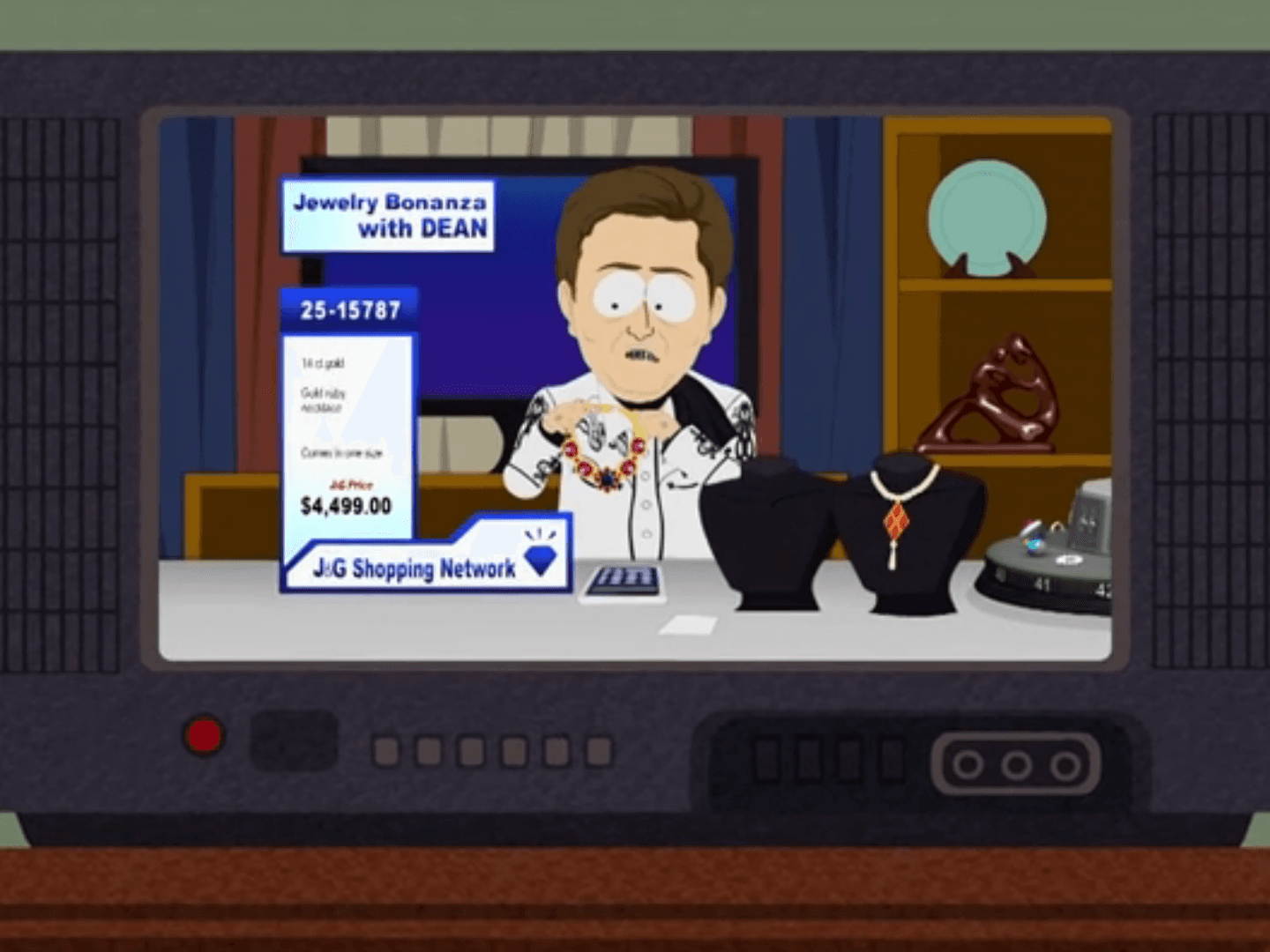
Source; South Park Studios
It starts in late November with the early birds. But this week - the week before Christmas - is when it reaches a fever pitch. What am I talking about?
The Great Holiday Snack Feast, of course.
The break room of every pension fund, family office, endowment and RIA that hasn't gone fully passive is a buyer's market for junk food. It used to be mostly popcorn tins - you know, the ones with the festive holiday scene on the side, and two or three different flavors available on the inside. Life pro-trip: always go with the white cheddar. Your New York-area funds are always good for a selection of toffees from Bridgewater Chocolate. No relation to the macro fund, apparently. Managers in non-traditional financial centers usually come up with more unique offerings. These range from the mundane (e.g. sausage and cheese from the Midwest) to the extraordinary (e.g. Goode Company Pecan Pies from the Gulf Coast) to the surprisingly good (e.g. some weird thing called a Yule Log from your friends across the pond) to the risky (e.g. a bottle of whiskey from the odd Kentucky or Tennessee shop) to the ill-advised (e.g. a literal smoked salmon I saw sent from Minnesota - really, people?).
But no Christmas gift for the asset owner or his advisers is as predictable as, well, predictions.
And yes, as I wrote earlier this week, the season of predictions is also the season of snark. But just like that In Brief, this one won't be criticizing the accuracy of past predictions or making fun of some of the new predictions being made for 2019. As you start to read these pieces, however, I want you to bear something in mind: nobody uses them.
Nobody.
Those recession probabilities from an economist at a sell-side shop or standalone research house - something one of Ben's and my new favorite bloggers brought up today - is anyone dropping those assumptions into asset allocation models? The predictions on year-end S&P 500 and 10-year levels? Odds on this outcome or that from the China trade war negotiations? Who is making adjustments to model portfolios or strategic asset allocation plans for new clients going into 2019 based on all these brilliant research pieces?
Nobody.
OK, sure, maybe there is a financial adviser or two out there who really is adjusting his positions because this research house or that thinks that this is where levels are going to be at year end. But that's not what these are for. That's not what these are really about. At every level, the Prediction Polka is a sales tool and nothing else.
The best way to understand this very odd thing that we do is (as so many things are) through the immortal genius of Trey Parker and Matt Stone. In an episode called Cash for Gold, the South Park boys walk viewers through a fanciful version of the low-end gold jewelry purchase-gift-and-exchange-for-cash cycle. It is a process, much like the market prediction racket, in which no one actually wants the product, but in which everyone needs to sell the product. The video, which is obviously offensive in three or four different ways - it's South Park, y'all - is must watch, even if it does require you to install Flash like some kind of 20th Century barbarian.
The basic idea in our industry is similar, and it goes something like this:
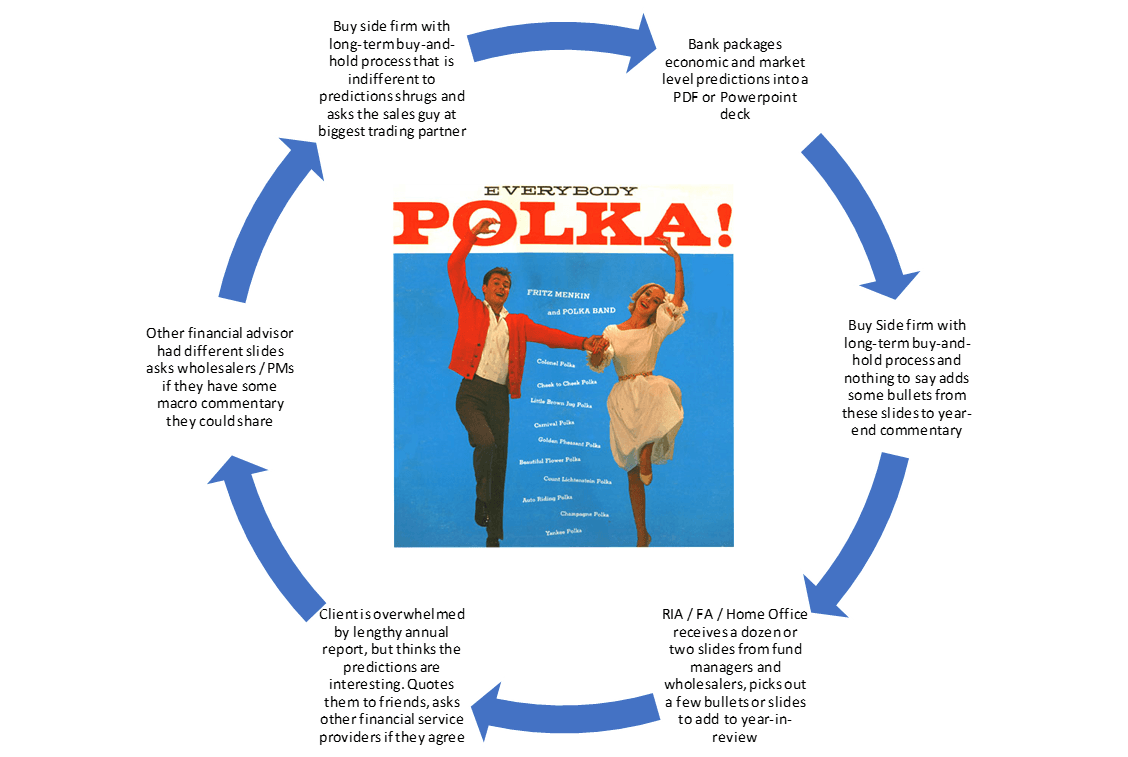
Now, we're not saying that all research is useless, and even if you are skeptical of its utility, every watcher of narratives should be mindful of how the sell side and buy side alike enjoy their roles as missionaries to sell their clients on the Next Big Rotation Trade. Our money is on Health Care being the name pulled from a hat in 2019, but it's always a bit of an adventure. But in this case, if we are talking about predictions on the S&P, the 10-year, and probabilities of this major economic event or that, better to see them for what they are: sales tools all the way down. They're usually not missionary vehicles. They're not really vessels for narrative. They're the thing-that-everyone-must-do-to-look-informed-to-clients.
So whereas we'd usually tell you that you don't get a pass from understanding what this kind of published content says about what the crowd knows that the crowd knows, in this case, here's your pass. Spend some time with the kids or that bottle of holiday whisky. If you're in the market for a nice value on peated whisky, I'm a fan of the Longrow Peated. If you favor a dram that's heavier on the sherry, I think that the Aberlour A'bunadh - despite being a part of the whole no-age-statement crazy - may be the best value in Scotch today.
Cheers!



Comments
We should not be upset that others hide the truth from us, when we hide it so often from ourselves.” –Rochefoucauld Maximes 11
The CEO, the monk and the Christian…And when the CEO gets in the elevator with us, and then a monk on the next floor, the same sorts of things are going on in each of our heads. I say the monk doesn’t get it because he’s abandoned too much that is pleasurable in the this material world. The CEO doesn’t think any of us get it because we don’t have two vacation homes and a yacht. And the Christian looks down at us because they know that Jesus is the answer.
We’re all subscribed to our own little fantasies, and they all result in squirts of pleasure. We like knowing that we’re part of a small group that “gets it”.
I’m sure you see the Morgan Creek quarterly letters. Lol
Cannot recall the source or exact phrasing but “many words have gone by trying to prove that money doesn’t matter” is my antidote to that occasional “gets it” feeling. Cheers!
Predictions are an attempt to generate transactions. I can remember as a bulge bracket junk bond trader, at a firm I will not disclose, listening to the morning commentary. We would joke about how many hands the economist/strategist/allocator/analyst had and which sentence or two any given salesman would use to drive a trade that sold down our inventory. Scary hilarious mostly because it worked and I imagine still does.
Brands promoting narratives is an ancient practice on this planet. What’s been recently game changing (and accelerating) is the intersection between technology and narrative diffusion. Quid is a truly fascinating platform in this regard. Narratives about narratives. Very meta.
This is why I like to say that a great sales or marketing staff will almost always trump a great investment staff in terms of raising capital from investors. People prefer a good narrative or story to data or analytics.
One of the reasons markets tend to be so volatile is because they trade based more on expectations than fundamentals and investor expectations are often at odds with reality. Much of the financial services industry revolves around expectations management. And when everyone is forced to deal with an unknown future, that expectations management is really more about being a storyteller than anything. --A Wealth of Common Sense
Continue the discussion at the Epsilon Theory Forum...