
The Problem with Brussels Sprouts
July 17, 2019·Money

I think it started in 2010.
Within six months of patient zero, they were everywhere. Every gastropub. Every upscale comfort food concept. Every ‘American Brasserie’ in a gentrifying neighborhood. Every farm-to-table that became an OK-maybe-a-little-Sysco-to-table after six months of food cost realities.
Brussels sprouts.
No, not the actual vegetable. That would be gross. No, I mean Brussels sprouts! These things that we quartered, soaked in olive oil and butter, bathed in salt and pepper and scorched until the memory of green was all that was left. These were things that, seemingly out of nowhere, an entire industry sold aggressively to a generation whose smell memory could still produce on command that acrid, metallic scent of unseasoned frozen sprouts being microwaved in water in a shallow Corningware dish – you know, the one with flowers or a cornucopia-style collection of earthy vegetables on the side?
Y’all, the only reason anyone orders this vomitous cabbage is because it is transformed into a cartoon of itself.
But hold that thought for a moment.
I had a colleague – now, sadly, passed away – who had a favorite expression: blue light, blue suit.
The idea behind the idiom was that the job of a fiduciary was not to blindly deliver what a client wanted, but what they needed. Still, one couldn’t get around the fact that clients want to be sold on what they want. If they want a blue suit, then give them a blue suit, dammit. But not an actual blue suit that would be wrong for them. Give them the gray suit they need – and shine a blue light on it if you have to.
I had a boss whose oft-used variant was the red convertible. Do your analysis, add whatever conclusions, bells and whistles you want, even take it up a notch. But the thing I get at the end of the day better at least look like a red convertible.
I met another wealth advisor once who favored a food-related analogy for the same concept. Investors need to eat their broccoli, he said, so figure out a way to make it taste good. It was, as you might imagine, a story offered in defense of investment policy statements which emphasized asset classes and strategies which (nominally, anyway) diversified home country equity risk. Heavy on foreign equities, alternatives, real assets, that kind of thing. After 10 years of S&P dominance, nobody really wanted them, but they needed them. The trick, he figured, was making the clients OK with getting the things they needed but didn’t really care about.
It occurs to me now, I suppose, that the food-related examples of this idea are overwhelmingly common. I know a CIO, for example, who characterized some of his firm’s strategies as hiding the pill in the cheese, a tactic immediately recognizable to any dog owner. It’s your job to give him what he needs, and it doesn’t matter how he gets it.
This is the heart of the meta-game of money management.
It is easy to see for those inside the industry why this meta-game playing is necessary. I hope that it is also easy for those same people to see how it might go very wrong. In practice, however, our own self-deception about why we sell investment advice in certain ways makes it far more difficult to detect. In the interest of circumventing that self-deception, let me offer another axiom:
There is no wealth management firm in the world for which investment expertise is a sustainable competitive advantage.
This is the Brussels sprouts are objectively gross statement of the story I am telling here. The only difference is that whereas some of you may have sufficiently bad food opinions to reasonably disagree with that statement, if you disagree with the above statement about investment expertise, I think you are probably just wrong.
If you think that the edge in your advice service is performance, you are probably wrong. If you think that the edge in your advice service is investment selection, you are probably wrong. If you think that the edge in your advice service is investment insight, you are probably wrong. If you think that the edge in your advice service is uncovering new investment ideas, you are probably wrong. And yet, if prospective clients don’t believe that we can do each of these things, we will almost certainly fail to build a business. What’s worse, those prospective clients will do business instead with someone less scrupulous.
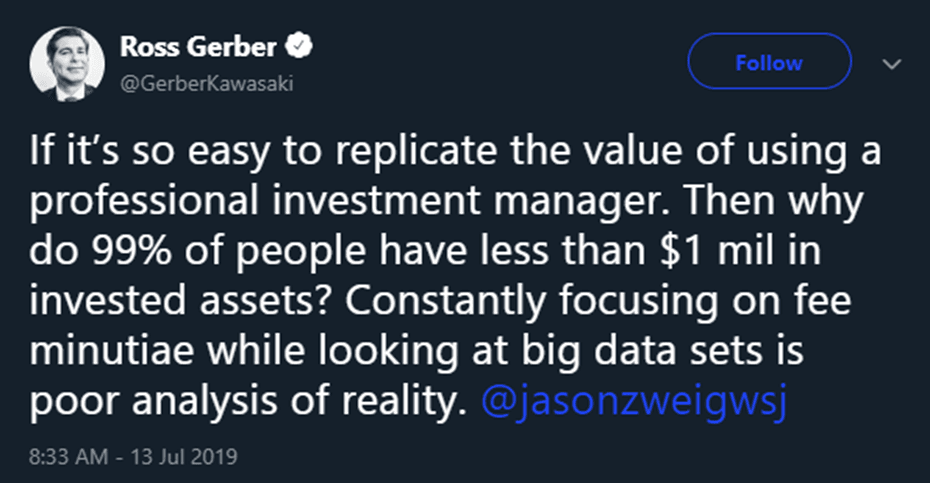
It is an uncomfortable truth, but the only reason we are usually hired is because we have been transformed into a cartoon of ourselves. A cartoon of relative expertise. A plate of Brussels sprouts, charred and covered with so much fat and salt as to be almost unrecognizable.
The inevitable path of the meta-game conscious financial adviser, then, is the creation of that cartoon of expertise. What does that cartoon look like? Well, we either celebrate some expertisey-sounding thing about our firm that really has nothing to do with expertise or the odds of any investment outcome, or we hold out the notion that something we are doing may be related to producing better investment results without exactly saying it.
We tout the home office’s resources.
We talk about the depth of our teams and resources.
We talk about team credentials.
We talk about our access to unique investments.
We talk about our ESG framework.
We talk about our research, our data, our analyst team.
We talk about our process.
We turn ourselves into a talking head. An expert.
In each of these cases, we may not say that these traits are definitely or explicitly related to better investment outcomes, but the reason we cultivate them and talk about them is absolutely to satisfy the client’s desire to hire a financial adviser with the most investment expertise. It is how we create a cartoon about our expertise, knowing full well that the client will associate that with their expected investment outcomes.
So if you’re a financial adviser, here’s the question you’ve probably asked yourself more than once: is this honest? Is it fair and good and right to heavily emphasize things in marketing that aren’t false, but which don’t really matter that much to the client’s outcomes, simply because we know the prospect or client cares about them? Does the fact that we really are delivering a very credible, high quality advice product at a really competitive fee that is far better than what the charlatans and churn artists out there are pitching mean that we can feel less bad about mentioning our amazing stock guy who’s had a great run the last few years <reluctantly insert compliance-required disclosure here>? Or the fact that our US-tilted portfolios outperformed our peer RIA across town, even though our positioning reflected bad diversification hygiene and our results reflected simple good fortune?
There’s a lot of salt and butter on those Brussels sprouts, y’all. These are hard questions. I don’t have an answer. But I do have a process: Clear Eyes, Full Hearts.
Clear eyes: There’s no way around it. We have got to talk about these things. Our clients are grown-ups, and don’t deserve our condescension. Yes, we’ve gotta have a page in our deck with the team’s years of experience and degrees. Yes, it’s OK to talk about our process and why we think it works. Yes, it’s OK to talk about historical client outcomes, provided we’re doing it in a seriously, honestly, humbly non-promissory (and compliant) way.
Full hearts: No, we don’t have to build our entire proposition on a cartoon of relative expertise. We don’t have to treat clients like children, but we also don’t have to treat them like marks. I think that means emphasizing, not just in marketing but in practice, the elements of financial and investment expertise that are real, important and rare. I can think of six:
- Identifying and consistently reevaluating and delivering the right level of risk.
- Delivering a nuanced, real understanding of diversification.
- Really influencing household expense management
- Financial, estate, tax and philanthropy management
- Business consulting for entrepreneurs and business owners.
- Structuring investments to properly complement existing illiquid holdings.
The more important truth, of course, is that the single most important thing an adviser can deliver isn’t any of these things. It isn't a question of investment expertise at all. It’s…well…advice. When risk appetites are high, restraining exuberant behaviors. When risk appetites are low, restraining fearful behaviors. And in all cases, working constantly to ensure that when these times arise, we have the kind of relationship and trust with our clients that will make them listen. The relationship is the thing. And while I’m not saying that you, individual FA, don't have a couple relationships that are strong enough to withstand a pretty rough go of it, I think we all need to be pretty clear-eyed about how much of these relationships will boil down over time to the perception of the results we produce.
I am also not saying that you should not earnestly try to outperform peers. I believe that there are behaviorally-driven strategies that will (nearly) always work over sufficiently long periods, even if those periods do seem to be getting, ahem, a bit longer. I believe that there are inefficiencies driven by non-economic actors in a variety of financial markets that can create opportunities with uncorrelated sources of return. I believe that there are changes in the structure of markets that occur from time to time that can create periodic sources of return. Ben and I spend half our time on these things, for God’s sake.
But they can't be the fundamental value proposition. Not for someone who wants to do this the right way. Control your cartoon, but don’t let it turn you into a raccoon.



Comments
This really touched a chord with me as I think about my own career path. I LOVE investment research. Real research, that is, not research! (a.k.a smart-sounding marketing material and simple statistical rankings of manager performance a sufficiently motivated admin or intern can run after a quick tutorial). Research! is soul-killing. Nothing more so than the manager selection merry-go-round.
Writing for ET and my own blog has been a kind of pressure release valve in that regard.
More and more I think the way to go is either find a very special investment organization (likely one with permanent capital) focused on Things That Matter, or go the financial planning and expense management route with individuals. The research! world is a wasteland.
Sorry to be a bit of a downer but I wrestle with this constantly.
I’m with you. I’m at something of an inflection point in my career, and looking to move from business valuation to a more investment management type role. In looking at firms, there are so many advertising the cartoon of expertise with no substance. There is such a need for investment management with integrity, reflecting the qualities Rusty listed, yet all I see are product shills disguised as “Advisors”.
My question is, I’m currently in the CFA program (for the knowledge, not just for the letters) – going forward, will CFA-type skills/knowledge be more valuable, or CFP-type skills? It seems like the latter.
Glad to know someone else is wrestling with this. I have both credentials, and I think you’re right. Going forward you’re going to want to be closer to the client. As close as possible per Ben’s comments in the Pricing Power series. The CFP-type skills are the ticket there (and, ironically, the oft-derided “soft” skills like writing and communication). From my experience the CFA/CFP combo is nice if you don’t mind taking tests and jumping through hoops.
Couldn’t agree more, and thanks for your insight. I’m ~10 years into my career, and the decline in soft skills coupled with advances in “hard” skills of those coming out of college has been noticeable. Which is ironic, since the soft skills are what will set people apart going forward (in my opinion, and has been discussed around ET often). In the business valuation world, a DCF is a DCF – anyone can set that up in Excel. Give me someone who can understand and communicate the limitations of a DCF any time.
I wrestled with it for most of my career, too. It’s a bit cheeky of me to only speak as boldly about it as I do now considering how much more influential it would have been to do more about it when leading an investment organization. Still, there’s a clarity you can only get from removing yourself from the ‘do well by doing well’ logical loops that we permit ourselves. Writing, as you say, is one of the ways to achieve that (whether anonymously as you do or independently as I do).
FWIW I still think the CFA has much stronger signaling value, just because it is so much more difficult. If the measure and your aim is “what will actually help me be effective adding value for clients” it’s probably the CFP.
This is as usual, great analysis, but for the past 10+ years BTFD, the Fed Put and financialization of the stock market has led us one the path to perdition. Index funds where people figure, correctly that the vast majority of “advisers” can’t beat the “Market” so go with Vanguards 7 basis point costs.
As Raoul Paul just pointed out Ford, GE, GM T and Dell alone have borrowed over $750 billion in BBB rated debt to buy back shares. Shale oil? Over a trillion alone and none of it sold has made a profit, Ok maybe some, but they lose money on every gallon, but they pump so many they make up for it. LOL. $4 Trillion borrowed to buy back shares; no productivity gains, no R&D, CAPEX, just increases in stock prices. Next recession 10-20% of this debt gets downgraded to Junk and pensions can’t hold it anymore. The market will lock up, freeze like Ice-9 in Cat’s Cradle, where will the money to buy that debt come from? Baby Boomers start selling as they get deep into their 70’s (10,000 a day turning 70 every day since 2016, and will until 2034. What will be the effect of that? Lower. Equity. Prices. What a revoltin’ development this is!
Just my opinion but I feel its part of a larger trend where younger people essentially interact with other’s via their ‘screens’. And are therefore almost always in their heads….
The soft skills so essential to human interaction come from actual human interaction……
Our bodies have to learn this. Not our logical minds. And our bodies only learn through experience. Whether is learning to play tennis, the piano, or interacting productively with other humans.
And even internalizing the lesson that experience matters takes, well, experience. Every bright young professional has an aha! moment of this kind. I think the trick is to have it as soon as humanly possible so that you can actually be productive.
You describe a world of Ice (everything freezes) There is another path…a world of Fire (everything heats up).
Our leaders decide to follow Japan and the EU of excessive easing (Japanese CB has a balance sheet at 100% of GDP, ECB at 40% of ECB vs 24% for the Fed. Japan is growing, EU is stable, Fed is shrinking - for now).
This will send the $ into freefall and send people scampering for scarce resources. The number of shares available on the US stock exchange (and the number of companies as well) have shrunk dramatically since 2000 (by nearly 50%).
So, if we go to negative interest rates and printing money…what do you do with your cash in the bank? Well you try and buy something that is hard to replicate, scarce and that others may want to own in the future.
A global platform lie Amazon delivering computing, entertainment and goods (amongst other things) might be an attractive place to store cash.
Not making a prediction, just observing that if money becomes even more cheap and plentiful the asset that is likely to get cheap is money not equities.
Why do I think this path is probable? Because of the work Ben and Rusty have been doing. It was through their lens that I was finally able to understand that the world has shifted and the old monetary regimes are dead because they no longer server political interests. We are in the world of bread and circuses.
Continue the discussion at the Epsilon Theory Forum...