The Recipe for Agent Orange - The Projection Racket, Pt. 3
December 1, 2022·Money
This is Part 3 of The Projection Racket, a series of notes detailing the civic arguments underlying a movement to both (1) make our lives less dependent on political, social and financial institutions with structurally broken features and (2) to protect the rights of our fellow-citizens to do the same by eliminating the source of those structural breaks so that these institutions can serve both the collective and individual good. It is an explanation of what we mean when we say to “Burn it the $!#* down.”
You can read Part 1 here and Part 2 here.
This Epsilon Theory note references individual public companies. Second Foundation Partners does not have a position in any security of the companies mentioned. It does not permit its employees to buy or sell the securities of individual companies in personal securities accounts. Nothing in this note should be construed as a recommendation to buy or sell any security. This is NOT investment advice. This is NOT a prediction about future returns for any security.

The more innocuous the name of a weapon, the more hideous its impact. Some of the most horrific weapons of the Vietnam era were named ‘Bambi', ‘Infant', ‘Daisycutter', ‘Grasshopper', and ‘Agent Orange'.
The Official Rules: 5,427 Laws, Principles, and Axioms to Help You Cope with Crises, Deadlines, Bad Luck, Rude Behavior, Red Tape, and Attacks by Inanimate Objects, by Paul Dickson
Every parent with more than one child knows the trick.
If you have one piece of cake and two children, the piece of cake must be cut in half. Under no circumstance can you be the one who cuts the cake. Neither can you be the one who allocates the slices, nor can you allow any child to perform both the cutting and the choosing. There is but one solution: You must allow one child to cut and the other to choose their slice. Anything else is asking for violence, recriminations and wasted cake.
It is a classic game theory problem in the field of envy-free choice. It also explains some of the thinking behind most nudges, the worst of many terrible ideas to come from the desk of Cass Sunstein. The perception of agency does a lot to help us accept an outcome. After all, if we were responsible for it, surely we made a good decision.
In practice, however, the designer of the Nudge doesn't always play fair. Especially if they have stakes. Especially if they are a principal, too. Hey, even the most soft-hearted libertarian paternalist can't be a perfect parent all the time.
Which is why I set up a little principal-involved variation on the envy-free cake experiment with my son. Because kids are weird, his favorite thing to drink is Orange Fanta. Plus, it's his birthday today and he wanted to have what is a pretty rare treat around our house for breakfast. So I filled up one glass with a half cup of Fanta. I filled up another glass with a full cup of it. I added a cup of ice to the glass with half as much. I then presented him with the choice between the tall, well-presented glass with half as much and the short, unassuming glass with twice as much.
Did he pick the watered down glass and feel good about it afterward in part because he got to make the choice? Did I know he would do so, and that I would benefit? Did he pick it because he doesn't yet understand fully the principles of liquid displacement by suspended solid objects? Did he pick it because I sold him on the narrative of the ice-cold glass, both of us knowing full well that there is more ice in the freezer? Did he pick it because he had good reason to believe (until now, anyway) that I would not purposefully deceive him with my superior information for my own gain?
Yes.
And yes, I filled up his glass again when he was done. I'll create a dystopian video about choice architecture and Nudging, but I'm not a monster.
Every society tells two stories about its enduring institutions, I think.
The first is a story about what the institution is. It is a descriptive story and often a boring one. We are told how the institution came about and why it was established. We are told how the institution interacts with other institutions and how it is empowered or constrained by law or tradition. We may not agree on all the details. If it is, in fact, a mature social institution, however, we will probably agree on a lot. Enough, anyway, not to throw the institution away on a whim.
The second story tells us what the institution means. This is the story we have all agreed to tell one another about the institution. The thing we all know everyone else has heard about it. This is a story which makes us feel duty-bound to believe that the institution matters and ought to be defended.
In other words, every mature social institution is at once built on both a true story and a Meme.
Now, don't let a dangerous word like 'true' trip you up. Both true stories and memetic stories pass through layers of perception, bias and facts that we may not all see in exactly the same way. They are stories, after all, and we are, all of us, unreliable narrators. But unlike the true story, the memetic story is a construction. At its most innocent, it is an emergent common understanding, shrewdly stewarded. At its more nefarious (and common), it is a fully fashioned narrative framework, its memetic features curated from infancy to foster a certain emotional attachment to and collective social narrative for the institution.
If 'persistent memetic stories' feels like too much phraseology, then consider the more common term for this kind of thing: myths.
Institutional myths are not necessarily bad. After all, every important social institution must have a mythology, or else we probably wouldn't call it important. In fact, we probably wouldn't call it anything. Institutions survive over multiple generations because they have a story that everybody knows and a story that still makes sense to the people the institution serves. This is why we argue that a healthy and enlightened society requires both small-c conservatives and small-l liberals. Conservatives to defend our myths. Liberals to make sure they still work for the people who will build their lives around them.
Nothing wrong with that. We prefer Immediate Theatre, but there's a time and place for Holy Theatre, too.
Still, our reliance on memetic energy to maintain Common Knowledge around agreed-upon cultural values doesn't come without risk. Memes are not just tools that are sometimes used for social manipulation. Memes ARE social manipulation. It is inevitable that individuals, institutions and the state will at some point seek to align some private aim with the myth of an established social institution. When they succeed, those erstwhile private aims are absorbed into the myth, simultaneously shielded by its memetic influence while subverting it for private benefit.
That is why instead of earnest discussions about the conventions and social role we have ceded to in-group serving universities masquerading under a myth of public benefit, we get to shout yay, college! Instead of real conversations about what it means to love and be loyal to one’s country, we get to shout yay, patriotism! Instead of dealing seriously with the manifold problems of a factionalized two-party equilibrium embedded in our electoral system, we get to shout yay, democracy! Parties, politicians, government departments, university systems and the armies of rent-seekers that suckle at the teat of these core institutions take our myths, add some self-serving lines that serve their interests, call them a fundamental part of the myth, then attack anyone who takes issue with it as an unbeliever.
So it is for the enduring American institution of free market capitalism.
Free market capitalism in America has both a true story and a myth. The true story is a powerful one. While we may not all agree on particulars, the evidence of the role it played in pulling generations out of poverty and into prosperity is powerful. The myth of American free market capitalism is also powerful, wrapped up as it is in deeply memetic imagery of rugged independence, industriousness and the constant threat response to the mere suggestion of any alternative system.
Yet over time, the myth has merged with and absorbed many other powerful and adjacent ideas. The memetically powerful narrative of the monopoly or oligopoly as just an extremely successful company getting their just rewards was imposed on it and absorbed into it. The memetically powerful narrative of progressive taxation or public social safety net policies being inherently antithetical to principles of free market capitalism was imposed on it and absorbed into it. So, too, have been the constructs of law and convention with which we designed our particular system. That means that many of the features of what "free market capitalism" means, and what we are all nudged to defend, are structural features which inherently distort the aims of its true story.
There's the rub.
You see, the true story of free market capitalism in America is perverted by a lot of things. By the kind of cronyism that exists at the intersection of government and corporate power. By the systematic and repeated abuse of tacit and explicit too-big-to-fail policies that permit the privatization of gains and socialization of losses. By the constructed pseudo-markets like the share of value traded in securities markets captured by market makers. By value extracted through obvious acts of collusion that we call convention instead (unclench for the time being, realtors, it's not your turn yet). These ALL subvert the social good that free markets in a capitalist system are capable of achieving, and each is worthy of a movement to reform them.
But for the most part, these perversions do not co-opt the myth of free market capitalism. Quite the opposite! Everybody knows that everybody knows these are perversions. We observe them, mutter something about Bigger Fish to Fry and excuse them away as a necessary evil to keep the engines of commerce and capital flowing. We'll deal with them one day. Just not today. Or perhaps we convince ourselves, not without cause, that the proposed solutions would be as bad or worse.
No, the really pernicious risk arises not from the things we all know "aren't true free market capitalism." It arises from the things everybody knows that everybody knows ARE true free market capitalism, even when they aren't.
It ain't what you don't know that gets you into trouble. It's what you know for sure that just ain't so.
Mark Twain or Yogi Berra or Will Rogers or maybe Al Gore, who knows?
Like the way that public companies are operated by boards of directors with "aligned incentives" that "serve shareholders" and hire management teams to run them.
Sound innocuous? Yeah, that's exactly why we call this kind of thing a Projection Racket. And, coincidentally, why they call deadly poisons innocent, even positive things like Agent Orange. So instead of giving you a typical "the problem isn't capitalism, it's that what we do is actually crony capitalism" thinkpiece, let me suggest to you something a bit more off-narrative:
Our present system of public boards as the vehicle for shareholder representation is the transmission mechanism for almost every gap between the reality of free market capitalism and the stories we tell one another about it.
The system is permitted to create this gap because those who benefit from the system have co-opted the myths of free market capitalism to make us all unwitting defenders of the status quo of this system of corporate governance.
The system is empowered by public company directors who, in practice, have an overwhelming and incontrovertible incentive to serve the interests of management subject to a minimum constraint of easily satisfied ‘duties' to shareholders under Delaware law.
This is only possible because the only other bulwark between shareholders and management – the investment advisers who vote proxies within our system – have become either so passive or short-term in nature that there is practically no limit to the self-enrichment of management that will be rubber stamped by the professional institutional investment community and its gatekeepers, so long as the proper forms are followed.
The end result is the observable systemic bias toward high and rising executive compensation.
It is defended by a nearly impregnable latticework of innocent, even positive-sounding narratives. We are told that the "Delaware Duties" create a positive duty to maximize shareholder value. We are told that stock-based compensation of any amount is inherently aligning and therefore inherently represents good governance. We are told that stock buy-backs are always a good return of capital to shareholders, even when they are used to obscure, obfuscate and sterilize massive issuance of stock-based compensation to executives. We are told that that Say on Pay gives shareholders real agency, even if our agents systematically refuse to exercise it.
Above all, we are told that ALL of these things are fundamental to what free market capitalism means. We are told that questioning or opposing these tools designed to protect a Board Class and Managerial Class against capital – against capital! – is rank communism.
In other words, you and I, fellow shareholders under the myth of free market capitalism, are being handed a tall glass of ice from management and directors, after which we are told that our agents made a great choice on our behalf.
It's so cold! And look how much you have in your glass. Plus, it was your choice! How could you hate something that sounds so innocent. I mean, c'mon Agent Orange. Sounds delicious to me! So yay, you! Yay, me! Yay, free market capitalism!
To build the true story of free market capitalism's promise back up, we have to burn this – all of this – the !#^@ down.

Four hundred thirty million dollars.
Back in March 2020 that's the number we came up with for the stock-based compensation that has been paid to the CEOs of the four biggest airlines in the United States (United, American, Delta and Southwest) since 2014. Not regular cash compensation. Not compensation from other board seats. Just stock. The pandemic was kind enough to arrange a group photo of these executives when they visited the White House with hat in hand a couple months later. Not pictured from our original article is United's Oscar Munoz, who had since been replaced by Scott Kirby. As a bonus for this photo op, we picked up execs from Alaska Airlines, Hawaiian Airlines and the industry lobbyist group called "Airlines for America."
Add in all that cash compensation and the extra members, and this becomes a club that has taken more like a billion dollars out of 401(k)s, IRAs, endowments, foundations and pension funds over that period. A billion dollars to run their entire industry into the ground through gross balance sheet mismanagement, again and again. A billion dollars to shout the absurd lie that a bailout of the current equity owners of each business was necessary to keep planes flying and the economy recovering.
But there's no need to gild the lily. Let's just use the same table we used more than a year ago.
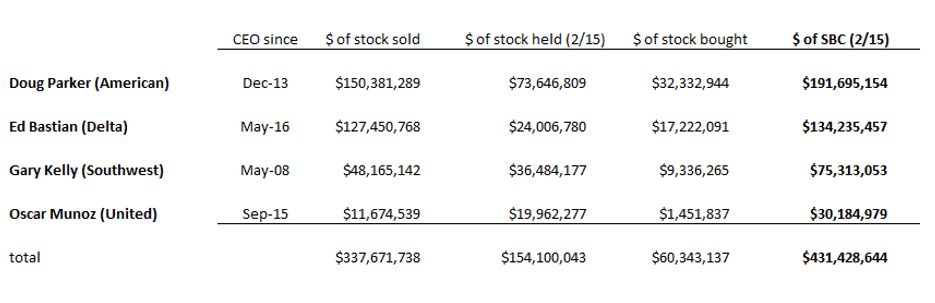
Source: Epsilon Theory, "Do the Right Thing"
Does talking about excessive compensation make you itch? Are you a bit concerned that this essay is going to take a socialist or anti-capitalist turn? Some of our readers know better – Ben's the somewhat-left-of-center goofball around here, not me. Still, if this is a seed of concern or excitement growing in your mind, why? Why is it our instinct to view concern about the structural funneling of value away from capital and into the hands of management as anti-capitalistic sentiment?
It is literally and definitionally pro-capitalism to be irritated by the pillaging of the American public company by the managerial-bureaucratic class. And yet doesn't it feel like the opposite? Doesn't it feel like we're being anti-capitalistic by even entertaining the idea that some executives may be getting paid too much of shareholders' money, and that we probably ought to do something about it? If it feels that way, then you are probably starting to grok what we mean by projection rackets. You may be starting to grok what we have allowed to be merged with our stories about what free market capitalism means. You are certainly awake to the danger of some of these Agent Orange narrative concoctions.
Still, you needn't have worried. As it happens, I don't really have a problem with people getting paid a hilarious amount of money. Don't really care about billionaire founders and their phallic space toys and social media vanity projects, although I do wish we'd find a way for more of them to pay their taxes. Don't care about the absurd palatial penthouse where one "activist" hedge fund manager hosted me for a reception, although I could have done without the full brothel scene fresco in the foyer. Don't even care about the very famous quant billionaire and his partners discussing their Ferrari purchases, although by reputation you'd have thought he'd be shrewd enough not to do so in front of representatives of a teachers' pension fund.
The point is that it isn't about the money. It's about how the money is being decided, and how the system for validating that decision has been empowered by and granted the imprimatur of right-sounding narratives.
When we have written about the airline industry in the past, we have done so from the perspective of a citizen during a global pandemic. In short, we asked what benefit a citizen and taxpayer receives from the tacit government backstop to the equity of publicly traded airlines that have operated with excessive leverage and extraordinary management compensation. We did it as a rhetorical question, because asking it as a real question means you end up with an obvious and slightly depressing answer: none.
Now we write about it from the perspective of the shareholders themselves – you know, the people who own the company. You know, the capital. What benefit do they receive?
In the case of the airlines? LOL.
Stock prices over even a medium horizon can be misleading as a measure of value creation or destruction, but given that by their own admission several of the airlines were functionally bankrupt barring taxpayer intervention in 2020, it's not like we can look at balance sheet management or the growth of productive assets. Showing a stock that somehow isn't at zero is just about the only way we can show charity to the operational performance of these executives. For all that, it still isn't pretty.
Here is the value created by Doug Parker since US Airways and American Airlines merged in December 2013. It is a period over which a dollar invested in AAL stock would now be worth 24.7% of a dollar invested in the S&P 500.
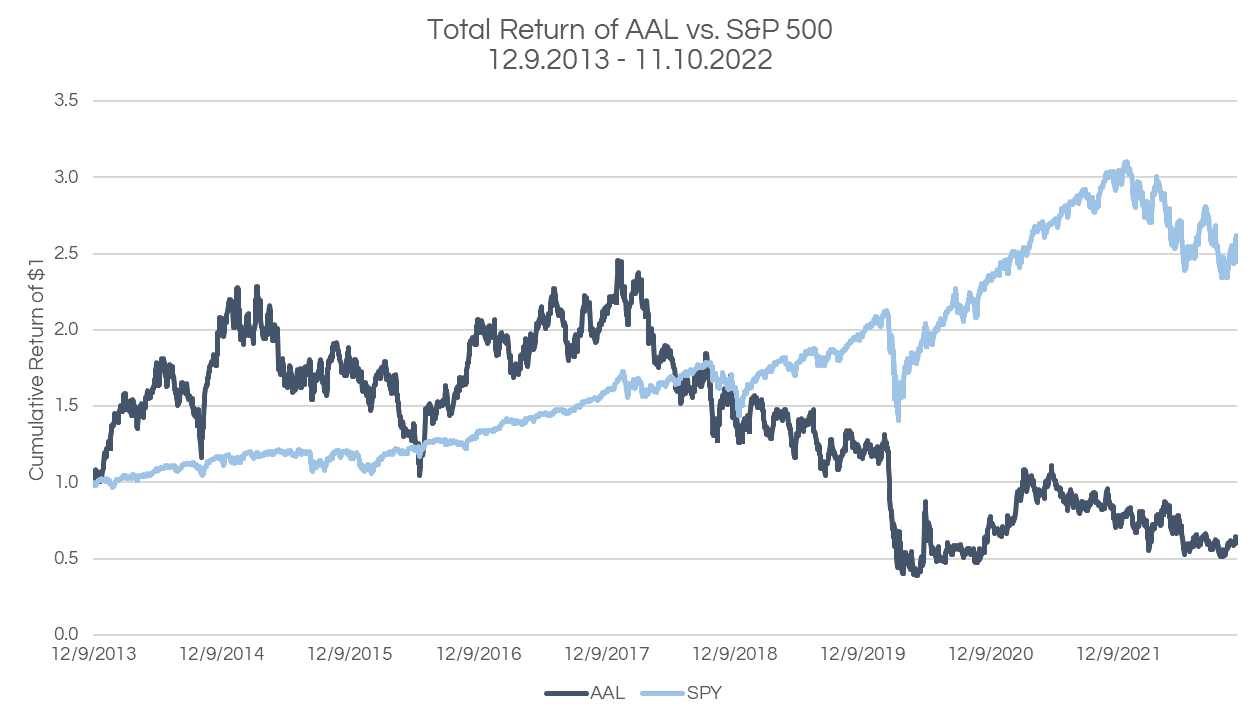
Source: Bloomberg
Ed Bastian's tenure at Delta coincided with both COVID and the post-COVID recovery. It is still a pretty ugly story. A $1 investment would be worth 43% of an S&P 500 index investment.
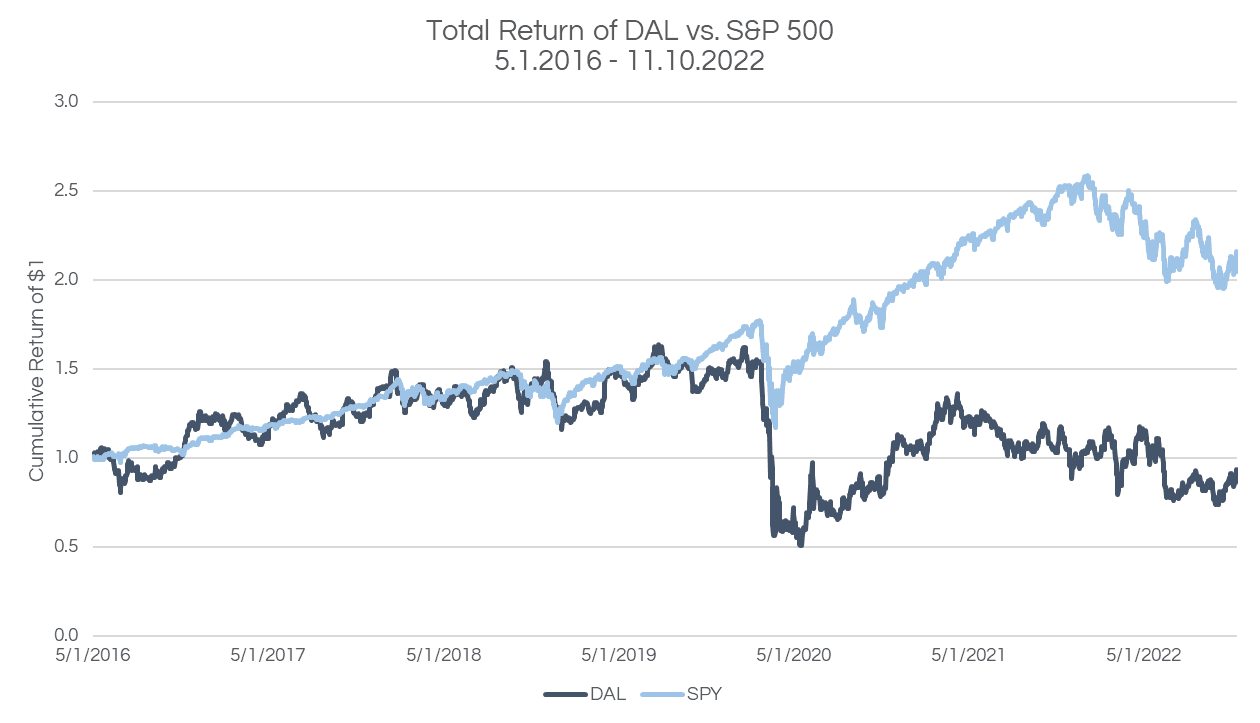
Source: Bloomberg
Oscar Munoz is to some extent a victim of timing, departing his role in the depths of the pandemic. Still, the stock has continued to languish, and the value destruction was stark even so. The $1.67 you would have received from investing in the S&P 500 on the date Munoz became CEO in 2015 and selling when he left the position in 2020 was about 3.2x what UAL shareholders received.
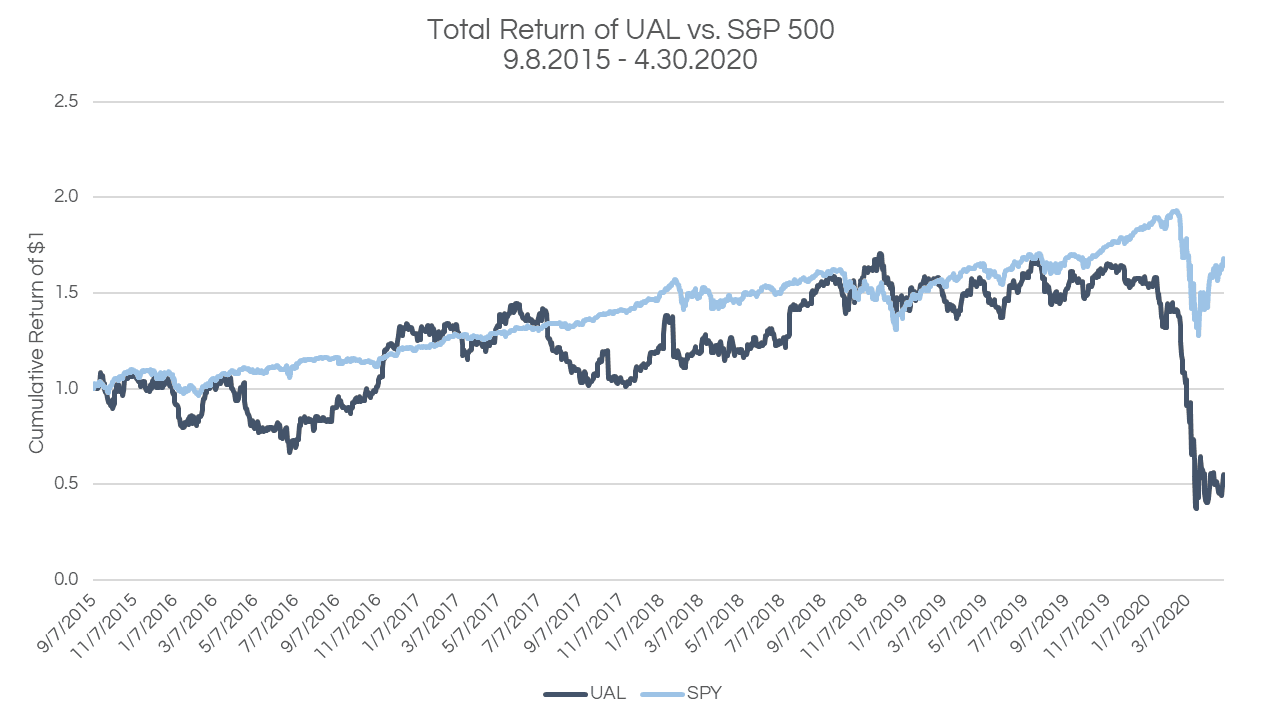
Source: Bloomberg
And then there's Southwest. Run by Gary Kelly since Herb stepped down in 2004 through early 2022, it is an outlier. That is true even while we are being unfair to Kelly by constraining this chart to the periods overlapping with our stock-based compensation analysis and the tenure of these other CEOs.
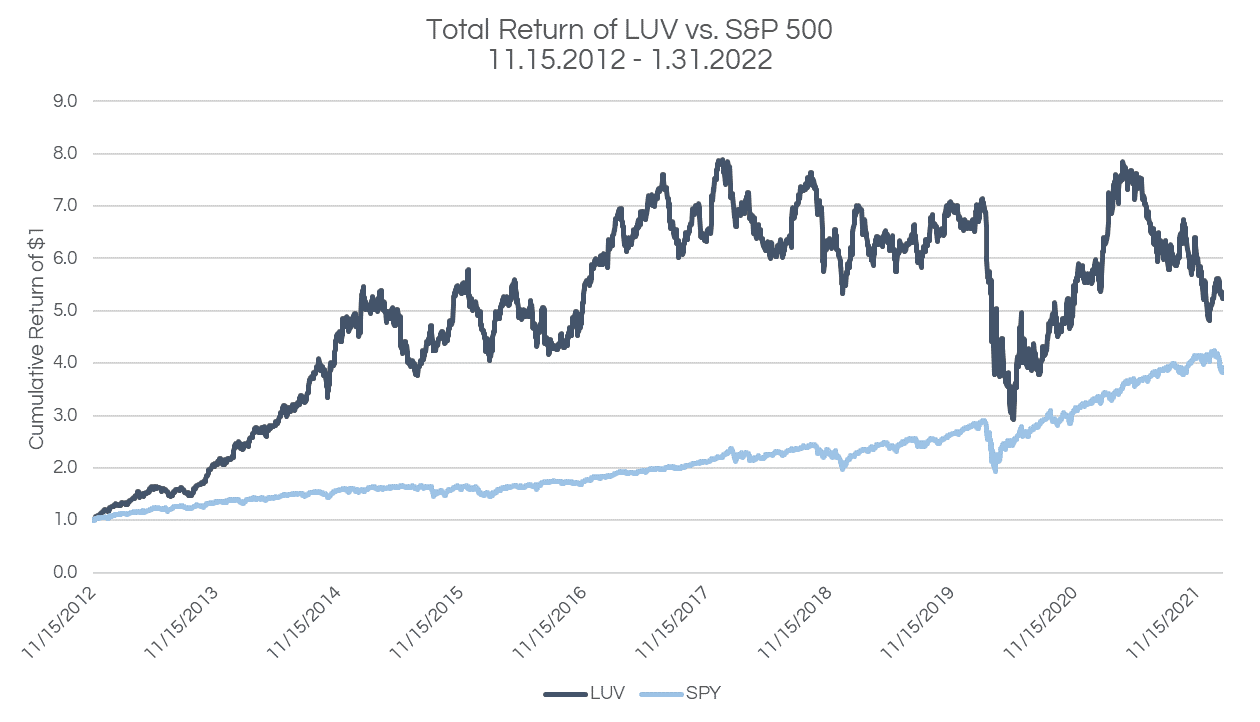
Source: Bloomberg
So what are we to take from all this?
Do I think that $200 million in stock-based compensation for Doug Parker over this period was insane? Yes.
Do I think that the fact that the CEO of the worst performing airline (by far) got the most stock shoveled his way and that the CEO of the best-performing airline (by far) almost brought up the rear on a per-year basis is damning evidence that executive compensation decisions aren't necessarily being made in ways that benefit shareholders? Yes.
Based on our iconoclasm-friendly readership, I suspect there will be little disagreement on either point. Still, no matter how thoughtful or informed our opinions may be, they remain that: our opinions. The true story of free market capitalism reminds us, helpfully if annoyingly, at times, that we adopted this system in part because the aggregation of our diffuse knowledge and preferences through markets is a far better way to arrive at the value of things than a few average-to-smart people doing their best.
The myth of free market capitalism, however, now whispers in our ears something else. Barely audible, it intones that the determination of compensation for these executives was made in exactly such a market. They used consultants to determine "market" rates! The board has duties and did diligence! They have every incentive to pay only what they need to find the executive with the skills and vision to maximize shareholder value! It was voted on as part of compensation policy in a proxy solicitation! The forms were followed, the rites administered! If you have a problem with this, you have a problem with free market capitalism!
You don't have to agree with me that $200 million is unequivocally a stupid amount of money to pay in stock to a CEO who flew his company into several figurative mountains over a decade.
I am not trying to convince you that there's a right or wrong amount to pay an airline CEO. I am absolutely not trying to convince you that my opinion about it has any special merit.
If you will bear with me, however, I WILL try to convince you that our present system for corporate governance and the narratives about it which have insinuated themselves into the myth of free market capitalism almost guarantee outcomes like the ones observed above with our dumb airlines. It is a system which directly and systematically incentivizes decisions in favor of management and at capital's expense.
Sixty-three percent.
That is the percentage of Alphabet free cash flow over the last decade that has gone toward buying back stock to sterilize stock-based compensation to employees. Let me say that again: over a ten-year period, two-thirds of the free cash flow of the third largest public company in the world, a top position in a thousand "Quality Growth" investment and "ESG" strategies, was sent directly to management under the narrative pretense of being "returned to shareholders."
Or, if you prefer, Seventy-seven percent.
That is the percentage of Meta's free cash flow that was used the same way for the same thing. Sure, maybe Facebook doesn't have the "quality company" cachet of Google, but we're still talking about an astonishing number.
A billion dollars isn't cool, airline CEOs. You know what's cool? Nearly one hundred and twenty billion dollars.
Don't believe me? We wrote about it all right here.
Now, Google has neither narrowly escaped bankruptcy nor come hat-in-hand to the White House to beg for bailouts (although somehow they have managed anti-trust scrutiny, despite wielding anti-competitive power in several markets that J.P. Morgan could only have dreamed about). Nobody is going to able to credibly argue that its management team has lit capital on fire in anything approaching Parker Tier shareholder value destruction. Even with the recent hit to technology stocks, a dollar invested in Google a decade ago is worth a lot more than a dollar invested in the S&P 500. More to the point, Google has churned out some $300 billion in free cash flow over the last decade, good for a current free cash flow yield north of 4%. Whether or not it has lived up to its commitment not to be evil, it is by almost any conceivable standard a well-run company.
And so the true story of free market capitalism tells us, plainly and correctly, that a management team producing that kind of cash flow with your capital while it grows the productive assets of the company should be and will be compensated well for it. Then, the myth whispers: yay, fiduciaries! yay, boards! yay, duty of care! into our ears. It tells us that, as shareholders, we can safely trust the degree of that compensation to the "market" and the "aligned incentives" of the Board of Directors. Whatever they come up with, well, we can be sure that the system of incentives we have created for those Boards, the proxy voting services and top holders of the shares of our company will ensure that they work to maximize shareholder value. If they didn't, it whispers, the market will correct it. I mean, what kind of Chairman and CEO would recommend a slate of very highly credentialed and experienced new directors that so irresponsibly paid another CEO far too much money?
Meta is similar in many respects. Like, Google, if you've been invested with this management team for the last decade, you are still well ahead of the S&P 500. Like Google, that number has dropped precipitously over the last several months, as interest rates not hovering around zero created carnage for, shall we say, aspirational terminal value estimates. As recently as September of last year, Meta investors were looking at an investment worth more than 4x what a comparable S&P 500 investment would have produced. And like Google, Meta produced real cash flow over that period. Not as much, mind you, but still north of $150 billion. Real money, as they say.
And so we hear the same plain voice of the true story of free market capitalism in our head. The same whispers of its myth. Is it too late to step back? Perhaps we can say a number out loud together. Do it with me, silent reader. I don't care if you're on an airplane or sitting on the New Haven Line with your bag on the middle seat like an asshole, positively willing the pre-caffeinated passengers coming on board at Stamford to give up on your humanity and stand in the vestibule. All together now:
Seventy. Seven. Percent.
Meta used seventy-seven percent of its free cash flow over the last decade to reward its staff with stock-based compensation.
I'm a little less excited about confessing that "this is ridiculous" remains just one dude's opinion in context of the true story of free market capitalism, but alas, it remains just one dude's opinion. And probably most of yours, for whatever that's worth.
And since we're all steeped in the myth of free market capitalism, we also know that we all know that this number was arrived at through a system approved by a board that did its best to maximize value for shareholders, duly considered and research by proxy voting services, and absolutely not sloughed off as an irrelevancy and rubber-stamped by the largest holders of the stock.
Enough.
We've paid enough homage to the true story. Now let's start the work of rescuing it. Let's explore how we've created a projection racket by embedding into the myth of free market capitalism four seductive ideas which are structurally biased to serve the interests of management and directors at the expense of shareholders.
Structural Problem #1: Delaware Duties are a Constraint, not an Objective
The basic idea behind a public company board is an entirely reasonable one.
In order for any large public company to effectively transmit the benefits of productivity, ingenuity, labor and industry to those whose equity capital empowered those things, it is a practical necessity to have a structure which delegates authority from those owners to management. In other words, do you really want a million individual shareholders voting on every use of company capital?
And so we have codified into corporate law a structure whereby owners elect agents to represent their interests. These directors and officers of companies – typically organized collectively into a board – in turn select a senior management team to lead the day-to-day operations of the business for the benefit of those shareholders.
Again, perfectly sensible.
From there, the philosophical question that sits at the intersection of the true story of free markets and the myth is whether and how we can ensure that these agents truly act in service of the interests of shareholders and capital..
It's a more complicated question than it seems on the surface.
Sometimes the question is addressed through individual corporate by-laws and charters which constrain and guide the nature of the authorities and decisions which fall under the scope of various agents. More importantly, however, in almost every jurisdiction that matters for shareholders of publicly listed US companies, the question is addressed through the enumeration of duties of officers and directors of those companies in state corporate and securities laws.
Under the most common (Delaware) law and most others, the duties that matter look something like this:
- Duty of Care
- Duty of Loyalty
- Duty of Good Faith / Business Judgment
In practice, the Duty of Care under Delaware law requires board members to make informed decisions that do not depart drastically from what a careful and reasonable fiduciary would do.
The Duty of Loyalty requires board members to ensure the company complies with the law and that they place the interests of the company ahead of their own.
The Duty of Good Faith (or Business Judgment) permits directors broad latitude to make decisions without liability for them ending up badly, provided that they are made with due care and in good faith.
It is not an exaggeration to say that the entire proposition of the benefits of capitalism as realized in widely held, publicly listed corporations rests upon whether or not these three duties adequately ensure that agents will make decisions for the primary benefit of capital.
So do they?
LOL.
Look, there's nothing wrong with the duties themselves. They're well-intended, they are good moral and ethical standards, and I think a lot of board members take them very seriously. I know I take them seriously when I sit in those seats (and I have, for multiple non-profit corporation and for-profit private corporations). I know that just about everyone else with whom I've shared those seats takes them seriously, too. I cannot think of duties I could add or modifications to the existing duties I could make in Delaware law that would constitute a material improvement.
Fiduciary duties of directors and officers don't fail to fulfill the true story of capitalism because they're wrong or bad. Fiduciary duties of directors and offices fail to fulfill the true story of capitalism because they are negative obligations parading as positive obligations.
And that is one of the oldest projection rackets in the book. Agent Orange, innocuous to the ear but dangerous all the same.
That is, it is memetically helpful to say that directors have a positive obligation to be loyal to the company and its shareholders. It makes us all feel good to believe that is the case. In practice, however, they have an obligation not to do anything which, in comparison to the actions of other companies and directors, would be explicitly and provably disloyal.
It is helpful memetically to say that directors have a positive obligation to use their best business judgment in service of shareholders. In practice, however, they have an obligation not to do anything which, in comparison to a standard of a person exercising care, would deviate egregiously in a demonstrable way (and if you've hired the right financial advisers and lawyers to show the trappings of yay, duty of care!, even egregious deviations may find safe harbor).
A board being sued for breach of duty of care concerning a sale of a business isn't really going to have their case adjudicated on whether the company's board did everything it could to maximize value (evaluation of a positive obligation), but rather on whether the steps taken by management to evaluate the reasonableness and terms of the offer deviated egregiously from a reasonable standard of care.
Don't mistake me. There's a good reason for all this as a legal standard. A world in which board members (which insurers and shareholders pay for anyway in all but a few extreme cases) are sued into oblivion or replaced with a clean slate for every decision that went wrong on the unprovable basis of a lapse in commitment to a positive standard of behavior is a world in which nobody is a board member and the rewards of capital and labor are funneled to lawyers even more than they are today. But just because we can't execute a fix to structural agency problems through a modification of the duties attached to agents in corporate law doesn't mean they aren't problems. It also doesn't mean there aren't other ways to fix those problems.
So let's be more specific in describing the problem we are talking about: The transformation of positive obligations into de facto negative obligations transforms the objective function of the agents operating public corporations, into one that is at best neutral to and more likely adverse to the interests of capital.
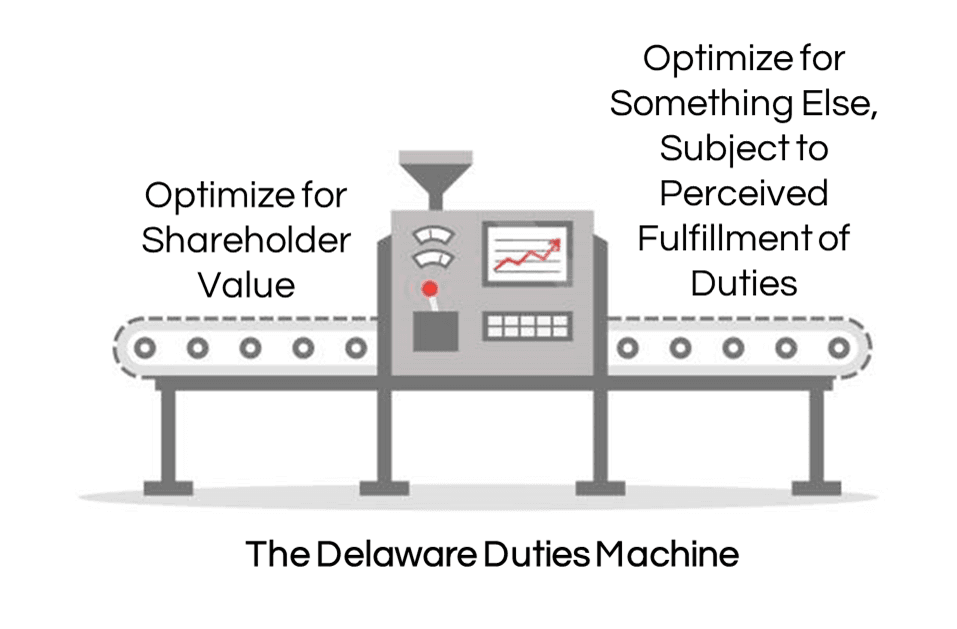
The question is, "What is that something else?"
I'm glad you asked. Because that's the second structural problem.
Structural Problem #2: Director Incentives are to Maximize the Value of their Directorships
If you were a C-Suite member of a publicly listed large cap company with a minor / non-influential equity ownership stake, what would you want in a board?
If you were a director or potential director of a publicly listed large cap company, what would you want in a management team?
Bear in mind in both cases that you can ask for whatever you want with confidence that it will be constrained by the negative obligations of your duties and the corporate lawyers stewarding them. You're not going to get sued for saying what you really want, so go bananas.
And yes, I get that it's an odd question. I'm asking you because in part because I want you to think about it, and in part because a discussion of incentives is inherently subjective. Still, I don't think you will find the list I came up with too controversial, especially because I mean it as a true list and not what CEOs would feel compelled to say (e.g. "I want a board with experience, great credentials, diversity and complementary skills! Whee!"). But I think your average C-Suite exec is going to have some variant of the following four items in some order at the top of their list:
- A board willing to maximize the executive's potential compensation;
- A board willing to make this compensation as close to guaranteed, current and contractual as possible;
- A board with the ability and relationships to hire them in the future; and
- A board willing to give them as free a hand to execute their plans as possible.
What does a director or prospective director want? It's a different list, but like the C-Suite list, I think it is a list that would be almost identical across the universe of prospective corporate public directors:
- As little stress and drama as possible;
- A strong, steady compensation package and perks;
- (For ‘retired' directors) A strong recommendation to other management teams, boards and gatekeepers as a director; and
- (For ‘non-retired' directors) Good connections for mutually beneficial business dealings.
Maybe your list is a little bit different. That's OK. But whether it's your list or my list, let's undertake a little thought experiment all the same. If these are, in fact, the incentives and preferences of C-Suite executives and prospective public directors subject to constraints of negative obligations, what will fill in the "something else" in our new optimization function for the management of our public corporation?
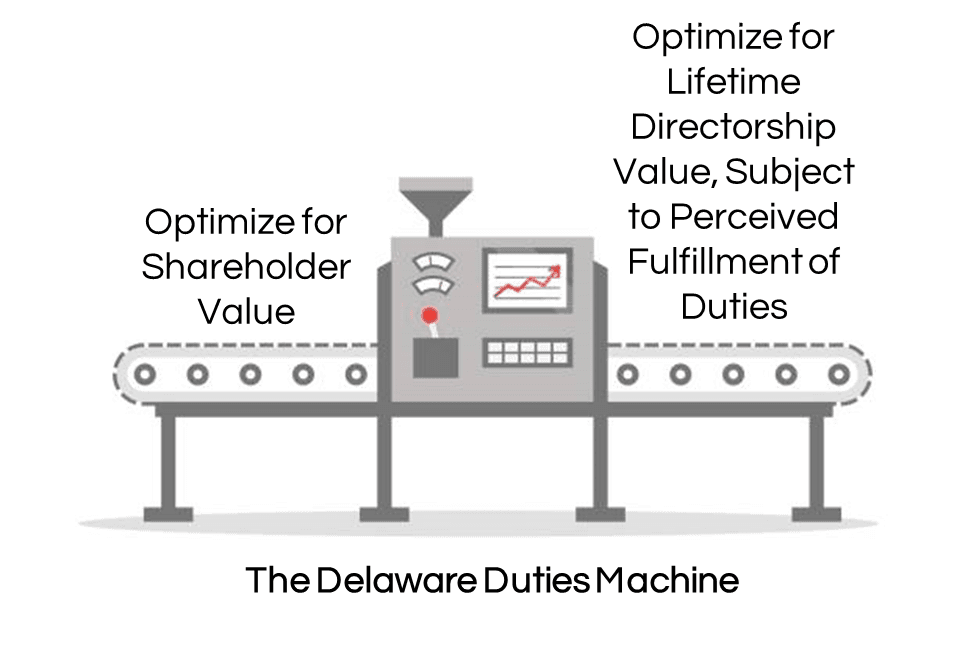
The defining feature of our chosen system of corporate governance is that it redefines the value-maximizing exercise that underlies the true story of free market capitalism to a constraint-satisfying exercise. Once you have transformed it into a constraint-satisfying exercise, then there is room for a new variable to maximize.
For the rational director, that new variable is the aggregate benefit the director expects to yield from their service.
There are a lot of ways to derive value from board service. The first, possibly the biggest and definitely the most complicated to quantify, is to use the service to develop relationships, identify potential transactions and aid value creation in other endeavors where the director has a more direct pecuniary interest. The second is to stay a director and clip the mid-six figure cash and non-cash compensation from doing so. The third is to increase the probability that they will be invited to join the slate of more boards (simultaneously) and future boards (subsequently).
How do you achieve all three as an independent director? Not complicated, y'all. You do it by opposing management and other directors as little as possible while remaining under the protective aegis of counsel, board process and the perceived "care" credit associated with documentation of meetings and discussion.
But aren't the gatekeepers sitting between shareholders and boards clamping down on abuse of this? Yes! But in a much more important, much more accurate way, no. It is true that just about every proxy advisor and big asset manager has a policy on the number of boards on which individuals may serve simultaneously. Institutional Shareholder Services (ISS), the most freewheeling of the proxy advisors, limits its support for independent directorships to no more than 5. Fidelity and AllianceBernstein are the tightest of the big boys at 3. Just about everyone restricts CEOs and other executives with a full-time job to a smaller number. Sometimes they'll support CEOs with one outside director gig. Sometimes two.
In general, however, the focus of these policies is not to hamstring the incentive of a "Director Class" to collectively play ball to keep the gravy train going. It is to constrain the extent to which these individuals' time is being stretched too thin. This is not an irrelevant consideration, to be sure, and it does have the effect of reducing the 6, 7 or 8 directorship nonsense that wasn't unheard of before the turn of the 21st century. Sorry, Greg Maffei, game's over on that gag. Still, there is almost zero emphasis on the core incentive problem.
If describing the causal mechanism (i.e. the director incentives we have been discussing in this section) doesn't convince you that there is a problem, and if extreme anecdotal instances aren't enough, then consider the aggregate randomness of the relationship between industry-relative pay and industry-relative performance. From Stephen O'Byrne's 2018 submission to the Journal of Applied Corporate Finance, Say on Pay: Is it Needed? Does it Work? we see the utter lack of relationship between pay differentials and results differentials in practice.
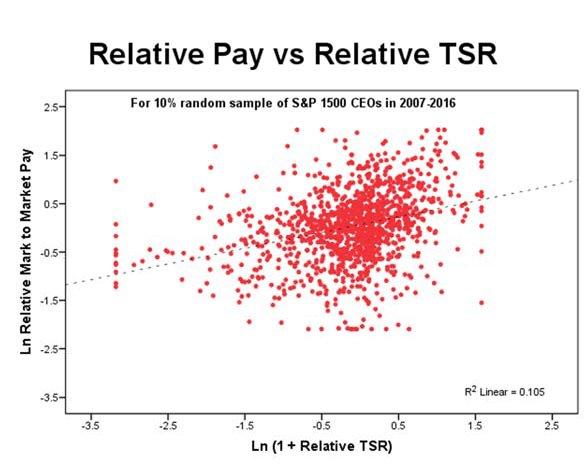
Source: Say on Pay: Is it Needed? Does it Work? by Stephen O'Byrne
All of this is true even using a share price-derived metric – relative total shareholder return (TSR) – that we would argue still allows for a substantial amount of gaming by management in a world of narrative management. Still, the projection racket isn't some executives figuring out how to get paid a bit more at the expense of capital. The projection racket is about how this becomes a systematic feature of the myth of free market capitalism through the steady embedding of narratives that serve management, and pretending that those narratives are fundamental to the true story of free market capitalism.
Rational management wants to maximize value for itself. The system we designed to make sure their pursuit of self-value maximization results in something like shareholder value maximization, however, reorients the oversight body toward a constraint-satisfaction role, permitting the director to pursue personal value maximization as the primary aim. Subject to perceived satisfaction of the duties, of course.
So what happens next?
What happens next is that management realizes that it maximizes its own value most when it can (1) influence the environment for management compensation "reasonability" assessments and (2) design and propose compensation structures that make it easier for a director to "play ball," which serves everyone's aims and gets nobody in trouble.
Structural Problem #3: An Executive Pay Environment Rich with Easily Exploited (and Easily Encouraged) Narratives
What's the easiest way to systematically influence the assessment of the reasonability of management compensation? Focus your efforts on getting industry executives sprinkled throughout public company compensation committees, then make sure everyone in the industry is singing the same tune on three easily exploited, right-sounding narratives straight from the recipe for Agent Orange:
Narrative 1: That talent in your industry is in high demand and that compensation demands you stay competitive, regardless of demonstrable ROI;
Narrative 2: That equity forms of compensation are inherently aligning, drastically reducing any concerns that directors or shareholders need to have about the magnitude of such compensation; and
Narrative 3: That returning capital to shareholders through shareholder buy-backs is indicative of Good Corporate Governance. What's that, those buy-backs are just being used to sterilize share issuance to management, you say? No, buy-backs are just tax-advantaged dividends! It's just math, you communist!
My stars, I wonder if anyone else came to a similar conclusion!
Remember Meta and that 77% figure? We didn't discuss any specifics about the Board that came to the conclusion that this was appropriate. Let's talk a bit more about the committee structure whereby the current Meta Board of Directors works with management to construct the company's compensation plan.
The compensation committee of Meta's Board of Directors (what they call their "Compensation, Nominating and Governance Committee") is chaired by a woman named Peggy Alford. Peggy was appointed to this directorship after previously serving as the CFO for Mark Zuckerberg and Priscilla Chan's charity, Chan Zuckerberg Initiative. She is presently employed full-time at PayPal, where she is EVP of Global Sales. I have no reason to believe Ms. Alford is anything other than a high integrity, highly capable executive. But subject to satisfying the constraint of the Delaware Duties, what incentive does Ms. Alford, an executive at a company with the same growth-company-that-can-pay-a-lot narrative as Meta, have to represent the shareholder side of the bid / ask on the "market for talent" in which Meta participates?
It's not a rhetorical question. Because PayPal executives absolutely have been direct beneficiaries of the executive compensation narratives created by Google, Meta and Apple and other high-flying growth companies.
Since its spinout, Paypal has used 37.4% of its free cash flow – $10.1 billion of about $26.9 billion – to sterilize and pay taxes on stock-based compensation for its employees. Indeed, of the 161 million shares repurchased and celebrated as disciplined return of cash to investors, 84 million, or just over 52%, were just being used to sterilize the shares issued to management as compensation. Paypal's management and board, like Meta, participated in and promulgated each of the three narratives.
Look just one box over from Alford in the Zoom meeting for the Meta compensation committee and you'll find Andrew Houston. Drew's the Chairman and CEO at Dropbox, Inc.
Since its IPO, Dropbox has been widely known as a high payer, especially in stock-based compensation. During that time, it has used 57.2% of free cash flow – $1.2 billion of about $2.2 billion – to sterilize and pay taxes on stock-based compensation for its employees. Of the 89 million shares it so responsibly and dutifully bought-back in a very shrewd return of capital to investors, about 34 million of those shares, or 38.5%, were simply to sterilize the shares issued to management. Dropbox's management, like Meta's, like Paypal's, participated in and promulgated each of the three narratives.
Andreesen hasn't signed onto the call yet, so let's look over one more box in the Meta comp committee Zoom meeting. Oh look, it's Tony Xu, Chairman, CEO and Co-Founder of DoorDash.
They've only been public for a short while, so they had some ground to make up. Did they? Boy howdy. It has used 96.5% of free cash flow – $530 million of about $549 million – to sterilize and pay taxes on stock-based compensation for its employees. Of the, well, 6 million in shares it has bought back, it has issued 39 million to employees. You know, let's call that a wash and say they've sterilized 100%. Even as early on as they are as a public company, DoorDash's management, like DropBox's, like Paypal's, like Meta's, participated in and promulgated each of the three narratives.
That's good information for DoorDash Corporate Development and Strategy Lead Gokul Rajaram to take with him to his board of directors meetings at Pinterest, where he, you guessed it, serves on the compensation committee. He won't be the only one who takes the message back home, however. You see, on DoorDash's own board, you'll find Greg Peters, the Chief Operating Officer of Netflix. Yes, he's on the compensation committee. And on the Netflix board, you'll find Anne Sweeney, who until January was the head of Disney's cable, broadcast and satellite properties. Yes, she's on the compensation committee.
Would you be surprised to learn that upon the 2019 launch of Disney's streaming business, in which they explicitly sought to piggy-back on these established narratives of "high flying growth" companies, their stock-based compensation rose by 81% in a single year, after a decade in which year-over-year changes in stock-based compensation never rose or fell by more than 10%?
And yes, when we say that they have participated in and promulgated each of the three narratives, we mean it. We also think that both claims are demonstrably true. The above shows how they've participated economically. How do we know they've participated in the promulgation of these narratives? Because when we use our Radiant system for mapping linguistic patterns to narrative archetypes and quantifying them in the wild, what we find is that the coverage of these companies by financial media is so rife with the loaded language of "shareholder alignment!" and "good corporate governance" that it dwarfs that of the companies generally perceived to be the highest quality, most appropriately governed companies listed in the United States.
To wit, we looked at the last 10 years of financial news coverage of each of the above companies, and compared it with that of the 10 US-based companies that ranked highest in Refinitiv's "Top 100 companies leading in corporate governance" with an adequate volume of coverage (in this case, 10,000 articles in our dataset). It is nearly a clean sweep for the Agent Orange companies. In almost every single case, they have succeeded in promoting coverage that presents them as being aligned with shareholders and managed with shareholder-friendly uses of capital in mind, to a degree that runs between 1.3x and 3.8x that of the US-listed companies with "Top 10" corporate governance practices.
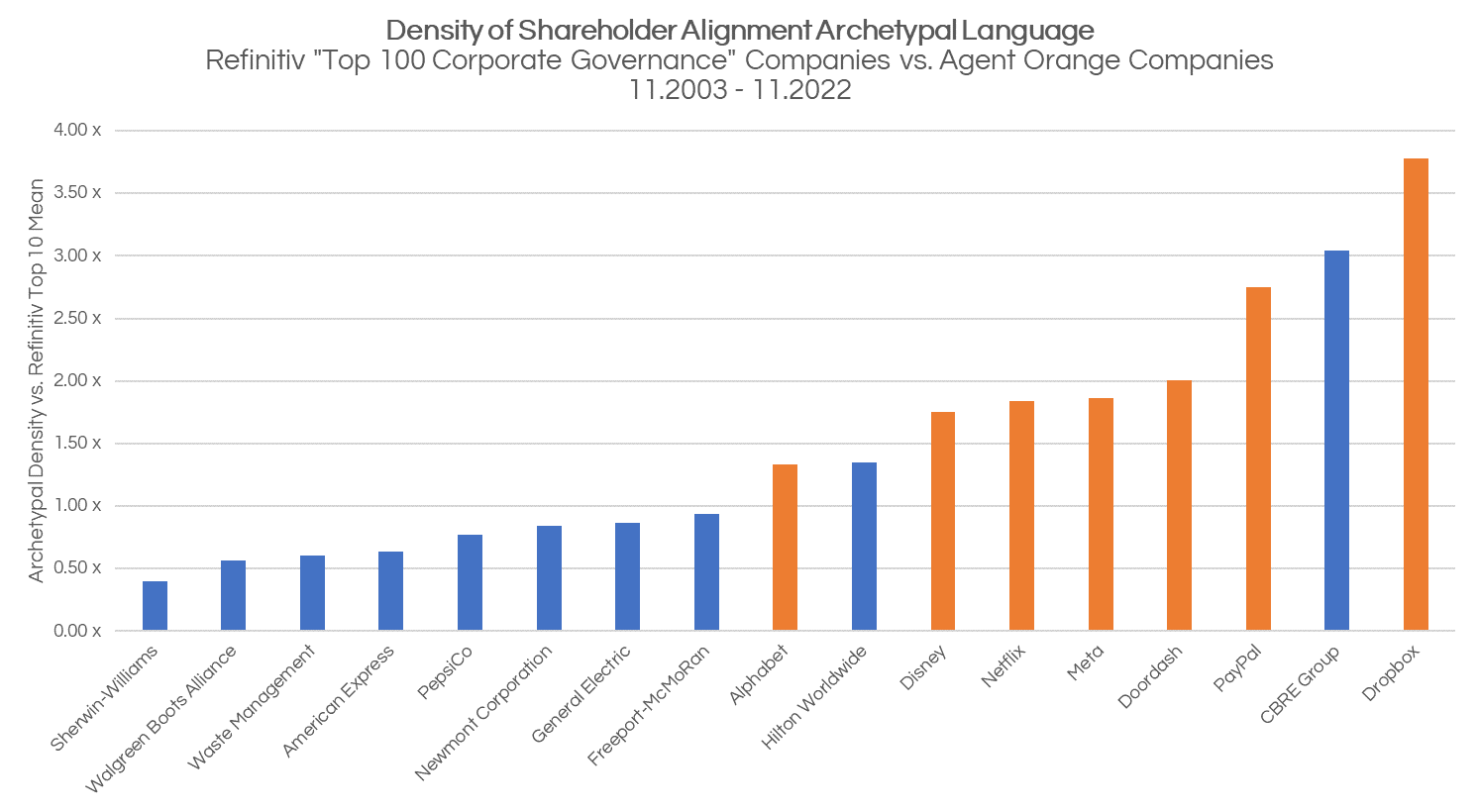
Source: Refinitiv, Lexis Nexis Newsdesk, Epsilon Theory
Look how ice cold that glass of cool, refreshing Fanta is! Can't you see the condensation on the glass? Aren't those pretzels making you thirsty?
Taking it back to the part of the equation that installs executives on peer company boards and compensation committees in particular, I want to be clear. I'm not saying that a peer executive would not bring some useful insights into industry norms, the expectations of talent and the best ways to incentivize that talent, although the idea that this is a strong rationale in light of the general dependence on consultants in the first place is a bit silly. I am not saying any of these people are anything but upstanding corporate citizens. Seriously, I'm not. We have zero evidence of anything of the sort. I am not saying any of these people are anything but extraordinary executives with powerful insights, sterling credentials and a history of success in everything they do. We have zero evidence of anything to the contrary.
What we do have evidence of, however, is a runaway train of compensation, especially stock-based compensation, taking place in executive suites of public companies across the country. What we do have evidence of is how brutally effective the management of these companies has been promoting the idea that their equity compensation policies are oh-so-aligned, and how their frequent buy-back policies are oh-so-shareholder friendly. Concentrated in technology and growth-oriented industries, this evidence exists in an broader environment in which executive compensation policy differences have little, if any, demonstrable relationship with shareholder value creation. The implication is that directors are asleep at the switch, at best.
So if all of this is so management-serving and shareholder-negative, how does the Board Class make it safe – no, optimal, wise, good – for directors with an incentive to keep a good thing going? How do we execute the triple play of paying management more, making it seem imprudent for any director to oppose it, and making it seem positively communist to criticize? Something sweet and gentle-sounding. Non-threatening, like Daisycutter. Like Grasshopper.
Like Agent Orange! Oops, I meant to say "like Say on Pay!"
Structural Problem #4: Institutions Representing Capital are Asleep at the Wheel

No, the idea for Say on Pay didn't necessarily come from directors or corporate management. There are almost certainly many directors annoyed by the partial removal of an authority that long been delegated by shareholders to them. I also think the regulators who introduced it to US markets with the Emergency Economic Stabilization Act of 2008 and memorialized it as a requirement in the Dodd-Frank Act had shareholder interests in mind. Or at least they had Sticking It To Rich Executives in mind, but that amounts to pretty much the same thing in my book, even if the politics are different.
In practice, however, despite everything about it seeming like it's all about freedom, agency and control for shareholders, Say on Pay is one of the most important narrative tools supporting the projection racket underlying high and rising executive compensation at the expense of shareholders.
Why? Because it creates a narrative of diligence, alignment and shareholder friendliness that frees up management and directors to come up with any compensation scheme their hearts desire, knowing full well that proxy advisors and institutional asset managers will be asleep at the wheel to actually exercise that agency on shareholders' behalf.
What do I mean by asleep at the wheel?
I mean that calling Say on Pay votes since their introduction a rubber stamp vastly overstates the effectiveness of the garden-variety rubber stamp. In 2012, Say on Pay proxies from companies in the Russell 3000 Index had 90.7% support among those shareholders and shareholder representatives. By 2017, that number had risen to 92.1%. Among larger companies with more extraordinary pay packages, the numbers are even higher. Just before the pandemic, in 2019, median investor support for S&P 500 constituent Say on Pay plans was 94.1%.
Does this support vary by the absurdity of the plan being proposed? Looking back at Stephen O'Byrne's work once again, the answer is yes! Votes are so sensitive to extraordinary results-relative pay that the support would, on average, fall below 50% when the proposed compensation structure incorporated a <checks notes> 9,679% premium to "fair" pay based on industry-relative performance. Sorry, I've gotta do the thing again. Nine thousand, six-hundred and seventy-nine percent.
And look, obviously this is just a playful way of talking about a tiny coefficient that generalizes the response profile of the population we're analyzing. In reality, the entire universe doesn't have a tiny sensitivity to relative performance in determining pay. The vast majority of the universe has zero sensitivity, and a vanishingly small sliver of the universe has moderate sensitivity.
The unequivocal conclusion to draw from this is that at least a plurality, and almost certainly a majority of institutional asset managers and proxy advisors, are literally and reflexively voting FOR on each and every Say on Pay proxy, no matter what matrix of right-sounding rules they've constructed so that it looks like they're actually doing something useful.
Really the only thing that seems to cause a handful of investor representatives to wake up for the briefest of moments is a bad short-term market for stocks. The agents tirelessly protecting the interests of capital only seem to care about how they vote on executive compensation when the market is off 25% and a FOR vote might look bad to a public fund client at their next quarterly update meeting. Still, the effects here are hilariously small. In 2021, 97% of Russell 3000 Say on Pay proposals still passed. In 2021, 97% of Russell 3000 Say on Pay proposals passed.
Of course, the proxy advisers themselves need to promote the idea that they are having an impact and Changing The World. And so, with the market down big, inflation up big and executive compensation up big (again), ISS decides that it's press release time:
These results potentially suggest a continued growing disconnect between board determinations of CEO compensation opportunities and shareholders’ support for the pay packages. Against the backdrop of the current inflationary environment, investors appear to be more inclined than ever to vote against large pay packages that aren’t justified by company performance.
Brian Johnson, Executive Director, ISS Corporate Solutions
What precipitated the excited claim of a growing disconnect, of blessed sanity returning to a world gone mad? A drop in investor support for S&P 500 Say on Pay proposals from 92.7% in 2021 to 92.2% so far in 2022. A drop of 0.50%. I won't do the repeated number gag again. That's on you, if you need to dramatize 50 basis points of nothing. That's not a change in the number of approved proposals. That's the change in the percentage of investor support. That's how much the local Democratic candidate's vote percentage changed when a dorm room in Berkeley was just too high to make it to the voting booth on Tuesday, not how many seats flipped. A total of eight S&P 500 Say on Pay proposals were rejected at the time of the press release. 97% of Russell 3000 Say on Pay proposals passed in 2021, the last full year. Y'all, I don't know how to tell you this, but nobody – nobody – cares about shareholders. Whatever number the board and management come up with for comp, it's...it's fine, whatever.
The directors and management are mixing the glasses.
The institutional asset managers and proxy advisors are picking the watered down one.
All of them are telling us how refreshing it's going to be, and how very hard and diligently they worked in picking between them, and how all of this is how free market capitalism is supposed to work.
But it is you and I, my friend, alongside every pension and retirement plan-dependent citizen in this country, that have to drink it.
Except we don't have to.
The problem with BITFD, of course, is that the solutions will sound insane. When we fight against projection rackets, we fight against narratives designed to tell us us that gutting a broken feature of an institution is gutting the institution itself. That's an especially tall order when that institution is one – like American free market capitalism – that we all rightfully see as a fundamental part of our culture and our social contract with America. It is doubly difficult when the true story, rather than the myth, of the institution is that it has lifted millions out of poverty into sufficiency and prosperity.
If you want to do something about the way in which board structure, legal conventions of Delaware law and right-sounding narratives are being abused to loot capital for the benefit of the Managerial Class and Board Class, however, I think there are five things that have to happen:
I. Split of Chairman / CEO Roles
The NYSE and NASDAQ must require the separation of Chief Executive Officer and Chairman roles. Independent Chairmanship should be a requirement for listing. The practical extent to which the dual role permits the setting of agendas by management is unacceptable for a company purporting to operate itself for the benefit of shareholders rather than management. An exception for companies with a very large founder-CEO who continues to be a controlling-scale shareholder (e.g. >25%) would probably be necessary and feasible.
II. Simultaneous Directorship Limits
NYSE and NASDAQ must not leave it to the flaccid policies of proxy advisors and investment managers acting as agents for shareholders. They must limit simultaneous directorships for all directors, independent and otherwise. We suggest a maximum of two.
III. Lifetime Directorship Limits
NYSE and NASDAQ must address the creation of a Board Class through management-friendly behavior that disadvantages the owners of its listed companies. It must limit the lifetime prospect of a lifelong gravy train of directorships. We suggest a lifetime limit of five directorships in public companies listed on either the NYSE or NASDAQ.
IV. Standardization of Sterilization Disclosures
The SEC must require standardized reporting of the monetization of stock-based compensation (SBC) so that shareholders can easily calculate and compare SBC monetization policies across publicly traded companies. Currently, the only aspect of SBC with standardized reporting is the non-cash expense for anticipated value of SBC found in the income statement. In contrast, the data required to calculate SBC monetization – (1) the number of shares issued to employees, (2) the number of newly issued shares withheld for taxes, (3) the cash paid to buy back these withheld shares, (4) the number of shares bought back on the open market, and (5) the cash paid to buy back stock on the open market – is often scattered throughout the quarterly and annual filings. Companies report this information using different language as well as different categorizations and levels of detail.
Standardized reporting of these five items within the Consolidated Statement of Shareholder Equity would link the SBC expense items from the income statement with the actual realization of share count change on the balance sheet with the actual use of cash to monetize SBC issuance on the cash flow statement, allowing an easily calculable and easily comparable measure of SBC monetization and the use of cash to sterilize shareholder dilution.
V. Clarification of Investment Adviser Proxy Duties
The SEC must make clear to all registered investment advisers through published policy and enforcement action that the engagement and use of a proxy adviser does not obviate the requirement for any registered investment adviser to document their research, diligence and rationale for every proxy they vote. No explicit or implicit proxy adviser safe harbors. No "we disclosed it in our proxy voting section of our ADV" outs.
Asset managers earn a tremendous amount of money holding themselves out as fiduciaries, but have spent decades framing that fiduciary responsibility around the decisions to buy and sell securities only. Safe harbors, consultants, proxy advisor hires, "voting rules" and other shortcuts have allowed them to fudge one of their most important fiduciary roles. No more. If an investment manager tries to treat proxy voting as an "operational due diligence item", tell them they're registered investment advisers, not brokers.
VI. Clarification of Implicit Say on Pay Safe Harbor
As we have argued, Say on Pay supports the projection racket, but if you can achieve the rest of this, I am convinced Say on Pay remains a net good. Even so, I think it is important that Delaware and other jurisdictions state clearly and unequivocally that the adoption of Dodd-Frank-required Say on Pay regulations and the affirmative vote of shareholders is not to be considered part of the fact pattern in consideration of directors' duties of care and business judgment. An egregious compensation structure for management must remain a breach of duties, even if "shareholders" voted for it.
None of these actions is a panacea. Frankly, a desire to BITFD implies a preference for a solution better than boards and duties for the oversight of public entities with dispersed ownership. But principal-agent problems are often intractable. Value and price information that intersect with a principal-agent relationship invariably and inevitably become functions of the nature and features of that principal-agent relationship.
The only way to get around this identity is to reduce the layers of principal-agent relationships to which we, as asset owners, are exposed. The more that shareholders do their own work, and the more they do to demand that their agents, where necessary, do their own work, the less the impact of these inherently flawed structures, for which ideas like the Delaware Duties are a necessary evil to constrain the worst outcomes.
Does that mean we should all reject the offers of Agent Orange and become activist investors ourselves?
Yes. Yes it does.
Because what the corrupted phraseology of the myth of free market capitalism calls an "activist investor," the true story of free market capitalism has a different term:
An investor.