The Road to Tannu Tuva, Pt. 1
December 19, 2018·Politics
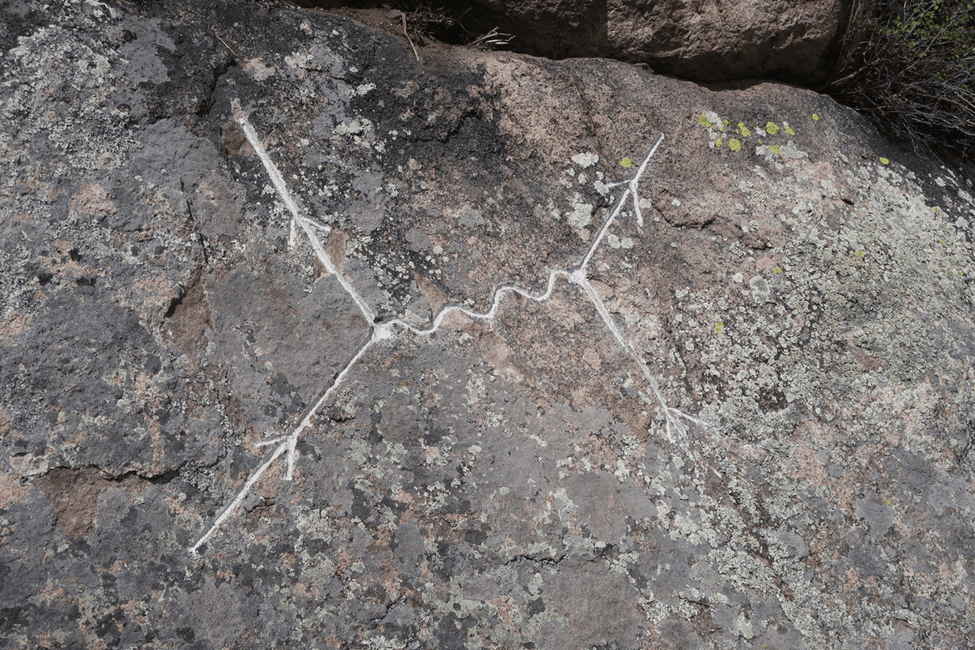
Source: Atlas Obscura's lovely atlas to this location,
There is a large, flat rock set into the gentle rise of a hill in a strange land called Tannu Tuva. Someone has carved a symbol into its face like some kind of ancient rune. But it is not an ancient rune. It was drawn there just this year by a man called Ralph Leighton. Likewise, Tannu Tuva is not some place out of fantasy. It is a Russian state that today is called the Tuvan Republic.
Those are the facts, anyway, but none of them is true. Not really.
In every way that matters, the stylized engraving of fermion scattering you see above, a famous illustration from the field of quantum electrodynamics called a Feynman Diagram, is an ancient rune. Even carved just months ago, it is at once both a mechanism for lucid communication and an esoteric symbol of one of the most mystical features of our natural world. Tannu Tuva, too, was and is a very real place. Yet it is also very much a place out of a fantasy, a conscious representation by a small group of scientists to the power of leaving the door to the unknown ajar, to the adventure of discovery, and to the commitment to overcoming barriers thought to be impossible.
You’ve heard of the man who first drew that diagram. You may have read much of his story. His name was Richard Feynman, and he is a genius. Or at least, he was until his death, 30 years ago last February.
Mathematician Mark Kac was also a genius. A Polish mathematician, Kac worked with Feynman at Cornell in the 1940s after Feynman left the Manhattan Project. Kac had arrived in New York after finishing his studies in Lwów in 1937. It was a near thing. His parents and his brother were murdered by Nazis in Krzemieniec in 1942. Each of Kac and Feynman pursued his own genius, Richard in theoretical physics and Mark in mathematics. But their mutual respect led to a significant joint achievement: The Feynman-Kac Formula
The Feynman-Kac Formula may not be familiar to you. Among other things, it allows for some stochastic problems to be solved using a deterministic framework. In other words, it allows us to use formulas to solve a certain class of problems that would otherwise require us to simulate the system to reach a result. While it can’t be used, lamentably, to solve a Three-Body Problem, it is the kind of mathematical approach that permits us to solve some similar problems without resorting to number crunching on iterative calculations and simulations.
If you work in finance, have studied for the CFA or went to business school, you have probably unwittingly used the Feynman-Kac Formula in what investors consider to be an important partial differential equation: pricing a stock option. Yes, by far the most famous application of the joint work of this mathematics wizard and physics genius is the Black-Scholes formula. Something tells me that being used primarily as a memorization test by second-year banking analysts to intimidate college seniors in Goldman Sachs interviews was not the fate Richard and Mark might have had in mind for their achievement. Their collaboration is still intriguing, not least because it gave us Kac’s description of what it was that made Richard Feynman so unusual.
In science, as well as in other fields of human endeavor, there are two kinds of geniuses: the “ordinary” and the “magicians.” An ordinary genius is a fellow that you and I would be just as good as, if we were only many times better. There is no mystery as to how his mind works. Once we understand what he has done, we feel certain that we, too, could have done it. It is different with the magicians. They are, to use mathematical jargon, in the orthogonal complement of where we are and the working of their minds is for all intents and purposes incomprehensible. Even after we understand what they have done, the process by which they have done it is completely dark. They seldom, if ever, have students because they cannot be emulated and it must be terribly frustrating for a brilliant young mind to cope with the mysterious ways in which the magician’s mind works. Richard Feynman is a magician of the highest caliber.
Enigmas of Chance: An Autobiography, by Mark Kac (1985)
Kac’s characterization of Feynman as the magician kind of genius is consistent with the observations made about Feynman by many others. Oppenheimer commented specifically on his unparalleled and unique relationship with both the theoretical and experimental physicists on the Manhattan Project, for example. Al Seckel’s stories about Feynman famously included references to his interactions with Stephen Hawking. In one such story, Feynman dismissed Hawking’s ability to perform path integration in his head, since it was “much more interesting to come up with the technique like I did.” Creativity, not technical mechanics, was the secret to Feynman’s genius. His genius was a difference in kind, not in magnitude.
Another Feynman peer and contemporary during his years at Caltech was a physicist (and genius) named Murray Gell-Mann. He is most famous for his Nobel Prize-winning role in the development of our understanding of elementary particles. He is also famous, especially in our little publication, for his role in describing Gell-Mann Amnesia. Popularized by Michael Crichton, of all people, Gell-Mann Amnesia describes our ability to read with disbelief the poor quality of conclusions in a newspaper or magazine story about a topic we know very well, after which we turn the page to take in reports on other fields of expertise and nod along happily.
Gell-Mann had a productive but challenging relationship with Feynman. As a charming read published by the Atlantic in 2000 put it: “Dick and Murray, as everyone soon called them, became inseparable. Strolling Caltech’s immaculately landscaped campus or dueling at the chalkboard over some calculations, the two scientists discussed physics for hours.” But the two were often at odds in matters of style and personality. They also approached the conventions of science – when you write up your findings, how early in your process you publicize your theories, how you publish – so differently that their partnership may have fallen short of what it could have been. At the least, it fell short of what many hoped. Gell-Mann, at once both confounded by Feynman’s form of genius and irritated by what he perceived as affectations of false-humility, playfully described Richard’s approach to science:
You write down the problem.
You think very hard.
Then you write down the answer.
It was a joke, and best told, as it was originally to Sidney Coleman and then to James Gleick in Genius: The Life and Science of Richard Feynman, with closed eyes and knuckles pressed to forehead, pretending to think very hard.
And yet.
There is a simple truth in this logical process that is faithful to, if obviously a comically oversimplified version of, what science means. It also happens to be the process whereby human ingenuity is transformed into tangible output in almost every other technical and social field. The technical prowess of ordinary geniuses in Kac’s terminology, and the act of thinking very hard in Gell-Mann’s, are important to any science. They are necessary conditions for science to have really found out anything. Necessary but insufficient. The transmission mechanism which begins with our world and the people in it, and ends with some tangible or intellectual product that influences that world, requires two more things:
Someone to write down the problem.
Someone to write down the answer.
These are roles that exist not only in physics, medicine, mathematics and other natural sciences or practical derivations thereof, but in any field which relies upon the discovery of truths about the world, predictions about the implications of those truths, and the evaluation of the credibility of those predictions. By right, that ought to (and does) include the social sciences - political science, economics, sociology, anthropology, language and history. It also includes the critical field of journalism, and yes, the business of investing and capital management.
When Kac spoke of Feynman as a magician, he was speaking in large part of his creative capacity to visualize problems in a different way. Much of Feynman’s reputation was built on his Nobel Prize-winning work with Tomonaga and Schwinger on quantum electrodynamics, but even more was built on Feynman’s illustrations that framed the analysis of those dynamics. He had a picture in his mind of what was happening in nature, and he constructed a language which not only helped to communicate those details, but which itself served to prod the discovery of the mathematics to describe it. A lifelong scientist whose conscious dabbling in visual art and music took place too late to amount to much beyond personal pleasure, Feynman’s greatest work was nonetheless a heavily symbolic creation of both art and language.
Yes. Feynman was a magician of the highest caliber.
The magician’s role - to be able to conceive the right questions to ask and right ways to ask them – is critical to every science, to investing and to journalism. It is also innately subjective. The reasons should be intuitive. We research what we think is important, what we think is interesting, and perhaps most importantly, what we think will pay the bills. The result is perilous for even the most well-meaning researcher. From the very beginning of each process of writing down our questions, our work is saddled with bias. The questions we ask, the stories we assign, the avenues of research we pursue and the investments we elect to evaluate are all heavily influenced by both external directives and our own judgments based on internal priors.
At each other stage of the research process – from analysis to interpretation – temptation is everpresent. We will naturally be more inclined to test theories which, if proven, fit with our other theories. We will naturally be more inclined to believe results which support a theory we favor. We will more easily see disqualifying flaws in data which do not support our theories, beliefs or priors. We will be tempted to inject non-falsifiable judgments and opinions we feel confident are self-evident into the gap between our findings and their implications.
We can never wholly avoid the injection of bias into our research. We can only adopt processes which seek to ruthlessly rip it out by root and stem.
When we, our colleagues and our peers are hell-bent on the falsification of every idea spawned by the questions we pose, and on expunging underdetermined explanations for some fact or theory about the world, we slowly erode the influence of that bias. What remains from that process is science. The true scientist, whether he be journalist, investor, physicist, mathematician or sociologist, does not stop research and challenge when he calculates a feature of some thing that is adequately explanatory. He stops when he and all the resources around him that can be marshaled can find no other way to destroy his idea.
When the scientist, journalist or investor does not aggressively seek out the falsification of his ideas and the questions which led to them, a strange thing happens: The magician becomes a missionary for his priors. What remains from his process is not science. What remains are facts tenuously grafted onto a premise he rather fancied. What remains is scientism - the meme of science!
It is for this reason, I think, that Feynman’s most unique trait may be his commitment to the absolute scientific necessity of doubt. No simple Pollyannaish visionary charmed by the magic of discovery, Feynman was also a missionary of another variety. In his case, however, his mission was to promote the vitality of doubt. Richard was talking about scientism and the meme of science! before almost anyone. He called it “cargo cult science.”
There is one feature I notice that is generally missing in cargo cult science. … It's a kind of scientific integrity, a principle of scientific thought that corresponds to a kind of utter honesty — a kind of leaning over backwards. For example, if you're doing an experiment, you should report everything that you think might make it invalid — not only what you think is right about it; other causes that could possibly explain your results; and things you thought of that you've eliminated by some other experiment, and how they worked — to make sure the other fellow can tell they have been eliminated.
Details that could throw doubt on your interpretation must be given, if you know them. You must do the best you can — if you know anything at all wrong, or possibly wrong — to explain it. If you make a theory, for example, and advertise it, or put it out, then you must also put down all the facts that disagree with it, as well as those that agree with it. There is also a more subtle problem. When you have put a lot of ideas together to make an elaborate theory, you want to make sure, when explaining what it fits, that those things it fits are not just the things that gave you the idea for the theory; but that the finished theory makes something else come out right, in addition. In summary, the idea is to try to give all of the information to help others to judge the value of your contribution; not just the information that leads to judgement in one particular direction or another.
Surely You're Joking, Mr. Feynman (1985)
In a world awash with narrative, it is precious and rare to know that a thing is what we say it is and not a glorified reflection of our priors and predispositions. It is even more rare, however, to come upon a process for taking in information as an investor or citizen that is capable of achieving that standard. Most investment processes – even many systematic strategies – are utterly incapable of achieving it. Most journalistic standards fall well short, too. Even many of our sciences, you will be unsurprised to discover, have empowered a great many shoddy analyses to exist through a combination of indifference and a lack of scientific integrity.
Over the next three editions of this Notes from the Road series, I will draw a map of how I think we can sharpen our awareness of the science! meme at work. I will explore our engagement as investors, consumers of news and evaluators of findings from the natural and social sciences. I will also draw a map of how we can do better as primary actors in our own research processes. Because I think that that Richard would find some delight in a dead serious treatment of Murray Gell-Mann’s tongue-in-cheek description of the Feynman Method, that will be our model. Three notes to follow this one, each discussing the ways in which the science! meme creeps into each phase of an otherwise legitimate fact-finding undertaking – in the questions we ask, the analysis we undertake, and the stories we tell about it.
The next note, Part 2, will examine how what questions we ask and how we ask them influence the quality and direction of underexamined research in multiple fields. This will be the start on our Road to Tannu Tuva. But it is important that you know it isn’t just a road of rigor.
“Okay, then what ever happened to Tannu Tuva?”
“Tannu what?” I said. “I never heard of it.”
“When I was a kid,” Richard continued, “I used to collect stamps. There were some wonderful triangular and diamond-shaped stamps that came from a place called ‘Tannu Tuva.’ ”
… I straightened up in my chair a bit and said, “Sir, there is no such country.’
“Sure there is,” said Richard. “In the 1930s it was a purple splotch on the map near Outer Mongolia, and I’ve never heard anything about it ever since.”
Had I stopped and thought a moment, I would have realized that Richard’s favorite trick was to say something unbelievable that turns out to be true. Instead, I tightened the noose that had just been placed around my neck: “The only countries near Outer Mongolia are China and the Soviet Union, I said, boldly. “I can show you on the map.”
We opened…a map of Asia.
“See?” I said. “There’s nothing here but the USSR, Mongolia, and China. This ‘Tannu Tuva’ must have been somewhere else.”
“Oh, look!” said Carl. “Tuvinskaya ASSR. It’s bordered on the south by the Tannu-Ola Mountains.”
Sure enough, occupying a notch northwest of Mongolia was a territory that could well once have had the name Tannu Tuva. I thought, I’ve been had by a stamp collector again!
“Look at this,” remarked Richard. “The capital is spelled K-Y-Z-Y-L.”
“That’s crazy,” I said. “There’s not a legitimate vowel anywhere!”
“We must go there”, said Gweneth
“Yeah!” exclaimed Richard. “A place that’s spelled K-Y-Z-Y-L has just got to be interesting!”
Tuva or Bust! Richard Feynman's Last Journey, by Ralph Leighton
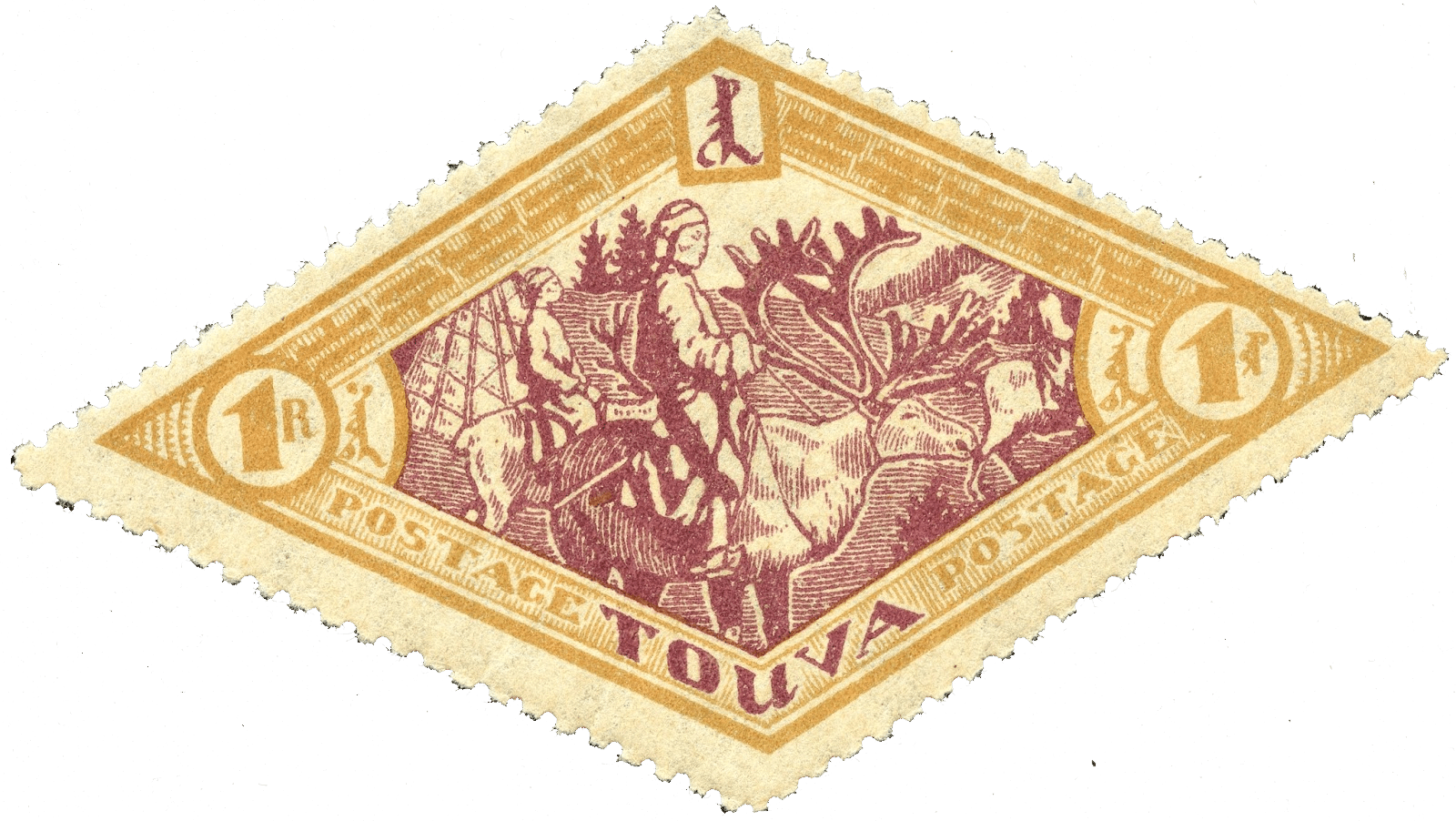
The Road to Tannu Tuva is the realization that the rigor of doubt and uncertainty on the one hand, and the joy of discovery on the other, need not be strangers. Far more than that, it is the realization that they are and ought to be considered one and the same.
Although truth be told, around these parts we have a different expression for this idea:
Clear Eyes. Full Hearts.