Until Further Notice
Rusty Guinn
March 31, 2020·Money

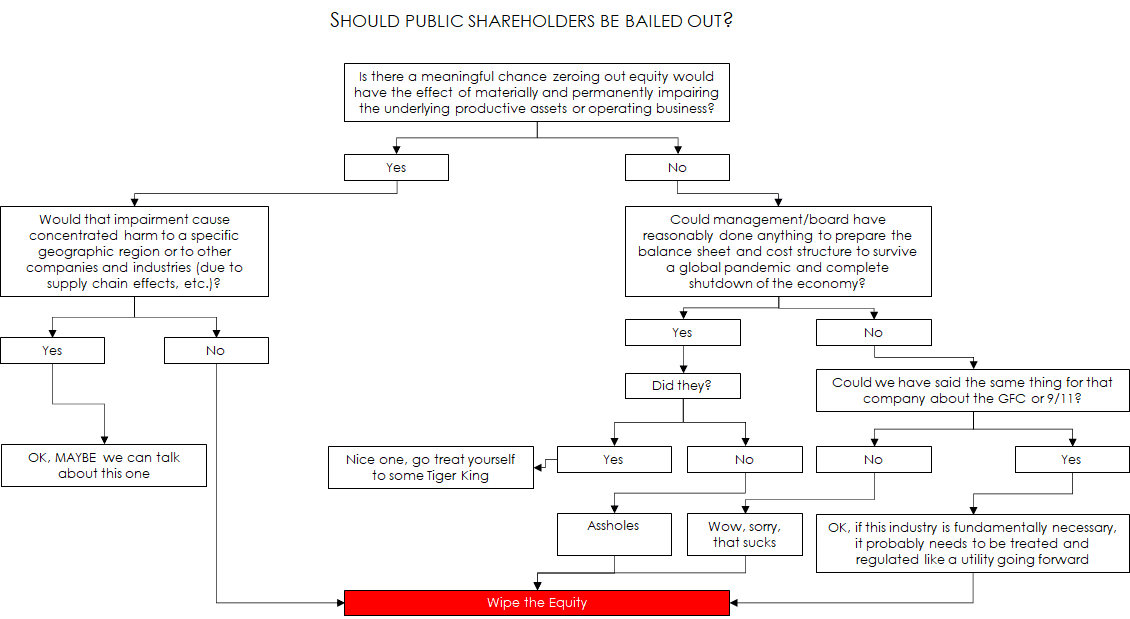
Since last week, we have received a number of requests to amplify our views on certain provisions of the CARES Act. Rather than opine on individual public shareholder bailouts likely to be executed under this act and its likely successor bills in 2020, we determined it would be easier to provide an easy-to-follow decision chart that will tell you in advance what our opinion will be.
Thank you for your understanding.
Money
ET Note
Money

Comments
This is handy. Do you have any go-to examples (today or projected) for some of these. Would be cool to see a visual or list w/ companies at the 5 end points: Can Talk / Nice One / Assholes / That Sucks / Utility.
Ah Rusty, exquisite in it’s simplicity. In my opinion, some of your best work so far!
It would be great if something like this was actually possible, but my question to you is “Who will actually need a bailout with PMCCF and SMCCF riding to the rescue?” I can’t find any covenants on the Fed’s website for these programs, no restrictions on buybacks or dividends except during an optional 6-month forbearance period. No reporting requirements, no public debate or worries about a public relations nightmare, in fact FOIA has been suspended. These SPVs are entirely opaque in a way that would make Kenneth Lay, Jeffrey Skilling and Andrew Fastow blush.
As far as companies that would not qualify under these programs because they’re below investment grade, I expect the Fed to create a new vehicle for these the next time JNK or HYG take a material hit. And with BlackRock in charge of program administration, I’m sure HYG (and all FOBR or Friends of BlackRock) will be fine. Couple that with ratings agencies that are well behind the curve with respect to properly reflecting risk in the corporate credit market, and likely under significant pressure to do no further downgrades, and I think the Fed can backstop any listed company to the extent that they would never want or need a (public) bailout. Am I missing something?
I was millennial age witnessing the Resolution Trust Corp from the S&L cleanup. Sure folks were concerned that certain bidders would get too good a deal, leaving the taxpayers with something less than optimal proceeds for the risk. But at least the business/asset was in new hands. The old management had already blown it and IMO giving them a do over at taxpayer expense is worse than giving new management a shot at a windfall. Besides, today’s old management already harvested their windfall in the form of stock awards. Wouldn’t it be a tell if those execs had to spend those windfalls to get their old “jobs” back. My preference would be be if some super smart and motivated millennials buy a cast off for next to nothing and turn it into a MBA case study for all time.
You have my vote for Bailout Tzar!
The way all roads lead to the same conclusion is quite elegant and certainly is appropriate. Count me appreciative.
Well done Rusty. Now where is the Narrative Structure on this one ?
The details of the PPP Loan program (administered via the SBA) appear to be finalized. The banks issuing the 2 year loans (for which they bear zero default risk, as it is 100% guaranteed by the government) are getting 1% annual interest (revised up from the original 0.5% after the banks complained) plus loan processing fees (paid for by the government) of at least $3.5BB.
Given the headlines/articles i’ve seen written and specifically the amount of airtime the Apollo’s of the world are getting Re: needing a backstop for HYG, feels like this HAS to be coming. Question is how long will it take them to implement and when to get long HYG/JNK. Next pull back?
Didn’t take long at all, did it?
Continue the discussion at the Epsilon Theory Forum...