
Wage Growth, Groucho Marx Edition
May 7, 2019·Money
This is an ET Professional note, and for the next few days we're making it available to everyone to review.
Every week, ET Pro subscribers get something like this - an original piece of research and analysis with a perspective that you can't find anywhere else.
Every month, ET Pro subscribers get updated narrative data and analysis on five core market risk monitors - Inflation, Central Bank Omnipotence, Trade & Tariffs, US Fiscal Policy, and Credit Cycle.
We’ve had what I think are some important breakthroughs on how to apply natural language processing (NLP) to investment research, and we think it’s something that every portfolio allocation, wealth management and active investment team can find useful, particularly for risk management.
ET Pro is the only place we provide direct access to our research.
The ET Pro service is $2,950/yr, with a 30-day full refund trial period, and we’re happy to work through a soft dollar provider. Any remaining time on an ET Premium subscription will be applied as an upgrade. We’ve designed ET Pro to be used by investment teams, allowing up to three simultaneous log-ins with the same credentials, and of course we’re happy to discuss more specific research applications and how you might incorporate them into your current investment or allocation processes.
You can see the ET Pro homepage here, and you can find more information on an ET Pro subscription here. Questions? Email us at info@epsilontheory.com.
Wage Growth, Groucho Marx Edition

The Secret of life is honesty and fair dealing. If you can fake that you've got it made.
These are my principles, and if you don't like them ... well, I've got others.
I'm not crazy about reality, but it's still the only place to get a decent meal.
A child of five could understand this. Send me someone to fetch a child of five.
Last March, I wrote a long note on the cartoon that labor statistics present, called The Icarus Moment. To set the scene:
Once you start looking for these cartoons, you will see them EVERYWHERE.
It’s not a Karl Marx world of alienation. It’s a Groucho Marx world of alienation.
The cartoon of our monthly theater regarding labor statistics, particularly wage growth, rests in the fact that they are reported as hourly wages. Even though the majority of wages in 2019 America are paid biweekly against an annual salary, the Bureau of Labor Statistics (BLS) reports ALL of our wages as if they were paid hourly. Why? Because in 1915 America, when the theater of labor statistics began, this was how most people got paid. Even today, the abstracted idea of hourly wages connects with people more effectively than the abstracted idea of weekly wages. Put that together with bureaucratic inertia, and that’s why this cartoon exists.
But here’s the problem with the hourly wage abstraction. It requires introducing a new data estimation into the mix, one that has nothing (or at least very little) to do with the real-world concept we’re trying to represent, which is whether you’re taking home more money today than you did this time last year. That additional layer of abstraction is the average length of the work week.
The root data collected by the BLS consists of the weekly wages paid by US businesses to their employees. That number is then divided by the total number of people being paid, and the result is the average weekly wage for Americans. Here is that abstracted data for the past 7+ years.
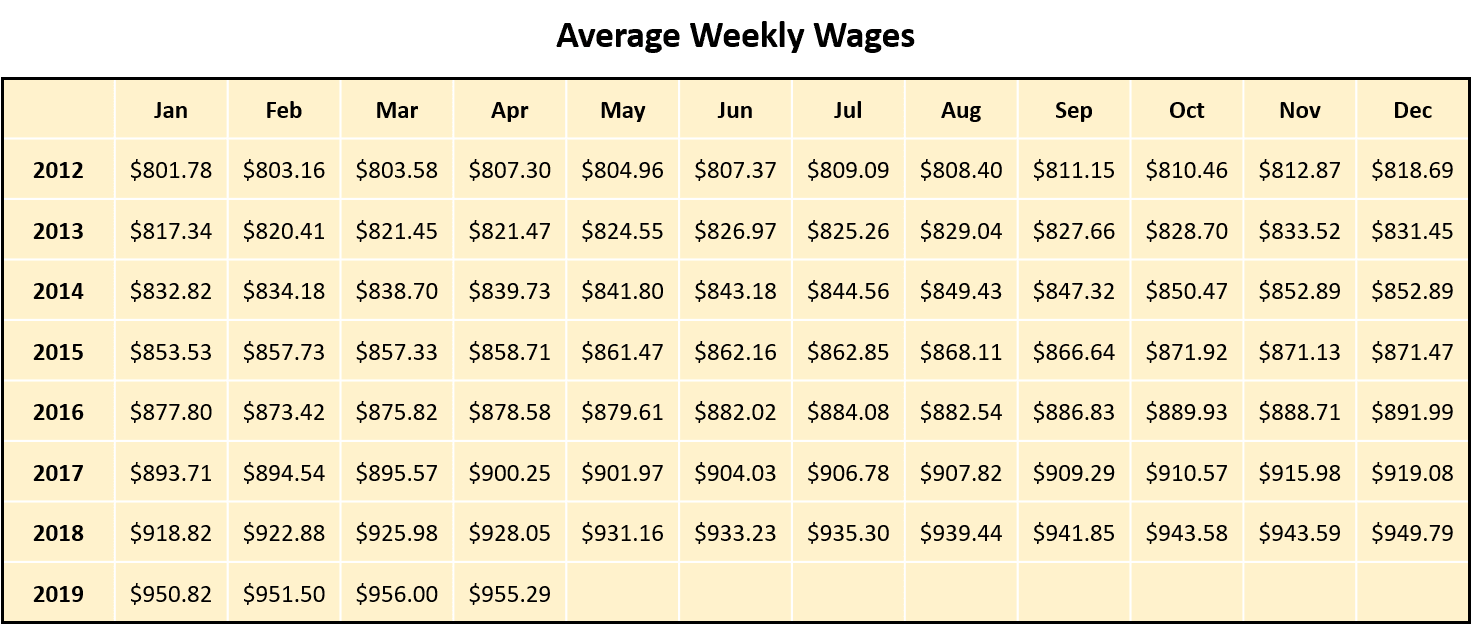
source: Bureau of Labor Statistics
But instead of reporting the annual percentage change on a month-to-month basis, the BLS also calculates the “average work week” so that they can maintain the cartoon of hourly rather than weekly wage reporting. Here is that abstracted data.
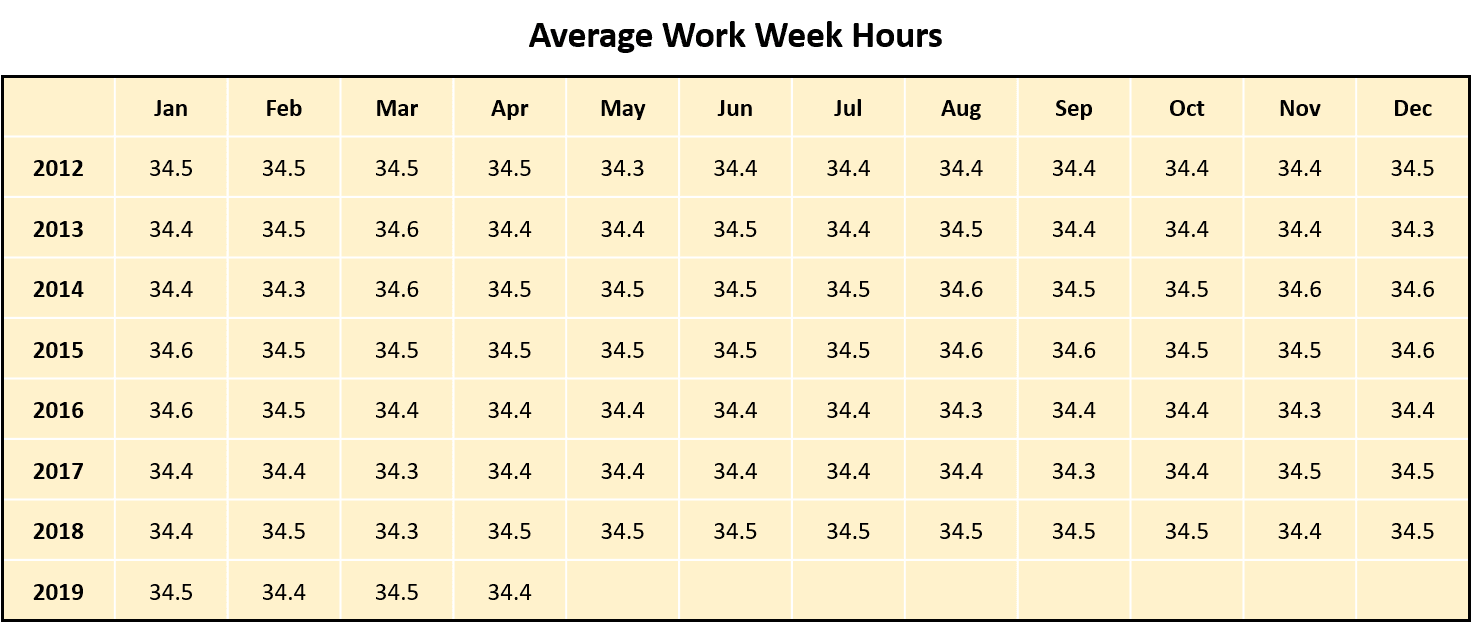
source: Bureau of Labor Statistics
For the past 7+ years, the average work week has averaged 34.45 hours, with a range from 34.3 hours to 34.6 hours. That’s 2,067 minutes, ranging from 2,058 minutes to 2,076 minutes. Here’s a graph of that.
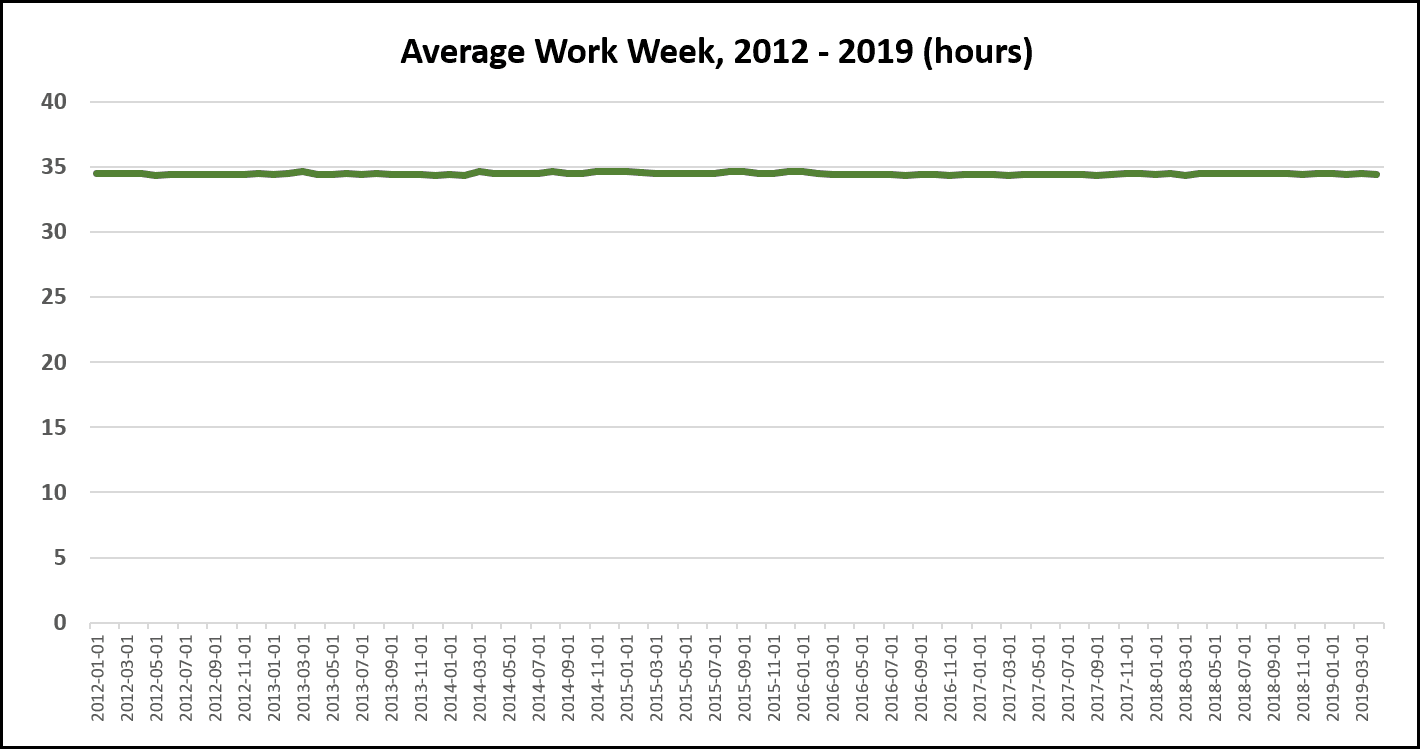
source: Bureau of Labor Statistics, Epsilon Theory
This is not a variable. This is a constant.
From a statistical perspective, given the inherent errors of measurement, any month-to-month difference of 6 minutes here or 6 minutes there is a totally random event.
Measured changes in the average work week are not real.
And yet they have very real effects on the narrative.
Here’s the year-over-year wage growth data from the singly-abstracted measure of weekly wages:
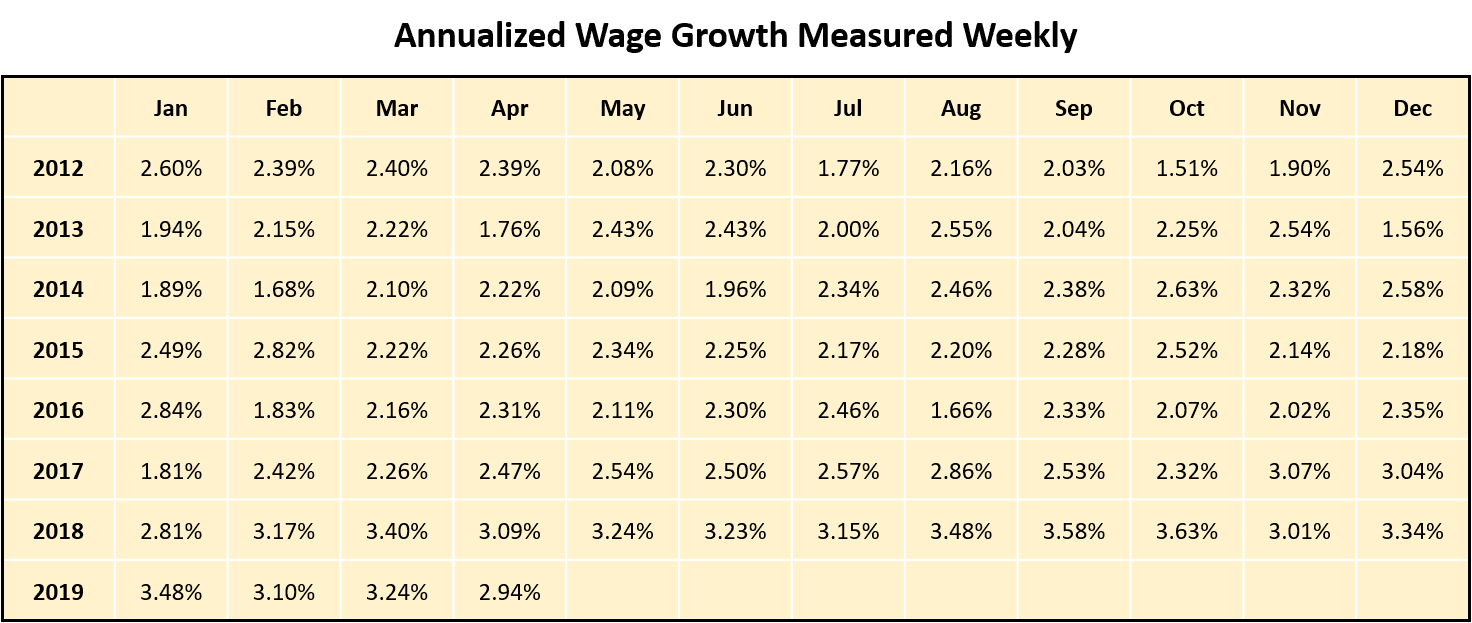
source: Bureau of Labor Statistics
These are the “true” results, or at least the most basic abstraction of what we're after.
And now here’s the year-over-year wage growth data from the doubly-abstracted measure of hourly wages:
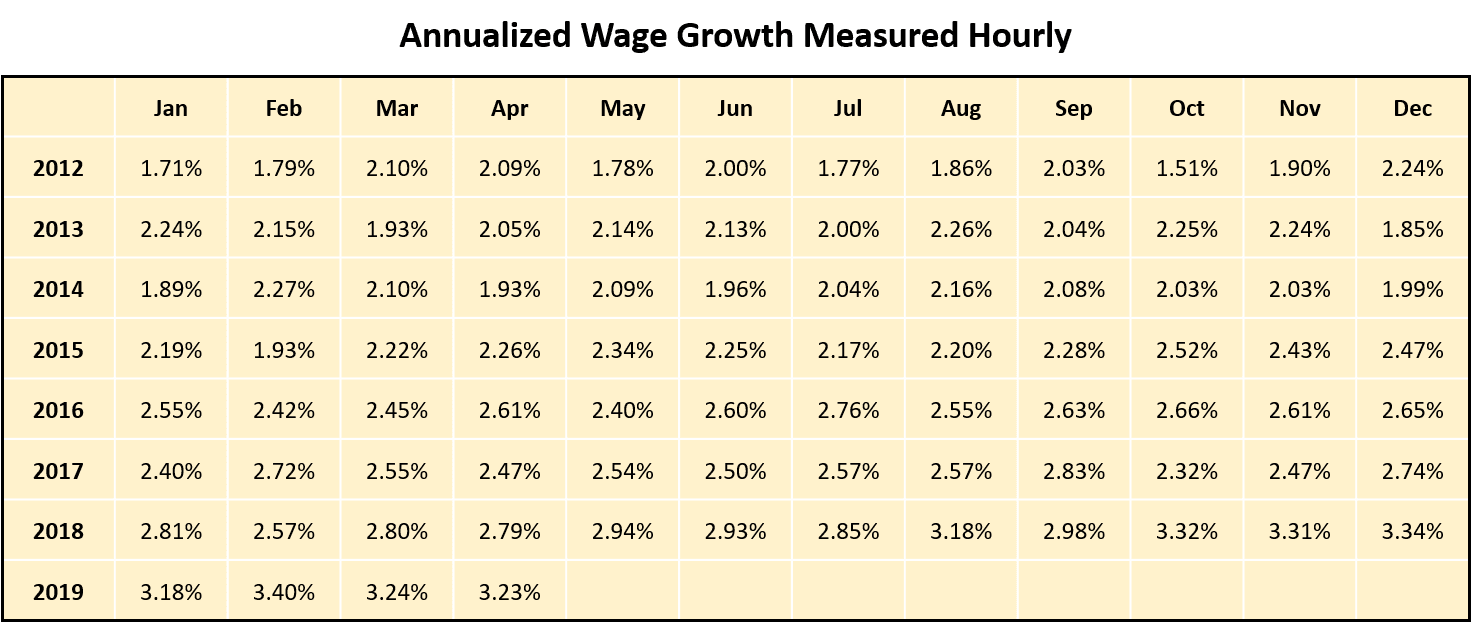
source: Bureau of Labor Statistics
These are the results that are reported to us and create the political and investment narrative.
And now here’s the difference in the two data series, with weekly wage increases subtracted from hourly wage increases. The numbers here are how much the reported wage growth result overstates or understates the actual wage growth result.
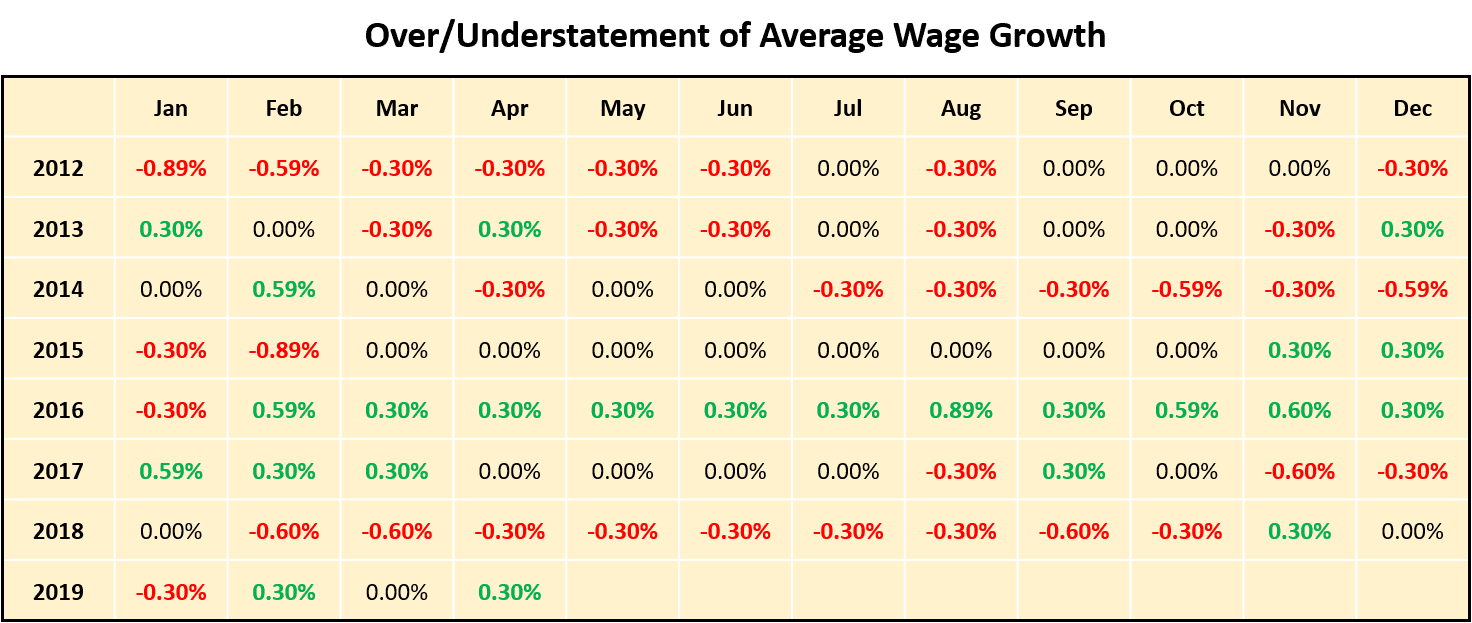
source: Bureau of Labor Statistics, Epsilon Theory
In 2016, reported wage growth massively overstated actual wage growth. Wage stagnation going into the 2016 election was actually much worse than you were told. Did this make a difference in the Midwestern states that swung the election, in that actual labor conditions were worse than everyone thought they were? I think yes.
In 2018, reported wage growth massively understated actual wage growth. Wage growth all last year was actually much better than you were told. Did this make a difference in the current Fed/Wall Street/White House narrative that inflation is dead and the easy money punchbowl can be maintained without consequence? I think yes.
What does all this mean for our investments? Here’s the money quote from The Icarus Moment:
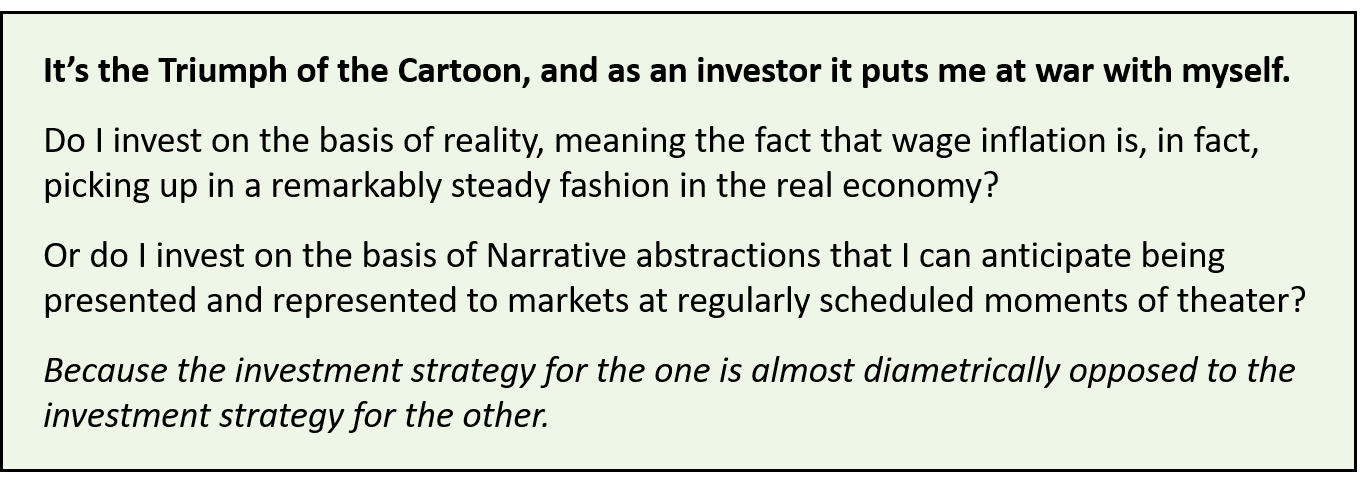
Honestly, I still don’t have a good answer to this question.
Do I invest on the basis of what I can see happening in real-world or do I invest on the basis of what I can see happening in narrative-world?
Ultimately, I STILL think that real-world wins out.
But the path for that … the timing of that … it’s utterly narrative dependent.
Groucho would understand.