Wall Street's Merry Pranks: Things that Matter #4
December 12, 2017·Money

Lisa Simpson: Get out! Get out!
Bart Simpson: OK! But on my way, I’m going to be doing this. <Closes eyes and begins swinging arms, windmill style> And if you get hit, it’s your own fault!
Lisa: OK, then I’m gonna start kicking air like this. <Closes eyes and starts kicking at random> And if any part of you should fill that air, it’s your own fault.
<Bart and Lisa begin screaming>
Marge Simpson: Hmm. I better go check that out. Now Homer…don’t. You. Eat. This. Pie!
Homer Simpson: Okaaaay. Alright pie, I’m just going to do this. <Makes chomping motion> And if you get eaten, it’s your own fault!
The Simpsons, Season 6, Episode 8 “Lisa on Ice”
So much of the nudging from our smiley-faced authoritarian overlords on Wall Street sounds like it is coming from a mid-windmill Bart Simpson. I’m going to give you low-cost tools. I’m going to create ways to encourage you to trade them (frequently) at close to no cost (that you can see, anyway). And if you happen to trade so much that you create short-term gains everywhere, if you end up with an underdiversified portfolio that blows up, if you end up selling at the bottom and holding cash through half of the recovery…well… it’s your own fault.
Verbal: Who is Keyzer Söze? He is supposed to be Turkish. Some say his father was German. Nobody believed he was real. Nobody ever saw him or knew anybody that ever worked directly for him, but to hear Kobayashi tell it, anybody could have worked for Soze. You never knew. That was his power. The greatest trick the Devil ever pulled was convincing the world he didn’t exist. One story the guys told me — the story I believe — was from his days in Turkey. There was a petty gang of Hungarians that wanted their own mob. They realized that to be in power you didn’t need guns or money or even numbers. You just needed the will to do what the other guy wouldn’t. After a while they come to power.
The Usual Suspects (1995)
I originally intended to include nothing but Spacey quotes that feel much creepier and weirder than they did six months ago. I decided against it but had to keep the classic Söze line.
Why? Because the greatest trick any nudger, any libertarian paternalist ever pulls is always to convince the world they don’t exist. Their new business model, their new sales pitch, is all about the customer. They are just conveying it to you, and it’s really your decision whether you’re going to take advantage of it. But don’t mistake value for virtue — the magic of free markets is that they empower value-seeking behaviors to generate societally virtuous outcomes. The low-cost investing revolution and its sister — the movement to empower individual investors — has been a generational boon for investors. They created immense value. But never forget that this is a business and that these products are created by profit maximizers, not virtue maximizers. When we see branding and advertising that convey psychic or moral value from do-it-yourself and low-cost investing, we must know that we’re being nudged toward other less virtuous, riskier behaviors.
Well, when all the people arrived in church, Eulenspiegel mounted the pulpit, said something from the Old Testament, tossed in the New as well, with Noah’s Ark and the Golden Bucket, in which the bread of Heaven Lay — and said, moreover, that all this stuff was the greatest holiness. Then at the same time he began to speak of the head of Saint Brendan, who had been a holy man. He had Brendan’s head right there — and it had been commanded of him that he use it to collect for the building of a new church, and to do so with purest goodness, never (on pain of death) accepting any offerings from any woman who might be an adulteress.
“And whoever here may be such women, let them stand back. For if they offer me something — those who are guilty of adultery — I won’t take it, and they will be revealed in shame unto me! So — know yourselves!”
Till Eulenspiegel: His Adventures, No. 31, Paul Oppenheimer (Editor/Translator)
The Söze-style penchant for creating havoc and disappearing into the background — and avoiding responsibility — is hardly new. It’s straight out of the playbook for the Trickster that exists within every major mythology. Till Eulenspiegel, a late middle ages version, is well known to Germans but almost completely unknown in America, which is a shame. This story is the best example I know of a trickster’s need to adapt his schemes to be more palatable when the world gets wise to him. Sound like any industries you know?
Some people always knew they wanted to be investors. They read Barron’s as a teenager and had their parents create an account for them to buy and sell stocks when they were 13.
Not me.
I wanted to be a composer. I would have settled for being an operatic tenor. If I couldn’t do that, I’d be willing to try my hand at being a musician in an orchestra. Short of that, I’d settle for being a drummer in a rock band. I supposed, if I couldn’t do any of those things, finance might be interesting enough. When I started the process of looking at universities, I considered pursuing each of these five things. I ultimately concluded that, if I were good enough at any of the first four, it wouldn’t matter if I had a degree saying that I was. So I studied finance. It’s a good thing, too, because it turns out I wasn’t nearly good enough at any of the others. I auditioned with some regional orchestras and opera companies, and got enough alternate work to pay for food and rent in college. It never would have gone any further than that.
Now, orchestral auditions are especially funny. These days, you’re called into the room and you sit in front of a screen. You are asked to play excerpts from the standard repertoire. I was a hornist. The horn is among the most versatile instruments, and so the point of the audition is to demonstrate your ability to perform all the things the horn is called upon to do. You need to display technical prowess, and so they ask you to play the famous horn call from Richard Wagner’s "Siegfried". You need to display facility throughout the range of the instrument, so you are called to play the opening from "Ein Heldenleben", by Richard Strauss. You must have a capacity for lyricism, for which you are asked to play the solo theme from the Poco Allegretto movement of Brahms' Third Symphony, which has been shamelessly stolen by everyone from Sinatra to a weird and creepy Santana-Dave Matthews duo. Then they ask you to show you can do all of those things at once by playing the corno obbligato solo from Mahler’s Symphony No. 5.
But there’s one piece that shows up every time, even though it doesn’t get played by orchestras too terribly often: Till Eulenspiegel’s Merry Pranks. It’s another Strauss tone poem, and it is the Tower of Babel to every richly scored Merrie Melodies and Looney Tunes cartoon. Seriously, listen to the whole piece with your eyes closed, and your mind will fill in just where Bugs Bunny tricks Elmer Fudd into shooting his shotgun into a rabbit hole that sends it back through a funnel into Fudd’s face. The piece itself is a musical imagining of Germany’s version of the classic trickster character. Of course, it’s Germany, so the pranks are pretty dark, and most are scatological. As with many such stories, however, they also effectively highlight some of the absurdities of language and human behavior.
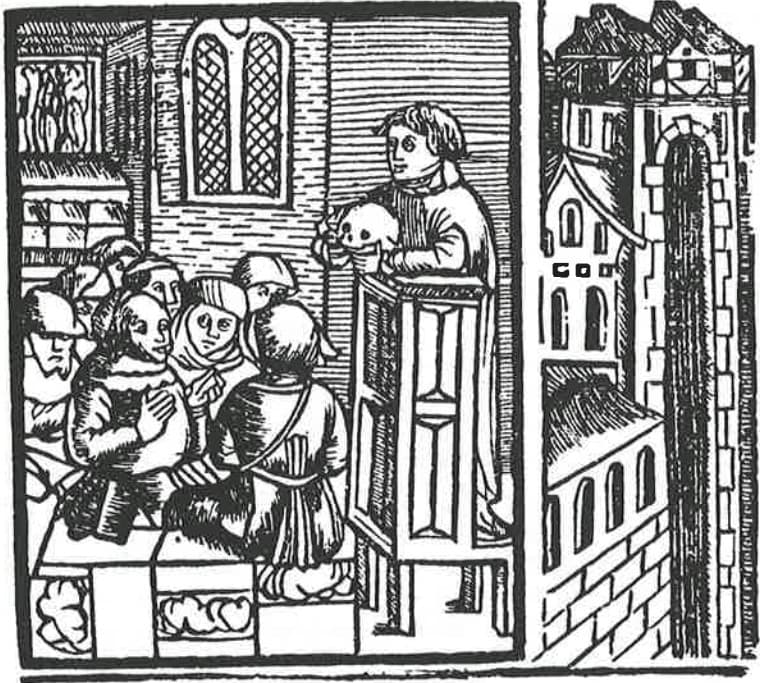
My favorite Till Eulenspiegel tale is the 31st of those that may have been assembled by Hermann Bote in the late 15th century. Paul Oppenheimer at CCNY did a lovely and sadly underbought translation, if you’re looking for an off-the-beaten-path and entirely inappropriate bedtime storybook. In this story, Eulenspiegel has become a bit too well-known to play his usual characters. A sort of Sacha Baron Cohen of the German late middle ages, if you will. He needs to find a new way to make money, and so he decides to pass himself off as a dealer in religious relics. He takes on a priest’s cassock and goes from town to town in Pomerania with a certain scam in mind. After procuring a skull from a graveyard, he inlays it with silver and asks the local priests — who are, naturally, universally corrupt and drunk — to allow him to raise money to build a new church in honor of the saint whose skull he carried. Which is, of course, just the remains of some dead blacksmith, but no matter. There is, however, a catch: our heroic church-building protector of holy relics is sworn never to accept donations from any woman who has ever committed adultery, and he will know if they are lying.
So who comes up to kiss the skull and drop some money in the pan?
Every woman in the church, of course. As soon as the first pious busybody makes her way up to demonstrate her faithfulness and purity (and to wait for the fireworks from her more libidinous sisters), all the other faithful wives don’t really have a choice. If she is going to go up there, then it’s not like they can avoid giving to the cause and proclaiming their virtue. Now, the guilty ones, their decision is a bit more complicated. Their bet is either that Eulenspiegel is a fraud or that he’s not. The alternative, not going up, results in the same outcome for them: being outed as an adulteress. So, for them, too, the best strategy is to kiss the skull and drop a coin or two in the basket. They were doomed to this roll of the dice as soon as the first woman walked to the front.
With every adulteress who comes to this conclusion, it’s easier for all the rest, because it’s more likely they’ve seen someone they know or suspect to be guilty come away blameless. At a certain point, despite Eulenspiegel’s bold words celebrating the holiness of their parish, most people have gotten wise. But who cares? We like the eggs. It’s a useful exercise for everyone. Eulenspiegel and the priest get paid. The pious confirm their piety. The guilty get a bit of public absolution, and even more license to continue their sin.
OK, great, so what does this have to do with finance, markets and politics? Well, "Till Eulenspiegel’s" is a story of those who would deceive us by exploiting our need to appear virtuous and good. It’s a story of the good among us proclaiming virtue and forcing the hands of others to proclaim it as well (whether they are virtuous or not). And when the non-virtuous join in the proclamations, it is a story of how they lean on their newly-found virtue to get themselves into some real trouble. Of course, by that time, Till Eulenspiegel has already gone full Keyzer Söze. He never even existed.
What virtue are we called upon to signal in finance, then? Well, is there any investing behavior more widely pursued, more universally lauded than low-cost, passive investing? Is there any trait more prized than empowerment of the individual investor to use those tools to take his investments into his own hands? When the industry comes to us, silver skull in hand and asking us to pledge ourselves to these virtues, most of us do so willingly. After all, we recognize that stock-picking is usually a waste of time. We recognize that spending a bunch of time fussing about which fund manager to pick is usually a waste of time. And we don’t like to pay fees that don’t buy us anything.
This pound-the-table religion about active vs. passive management is all well and good for those of us in the business, who mostly live and breathe the Things that Matter. But for a universe of individual investors (and rather distressingly, probably some institutional investors, too), the message of empowerment is anything but. It’s a nudge into terrible portfolios, terrible costs and terrible outcomes. But hey, at least they got religion and implemented those terrible, far-too-actively-traded portfolios with ETFs! I recognize that this is an odd way to start a note that’s going to be about the importance of costs in investing. And that really is what this note is about. It’s an especially odd way to start a note that’s going to characterize those costs as one of the big Things that Matter in investing. But while we walk through just how indispensable low-cost investment tools must be to any modern portfolio, what I really want to emphasize is that the order of this Code was not an accident. By and large, the decisions you make about risk, diversification and behavior are all going to impact your portfolio more than the expenses you are paying on funds or to your financial advisor.
Perhaps more controversially, I also want to observe that even among costs, those direct expenses will often fall short of other costs that get short shrift in most solutions offered: especially taxes, transaction and market impact costs, and the indirect costs imposed by buy/sell behaviors.
More to the point, I fear the empowerment of low-cost investing tools is making adulteresses of many of us. Given license by a perception that buying a bunch of index funds makes us passive (it doesn’t), we actively trade those positions in ways that impose far more costs than we ever would have borne directly. We build portfolios that are excessively risky (or too defensive), underdiversified or dependent on single factors that produce long-term risk and return impacts that dwarf the costs of advice on portfolio construction. We trade portfolios for no cost without recognizing the terrible execution we are getting. We fire the only people holding us accountable for our behavior as investors — our financial advisors — to chart out our own course.
And the Pranksters and Priests of Wall Street love every minute of it.
The Most Important Development in Finance Since 1952
So now that I’m done negging on low-cost investing, let me give you a slightly more positive take: the availability of low-cost indexed vehicles to access the world’s financial markets is the single most important development in finance since at least the development of the 401(k) in 1978, and probably since Markowitz in 1952. It’s difficult to really measure the impact that indexing has had, because it has taken a variety of forms. Most people think of the direct impact of funds flowing from expensive actively managed mutual funds to indexed mutual funds and ETFs with a lower cost. This alone has had a multi-hundred-billion-dollar impact, retaining wealth in the hands of individuals that would otherwise have gone to fill the coffers of fund management companies. There has also been a direct shift from ownership of individual securities to index funds, which has had the effect of reducing commissions paid to brokers by an amount that is probably somewhat less. I haven’t seen a detailed study on the matter, but my back-of-the-envelope math says investors have accumulated something on the lower end of hundreds of billions here as well.
Indirect benefits have been significant, too. Because of prevalence of low-cost index fund options, active funds and other strategies have been under pressure to lower their costs in response. This kind of thing is hard to quantify, but as the guy running a fund management business, trust me… it’s a lot. And while all this was going on in retail land, we’ve observed financial futures contracts becoming more common, more liquid and among the most cost-effective means of accessing global financial markets for institutions. We have also seen hedge fund fees drop steadily, incentive fees shift toward a recognition of underlying market betas, and private equity managers begin to move away from fees on uncalled commitments. In a 2016 article, Bloomberg estimated the cumulative impact for asset owners at a cool trillion, give or take. I think this number is probably a bit light once the indirect impact is considered fully.
I argued in "You Still Have Made a Choice" that investors should think constantly about opportunity costs and the implicit bets they make in their portfolios. There, my focus was on the implicit bets we make on one asset class or investment to outperform another when we under diversify. One could just as easily apply that kind of thinking to the explicit expenses we pay. And they set a very high bar. If you think that you have a good chance of selecting a manager in a major asset class that is likely to consistently outperform the 70-80bps per year you typically save these days by selecting a comparable passive option, you are suffering from hubris, delusion or both.
The “Other” Direct Costs of Investing
OK, so the amount of ink spilled on saving the 70-80bps previously paid to financial advisors and fund managers is justifiably voluminous. But here’s where Eulenspiegel takes us for a ride — and where those of us jumping up to kiss the skull act as their accomplices: In celebrating this victory, we seem to assume that everyone else is using their newfound freedom from a financial advisor and an infinite array of index funds the same way that we are. We assume that they are long-term, diversified, generally buy-and-hold investors in command of their behaviors that are reveling in the synergy of that approach with an arsenal of low-cost solutions.
It is a pleasant fiction, isn’t it?
In a prior piece about the Things that Don’t Matter — "And They Did Live by Watchfires" — I referenced some of the data showing just how fictional that is, at least as it pertains to ETFs. Most of the data on average holding periods you can find pretty easily, something I encourage everyone to do. The data and reports you’ll find split the world into two pieces. On the one hand, you’ll find a lot of studies showing that average holding periods for ETFs are somewhat less than for other vehicles — usually around 1 ½ to 2 years — but still on the longish side. On the other hand, mean holding periods of the instruments themselves end up being shorter. Much shorter. In some cases, these periods can be measured in weeks. So what gives?
What gives is that you’ve got a very bipolar universe of users. Most of the world — especially people with financial advisors — see low-cost index strategies, whether they come in mutual funds, ETFs or futures contracts, as tools to develop an efficient portfolio. All hail us, the faithful wives. But you’ve also got a smaller universe of (mostly individual) investors who have rallied around the message of low-cost investing to execute strategies that are anything but. Witness the march of the adulteress army to the altar. How do I know these people exist, other than the fact that the data show that they exist?
Because I meet them every day. Because financial advisors tell me about them and ask me what to do about them every day. The amount of bitcoin day-trading, TVIX-flipping, SPY-to-QQQ-to-IWD swapping that goes on in some individual investor accounts is shocking. And to a one, these investors are painfully cost-conscious. They wouldn’t dream of paying a management fee to a fund manager. And paying a financial advisor? Forget about it!
And yet.
The Petajisto paper referenced in "Watchfires" covers trading costs reasonably well, although increases in size and volume of the market have almost certainly narrowed some of the spreads since it was originally published. Still, trading costs of any actively traded strategy have the potential to be as large as the average difference between a passive and active fund. All investors should be thinking about trading costs as a Thing that Matters every bit as much as direct advisory costs, and based on my conversations with advisors and individual investors, I don’t think most investors give it much of a thought at all.
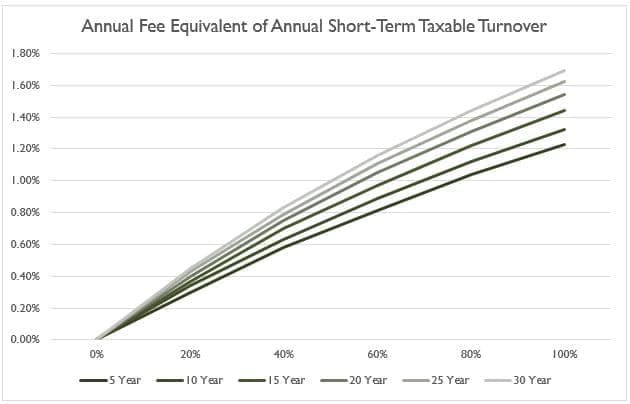
Separately, and potentially far more importantly, the kind of activity implied by the increased turnover of this special class of investors in low-cost vehicles can have a massive impact on taxes. In the chart below, I show the equivalent advisory fee you would pay in order to equal the impact of different levels of annual short-term taxable turnover.
Source: Salient 2017. For illustrative purposes only.
Let’s unpack that. Assume, for example, that you had a 20-year horizon. Now assume that every year you turned over 40% of your portfolio, and that you did so with positions that produced short-term gains. This is fairly typical of the activity I see even from goody two-shoes virtue-signaling investors and advisors like me, whose average holding periods are in the 18-to-24-month range. Even in this case, the impact from taxes is the same as paying a 75bp advisory fee to a fund manager or financial advisor. Now imagine (or just look above to see) what a more actively traded approach is going to look like. It’s not pretty.
Now, I’ve made a lot of fuss about how some misguided investors are misusing index funds and ETFs, but this isn’t really about that. Frankly, this is a point that needs to be heard by investors in any commingled vehicle, mutual funds and hedge funds perhaps more than any, so I want to say this as clearly as I can: if you are a taxable investor, taxes matter more than fees, and you’re not paying enough attention to them.
No, Virginia, You’re Not a Passive Investor
The “vehicle-centric” view of investing guides investors toward do-it-yourself solutions where the only important consideration is whether you’re paying an explicit fee. The resultant behaviors for a portion of those investors lead to disproportionate tax impacts, and they lead to transaction costs. There’s a reason why I’ve written that Investor Behavior Matters. But those behaviors matter most when they impact the two biggest decisions that investors must make: how much risk to take and where to take it (diversification). So, unsurprisingly, I do want to take another opportunity to remind everyone that they aren’t passive investors just because they bought a bunch of index funds. In "I am Spartacus", I put this in context of a global portfolio of financial assets. Here, I want to take a different tack.
Let’s assume that the world of index funds (here, I use ETFs, but could just as easily be mutual funds) consisted of the 100 largest such vehicles as they exist today. Now consider an exercise in which we decided we wanted to buy 10 of those funds at random, assigning them 10 different portfolio weights (also at random). If we did this random selection, say, 100,000 times, how often would we have gotten different risk and return outcomes[1]? How much would they really differ from one another? Basically, what I’m trying to answer is, “If I had absolutely no insight into asset allocation, but was being told I needed to keep costs down and do the investing myself, what is the range and likelihood of different portfolios I could end up with using those instruments.” The table below shows the answer.
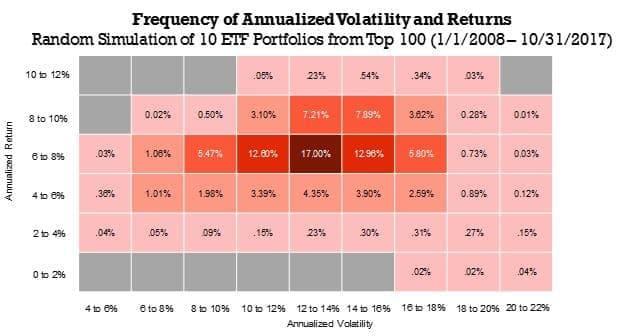
Source: Salient 2017. For illustrative purposes only.
First, how do we interpret this? In short, the difference between good and bad asset allocation decisions is big. It’s bigger than taxes. It’s bigger than transaction costs. It’s bigger than advisory fees. And if you are assuming that you don’t really have a lot of ex ante insights, that’s kind of a big deal.
A nice portion of the portfolios cluster around a 6-8% return with 12-14% volatility, but they’re only about 17% of the total. More than 43% of the portfolios have returns that differ materially (by 2-4%). And if you’re comparing the best 20% to the worst 20% of portfolios we could have selected, you’re talking as much as a 6% annualized difference in returns, with correspondingly large differences in the amount of risk you were taking to achieve it. And this is just including the Top 100 ETFs, which are largely confined to large, liquid, broad market instruments, and not the more esoteric options that begin to fill up the portfolios of many practitioners.
To many readers this is certainly intuitive, and so I don’t pretend I’m making a novel point here by saying that asset allocation matters. Other readers might criticize this by saying, “Surely we should expect more from folks than just a random allocation to funds.” This is the point in the conversation where I would stare at you intently, but quietly, until you amended your statement to something less stupid so that we could continue our erstwhile cordial discussion.
More novel, however, is the observation that — in rough numbers — a better than random approach to asset allocation can matter to the tune of 2-6x the impact of a typical active fund’s fees.
In Defense of the Financial Advisor
So yes, Costs Matter. And if you asked me how much each of these direct and indirect costs matter, my very generalized, not-at-all-personalized for you list would look something like this:
- Indirect Behavioral Costs on Asset Allocation Decisions
- Taxes
- Advisory Fees (Tie) / Transaction Costs (Tie)
One of the responses Ben and I invariably get from readers is, “Include more actionable ideas!”, so I’m ready for the chorus of, “OK, I get it. What do I do?” Here’s what you do:
Hire and pay a financial advisor.
Before anyone jumps in, I’m not telling you to pay a bunch of high fees for actively managed strategies in markets where they don’t have a prayer of producing sustained outperformance after those fees. God knows homo marketus can find just as many perfectly good ways to create taxable gains and transaction costs in actively managed solutions as well.
What I AM telling you is that you should find someone who you trust. Find someone who is looking out for you on taxes. Find someone who is looking out for you on transaction costs. Find someone who tells you the truth about how much you’re paying them. Find someone who is going to save you from your fear when you want to sell low, and who will protect you from your greed when you want to buy high. Find someone who will keep you diversified when you want to take stupid risks in markets and securities where you don’t have an edge (which is all of them — sorry). Find someone who isn’t trying to get you to trade in and out of new ideas all the time. Find someone who doesn’t sell to you with Eulenspiegel-style virtue signals. Find someone who doesn’t disappear like Keyzer Söze when things go wrong.
Find someone who will treat you like a partner, and pay them.
But not too much.
[1] Here, we present this as a historical analysis. No resampling, etc.
PDF Download (Paid Subscription Required): http://www.epsilontheory.com/download/15781/