
We Are All Epsilon Theorists Now
January 7, 2019·Money
Jay Powell describing the current size of his credibility at Friday's press conference
I'll save my specific investment advice on Jay Powell's narrative about-face last Friday for ET Pro subscribers, but I'll share the title of that note: "LOL". I mean, if you can't laugh at this sort of craven performance art, you're taking the world way too seriously.
All of that stuff from December's FOMC meeting about looking at the real economy to figure out what monetary policy should be? All of that stuff about caring more about Main Street than Wall Street?
JK!
At Friday's presser, Jay Powell did what I thought he would do in December - he answered the prayers of all the Wall Street penitents, from schlocky TV evangelists like Jim Cramer to hair-shirted saints like Stanley Druckenmiller. Please Lord, make me chaste ... but not yet.
Powell on Friday: I hear you, my children. I hear you.
And there was much rejoicing.
Back in 1971, when Nixon took the U.S. off the gold standard and adopted a broad swath of activist and "modern" monetary policies, he famously said (ruefully, if the stories are to be believed), "I am now a Keynesian in economics". In this he was channeling Milton Friedman, who coined the phrase "we are all Keynesians now" in the 1960s to describe the overwhelming political pressure to adopt easy money and stimulative policies whenever cold economic winds start to blow.
Today, though, easy money and stimulative policies aren't enough. Or rather, they are so commonplace, so expected and banal, so much the warp and woof of Western political order, that it's not enough - not nearly enough! - to have an incredibly accommodative and market-friendly policy of ultra-low interest rates and a massive balance sheet.
No, today just DOING the right policy isn't enough. You've also got to SAY the right policy.
In fact, saying the right policy IS the policy.
And everyone knows that everyone knows this is true. It's the most pervasive Common Knowledge of our modern economic lives, that the instrumental words of "guidance" are themselves the only policy of meaning.
We are all Epsilon Theorists now.
The seriously messed-up LOL part of this is that the most confirmed Epsilon Theorists today are the central bankers themselves, along with their staffers. How do I know?
Because they've started to create econometric models of the impact of their own empty words.
Case in point: BIS Working Paper 761 "Non-Monetary News in Central Bank Communication" by Anna Cieslak and Andreas Schrimpf, published last month. (h/t long-time ET reader and pack member Clive Hale).
The paper is written in the modern day cant of academic economics, with trenchant prose like this:
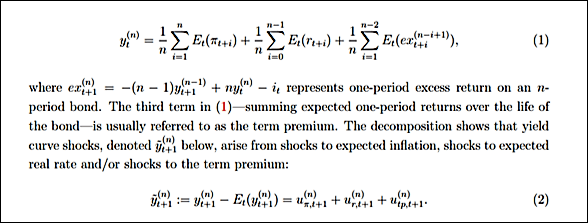
So the money quote will need a bit of translation.
"we show that the non-monetary information content—i.e., news about economic activity and shocks to risk premia—dominates more than half of communication events. ... Risk premium shocks exert substantial nonlinear effects on asset prices, and their importance increases with the implementation of unconventional monetary policies."
In English? Since the Great Recession, central banks - especially the Fed and the ECB - talk less and less about their actual monetary policy decisions. But they talk more and more about their expectations of investment risk and reward in capital markets. Their instrumentally constructed opinions about investment risk and reward - which are presented as "news" - move markets dramatically. And dependably. And predictably.
It's not your imagination. The words of monetary policy authorities about everything BUT monetary policy have enormous power. More power than the monetary policies themselves. They know it. You know that they know it. They know that you know that they know it.
We're a very knowledgeable family.
LOL.
The machines didn't do this. The quants didn't do this. We did this. We willingly gave ourselves to the Powells and the Draghis and the Bernankes and the Yellens. We willingly gave ourselves to the Cramers and the Hilsenraths and the Buffetts. We willingly gave ourselves to the Obamas and the Trumps. We willingly sold our soul to the Narrative devil.
And we're not getting it back.
This is why your fundamental research doesn't matter anymore.
This is why your fundamental research will never matter again.
We are all Epsilon Theorists now.



Comments
The december FOMC standup chair against Trump and wall street print a S&P 2400 PUT on his head on Friday. I do NOT know whether Powell designed this experiment to gauge the market and FED communication method OR he did NOT know what he was doing in FOMC and later on changed his mind. I totally lost respect for Powell. Let’s see when S&P break down below 2400 and Powell reveal his next PUT. It could be a long time.
So how will the Weinstein moment of this particular Common Knowledge game play out?
Interesting Points/Reads, this am on this matter which is pure comedy and kabuki theater:
*The entire US economy today is about the quick buck. It’s about tomorrow morning only because nobody has the guts to look at 10 years from now. That makes Jay Powell and his whole Federistas staff worse than useless. It makes no difference if perhaps jobs are doing well; the pre-Powell Fed launched a bubble and that bubble will burst one day, a whole series of them will.
The only good thing he can do is get out of the way and let the markets be the markets, to let them discover prices by letting people interact with people. But who exactly in the US has the power to make the Fed go away? —Illargi
*Inflation & Output: The question is whether the slow pace of wage growth in the last year or two can be explained to any substantial degree by changes in the mix of workers, specifically lower paid younger workers taking the place of relatively higher paid workers who are retiring. When Unemployment decrease the rate of wage groupthink should increase, but that is not the case…which points to demographic changes slowing the rate, and a jump in energy prices. —Dean Baker
*It’s entirely unrealistic to expect Fed officials to reflect the views of market monetarists—that’s now how our system works. Nor will they reflect the views of other obscure groups, like MMTers or fans of the fiscal theory of the price level. That’s why I favor NGDP level targeting, it’s a regime that will lead to pretty good results under almost any competent leadership.
Instead, the Fed would give the New York open market desk the following instructions:
That’s all. Let the market set interest rates; they are much better able to determine the appropriate fed funds rate.
OK Fed, you’ve got a landing. Now let’s make it “soft”.
PS. As I contemplate the Fed’s current (flawed) policy regime, I feel sad and blue —The Money Illusion
Dean Baker this am…
I think we are seeing some modest inflationary pressure coming from wages, but it’s not there yet. In any case, it is likely a story of inflation rising to 2.5%, perhaps 3.0 percent, if the recovery contnues long enough. It is not a 1970s double-digit inflation story.
Maybe it’s just pure hope on my part but it seems probable to me that Powell was getting so much pressure from within the Eccles building (think about the 300 Neo-Keynesian PhD’s as well as his colleagues at the FOMC, think about a true believer like Charlie Evans and former Goldmanite Kashkari) and outside influences ( the President and all the Wall Streeters)
and he HAD to give them something.
But he didn’t give them anything.
He acknowledged that he did recognize that the market was signaling something. True he should, markets can send important signals
And he said policy wasn’t written in stone.
The market of course (after 3 decades of Fed Chairs caving to the Jim Cramer’s of the world) assumed this was
THE CHANGE THAT ALWAYS OCCURS
I think there’s sufficient logic for my hopefulness that Powell isn’t going to cave so easily and he wants the Fed to get out of the market manipulation business.
Regretably, I actually understand Equations (1) and (2) above, but I still haven’t a clue how the Fed and member banks interact with the UST and the open markets. I have yet to find a well written, succinct, and relatively jargonless (e.g. depository institutions, repo, discount window) summary and would very much appreciate any ET pack suggestions. Thx!
A Primer on
Money and Banking
Full Reserve Banking
A National Depository System
http://wfhummel.net
Soft Currency Economics II (MMT - Modern Monetary Theory Book 1) Kindle Edition
by Warren Mosler
https://www.amazon.com/Currency-Economics-Modern-Monetary-ebook/dp/B009XDGZLI/ref=sr_1_1?s=digital-text&ie=UTF8&qid=1352305630&sr=1-1&keywords=soft+currency+economics
Just my two cents…
Still a man hears what he wants to hear
And disregards the rest – Paul Simon
Beware confirmation bias, Ben.
https://papers.ssrn.com/sol3/papers.cfm?abstract_id=1905625
It’s one thing to say that something doesn’t matter now but it’s going out on a limb to say that something will never matter again. Fundamental research will matter when people stop doing fundamental research. Early in this century the narrative was that home prices never go down.
But as we learned in “The Big Short”, the people who did the basic, fundamental research on the subprime mortgages did quite well in the end. It took longer than they thought it would, but the fundamentals finally overcame a very powerful narrative.
It reminds me of the Hans Christian Andersen story of “The Emperor’s New Clothes”.
The narrative being that if you couldn’t see the emperor’s magnificent new garments then you were hopelessly stupid. And not a soul who watched the emperor parade down the street would admit to what their eyes told them. Until one little boy stated the fundamental fact that
“He isn’t wearing anything at all”
Continue the discussion at the Epsilon Theory Forum...