
Welcome to Metaworld
July 16, 2021·Media

Source: Images from two dueling opinion articles on a rise in violent crime in the US - both from John Minchillo (AP)
Let's start with an assignment.
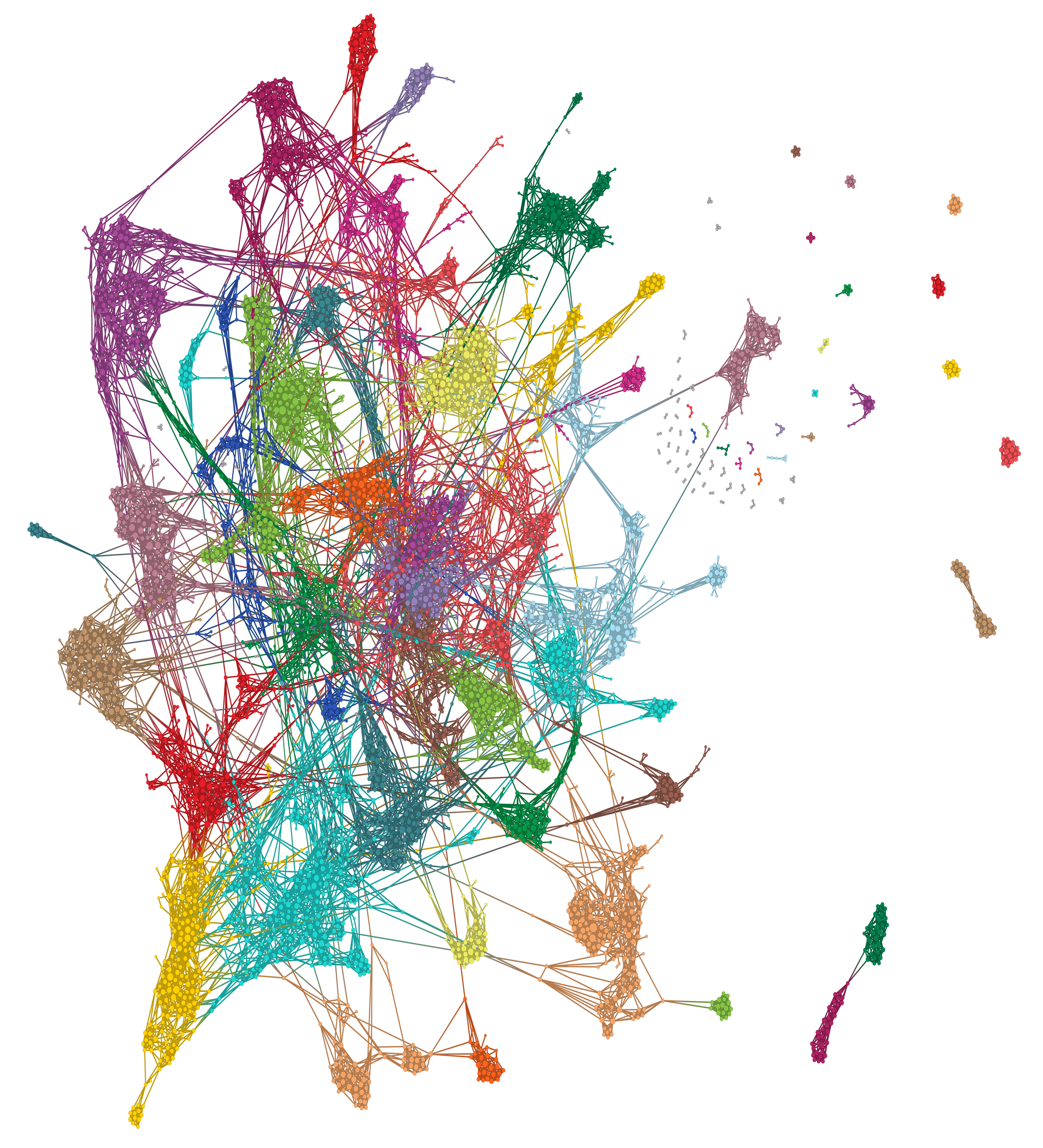
Take a look at the graphic below. It is a network graph visualization built using the software from Quid, much like the network maps we publish all the time. A dot (or node) in this visualization is a single news article. Articles with the same colors have been arranged into a cluster by linguistic similarity. Connecting lines likewise indicate linguistic similarity, only between nodes in different clusters. Up, down, left and right don't have any meaning, and the colors for clusters are arbitrarily chosen. Distance and connection are the only dimensions that matter.
Which cluster would you say is the most similar to everything else? Where is the beating heart of this network visualization?
Source: Quid, Epsilon Theory
If your eye is drawn to the lavender, purple, red and orange clusters there at the center, you're on to something. But a 2D visualization is an inherently crude way to present these kinds of relationships. After all, this network graph is trying to represent about 12 million relationships between blocks of unstructured text, and you'd need a lot more than two spatial dimensions (and the sort of pseudo-third dimension you get from the wormhole effect of connectors) to do so faithfully.
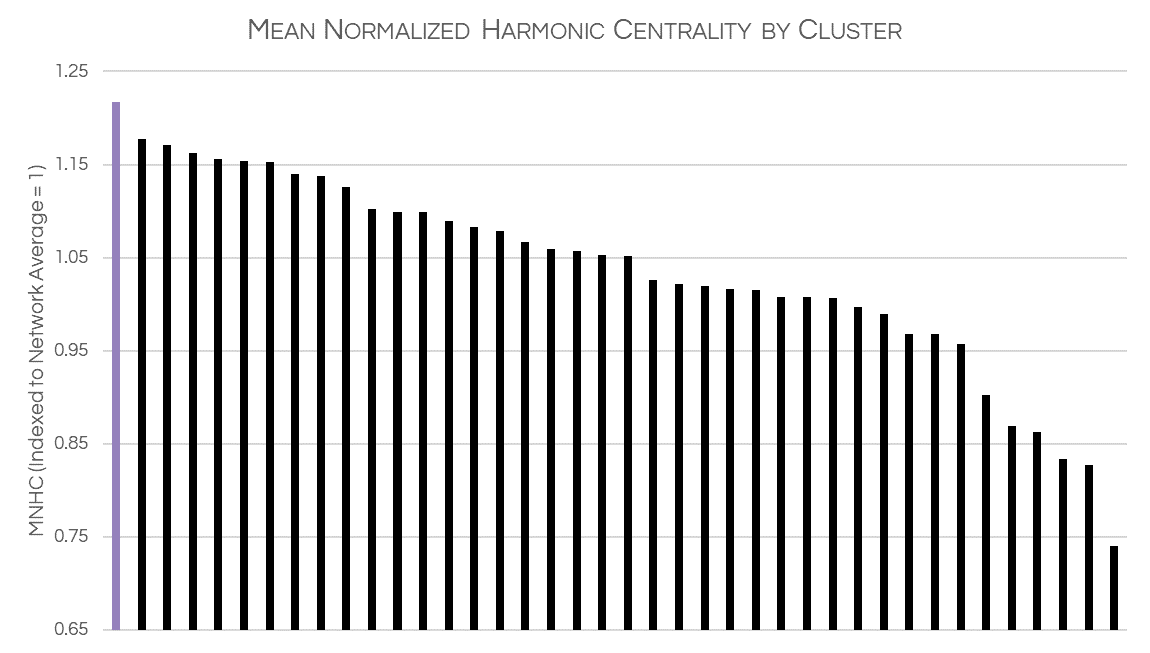
So I'll give you the answer: it's the lavender cluster, and it's not especially close. Here are our own mean normalized harmonic centrality scores by cluster, which I acknowledge is a complicated-sounding mouthful. It's actually pretty simple. It is a measurement of how linguistically similar the average news article categorized in a cluster is to every other article across the network. The units are not necessarily intuitive, so I'll put it in context: that's a damn big gap between the top cluster and everything else.
Source: Epsilon Theory
So what IS that cluster? And for that matter, what is the dataset being used to populate the network map itself?
The network map is an arrangement of 4,804 articles from the Lexis-Nexis Newsdesk database published by broad-circulation, US-based outlets between January 1, 2021 and July 15, 2021 referencing violent crime. And the most influential lavender cluster...well, that's the thing. It's a cluster defined by people writing about how other people are writing about violent crime.
In short, welcome to Metaworld, in which articles which explain the news increasingly ARE the news.
The easiest way to get a sense of this is to read the articles. Here is a pretty thorough sampling of what you'd find in that lavender cluster:
The Role of Covid Lockdowns in 2020's Homicide Surge | InfoWars
After a Violent Year, a Search for Answers | Bloomberg
"Perfect storm" drove major surge in 2020 homicides | CBS News
Study: Killings surge in 2020; pandemic, protests play roles | Washington Post
The Minneapolis Effect | Yahoo News
Quiz: How Well Do You Understand Today's Crime Trends? | New York Times
How crime stats lie - and what you need to know to understand them | CNN
Chicago Is Not the Murder Capital, and Other Misperceptions | New York Times
Horowitz: NYT admits homicides in 2020 likely topped 20,000, most since 1995, but can't figure out why | The Blaze
New research shows homicides rose in cities that experienced Black Lives Matter protests | The Blaze
Why Is the U.S. Murder Rate Spiking? | Bloomberg
Factcheck: "Crime is escalating to a level we haven't seen in decades as a direct result of Democrats' defund the police movement and Biden-Harris open-border policies." | Politifact
Stop Blaming Crime Rates on Defunding the Police | Mother Jones
NY Post Editorial Board: Murders soared in 2020 - and the anti-policing movement is clearly to blame | NY Post
Nolte: Study Shows Murders Skyrocketing in Anti-Police, Democrat-Run Cities | Breitbart
Fact-checking claims bail reform is driving increase in violent crime | CNN
Most of those articles are opinion journalism - editorials, op-eds and essays from established and well-known opinion journals. Many are vaguely noted as "analysis" pieces, some are of the "fact-checking" genre, and a few are marketed as hard news. And there's nothing wrong at all with interested citizens and journalists writing opinion pieces, analyzing the events of the day or checking facts. I mean, you may think that some of the opinions are really bad, but unless you live in one of several European countries or Asian metropolises with Epsilon Theory readers where this isn't the case, bad opinions are still legal.
What IS concerning to me, however, is that in the last 18 months, this emergence of a central meta-cluster dominated by discussions of discussions of the topic has become the rule for practically every topic of any social importance. Network graphs visualizing coverage of America's COVID response, the January 6th riots, the environment, the future of remote work, voter suppression / voting integrity, CRT / privilege education, and now violent crime, have all demonstrated this property. It even showed up in an analysis we conducted as part of an ad hoc Epsilon Theory Forum discussion about changing narratives of American geopolitical dominance.
I am concerned because it hasn't always been this way. This isn't a natural feature of "meta" content being central because of topical language, or because of some tautology of self-referential language spiking linguistic similarity calculations - or at least it isn't only because of that. This is a more recent phenomenon.
I am concerned because our data indicates that the language patterns, phrases, framing structures and arguments of opinion, analysis and explainer content are increasingly making their way into nominally hard news content.
I am concerned because our data also indicates that opinion, analysis and explainer content are becoming a higher volume of published journalistic content, even before taking into account the disproportionate distribution bias toward such content on the social media channels used as primary news consumption vehicles for most Americans.
I am concerned because the combination of those factors is steadily removing feasible ways to consume real news that isn't debased by fiat news, our term for opinions stated as facts.
I am concerned because this trend exacerbates and very likely prolongs political bi-polarity. It continues to support a world with two wholly distinct sets of 'facts'.
So what can we do?
Same as ever for news consumers: never stop asking why am I reading this now? Look for hammers and nails. Be mindful of attempts to auto-tune facts and opinions to archetypes. And support your local and regional news outlets. Our work on fiat news has consistently found that well-staffed city papers, even those with a heavy political slant on their editorial and opinion pages (in either direction), do a much better job insulating their news content from their opinion content than national and principally web-based outlets.
Influential individuals and institutions in the media who are interested in stemming the tide of fiat news could do a lot, too. More news organizations electing to be news-only outlets would go a long way, but the economic model on that may have long since sailed. More realistically, a commitment from a group of large news organizations to clearly mark and separate opinion, analysis, feature and 'fact-checking' content from hard news where they can control its distribution would be a big step. A set of protocols and standards for doing so that would allow other full-hearted publishers to join in would be a bigger one.
And come to think of it, that sounds like an interesting use-case for a distributed, non-government controlled system for emphasizing and rewarding positive externalities.



Comments
CNN employs two people as so-called media critics. Their job, as best I can tell, is to watch Fox News and then report back what the people over there are saying. It’s an odd business model (and based on how their ratings have been going down it seems not to be a great one). But someone at CNN thought that their viewers would really enjoying hearing what the other guys are talking about but they would also need to keep their hands clean while doing it. See, you could always just watch another station, but what if that other station was full of crazies and weirdos and it’s just too icky for you? Enter the media critic. You get all the information (that they want you to have) without being one of those unwashed viewers of Bad Cable News Channel X. And it works for everyone! Want to hear some disingenuous thing Jake Tapper said? Well there’s definitely like three different right wing podcasts that will tell you about it. Did Tucker Carlson really say that about vaccines? Worry not, Brian Stelter will do a whole segment on it tonight. In a world where access to information has never been easier or cheaper we have built an ecosystem that ensures we are always watching the crowd watching the crowd. The internet revolution didn’t cut out the middle man, it gave us a seemingly inexhaustible supply of middle men. And we absolutely asked for it.
Where does commentary from increasingly popular (? - I don’t think it’s an illusion) “independent media analysts” fit into this equation - like the people writing on substack as free agents who used to work for news organizations.
It is possible to argue that ET is in this category sometimes as well - not necessarily in service of political narratives - but in analyzing the presentation of news.
For instance, where would this post be in your narrative map?
I wonder if there are two types of meta-commentary: (1) the kind that you’re highlighting: articles attacking or supporting other narratives by social, media, and political actors, and (2) the kind of meta-commentary on this platform: where we learn to examine how the information we consume is packaged and shoehorned into larger ideas and narratives.
What is curious to me is that I would think that the increasing popularity of free agents would make the map more diffuse, or is this an indication that this is not occurring? Or is this contributing to the glut of metacommentary?
I am almost surprised to learn that there is any simple reportage of facts anymore. Both sides know that the issue of crime broadly is an important one for their campaigns. One side gained mightily from the perception of police brutality last year and the other is attempting to exploit the mayhem that ensued and the various issues around that. When the Rothschild’s pigeon’s were carrying the news of Waterloo, no one had access to any facts. Now the sky is thick with them but no one can tell which are real.
Hey, Eric! Really good thoughts and questions!
I think if you write about narrative, you’re always going to live in the meta. It’s unavoidable. I’d like to think we don’t have an ideological axe to grind, but of course we do. I think it just happens to not be on the most dangerous and divisive axis socially, but that’s my story, not a fact. I’d like to give our genre of media criticism a separate category as you do, but I’m not sure it’s always as distinct a thing as we’d like.
As for Substack journalism, I think it’s mostly supplanting similar volume coming out of larger publishers (especially the volume of a person who leaves such an outlet to set up their own direct content feed). That would make it more of a fragmentation than a shift, and I wouldn’t expect that to have a material effect on the mix or nature of the meta’s influence on coverage more broadly. That’s mostly assumption work on my part, though. I don’t know if my priors about how free agents supplant mainstream content are correct.
No doubt. FWIW, I think @bhunt watches the shows-about-the-show networks promote when he watches The Bachelor, etc., so while we are all to blame, he may be slightly more to blame.
Even more worrying - I’m not sure if we care!
This is spot on and going on in the the micro level as well as the macro media level. When anyone talks current events 1v1, almost all of what they’re remarking on is the coverage of the event in question. Very little gets discussed about the actual fact pattern.
Could this emergence of a central meta-cluster dominated by *discussions of discussions" possibly reflect that most newspapers (media) have moved online and most news articles now allow readers to “comment”?
From a technical perspective, not explicitly, in that the text we’re analyzing doesn’t include those comment sections.
But I think it’s certainly the case that writing to induce comments and social media sharing is a big part of ALL content production, including that of hard news, so in a way it is absolutely a part of why this sits at the center.
When the primary job of news media became to shape opinion rather than report news , I guess this was inevitable.
Continue the discussion at the Epsilon Theory Forum...